
Normal view

There are new articles available, click to refresh the page.
Before yesterdayPédagogie

How Can the Metaverse Transform Learning?

16 October 2023 at 18:55
Beata Mirecka-Jakubowska, M.A.
Founder & CEO, Intercultural Education Consulting

The metaverse, a virtual, interconnected, and immersive digital space where users can interact with each other and digital environments, holds tremendous potential to transform education. It can facilitate immersive learning environments, allowing educators to craft virtual classrooms or historical settings so that students engage in interactive and captivating lessons. Collaborative learning thrives in the metaverse, fostering teamwork and cross-cultural communication as students from different locations collaborate on projects. Experiential learning is enhanced, offering a safe platform for hands-on activities like science experiments. AI-driven avatars and virtual tutors enable personalized learning experiences, catering to individual learning styles. Geographical barriers are dissolved, granting global access to high-quality education for students from diverse backgrounds.

Beata Mirecka-Jakubowska, the founder and CEO of Intercultural Education Consulting Group, has 36 years of international classroom experience. She turned to ViewSonic’s 3D immersive platform UNIVERSE with her online graduate students in Indonesia and later tried it with the Connected Learning project team in Iceland. Mirecka-Jakubowska has a contagious passion for learning and urges educators to embrace this new technology. EdSurge had the opportunity to speak with Mirecka-Jakubowska about her exploration of UNIVERSE, its impact on student engagement, the need for open-mindedness among educators and the exciting potential of the metaverse in education.


Watch this video to see what teaching and learning in UNIVERSE looks like!

EdSurge: How did your teaching journey lead you to try UNIVERSE with your college students?

Mirecka-Jakubowska: That’s a very long story that goes back to the 1970s when I attended the United Nations International School in New York. [Laughs]. I learned early to be open to change. I had very good training as a substitute teacher in my first year at TASIS Hellenic International School in Greece. I went to school every morning, and whoever was absent, I replaced that person. So I taught Greek, Arabic, PE, first grade, 12th grade, IB, middle school — anything! How did I teach Arabic when I had no clue what the individual letters even looked like? I tried to be creative, use the resources around me and empower my students. I gave the reins to my students, and they loved it! That got me thinking about student-centered learning — something not well known back then. With that knowledge, when I moved to Jakarta International School in Indonesia, and with the help of several dear colleagues, we began creating student-centered programs.

Recommended Links

When technology evolved in the late 1990s, first with email and then websites, the school’s IT head said, “Trust me, you want to learn all of this.” So, that’s what I did. I trusted him, and I even learned to code. As technology continued to develop, I often thought, Oh, that’s something my students need to know for their future. Who’s going to teach them? And I realized I’m the one who is going to teach them these skills. I integrated project-based learning and technology in all kinds of ways. I asked my English language learners to create films. I asked them to create websites. I asked them to create blogs to interact through blended learning. Did we have failures? Absolutely. There was always something to improve, something that went wrong. But I would tell my students, We will learn from this. What can we do better next time?

In 2018, I attended a workshop where I talked with a game-app developer. We started talking about gamification and how we could use games in a different way, a more developmental way. I envisioned a classroom with avatars who work on interactive projects together, and students could log in from anywhere. Then, in 2022, I was at the Singapore EDUtech Asia conference, and as I was walking by the booths, I saw my vision had become a reality. I thought, How is it possible that somebody else made my dream come true? I tried UNIVERSE there, and it blew me away. I could walk between student groups and hear all the conversations. I could stop and talk but still hear other groups in the background. It was totally different from [video conferencing]. And I knew I had to use it with students.

How did UNIVERSE help increase student engagement and interactions for learning in a virtual setting?

I noticed during the class that everyone wanted to say something. Even those students who were not usually talkers were super engaged. Those who were normally reluctant to speak seemed to speak up, perhaps because of their fascination with the technology or because they could be avatars. Their shyness was detached; they could try on a different persona and change their interactions in the classroom. They seemed to feel safe speaking among the cacophony of other voices in the background.

The adaptability, flexibility and creativity of the teacher will play a huge role in designing and implementing a lesson in the metaverse to have learning outcomes that surpass those of the traditional classroom.

— Beata Mirecka-Jakubowska

One exercise that worked very well was the interactive Collaboration Board. I placed an image with a question on the board, and all the students responded either with sticky notes or text. That is a great writing and thinking tool. And then there is that fantastic button that the teacher can press, and all of the avatars are seated and muted. I think UNIVERSE has great potential.


Students are circled around the Collaboration Board to share their thoughts on a discussion topic using sticky notes and texts.

What challenges did you work through during the implementation process?

The preparation involves designing the classroom. Teachers need to think about how to set up the flow of the room for the best experience. It takes time to navigate everything and learn the technology. It takes time to teach the technology to students. A teacher probably won’t get everything done on the first try. The adaptability, flexibility and creativity of the teacher will play a huge role in designing and implementing a lesson in the metaverse to have learning outcomes that surpass those of the traditional classroom.

For students who logged in from different islands around Indonesia, sometimes their Wi-Fi wasn’t strong enough to carry their voices without breakage. But the drawbacks of the experience were mainly technical. Once we worked through what we could, students completed several tasks and activities in UNIVERSE for about 50 minutes and didn’t want to leave.

Technology is on a course of its own. We must embrace new technology and improve upon it to enhance learning. This is history in the making, and it is exciting to be a part of it!

— Mirecka-Jakubowska

What guidance can you offer educators who are considering incorporating metaverse experiences into their teaching environments?

My advice is to be open-minded. Embrace the changes and embrace the challenges. Some teachers worry about students using Chat GPT, so they say it is forbidden in their classes. That is similar to 10 or 15 years ago when teachers said phones are forbidden in class; put them on the side. And I said, no, bring the phones in. That's your dictionary. That's your resource. Learn to use it wisely and manage distractions. Learning how to use the metaverse wisely is something to bring to the table with that open-mindedness because we are never going to stop technology. Technology is on a course of its own. We must embrace new technology and improve upon it to enhance learning. This is history in the making, and it is exciting to be a part of it!


To learn more about UNIVERSE by ViewSonic and how it can help support your teaching and learning needs, you can schedule a demo with a solution expert here.

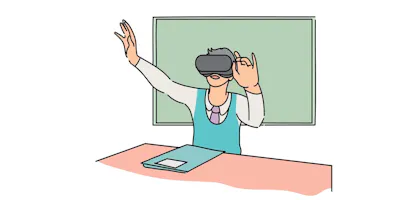
How Can the Metaverse Transform Learning?

Will Virtual Reality Lead More Families to Opt Out of Traditional Public Schools?

19 September 2023 at 23:01

For students at a new Florida-based charter school, entering the classroom means strapping on a VR headset.

While plenty of schools have experimented with short lessons conducted in virtual reality, this new school, called Optima Academy Online, has embraced the technology as a primary mode of course delivery. That means participants log a lot of time in VR most every school day: Students in third through eighth grade are given a Meta Quest 2 VR headset and wear the devices for about 30 to 40 minutes at a time for three or four sessions, spaced out over the course of a day. (Younger children in the school take courses using more-traditional online tools, including Microsoft Teams.)

The school’s founder, Erika Donalds, hopes this cutting-edge technology can help spread an educational approach that is decidedly old-fashioned. She’s a champion of a model of education that favors students reading classical texts and otherwise focusing on the traditional canons of arts, literature and culture. And, ironically, she thinks that the latest VR technology provides a unique way for students to hold socratic dialogues and engage with ancient texts in ways that can’t be done in other formats.

“With our approach to classical education,” the school’s website says, “students learn about historical events, characters, stories, fables, myths, scientific facts, and mathematical proofs in the locations where these educational advances were made.”

Emma Green, a staff writer for the New Yorker, has been spending time visiting these VR classrooms and researching the company for the magazine. Her article, published earlier this month, digs into how the school’s backers hope it will lead to the next frontier in the school choice movement. Because it turns out that Donalds, Optima Academy Online’s founder, is a longtime Republican activist pushing for ways for parents to opt out of public schools..

For this week’s EdSurge Podcast, we connected with Green to find out what she learned about the school, about why some edtech experts are concerned about the amount of time its students are spending in VR, and about how the high-tech experiment fits within broader debates about the future of public education.

Listen to the episode on Apple Podcasts, Overcast, Spotify or wherever you get your podcasts, or use the player on this page. Or read a partial transcript below, lightly edited for clarity.

EdSurge: So you saw some demos of this VR school with their sixth graders and eighth graders. What did the VR classroom look like?

Emma Green: It felt to me a little bit like I was in a video game when I was in these environments. Teachers are able to spawn all of these different tools, like big [virtual] Post-it notes that they can put in the air, or a blackboard that they can use to project images or write words. They can decorate these scenes to try to be more historically accurate. So there's a lot of adaptability in the setting that they use.

They use Engage as their platform, which gives them a lot of flexibility to be able to design their own landscapes. So it's very interesting and seems very flexible in terms of how the teacher wants to create different formats for different age groups.

So everyone is doing this from their own homes instead of a school building, right?

The teachers are all over the country. I talked to the headmaster, who is in North Carolina. The person who's the chief technology officer lives in Mississippi. Over the past year, all of the students who participated in Optima Academy Online lived in Florida, but they're now expanding their offerings so that it's possible that students might be in a classroom setting with kids who are actually in different states.

And indeed, when I talked to Erika Donalds, who's the woman who founded OptimaEd, the company that runs the school, her vision is that ultimately their academy can be not bounded by geography — that students could put on their headset and they could be in a classroom with kids who live thousands of miles away from them, but still have the same curriculum, have access to the same field trips to Mars or to the ancient world of the dinosaurs and not have distance or the setting where you live be a limiter on your ability to access this kind of education.

How did you come to even hear about this school?

I first heard of OptimaEd through a story that I was reporting on about a college in Michigan called Hillsdale College, which is a conservative school. It's a pretty central node of the intellectual conservative movement. And in recent years, Hillsdale has started to champion charter schools — and, specifically, classical charter schools, schools that use a curriculum that emphasizes the liberal arts, the teaching of language, ancient languages, the teaching of “Great Books” and original texts, like actually reading the Constitution instead of just reading about the Constitution. And these classical schools, which have sprung up across the country with Hillsdale’s support, are really flourishing and growing. There's a lot of demand for them.

And one of the hubs for this growth is Florida. Erika Donalds, who lives in southwest Florida and is the wife of [Republican] Congressman Byron Donalds, has been an education activist. And one of her projects has been to work with Hillsdale to launch charter schools in this classical model. And she's helped to do that for brick-and-mortar charter schools in Florida. And then during the pandemic, she had this opportunity to launch a virtual school, which ultimately led to Optima Academy Online. It's claiming to be the first ever all-virtual, virtual reality classical school.

Typically VR efforts are associated with Silicon Valley, which is known for some liberal and progressive values. But in this case it sounds like a Republican activist is using this technology to advance a conservative agenda. That’s kind of a surprising contrast.

It is. And her activism, as you said, very much has been within conservative education movement. She's a big school choice advocate going back all the way to the anti-Common Core movement.

And what was so interesting to me talking to her about her vision is that she sees virtual reality school as a logical extension of the work that she has done in the school choice movement because fundamentally, the school choice movement is about giving parents and families the flexibility to be able to access a free, publicly funded education, but to do so on their own terms, not to just be wedded to their local zoned public school.

And to her, the option to have your kids stay at home anywhere in the state of Florida or anywhere in the country for that matter, if her great plans succeed, and be able to access their school through a headset that you have at home and then later in the afternoon be able to do their homework and do the rest of their schoolwork on their own terms, at their own pace to accommodate the rest of their family's schedule or maybe a sports schedule — that to her is ultimately school choice.

This is an unusual amount of VR use for a school. I understand that has raised some concerns.

I talked with an expert at Stanford named Jeremy Bailenson, who really is the guy when it comes to understanding VR and the consequences of VR use over time. He's done some research on VR and education as well. And he told me that he finds it hard to imagine having VR as the main delivery mechanism for full-time school in which kids as young as maybe 8 or 9 or 10 having on a headset for multiple hours over multiple days of a week over multiple weeks in a year.

He actually had the opportunity during the pandemic to run this experiment. He took students at Stanford where he teaches and created through the pandemic these virtual reality classrooms, and they ran experiments on what was useful to do in the classroom setting in VR and what wasn't useful, how long did they want to stay in, how did they put parameters on the use of the technology in order to keep people from experiencing the fatigue that is common from using these headsets over long periods of time.

It's kind of like getting car sick or being on a boat and feeling nauseous. ‘Simulator sickness’ is what it's called. That's one possible consequence. And what he found after having multiple rounds of these classes that were set in VR is that he really felt strongly about placing boundaries of limits on the amount of time that anyone was in VR, let alone people who are still developing in their brains and their eyes as kids. His rule in his lab is 30 minutes at a time, so you do 30 minutes, you set aside the headset, maybe you come back later in the day, but 30 minutes is kind of the outer edge of it.

So from his perspective … there are some real downsides to trying to make VR an all-the-time platform. And that researchers just don't know what happens when you try to put kids into a headset for multiple hours over a sustained period of time.

So what does Erika Donaldson say, the founder of this school, when presented with that kind of concern about the overuse of this format for students?

I talked to Erika about this, and it was very clear to me that she's up in the literature because she was citing to me some of the Stanford studies. And she said that they do have some limits in place, so it's not all day. They typically will have the headset on for maybe three to four, potentially five sessions in a day. There are those time limits, 30 to 40 minutes of a session. And so they are setting some boundaries around it. They encourage students to do the same things that Jeremy Bailenson encourages his students to do, which is to talk to a regular person, have a glass of water, take a walk around when you take the headset off so that you can get grounded in reality.

She thinks that the benefits outweigh the costs and that it's worth doing what they're doing. I think that in some ways, they're running the experiment. They are trying to pioneer something that hasn't been tried before. And I think for researchers who are in this world, they're a really interesting potential case study to see what does happen.

Why use VR instead of other forms of virtual education?

She made the case to me that you can't really do classical school on Zoom — that for whatever reason, these platforms that are two dimensional just feel flat. It's not really possible to engage in the same way. They had an experience with their brick-and-mortar charter schools over the pandemic trying to do classical school in a Zoom setting, which was good. I think there was interest in it, and she said it was really successful, but it ultimately left her feeling like you couldn't have the kind of engagement that you need. So she made the case that VR really does add something that goes above and beyond, being able to go to these places and have that kind of tactile engagement. She says there's more opportunity for robust learning.

Hear the complete interview, including more details on what it looks like when a group of kids do a lesson in a VR simulation of the moon, on the EdSurge Podcast.

© Pita Design / Shutterstock

Will Virtual Reality Lead More Families to Opt Out of Traditional Public Schools?
❌
❌