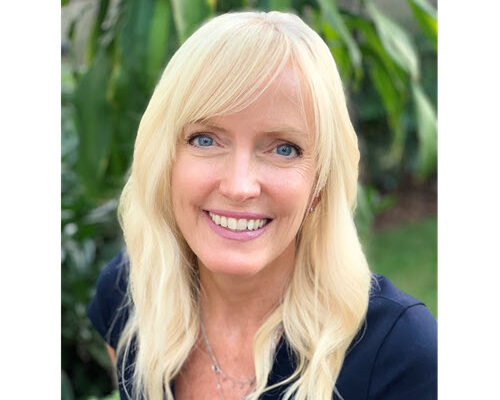
Chicago, IL – Acceleration Academies, the nation’s leading provider of tech-enabled flexible education, announced today that Kelli Campbell will assume the role of Chief Executive Officer to accelerate growth and broaden impact to school districts and students.
Campbell spent 17 years at Discovery Education, the global leader in standards-based digital content for K-12 school districts, and most recently served as President of the company. As a career EdTech executive, she brings a demonstrated history of success leading the sales and marketing, product development and operations functions for pioneering educational technology organizations.
“After thorough succession planning and a comprehensive search process, the board is pleased to have found the best individual to take Acceleration Academies into its next stage of growth and expansion,” said Steve King, co-founder of Daniels & King Ventures, the main funding source for Acceleration Academies. “Kelli has a track record of strong leadership in the EdTech industry, established relationships with K-12 school districts, and success in private equity value creation. We are confident that Kelli is the right leader to accelerate the company’s growth opportunities.”
The change in leadership comes as Acceleration Academies is rapidly expanding its school district partnerships nationwide to provide a flexible, supportive and personalized program for students who are not experiencing success in a traditional high school.
“As our organization has matured and we are serving a record number of students, we are excited to welcome additional leadership expertise to help us reach the next level. We must support our accelerated growth so that we can serve more students and school districts, while maintaining the efficacy and integrity of our model,” states current CEO and co-founder Steve Campbell.
Co-founders Steve Campbell and Dr. Joseph Wise will remain actively involved in the business.
“Acceleration Academies is an extraordinary company that is positively impacting the lives of young adults who struggle in a traditional school setting,” said Kelli Campbell, Acceleration Academies’ incoming CEO. “Throughout my career I have championed equity in education. Acceleration Academies provides the necessary supports to help remove obstacles so that students can not only graduate from high school but be prepared for post-secondary and job success. I am tremendously excited for the opportunity to support the mission and help expand the number of students that we serve.”
About Acceleration Academies
Founded in 2014, Acceleration Academies is a national leader in re-engaging young adults not experiencing success in a traditional high school setting. We partner with school districts across the U.S. to offer dropout recovery and re-engagement services, credit recovery and a flexible, personalized alternative for students (and former students) to earn a customary district issued high school diploma. Our hybrid learning model and Cognia-accredited web-based curriculum allows students to receive in-person support at academy locations and work online anytime from anywhere. Students receive a dedicated social and emotional support system to remove impediments that have caused them to struggle in a traditional setting. Currently, Acceleration Academies has more than 5,000 students enrolled in 19 academies in seven states.
On a recent Friday at Gary Comer Middle School in Chicago, you had to squint to see signs of the pandemic that upended American education just a few years ago.
Only a handful of students wore face masks, and even then, some put them on to cover up pimples, staff said. The hand sanitizer stations outside every classroom mostly went unused, and some were empty. Students stopped to hug in the hallway and ate lunch side by side in the cafeteria.
“I don’t think it’s a big deal as much as it was before,” said 12-year-old Evelyn Harris, an eighth grader at Comer, whose lasting memory of pandemic schooling is that online classes were easier, so she got better grades. “The pandemic didn’t really affect me in a big way.”
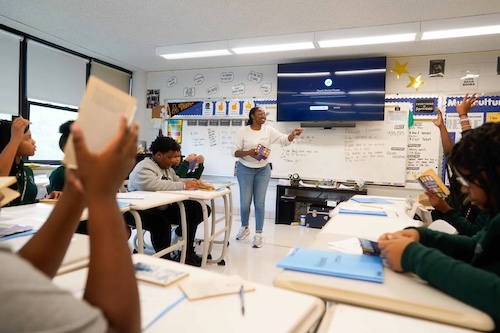
But inside Nikhil Bhatia’s classroom, the evidence was on the whiteboard, where the math teacher was shading in slices of a pie to illustrate how to find a common denominator. That day, his seventh graders were working to add and subtract fractions — a skill students usually learn in fourth grade.
Maybe you learned this before, Bhatia began. “Or, during the pandemic, you might have been on Zoom,” — a few students laughed as he dragged out the words — “put your screen on black, went to go play a couple video games. Snap if that sounds familiar?”
Clicking fingers filled the room. “That’s OK!” Bhatia responded. “That’s why we’re going to do the review.”
As the new school year begins at Comer and elsewhere, many students and educators say school is feeling more normal than it has in over three years. COVID health precautions have all but vanished. There’s less social awkwardness. Students say they’re over the novelty of seeing their classmates in person.
But beneath the surface, profound pandemic-era consequences persist. More students are missing school, and educators are scrambling to keep kids engaged in class. Many students remain behind academically, leaving teachers like Bhatia to fill in gaps even while trying to move students forward. Rebuilding students’ shaken confidence in their abilities is especially important right now.
“It’s OK that you don’t know this,” Bhatia tells his students. “It’s normal right now.”
Nationally, many students remain far behind in math and reading where they would have been if not for the pandemic. There have been especially steep learning drops at schools that taught virtually for most of the 2020-21 school year, as schools did across Chicago and within the Noble charter network, which includes Comer. It’s an issue that’s even more pressing for older students, who have less time to fill in those holes.
At Comer, 28% of eighth graders met or exceeded Illinois math standards the year before the pandemic, not far off from the state’s average of 33%. But by spring 2022, that had fallen to just 2%, compared with 23% for the state.
In reading, meanwhile, 9% of Comer eighth graders met or exceeded state standards pre-pandemic, and that dipped to 4% in spring 2022, when the state’s average was 30%.
The school made gains they’re proud of last school year, with 10% of eighth graders hitting the state’s bar for math and 22% hitting it for reading, though school leaders say they know there is still work to be done.
“If you don’t have some foundational skills and basic skills, it will be almost impossible to keep up with the curriculum as the kids get older,” said Mary Avalos, a research professor of teaching and learning at the University of Miami, who has studied how COVID affected middle school teachers. “That’s a big issue that needs to be addressed.”
How teachers are addressing pandemic learning gaps
Most of Bhatia’s students missed key skills in fourth and fifth grades — the years that school was remote, then interrupted by waves of COVID — but they mastered more advanced concepts in sixth grade last year.
That’s left Bhatia, like many teachers across the country, with the tricky task of coming up with mini lessons to fill in those elementary gaps, without spending so much time on prior concepts that students fall behind in middle school.
On a day like Friday, that meant to get students ready to add negative fractions, a seventh grade skill, Bhatia first had to teach a short lesson on adding fractions, a fourth grade skill. At first, some students mistakenly thought they should use the technique for dividing fractions they learned last year.
“They’ll say: ‘Oh is this keep, change, flip’?” Bhatia said. “The gap isn’t exactly what you would expect it to be.”
This kind of teaching happened “once in a while” pre-pandemic, Bhatia said, but “now it’s like day by day I have to be really critical in thinking about: ‘OK what might be the gap that surfaces today?’”
Aubria Myers, who teaches sixth grade English at Comer, sees ways the familiar rhythms of school are just now returning, four months after federal health officials declared an official end to the COVID-19 emergency.
“This year, for me, feels the most normal,” Myers said. Students are saying: “Oh wait, what’s the homework again, can I get another copy?” she said. Last year when she mentioned homework, “they were like: ‘What is that?’”
On that recent Friday, Myers led an activity in her multicultural literature class that would have been impossible two years ago when students had to stay seated in pods of color-coded desks.
Her sixth graders huddled close to one another as they tried to hop across the classroom, an exercise designed to give her fidgety students a chance to move around, while exemplifying the communication and teamwork skills that would be at the center of Seedfolks, the novel they were about to read in class.
Still, Myers had chosen the book, with its short chapters and lines full of metaphors and irony, to meet the needs of this crop of sixth graders, who spent all of third grade learning online. Many, Myers knows, never logged on. They have shorter attention spans and doubts about their reading skills but love class discussions, she said.
“They remember that time in their life when they were stuck talking to only people in their house,” Myers said. “They’re in class wanting to engage with each other.”
Myers has tried to prevent her students from getting discouraged by their learning gaps. At the start of this school year, for example, she’s pointing out spelling and punctuation errors, but not docking points yet. She wants to make sure her students first have time to learn some of the key skills they missed in earlier grades.
“We have kids who don’t understand how to put a period somewhere in your sentence, or how to put spaces between their words,” Myers said. “I see these very beautifully strung together ideas, these really well thought-out explanations, but they’re missing some of those key mechanics.”
Student mental health and engagement still top of mind
Comer has responded to students’ post-pandemic needs in other ways, too. The school expanded its team of social workers and other staff who work with students to resolve conflicts and address mental health needs, a trend that’s been observed nationwide.
The school has long felt the effects of neighborhood gun violence and student trauma, but staff say having more adults focused on those issues has helped students open up and seek help. Now, more students are requesting verbal mediations to head off physical fights, staff say.
“If you follow us through the building, you’ll see,” said Stephanie Williams, a former reading teacher who now directs Comer’s social and emotional learning team. “Kids will seek you out, or find you, and let you know: ‘Hey, I need this.’”
And this is the second year the school has scheduled all core classes earlier in the week, so that students can spend part of Friday practicing math and reading skills on the computer, and the rest of the day taking two special electives. It’s a strategy meant to keep students engaged — and showing up to school.
The school offers classes that pique students’ interests, such as the history of hip hop, hair braiding, and creative writing. Brandon Hall, a seventh grader at Comer, blended his first smoothie in a “foodies” class and bonded with his basketball coach through chess. He came to see similarities between making plays on the court and moving pawns across the board.
“I learned a lot from him,” he said.
On “Freedom Fridays,” attendance is higher and student conflicts are rarer, school officials say. That’s been important as the school, like many others, has seen higher chronic absenteeism rates over the last two years. At Comer, 1 in 3 sixth graders missed 18 or more days of school last year. Before the pandemic, that number sat closer to 1 in 5.
The approach runs counter to the calls some education experts have made for schools to double down on academics and add more instructional time — not take it away.
A recent report by the Center on Reinventing Public Education, for example, spells out the numerous ways students are still struggling, and calls for “a greater urgency to address learning gaps before students graduate.” Harvard education researcher Thomas Kane noted that few districts have lengthened the school day or year and warned that, “The academic recovery effort following the pandemic has been undersized from the beginning.”
But JuDonne Hemingway, the principal of Comer, said devoting time to enrichment activities during the school day is worth it to ensure all students have access to them. These classes, she added, are helping students develop interests they may pursue in college or as part of a career.
“They’re not just random experiences for kids,” Hemingway said. “We think they are just as important as any traditional academic class.”
Chalkbeat is a nonprofit news organization covering public education.
I remember the first and only time I’ve ever yelled at a teacher in class.
Growing up in the U.S. as a female child of immigrants from Taiwan, this kind of behavior is practically sacrilegious; certainly scandalous and wildly antithetical to my traditional upbringing. I was raised above all else to not only revere education, but to literally show respect to educators and elders by being a dutiful, quiet, listening and obedient learner. This meant I was consistently rewarded at school for putting my head down and striving to be a “good student” and “high achiever,” but never for challenging authority or speaking up when something was wrong.
I broke that mold on the day that a substitute lecturer addressed my Ph.D. class.
“You can’t interview Asians because they won’t say anything substantive due to the norms of their culture,” she said.
Wait, what? I was in the first year of the top doctorate program in my field, and we were 20 educators-in-training being taught best practices of various communication research methods by supposed leading experts. This guest speaker was talking about how to run group interviews, and she, a white woman, was imparting what she learned from years of research with various U.S. populations, including “tips” on how to work with diverse communities.
“Asians have a politeness norm, so it’s difficult to get anything useful out of them,” she continued.
It was hard for me to hear anything after that, over the whooshing sound of blood rushing to my head, my heart pounding from the cortisol spike in my body. Did this professor really just wield her authority at the front of this room and say to an internationally diverse class of scholars, educators, and thought-leaders-in-training, that Asians — all the Asians — were not worthy of study or deep understanding because, in her professional experience as a white researcher, it was difficult to get people of different backgrounds to talk to her?
I spoke up. I don’t even remember exactly what I said, but I know I said it forcefully, interrupting her mid-lecture and vehemently arguing back. My voice was shaking and my face most certainly was red, but I said something to the effect of:
Asian and Asian American experiences and voices matter. Our humanity matters, but our unique experiences also matter. And we’re not just one homogenized, stereotypical group. And it’s really problematic and a glaring function of white supremacy to dismiss the importance of collecting information on the lived experiences of large swaths of people of color you deem unimportant because you didn’t establish a trusting relationship with them, so of course they wouldn’t talk to you. Accurate information directly impacts who gets what resources — aren’t you an educator and literal expert in communication and research? Shouldn’t you know that? And what depth of knowledge, background, or experience gives you the authority to speak on what works best culturally for Asians anyway?
At least, I hope I said something like that. I’ve spent so much energy replaying what happened, trying to process it with friends, ruminating about what I should’ve said or done instead, that you’ll have to ask my classmates how it really went down. My memory is tainted by the rage and stress of being unexpectedly triggered yet again by yet another racial microaggression in yet another school setting.
It’s the kind of experience I’ve studied as well as lived through. For my dissertation, I researched the power of youth activists creating and circulating counternarratives in response to racial microaggressions, the layered, subtle, and often unintentional forms of everyday racism experienced by people from marginalized racial and ethnic populations. A key finding from this work shows that mobilizing personal stories through a range of artistic and cultural expressions, outlets and collaborative networks can help individuals and groups process, heal from and speak back to these everyday experiences and their cumulative effects.
As a scholar, as an Asian American, and as a product of the U.S. school and university system, I wanted to find out how microaggressions shape the experiences of Asian American K-12 educators. In summer 2022 as part of the Voices of Change project, we at EdSurge Research convened and conducted group interviews with 80 classroom teachers, administrators, school counselors and literacy and tech coaches, who described how everyday experiences of casual racism persistently weigh them down by requiring tough mental calculus about whether and how to respond, and by reinforcing stereotypes about Asian Americans as perpetual foreigners. Yet they also shared that they sometimes seize microaggressions as opportunities to push back against bias, in the moments when they’re willing to take on that extra burden.
Sharing the results of this study is important, primarily to validate the experiences of Asian American educators and also to inform others about the harms microaggressions cause in schools. I’ll offer my perspective, too, both as a professional researcher and a person.
What Are Microaggressions?
Microaggressions are the subtle, causal, everyday assaults, indignities and invalidations that people of color and marginalized communities face incessantly in this country. Often characterized today as “death by a thousand cuts,” the concept was first described in the late 1960s by professor of psychiatry and education Chester Pierce. In his work with Black families and students, Pierce reported “subtle, stunning, often automatic, and non-verbal exchanges which are ‘put downs’”¹ that control “space, time, energy, and mobility … while producing feelings of degradation, and erosion of self-confidence and self-image.”²
Since then, many scholars and researchers have expanded upon this work. Psychologist Derald Wing Sue developed extensive frameworks³ showing the depth and range of microaggressions, their impact, and the unrelenting frequency with which they occur for people perceived as “different” from an imagined “normal.” Critical race and education scholars like Daniel G. Solórzano and Lindsay Pérez Huber contextualize these harmful lived experiences through vivid storytelling and rigorous research,⁴ illuminating their lasting physical, psychological and social consequences.
The corrosive and life-threatening effects of exposure to chronic racism have also been long documented.⁵ Coping with chronic forms of overt, intentional racism is itself damaging enough and microaggressions are no different — they fester, layer and compound depending on context and other aspects of identity (for example, one’s gender, religion, class, sexual orientation, indigeneity, ability, immigration and/or citizenship status, etc.). For those having to incessantly navigate painful, disruptive experiences of frustration and anger, self-doubt and helplessness, regular exposure to these unpredictable expressions of social discrimination has also been linked to ulcers, insomnia, elevated blood pressure, heightened stress, anxiety, chronic pain, depression, suicide, and other life-threatening symptoms akin to those who have experienced severe traumatic stress.⁶
In other words, microaggressions may seem small, but their impact is big. Unlike more direct, overt, or deliberate acts of discrimination, microaggressions are often subtle, happen quickly, and are frequently, though not always, unintentional. Their assaultive power comes from their cumulative and lasting effects, from experiencing them all the time, unpredictably, everywhere, including in schools.
In our Voices of Change research, it became clear that Asian American educators face microaggressions all too often.
In our virtual learning circles, structured small group discussions where educators could connect, share resources and learn from each other, we discussed a range of issues weighing heavily on the minds of many U.S. educators — the lasting social and economic impact of COVID-19 and America’s ongoing racial reckoning; teacher burnout, trauma and mental health; low pay and low morale in the profession; public scapegoating of teachers; and the incessant escalation of demands on their time with shrinking professional resources.
We also talked about the realities of being Asian American educators, who represent only 2 percent of K-12 educators in the U.S. We discussed regular paradoxical experiences of both hyper-visibility and invisibility in their schools, and recounted the numerous damaging stereotypes and discriminatory moments they had to navigate with students and colleagues, often with little to no institutional support. Despite hailing from diverse urban, rural and suburban school communities across 18 states and D.C., a shared experience that repeatedly came up was the frequency and weight of casual, everyday racism they encountered as Asian Americans, many of which had gone unacknowledged for years.
For many participants, these small group conversations were the first opportunity they had to gather with other educators like themselves to bear witness to and process the repeated painful microaggressions they’ve endured, as well as the joys and successes they’ve had in bringing themselves fully to work and in modeling this for their students and other teachers.
Responding to Microaggressions
Everyday instances of casual racism are already insidious enough to bear, but the mental calculus one has to go through to figure out a response in these moments is part of the cumulative weight of microaggressions. As we heard in our groups, in a split second, educators have to decide:
What’s my goal — to educate, to call them out to do better, to defend or protect others, to preserve my own well-being? Is it safe to have a conversation with this person? Are there power differences at play or risks to my person or livelihood? Will others be harmed by my silence or my actions? Will I lose my job? Do I have the time and energy right now? Is it worth the emotional toll it will take?
For those who experience racism and interpersonal microaggressions frequently, the choice often feels like it’s between the lesser of two evils: Do I want to feel bad about not saying something at all, or do I want to feel bad about not saying the “right” thing at that moment?
The truth is, there is no perfect response. It’s tempting to fixate on it because we think that if we could’ve just found the perfect thing to say or do, or said something faster, or more exacting, it somehow could’ve made the interaction hurt less, or be less invalidating and harmful. Staying silent can sometimes feel like defeat or betrayal of self or others, yet we also feel angry, resentful and defiant that we have to experience this at all. So much emotional energy is expended attempting to reconcile the disempowering moment in order to reclaim our humanity. It is exhausting and often invisible to people who do not experience this.
People are often unaware of how their internal biases bleed out in everyday conversations with others, so one strategy for responding to microaggressions is rooted in a simple goal: Call attention to what’s not being said. Make the underlying assumptions visible by pointing it out. This can be accomplished in many ways — through a simple, quick statement or expression (like “ouch!,” or a grimacing “yikes”) before moving on; by making a joke or using humor to try and disarm the situation; by striking or pushing back; by taking the time to engage in further discussion to educate; or some combination of all of these tactics.⁷
For example, in our conversations with Asian American educators, one particular microaggression cropped up repeatedly across the various learning circles, rooted in the stereotypical idea of Asians as perpetual foreigners. That no matter how long a person has been in America, they are foreign or “other,” and therefore don’t belong. This manifests particularly in what many perceive as an innocuous question: “Where are you from?” (often followed immediately by “No where are you really from?,” as if one cannot be from here because they must be from an exotic, distant land). Other invasive and tokenizing forms of the question manifest as “What are you?” or demands to perform foreignness and “say something in that language.”
The educators in our circles shared with each other the range of what they do when this happens to them at school, depending on the situation and who it’s coming from.
“I have grown into an educator who believes that you’ve got to take it head on, vocally and preemptively,” said Robert Fung, principal of a public high school in San Diego.
In the learning circle he joined, he and other teachers and administrators discussed how it’s relatively manageable learning how to respond to the kids they work with, but often much harder to figure out how and when to have these conversations with other adults, like fellow teachers or parents.
“I look for opportunities to take those defining experiences and turn them into something that other people have to deal with now,” he said, using his position as a principal and those quick, fleeting, painful moments to prompt perspective-taking. “What I ask people is, ‘look, this is a question that I've gotten all my life and it's put me in this defensive place, so I want to turn it onto you and imagine if you were asked that, but your answer — “I'm from San Diego or I'm from Cleveland” — is not good enough … how would you respond to that question? “Where are you really from?”’"
He explained that he wants to nudge other people outside of their comfort zones, challenging the “privilege and entitlement” enjoyed by those who don’t regularly have to think about their race and who are not asked to justify where they come from. As a school leader, Fung intentionally creates space to engage in these tough but necessary conversations, which he’s found can open up dialogue in a way that is productive with adults, whether they are other educators or parents.
Similarly, when stereotypical interactions come from his teenage students, Fung looks for other meaningful points of connection. By being vulnerable and sharing experiences of what it was like also growing up with an undocumented parent, for example, he ultimately tries to emphasize, "Look, we are not that different simply because you think I'm this foreign person from another land. There is a way we can connect."
For the educators working with elementary- and middle school-aged students, many described turning microaggressions into opportunities for learning by using pointed but neutral follow-up questions to prompt student self-reflection, like “Why do you want to know?” or “Why is that important?” Questions like that force the asker to think about and articulate the assumptions underlying their questions.
First grade teacher Mayrin Bunyagidj in Northern California, for example, said that she will often respond by asking her young students clarifying questions. “I always just go back with … what do you mean by that? … Are you asking about my culture, what languages I speak, or what my family history is?” This invites her 6- and 7-year-olds to continue being curious and make connections with others, but to also start paying attention to the precision and consequences of their communication.
Yet for others working with older youth, the strategy is to put the microaggression back on them. When Whitney Aragaki, a high school biology and environmental science teacher in Hawaii, hears “What kind of Asian are you?”, she immediately challenges the frame. “I turn it around, ‘What kind of white are you?’ ‘What kind of whatever are you?’ ‘What kind of brown are you?’ It’s extremely offensive if you were to phrase it in any other terminology, so if you do that, then it sounds like, ‘yeah, that is racist.’” By putting the question back on the asker, they are forced to feel what it’s like to be asked such a problematic question. People are stopped in their tracks and compelled to check themselves.
Aragaki also reflected to her group that in these kinds of conversations, she noticed the person who is being ‘othered’ is often the one being asked to disclose something personal about themselves first, which can make the conversation feel risky and not safe to join. When students ask about alternative ways they can connect with someone whom they perceive as different, she will advise that “if you want to know something, offer something up first and then engage in conversation. ‘My favorite food is this, or this is my favorite dinner at home. What’s yours?’” It becomes more of an exchange as opposed to a one-sided demand for information.
While most of the educators we talked to felt equipped to handle conversations about identity, difference and belonging with the students under their care, the deep frustration and exhaustion came from having to constantly field invalidating interactions from colleagues, bosses, parents, diversity, equity and inclusion (DEI) trainers, and other adults at school. They wish that people who ask "Where are you really from?" or "What kind of Asian are you?" would ask themselves which stereotypes they are trying to project onto what group of people. What do they want to know? And why is it important? If these question-askers are seeking to make a connection, is there another way they can do so, without reducing the connection point to a racial or ethnic stereotype?
As these examples above show, there are a range of ways to respond when something like this comes up, and it’s going to differ based on context and goals.
Personally, when people ask me “What are you?”, I’ll sometimes smile, look them in the eyes and respond sweetly, “Human. What are you?”
Prepare for Discomfort, Denial, Defensiveness, Dismissal or Gaslighting
As the educators pointed out, responding to microaggressions is going to get uncomfortable. Depending on the speaker and situation, people will respond in a variety of ways if you point out that they acted in a way that caused harm. A common response is either denial or defensive dismissiveness: “I didn’t mean that” or “it was just a joke.” Other times, people lash out and try to deny your experienced reality by saying, “that’s not what happened,” “you’re too sensitive,” or “you’re taking it the wrong way.” They may try to keep the focus on themselves, prompting you to reassure them that they are “not a bad person.”
As one educator from our circles who asked not to be named shared, she is used to the casual racism she experiences daily in her job, being constantly mistaken for other Asian teachers or parents by both children and adults, or having to navigate stereotypical or racist questions about Asians. Like all Asian Americans, she picks which of those battles to spend her energy on, but it was different when she found out from another parent that kids in her child’s middle school class had tauntingly “thanked” the child for building the Transcontinental railroads after learning about it in the Western Expansion section of their social studies unit.
“I had a conversation with the administrator and the dean of students, and it was really hard, because their immediate response was to be defensive about it,” she shared with her group. They pushed back as if it were a personal attack on their character or values, saying, “We really believe that equity is at the center,” but to this educator, that was not the point.
“We can’t just say ‘we believe in equity’ and then be done with it,” she said. “The kids are talking about this; how are you equipping teachers to have conversations like this? … How are we going to help teachers to adjust their own biases and raise their own awareness and understanding so they know how to have a conversation instead of feeling uncomfortable themselves?”
In another learning circle, we heard from other seasoned educators that these conversations are always going to be uncomfortable because learning anything new is going to be uncomfortable, and that teachers and school leaders can learn to sit with the discomfort as part of the process of guiding others through it.
As a teacher of English as a second language and ethnic studies who works with older youth in Boston, Somy Kim has significant experience with facilitating complex conversations about identity, racism and history, and with it, the delicate task of helping students navigate the discomfort that comes with learning hard truths that can challenge their fundamental understanding of themselves and their worlds.
“Things that are consequential will of course make people feel uncomfortable, because it matters,” she said. “When it’s consequential and people’s feelings and impact is involved, then people are like ‘Wait a minute, I did that. I committed that microaggression just this morning. Does that make me a bad person? I don’t want to be a bad person.’”
Kim recalled a difficult moment when a Latina student was unknowingly but blatantly saying racist things about Asians in class. Kim had decided to let it pass, but her Mexican American co-teacher felt it was right to intervene, so they talked to the student privately later. The student grew defensive, saying, “I think you guys are calling me racist and I’m not racist.” Despite being careful to not call her out in front of other students and trying to calmly explain the reasoning behind their conversation, the student felt judged and like her character was being attacked. She was ultimately unable to hear the larger message. Despite Kim’s best efforts to build up trust again, Kim described their teacher-student relationship deteriorating after that.
“There's so much involved in learning that has to do with our own identity and how we see ourselves as good people,” Kim said. Especially “when real learning about historical truths that were hidden from us happens, people are going to be upset or people are going to be defensive, people are going to say, ‘that's not true’ … or … ‘was it that bad?’” she said. As an educator, she tries to prepare herself for the potential reactive emotional experiences of others by expecting it as part of the process of learning, and to model for students that it is going to be uncomfortable to grow.
“I've gotten to the point where I'm like, I'm bearing witness to and holding the hands of the people I'm learning alongside and just allowing it to happen, allowing the emotions and the rollercoaster to happen,” she described.
Other educators in her group understood how difficult it is to navigate these conversations, especially when everyone’s racial identity development, self-awareness and understanding of social context are in vastly different places. “It’s really hard,” commented high school English teacher Charlene Beh, especially, she added, “for students of color to have that recognition of ‘I can do harm to another student of color.’ That’s a lot.” One approach Beh takes in those moments is to pause if she can and seek understanding, asking, “What do you mean? I’m with you,” to try and work it out with them. “It takes time,” she admitted, but “continuing to extend those invitations of ‘let’s check in again,’” can foster trust to continue having the hard conversations that hopefully can then lead to learning outcomes for all.
“These conversations around anti-racism and equity are a long-term game,” Beh counseled. “Even within a year with a student who you had a good relationship with, and then it got less good because of those hard conversations … I try to have faith that, you know what, at some point there's a possibility that that student two years later, five years later, 10 years later, will think back and be like, ‘You know what, I recognize now we're all part of this racist system. So I said something that was racist, and in that moment I was fragile or I didn't treat it well. But now looking back, I recognize that that was part of my growth.’”
“I try to hold on to that sense of, we're planting seeds and sometimes those seeds take a super long time to grow,” Beh added. “But all we can do is just continue to plant those seeds and hope.”
References
¹ Pierce, C. M., Carew, J. V., Pierce-Gonzalez, D., & Wills, D. (1977). An experiment in racism: TV commercials. Education and Urban Society, 10(1), 61-87.
² Yosso, T., Smith, W., Ceja, M., & Solórzano, D. (2009). Critical race theory, racial microaggressions, and campus racial climate for Latina/o undergraduates. Harvard Educational Review, 79(4), 659-691.
³ Sue, D. W. (2010). Microaggressions in everyday life: Race, gender, and sexual orientation. John Wiley & Sons.
Sue, D. W., & Spanierman, L. (2020). Microaggressions in everyday life. John Wiley & Sons.
⁴ Solórzano, D. G., & Huber, L. P. (2020). Racial microaggressions: Using critical race theory to respond to everyday racism. Teachers College Press.
⁵ Centers for Disease Control and Prevention. (n.d.). Racism and health. Retrieved November 8, 2023, from https://www.cdc.gov/minorityhealth/racism-disparities/index.html
⁶ Nadal, K. L. (2018). Microaggressions and traumatic stress: Theory, research, and clinical treatment. American Psychological Association.
⁷ Sue, D. W., Alsaidi, S., Awad, M. N., Glaeser, E., Calle, C. Z., & Mendez, N. (2019). Disarming racial microaggressions: Microintervention strategies for targets, white allies, and bystanders. American Psychologist, 74(1), 128–142.
For more news on AI in education, visit eSN’s Digital Learning page
Aresounding 90 percent of educators in a recent survey said they believe that AI has the potential to make education more accessible.
Teachers are recognizing that when implemented ethically and with thoughtful consideration, AI can help students with special needs, learning disabilities, and language barriers, for example, and experience more effective, personalized learning methods, according to the 2023 Educator AI Report: Perceptions, Practices, and Potential from digital curriculum solution provider Imagine Learning.
With generative AI emerging as a pivotal element in the dynamic educational landscape of 2023, Imagine Learning conducted the survey to explore the perceptions, current practices, and future aspirations of educators who have already embraced technology in the classroom. The inaugural report showcases a comprehensive exploration of AI’s current and future role in K-12 classrooms.
When it comes to readiness, however, only 15 percent of educators feel “prepared” or “very prepared” to oversee the use of generative AI in the classroom, with over twice that number (32 percent) expressing they are completely unprepared to do so. What’s more, educators indicate a disparity when it comes to the likelihood of using Generative AI in the classroom, with district and school leaders perceived as less likely to embrace new AI tools when compared to educators and students.
On top of this, only one-third (33 percent) of surveyed educators feel that they have the support they need from their district and school leadership to successfully implement generative AI into their teaching.
Other key findings from Imagine Learning’s report include:
Almost half of educators (44 percent) who have used generative AI believe that its use has alleviated the burden of their workload and made their jobs easier.
Of the respondents who reported they have not used AI in the classroom, 65 percent cite a lack of familiarity as the primary obstacle to the future utilization of generative AI, with 48 percent also expressing ethical concerns.
72 percent of educators are most concerned about plagiarism and cheating due to generative AI, highlighting the need for clear guidelines for students for using AI with academic integrity.
“Generative AI is a blend of promise and prudence. Its transformative potential is undeniable, but the journey forward requires thoughtful consideration,” said Sari Factor, Vice Chair and Chief Strategy Officer, of Imagine Learning. “Learning is above all a human endeavor. With generative AI as a tool to simplify lesson planning, reduce administrative tasks, and enhance personalized learning, we can empower the potential of teachers and students and improve learning outcomes.”
When you’re not sure where you’ll sleep, showing up to class isn’t what you’re worried about.
For educators, this makes for a daunting test.
“When families are dealing with not having basic necessities, school just isn’t a priority,” says Susanne Terry, coordinator for homeless education services in the San Diego County Office of Education. It’s worse for students who move around a lot, she says. They fall furthest behind.
Like in other major metro areas, privation exists alongside wealth in the Pacific coast city famous for its great weather and golden beaches. In San Diego, by some estimates the most expensive area in the entire country and a common vacation destination, about one-tenth of people live in poverty, according to a report from a grantmaker, the San Diego Foundation, published in late October. That’s 86,000 children experiencing poverty.
For students struggling to simply show up for school, this can translate to poor access to the basics. Housing is not always available, let alone stable access to food, a ride to and from school and the other conditions that have to be met for a student to really sink into learning, like internet access and a dedicated space for homework.
The absentee rates in San Diego — where, in 2021-2022, 30.4 percent of students were chronically absent, meaning they have missed at least 10 percent of school — are comparable to other large California cities. For homeless students, that rate is typically higher.
And the challenges are front of mind for many educators in the area, Terry says.
So how are they responding?
Attempting the Long Jump
Some districts say they’ve really tried to make lowering the rates at which homeless students miss school a priority.
Poway Unified School District, located in San Diego with more than 35,000 students, has a 15.7 percent chronic absentee rate, according to data from California’s Department of Education.
The district has truly made a concerted effort to make sure students are coming to school, says Mercedes Hubschmitt, director of learning support services and homeless liaison for the district.
Chronic absenteeism is not caused by the same problem for everybody, she says. It’s specific. So solving it requires the district to be mindful of students’ actual needs and to carefully plan steps to solve whatever hurdles those students face, she says.
How? Poway runs attendance reports and investigates why students aren’t showing up. District staff make “home visits,” sitting down with families to figure out what obstacles they have. What they’ve learned, Hubschmitt says, is that homeless students are missing the things that most people take for granted. The most common problem? It’s the physical part of getting kids to class. So the district attends to bus routes, gives out cards that provide free use of public transportation and, in some cases, provides gas reimbursement for families. Leaders are also working with companies like HopSkipDrive, a ridesharing company that gets students to school.
But Poway is also trying many similar approaches as other districts in San Diego. There are programs that provide limited time in hotels to stabilize housing. There are also attempts to get students access to clean clothes — for example, through access to laundry machines.
Other districts in San Diego tell EdSurge they are increasing training in trauma-informed care, providing more tutoring for homeless students, and focusing on college and career planning and guidance — sometimes including field trips to university campuses.
The hope is that these solutions will help cover the unique challenges faced by homeless students.
“Post-COVID, I think all of us went through different things. And I think that there are things that may have bubbled up that didn't exist before, around health, around priorities, around access. And so our team is really focused on trying to ensure that our kids have what they need to be successful,” Hubschmitt, of Poway, says.
Another stumbling block: health care.
Disparities in who has access to health care are cited in reports like the one by the San Diego Foundation as a reason why white people in the city live on average five years longer than Black people.
For homeless students, this can mean there’s more untreated sickness in the family.
Poway has tried to adapt. The district uses a grant to give out Uber gift cards that students’ families use for rides to doctor’s appointments, Hubschmitt says.
Think Small
For rural areas, the situation looks different.
Kellie Burns, district executive officer for Yavapai Accommodation School District #99, finds that her staff is able to connect with students personally. Hers is a small district, in central Arizona, with only 90 students. The dozen staff in the district hand out their personal phone numbers to students and give them rides to school. When those students are missing, the staff calls and texts them, even showing up to their houses. Sometimes, Burns says, staff even track students down at their jobs.
The extra effort forges one-to-one connections with the students, Burns argues. It’s those relationships that can keep students trudging through the doors when they don’t want to, according to attendance experts. But it’s something that probably isn’t practical for large urban districts, Burns acknowledges.
During the pandemic, the number of chronically absent unhoused students in Burns’ district shot up. It was more than 50 percent in 2020. But it’s tapered off: Now, it’s only “slightly higher” than it was pre-pandemic, Burns says. By percentage, the number of chronically absent students in Yavapai actually sits near the official figures of urban areas like San Diego. The chronic absentee rate for Yavapai has been 31.9 percent so far this year, according to figures sent to EdSurge in November.
But while the number of homeless students in the district has risen, only about 9 percent are chronically absent, Burns reports.
And others in rural areas have noticed a similar pattern.
Fewer homeless students are chronically absent in rural areas because it’s harder for them to hide, says Tina Goar, senior education specialist of rural initiatives for Generation Schools Network, a nonprofit that partners with schools to create “healthy school ecosystems.”
Rural areas tend to have fewer students overall, and that allows for the districts to really know the homeless students, she says, reflecting specifically on her own experience with rural Colorado schools.
What the rural districts she’s familiar with have a harder time doing is providing social services.
Rural areas rely on connections with big cities and towns to fund social support. When it comes to finding social workers, housing aid or job training, Goar says, “It’s challenging.” And that’s what the schools Goar works with say they want, as much as specific solutions to chronic absenteeism.
Playing Catch-Up
Yavapai, the district Burns works in, is an alternative school. It also only works with high schoolers, most of whom have lagged seriously behind in credits for graduation, usually by more than a year, Burns says.
These students also tend to have had trouble with the law, be caregivers, or have physical, emotional or mental issues they are dealing with, she adds. So they often aren’t very interested in school.
About 75 percent of the students who dropped out during the pandemic aged out of the system and never returned to school, Burns says.
When the pandemic hit, Burns says, most of those students got full-time jobs working in fast food, construction or landscaping. To the students, it can seem like good money, which makes them more reluctant to abandon those jobs to return to school, Burns says. These students tend not to come back for their diploma or GED.
But some other students are lured back.
They face another challenge, Burns says: They often don’t have the foundation they need to succeed in higher grades. They’ve missed a lot of class time. So even though they moved up, they now have to deal with the frustration of that missed learning. This can cause depression or defiance. Burns says she spends a lot of her time trying to catch these students up to where they would be if they had stayed in school.
“If they are told ‘you're not a failure just because you're behind,’ they have been more likely to try and to focus more on their school,” Burns says. But ultimately, it can depend on the support system the student has at home.
Are they permanently behind? Burns is optimistic. “They can all catch up. We'll get them there,” she says. It helps that Arizona doesn’t age out a student from school until 22, she adds. That can buy more time.
Burns says that showing compassion for these students and making a connection with them is critical. She tells them: “You've got extra time to do this. You're not a failure, just because you graduated later than what you thought you were going to graduate when you entered kindergarten.”
CALGARY, AB –SMART Technologies is proud to announce the launch of the company’s latest innovation for education: the SMART Board® RX series. This revolutionary display is designed with accessibility in mind and provides teachers with the tools they need to make learning more engaging for students, while saving precious time for teachers, too. This performance display comes with optically bonded glass and a multi-color stylus for an effortless inking experience, as well as leading student device integration, putting it in a category of its own.
At the heart of the SMART Board RX series are the features and functionality, purposefully designed to help make classroom time higher quality time and engage all students in inclusive and accessible learning experiences. Most notably, the RX series comes with SMART’s exclusive Tool Explorer® technology that enables all students – including those with diverse learning needs – to actively engage with content and easily communicate with their peers and teachers.
Tool Explorer digitally recognizes blocks that come in pre-programmed sets with images such as emojis that can help enable social and emotional learning. The blocks are also programmable, giving teachers or students the ability to program any image onto a block. Tool Explorer provides a unique way for students to communicate and participate – including those students who are non-verbal, those who struggle to hold a pen or to write, and those who require or simply prefer different methods of communication. Tool Explorer is only available with the SMART Board RX series.
The SMART Board RX series is Google EDLA certified, giving users native access to the Google Play store, Google Classroom, Chrome Browser, and other Google services so that teachers can have all their favorite apps at their fingertips. It comes with a completely refreshed embedded experience – iQ 4.0. The new version of iQ is designed to simplify workflows for teachers and make lessons engaging for students.
The RX series also includes SMART’s exclusive ability for continuous differentiation of all interaction types, which enables multiple users to intuitively write, erase, and touch at the same time, without interfering in each other’s work for a truly collaborative experience.
“The SMART Board RX series represents a major leap forward in classroom technology,” said Nicholas Svensson, CEO of SMART Technologies. “Our goal was not just to create another interactive display but rather an investment that helps to create inclusive, accessible classrooms that will stand the test of time.”
The SMART Board RX series offers an array of features, including:
Android 13 for enhanced security and smooth performance, with expandable storage up to 576GB.
Optically bonded glass which provides a smooth, precise inking experience and unmatched viewing clarity.
Simultaneous Tool Differentiation so multiple students can intuitively collaborate at the display together.
An all-new multi-color LED stylus for easier color switching and simple, intuitive inking with color built right into the pen.
NFC and QR code-based sign-in with one-click sign-out for added security and convenience.
Integrated sound bar with two 20W speakers and a 15W subwoofer.
New environmental and air quality sensors including a particulate matter sensor and volatile organic compounds sensor.
All the software educators need, for free.
The SMART Board RX is designed to serve districts for years to come. The RX series has an energy-efficient design that is designed to be a sound investment for many years. Automatic over-the-air updates keep customers up to date with new features, patches, and operating system upgrades—keeping pace with market trends and new options and features without spending budget on a new display. Schools and districts can get more out of their technology investment and continue to deliver high-quality learning experiences for years to come.
About SMART Technologies ULC
SMART isn’t just a leading tech company, but a connections company working tirelessly to create and advance technology that helps teachers, learners, businesses, and teams make meaningful connections every single day. The original SMART Board® launched in 1991, and has continued to innovate through Lumio, an award-winning cloud-based learning software. With a full range of products, including an impressive selection of easy-to-use interactive displays used by millions of businesses, educators and students around the world, SMART creates connections that matter. To learn more, visit www.smarttech.com.
For more news on AI in education, visit eSN’s Digital Learning page
Last spring, a few weeks after I started using ChatGPT, I challenged my high school English students: “Artificial intelligence can do any of your class assignments,” I told them flatly. “Now prove me wrong.”
I wanted to provoke them, to get them to ask questions, and to start using these tools—not to cheat—but to flip their learning on its head. I knew we needed to learn this together. And since that day, we didn’t just shift the paradigms—we sent them into somersaults.
1. Putting ChatGPT on trial
I first became aware of ChatGPT last February when I began reading mind-blowing comments of several progressive educators. As a teacher who strives to help students uncover their interests and stretch their imaginations, I wanted to ensure they were participating in this new technology. We were about to begin our unit on The Crucible and I began wondering how we could leverage ChatGPT.
Typically, at the end of the unit, I ask my students to put various characters on trial, backing up their ideas with plenty of original evidence. This time around, I wanted them to also put ChatGPT on trial. What are its strengths and opportunities, its weaknesses and threats?
So I created a project-based scenario: The students were attorneys for a law firm, and I was their client, bringing them this challenge: I was thinking about investing in ChatGPT. Based on their understanding and the research they’d conduct during The Crucible unit, should I? What would be the implications? The upsides and the down?
So the students began, first reading The Crucible, relying only on their human intelligence. Then, after a week, they opened up their understanding of the classic play through ChatGPT. And it was astonishing: ChatGPT helped students discover subtle nuances and character traits they’d missed initially, created authentic-sounding trial documents that outlined their arguments, provided historical information about the Salem witch trials, and prompted students to explore the play’s themes and messages. It also generated hypothetical conversations between characters, providing fresh insights into how characters evolved throughout the play.
At the unit’s completion, the students had glimpsed AI’s potential—and its potential problems. Many students were concerned about cheating, about bias, about invented “facts,” and about privacy. But, ultimately, the majority of students advised that I, as their client, should invest in AI, finding that it increased efficiencies, helped with workload, sped up research, improved grammar, relieved deadline stress, and more.
2. Using ChatGPT as a creative partner
When they returned from spring break, students found that I’d taken their advice to heart: I’d invested $20 on a premium version of ChatGPT and had created an AI workspace in our classroom. Now I invited them to use ChatGPT during our final inquiry unit, during which they’d ask questions, come up with a plan, leverage their research, and then go public with their findings. Soon they found they could use ChatGPT as a creative, brainstorming, spit-balling partner—with great results: generating open-ended questions, discovering and exploring their interests, creating a day-by-day calendar to reach goals, ideating original art pieces, and augmenting lyrics for songs and scripts. To say they were wowed by ChatGPT’s ability to take their own thinking and creativity further would be an understatement.
3. Considering what’s next
During that inquiry unit, I wanted to better understand—and for my students to better understand—what might be ahead of us in terms of AI. So I invited our school librarians to visit our class, presenting glimmers of what’s ahead: the good, from conducting medical research to solving complex global problems; the bad, from impersonating someone’s speech to waging war with AI; and the surprising, from saving bees to predicting earthquakes.
Impressively, the librarians also fielded questions, addressing ethical considerations of AI, detailing the importance of vocabulary when it comes to writing powerful prompts, and reminding students that they need to be thinkers themselves and not just settle for what ChatGPT generates.
4. Going from zero to hero
Just days before our fall semester started, I learned that I’d been assigned mythology—a subject I’d not taught before and one without a syllabus. But, like my students during their inquiry unit, I knew I could turn to ChatGPT as my creative partner. To begin, I wrote a thorough prompt, telling it: “You’re a high school English teacher who wants to teach an inquiry-based mythology class with self-directed learning. You have questions and you’re looking for answers. (That’s so the hero’s journey à la Joseph Campbell.) Now create a syllabus, complete with readings.” Less than a minute later, there it was, in all its mind-boggling near perfection. Next, I asked ChatGPT to create a hero’s journey chart with student checkpoints along the way. Once again, in 20 seconds, there it was. In class, I’ve stuck with these materials mostly and, so far, so good.
5. Clubbing—AI style
Most recently, I’ve teamed up with a school librarian to create an extracurricular AI club. We’re not totally clear on our mission or our goals—we’re in the early days. But we do want students to understand what’s happening with AI and to be, if not prepared, at least thinking about AI and how it may impact not only their careers but their lives.
As for that first challenge I presented—the one about AI being able to do any schoolwork—unfortunately, it proved true: AI can do pretty much any class assignment. And that made us all squirm. In fact, that feels scary. But that’s all the more reason to delve into AI. As Bill Gates said last spring, “You definitely want the good guys to have strong AI.” You don’t want only the “bad guys” to be using it, manipulating it to deceive or to swindle or to gain power or to wage war. That’s why we must keep talking about AI with our students. We can’t run away.
Soon AI will be a common tool in myriad fields. That’s why we as educators need to help our students use it, become familiar with it, and think for themselves about its implications. Yes, it’s threatening. It’s also exciting. And it’s going to be their world.
For more news on STEM education, visit eSN’s STEM & STEAM page
A new study at the University of Missouri–in partnership with Harvard-Smithsonian researchers–shows that when colleges host ‘STEM Career Days,’ the students who attend are far more likely to pursue a career in a STEM (Science, Technology, Engineering and Math) related field.
The findings not only highlight the benefits of college recruiters introducing high school students to STEM-related opportunities, but they can also help increase and diversify the STEM workforce in the United States.
Michael Williams, an assistant professor in the MU College of Education and Human Development, analyzed a nation-wide survey conducted by Harvard University that asked nearly 16,000 college students if they attended a college-run STEM Career Day while in high school. He found that the students who attended were far more likely to have STEM-related career aspirations compared to the students who did not attend.
“Now that we have found that this type of intervention works for turning that potential interest in STEM into career aspirations in STEM, we can work on designing these interventions in a way to be even more effective and accessible to develop a more diverse STEM workforce,” said Williams, who is also a faculty fellow in the MU Division of Inclusion, Diversity & Equity. “If you want someone to be good at something, you want them to develop a sense of efficacy, which is about putting them in a position where they can see themselves doing it and succeeding at it, and seeing other people that look like them doing it as well.”
When Williams was pursing a master’s degree in computer information technology, he remembers being the only Black student in classes such as computer engineering and differential equations. He also remembers the classes being disproportionately made up of international students.
“The United States trails a lot of global competitors in the production of STEM talent, especially in areas like sophisticated technology and quantitative methodologies,” Williams said. “The National Science Foundation has pushed for broadening participation in STEM fields and increasing diversity for populations that have previously been excluded from STEM-related opportunities. So, I am passionate about reaching people earlier in the educational pipeline and seeing what interventions help turn interest into career aspiration.”
Williams added that MU is a land-grant university and has several community outreach initiatives to not only expose Missouri students to STEM topics at the high school level, but also at the middle and elementary school levels.
“STEM Cubs is a free STEM education program for students in kindergarten through eighth grade that is hosted by the MU Office of Academic Access and Leadership Development, MU College of Education and Human Development, and MU College of Engineering that emphasizes the importance of exposing all students to exploratory and experiential learning,” Williams said. “The program seeks to engage young students, particularly those historically underrepresented in STEM education and career fields, to hands-on STEM activities. By allowing them to learn about scientific concepts and how they relate to everyday life, the program helps them build interest in science and science-based careers.”
As a math educator at the high school and middle school levels, I lived for the moments when students’ furrowed brows ever-so-slightly began to unfold and smiles emerged.
Those “aha” moments were often accompanied with a gleeful, “I get it!” I refer to those epiphanies, when the metaphorical light bulb above a student’s head switches on, as “luminations.”
Many of those luminations surfaced because the lessons my students engaged with were designed to promote student inquiry and prioritize cultural relevance. Though some argue that mathematics is culturally independent, I can say from experience that it is anything but. Culture embodies our deepest collective social norms and beliefs, and provides the reference points for future learning. The brain makes sense of the world, and mathematics, through culture.
As the math educator in residence at Just Equations, a nonprofit focused on the intersection of math and equity, I research math education and I think a lot about my years in the classroom.
Brain science research is increasingly bolstering the idea that math instruction rooted in culturally relevant problem-solving helps students draw from their lived experiences and activates distinct areas of the brain, producing durable and deep learning.
Creating Community-Connected Learners
My geometry students did this kind of creative mathematical reasoning during a series of lessons that used geometric modeling to address food apartheid in Lawrence, Kansas.
In one of the lessons, students accessed the Agriculture Department’s Food Access Research Atlas to locate food deserts in their city. The goal was to develop a proposed site for a healthy grocery store or alternative option for fresh, wholesome food. The location students identified had to be strategically located for equitable access, accounting for the needs of community members most limited by transportation and low economic support.
During this lesson, students identified a bridge as a barrier in Lawrence that restricted convenient access to healthy and affordable foods. Working in small groups, they described both the physical structures and city policies that prevent the development of a grocery store in the area, thus sustaining the food desert.
Students constructed a triangle for the perimeter of the geographical space containing the food desert, then applied mathematical concepts to identify whether the centroid, circumcenter, incenter or orthocenter of the triangle would provide the most equitable access to the residents.
Lessons like these promote mathematical investigations within community-oriented contexts and require deep analysis. Students must think holistically about a real-world problem, and use mathematical tools to arrive at a solution. This process is meant to leverage not only the brain science behind complex mathematical reasoning, but also students’ passion for making change in the world on their own terms.
This lesson required spatial reasoning skills, which engage the parts of the brain most closely associated with mathematical thinking. A 2018 meta-analysis of functional magnetic resonance imaging (fMRI) studies of children ages 14 and younger demonstrated that math performance in children emerges from areas of the brain that are associated with number processing, such as the parietal and frontal areas. What’s interesting is that the parietal lobe also integrates sensory information, such as the body’s awareness of where it is in space, including in relation to itself, creating a spatial mental map to represent the world.
Sensory information is also significant to how people develop an awareness of identity and their relationships to the surrounding environment and sociocultural experiences within that environment. Therefore, mathematics grounded in sociocultural contexts helps students make sense of their world and make connections with new content.
Lighting Pathways in the Brain
The process the brain goes through during this kind of mathematical thinking can actually be observed in real time. In a study conducted at Carnegie Mellon University in 2016, researchers monitored the brain activity of study participants as they confronted complex math problems that demanded creative mathematical reasoning.
That research identified four distinct stages of problem solving — encoding, planning, solving and responding — that engaged diverse areas of the brain. That kind of increased brain activity has been shown to lead to better performance and higher retention of learning.
Just as student engagement in creative and constructive processes when learning mathematical reasoning has beneficial effects on learning and long-term memory, culturally responsive mathematics uses culture as a scaffold for deeper connections, building students’ brain power and improving information processing skills.
Importantly, lessons like the one addressing food apartheid in Lawrence also make math feel more relevant by connecting students with vital questions about systemic structural, racial and economic barriers. They offer an invitation to analyze how mathematics can be applied to promote civic engagement, advocacy, policy change and increased access to resources.
Geneva Gay, a professor of education at the University of Washington-Seattle, wrote that culturally responsive instruction allows teachers and students alike to develop "social consciousness and critique; cultural affirmation, competence, and exchange; community-building and personal connections; individual self-worth and abilities; and an ethic of caring." When we cultivate learning spaces designed to inspire and spark curiosity, students begin to forge their own mathematical identities. They come to see themselves as capable learners and doers of mathematics, and as essential members of the mathematical community.
This science suggests that all teachers can make use of these approaches. There are a wide range of resources available to help educators employ culturally-responsive brainstorming, visual imagery, storytelling, and interactive pedagogy in their own classrooms. Teachers who do so will foster not only durable academic success, but independent and lifelong learners.
As the hoopla surrounding emerging AI technologies and their impact on education endures, we need to get past whether or not to use ChatGPT—Pandora’s box is officially open—and focus instead on how best to use it. Despite OpenAI recently releasing a guide for ChatGPT in the classroom that demonstrates how teachers can use the large language model software to enhance learning, Zarek Dozda, director of UChicago’s Data Science 4 Everyone, does not think it goes as far as it should to address educators’ concerns about the growth of this emerging tech in classrooms.
In this insightful conversation, Zarek breaks down several particulars he feels need to be addressed, including:
More research – OpenAI’s guidance focuses on anecdotal evidence of ChatGPT in classrooms but has little to say about best practices when using ChatGPT as an educational tool.
Focus on mechanics – Instead of highlighting education tactics that utilize ChatGPT, OpenAI should provide a more thorough explanation of large language models and how they work.
Training for teachers – The specific teachers mentioned in OpenAI’s guidance should be applauded for embracing emerging tech, but there needs to be greater resources for teachers just trying to keep up with AI.
Data Science for Everyone is a coalition advancing data science education so that every K-12 student has the data literacy skills needed to succeed in our modern world. Equitable access to data science education is an opportunity to open doors to higher education, high-paying careers, and an engaged community. Created by the University of Chicago Center for RISC and organized in partnership with The Learning Agency and the Concord Consortium, the group supports a growing community that knows that the data revolution has transformed modern life and we need to prepare our students.
Other highlights from the conversation include:
Responsibility in AI Usage: Zarek emphasizes the importance of instilling responsible and efficient AI usage in students, preparing them for a future where digital skills are integral to various careers.
Changing Perceptions: The discussion challenges preconceived notions about AI, acknowledging shifts in attitudes among educators and students toward embracing technology as a valuable supplement to traditional teaching methods.
Educator Empowerment: Teachers are encouraged to view AI as an opportunity for professional development, using tools like ChatGPT 4 to create lesson plans and assessments, fostering a collaborative approach to interdisciplinary solutions.
Foundational Skills Remain Crucial: While AI tools advance, Zarek emphasizes the continued significance of foundational skills, asserting that students should still learn mathematics, coding, and critical thinking to understand and address AI-generated errors.
Balanced Implementation: Zarek advocates for a measured approach to AI integration, steering clear of extremes such as outright bans or complete reliance on AI for educational planning. Instead, a gradual introduction with teacher guidance is recommended.
Global Talent Race: The conversation concludes with a call for policymakers to recognize the urgency of upskilling educators, framing education as critical for future economic and international success in a rapidly evolving digital landscape.
Malvern, Pa. and Bloomington, Minn. (GLOBE NEWSWIRE) —Frontline Education, a leading provider of administration software purpose-built for educators in K-12, and Vanco, a leading solution for event planning, ticketing, fundraising and patron engagement, today announced an exclusive partnership that provides K-12 school districts with a seamless and secure way to sell tickets and manage registrations for school events, at no cost to the school districts.
Vanco is a trusted provider of payment solutions tailored to meet the unique needs of K-12 schools and districts. With a focus on secure, efficient payment processing, Vanco enables educational organizations to streamline financial operations and improve the overall experience for families. Adding Vanco’s secure payment processing platform to Frontline’s comprehensive suite of solutions provides K-12 districts nationwide a powerful set of financial and business management capabilities.
“Our Vanco partnership brings K-12 school districts a secure payments solution for effortlessly administering events and transactions,” said Mark Friedman, Chief Marketing Officer at Frontline Education. “It’s exciting to empower schools to create memorable experiences for the communities they serve.”
Key benefits of the partnership include:
Efficient Payment Processing: The solution streamlines payment processing, enabling districts to securely manage event transactions, including fees, donations, and registrations, in an intuitive and user-friendly interface.
Real-time Financial Insights: Districts will have access to advanced reporting and analytics, providing administrators with valuable insights to make informed financial decisions.
Enhanced Security and Compliance: Vanco’s offering ensures that all financial transactions are conducted in a secure and compliant manner, providing peace of mind to districts and families alike.
Seamless User Experience: The solution provides a seamless experience for end-users, eliminating the need for duplicate data entry and reducing administrative overhead.
“Our collaboration with Frontline Education will bring our innovative, state-of-the-art event management platform to a broader audience, creating a synergy that will benefit both organizations and, more importantly, our customers – schools, parents and students,” said Faton Gjuka, Chief Revenue Officer at Vanco.
For more information on the Frontline and Vanco partnership, or to start benefiting from the offering, please visit here.
About Frontline
Frontline Education is a leading provider of school administration software, connecting solutions for student and special programs, business operations and human capital management with powerful analytics to empower educators. Frontline partners with school systems to deliver tools, data and insights that support greater efficiency and productivity, enabling school leaders to spend more time and resources executing strategies that drive educator effectiveness, student success and district excellence.
Frontline’s broad portfolio includes solutions for proactive recruiting and hiring, absence and time management, professional growth, student information systems, special education, special programs, Medicaid reimbursement, school health management, inventory control and asset management, payroll, benefits and financial management, and analytics solutions that help district leaders tap into their data to make more informed decisions for the benefit of their students and communities. Over 10,000 clients representing millions of educators, administrators and support personnel have partnered with Frontline Education in their efforts to develop the next generation of learners.
About Vanco
Based in Bloomington, MN and Atlanta, GA, Vanco is the approachable, community-focused financial technology leader. Over 45,000 churches, schools, and community organizations trust Vanco to transform their giving, payment, and financial management experience so they can serve and inspire their communities to build a better tomorrow. Visit vancopayments.com to learn more.
For more news on AI and creativity, visit eSN’s Digital Learning page
Nearly 40 percent of teachers expect to use AI in their classrooms by the end of the 2023-2024 academic year. This use of AI at school will impact how students learn and use their creativity as innovation, which will be increasingly necessary in the future as even higher-order thinking skills become standard. There will be long-term effects if the methods of teaching creativity are not adjusted, but if educators embrace AI mindfully, there will be long-term benefits.
In my experience observing educators and students, I started to see a need for more moments of reflection. The education space and other industries are quickly evolving because of AI, but humans, especially young students, aren’t yet hard-wired to adapt at the same pace. In response, educators need to take more time and enlist the help of tools to begin planting the seeds of mindful creativity in relation to AI, which will be a critical skill as young children grow into tomorrow’s workforce.
Moving forward, meta creativity–routines that help us engage fully with the hardest parts of creativity–and even higher-order thinking should be on every educator’s mind when building an environment conducive to both creativity and AI use.
The relationship between AI and creativity
When most people think of creativity, they relate it to the ability to ideate and express original ideas. However, the AI era we live in suggests that we should change this definition since AI can be trained on more information and has demonstrated the ability to make stronger creative connections than humans. We must evolve our definitions of creativity to higher orders to stay relevant, including successfully using AI in and out of the classroom.
One of the most challenging parts of creativity is resisting the impulse to give up when you meet failure or criticism of your ideas, which students commonly face at school when working on group projects or receiving grades. Failure and criticism can lead to students abandoning their own ideas and relying too heavily on AI to be their brains, so to speak. If this is regularly done during school, students will likely continue this habit at their future jobs or other parts of life. To avoid this dependency on AI and other technology, students need stronger self-awareness and reflective routines to engage in the full complexity of creativity.
What is meta-creativity?
Remaining creatively relevant requires self-awareness, adaptability of thinking, and impulse control during the creative process. New routines that help humans engage fully with the most challenging parts of creativity must be introduced. One example of such a routine is mindful breathing when a student faces a setback when working on a creative project. This routine will help students calm down and refocus on the task they’re working on without losing too much progress.
Routines like this are considered meta-cognitive functions, which can serve as solutions for students and teachers trying to remain creative and engaged in the classroom using AI.
How to foster meta creativity
Reflective tools–educational instruments or techniques that encourage students and educators to reflect on their learning experiences and outcomes–are an excellent way for educators to foster meta-creativity in their students. These tools are designed to prompt and support higher-order skills such as critical thinking, self-awareness, and continuous improvement, which are critical for education and life beyond the classroom.
In addition, reflective tools can help educators adapt to today’s rapidly changing world while fostering stronger attention, connection, and intrinsic motivation within their students. By using these tools, educators are taking a step to remove the stigma that schools stunt creativity with their strict rules and routines.
American society is built on the foundation of innovation–that mindset is what starts and operates businesses, creates new products, and continuously sets new standards of excellence worldwide. But where does this innovation come from? The contrast between the constraining creativity in the traditional education system and the defiant, independent culture of regular society may create this innovative thinking, which now translates to higher-order skills and meta-creativity. In addition, the ability to make something from nothing is now the baseline of creativity, and even higher-order thinking will be necessary to excel at this.
While many believe schools are one of many factors diminishing basic creativity, I think schools provide constraints that can actually build up students’ meta-creative capabilities in the long run. After years of structured school days, students are craving a freedom that they never had before. And all the creative and mindful muscles they spent 12 years building are ready to be unleashed as they enter society outside school. Their eagerness to showcase their unique skills will position them to have a positive impact in whatever sector they choose to enter.
AI and other technology have changed how humans think and live. For the education space, specifically, teachers must create a learning environment where students can reach a new level of creativity that allows collaboration with AI and requires even higher-order thinking skills to flourish. This is what will prepare students for the rest of their lives.
While it might be an adjustment at first, implementing meta-creativity and engaging with the most challenging parts of the creative process will result in the best outcomes for educators and students as the era of AI continues to gain momentum.
In one Idaho town, in the southeastern part of the state, families strive to “read, talk, play” with their children every day while the wider community marches toward its goal of achieving universal preschool.
In another, located outside of Boise, a host of once-unavailable services — a food pantry, a Head Start preschool, a health center, and a migrant family liaison — are now housed under a single roof near the center of town, readily accessible to families in need.
In the northern panhandle, where early learning programs tend to operate in isolation, providers are convening in person and online to share ideas, participate in training and build connections.
These are among the dozens of tailor-made programs, called “early learning collaboratives,” that have sprung up in communities all across Idaho in recent years. It’s part of a coordinated yet bottom-up approach, fueled by early learning advocates but led by locals, to build a system of early care and education in a state where it would not otherwise exist.
Idaho is one of the last remaining states that does not provide any funding for public preschool. In fact, it is unconstitutional for K-12 schools there to spend their state funding on children under age 5.
Even as many states, including politically conservative ones, have begun to invest in early learning, Idaho has resisted, with some far-right lawmakers arguing that more government intervention in education would only harm children and erode “traditional” values including the nuclear family.
Yet that doesn’t reflect the reality of Idahoans. More than half of children under age 6 require some sort of care arrangement because their parents work. And an estimated 28 percent of families need child care but can’t access it, a gap that prevents some parents from working and bolstering the economic well-being of their families. (It’s estimated that Idaho’s economy misses out on nearly half-a-billion dollars annually due to its inadequate child care infrastructure.)
Since neither the federal government nor the state of Idaho are stepping in to support young children and families, despite this tremendous need, early learning advocates across the state have organized a patchwork of local programs that simultaneously solve the problems communities are facing right now while also generating support for future endeavors. Other red states have adopted the collaborative model, but Idaho’s approach is unique in that it lacks funding from the state.
The success of locally devised early learning solutions in the Gem State, advocates believe, could serve as a roadmap for other parts of the country where elected leaders decline to invest in early care and education.
‘Community Spirit Trumps Anyone’s Political Agenda’
The first of the collaboratives launched in 2018.
Leaders at the Idaho Association for the Education of Young Children, a nonprofit advocacy group, were not making progress persuading lawmakers at the statehouse. Yet they knew that children were struggling, showing up to kindergarten having missed all sorts of academic and developmental milestones and expected to somehow catch up. Low-income families, meanwhile, were being crushed by the cost of care and the lack of high-quality options.
Beth Oppenheimer, executive director of Idaho AEYC, believed that Idahoans needed support. She and her colleagues had the idea to go ahead and start providing it to families, with or without backing from state leaders.
“Let's start building a system. Let's just start to do something,” Oppenheimer remembers thinking.
With a grant from the W.K. Kellogg Foundation, Idaho AEYC funded the creation of 10 early learning collaboratives across the state, with a goal of increasing access to high-quality, affordable early care and education opportunities. Those programs would bring together local leaders in the education, business and nonprofit sectors, as well as parents and community members, to ask: What problem are we trying to solve in early childhood, right here where we live?
In the five years since its inception, the program has grown from 10 local collaboratives to 25. Many have been established in deep-red, rural communities represented by some of the same state lawmakers who have been vocally opposed to early learning investments.
The need is so great for investment in early childhood education ... that locals are continuing to ignore the culture wars in Idaho.”
— Martin Balben
But that’s the beauty of bringing neighbors together to create their own solutions, backers say.
Tennille Call, interim director of education at the United Way of Southeastern Idaho, a nonprofit that serves as a backbone support for collaboratives in the region, notes that conservatives — of which Idaho has many — love to champion local control of policies and programs rather than state or federal mandates. “This is local control,” she says of the collaborative model.
In the small agricultural town of American Falls, it was the district superintendent who promoted the message of “read, talk, play” that has caught on widely with families, making early learning a point of pride.
“Here, the community can get behind it because it’s a community thing,” Call says of American Falls. “Community spirit trumps anyone’s political agenda.”
Martin Balben, the early learning collaborative project director for Idaho AEYC, says the uptake of the local collaboratives, as well as the scale and strength of them, underscores the desperation so many families feel.
“The story here,” Balben says, “is that the need is so great for investment in early childhood education, particularly birth through age 5, that locals are continuing to ignore the culture wars in Idaho.”
Heather Lee, who is the director of operations for the early learning collaborative project at Idaho AEYC, notes that parents’ desire for their children to thrive transcends ideology.
“You don’t hear bitter partisanship” from families the way you do at the state Capitol, Lee says. “You hear stories of struggle.”
Inherent in the model is an understanding that a one-size-fits-all approach won’t work in a state as geographically, politically, religiously and culturally diverse as Idaho, which runs nearly 500 miles from its tip at the Canadian border to its base abutting Nevada and Utah.
Cathy Kowalski, owner and director of The Learning Garden, an early learning program in Post Falls, a small city in northern Idaho, feels that the community-driven nature of these efforts honors the uniqueness of each region in the state.
“Our communities are so different. It’s hard for individuals in Boise to truly understand what’s going on in North Idaho,” Kowalski shares. “That’s what I love about the early learning collaboratives — we’re bringing it back to local.”
Playing the Long Game, With Short-Term Results
Idaho didn’t invent the idea of local early learning collaboratives. Mississippi has used the model for a decade. Arkansas is launching a similar program.
The difference is those states fund their collaboratives.
“We’re having to do it in reverse,” says Oppenheimer. “We’re having to build the system for the state to fund, whereas the other states figured out how to build the system and fund it at the same time.”
For now, the experiment is working. Every day, thousands of families across Idaho benefit from the programs that have been created in their communities.
In American Falls, families have united around a campaign to “read, talk, play” with their children every day. The message is now ubiquitous across the small, rural community. Photo by Prisma Flores.
In American Falls, families have become more involved in their children’s learning and development. That includes dads, who proponents say are noticeably more engaged in raising their kids than fathers in the region used to be. About three-quarters of the town’s 3- and 4-year-olds are enrolled in high-quality preschool now, compared to about a quarter five years ago. Tests measuring children’s early literacy rates have continually improved since the collaborative’s launch.
In North Idaho, a five-county region where child care is as hard for families to afford as it is for them to find, child care scholarships have helped more than 500 families pay for their children’s care in just the last two years. Many of the recipients are single parents who work full time.
“When I saw that we were awarded the scholarship … a huge weight was lifted off my shoulders,” one parent told the leaders of the North Idaho collaborative. “I went from constantly wondering how I was going to be able to keep up with providing for my family to knowing that we were going to be OK.”
“Having a few extra hundred dollars in our bank account has made a world of difference in what we can provide for our children,” the parent shared.
Longer term, Oppenheimer hopes that the collaboratives’ success will be undeniable, and that if locals and early learning advocates build the system, the funding — and with it, sustainability — will follow.
“Our goal is not to fund this forever,” Oppenheimer says of Idaho AEYC. “We're a nonprofit. We can't be responsible for funding early childhood education in Idaho.”
That future funding doesn’t have to come from the state, although that would be a welcome surprise to early learning advocates. It could come from businesses, too, or public-private partnerships.
Already, some collaboratives are so deeply rooted in their communities that if Oppenheimer’s group were to disappear, she says, those programs would continue.
In American Falls, a number of businesses have sponsored the community’s early learning programming. A car dealership in town covered the costs of a family game night once, and a local hospital provided materials for another family engagement event.
Lamb Weston, a major potato producer based in Idaho, operates a processing plant in American Falls. The company has joined the local collaborative and has helped fund scholarships to expand preschool access for children in town.
“Businesses like to fund things in their backyard, especially in rural Idaho,” Oppenheimer says.
But it’s more than just charity for companies like Lamb Weston, she adds: “They've noticed that employees aren't calling out sick as often because they have child care. They have more people that are going to work every day that want to work. Their employee base in American Falls has been consistent and thriving.”
Though American Falls is the “gold star” of Idaho’s collaborative model, as Oppenheimer puts it, other towns are not far behind. Their programs’ existence — not to mention their success — proves that local, homegrown efforts can be an avenue for building early care and education infrastructure despite a dearth of government support.
“It’s hard,” Oppenheimer says, “and you have to play the long game. But we’re in it for the long game.”
After the pandemic, the nationwide adoption of online high-dose tutoring was expected to address deepening educational disparities. Additionally, it gained attention for its ability to provide high-quality education in regions with inadequate supplies of teachers, especially in higher-grade STEM education.
However, as of 2023, the effectiveness of high-dose tutoring has gradually declined due to low student participation rates and skepticism from education authorities regarding the actual educational impact of online high-dose tutoring. Some school districts have opted for in-person high-dose tutoring. So, is the low effectiveness of high-dose tutoring simply due to its online nature?
To answer this question, examining the conditions enabling online classes and exploring how EdTech technology can help address educational disparities and teacher shortages in our education system is crucial.
To effectively conduct high-dose education, teachers need not only to explain and repeat but also to find novel ways to help students understand difficult concepts, including encouraging students to take a central role, solve various examples themselves and explain their understanding to the instructor to be educationally effective.
Currently, most online high-dose education services do not provide students with the same quality of lessons as in-person classes. To effectively conduct high-dose education, teachers need not only to explain and repeat but also to find novel ways to help students understand difficult concepts, including encouraging students to take a central role, solve various examples themselves and explain their understanding to the instructor to be educationally effective. Especially for students with low achievement, diagnosing what they don't know through various questions is crucial, as students themselves often don't know where they need improvement.
However, attempting to conduct such "high-level communication" with flat-dimensional video alone or showing pre-made lesson slides through screen sharing can deter student engagement and make it challenging to achieve lesson goals. So, what additional elements are needed to attain frequent problem-solving communication in education online?
Throughout history, humans have used various media such as stones, wood, paper and chalkboards to explain and learn abstract concepts and complex knowledge. Chalkboards are often used by teachers to describe concepts, but they can also serve as a medium for students to come forward and try solving problems to ensure their understanding. In one-on-one tutoring, blank notes between the teacher and student serve as a substitute for chalkboards. Even students who do not ask questions because they don't know what they don't know can be encouraged to explain what they just learned to the teacher or classmates or to attempt problem-solving, revealing their true abilities to the teacher. This way, teachers can help students achieve the lesson's goals by providing more diverse examples and problem-solving.
During the recent pandemic, online high-dose tutoring was not embraced by teachers, students and parents for a number of reasons. Teachers had to rely on their voices to capture students’ attention and adapt to unfamiliar remote teaching methods to motivate students who only appeared on video. However, despite teachers’ efforts, students remained passive participants and could not actively engage in lessons as they would in a physical classroom. Observing these unengaged students, parents began to think that offline classes would be more effective.
In other words, to achieve online education of the same quality as offline, the whiteboard function, serving as a substitute for chalkboards, is not optional but essential. This whiteboard should not be a rudimentary feature where you can only draw rough underlines and lines with a mouse. It should provide a writing experience similar to using a pencil on paper or writing graphs and equations with chalk, capturing the feeling of offline note-taking. Only then can online education achieve the same quality as offline.
To achieve online education of the same quality as offline, the whiteboard function, serving as a substitute for chalkboards, is not optional but essential.
You might think popular video conferencing solutions already have a whiteboard function. However, the standard whiteboard function is more geared toward assisting business meetings rather than the feeling of a classroom whiteboard. There are apparent differences between educational and business whiteboards.
According to operational data from Pagecall, which provides whiteboard functions to educational companies, teachers and students input around 20,000 strokes of communication data in an average 60-minute online class. Unlike business whiteboards, which draw simple underlines and circles on presentation materials, educational whiteboards must synchronize a large amount of input data generated quickly among participants in real time and represent it graphically. Moreover, implementing such real-time communication and graphic rendering functions in tablet devices, which have lower hardware capabilities than PCs and suffer from battery drain and heating issues when performance is pushed to the limit, presents a considerable technical challenge. However, only when teachers and students can communicate with each other efficiently in this way, similar to offline teaching, will they feel that the quality of online education has improved.
Recently, in South Korea, one of the most competitive countries in the world for education services, the Seoltab service has grown significantly. It lacks video features and relies solely on audio and whiteboards for communication between teachers and students. Still, it has attracted thousands of users nationwide and continues to grow. Seoltab has grown as a beloved online education service for students and teachers because they have tablet devices with stylus input, allowing them to communicate effectively in a non-face-to-face environment, much like explaining on a practice sheet as if they were meeting in person.
Some school districts that are disappointed with online high-dose tutoring attempt to return to offline methods. As it becomes more difficult to find teachers who can adequately cover the subjects and study hours that students require, the disadvantages of online learning will slowly diminish, leading to a shift in focus toward online education. This transition will be accelerated by advancements in AI technology, the widespread adoption of digital textbooks and the emergence of vertically integrated super apps for edtech solutions. However, the starting point of this change will be the digital transformation of the chalkboard, which has been a core element of the education field for thousands of years.
Editor’s note: This story on how to manage academic integrity as generative AI moves into classrooms originally appeared on CoSN’s blog and is reposted here with permission.
The rapid advances in artificial intelligence (AI) technology present both incredible opportunities and significant challenges for educational settings. Whether or not a school district is considering leveraging AI, the influence of this technology on educational ecosystems is undeniable. As AI increasingly becomes a part of our daily lives, district leaders have a responsibility to understand its impact in educational settings and make informed decisions accordingly. This is true whether the aim is active adoption or simply preparation for a future where AI tools become more prevalent in educational settings.
To ensure school districts are adequately prepared for the integration of generative AI into their instructional and operational systems, the Council of Great City Schools, CoSN – Consortium for School Networking, and Amazon Web Services have partnered to create the K-12 Gen AI Readiness Checklist Questionnaire. There are several ways in which district leadership can best use this checklist for assessing and enhancing their readiness for integrating generative AI technologies into both instructional and operational systems.
The first step should be to bring together a group of individuals that will form the district’s Generative AI Leadership Team. Who Should Be Involved?
Superintendents and District Leaders: As decision-makers, your insights into aligning AI adoption with overall goals and strategies are critical.
Chief Technology Officers and Chief Information Officers: You will be the primary users of the checklist, evaluating technical capabilities, limitations, and needs.
Cross-Functional Teams: The checklist addresses a wide array of considerations, making it essential for input from representatives of all departments involved, including academics, finance, and legal.
The Checklist covers readiness in Executive Leadership, Operational, Data, Technical, Security, Legal/Risk Management. Below are some ideas for how the Checklist can be leveraged in your school district.
Initial Assessment
Alignment with District Goals: Start by examining whether AI technologies align with your district’s mission, vision, and values. Resource Inventory: Make sure you have designated teams or individuals who will be responsible for overseeing AI adoption. Tactical Steps Legal Review: Consult the legal department to ensure compliance with state laws or district rules concerning the use of AI technologies. Policy Development: Establish clear policies around the responsible use of AI, keeping in mind to align them with existing federal guidelines and best practices. Staff Training: Ascertain the training needs for different roles within the district and prepare a training roadmap.
Operational Readiness
Procurement Standards: Set forth clear standards for AI procurement, with a focus on compliance and ethical considerations. Data Governance and Privacy: Make sure you have robust data governance policies in place and that you are compliant with privacy regulations. Technical Readiness Security Framework: Update your cybersecurity policies to include AI-specific considerations. Identity and Access Management: Implement centralized role-based data access controls specifically for AI tools. Monitoring: Develop processes to keep track of systems that use AI and how they are used.
Risk Management
Legal Remediation: Update terms and conditions to include AI-specific clauses and ensure the legal team has remediation plans. Copyright Policy: Create or update the copyright policy to include content created using AI tools. Continuous Review Iterative Approach: The adoption of AI is not a one-off event but a continual process. Periodic reassessments should be conducted.
Making the Most of the Checklist
Customization: One of the key strengths of the checklist is that it is designed to be adaptable. Districts should customize it according to their unique needs and challenges. Community Resource: The checklist is intended to evolve. Once it is made publicly available under a Creative Commons license, districts can not only modify it but also share their experiences and modifications, contributing to its value as a community resource.
The extremely rapid pace of gen AI development brings with it both great opportunities and exposure to risk. Creating a team to provide governance for the adoption of AI in educational settings is a critical step in guiding use and preventing abuse. The K-12 Gen AI Readiness Checklist provides a comprehensive framework to guide district leadership to engage in understanding a complex AI ecosystem and the numerous considerations that come with AI adoption. By strategically leveraging this checklist, school districts can navigate the complexities of AI technology while aligning with educational objectives and ensuring data privacy and security.
The goal is not just to blindly adopt new technology but to transform our education systems for the better, and this checklist is a strong step in that direction.
In 1998, I began my journey as an elementary teacher under the tutelage of my aunt and revered educator, Marva N. Collins. My mother was also a teacher, so I saw firsthand what it meant to be a passionate educator who is deeply committed to students. Their commitment and passion for teaching were the reasons why I chose this profession. After watching them devote time and energy to their craft, I entered the profession with enthusiasm and excitement, not knowing what the next 25 years would bring.
I wanted to become a teacher with a calming presence and a positive attitude — a teacher who could help all students succeed. Unfortunately, becoming the teacher I wanted to be has taken more energy than I thought it would.
After more than two decades in the classroom, supporting students facing intense challenges in their home lives and trying to keep up with the unrealistic expectations set by administrators, I’ve finally hit my breaking point and all the compassion I have for my students and my dedication to the field may not be enough to help me recover.
How It All Began
When I began my first position as an English language arts teacher on the north side of St. Louis, I remember walking into the building as books and computers were thrown out of the third-floor window. Next door, there was a halfway house filled with young men, some of whom were fathers to the students I would be teaching. I remember wondering, “What in the world am I committing myself to?” My four years in college studying to become an educator did not prepare me for what I encountered. I was coming to teach the masses, full of hope and determination – how quickly I had to change focus.
Once I entered the school building, a young man was being detained for his behavior. I asked the school officer if I could speak with him, and she reluctantly agreed. When I asked him his name and why he was behaving this way, he became immediately defensive, asserting that I would soon be run out of the school like the teachers before me.
I knew from watching my mother that you couldn’t put out a fire with fire, so I decided to take a gentler approach, reminding him that despite his resistance, I was there to provide support and understand his issue better. Eventually, he revealed that the teacher had asked him to read; when I asked if he knew how to read, he dropped his head while a tear rolled down his face. His admission made me emotional, but I quickly gathered myself and told him if he gave me the opportunity, I would help him learn how to read.
I could only imagine what it felt like for a 13-year-old boy to be in the eighth grade and unable to read. His behavior became an outlet for his anger but all he needed was someone to listen and acknowledge his pain. This ended up being the beginning of a beautiful relationship. For years, Eric had seen people quit and move him along without any care for his needs. I was the change and hope he needed, but I would soon learn there were so many more like him.
Unrealistic Expectations
I remember being so excited about my role as a teacher — the creativity I possessed, the influence I knew I would have, and the sheer joy I gained knowing that one day, I would be a change agent. By the end of my fifth year of teaching, though, that excitement had changed. I became inundated with demanding and unrealistic expectations and realized that one of the key ingredients to supporting my students was supportive leadership, and we didn't have that at my school.
In fact, most of the administrators I worked with daily did not know the challenges students would come into the classroom with, much less what took place in the classroom. Most administrators were more concerned with meeting academic standards and metrics than offering holistic support to students who couldn’t meet these standards because of their personal challenges.
In my current role as a school and community engagement manager, I work with students and families facing a range of challenges — often very serious situations such as experiencing homelessness or community violence. It’s not uncommon for the trauma to follow my students into school. This kind of work makes it hard to disconnect, and the weight of my students’ personal hardships regularly follows me home at night.
Even though I knew I would have to endure classroom challenges without the support of administrators, I refused to give up despite the negative impact it had on my mental health and well-being. I know I am a capable teacher who can speak out against administrative issues and advocate for students who experience marginalization that impacts their academic performance. After all, I’ve always been a rebel, and I follow in the footsteps of my mother, who retired from teaching because she refused to conform.
I was committed to meeting my students where they were. I chose to stay and fight for them, but compassion has a cost that almost always falls to the teacher.
Staying in the Fight
To sustain in this field, you must possess a level of mental toughness and tenacity to endure. It is hard, and I, along with so many others, question whether our compassion for our students is enough to fix the state of our education system and keep us in the profession.
While I want to save my students, I know that there is only so much I can do before the weight of it all bears down on me. I was and still am in the trenches, fighting for what I believe my students and their families deserve – but this work isn’t for the faint of heart.
It has been a year since the release of ChatGPT, and educators are still scrambling to respond to this new kind of AI tool.
Much of the conversation has revolved around the double-edged nature of AI chatbots for educators. On the one hand teachers worry that students will suddenly cheat on homework with abandon, since chatbots can write essays in ways that are difficult to detect. On the other hand, though, educators see the potential of the tools to save them time on administrative tasks like writing lesson plans.
But in a recent working paper, a trio of education scholars say that these discussions are far too “parochial” and short-sighted. They argue that if the technologists building these new AI chatbots are right that the tools will quickly improve, then the technology will likely lead to massive shifts in knowledge work — including in academic research and the white-collar workforce — and therefore raise profound questions about the purpose of education.
“It just raises all these issues about what on earth are schools for?” says one of the paper’s authors, Dylan Wiliam, an emeritus professor of educational assessment at University College of London’s Institute of Education.
The paper imagines four possible scenarios for how generative AI, as the technology behind ChatGPT is called, might change society — and what those changes could mean for schools and colleges.
The goal behind the thought exercise is to get ahead of a rapidly changing technology, and to avoid what the scholars call the “worst-case scenarios” that could result. With that in mind, they close with a list of recommendations for how education and technology leaders can respond to try to best harness the benefits of the technology.
At times the paper is intentionally provocative. For instance, it imagines a scenario in which AI becomes so good at instantly creating learning tutorial videos and entertainment that people stop learning how to read.
“Literacy has been a relatively recent thing … and it’s actually really hard,” says Arran Hamilton, a director at the consulting firm Cognition Learning Group. “We have to co-opt a part of our brain that actually is generally used for facial recognition and we're borrowing that to use for literacy.”
After all, the scholars note, some research shows that the recent rise of GPS technology and mapping apps on smartphones have led people to become less able to read maps without the tools. Could it be possible that within a few short decades reading may, as the paper imagines, “become as quaint as Latin and the Classics—things that we learn for bragging rights and the conferment of social status, but not in the least essential (or even useful) for day-to-day living”?
For this week’s EdSurge Podcast, we connected with Wiliam and Hamilton to talk through what this AI-infused world might look like, and how educators can start preparing. They argue that the recent executive order by the Biden administration on the safe development of AI is a good start, but that it will take more big-picture thinking to respond to this technology.
Celina Pierrottet remembers 2016 as the year when she and her colleagues at the middle school where they taught noted a pointed change among their students.
“We were just like, ‘Is it just me, or are kids really nervous?’” Pierrottet recalls. “That year we had a lot of kids who were displaying some sort of school avoidance and other behaviors that we hadn't quite seen as much. I remember my colleagues and I looking at each other like, ‘It's more this year’ — and then fast forward to the pandemic.”
The rise in mental health needs among students following the start of the COVID-19 pandemic catalyzed the U.S. Surgeon General to declare a youth mental health crisis, and the federal government has rolled out billions of dollars since then to help schools respond.
But Pierrottet, who now works as associate director of student wellness at the National Association of State Boards of Education, noted in a policy brief a major hurdle in getting students the help they need: an inadequate supply of mental health professionals, specifically those credentialed to work in schools.
Here’s what she found is standing in the way — and how states are finding solutions.
Slim Pickings
One issue is that growing the number of mental health professionals in schools takes time. Investments made into increasing the pipeline now won’t see results — in the form of hireable mental health workers — for several years.
During Pierrottet’s research, she found that officials on Nevada’s State Board of Education noted in April of last year that the state’s prep programs for mental health professionals only graduate 12 people each year. At the time, the state had a shortage of 2,863 school mental health professionals.
“It continues to be a challenge because it’s a profession that requires advanced coursework,” Pierrottet says. “No one’s saying they need to change those requirements, but it’s a slow investment.”
There’s also the need to ensure that school mental health professionals — be they school psychologists, social workers or counselors — reflect the demographics of the students they serve, she adds. One of the challenges is that, like their classroom teacher colleagues, mental health professionals-in-training have to complete hundreds of unpaid practicum hours.
Pierrottet points to Virginia and Ohio as examples of states that have responded to that hurdle by creating programs that pay graduate students studying mental health care to work in schools. The 2019 program in Virginia “placed graduate students in school district positions and provided 200 trainees with financial incentives to work in schools,” according to her report, and Ohio has a similar, decades-old program for school psychologist interns.
“Slow and steady wins the race here in making sure that schools are attracting candidates that are diverse, that meet the diverse needs of their students,” Pierrottet says.
Managing the Workload
But the immediate mental health needs have created crushing workloads for counselors.
Pierrottet writes in her policy paper that national trade organizations recommend student-to-professional ratios of 1:250 for school social workers, 1:250 for school counselors and 1:500 for school psychologists.
There’s a long way to go to ease workloads for all three types of positions. No states meet the recommended ratio for social workers, while Pierrottet found only New Hampshire and Vermont have better caseloads than the recommendations for counselors. For school psychologists, only Idaho and Washington D.C. do better than the recommended ratio.
Some states have gotten creative to increase the availability of mental health professionals in their schools, like turning to telehealth for counseling services.
It’s not just school staff anymore who are alerting counselors that students need mental health support. One of the forces driving the increased demand for services is simply that students are asking for them, she notes, as evidenced by the federal School Pulse Panel. The most recent results show that 69 percent of schools report an increase in students looking for mental health support since the COVID-19 pandemic began.
“Schools are saying there's actually just a growing demand for more mental health services in schools from students themselves who are just expressing more anxiety in schools,” Pierrottet says. “Sometimes it can be an issue if students are saying, ‘I need this,’ but they can't get that connection in the school or maybe even outside of the school.”
Footing the Bill
A win for increasing staff levels is that states have gotten funding for school mental health services from massive federal cash infusions, Pierrottet says, like $188 million from the 2022 Bipartisan Safer Communities Act. The U.S. Department of Education projects that one of its grants will lead to more than 14,000 more mental health professionals in schools, according to the policy paper, and new federal guidelines are making it easier for schools to bill mental health services to Medicaid rather than pulling money from their own budgets.
That doesn’t mean that getting states to fund mental health services has been easy. Yet Pierrottet says that the programs she highlights in her report have benefited from states having what one analysis called an “all-time high” of financial cushion due to budget surpluses — a result of factors including COVID-19 relief funds and higher-than-expected tax revenue. States like Michigan and Texas — both of which are looking at billions in surplus dollars — this year — are putting some of those funds toward mental health spending. Michigan has hired more than 2,700 full-time licensed behavioral health providers in schools since 2019, the report highlights, while Texas has set aside $280 million for telehealth counseling in schools starting in 2024.
“I think that right now there has been more success than in previous years because of this crisis, right?” Pierrottet offers. “It would be more difficult if there wasn't a surplus right now in the budget. I think right now, the stars are aligning. There is will, there's motivation, and so at least in the last year there was some movement toward funding.”
Pierrottet added that it’s important not to think about students’ mental health needs as something that can be solved with funding alone. Rather, she described it as an issue that needs to be addressed from multiple sides. For example, some teachers are enthusiastic about getting more training about how to support student mental health, she says, and those teachers likewise need support for their own mental well-being in order to be effective in the classroom.
“It's important to think of this holistically,” she says. “When students are healthy and when they're not having these anxious feelings, they're present, they're able to learn. So it's important for state leaders to think of this as not just, ‘Oh, we need to provide more mental health staff.’ It's about the whole continuum, the comprehensive school mental health system, and looking at it through a whole child” lens.
In the evolving landscape of education, one topic has taken center stage: generative AI. As educators, we tend to be on a continuous quest for innovative edtech tools that will enhance the learning experience for students. The potential of generative AI is both promising and profound, but it raises critical questions: How can this transformative technology be harnessed not only to educate but to empower inclusively and equitably?
Examining the Global Impact of Generative AI in Education and Beyond
In April 2023, Goodnotes initiated an exploration into the global utilization of generative AI within educational institutions, businesses and non-profit organizations. The objective was to discern how these innovative tools were being seamlessly integrated into daily routines and to ascertain their implications for the future of education. To achieve a comprehensive understanding, over 50 experts from 20 countries were convened, aiming to provide practical, implementable and secure recommendations for educational institutions.
The potential of generative AI is both promising and profound, but it raises critical questions: How can this transformative technology be harnessed not only to educate but to empower inclusively and equitably?
This research was motivated by Goodnotes' position as the AI-powered digital paper preferred by millions of students and teachers worldwide. When Steven Chan founded Goodnotes, he was a student at the time, and so his commitment to understanding the teaching and learning experiences of the community he built was essential to his mission, which is to revolutionize the way ideas are shaped and amplified. In addition, research contributors such as Dr. Alessandra Sala, the President for Women In AI and Director of AI and Data Science at Shutterstock, are clear about how much potential generative AI has in shaping education in the future.
The consequent published research is broken down into five recommendations that our contributors have highlighted as the most important, with diversity and equity at the forefront of our thinking. We understand that many schools around the world will be taking substantial steps to utilize this new technology, not just in handwritten digital note-taking but from bringing generative AI on board as a deputy head to recruiting directors of artificial intelligence. Indeed, premium private schools have a lot more scope to harness the potential of AI than the vast majority of public or state schools, many of which are underfunded and struggling to ensure that their students have equitable access to the subjects they want to study and their desired career paths.
For this reason, we intentionally collaborated with contributors from various backgrounds, including underprivileged schools, keen on exploring how generative AI could help educators better address student and community needs. Therefore, our recommendations prioritize facilitating discussions on the technology and providing practical deployment examples rather than prescribing specific solutions.
A Strategic Roadmap for Integrating Gen AI Into Schools
1. Create Guidelines: Create guidelines for the use of generative AI, ensuring accessibility across different regions and addressing diverse student and family needs. Involve various stakeholders, including boards of directors and caregivers. Prioritize safeguarding, child protection and adherence to regional regulations. Ensure that despite the excitement surrounding this technology, essential policies concerning child safety and data trust remain unwavering, as emphasized during the recent research publication event at DLD College in London Lord Jim Knight, Bukky Yusuf and Dr Andy Kemp.
2. Rethink Homework: Promote self-motivated study outside the classroom, encouraging students to deepen their knowledge at home. Discourage traditional homework assignments involving written tasks and essays, especially with unreliable AI detection tools. Remove grading for non-end-of-year assessment work. This recommendation stems from the experiences of students who have harnessed generative AI to enhance their understanding of subjects, promoting curiosity, confidence and deeper learning.
3. Transform Coursework and Assessment: Focus on redefining the process of completing coursework rather than altering the content, considering the various forms coursework can take. Encourage innovative classroom dynamics, such as co-working environments with AI 'copilots' to support independent student work. By transforming how coursework is completed, classrooms can become hubs of dynamic learning, empowering students to explore subjects more deeply with AI as their guide.
4. Promote Professional Development: Empower teachers to embrace AI-driven changes through closer collaboration with industry and the dissemination of AI's general capabilities and limitations. This recommendation centers on the importance of nurturing educators' confidence in adopting AI innovations through industry partnerships and knowledge-sharing within the teaching community.
5. Prioritize Equity and Diversity: Recognize the resource disparities between schools and the scarcity of technology in some regions. Encourage collaboration and knowledge exchange among schools and teaching communities, ensuring that no institution is left behind in the adoption of AI, with a focus on supporting teachers in pursuing their passions and addressing individual student needs. The emphasis on collaboration is particularly relevant in ensuring that even schools with limited resources can access the transformative benefits of AI in education, fostering inclusivity and diversity across the educational spectrum.
Inevitably, there will be schools that find this transition more difficult than others, and one of the consequences of this work is that Goodnotes has a strong network of determined and passionate schools and AI experts willing to help. We are eager to assist when it comes to ensuring that this transformation in education is as equitable as possible in providing access to knowledge and as diverse as possible when it comes to offering opportunities to learn and share experiences.
Launched in 2011, Goodnotes started as an improvement to physical paper notes — introducing the ability to take handwritten digital notes, search handwritten text and organize everything into a digital library. Today, Goodnotes is pioneering generative AI for digital handwriting in the productivity space. To learn more about Goodnotes research-based initiatives or to join our mission, find us at www.goodnotes.com/research
Changing teaching was the biggest theme of our most popular articles in October.
Topping our monthly Top 5 list was a look at how professors are rebooting oral exams to respond to concerns that students can now use ChatGPT and other AI tools to cheat on essays. And the list included an interview with a Nobel prize winner about his research to improve science instruction; a set of reader responses to our coverage of “math wars”; and a look at what’s keeping teachers from embracing edtech. Also making the list was an essay by a teacher launched into a leadership position at age 26 reflecting on a lack of support during the shift.
1. As AI Chatbots Rise, More Educators Look to Oral Exams — With High-Tech Twist: The rise of ChatGPT has left educators scrambling to find alternatives to written essays. Some are bringing back a classic approach that was once common in medieval universities: the oral exam. Can technology help make them less time-consuming to deliver?
2. How Teaching Should Change, According to a Nobel-Prize-Winning Physicist: Since winning the Nobel Prize for physics in 2001, Carl Wieman has devoted the bulk of his energies to trying to improve teaching. That has led him to promote active learning — and to look for better ways to evaluate teaching. Will the ideas catch on?
3.Readers Respond: Does Fixing the Leaky STEM Pipeline Require Calculus To Adapt?: With declining student math scores and “math wars” waging over instruction this year, EdSurge headed over to Harvard to observe instructors at work trying to update the calculus curriculum. They argue that their methods will keep more students from being pushed out of STEM. But that was just the beginning of the conversation. Find out what readers had to say, in favor and against that idea.
4. Catapulting Teachers Into School Leadership Positions Too Soon Comes With a Cost: Elevating young teachers into school leadership roles without adequate support can be risky, writes Lindsey Fuller, executive director of The Teaching Well. Fuller knows this all too well because at age 26, she was promoted from teacher to administrator without guidance or training. When teachers are promoted to leadership positions, Fuller says, they need support to do their jobs effectively.
5. What's Really Getting in the Way of Teachers Embracing Edtech?: What’s holding teachers back from embracing edtech tools and tech-enabled instruction? That was the driving question behind a project designed to better understand the gap between teaching practices and tech use. Two researchers share what they learned about how edtech can be used most effectively in instruction, the barriers to adoption and the tools that can best support teachers in shifting their practices.
During his yearslong quest for a bachelor’s degree, José Del Real Viramontes encountered trials at four different California community colleges.
At his first college, right out of high school, the young man born in Zacatecas, Mexico, hoped to play for the football team. But Del Real Viramontes never made it to tryouts, he says, and when his best friend left the college, he decided to leave, too.
At his second college, close to his home in East Hollywood, he says that he had a bad experience with the instructor about an early assignment in a developmental English course. That, plus feeling like as the oldest child he should clock hours working to earn money to contribute to his family’s household, pushed Del Real Viramontes out of school again, this time for three years.
At his third college, his enrollment came as something of a surprise. A friend filled out an application and submitted it for him. This institution fit just right. Del Real Viramontes joined its Puente program, which embedded him in a cohort of students in a math and English course sequence. The group studied Chicano literature, offering him the opportunity to read about experiences that reflected his own.
“I think that program was the first program that really provided this idea of transferring to a university,” he says. “We were in a very supportive environment.”
A transfer counselor sat in on class sessions. He took students on tours of university campuses and helped them build connections there.
“It’s ironic,” Del Real Viramontes says, “because I remember going to UC Riverside, where I work now, visiting, and never in my wildest dreams did I think I was gonna be back as a professor.”
Looking back now, at age 40, as assistant professor of higher education administration and policy in the University of California system, Del Real Viramontes can see what his story shares in common with the experiences of so many students who start out at community colleges hoping to eventually earn a bachelor’s degree.
They may intend to earn two years’ worth of general education credits at more affordable rates before transferring to a four-year college or university. They may want to boost their grades before applying to a more selective institution. They may prefer to start out at an institution close to home, one with smaller class sizes and an environment that feels more approachable. Or, like Del Real Viramontes, they may be the first in their families to attempt college and lack information about where else to apply.
But data shows these strategies don’t actually work for most of the people who enroll at community college. Six years after they start out at what is called a two-year college, only about a third of students successfully transfer to a four-year college. And only about 16 percent end up earning a bachelor’s degree.
It’s a disappointing status quo. It’s really unacceptable.
— John Fink
“It’s a disappointing status quo. It’s really unacceptable,” says John Fink, a senior research associate and program lead at the Community College Research Center. “As a system, that’s just not really living up to its potential.”
The transfer outcomes are even worse for Black students, Latino students, and low-income students, he adds.
This week, the U.S. Department of Education is hosting a national summit about improving transfer outcomes. It’s a goal community colleges have been striving for in recent years. But they can’t do all the heavy lifting alone, experts say. To successfully hand students off from one campus to another also takes effort and resources from the colleges that students hope to transfer to: institutions that grant bachelor’s degrees.
Four-year colleges and universities need to take “co-ownership” for transfer students’ success, says Tania LaViolet, a director at the College Excellence Program at the Aspen Institute.
As higher ed enrollment declines, will that finally start to happen?
Partnership Required
Many barriers block students from transferring to a four-year college, according to Fink, including bachelor’s-degree programs that don’t accept transfer credits and a lack of adequate advising.
“Too many students are just left on their own to navigate this process,” he says.
Some students get stuck in remedial or entry-level courses at community colleges. That’s what happened to Del Real Viramontes. Even though he fit in at the Puente program at his third college, he struggled to pass English 101 there, having trouble completing a research paper assignment. He attempted it three times, and then had to find a different institution where he could take the course again, he says, due to rules about limits on the number of times students are allowed to retake the same course.
To address this, community colleges have been doing away with developmental prerequisite courses and creating “guided pathways” that blend advising, career exploration and straightforward guidance about what courses to take that will apply toward a bachelor’s degree.
But without participation from four-year colleges, community college efforts are like a bridge that only spans half of a river.
“Right now, the status quo is that supports and advising for transfer students is too little, and too late, and really too absent the presence of the four-year partner,” Fink says.
A few pressures might incentivize four-year colleges to step up their efforts. For example, if it’s part of the mission of a bachelor’s degree-granting institution to educate diverse students and facilitate economic mobility, then supporting transfer students from community colleges fits the bill, LaViolet says.
After all, according to analysis from the Community College Research Center, in the 2020-21 academic year, half of all Hispanic undergraduates were enrolled at community colleges, as were 42 percent of Asian undergrads, 40 percent of Black undergrads and 39 percent of white undergrads. In 2015-16, community colleges enrolled more than a third of dependent undergraduate students whose families earned less than $20,000 a year.
Some public flagships are paying attention to the transfer pipeline’s potential for educating people of varied backgrounds.
“It helps us fulfill our mission as a public university,” University of Virginia president James E. Ryan told The Washington Post in 2022, “which is to be a place of opportunity, a place of social mobility.”
But LaViolet says it’s unlikely that the recent ban on affirmative action will motivate most four-year colleges and universities to recruit and retain transfer students as an alternative to race-conscious admissions. That’s because only a small sliver of such institutions are affected by the U.S. Supreme Court’s decision this summer on the issue. The majority already admit most of the people who apply and so don’t need nuanced admissions criteria anyway. And the relatively few selective colleges and universities in the country could only enroll a tiny fraction of the students who start out at community colleges even if they tried to recruit more.
Instead, there’s a different force at play that might work in favor of transfer students.
Higher ed leaders are concerned about the fact that college enrollment is on the decline, not only coming out of the COVID-19 pandemic but also because of national demographic changes that will shrink the pool of 18-year-olds to a smaller size than admissions offices have gotten accustomed to fishing in. Recent years have seen some colleges close or consolidate because of enrollment problems.
Improved transfer pathways could yield better enrollment. The pressure four-year colleges are facing these days to boost student numbers — and shore up the bottom line — could spur some to take action on transfer students, LaViolet argues.
“When you support stronger partnerships and collaborations with a local community college, what that does is it increases your market share … in reaching students who would not have come to you otherwise,” she says. “In an enrollment-challenged context, that’s critical to your business operations.”
Collaborations might look like a university agreeing to admit all students from a certain community college who meet specific academic criteria, an arrangement known as guaranteed or dual admission. In such cases, the institutions work out which credits will transfer and apply to which majors, effectively telling students, LaViolet says, “here is a four-year map to complete your bachelor’s degree.”
“It’s the clarity of the pathway and certainty you’re providing students that is at the heart of the value proposition,” she adds.
Successful partnerships tend to be forged between one community college and one four-year institution, which are often physically close to each other, LaViolet says. Examples include the partnership between Northern Virginia Community College and George Mason University, called Advance, and a program that ties the University of Central Florida to half a dozen Florida community colleges, called DirectConnect. Most such partnerships are created between community colleges and public four-year colleges, LaViolet adds, but she sees an opportunity for more private institutions to do this, too.
LaViolet says top leaders help drive these collaborations, and Fink adds that academic departments and professors also have a role to play in doing outreach that helps transfer students. That might look like, for example, chemistry faculty at a university talking to chemistry faculty at a community college to align on course sequencing, instruction techniques and assessments of student learning.
“That really requires broad investment from faculty and other academic leaders at the university in particular, really reaching out to their colleagues to figure out what’s the right pathway to a specific major,” he says.
Policy might help, too. For example, new legislation in California will create a pilot program at the University of California, Los Angeles, to offer priority admission in certain major programs to students from some community colleges who earn an “associate degree for transfer.”
The Human Element
University outreach made the difference for Del Real Viramontes. One day, he visited the transfer center at his fourth community college, where he chatted with a peer mentor from UCLA. She eventually invited him to an opportunity at the four-year institution that she thought he might appreciate.
“That program,” Del Real Viramontes says, “changed my life.”
For six weeks, he could take a UCLA summer class and benefit from wraparound services. Del Real Viramontes applied, with a letter of recommendation from his English teacher at his fourth community college. He enrolled in a course about public policy — not knowing what public policy was. He says he received an A in the class.
Community college and transfer students, we are very resilient. We are very good at figuring things out.
— José Del Real Viramontes
“I think that’s one of the biggest reasons I am where I am today,” Del Real Viramontes says.
“Being able to be part of that program and doing well in the class, it allowed me to see myself at UCLA.”
He credits that experience with giving him the academic confidence he needed to transfer to a university. It exposed him to campus resources, so he knew where to go to find support. It offered him validation about his culture and background, and revealed how he could view the challenges he overcame at community college as preparation for bigger adventures.
It’s an example of how, as much as sorting out institutional policies and partnerships matter for transfer students, boosting students’ confidence and making sure they can access supportive advising are important elements, too.
“You could have the best major-specific articulation agreements, but if students aren’t using them or working with advisers to explore their options early on and develop a plan and change it as needed and keep progress along the way, all that great articulation work isn’t going to yield any fruit,” Fink says. “It’s not going to change the student experience.”
UCLA offers this kind of program for students through its Center for Community College Partnerships. Run by more than a dozen staff members and six dozen peer advisers, the center also trains community college staff and builds support among administrators and faculty at the university.
About a quarter of community college students who try to transfer to UCLA on their own succeed, according to Santiago Bernal, assistant director of the Center for Community College Partnerships. In contrast, about half of students who participate in the center’s programs are admitted.
For decades, the Center for Community College Partnerships “has been a national example of creating a transfer-receptive culture at a university, one that is affirming to Black and Latino [students] and men of color and women in STEM,” Fink says. “Staff have a regular presence at their partnering community colleges, to sort of help students plan and think about transfer to UCLA before they transfer.”
Del Real Viramontes ended up transferring to UCLA. He majored in Chicano studies, participated in the McNair Scholars program that prepares students for doctoral studies, and graduated with his bachelor’s degree. He went on to earn his Ph.D., and he now studies the college transfer experience, especially for Latino students.
It’s important to him to highlight the agency students exercise, and the cultural resources and relationships they draw on, when they face challenges along the transfer pathway.
“Community college and transfer students, we are very resilient. We are very good at figuring things out,” he says, describing the group as “very aspirational.”
Del Real Viramontes went back a few years ago to teach the summer program class that altered his own trajectory. He still keeps in touch with those summer students he taught.
In fact, he says, giving transfer students the chance to build relationships with other people who already successfully navigated similar paths is key to helping them feel like they belong at a university and can thrive there, too.
“Students involved in this class in the summer program,” he says, “they already see themselves at UCLA.”
For high school students in search of a career pathway that combines the challenges of building a floating city with the difficulty of launching a rocket into space, there’s a relatively little-known college major that might float their boat — naval architecture.
Naval architecture first caught our attention in 2022, when it appeared in an EdSurge analysis of federal data about high-earning college majors. It stuck out among a slew of programs in the technology and medical fields. Then naval architecture topped our list of majors that yield high starting salaries for low-income students. (The U.S. Department of Education made a change in 2023 by classifying naval architecture in tandem with the related field of marine engineering.)
We set out to find out why a college major that pays dividends for students seemingly doesn’t have much name recognition.
What Is Naval Architecture, Anyway?
Naval architects are responsible for the entire design of a ship, says David J. Singer, the undergraduate program chair of naval architecture and marine engineering at the University of Michigan. Meanwhile, marine engineers are focused on the engine room.
“The reason it's called ‘naval architecture’ is because the profession existed thousands of years ago, before the word ‘engineer’ came around,” Singer explains. “And so naval architecture, historically, was the hull shape. It was the architecture of the ship in terms of the whole form’s resistance, its seakeeping, its stability, its motions, its maneuverability.”
The types of jobs students can get with a naval architecture degree vary widely, he says. They can specialize in the construction of military ships; go into oil and gas or renewable energy; design luxury cruise ships; pursue maritime law, research and development; or work for regulators that ensure ships are constructed safely.
“If you want to be in charge of something huge at a young age, like a multibillion-dollar program, and work on the cutting-edge hardest problems, then you go work for the Navy at one of the warfare centers” as a civilian, Singer says. “If you want more of that corporate trajectory and make a little bit more money, you go defense contractor. It's one of the few professions that truly is global by nature, and that provides huge opportunities.”
The job of a naval architect is, perhaps unsurprisingly, important to the U.S. Coast Guard. Elizabeth “Elisha” Garcia is a professor in the U.S. Coast Guard Academy’s naval architecture and marine engineering department. She says that understanding how to salvage ships is a big part of a naval architect’s job. That includes not just what to do with a boat that’s no longer usable, she adds, but how to safely modify boats for a new purpose — like transforming a river barge into one that can be used at sea.
“If your boat’s no longer floating upright for a variety of reasons, and you're trying to figure out what's next, are there human lives at stake that we need to get off? Are we gonna refloat the boat? Are we just gonna torpedo it and sink the boat?” Garcia says. “There's so many companies that work within that field, and they have to work with governments all around the world for that type of thing.”
Naval architects are highly sought-after, Singer says, because their expertise can’t be substituted by other types of engineers. Whether it’s a ship or oil rig, people work and live on the structures that naval architects create.
“I always tell my students that doctors can kill one person at a time. We can kill thousands, so the importance and the challenges we have are also commensurate with the dangers and the responsibility we have,” Singer explains. “I don't care if you're making an oil platform or you're making a military platform. You have lives and the environment under your purview as an engineer.”
As the Director of Quantitative Research and Data Science, as well as the Data Privacy Officer at Digital Promise, I aim to demystify the complex world of data privacy, particularly in the realm of education and AI tools. Having begun my journey as an Institutional Review Board (IRB) committee member during my graduate school years, I've been committed to upholding ethical principles in data usage, such as those outlined in The Belmont Report. Collaborating with researchers to ensure their work aligns with these principles has been a rewarding part of my career. Over the past decade, I've grappled with the nuances of anonymous and de-identified data, a challenge shared by many in this field. In a time when student data is being captured and used more prolifically than we know, understanding how privacy is maintained is crucial to protecting our learners.
Anonymous Versus De-Identified
In a time when student data is being captured and used more prolifically than we know, understanding how privacy is maintained is crucial to protecting our learners.
The Department of Education defines de-identified data as information from which personally identifiable details have been sufficiently removed or obscured, making it impossible to re-identify a person. However, it may still contain a unique identifier that could potentially re-identify the data.
Similarly, the General Data Protection Regulation (GDPR) characterizes anonymous data as information that does not relate to any identified or identifiable individual or data that has been rendered anonymous to the extent that the data subject cannot be identified.
These definitions, while seemingly similar, often lack clarity and consistency in literature and research. A review of medical publications revealed that less than half of the papers discussing de-identification or anonymization provided clear definitions, and when definitions were provided, they frequently contradicted one another. De-identified data can be considered anonymized if enough potentially identifiable information is removed, as suggested in HIPAA data de-identification methods. Conversely, others contend that anonymous data is data from which identifiers were never collected, implying that de-identified data can never be truly anonymous.
Simplifying Data Privacy: Three Key Strategies for Educators
In a time when the difference between anonymous and de-identified could matter greatly, what are educators to do about the data collected by AI tools they might use? I offer three overly simplified strategies.
If you do not want to spend hours researching whether the company collects and uses anonymous or de-identified data and how it defines it, you can always ask. A few examples of these questions include:
What data will you collect?
Can that data be connected back to the students themselves?
The Belmont Report states that in order to uphold the Respect for Persons principle, individuals should be given the opportunity to choose what shall and shall not happen to them and, by extension, their data. Providing students the opportunity to choose whether they want to use an AI tool that will make use of their data whenever possible upholds this important ethics standard and gives students autonomy as they traverse this tech-rich world.
3. Allow Parents to Consent.
A further look at the Respect for Persons principle shows that individuals with diminished autonomy are entitled to protection. The Common Rule, or the federal regulations that outline processes for ethical research in the United States, states that children are persons who have not yet attained the legal age for consent and are one of the many groups entitled to this protection. In a practical application, this means that permission is needed by parents or guardians for participation, in addition to the child’s consent.
To the greatest extent possible, parents should also have the opportunity to understand and agree to a child’s data being gathered and used.
Let’s Navigate the Nuances Together
As someone who has been thinking about how to best protect students’ data since before you could wear your iPhone on your wrist, I regularly rely on these three strategies to best uphold the ethical principles that have guided my career. I ask when I do not understand, I strive to give individuals autonomy over their choices and their data and I seek consent when additional protection is needed. While these three practices won’t allay every fear one may have about the use of AI in classrooms, they will allow you to gather the information you need to make better choices for your students, and I have confidence that we can navigate the nuance together!
In her memoir, “Men We Reaped”, Jesamyn Ward discusses the young men she’s lost in her life — five in the span of four years. After naming the young men and the months in which they died, she said, “That’s a brutal list that silences people. It silenced me for a long time…But my ghosts were once people, and I cannot forget that.” I, too, have a brutal list. In my thirteen years of teaching, I’ve lost more students than I can count on two hands.
It has not been possible for me to continue to teach unchanged by these losses and the structural reality that ensures they will continue. I’ve had to develop a guide for myself to teaching and loving children knowing you may lose them and grappling with the white savior beliefs and practices that made me believe I could save them.
This experience has been brutal, but I am a better person and a better teacher for shifting my priorities to honor the people my ghosts — and former students — once were, and the meaningful relationships we built while they were alive.
What follows are the steps I take to manage and process grief when I've lost another student and the ways I have changed my mindset to focus on what will always matter, even as my students keep dying.
Step 1: Feel the Loss
The shock that comes when you lose a student you love swallows you almost immediately, and doing anything but feeling it is not an option. You may find yourself numb in a way that could be familiar or frightening. You may wonder what is wrong with you and why you aren’t impacted more or less.
You are doing it right, so long as you don’t force it or run from it. Timelines aren’t useful to you now. Grief doesn’t abide by time.
If you can bear it, if there is an opportunity, show up. Find, join or create a space and time dedicated to this loss. Bear witness not just to your lost one, but to the pain of those who loved them with you. Be present, if you can. Be reminded that it was a miracle of time and chance and even more, that you were able to love each other in the first place.
If this is not your first loss, feel it all the same. Fight the numbness that creeps in when you’ve been exposed to too much harm, violence and injustice. Honor each lost student as the individual they are, not a number or a statistic.
Step 2: Create a Ritual
In “Ritual: Power, Healing, and Community”, authors Malidoma Patrice Somé detail the ways that ritual is essential to the wellness of the human spirit and how it “is not compatible with the rapid rhythm that industrialization has injected into life.”
I find that my grief is decidedly not compatible with said rhythm, and ritual creates a space where this rhythm is neither expected nor required. Frankly, ritual keeps me from losing my mind in the face of not only those students I've lost in the present but those I may lose in the future, and the terrible fact that there will inevitably be more to come. Counter to what I sometimes fear, it is letting the loss in and sitting with it that keeps me from being overcome by it.
Find the ritual that works for you. In New Orleans, we honor our dead with candlelight vigils and second lines, repasts and t-shirts bearing their images with newly added wings. These communal celebrations do something meaningful for me, but I have a more private ritual I use when I am ready.
My ritual is as follows: I light a seven-day candle and sit before it to write a commitment to carry forward what I learned from the person I’ve lost. For as long as the candle burns, I sit with it each night, reading the commitment aloud again, affixing it, I hope, to something deeper than memory.
Step 3: Realize All The (White) Savior Rhetoric You’ve Been Fed is a Lie
It is painful to realize that most of what you’d hoped was true about teaching, or about America, is a myth. I, like many other white teachers, was recruited under the guise that by simply showing up and teaching well, we could change the public education system in America, as though the problem was a lack of good teachers and not a system built upon segregation and the disparity of resources and opportunities.
I once had a former student who was one of the only kids I’ve taught who straight-up didn’t like me when we first met. He was a straightforward and determined young man whose smile lit up the room when he decided to show it. During his senior year, he was stuck with me twice a day, the second of which was a class designed to prepare him for a state test he needed to pass in order to graduate. Our relationship was a tenuous one, built slowly around this shared goal. On his graduation day in 2014, he found me after the ceremony and hugged me, thanking me for helping him get there. It was a beautiful moment in our relationship. Unfortunately, he died on Thanksgiving day two years later.
In New Orleans, there is a 25.8-year difference in the life expectancies between white neighborhoods which are often rich in access and resources, and Black neighborhoods where there is a lack of resources and opportunities. None of our systems — whether criminal, legal, medical or educational — are serving Black children.
When white teachers are recruited into school systems, like New Orleans’ segregated schools that serve predominantly Black students and children of color, it is often to appeal to white arrogance. To believe that the failures of our education system can be fixed by simply recruiting better teachers — often a dog whistle for white teachers — is a convenient way to avoid addressing the context in which our students are educated.
To say that if we teach well enough, we can save our children from the neglect, violence and inequalities of our city is a lie that at best appeals to our optimism and at worst to our egos. It simply isn’t true. We cannot teach well enough to save all our children from an unwell society. Our teaching has to be about more than this.
Step 4: Make Meaning
As my students kept dying and I realized that I could not save everyone, I had to figure out what actually mattered in my classroom. This shifted my priorities indelibly. These days, I make three commitments to my students and their families:
Treat every student with care and dignity.
Challenge every student.
Teach something relevant to every student’s current life.
Each day at school, my children and I have precious time to spend together learning in community. I have not given up on preparing my students for future opportunities in college or careers, but I have used these commitments to balance these aspirations with a focus on what is meaningful today, in the here and now, whether or not we will see each other again tomorrow.
My students will continue to walk an incredible variety of paths and experience many beautiful aspects of life after they leave my class — but some will continue to die. No matter what happens to my students, the relationships we are able to have when I prioritize these commitments cannot be taken away from us. The experiences we have in my classroom and the community we build are about more than preparing for a certain kind of life. They are meaningful, in and of themselves.
Death Ends Life, Not a Relationship
This past summer, my school community a young woman who was beloved by everyone she met. A rising senior, she had just become a mother — and a fantastic one at that. Certainly, many of us had lost young people in our lives before; in fact, more than half of New Orleans's young people have lost someone to homicide, but to lose her felt especially unfair.
At a candlelight vigil we held in her honor, I passed around a basket of tea lights and urged my students to make time to honor her passing in a way that felt appropriate for them. I reminded them that grief takes shape in many different ways and shared my ritual.
In our first major project of the year, my students created quilt squares depicting the face of someone they wanted to pay tribute to and artist statements detailing the impact these people had on their lives. Stitched next to Halle Bailey as Ariel, Kobe Bryant, self-portraits and Princess Tiana were several quilt squares honoring the student we lost, a person whose impact we will not forget, with whom our relationship has not ended.
When I center my teaching on challenging my students each day instead of on a final outcome of “saving” my students, on building meaningful community in the day-to-day instead of on relentlessly pursuing future outcomes, I am honoring the value that our lives and learning have without needing a successful future outcome to validate them. Every day that I get to challenge my students and be in relationship with them is a gift, and nothing, not even death, can take that away.
In remembrance of all my students who have been victims of violence in New Orleans and all the children we have lost from the deep inequality of our American education system.
Students can be excellent little actors in a traditional classroom, going through the motions of “studenting,” but not learning much. At that critical moment when a teacher chalks a problem on the board and asks everyone to write out an answer, for instance, one kid might stall by sharpening a pencil, another might doodle or feign writing, and another might stare into space — though not thinking about the problem at hand. Yet all seems well to the teacher at the front of the room, who, after a brief pause, reveals the answer.
That’s the argument of Peter Liljedahl, a professor of mathematics education at Simon Fraser University in Vancouver, who has spent years researching what works in teaching. And he’s found that in this common classroom format, very few students are actually thinking: maybe no more than 20 percent of them, and only 20 percent of the time, according to his experiments.
By thinking, he means actively engaging with the course material. The most problematic strategy that many students try instead, he argues, is what he calls “mimicking,” which he has especially found in the math classes he studies. These mimickers dutifully copy the problems presented in classes, but never grok the conceptual underpinnings, so they’re left able only to do problems that are nearly identical to what the teacher showed them.
These are the students who end up hitting a wall when math courses move from easier algebra to more advanced concepts in, say, calculus, he argues.
“At some point, mimicking runs out,” says Liljedahl. “And when that happens, students don't go from an A to a B, they go from an A to a D, because they haven't actually learned the things that they need to learn to set them up for success.” He argues that that’s why so many students get to college and have to repeat their first-year calculus course.
Liljedahl has developed a strategy for teaching that he says greatly improves how many students in a class are actually thinking about course material. He’s outlined the strategies in his book, “Building Thinking Classrooms in Mathematics.”
But he has decided not to try to convince schools and school systems to adopt his system. Instead, he’s spreading the word to teachers one by one, through the book and by tirelessly speaking at conferences and other education forums.
And his ideas appear to be going viral. A search of YouTube or TikTok shows seemingly endless videos of teachers sharing examples of their adoption of the approach in their courses. That has made the book an unusual bestseller for a title on teaching practice, with more than 200,000 copies sold and editions translated into a dozen languages.
EdSurge connected with Liljedahl recently to hear what he’s found and learn why what he sees as faulty teaching practices have stuck around for so long.
Some educators on Reddit discussion boards have pointed out that Liljedahl has not published research on whether his approach leads students to earn higher marks on standardized tests, focusing instead on student engagement. But the researcher says he has heard from hundreds of teachers who have reported improvements in test scores.
Listen to the episode on Apple Podcasts, Overcast, Spotify, Stitcher or wherever you listen to podcasts, or use the player on this page. Or read a partial transcript below, lightly edited for clarity.
EdSurge: Early in your teaching experiments, you tried a classroom with no furniture at all. How did that go?
Peter Liljedahl: So early on in the research, what we realized was we're going to have to break norms. And that kind of became the mandate: Break norms and see if it improves student thinking. Can we get more students thinking? Can we get them thinking for longer? And we were trying anything and everything.
And one of the things was, let's take the furniture out of the room. Let's see what effect that has. It was almost a lark.
The kids come in and there's no furniture — no desks, no teacher desk, no file cabinet, nothing, just blank. And we didn't really expect that much out of that.
Well, here's the problem: Thinking improved. We had more students thinking and thinking for longer. And it took a year and a half for me to understand why that was.
For those of you who are listening, I don't recommend taking out the furniture. Teachers don't like teaching in classrooms without furniture. Teachers hated it. And this actually raised an interesting tension in the research, because it was so participatory and collaborative, but one of the things I've learned is there's no point coming out with solutions that teachers don't want to implement. We don't need another socially engineered solution that nobody wants to do. It has to be something that's within reach, within feasibility and within approachability by teachers.
But at the same time, I'm not going to use their comfort level to limit the things that we explore. It just all has to work together.
So why did it work?
It actually comes from a theory from the 1970s. It's a theory called systems theory. So we have to think of any social situation, any sort of situation that we engage in, whether it's scouts or Brownies or a ski club or a track club or a book club or a classroom, any place that has an organization, any structure, think of that as a system. So what is a system? A system is a collection of agents and forces.
So in a classroom, who are the agents? There's a teacher and there's the students. Now what are the forces? Well, the teacher's applying force to the students and the students are applying forces on the teacher through their resistance or compliance and so on. But the students also apply forces on each other. And I don't mean every student applies a force on every student, but some students apply forces on some students and so on and so forth, but they're not the only agents in the system.
We also got colleagues pushing, putting forces on the system, and then parents and administrators and then the curriculum. So what you get is you have all these agents and they act like nodes. And then you have these forces and they act like edges, and they're pushing on each other. And then when you have all these forces and agents pushing on each other, eventually the system reaches a stable point, a stasis, right? It stabilizes and everything is sort of in harmony with each other. That doesn't mean that the forces have disappeared, they're still there, but everything's sort of balancing each other out.
Now, how do we change a system? Number one is when you try to change the system, the system will defend itself because you have all these forces that have now reached the stable point. If you now move one of these agents or introduce a new agent or increase a force from one of these agents, the system wants to restabilize and the most with all those forces and all those agents, it's more likely to restabilize back to the way it was.
And this is what we were seeing in the students in these ‘studenting’ behaviors we talked about earlier. When students’ studenting behaviors are just their habits, that's how they behave. And when a student walks into a classroom that looks like every other classroom they've ever walked into, they're going to invoke those same habits. If they're a slacker in this lesson, they're going to be a slacker in that lesson. They are constant in this regard.
So they bring these habits into the room, and then the room pretty much rewards that because it's got its own forces and those forces are more like every other room and so on and so forth.
So how do you achieve change in any setting if that's the case? Well, the way you affect change is you have to overwhelm the system. You either have to apply a single force or multiple forces in a way that overwhelms the stability of the system. So the system has to restabilize into a new form. And what taking the furniture out did was it was an overwhelming force. When those students walked into the classroom, this didn't look like anything they'd seen before. So they left their habits at the door and then they were willing to construct new habits inside this setting.
You don’t recommend taking out the furniture, but you do have a set of strategies you recommend for what you call a “thinking classroom.” What are the main aspects?
Well, for one, the workspace. What was the optimal workspace?
Before I tell you that, let me tell you what the worst workspace was. The worst workspace was having students sit and write in their notebooks. That one performed worse through a metric of thinking than any other workspace.
What was optimal? Having students work in groups at vertical whiteboards. Except it didn't have to be a whiteboard, it just had to be vertical and erasable. So like a window would work, the side of a file cabinet would work. … Blackboards worked. It just had to be vertical and erasable.
They stood in their groups.
Why standing?
It's not that standing is so good, it’s that sitting is so bad.
It turns out that when students are sitting, they feel anonymous, and the further they sit from the teacher, the more anonymous they feel. And when students feel anonymous, they disengage. And that's both a conscious and a subconscious act. And what standing up did was it took away their anonymity.
Just think back to the last time you went to a professional development workshop. Think about that. You were in this room and you were sitting down and you felt anonymous. And in fact, you may have put yourself in the back row of this room so that you could feel anonymous, so that you could disengage, right? This is not a phenomenon that's unique to kids. This is human nature.
So what was the optimal way to form a group? Well, it turns out that strategically constructing the groups like we see in a lot of elementary schools turned out to be a disaster. That was not conducive to thinking. Likewise, having students set their own groups was a dumpster fire — that was not conducive to thinking.
The optimal was to form groups at random. And it wasn't good enough that it was random. It had to be visibly random. They had to see that it was random, and it had to change frequently. About once every 60 to 75 minutes, we re-randomized.
And any task we give them had to be a thinking task. Thinking is what we do when we don't know what to do. If we already know how to do it, it's not a thinking task, it's an exercise.
Or busywork, I guess somebody might call it.
A thinking task had to be something that they don't know how to do — which means that if they're going to have to think, they're going to get stuck. But it also means that we can't pre-teach them how to do it.
So here we have in a thinking classroom: The students standing at the whiteboards in their random groups of three, one marker per group, working on these thinking tasks.
And that produced thinking classrooms. All of a sudden, overnight, we went from 20 percent of students thinking for 20 percent of the time to 80 percent of students thinking for 80 percent of the time.
You paint a pretty critical picture of common teaching practices. What are you doing to get the word out about these issues and your approach?
Building thinking classrooms is not a curriculum, first of all. It's a pedagogy, it's a framework for helping teachers enact whatever curriculum that they have to work with. Curriculum is mandated, pedagogy is professional. So this helps teachers enact whatever curriculum content that they have to get through.
And I respect teachers' professional autonomy. I think teachers should have the professional freedom to judge for themselves what's going to work for them. And if this is going to work for them, I'm there trying to support it. I don't want to mandate this because I don't believe that mandating pedagogy is an effective way to change pedagogy.
And it's like growing everywhere. … The projection for the number of teachers using it in Denmark is in the 90 percent [range]. It's starting to gain traction in Australia. And the book is also coming out in Mandarin. It's coming out in Korean, it's coming out in Greek and Turkish and Polish and French. And so we're starting to see this. It's all these exponential curves at different points of time.
Listen to the complete interview, including more details about what goes into a ‘thinking classroom,’ on the EdSurge Podcast.
Paula Stamey, a seventh-grade social studies teacher in Benton, Tennessee, taught for 20 years before her school became a Verizon Innovative Learning School and adopted one-to-one technology in 2017. Initially, she resisted this change, feeling it was unnecessary and distracting. “I felt I had a system that worked, and introducing this ‘nonsense’ wouldn’t add anything to my classroom and would only create more work for me and be a distraction for my students,” she said. She had her students put their devices away when they entered her classroom and continued teaching the same way she had for the last two decades.
But when the COVID-19 pandemic shut down schools in March 2020, Mrs. Stamey realized that everything she had been doing suddenly needed to become digital. She knew she had to prepare herself for what may come, so she thought back on what she had learned during her initial Verizon Innovative Learning Schools learning experiences and began diving into every professional development and certification opportunity she could find. “I wanted to have as many tools in my belt as possible when the new school year rolled around,” she said.
Educators often experience professional development as a patchwork of different providers and formats disconnected from district initiatives, characterized by a mostly passive delivery model with few opportunities to connect learning to the local context or to extend learning into meaningful classroom practice.
Mrs. Stamey is not alone in her initial reluctance to use technology in her classroom. While she had time to change her mindset and be intentional with how she added technology into her teaching, so many teachers have grappled with the rapid influx of technology since districts hastily adopted one-to-one programs in a scramble to offer distance learning solutions for students during the pandemic. The heroic accomplishments of district and school leaders, IT leaders, teachers and parents to keep learning happening amidst the unprecedented events revealed two essential truths about one-to-one programs:
The steady advances in educational technology — including devices, connectivity and software — affirm its tremendous potential to support teachers with powerful tools capable of reaching learners in vast and varied ways.
The challenges for implementing a one-to-one program effectively to maximize that potential are complex, intertwined and not easily solved.
As schools enter their third year post-pandemic, they face challenges like aging devices and the need for robust systems supporting device procurement, connectivity and maintenance. Educators require support in harnessing technology for diverse student needs, emphasizing digital competencies and 21st-century skills. To address this, comprehensive professional learning integrated into one-to-one programs is crucial for sustainable digital transformation. It aligns district and school leaders' vision with systems for implementation, ensures IT support for device access and equips educators for student-centered learning. This comprehensive approach aligns with Digital Promise’s soon-to-be-released Digital Equity Framework, fostering meaningful improvements in student outcomes.
Still, empirical research into what makes professional development effective at developing new skills and in changing instructional practices that impact student learning point to several effective practices that can inform the design and delivery of the type of professional learning that is needed for districts and schools to transform their one-to-one programs into high-impact models. Our experiences supporting districts to implement successful one-to-one programs through the Verizon Innovative Learning Schools program over the past 10 years revealed these evidence-based keys to effective professional learning:
Coherent and Sustained Duration. There is a consensus among researchers that educators benefit from sustained and ongoing professional learning that is connected to both district and school initiatives and grounded in a local context, with some suggesting approximately 50 hours in a specific area. Unlike one-off workshops that may spark interest in the short term, repeated opportunities to engage with concepts and develop related skills over time are essential for educators to transfer what they learn from professional development sessions into new classroom practices. The multi-year professional learning program for Verizon Innovative Learning Schools supports learning for multiple stakeholders responsible for the successful implementation of one-to-one programs. The scope and sequence of professional learning for each stakeholder ensures numerous hours of coherent and connected content intended to spiral the development of the high-leverage knowledge and skills for each role. The numerous touchpoints over time allow concepts to develop, prompting regular opportunities to practice and refine application across all aspects of implementation.
Active and Responsive Learning. An active learning model promotes deep cognitive engagement and opportunities to practice while remaining responsive to individual learning needs. Feedback from experts and peers is essential for an active and practice-rich professional learning model. Furthermore, offering learners agency and choice with regard to paths and pace increases active learning and can increase their engagement. We accomplish these goals in a number of ways as part of our instructional design process. First, we lean into designing learning for multiple modalities, both synchronous and asynchronous. Live synchronous sessions are rich in modeling and collaborative meaning-making. Asynchronous sessions are more flexible for learners who can explore concepts and examples based on their interests and areas for growth. Finally, we provide bite-sized practice opportunities in the classroom, enhanced by on-the-ground instructional technology coaching. This adds motivation and enables real-time feedback for reflection and skill improvement. Verizon Innovative Learning Schools coaches are the centerpiece for an active and responsive professional learning model, constantly connecting learning to the local context and supporting ongoing cycles of practice, feedback, reflection and sense-making.
Collective Participation. Being intentional about collective participation speaks to the benefit of pursuing professional learning with others from the same school or district, which can increase peer-to-peer support and spur ongoing learning outside of the structured professional development sessions. The cohort model of the Verizon Innovative Learning Schools program means that learners from different roles engage in professional learning tailored to their individual contributions for one-to-one implementation, which supports collective participation. This collaborative approach is heightened through our promotion of online professional learning communities. To this endeavor, we leverage community spaces, both online and through in-person and virtual events, to connect learners within districts, across districts and across cohorts in different stages of implementation.
Mrs. Stamey never went back to her old ways of teaching. “Once I allowed myself to finally give in to technology and I saw how much it increased student engagement, I began to let go of other ‘old school’ notions of what a classroom should look like and how a class should function,” she said. Thanks to insights gained from her professional development, Mrs. Stamey has created a classroom where students have a choice in what they work on and how they work on it. “I don’t think any of this would have been possible without Verizon Innovative Learning Schools… letting me see just how much more I could give to my students,” she said. “I feel more invested and engaged in my career than I have in a long time.”
In September, a teacher in the Hamshire-Fannett Independent School District, in Southeast Texas, was fired when district leaders learned that an eighth grade class was reading a graphic novel based on the diary of Anne Frank.
The novel had not been approved and was deemed inappropriate, and the firing made headlines. It was an extreme example of the political strain public school teachers are under from parents and activists. Along with a rise in Holocaust denialism — fueled by misinformation, along with poor knowledge of the history — researchers have noted that disagreements over curriculum, book bans and politically contentious issues have ratcheted up the pressure on educators.
When schools are already suffering from severe staffing shortages, it’s a dynamic that may have dire consequences. At least one survey found that the majority of teachers have decided to limit talk of political and social issues in the classroom, with some being asked to do so by their school or district. But the real trouble for schools may come when those teachers decide to leave.
Political scraps may speed up teachers’ decisions to quit, according to Zachary Long. A former history teacher from Florida, Long left the classroom in 2019. Long and his wife Brittany Long, another ex-teacher, started Life After Teaching, a Facebook group meant to help others transition out of the profession. Since the pandemic, the group has exploded. Their group now has 107,500 members, with 6,700 members joining last month, Long says.
While politics wasn’t what pushed Long out, he has seen it impact some teachers. When added to the other issues — low pay, long hours and the increase in students’ social-emotional issues coming back from the pandemic — it makes the job just that much harder, he argues. That can make an exit more attractive.
Long says he notices the issue particularly in “hotbed states,” like Florida or Tennessee, where political battles are racking education. He also adds that other teachers often swear they will never move to those states, with teachers already living in the states warning others not to come.
It can be fierce. Outside of the classroom, the pushback against critical race theory and social-emotional learning has really affected teachers, says Mylien Duong, senior director of research for the institute. It’s a relatively small number of parents who are leading the charge, but they are outspoken and hard to engage in a constructive way, Duong adds.
A clinical psychologist with experience in school mental health, Duong conducted a qualitative study of how the increasing political tension is affecting teachers. She interviewed 14 teachers, mostly in English language arts and history, from around the country. The study found that the problems are especially notable when schools are deciding which textbooks to use and which curriculum standards to adopt. One teacher quoted in the report suggested that, during the review process, what state a book came from and how the community politics might influence its reception came up before the quality of the resources.
One of the history teachers Duong interviewed had hit a breaking point. When teaching about the Holocaust, including graphic depictions of its horrors, one student kept laughing. “The teacher was like, ‘I don't even know how to deal with this. I've not been trained for this and never come up before,’” Duong says. That teacher took a leave of absence. Intense interactions involving students, more than anything else, seem to shake teachers, she adds.
Confronting these trends means overcoming new realities.
It’s becoming easier to believe falsehoods because they are being confirmed by our immediate environment, Duong argues, since people no longer interact as much with others who disagree with them and it’s easier to seek out information that confirms your biases.
But this doesn’t only impact current teachers.
More Than Just Skin Color
For other observers, the pressure is worrisome because of what it might mean for future teachers.
District leaders say they want more diverse teachers, says Sharif El-Mekki, the founder of the Center for Black Educator Development, a teacher pipeline program based in Philadelphia. “But just in skin tone, not in thinking, not in curricula,” he says.
For El-Mekki, part of the reason there are so few Black teachers is that their experiences have been pushed out of the public school system for a long time. Feeling unable to speak openly and truthfully about their perspectives without fear of repercussions deters prospective Black and Indigenous teachers from joining the profession, El-Mekki argues.
In a report co-published by El-Mekki’s organization and Teach Plus, an organization trying to diversify the teaching force, Black and Indigenous high school students interested in becoming teachers highlighted inclusive curricula and a sense of agency in the classroom as crucial factors in making them want to teach. Political pushback against those gives them pause about joining the profession, El-Mekki argues.
For El-Mekki, this exposes a conflict in district priorities.
“They're basically saying, like, ‘yeah, we want diverse teachers, but we want you to erase yourself,’” El-Mekki says.
What should be done? Surprisingly, observers believe the antidote to divisive political rhetoric may be more and deeper political participation.
For El-Mekki, it’s about making sure families are aware of what’s happening and how that may shape student growth and development. For instance, he argues, more families of color should seek representation on school boards where they can influence policy decisions.
Duong, the Constructive Dialogue Institute researcher, thinks that broader political engagement could improve the situation.
The groups dominating school board fights right now are only a small percentage of the overall population, Duong says. There’s a much larger percentage, an “exhausted majority,” who are tired of the fighting and who support compromise, she argues: “I actually think that activating or engaging more people in politics more of the time would actually provide a level of moderation to our current discourse.” In school, that means parents and teachers coming together, trying to have constructive conversations with each other and with more members of the broader community.
It’s also vital, Duong says, that administrators are clear about the expectations for teachers around these issues, which can reduce the stress caused by these fights. She suggests that administrators give clear guidance that spells out how teachers can respond when they receive political pushback and how the administrators will support teachers who find themselves under fire.
Digital badges, microcredentials and digital credentials… What sets them apart, or are they synonymous? Essentially, these credentials share a few attributes: They are skill-specific and emphasize industry-relevant competencies. Moreover, they possess the valuable quality of being stackable, allowing learners to accumulate multiple credentials over time, systematically enhancing their expertise through a portfolio of competencies.
One of the draws to credentialing programs is that they afford learners unparalleled flexibility while requiring a considerably smaller investment of time than traditional degree programs. Nevertheless, a pressing question remains: Do all credential programs uniformly pave the way to enhanced career opportunities?
The credentialing world has grown significantly in the last few years, resulting in an evolving and sometimes undefined digital education model. Yet, there is clear value in digital credentials within higher education and job-embedded professional learning. Recently, EdSurge spoke with Rob Coyle, a digital credential program manager at 1EdTech, a 25-year strong, members-based standards consortium focused on uniting digital learning systems and standardizing learning credentials. Coyle’s background in instructional design in higher ed has provided him with an important perspective when tackling the drive for interoperability in the credentialing landscape.
EdSurge: How has the concept and practice of microcredentialing evolved over the years?
Rob Coyle Digital Credential Program Manager at 1EdTech
Coyle: It seems every credentialing organization has its own definition of microcredentials, alternative credentials, digital credentials and badges.… But I think, ultimately, we're often talking about the same thing: a formal expression of a skill that can be demonstrated or knowledge that can be assessed as something that has been mastered.
Digital credentialing is an electronic means of transferring data about an individual’s accomplishments, resulting in a PDF, image or other digital learning record. Credentials that adhere to the Open Badges or CLR [Comprehensive Learner Record] standards have a specific way of packaging that data to be both human-readable and machine-readable. That's where the credential value comes in. Not only are you communicating what the data is, but you're doing it in a way that can be used by people and machines, verifying various academic and workplace achievements. Because the credentials are standardized, we can make that flow of information much more seamless across different systems. This adds value to the credential.
What are the advantages for learners to use digital credentialing? How does badge standardization affect employers and higher education institutions?
The Open Badges and the CLR standards help learners express the skills and knowledge they have achieved. Courses don’t always provide such transparency around these competencies. Your history course may not specify that you are gaining skills in research, writing and evaluation logic. Digital credentialing helps unpack and identify each skill. That in itself is valuable to learners: understanding the skills they are gaining and conveying that to others. This is priceless in a job interview. When you have electronically verifiable credentials, you're taking it to a whole new level to empower the learner to maximize their potential.
Digital credentialing helps unpack and identify each skill. That in itself is valuable to learners: understanding the skills they are gaining and conveying that to others.
— Rob Coyle
With digital credentials, learners can showcase skills they have mastered in a smaller package than a degree — before earning a degree. In the context of higher education, students can earn badges for their skills along the way. This means learners can try out different career pathways without having to fully commit to that degree. Or maybe you already have a degree but want to change course. Microcredentials allow learners to respond to market needs faster. Technology certifications change constantly; a digital credential allows learners to continue building on those new skills, allowing them to be agile. That badge gives learners more opportunities in different internships and careers.
The digital credential provides employers with verifiable information about prospective employees. That’s an important advantage for employers. It saves time in the hiring process and brings more confidence in the hiring decision. A partner organization recently told me one of their employers hired someone specifically based on their digital credentials, cutting out two weeks of background research.
And the number of credentials is increasing drastically. There have been over 74 million badges issued worldwide. That growth is just bringing more attention to digital credentials and, ultimately, more value to the employer for badge standardization.
In the higher education setting, a lot goes into the governance structure around creating course content. Our conversation with institutions is that they don’t need to create new content or new programs for badges; there doesn’t have to be this hurdle of creating something new. Instead, start with badging the skills that are in the existing courses. Package those skills in a digital credential. That brings more value to their programs.
I often get email inquiries from faculty about offering Open Badges to students in their courses. We clearly need a systematic approach to implementing digital credential programs at the organizational level. As an edtech organization whose background is in standards and interoperability, 1EdTech is positioned to contribute here. We collaborate with institutions and edtech vendors to help universally define the standards ecosystem and support the mobility of digital credentials through technology solutions, and we offer certification of platforms to ensure they are adhering to the standards as intended.
Now, we’re working on a new framework to increase the value of microcredentials for all stakeholders. Our TrustEd Microcredential Coalition is working on setting a standard for what the information digital credentials need to contain in terms of transparency with respect to skills, knowledge and abilities a learner achieved, and ensuring the credential is interoperable. We hope to have a framework finalized in time for 1EdTech’s Digital Credentials Summit in March.
What is a success story related to the implementation and recognition of microcredentials within educational and employment contexts?
My colleague Kelly Hoyland just shared with me about an institution we are working with that has made it a priority to issue microcredentials focused on transitioning a learner to a family-sustaining wage. This particular institution is in a very impoverished city, so anything we can do to help those learners break through the barriers and increase their salary is a success.
Another success story that comes to mind is from a provider that is partnering with a social justice nonprofit to help give internship opportunities to students from disadvantaged backgrounds. The digital credential program is helping promote equity and social justice, reaching communities beyond the traditional educational pathway.
There are so many examples like these, and that’s what I love about the 1EdTech community, is that we have all of these different people representing different types of industries and learners working together to find standards and solutions that will help everyone be successful.
As a lecturer at the Princeton School of Public and International Affairs, where I teach econometrics and research methods, I spend a lot of time thinking about the intersection between data, education and social justice — and how generative AI will reshape the experience of gathering, analyzing and using data for change.
My students are working toward a master’s degree in public affairs and many of them are interested in pursuing careers in international and domestic public policy. The graduate-level econometrics course I teach is required and it’s designed to foster analytical and critical thinking skills in causal research methods. Throughout the course, students are tasked with crafting four memos on designated policy issues. Typically, we examine publicly available datasets related to societal concerns, such as determining optimal criteria for loan forgiveness or evaluating the effectiveness of stop-and-frisk police policies.
To better understand how my students can use generative AI effectively and prepare to apply these tools in the data-related work they’ll encounter in their careers after graduate school, I knew I needed to try it myself. So I set up an experiment to do one of the assignments I asked of my students — and to complete it using generative AI.
My goal was twofold. I wanted to experience what it feels like to use the tools my students have access to. And, since I assume many of my students are now using AI for these assignments, I wanted to develop a more evidence-based stance on whether I should or shouldn’t change my grading practices.
I pride myself on assigning practical, yet intellectually challenging assignments, and to be honest, I didn’t have much faith that any AI tool could coherently conduct statistical analysis and make the connections necessary to provide pertinent policy recommendations based on its results.
Experiments With Code Interpreter
For my experiment, I replicated an assignment from last semester that asked students to imagine how they would create a grant program for health providers to give perinatal (before and after childbirth) services to women to promote infant health and mitigate low birth weight. Students were given a publicly available dataset and were required to develop eligibility criteria by constructing a statistical model to predict low birth weight. They needed to substantiate their selections with references from existing literature, interpret the results, provide relevant policy recommendations and produce a positionality statement.
As for the tool, I decided to test out ChatGPT’s new Code Interpreter, a tool developed to allow users to upload data (in any format) and use conversational language to execute code. I provided the same guidelines I gave to my students to ChatGPT and uploaded the dataset into Code Interpreter.
First Code Interpreter broke down each task. Then it asked me whether I would like to proceed with the analysis after it chose variables (or criteria for the perinatal program) for the statistical model. (See the task analysis and variables below.)
Screen shot of Code Interpreter's task analysis. Courtesy of Wendy Castillo.Screen shot of Code Interpreter's variables. Courtesy of Wendy Castillo.
After running the statistics, analyzing and interpreting the data, Code Interpreter created a memo with four policy recommendations. While the recommendations were solid, the tool did not provide any references to prior literature or direct connection to the results. It was also unable to create a positionality statement. That part hinged on students reflecting on their own background and experiences to consider any biases they might bring, which the tool could not do.
Screen shot of Code Interpreter's recommendations. Courtesy of Wendy Castillo.
Another flaw was that each part of the assignment was presented in separate chunks, so I found myself repeatedly going back to the tool to ask for omitted elements or clarity on results. It quickly became obvious that it was easier to manually weave the disparate elements together myself.
Without any human touch, the memo would not have received a passing grade because it was too high-level and didn’t provide a literature review with proper citations. However, by stitching together all the pieces, the quality of work could have merited a solid B.
While Code Interpreter wasn’t capable of producing a passing grade independently, it's imperative to recognize the current capabilities of the tool. It adeptly performed statistical analysis using conversational language and it demonstrated the type of critical thinking skills I hope to see from my students by offering viable policy recommendations. As the field of generative AI continues to advance, it's merely a matter of time before these tools consistently deliver “A caliber” work.
How I’m Using Lessons Learned
Generative AI tools like the one I experimented with are available to my students, so I’m going to assume they’re using them for the assignments in my course. In light of this impending reality, it’s important for educators to adapt their teaching methods to incorporate the use of these tools into the learning process. Especially since it’s difficult if not impossible, given the current limitations of AI detectors, to distinguish AI- versus human-produced content. That’s why I’m committing to incorporating the exploration of generative AI tools into my courses, while maintaining my emphasis on critical thinking and problem-solving skills, which I believe will continue to be key to thriving in the workforce.
As an educator, I have a duty to remain informed about the latest developments in generative AI, not only to ensure learning is happening, but to stay on top of what tools exist, what benefits and limitations they have, and most importantly, how students might be using them.
As I consider how to weave these tools into my curriculum, two pathways have emerged. I can support students in using AI to generate initial content, teaching them to review and enhance it with human input. This can be especially beneficial when students encounter writer's block, but may inadvertently stifle creativity. Conversely, I can support students in creating their original work and leveraging AI to enhance it after.
While I’m more drawn to the second approach, I recognize that both necessitate students to develop essential skills in writing, critical thinking and computational thinking to effectively collaborate with computers, which are core to the future of education and the workforce.
As an educator, I have a duty to remain informed about the latest developments in generative AI, not only to ensure learning is happening, but to stay on top of what tools exist, what benefits and limitations they have, and most importantly, how students might be using them.
However, it's also important to acknowledge that the quality of work produced by students now requires higher expectations and potential adjustments to grading practices. The baseline is no longer zero, it is AI. And the upper limit of what humans can achieve with these new capabilities remains an unknown frontier.
Since the release of ChatGPT nearly a year ago, teachers have debated whether to ban the tool (over fears that students will use it to cheat) or embrace it as a teaching aid (arguing that the tool could boost learning and will become key in the workplace).
But most students at K-12 schools are not old enough to use ChatGPT without permission from a parent or guardian, according to the tool’s own rules.
When OpenAI released a new FAQ for educators in September, one detail surprised some observers. It stated that kids under 13 are not allowed to sign up (which is pretty typical, in compliance with federal privacy laws for young children), but it also went on to state that “users between the ages of 13 and 18 must have parental or guardian permission to use the platform.”
That means most students in U.S. middle and high schools can’t even try ChatGPT without a parent sign-off, even if their schools or teachers want to embrace the technology.
In my eighteen years of working in education … I’ve never encountered a platform that requires such a bizarre consent letter.
— Tony DePrato
“In my eighteen years of working in education … I’ve never encountered a platform that requires such a bizarre consent letter,” wrote Tony DePrato, chief information officer at St. Andrew's Episcopal School in Mississippi, in an essay earlier this year.
In a follow-up interview this week, DePrato noted that one likely reason for the unusual policy is that “the data in OpenAI cannot easily be filtered or monitored yet, so what choice do they have?” He added that many schools have policies requiring them to filter or monitor information seen by students to block foul language, age-restricted images and video or material that might violate copyright.
To Derek Newton, a journalist who writes a newsletter about academic integrity, the policy seems like an effort by OpenAI to dodge concerns that many students use ChatGPT to cheat on assignments.
“It seems like their only reference to academic integrity is buried under a parental consent clause,” he told EdSurge.
He points to a section of the OpenAI FAQ that notes: “We also understand that some students may have used these tools for assignments without disclosing their use of AI. In addition to potentially violating school honor codes, such cases may be against our terms of use.”
Newton argues that the document ends up giving little concrete guidance to educators who teach students who aren’t minors (like, say, most college students) how to combat the use of ChatGPT for cheating. That’s especially true since the document goes on to note that tools designed to detect whether an assignment has been written by a bot have been proven ineffective or, worse, prone to falsely accusing students who did write their own assignments. As the company’s own FAQ says: “Even if these tools could accurately identify AI-generated content (which they cannot yet), students can make small edits to evade detection.”
EdSurge reached out to OpenAI for comment. Niko Felix, a spokesperson for OpenAI, said in an email that “our audience is broader than just edtech, which is why we consider requiring parental consent for 13-17 year olds as a best practice.”
Felix pointed to resources the company created for educators to use the tool effectively, including a guide with sample prompts. He said officials were not available for an interview by press time.
ChatGPT does not check whether users between the ages of 13 and 17 have the obtained permission of their parents, Felix confirmed.
Not everyone thinks requiring parental consent for minors to use AI tools is a bad idea.
“I actually think it’s good advice until we have a better understanding of how this AI is actually going to be affecting our children,” says James Diamond, an assistant professor of education and faculty lead of the Digital Age Learning and Educational Technology program at Johns Hopkins University. “I’m a proponent of having younger students using the tool with someone in a position to guide them — either with a teacher or someone at home.”
Since the rise of ChatGPT, plenty of other tech giants have released similar AI chatbots of their own. And some of those tools don’t allow minors to use them at all.
Google’s Bard, for instance, is off limits to minors. “To use Bard, you must be 18 or over,” says its FAQ, adding that “You can’t access Bard with a Google Account managed by Family Link or with a Google Workspace for Education account designated as under the age of 18.”
Regardless of such stated rules, however, teenagers seem to be using the AI tools.
A recent survey by the financial research firm Piper Sandler found that 40 percent of teenagers reported using ChatGPT in the past six months — and plenty are likely doing so without asking any grown-up’s permission.
In our increasingly digital world, educators recognize the significance of integrating AI tools in the classroom. AI integration can address diverse learning needs, promote data-driven decision-making, and spur class discussion. Leveraging AI in the classroom can enhance teaching while preparing students for a future where AI is integral to the workforce. It is essential for educators to tap into professional development (PD) opportunities to advance their understanding of how to use AI to improve the classroom experience.
ISTE U serves as a digital hub offering top-tier professional learning courses designed to assist educators in developing fundamental skills for teaching and learning in a digital world. Recently, EdSurge spoke with Chelsey McClelland, a third-year social studies teacher at Lawrence North High School in Indianapolis who recently completed the ISTE U course Artificial Intelligence Explorations for Educators.
EdSurge: Why did you decide to take the ISTE U AI course? What were your goals?
McClelland: One of the things that piqued my interest in the ISTE U course was that I didn't know much about using AI. I knew of ChatGPT from reading articles online, but I didn't know how it worked. I was just worried that my students would use this to write all their essays! And at first, our school blocked its use. I think all educators grew concerned.
I was at a crossroads; I didn't want students to use it because I didn't want academic dishonesty, but I also knew this technology would not go away. I thought it was really important to take the course because if I don't learn how to use it effectively and I don't learn what it is, then I won't be able to convey that to students. I'm doing them a disservice if I don’t learn about AI.
What elements of the course structure and content were particularly effective in facilitating your learning about AI?
The instructor was really supportive. The course seemed more focused on my outcomes — on my learning and applying the material — rather than meeting a deadline. I loved that the course was asynchronous and self-paced. As much as I love being a part of live PDs and collaborating with other educators across the country, it's really hard to do that weekly.
In the ISTE U course, we could regularly chat with classmates through posts and replies. I could still connect with educators but without having to be on a [video conference call], especially considering different time zones and start dates for school. My school started in early July, so I finished the course during the first few weeks of my school year. I appreciated having the flexibility to say, I'm super swamped this first week back at school and don’t have time in the evenings; I'm just going to sit down and do this on Sunday when I'm doing my lesson planning.
I think of it as levels of taxonomy: AI can give us a basic understanding, but then students need to analyze and create from there.
— Chelsey McClelland
I really loved that every module opened with a fun way that AI can be used — it's not just ChatGPT writing an essay or MagicSchool AI making your lesson plan. One of my favorite activities was giving prompts to different generative art AI bots, resulting in completely different designs. Even the AI tools that are trained using the same information could still give unique results! This later became a great discussion point with my students.
Another great example from the course was a whole lesson on deepfakes, which involve creating audio or video of situations that never actually happened. Being a government teacher and teaching about political elections, I'm really excited to apply what I’ve learned in my classroom. This will help me educate students on spotting deepfakes and discussing the possible implications.
The crux of what I got from the course, which has helped me a lot in approaching AI and how to use it in the classroom, is that there are so many things to learn. As educators, we often think that it’s bad for students to use ChatGPT and that it's going to lead to them not learning anything. But we can't knock students for not knowing how to use it properly if we don't know how to use it properly ourselves; we need to teach them in what context to use AI and how to do it in an academically honest way.
Watch to learn more about the ISTE U course Artificial Intelligence Explorations for Educators.
AI can teach kids content, but it doesn’t teach them how to apply it. That’s our job as teachers.
— McClelland
Can you share specific examples of how you integrated AI concepts or tools into your teaching practices as a result of taking this course?
I work in a school with an emerging multilingual population, and AI has been so beneficial in helping me scaffold resources to make them more accessible for my students. Especially in a social studies classroom where I’m working with a lot of primary sources, sometimes it's hard to figure out how to break down that language so that English learners are still accessing the same content but not losing the academic vocabulary.
In government class the other day, we used AI to gather background information on past political parties. Once students understood the basic points, we then discussed how those parties may have merged into modern political parties.
I have also held class discussions about how AI works and how it is trained with information from the internet. This leads to conversations around what problems could arise. I ask students, “Could AI be trained on bad information? What can we do about that?” We discuss how we can’t blindly trust AI; rather, we can use it as a baseline to build knowledge. I think of it as levels of taxonomy: AI can give us a basic understanding, but then students need to analyze and create from there.
What advice can you offer other educators looking to learn more about integrating AI in their classrooms?
If we as educators are trying to prepare students for the world of college and careers, we must train them to use AI tools responsibly.
— McClelland
Don’t be afraid of AI. It seems like there exists this fear that AI will replace teachers. AI can teach kids content, but it doesn’t teach them how to apply it. That’s our job as teachers. Our role is changing a bit, but for the better. Now, we don’t necessarily need to spend as much time teaching the baseline information. Instead, we can do more projects, engage in more class discussions, and help students apply that information.
I encourage teachers to find their online communities. I follow several edtech accounts that offer ideas on using AI in the classroom, and I adjust the ideas to my different classes. This doesn’t mean redoing everything in your lessons. Try revising a couple of lessons for each unit by integrating AI tools. You don’t have to totally change what you are doing to expose students to AI.
AI is going to become a more integral part of the workforce. If we as educators are trying to prepare students for the world of college and careers, we must train them to use AI tools responsibly.
ISTE U’s Artificial Intelligence Explorations for Educators course is offered each spring, summer and fall. Private cohorts are available for cohorts of 20 or more educators. Learn more at iste.org/AIcourse or reach out to isteu@iste.org for more information.
MENLO PARK, Calif. — Forty minutes. That's how long it took Laura to walk from her home to her high school two blocks away one sunny April morning.
Getting to the classroom has been a struggle for students like Laura, 15, who just finished her freshman year at East Palo Alto Academy (EPAA). She has had heart palpitations and difficulty sleeping since the onset of the COVID-19 pandemic in 2020. Her anxiety is worse on days when her best friend won't be at school. She was absent from one class 28 days during the 2022-23 school year. We agreed not to publish Laura's real name, to protect her privacy.
Yadira Mederos De Cardenas, a teacher at the early learning center All Five, in the Belle Haven neighborhood of Menlo Park, May 26, 2023. Photo by Lizzy Myers for The Almanac.
In the past, Laura's mother Yadira Mederos De Cardenas, a preschool teacher at All Five in Menlo Park's Belle Haven neighborhood, would have called in Laura's absence to the high school. But having already missed so many work days this past school year — about a week per month of work to care for her children — she put her foot down.
"I said, 'Sorry your friend is not here; I'm going to drop you off, and I can call the counselors and let them know what happened, and you can do classes in the office,'" said Mederos De Cardenas
For a long time, test scores have slumped at schools in the area, which lies in the shadow of Stanford University and neighboring wealthy Silicon Valley school districts on the other side of Highway 101. But last school year, something else concerning happened: there was a huge jump in the number of students who weren't coming to school at all.
Laura is among the skyrocketing number of students in the East Palo Alto area over the last two years who have been chronically absent, which the state defines as missing 10 percent or more of the school year. The state began collecting and publishing chronic absenteeism data from schools during the 2016-17 school year.
East Palo Alto Academy, a small charter high school, saw a chronic absenteeism rate of 199 out of 355 students (56 percent) during the 2021-22 school year, according to state data. Numbers improved this school year, with 111 of 290 (38 percent) students chronically absent as of mid-May, according to Sequoia Union High School District data.
Source: California Department of Education. Note: Figures include charter schools. Graphic by Zoe Morgan of Embarcadero Media.
The Ravenswood City School District, which has about 1,600 students in its elementary and middle schools (excluding charters) in East Palo Alto and Menlo Park, saw chronic absenteeism spike from just 471 out of 2,549 (18.5 percent) during the 2018-19 school year to 846 out of 1,637 students (51.7 percent) in 2021-22.
This one district is just one example of a nationwide issue. In 2021-22, 6.5 million more students across the U.S. missed at least 10 percent or more of school days than in 2017-18, according to an Attendance Works analysis.
The schools in the Ravenswood district serve an especially diverse, low-income area of the Bay Area. Some 86 percent of students in the district during the 2021-22 school year met the definition of socioeconomically disadvantaged, which means that they are eligible for free or reduced priced meals or have parents or guardians who did not receive a high school diploma. Nearly 47 percent of district children have experienced homelessness. At EPAA, 81 percent are from low-income households.
Students miss out on foundation skills that impact them forever when they miss school, including learning to socialize with their peers, said Sara Stone, Ravenswood's assistant superintendent of teaching and learning.
"When students are chronically absent, no matter what the issue is, you're missing out on learning," she said. "School is about giving kids the keys to the locks that are going to be in front of them in their lives."
Children who are chronically absent in preschool, kindergarten and first grade are much less likely to read at grade level by the third grade, according to U.S. Department of Education data. Students who cannot read at grade level by the end of third grade are four times more likely than proficient readers to drop out of high school, according to the Department of Education.
Alex said that students who are chronically absent "very easily fall behind."
"Considering in the district that a lot of students are behind in reading level or math level, it's very easy for them to fall behind even more. A lot of students are behind by multiple grade levels."
Just 6 percent of students met or exceeded the math standards in 2022. Only around 12 percent met or exceeded the English language arts (ELA) standards.
Students performed better in 2019, with 18 percent meeting state standards for ELA and just under 12 percent meeting standards for math. In 2018, scores were higher still, with 24 percent of students meeting ELA standards and 15 percent meeting math standards.
Ravenswood trustee Bronwyn Alexander told the board in June that when absenteeism rates are this high, it is going to directly reflect in test scores.
The Ravenswood district does not keep a detailed database on the causes of students' absences. Instead, missed days are recorded and marked as excused or unexcused. Notes on absences are kept within individual student records, but the districts do not keep such notes consistently.
Why Students Are Absent
Ravenswood district officials attributed the increase in absences this past fall and winter to the so-called "tridemic" of RSV, flu and COVID-19, especially among young children. School officials have encouraged students to not come to school when they feel sick so they don't expose other students.
"Obviously our target is that every student comes to school regularly and no students are chronically absent, but in this world in which we're living, we want our students to feel safe, healthy and secure," Jennifer Gravem, executive director of Educational Services with Ravenswood City School District, said this past winter.
Pre-pandemic, illness was always the top reason for student absences, said Emily Bailard, CEO of EveryDay Labs, a Redwood City-based startup that helps schools nationwide reduce student absences and has worked with the Ravenswood district. Sickness still only accounts for about half of absences at schools her organization worked with this past school year.
"Portraying absences simply as illness-related is missing half of the picture," she said. "Particularly this year, as school policies around COVID or illness are a lot less strict."
Ravenswood Superintendent Gina Sudaria concurs that there are many reasons for student absences. Sudaria said the district planned to spend this summer finding the root cause of why students have been chronically absent from classes.
Ravenswood school district interim Superintendent Gina Sudaria delivers a presentation on which district schools may merge at a school board meeting in East Palo Alto on Dec. 6, 2019. Photo by Magali Gauthier for The Almanac.
"We are always constantly trying to build a stronger school culture," she said. "In reality, we also don't want kids coming to school sick because of COVID. We don't want perfect attendance anymore. We do want to be mindful of their mental health issues."
We as a society got scared to be in public together because of our health," Stone said. "It's a valid thing. We potentially instilled more fear in them (children) than was necessary.
— Sara Stone
Students are feeling more socially anxious than before lockdown, according to Stone. School officials are working to help them, including allowing students to go to quiet spaces for breaks, and to be a "tiny bit" late to school, rather than punishing them for not being on time. They are also working with families to designate a trusted adult for students to talk to during the school day.
"We as a society got scared to be in public together because of our health," Stone said. "It's a valid thing. We potentially instilled more fear in them (children) than was necessary."
Bailard said mental health challenges are manifesting into higher rates of anxiety, which leads to school refusal — defined by the Children's Health Council as repeatedly balking at attending school or staying there.
There are also affluent families who feel more willing to pull their child out of school for a vacation, or trips to visit family to make up for what kids missed out on during the pandemic, she said.
"The norms around going to school and acceptable reasons to miss school have just fundamentally shifted," Bailard said.
EPPA Principal Amika Guillaume said students at her school who perpetually miss classes are struggling with their mental health or family challenges. There are also students juggling school with 30 hours or more of work per week to help their families pay rent.
Aside from illness, adults who are struggling with their own mental health or other illnesses have trouble bringing their kids to school, said Alex, who works in the Ravenswood district but asked to not be named to protect her job.
"Some (students) are disappointed and acknowledge the fact they are falling behind," Alex said. "It's tough to see from the perspective of, I'm there to support them and they don't really have a lot of control over (missing school)."
Unreliable transportation can also be an obstacle for getting to the classroom. Gravem recounted a case in which the days a student was missing were the ones when they weren't at home and were staying with an uncle.
Need for More Mental Health Resources
Nearly a third of Silicon Valley's middle and high school students reported experiencing chronic sadness, and one in eight report having considered suicide, which is alarmingly high, according to the 2023 Silicon Valley Index, which measures the region's economy and community health.
In 2020, at 16.2 percent, East Palo Alto had the highest rate in the county of residents who said they struggled with poor mental health for two weeks or more over the last month, according to the Centers for Disease Control and Prevention.
Mederos De Cardenas said EPAA offers few mental health supports to her daughter and her family can't afford to pay for therapy.
She herself has always struggled with anxiety and panic attacks, but it's gotten worse since the pandemic, she said. She contacted three different therapists but couldn't afford them so she has a monthly therapy session with her psychiatrist instead.
Yadira Mederos De Cardenas, center, plays games with her son, Nicolas, right, and fellow student, in her classroom at the early learning center, All Five in the Belle Haven neighborhood, in Menlo Park on June 8, 2023. Photo by Lizzy Myers for The Almanac.
EPAA Principal Guillaume acknowledged the shortage of therapy services.
Still, the charter high school is better resourced than others. There are two psychiatry fellows and three therapy interns from Stanford who work part time on campus. The school also has a full-time social services manager.
All Five executive director Carol Thomsen said her early childhood learning center, which is next to Ravenswood's Belle Haven Elementary School, is unique in that it has a counselor available to staff and families onsite on Mondays through One Life Counseling Center.
"It lessens the stigma," said Thomsen. "It's the best we can do for now. Unfortunately, they (the counselor) don't speak Spanish."
The state itself is facing a shortage of behavioral health workers. A 2018 report by the University of California at San Francisco predicted — even before the pandemic increased need for such services — that by 2028, demand for mental health providers would be 40 percent higher than supply.
Cultural Barriers to Mental Health Care
Stigma around talking about or seeking treatment for mental health struggles is an ongoing barrier for care in the Ravenswood community, said Fong of San Mateo County Health.
Alex, who works in Ravenswood district classrooms, said she works with a lot of students who come from families of color where mental health is not discussed.
Ethnic minorities tend to access mental health services at a much lower rate than their white peers, according to 2009 research. Latinos have been found to be about half as likely as white men and women to access these services when they need them, according to a 2018 national survey.
Behaviors learned during the pandemic are also contributing to absences. Mederos De Cardenas said she continues to follow quarantine policies put in place during the pandemic. Even if her 4-year-old Nicolas isn't feeling sick, she keeps him home if one of his siblings is ill, to protect his classmates in case he's contagious but isn't showing symptoms yet.
"It's something I'm working on, thinking about in the future if I should send him," she said. "My feelings were different before the pandemic." As a teacher, she said she calls parents to find out about a student's illness and would not say, "Don't bring them in" if their siblings were sick and they weren't.
She said in Mexican culture it's the mother's responsibility to take care of children.
"I'm more informed about my culture and working on the way I was raised," Mederos De Cardenas said. "I have this job that I tremendously love and I don't want to lose it."
She said she's also pulled her children out of classes during the school year to travel to Mexico to see family, especially since her father died four years ago. She now only plans to travel to Mexico during the school year for emergencies.
"I want to be a role model," she said. "The situation (absences) is impacting my two children at school — I regret it and being home with them. ... There's just this trauma from the pandemic."
AMERICAN FALLS, Idaho — After reading a book about the five senses to a semicircle of rapt 4-year-olds, Abi Hawker tells the children in her afternoon preschool class that she has a surprise for them.
She drags a small popcorn maker onto the carpet and asks them to consider: Which of their senses might be activated when she pours the kernels into the machine? When the kernels heat up? When the popcorn begins to pop?
Moments later, the children shriek with joy as the corn kernels burst.
While Hawker explains what the kids are seeing, she asks them questions that connect back to the day’s lesson. From the activity, the class transitions to snack time, stimulating two more senses: touch and taste.
A few years ago, this experience would’ve been inaccessible to nearly half of the children in Hawker’s classroom. Their families don’t make enough money to afford early childhood education. Other kids come from families who may have the means but, until recently, didn’t make early learning a priority.
Today, though, American Falls is a town transformed.
This one-stoplight farming community on the banks of the Snake River has seen marked improvements in family engagement, preschool access and kindergarten readiness in just the last few years — the results of a grassroots effort to support children and families in this enclave of southeastern Idaho.
Hillcrest teacher Abi Hawker, left, leads preschoolers in a sensory-based learning activity involving popcorn on Thursday, Sept. 28, 2023. Photo by Kyle Green for The Associated Press.
It could not have come at a more critical time. As President Joe Biden’s efforts to expand child care support have faltered, states have been the next-best hope for addressing a nationwide crisis in early childhood education. Some, such as New Mexico, Minnesota and Vermont, have invested heavily. But others have made clear they view early care and education as an individual, not government, responsibility.
In reliably conservative Idaho, lawmakers have gone a step further. They’ve withheld statewide support for early learners — Idaho is one of the few states that does not provide funding for preschool — and rejected federal grants to improve early childhood education. Some have expressed open hostility toward early learning, including one Republican lawmaker who said he opposed any bill that makes it easier “for mothers to come out of the home.”
American Falls swings conservative, too. Yet the town has proudly embraced a goal that backers describe as “progressive”: universal preschool. Residents have rallied around a simple mantra — “read, talk, play” — and turned it into a movement.
Hawker leads children in a breathing exercise, the kind of lesson designed to help them manage emotions. Photo by Kyle Green for The Associated Press.
That homegrown success has been fueled by a broader experiment spreading across the state, where communities build their own systems for early childhood education. These ad hoc projects are known as “collaboratives,” and they bring together educators, school district leaders, and nonprofit and business executives to identify and dismantle barriers to early childhood development. It’s known here as early learning done “the Idaho way.”
“The bottom-up approach is critical to its success,” says Beth Oppenheimer, executive director of the Idaho Association for the Education of Young Children, a nonprofit that champions the collaborative model.
A town of 4,500, American Falls has seen marked improvements in family engagement, preschool access and kindergarten readiness in just the last few years — the results of a grassroots effort to support children and families. Photo by Kyle Green for The Associated Press.
These local partnerships offer hope to families in the 25 Idaho communities and counting that have launched them. The goal: for the success of these self-determined efforts to prove to state lawmakers that early learning programs are good for all Idahoans and worthy of state money.
“We’re building something that they can see, feel, touch, experience in their backyards. We’re showing them it can work in their community,” Oppenheimer says. “So if you invest in early childhood, you are going to see better fall kindergarten [readiness] rates. You’re going to see families who know where to go for resources. You’re going to see children thriving.”
That’s what is on display in American Falls, the darling of Idaho’s early learning enterprise.
It started with Randy Jensen, who became superintendent of the American Falls school district in 2017. At the time, he says, kindergarten readiness rates “were like, whew, rock bottom.” To turn things around, he encouraged families to read to their children, talk with their children and play with their children every single day.
“In the world today, everyone's so divided. ‘Read, talk, play’ is something the whole community could support,” says Randy Jensen, the superintendent of American Falls School District since 2017. “Who can argue with it?” Photo by Kyle Green for The Associated Press.
Six years later, after a community-wide campaign, the concept is ubiquitous in the 4,500-person town, where half of residents identify as Hispanic. At the bank, in the grocery store, at the mayor’s office, people in town wear their “read, talk, play” shirts with pride. The message, sometimes translated to the Spanish “leer, hablar, jugar,” can be found also on decals in shop windows, pinned to office bulletin boards and on banners hung from light poles.
“It’s just part of the culture here now,” says Tennille Call, the interim director of education at United Way of Southeastern Idaho. The nonprofit supports early learning in American Falls financially and by hosting regular events where parents and children participate together in learning activities.
A preschool push started in 2019.
A small number of families in town could afford to pay out of pocket. Others qualified for free Head Start or child care subsidies.
But the majority fell into an overlooked middle category.
“They don’t have money for preschool,” Jensen says, noting his rural district has one of the highest poverty rates in the state. “They’re living paycheck to paycheck.”
The United Way stepped forward with scholarships that today support nearly 40 percent of the children who attend preschool in American Falls, which now has five programs — a mix of private and public.
“But then, we didn’t just want kids in preschool,” Jensen adds. “We wanted them in a high-quality preschool.”
As the 3-year-olds in Honi Allen’s class grab their seats and get started on the art activity, she notices a few grip their crayons like one might stir a cauldron, fists closed tightly. She reminds them to “pinch, pinch, pinch” the utensil. They adjust their grips.
Too often, teachers are rapidly elevated from the classroom to school leadership positions, whether to fill an unexpected vacancy, act as an interim administrator or to take on a permanent leadership role. But ushering teachers into administrator roles before they are prepared and without adequate support poses risk of burnout — or worse, opens up the possibility of causing harm to themselves or their school community, out of sheer lack of experience.
In my work at The Teaching Well, where I support teachers and administrators in wellness and sustainability, I hear about this issue regularly, and in the decade I spent working in schools, I saw it happen to colleagues frequently. I also understand the problem deeply on a personal level because it happened to me.
Early in my teaching career, when I was 26 years old, I was offered and accepted a position as a dean at an elementary school in East Oakland, California. The following school year, I was promoted to assistant principal, and a year into that role, I had to cover our principal while she was on maternity leave. None of these promotions came with special training or additional coaching; I wasn't even told to read any books in preparation. I found myself burning out and I didn’t have the language to advocate for my needs, let alone hold that space for the staff I was responsible for.
It is essential to recognize that the premature placement of teachers into leadership roles comes at a cost. If we’re going to elevate young teachers, the system owes it to them — and to their colleagues and the students they serve — to wrap them with empathy, support and comprehensive training.
When Elevating Teachers, Support Is Key
In the face of recent shortages and staff turnover in schools, I understand why many district leaders quickly move teachers into vacant administrative positions. In fact, I was a district leader who made this recommendation at times. With so many leaders leaving, we are in a hiring crisis and there is no surplus of candidates clamoring for these jobs. What could be a better solution than talent you know personally and can cultivate from within?
A talented teacher is often a natural leader. But there’s a difference between commanding presence with students and leading staff. I know because I’ve lived it.
I was a green educator catapulted into a leadership role. To a certain degree, I was open to the opportunity and maybe I even sought it out. At the time, I was grappling with the decision-making at my school, particularly when it came to serving our Black students, and I wanted to make a change. My proactive nature, my work as a peer observer and my facilitation of a professional learning community at our school is part of what opened up the opportunity to move into an administrator role.
Me in my final year as a teacher, just before becoming an administrator. Courtesy of Lindsey Fuller.
When I became a dean, I was thrust into a demanding position with a tremendous amount of responsibility. I quickly realized that holding space where educators can gather and share in a grade level team meeting isn’t the same as building a strategic professional development scope and sequence. Observing a peer isn’t the same as being able to provide a thorough evaluation. I had never formally supervised anyone, but was required to facilitate difficult conversations regularly. No one told me about the ugly parts of people management, like having to write folks up or design and implement support plans.
Fortunately, relationship-building came easily and when I made mistakes, I did my best to own them. It also helped that I was from the community I was serving, which enabled me to navigate many of the cultural nuances of working in our school. Even with these strengths, my learning curve was steep.
Physically, mentally and emotionally, this was one of the most challenging times of my life. At the time, I was pregnant with my first child and my husband was in law school. Eating balanced meals at work felt impossible. I was fainting regularly and developed insomnia. My inexperience caused ruptures with colleagues that I had to repair. In my role I was often called to support students with intensive needs, sometimes having to physically restrain them while breaking up fights or to prevent self-harm. When I got home, I was tapped out. It was hard to want to hug my partner or have my new baby crawling all over me. I had immense guilt as a parent and partner and overwhelming feelings of failure — and I felt isolated.
My healing work with school leaders today has helped me realize I wasn’t alone. The feelings I had were natural and many in the field experience similar emotions.
Over the years, I’ve worked with school leaders who are excelling and making it work despite unthinkable odds as they’ve unpacked the pressures they feel. I’ve also worked with leaders who have held their role for a few months or years before burning out and leaving as an act of self-preservation. Some have expressed that their reputation was damaged or that they developed an inner narrative of failure. I remind them that they opened their hearts to serve even though no one was serving them — that they are leaders who weren’t led.
We talk about our young people as the future, as liberatory agents, as the ones who will elevate our society. We should invest deeply in those leading our schools, especially new leaders. And when we promote teachers to leadership positions, we owe it to them to provide the support they need to do their jobs effectively.
Districts, families, communities and youth-supporting organizations all have vested interests in supporting the academic journeys of students, yet their decisions affecting education often occur independently. This disconnect is especially evident for students from communities that have historically and systematically been excluded (HSE) from opportunity and access in education: Black, Brown, Indigenous, those experiencing poverty, multilingual learners and students experiencing learning differences.
BIPOC solution providers are for-profit and non-profit education organizations led by people of color who have created programs, tools and models for districts and classrooms.
Solving deep-seated equity challenges in education is complex for a myriad of reasons. One key and solvable challenge is for solutions to be informed by the cultural and contextual expertise of the communities in which they’re implemented. One consideration is that BIPOC solution providers and developers likely possess deep community and cultural expertise but often lack the necessary access to share their solutions.
“And just something didn't feel right about that to say, ‘Hey, why aren’t folks who are from the communities that we serve the folks who are actually building and leading these initiatives, right? Inherently, are we saying that they're not capable of addressing the community concerns that they have, right? Because for whatever reason, we're not creating pathways for folks to actually be able to come into whatever the solutions are.” — Solution Provider
Digital Promise’s Center for Inclusive Innovation engaged in exploratory research through a pilot initiative called Learning Salons to explore this idea. These BIPOC solution providers hidden in plain sight are people of color leading high-value edtech companies who potentially have created the solutions that can effectively address districts’ needs.
The Imbalance Between the Need and Opportunity
Grounded in the spirit of the Inclusive Innovation Core Tenets, we outlined criteria for consideration when evaluating solutions for promise toward meeting an equity-based challenge:
Centered in belonging and identity
Natively designed to meet the needs of diverse students
Reflective of the culture, languages and experiences of diverse students
Inclusive of the voice and input of diverse communities
Image Credit: Digital Promise
Using criteria such as this will help source education solutions and BIPOC solution providers that wholly embody equity as a starting point for support for HSE student access and support. Still, a larger problem rooted in the stratification of opportunity for BIPOC solution providers remains.
BIPOC solution providers have the ability and determination to develop impactful education solutions. However, they encounter obstacles in establishing district relationships and contracts. Our report describes an effort to address the barriers to opportunity navigated by a sample of BIPOC solution providers we had the honor of working with over the past year, including:
Human, financial and social capital barriers related to their social and professional networks, funding and the capacity it takes to navigate a complex education solution industry.
Challenges associated with the nature of industry practice and district procurement practices.
Sociocultural barriers related to perceptions of BIPOC solution providers and the sociopolitical climate surrounding equity-centered work.
These barriers all have implications for the visibility and success of solutions that are aligned to the needs of HSE students and, ultimately, how many HSE students are able to receive support designed with their needs in mind by people who understand—and in some cases, share—their experiences.
Amplifying BIPOC Solution Providers Through a Learning Salons Model
Digital Promise and our partners designed the Learning Salons model to create opportunities for school districts to broaden their lens on sourcing solutions to meet the needs of HSE students through a rapid-cycle approach anchored in each district’s problem of practice to discover innovative, equity-centered programs and practices.
The Learning Salons engaged district leaders and BIPOC solution providers in a collaborative experience focused on:
Defining the root cause of a district’s problem of practice.
Identifying a solution pathway to address the problem of practice with the goal of achieving student-centered outcomes.
Matching and adapting equity-centered learning solutions aligned directly to a district’s problem of practice to define opportunities for partnership and engagement.
Benefits and impact of Learnings Salons for district leaders and BIPOC solution providers:
Prioritized opportunities for districts and BIPOC solution providers to collaborate on problems of practice to discover equity-centered, innovative and effective student-centered tools.
Created a platform for BIPOC solution providers to share their deep content and context expertise on high-priority challenge areas and showcase their solution and its impact.
We supplemented the Learning Salons with a broader opportunity designed to engage leaders and decision makers from states’ district and charter school teams, practitioners, researchers and funders in a showcase of BIPOC-created solutions where they learned about undiscovered teaching and learning solutions and tools.
The Learning Salons approach helps to mitigate the equity gap by:
Creating awareness of solutions and tools that are unknown to district leaders and decision makers.
Fostering collaborations on co-designing solutions that align with district-specific challenges or problems.
Building relationships between district leaders and BIPOC solution providers founded on a shared commitment to an equity challenge.
The Promise of Addressing the Needs of Historically and Systematically Excluded Students
When BIPOC solution providers are intentionally engaged and have a platform to showcase their talent and solutions, the opportunities for addressing inequity abound, informed by:
The Value of Deep Equity Content and Context Expertise: BIPOC solution providers contribute their extensive knowledge and lived experience to address critical challenges. Their insights offer practitioners valuable perspectives, methods and successful models tailored to HSE students' needs, providing effective solutions for district leaders' equity challenges.
Surfacing Culturally Relevant Solutions: BIPOC solution providers naturally integrate culturally responsive pedagogy into solutions for HSE youth. With inclusive research and ongoing enhancement, plus careful diversity of representation, they create impactful solutions. Their understanding of excluded students' authentic experiences drives meaningful, resonating change.
Broadening the Definition of and Measurement of Impact: Like most BIPOC solution providers, BIPOC solution providers design products and programs to meet traditional standards and metrics that demonstrate solution impact. BIPOC providers may offer different perspectives on measures and progress indicators that are most meaningful to HSE students and communities, such as engagement and belonging, identity reflection, agency and other factors that are most important for HSE student achievement in education.
Reimagining a More Inclusive Future
If we are committed to a more inclusive future in education, we must also imagine a path that ensures HSE scholars have the support they need to thrive. Doing so means that we must actively seek out and embrace BIPOC solution providers as experts, given their experience and proximity to the challenges of HSE students. Changes in practice can lift the veil.
Three Practical Recommendations for Change
Redefine Solution Development Readiness Criteria: Evaluations of solution provider readiness should include relevant and equitable criteria with a laser focus on sourcing diverse tools, curricula and resources that support the HSE student population with intentionality.
Reconceptualize Expertise: Consider the cultural community knowledge and lived experience necessary to inform effective solutions for HSE communities that have historically been left out of district decision-making and education R&D processes.
Repave Procurement Pathways: Allow for consideration of lesser-known education BIPOC solution providers who have developed solutions that show promise for meeting the needs of HSE students, such as BIPOC and equity-centered education BIPOC solution providers.
These three small pivots in practice will take a meaningful step toward creating an education system where all students can learn, grow and thrive as their authentic selves with the support and resources they need. Breaking down the barriers makes room for solutions that reflect the growing diversity of the student body.
To learn more about the Learning Salons and Showcases click here.
While I’m not proud to admit it, at the height of the COVID-19 pandemic, I thought teaching remotely would be a dream come true. It wasn’t that I didn't value, cherish and miss the face-to-face interactions I had with my students, but because I naively assumed that my more reluctant colleagues would see the light and finally embrace edtech. As a techie at heart, I envisioned a digital utopia where post-pandemic schools would become fully digitized with students and teachers always remote and online while still preserving the magic of human interaction.
But when I looked over my classes after returning to in-person instruction, I had the sinking feeling that I had exchanged the traditional model of student instruction with individual seats in rows and columns for a replica with devices instead. Are we just educational luddites or has the edtech revolution fallen short of its promises? As educators, we need to be more discerning and discriminating about the use of technology in our classrooms and be willing to admit when the drawbacks outweigh the benefits.
The Hype Has Left the Building
The tech landscape at my school was far from unique before the pandemic. Between early adopters and strident naysayers, most teachers fell in the middle. Google classrooms were rarely used, and laptops, while ubiquitous, were primarily used during standardized testing season. The landscape seemed ripe for a tech revolution but it never gained the critical mass needed to be realized.
While I thought the integration of new tech at my school would be a good thing, it turned out to be mediocre, at best. Working from home on a subpar laptop, most of my time was spent waiting for things to load. Even the best tech couldn't drown out the sounds and distractions from neighbors in my building who were also forced to shelter in place and work from home. A dropped Internet connection – a minor annoyance in the best of times – became the straw that broke the camel’s back.
Ironically, though, it was the lack of human interaction that became the central issue. Chat messages were not able to mimic lively in-person exchanges between students, shared documents couldn’t replace collaboration in real-time, and a collage of student avatars was certainly no substitute for seeing students face-to-face — even in the rare instances when they would choose to turn on their device cameras. When tech adoption was voluntary, these shortcomings could be mitigated by using technology to enhance rather than replace human-centric teaching. When there was no alternative to making it the centerpiece, its deficiencies became impossible to work around.
Being a computer science teacher, I thought I had a natural affinity for technology that could translate into a successful tech-agnostic approach to curriculum and instruction; however, by Thanksgiving of the following year, I had led one too many uninspiring and demoralizing online classes where it felt like I was talking into a deep, dark void. Swapping stories with fellow teachers over the past year, it is apparent that these experiences are nearly universal. As the medium and the messenger, technology became the scapegoat for all the frustration and discouragement teachers and students felt at that time, including myself. Ultimately, when put to the test, the edtech boom in 2020 fell far short of its hype.
The Exhaustion Lingers On
The lingering fatigue many teachers and students are experiencing with edtech is real, and in hindsight, completely predictable. Lockdowns and hybrid classes during the pandemic gave edtech companies a golden opportunity to peddle their wares to a captive audience, and it gave teachers enthusiastic about edtech a virtually limitless playground to try out new tools and apps. The tech deluge also necessitated that users create multiple accounts on multiple platforms, each with its own dashboards to monitor and quirks to work around. “I just delete all the emails from tech companies and people offering PD because it’s just too much,” a colleague told me in the later stages of the pandemic.
Even students, the “digital natives'' whom many of us assumed would be much more facile with technology, eventually got tired of juggling so many different platforms. In each of my classes — from freshman introductory programming to my senior-level advanced placement calculus — as the months went on, I noticed much lower student engagement with numerous tech platforms I used to teach. Every new app seemed to fill the gap and provide features that other apps were missing, so it was tempting to try and find a use case for all of them, but the experience left us dazed, confused and apathetic.
Much of my time was spent learning keystrokes and navigating preferences instead of thinking about the more impactful question of how to incorporate technology in a meaningful way that would facilitate the human aspects of teaching and learning, like discourse and creativity. The time I spent fiddling and tweaking classroom tech gave me a harmless, mindless and justifiable escape from confronting the realities of an unprecedented worldwide pandemic, but these distractions were also emblematic of my worldview before the world changed. My preference for a technological solution above all others was as much an unconscious attempt to mitigate and hide deficiencies in my own teaching as it was about my belief in the superiority of bits and bytes. This was a hard truth to swallow, one which spurred me to delete more than a few accounts and intentionally cherish the slivers of human contact that managed to make it through digital filters and firewalls.
Observing my classes during these early days back to in-person instruction and seeing a sea of silent, unresponsive, and almost shell-shocked students, I felt more defeated, ineffective and powerless than at any other time in my career. There is an exhaustion that lingers from that experience, an exhaustion that teachers have not had the time and space to recover from before being thrown back into the classroom to make up learning losses and bolster social-emotional learning deficits.
Accepting What Never Was
As we continue on in this new school year, I finally feel a sense of normalcy has returned to our campus. Classrooms are filled with excited and happy student voices, but among us teachers, there is still skepticism about edtech that remains. While that may seem unfortunate, it is actually healthy and, in the long run, serves as a cautionary tale for us all. Like all of the human actors in the pandemic drama, edtech was forced into a role that it was never designed for.
Our humanity remains at the heart of good teaching, and tech is best used to support, enhance and facilitate the human-to-human interactions that underlie it. When it tries to assume a starring role and become all things to all people, its rapidly diminishing benefits become outweighed by its drawbacks. While my digital utopia never came to fruition, at least edtech has given us a better ability to distinguish between a dream and reality.
Daniel Lim reads through the resumes of prospective college students with the excited patter of a color commentator at an NFL game. On his popular TikTok channel, the Duke University senior highlights the seemingly endless number of ultra-achieving students who fail to land acceptances at selective colleges, or, more often, who win some bids and lose others.
“This valedictorian with a near-perfect SAT score got rejected by every single Ivy League school he applied to,” he says in one recent video, in a tone of disbelief. “Let’s look at his application and see what happened.”
It turns out that this anonymous student Lim’s describing — with an SAT score of 1570, trophies in state and regional championships for gymnastics, experience in concert band since fourth grade and membership in honor societies — says that he was rejected from Harvard, Princeton, Stanford, MIT, Columbia, Yale, Cornell, Duke, Carnegie Mellon, and the University of Michigan. The student says he got into Penn State University and the University of Maryland.
Lim, who has more than 200,000 followers, says that nearly 2,000 high school students have sent him their college applications — along with the list of institutions they applied to and the results of their attempts — for him to share and riff on in his videos.
He’s part of a genre of social media trying to make sense of who gets into which selective college — and why — at a time when landing a ‘Yes’ from a selective college is harder than ever.
Statistics show it really is harder to get into college these days, if you’re trying to get into a selective one. If you look at the top 100 universities and the top 50 top liberal arts colleges, the median SAT score it takes to get in has risen significantly since about 35 years ago, according to an analysis a couple years ago in Education Next.
College counselors work to emphasize that finding the right college should be about discovering the right fit — and the fact is that most U.S. colleges, especially community colleges, admit most of the students who apply. But regardless, many students and families perceive selective colleges as the ticket to more opportunity. And at a time of rising college costs, students strive to get into state flagship universities that offer high-quality offerings at a fraction of the cost of private colleges, or to land at Ivy League schools with big endowments that can afford to offer more-generous financial aid than other institutions.
So the process has high stakes. And yet it can seem like a game.
And the rules of that game keep changing.
The pandemic led more colleges to make SAT scores optional, putting more emphasis on so-called “holistic” reviews of candidates. And admissions officials say there’s widespread misperceptions about how that process works.
“A lot of people think if a school has a 5 percent admit rate, they have a one in 20 chance of getting in, which is not what it is,” says Nathan Mathabane, associate director of college counseling at Woodside Priory School, in California, and a former admissions officer at Princeton University. “Some students will have an 80 or 90 percent chance of getting in and many students will have a 0 percent chance of getting in.”
And a landmark U.S. Supreme Court ruling this summer striking down the consideration of race in college admissions has thrown even more uncertainty into the process, as even colleges themselves seek to quickly change their processes to comply with the law.
So students are turning to TikTok and other social media platforms to fill the information void about whether, why and how they’ve got a shot at landing a spot at a selective college.
Another example that Mathabane points to is a Reddit channel called “chance me,” where applicants post their credentials and ask the internet to predict what their chances are of getting into the college that they think works best for them. And some of the comments end up being unkind, or come filled with misinformation about the process.
“I think it’s super toxic,” Mathabane says of the site. “I don't think there's anything that you're going to get from these sites that is going to improve your college search, full stop, and it probably will only stress you out more.”
But Lim argues that his videos, which he also posts on YouTube and Instagram, can help students feel less alone in a stressful process. And he says he can relate, from the stress of his own college search.
For this week’s EdSurge Podcast, we talk with Lim about what he’s learned from seeing so many college applications and from the reactions to his videos, and we hear from Mathabane about how admissions is changing.
Listen to the episode on Apple Podcasts, Overcast, Spotify, Stitcher or wherever you listen to podcasts, or use the player on this page.
What a Popular TikTok Channel Reveals About the Stress of College Admissions
If you’re a history buff, you may already know that Cleopatra had a substantial amount of rizz. King Henry VIII, on the other hand, could be considered the Tom Sandoval of his time. Meanwhile, Czar Nicholas II struggled to, well, pick a struggle.
History teacher Lauren Cella's "Gen Z Teaches History" series has earned about 30 million views on Instagram and TikTok combined.
All three of these historic royals have been the subject of “Gen Z Teaches History,” a viral video series created by Lauren Cella, who teaches 10th grade history. In it, the California educator assumes the persona of a Gen Z teacher from the future, delivering overviews of historical figures and events using a hilarious mix of opaque (if you’re a Millennial or older) slang and Taylor Swift lyrics.
“A positive compliment that I hear sometimes from my students or from people on the internet is like, ‘Oh my goodness, you make history so interesting,’” Cella explains. “And I always say, ‘History is interesting.’ I think other people make it boring. I'm not making it interesting. I'm just telling you what happened.”
What began on a lark on social media has earned Cella millions of views across TikTok and Instagram, along with the admiration of students and commenters who appreciate how much they learn from each installment.
I’ve had teachers of different ages that were able to break it down in a way that we could understand, and that made me fall in love with history. So the series is really just an homage to that.
— Lauren Cella
“Thank you for helping me get my PhD in 20th century history,” wrote a commenter about Cella’s explanation of the Cold War.
Behind the lighthearted series is Cella’s real love of history and desire to make it more accessible, just as her own teachers did for her.
“I think other people make it inaccessible,” she says. “I think other people purposely want to not tell different sides of the story, they want it to be an easier narrative, they purposely use vocabulary that only encompasses upper academia. They don't want other types of people to be able to have access to the curriculum, and that's done on purpose — especially in social studies.”
How It Started
Cella loves a good story.
It's why she studied history and journalism as an undergrad, and why teaching history appeals to her. Before that, Cella grew up hearing stories from her paternal Hawaiian grandparents — who are also of Chinese and Puerto Rican heritage, which Cella says is a common “hapa” mix of backgrounds — about their lives and the family’s history. They shared stories about what they witnessed during the bombing of Pearl Harbor, and they also regaled her with the history of Puerto Rico’s indigenous Taino people.
“Then on my mom's side of the family, all the elders would tell stories about how the family came from Mexico,” Cella recalls. “From a really young age, I was really interested in Liberty's Kids and the American Girl series. I should have known I was going to be a history teacher.”
It’s a lack of connection to the past that Cella sees as a barrier to students finding their own love for history.
“A lot of these things were 100 years ago, 200 years ago, and maybe if you're reading about it from a primary source, it can be really difficult to understand,” Cella explains. “I’ve had teachers of different ages that were able to break it down in a way that we could understand, and that made me fall in love with history. So the series is really just an homage to that.”
It was Cella’s students who encouraged her to start posting history lessons online, and she finally gave it a try during the pandemic.
“I was like, ‘No, I'm too old. Nobody does that,’” Cella recalls thinking about the notion of taking to social media to teach lessons. “And they're like, ‘No, Miss, they do. You can actually learn a lot of stuff. People go on it to learn.’ So I started kind of posting more and just experimenting, and I noticed that my stories about teaching or my reels about history were getting a lot more engagement than anything else I was posting.”
Her first viral hit was a Gen Z history lesson on the Russian Revolution, which gained 1 million views on Instagram and then another million views on TikTok. Cella says that she chalked it up to luck, but then her next video on the French Revolution reached 2 million views. Subsequent history videos continued to perform well.
Most of her online audience is made up of people her age or older, Cella says. While they might not understand all of the slang, she muses, they’re drawn in by the format and pleasantly surprised to end the videos knowing more than when they started.
“Literally have never understood WW1 until right now,” a commenter wrote on her most popular TikTok video to date.
Cella likes to “trick” people into learning when they think they’re just watching a funny social media post.
“Of course, it's an oversimplification. The videos are a minute long, but it gets people interested,” she says. “I'm really just doing the same thing on TikTok and reels that every great teacher does, and that's just connecting with their students and breaking it down into a language that they could understand in a way that is inclusive and maybe a little bit fun.”
Fun can be hard to come by for teachers these days. Cella hopes that her videos offer an example to fellow educators about how, despite the difficulties of the profession, they need not always let worry dominate.
“If you're worried that you're not doing enough, you probably are. Because the good teachers that I know are always trying to do the best for our students,” she says. “So if that's where your heart is, 99 percent of the time, you're probably already doing enough.”
Behind the Scenes
There are a few recurring elements to Cella’s Gen Z history videos: She’s sitting behind a desk or podium, sunglasses perched atop her head, iced coffee in hand.
Cella says she never intended for the iced coffee in particular to become a staple of the format, but there’s no going back now. That’s because it signals a pivotal moment in her videos, when she shakes the ice-filled cup, switches hands, and introduces important context for the story with a pointed, “Meanwhile…”
“This is so embarrassing, but sometimes it takes me a few takes and the ice would melt, and then I would have water. And I'm like, ‘What do you do?’” she recounts. “I would go buy another one, but then I was all hyped up on coffee. So I have fake ice in the iced coffee now.”
Cella is a student of her time. As a high schooler, she was a fan of comedy history shows like Drunk History and Epic Rap Battles of History — series that approached dry subject matter with a comedic slant that earned them wide appeal.
But her influences now include her students, who give her ideas for new slang to incorporate and keep her up-to-date on the ever-evolving Gen Z — and now Gen Alpha — lexicon.
It was her students' frank way of speaking about the world that inspired the character Cella plays. Cella says that if she’s making fun of anyone, it’s herself and not the kids.
“The way we were taught [history] was so boring and so dry and only told one side of the story, and Gen Z is not about that,” Cella says. “So when they actually get to be the history teachers, that was the inspiration. They're going to really give us the tea, they're really going to tell us how it is.”
‘Gen Z Teaches History’ Is a Viral TikTok Series That Mixes Learning and Humor
Emerging technologies have the potential to reshape the educational landscape. From the earliest stages, as Pre-K parents search for activities and resources to nurture their child's growth, to K-12 schools adopting technology to improve student outcomes and operational efficiencies, the impact of modern learning tools is undeniable. The broader post-secondary landscape, including higher education and workforce development, has also quickly embraced online learning and up-skilling opportunities to better engage students and employees remotely.
Navigating this evolving landscape, edtech founders are confronted with many challenges in taking their products to market. Here’s how maintaining a focus on data, analytics and the responsible use of artificial intelligence can help edtech founders earn trust with their customers, unlock new opportunities and positively impact educational outcomes.
The AWS Education Accelerator application is now open. Apply now.
Key milestones in education innovation
Looking at the innovations in education over the last few decades shows how much the landscape has adapted and changed. In 2002, a critical transition occurred when 94 percent of public schools secured always-on broadband connections, granting educators and students increased access to rich media content. This was followed in 2006 with Amazon’s launch of Amazon Web Services (AWS), which enabled edtech entrepreneurs to build their solutions in the cloud, allowing them to rapidly and constantly iterate based on customers’ needs throughout the academic year.
Then, in March 2020, schools across the globe closed their doors, quickly pivoting to online instruction. Virtual classrooms became the norm. Edtech startups rapidly launched and scaled solutions, ranging from mental health supports to online proctoring tools. This abrupt transition not only changed the immediate education landscape but also left its mark on the future of education.
Today, as we navigate the post-pandemic era, the education industry is faced with numerous challenges, such as teacher shortages, declining enrollments and cybersecurity threats. Yet, this period is also marked by the promise of AI and the opportunity for educational institutions to develop robust partnerships with edtech startups to address these most pressing challenges.
Unique challenges of the education market
In education, alignment and collaboration are essential as edtech founders develop their go-to-market strategies. Founders must recognize that education sales involve multiple stakeholders, ensuring that varied perspectives are considered and the best solutions are adopted. They must align their planning to the academic calendar and the distinct buying cycles of the educational market.
Standards around security, compliance and compatibility are critical because they reinforce a commitment to safeguarding student information and ensuring quality solutions. And a recent push for evidence-based solutions with demonstrated efficacy increases the likelihood of positive implementations.
4 Ways to earn trust and unlock new opportunities with institutions
For edtech founders, the future is full of opportunities to reshape and elevate the learning experience. By maintaining a focus on data, analytics and the responsible use of AI, here are four ways founders can address some of the unique challenges in education to earn trust with customers and unlock new opportunities for growth.
Data privacy and security. Adherence to privacy laws, like the Family Educational Rights and Privacy Act (FERPA), is non-negotiable. Beyond compliance, data should include robust security measures to protect sensitive information and should be delivered in a way that is actionable and efficient for educators.
Evidence-based solutions. Educators want proof of efficacy. They want to know that what they're investing in delivers the intended outcomes. Furthermore, by harnessing data analytics, founders can collaborate closely with educators to refine instructional methodologies, refine product attributes and enhance learning materials.
Compatibility with existing systems. It’s essential for edtech solutions to integrate with existing systems. Adopting standardized data formats and helping to reduce the number of isolated systems leads to a more streamlined experience for both students and educators.
Responsible use of AI. Founders have the exciting task of exploring AI opportunities for educators. As they engage with customers, they should be diligent in their implementations by proactively identifying and addressing biases in data utilization or interpretation to ensure the outcomes are fair and equitable for all learners.
The future of education is full of opportunities for edtech founders to transform raw data into actionable insights for educators. Combined with the undeniable potential of AI, edtech founders have an incredible opportunity to partner with educators and help solve some of the most pressing challenges in education.
Apply today for the AWS Education Accelerator
To help accelerate innovation in education for edtech companies, AWS has launched the new AWS Education Accelerator. The first cohort is focused on startups that can demonstrate early-stage traction with solutions aimed at enhancing the teaching and learning experience and improving educational outcomes.
The AWS Education Accelerator is a 10-week immersive program open to edtech startups globally. Applications are being actively accepted through November 17, 2023. This hybrid program will kick off with an in-person event at an Amazon office.
Back in March of this year, EdSurge published my article outlining the nearly 400-year history of higher education in America, how that past shapes the way the country views colleges today, and why microcredentials, while critical to the future of the U.S. economy, are causing a dilemma for the academy. Since then, I have enjoyed serving on various panels like those with the Colorado Business Roundtable discussing the future of higher education and its intersection with economic and workforce needs.
Several critical themes have emerged from these conversations that create burdens for workforce partners and higher education institutions. For one, agreement around the purpose of higher education is fragmented. In 2019, Brandon Busteed penned an article for Forbes that beautifully describes what I have witnessed in these discussions. Busteed described a "decidedly false dichotomy" where some argue that higher education is about preparing a person for work versus, more broadly, preparing a person for success. While I have enjoyed the dialogue, the fact remains that this intellectual discourse is being held amongst some of the most privileged and well-credentialed persons in society.
In these conversations, another critical theme emerges: the need for more decision-makers to understand that U.S. population growth has nearly flatlined. It is vital to note that this trend is NOT a blip but the result of a steady decline, and that higher education as a whole must address it. One implication is a recent prediction by the Bureau of Labor Statistics that the labor force participation rate may fall from 62.2 percent in 2022 to 60.4 percent in 2032. A second implication is the absence of sufficient numbers of workers in professions such as health services, trade, and hospitality. According to the U.S. Chamber of Commerce, as of June 2023, the national labor force participation rate was 0.7 percentage points below pre-pandemic levels. That equates to 1.9 million workers who have left the workforce since the pandemic’s start in early spring 2020.
The lack of an available and prepared workforce in America adds unnecessary fuel to the fire of poverty that burns uncontrollably throughout our communities, and that leaders don’t seem to feel an urgency to extinguish. According to the U.S. Census Bureau’s Poverty in the United States: 2022 report, the supplemental poverty measure (SPM) rate in 2022 was 12.4 percent. This increase of 4.6 percentage points from 2021 represents the first increase in the overall SPM poverty rate since 2010. Furthermore, the SPM child poverty rate more than doubled, from 5.2 percent in 2021 to 12.4 percent in 2022.
To address our children’s hunger and our communities’ poverty, our educational system must be redesigned to remove the boundaries between high school, college and careers so that more Americans can train for and secure employment that will sustain them.
In 2021, Jobs for the Future outlined a pathway toward realizing such a revolution in The Big Blur report, which argues for a radical restructuring of education for grades 11 through 14 by erasing the arbitrary dividing line between high school and college. Ideas for accomplishing this include courses and work experiences for students designed for career preparation. Joel Vargas, contributing author to this report and JFF executive, spoke at length about his personal life story and reason for serving as an ambassador for educational redesign on my Discovering Your Mission podcast earlier this year. He said that, “We have to change the [educational] systems that students experience, because it is pretty obvious, our systems are designed to work against students as a whole.”
As a Policy Leadership Trust member of JFF, the Community College of Aurora (where I serve as president) has served as a national leader in the work to apply higher education to drive social and economic mobility in today’s society by aligning student learning outcomes directly with workforce needs. Such goals are achieved when the institution understands its responsibility in the fight to eliminate poverty and support equitable educational attainment by providing our students with key skills that are relevant and transferable throughout industries.
This commitment to student success is what students look for most, according to the Strada Education Foundation. In its most recent nationally representative study of more than 3,200 people who completed bachelor’s degrees since 2002, Strada found that graduates who reported they developed key skills during college earned $8,700 more in their first year after graduation than their peers who reported lower levels of skill development through college. As Americans’ confidence in higher education has fallen, and its students have amassed more than $1.7 trillion in student debt, institutions must focus on providing the tools critical to thrive in a skills-based economy.
This year, the Community College of Aurora hosted U.S. Secretary of Education Miguel Cardona, the Departments of Transportation, Energy, Commerce, and Labor, along with several national, state, and local officials for the Biden-Harris Administration’s nationwide Unlocking Pathways Summit series, which focused on helping young Americans access good-paying jobs. One component, Unlocking Career Success, is an interagency initiative that reimagines how our nation’s high schools prepare all students to thrive in their future careers. Guided by the four keys of dual enrollment, work-based learning, workforce credentials, and career advising and navigation, this initiative, in collaboration with JFF, aims to evangelize the need to revolutionize the American education and higher education systems.
The future of America depends on our ability as a community of educators, workforce partners, governmental agencies, and legislators to work together to develop seamless academic and career pathways for more students. Together, we can unlock upward social and economic mobility for our youth and for working adults. Failure is not an option; America is depending on us.
I’ve spent more than a decade working as a teacher and principal. In 2015, I left the classroom for a year to try something different and it completely reshaped my work.
I took on a role as a teacher recruiter at Achievement First, where my focus was working with principals to hire teachers. At the time, I had just finished my Teach For America commitment at my placement school, Miami Northwestern Senior High School, where I had the benefit of working in a historically Black community at a public high school with a majority Black staff and leadership team with members who looked like me.
I assumed that all Black students experienced Black teachers in school. I was wrong.
When I became a teacher recruiter, part of my job was to visit each school, observe classrooms and talk to students to get a better understanding of the atmosphere and personality of each school community. There was one trend that was consistent across the majority of schools I worked with: Most of the students identified as Black, while the majority of the teachers were white.
As a recruiter, I saw this picture clear as day and I wasn’t the only one. In fact, one of the principals I was working with looked me straight in the eye during one of our check-ins and said, “Damen, I need Black teachers.”
I didn’t have an immediate solution for her, but I did have a community I could tap into to find strong Black teacher candidates. I had graduated from a historically Black college (Morehouse College), I am a member of a historically Black fraternity, and many of my family members had ties to the education profession.
I turned to my network for referrals and it started to work. Some of the principals I was working with began hiring more Black teachers. One of them — the principal at Achievement First Brooklyn high school — hired six Black teachers that year, including me.
When I went back to the classroom after my year of recruiting, I noticed the problem again. Our students were majority Black but (at that time) our staff was mostly white. Though my decision to return to the classroom was helping to change the narrative in my own school building, the gap persisted and I wasn’t in a position to change it systemically.
Now, eight years later, I am the principal of that same school and I’m proud to say that every student has multiple Black teachers each year, an anomaly given that in the United States, only 7 percent of public school teachers identify as Black according to data from the National Center for Education Statistics.
This change didn't happen overnight — it took years to ensure that our staff reflects the diversity of our student body. To get there, I had to shift my mindset towards equity and applying what I learned from my role as a recruiter to refining our hiring process. But before all of that, I had to turn to history for a deeper understanding of how we got here.
Turning to History
When I started this work, it felt critical to understand why there are so few Black teachers in American public schools. The 1954 Brown vs. Board of Education decision was revealing. Though the case nullified the Plessy vs. Ferguson doctrine of “separate but equal,” and created the landscape for racial integration in America's public schools, it decimated the Black teacher and administrator workforce. Widespread resistance to integration led to the firing, dismissal or demotion of 100,000 Black principals and teachers between 1952 and the late 1970s, according to Brookings Institution. Since the 1970's, the number of Black teachers has been on the decline.
While learning about the history of the problem, I reflected on my own journey as a Black student, teacher and administrator. I grew up in an upper-middle-class neighborhood where most of my neighbors were white, which had a big impact on my experience with race in school. I never lived in a majority-Black neighborhood or attended a majority-Black school. But I did have Black teachers and administrators in school and in my community who made me feel seen and valued in spaces where I was the minority. In fact, my first elementary school principal was a dynamic Black woman whose kindness and warmth I still feel and keep with me as a principal today.
I carry these memories as reminders of the tremendous impact Black educators had on my confidence, identity development and academic success. Their representation was validating, motivating and propelled me not only to pursue excellence in my own education but to build a career in the field.
Turning a Problem Into an Opportunity
Becoming a principal was a career-defining opportunity in a number of ways, but mostly because it positioned me to make even more change at my school by turning a challenge into an opportunity. At the top of my priority list was hiring a diverse and effective staff that represented our student body.
As principal, I interview and make the final hiring decision on all staff, so the buck starts and ends with me. I have the power to create the team I believe students need, but to do that, I’ve had to rethink our hiring practices, including our recruitment strategy and interview process. I’ve prioritized ensuring that every kid under my care has the teachers they deserve, and have revised our practices to make it happen.
I made a few significant shifts to our hiring process. First, I navigate the national teacher shortage by leaning on a lesson I learned from recruiting and turning to my staff for referrals. Excellent people know excellent people, so whenever there is an opening or a departure, I look to my community for support which has led to tremendous success. My operations team, instructional staff and leadership team have all been made stronger by turning to those who work in my organization for candidate recommendations.
Second, I always include members of my leadership team in interviews to widen my perspective and mitigate any unconscious bias that may be at play. I intentionally pick a hiring committee that reflects the existing role, skill and life diversity present in my school, and after each interview, we use a competency rubric, not just our gut, to assess each candidate objectively.
Finally, I explicitly ask interview questions about race and its impact on our work as educators of Black children in the public education system. I’ll pose a question like this: “Leading for racial equity is something we value here at my school. Given your identity and personal values, what do you believe your role is in leading for racial equity?” Or, “What do you think your role is in dismantling systemic racism given your role as a teacher?” These kinds of questions allow my team and I to assess a candidate’s value’s alignment and commitment to our mission. These questions also make clear where my school stands, showing the candidate we care about diversity and are not afraid to talk about it.
When I took a year off from teaching to become a recruiter, I never thought it would shape my career the way it has. It taught me to question the status quo, to lean on history for a clearer picture on how some of the complex problems in education came to be, and most importantly, it reminded me that the presence of Black educators and school leaders is more than just “nice to have” — it is critical to the success of all learners, particularly Black students.
 Login
Login