Normal view

There are new articles available, click to refresh the page.
Before yesterdayPédagogie

Are Local Efforts the Secret to Supporting Early Care and Education in Red States?

16 November 2023 at 10:09

In one Idaho town, in the southeastern part of the state, families strive to “read, talk, play” with their children every day while the wider community marches toward its goal of achieving universal preschool.

In another, located outside of Boise, a host of once-unavailable services — a food pantry, a Head Start preschool, a health center, and a migrant family liaison — are now housed under a single roof near the center of town, readily accessible to families in need.

In the northern panhandle, where early learning programs tend to operate in isolation, providers are convening in person and online to share ideas, participate in training and build connections.

These are among the dozens of tailor-made programs, called “early learning collaboratives,” that have sprung up in communities all across Idaho in recent years. It’s part of a coordinated yet bottom-up approach, fueled by early learning advocates but led by locals, to build a system of early care and education in a state where it would not otherwise exist.

Idaho is one of the last remaining states that does not provide any funding for public preschool. In fact, it is unconstitutional for K-12 schools there to spend their state funding on children under age 5.

Even as many states, including politically conservative ones, have begun to invest in early learning, Idaho has resisted, with some far-right lawmakers arguing that more government intervention in education would only harm children and erode “traditional” values including the nuclear family.

Yet that doesn’t reflect the reality of Idahoans. More than half of children under age 6 require some sort of care arrangement because their parents work. And an estimated 28 percent of families need child care but can’t access it, a gap that prevents some parents from working and bolstering the economic well-being of their families. (It’s estimated that Idaho’s economy misses out on nearly half-a-billion dollars annually due to its inadequate child care infrastructure.)

Since neither the federal government nor the state of Idaho are stepping in to support young children and families, despite this tremendous need, early learning advocates across the state have organized a patchwork of local programs that simultaneously solve the problems communities are facing right now while also generating support for future endeavors. Other red states have adopted the collaborative model, but Idaho’s approach is unique in that it lacks funding from the state.

The success of locally devised early learning solutions in the Gem State, advocates believe, could serve as a roadmap for other parts of the country where elected leaders decline to invest in early care and education.

‘Community Spirit Trumps Anyone’s Political Agenda’

The first of the collaboratives launched in 2018.

Leaders at the Idaho Association for the Education of Young Children, a nonprofit advocacy group, were not making progress persuading lawmakers at the statehouse. Yet they knew that children were struggling, showing up to kindergarten having missed all sorts of academic and developmental milestones and expected to somehow catch up. Low-income families, meanwhile, were being crushed by the cost of care and the lack of high-quality options.

Beth Oppenheimer, executive director of Idaho AEYC, believed that Idahoans needed support. She and her colleagues had the idea to go ahead and start providing it to families, with or without backing from state leaders.

“Let's start building a system. Let's just start to do something,” Oppenheimer remembers thinking.

With a grant from the W.K. Kellogg Foundation, Idaho AEYC funded the creation of 10 early learning collaboratives across the state, with a goal of increasing access to high-quality, affordable early care and education opportunities. Those programs would bring together local leaders in the education, business and nonprofit sectors, as well as parents and community members, to ask: What problem are we trying to solve in early childhood, right here where we live?

In the five years since its inception, the program has grown from 10 local collaboratives to 25. Many have been established in deep-red, rural communities represented by some of the same state lawmakers who have been vocally opposed to early learning investments.

The need is so great for investment in early childhood education ... that locals are continuing to ignore the culture wars in Idaho.”

— Martin Balben

But that’s the beauty of bringing neighbors together to create their own solutions, backers say.

Tennille Call, interim director of education at the United Way of Southeastern Idaho, a nonprofit that serves as a backbone support for collaboratives in the region, notes that conservatives — of which Idaho has many — love to champion local control of policies and programs rather than state or federal mandates. “This is local control,” she says of the collaborative model.

In the small agricultural town of American Falls, it was the district superintendent who promoted the message of “read, talk, play” that has caught on widely with families, making early learning a point of pride.

“Here, the community can get behind it because it’s a community thing,” Call says of American Falls. “Community spirit trumps anyone’s political agenda.”


Read about how American Falls, a one-stoplight farming community in conservative Idaho, embraced a goal that backers describe as progressive: universal preschool.


Martin Balben, the early learning collaborative project director for Idaho AEYC, says the uptake of the local collaboratives, as well as the scale and strength of them, underscores the desperation so many families feel.

“The story here,” Balben says, “is that the need is so great for investment in early childhood education, particularly birth through age 5, that locals are continuing to ignore the culture wars in Idaho.”

Heather Lee, who is the director of operations for the early learning collaborative project at Idaho AEYC, notes that parents’ desire for their children to thrive transcends ideology.

“You don’t hear bitter partisanship” from families the way you do at the state Capitol, Lee says. “You hear stories of struggle.”

Inherent in the model is an understanding that a one-size-fits-all approach won’t work in a state as geographically, politically, religiously and culturally diverse as Idaho, which runs nearly 500 miles from its tip at the Canadian border to its base abutting Nevada and Utah.

Cathy Kowalski, owner and director of The Learning Garden, an early learning program in Post Falls, a small city in northern Idaho, feels that the community-driven nature of these efforts honors the uniqueness of each region in the state.

“Our communities are so different. It’s hard for individuals in Boise to truly understand what’s going on in North Idaho,” Kowalski shares. “That’s what I love about the early learning collaboratives — we’re bringing it back to local.”

Playing the Long Game, With Short-Term Results

Idaho didn’t invent the idea of local early learning collaboratives. Mississippi has used the model for a decade. Arkansas is launching a similar program.

The difference is those states fund their collaboratives.

“We’re having to do it in reverse,” says Oppenheimer. “We’re having to build the system for the state to fund, whereas the other states figured out how to build the system and fund it at the same time.”

For now, the experiment is working. Every day, thousands of families across Idaho benefit from the programs that have been created in their communities.

In American Falls, families have united around a campaign to “read, talk, play” with their children every day. The message is now ubiquitous across the small, rural community. Photo by Prisma Flores.

In American Falls, families have become more involved in their children’s learning and development. That includes dads, who proponents say are noticeably more engaged in raising their kids than fathers in the region used to be. About three-quarters of the town’s 3- and 4-year-olds are enrolled in high-quality preschool now, compared to about a quarter five years ago. Tests measuring children’s early literacy rates have continually improved since the collaborative’s launch.

In North Idaho, a five-county region where child care is as hard for families to afford as it is for them to find, child care scholarships have helped more than 500 families pay for their children’s care in just the last two years. Many of the recipients are single parents who work full time.

“When I saw that we were awarded the scholarship … a huge weight was lifted off my shoulders,” one parent told the leaders of the North Idaho collaborative. “I went from constantly wondering how I was going to be able to keep up with providing for my family to knowing that we were going to be OK.”

“Having a few extra hundred dollars in our bank account has made a world of difference in what we can provide for our children,” the parent shared.

Longer term, Oppenheimer hopes that the collaboratives’ success will be undeniable, and that if locals and early learning advocates build the system, the funding — and with it, sustainability — will follow.

“Our goal is not to fund this forever,” Oppenheimer says of Idaho AEYC. “We're a nonprofit. We can't be responsible for funding early childhood education in Idaho.”

That future funding doesn’t have to come from the state, although that would be a welcome surprise to early learning advocates. It could come from businesses, too, or public-private partnerships.

Already, some collaboratives are so deeply rooted in their communities that if Oppenheimer’s group were to disappear, she says, those programs would continue.

In American Falls, a number of businesses have sponsored the community’s early learning programming. A car dealership in town covered the costs of a family game night once, and a local hospital provided materials for another family engagement event.

Lamb Weston, a major potato producer based in Idaho, operates a processing plant in American Falls. The company has joined the local collaborative and has helped fund scholarships to expand preschool access for children in town.

“Businesses like to fund things in their backyard, especially in rural Idaho,” Oppenheimer says.

But it’s more than just charity for companies like Lamb Weston, she adds: “They've noticed that employees aren't calling out sick as often because they have child care. They have more people that are going to work every day that want to work. Their employee base in American Falls has been consistent and thriving.”

Though American Falls is the “gold star” of Idaho’s collaborative model, as Oppenheimer puts it, other towns are not far behind. Their programs’ existence — not to mention their success — proves that local, homegrown efforts can be an avenue for building early care and education infrastructure despite a dearth of government support.

“It’s hard,” Oppenheimer says, “and you have to play the long game. But we’re in it for the long game.”

© Photo by Prisma Flores

Are Local Efforts the Secret to Supporting Early Care and Education in Red States?

How a Small Town in a Red State Rallied Around Universal Preschool

30 October 2023 at 08:02

AMERICAN FALLS, Idaho — After reading a book about the five senses to a semicircle of rapt 4-year-olds, Abi Hawker tells the children in her afternoon preschool class that she has a surprise for them.

This story was published in collaboration with The Associated Press.

She drags a small popcorn maker onto the carpet and asks them to consider: Which of their senses might be activated when she pours the kernels into the machine? When the kernels heat up? When the popcorn begins to pop?

Moments later, the children shriek with joy as the corn kernels burst.

While Hawker explains what the kids are seeing, she asks them questions that connect back to the day’s lesson. From the activity, the class transitions to snack time, stimulating two more senses: touch and taste.

A few years ago, this experience would’ve been inaccessible to nearly half of the children in Hawker’s classroom. Their families don’t make enough money to afford early childhood education. Other kids come from families who may have the means but, until recently, didn’t make early learning a priority.

Today, though, American Falls is a town transformed.

This one-stoplight farming community on the banks of the Snake River has seen marked improvements in family engagement, preschool access and kindergarten readiness in just the last few years — the results of a grassroots effort to support children and families in this enclave of southeastern Idaho.

Hillcrest teacher Abi Hawker, left, leads preschoolers in a sensory-based learning activity involving popcorn on Thursday, Sept. 28, 2023. Photo by Kyle Green for The Associated Press.

It could not have come at a more critical time. As President Joe Biden’s efforts to expand child care support have faltered, states have been the next-best hope for addressing a nationwide crisis in early childhood education. Some, such as New Mexico, Minnesota and Vermont, have invested heavily. But others have made clear they view early care and education as an individual, not government, responsibility.

In reliably conservative Idaho, lawmakers have gone a step further. They’ve withheld statewide support for early learners — Idaho is one of the few states that does not provide funding for preschool — and rejected federal grants to improve early childhood education. Some have expressed open hostility toward early learning, including one Republican lawmaker who said he opposed any bill that makes it easier “for mothers to come out of the home.”

American Falls swings conservative, too. Yet the town has proudly embraced a goal that backers describe as “progressive”: universal preschool. Residents have rallied around a simple mantra — “read, talk, play” — and turned it into a movement.

Hawker leads children in a breathing exercise, the kind of lesson designed to help them manage emotions. Photo by Kyle Green for The Associated Press.

That homegrown success has been fueled by a broader experiment spreading across the state, where communities build their own systems for early childhood education. These ad hoc projects are known as “collaboratives,” and they bring together educators, school district leaders, and nonprofit and business executives to identify and dismantle barriers to early childhood development. It’s known here as early learning done “the Idaho way.”

“The bottom-up approach is critical to its success,” says Beth Oppenheimer, executive director of the Idaho Association for the Education of Young Children, a nonprofit that champions the collaborative model.

A town of 4,500, American Falls has seen marked improvements in family engagement, preschool access and kindergarten readiness in just the last few years — the results of a grassroots effort to support children and families. Photo by Kyle Green for The Associated Press.

These local partnerships offer hope to families in the 25 Idaho communities and counting that have launched them. The goal: for the success of these self-determined efforts to prove to state lawmakers that early learning programs are good for all Idahoans and worthy of state money.

“We’re building something that they can see, feel, touch, experience in their backyards. We’re showing them it can work in their community,” Oppenheimer says. “So if you invest in early childhood, you are going to see better fall kindergarten [readiness] rates. You’re going to see families who know where to go for resources. You’re going to see children thriving.”

That’s what is on display in American Falls, the darling of Idaho’s early learning enterprise.

It started with Randy Jensen, who became superintendent of the American Falls school district in 2017. At the time, he says, kindergarten readiness rates “were like, whew, rock bottom.” To turn things around, he encouraged families to read to their children, talk with their children and play with their children every single day.

“In the world today, everyone's so divided. ‘Read, talk, play’ is something the whole community could support,” says Randy Jensen, the superintendent of American Falls School District since 2017. “Who can argue with it?” Photo by Kyle Green for The Associated Press.

Six years later, after a community-wide campaign, the concept is ubiquitous in the 4,500-person town, where half of residents identify as Hispanic. At the bank, in the grocery store, at the mayor’s office, people in town wear their “read, talk, play” shirts with pride. The message, sometimes translated to the Spanish “leer, hablar, jugar,” can be found also on decals in shop windows, pinned to office bulletin boards and on banners hung from light poles.

“It’s just part of the culture here now,” says Tennille Call, the interim director of education at United Way of Southeastern Idaho. The nonprofit supports early learning in American Falls financially and by hosting regular events where parents and children participate together in learning activities.

A preschool push started in 2019.

A small number of families in town could afford to pay out of pocket. Others qualified for free Head Start or child care subsidies.

But the majority fell into an overlooked middle category.

“They don’t have money for preschool,” Jensen says, noting his rural district has one of the highest poverty rates in the state. “They’re living paycheck to paycheck.”

The United Way stepped forward with scholarships that today support nearly 40 percent of the children who attend preschool in American Falls, which now has five programs — a mix of private and public.

“But then, we didn’t just want kids in preschool,” Jensen adds. “We wanted them in a high-quality preschool.”

As the 3-year-olds in Honi Allen’s class grab their seats and get started on the art activity, she notices a few grip their crayons like one might stir a cauldron, fists closed tightly. She reminds them to “pinch, pinch, pinch” the utensil. They adjust their grips.

© Photo by Kyle Green for The Associated Press.

How a Small Town in a Red State Rallied Around Universal Preschool

What to Know About the Relationship Between Teacher Turnover and Housing

26 September 2023 at 10:58

Today, a 20-acre stretch of green space known as the “Coy facility” remains an active school campus in East Austin. But soon, Austin Independent School District will convert it into an apartment complex to house teachers and staff who are increasingly getting priced out of the urban Texas district.

The goal is to create at least 500 new rental units on the site, alleviating — if not solving — the housing burden that so many of the district’s 10,000 staff members say they face.

A conceptual design for the apartment complex that will eventually be constructed for educators on district-owned land in East Austin, Texas. Photo courtesy of Austin Independent School District.

Scores of districts across the country are undertaking similar projects, as a lack of affordable housing in parts of the United States has led teachers to shoulder long commutes, decline job offers and vacate their positions altogether.

This year, EdSurge has been reporting on the relationship between America’s housing crisis and high teacher turnover rates in K-12 education.

In our first story, we explored the impact of rising housing costs on teacher shortages by visiting a rural mountain community where this crisis is playing out in real time. Then, we highlighted a school district in the San Francisco Bay Area where an affordable housing complex built on district-owned land and occupied exclusively by teachers and school-based staff is already showing signs of success.

Over the past six months, we have spoken with teachers and school support staff from rural and urban districts whose modest salaries are not keeping pace with the housing prices in their communities. We’ve interviewed education researchers, district leaders and economists about what both the data and anecdotal evidence reveal about this dynamic. We’ve scoured local and state news sources, case studies and reports to understand the different solutions being proposed and implemented. And we took two reporting trips to visit school districts that are considering — or have already begun — construction on housing projects for staff.

Here are the key takeaways from our reporting:

1. The rising cost of housing is driving teachers and support staff out of their schools and communities.

The costs of both renting and buying have increased dramatically since the pandemic, and teacher salaries have not been able to keep pace with that growth rate. In areas where housing prices and the cost of living are especially high, turnover rates have reached alarming levels.

Jefferson Union High School District, located in the San Francisco Bay Area, had been losing between 20 and 25 percent of staff annually before opening an apartment complex on district-owned land last year.

“We kept hearing, ‘It’s not because we don’t want to work here. It’s because we can’t live here,’” says Austin Worden, director of communication and staff housing for the district.

At Eagle County School District, in Colorado, turnover hovers around 20 percent annually. “We continue to be short-staffed in every department,” a district official shares.

In both districts, the median sales price for a home exceeds $1 million, and rental rates for a one-bedroom apartment can easily cost $2,000 a month or more.

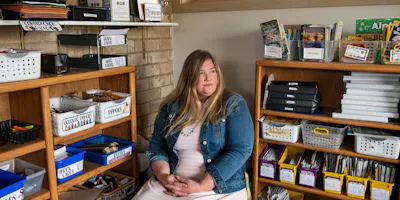
Eagle County School District teacher Carrie Rodgers is among the educators who have faced repeated challenges finding adequate, affordable housing. Photo by Kelsey Brunner for EdSurge.

In Austin, Texas, as newcomers arrive to the city and housing prices balloon, many education staff are being pushed farther and farther into the suburbs. Some eventually may be forced to leave the district or find higher-paying professions.

More than half my paycheck goes to rent and living expenses. ... Many of us are resigning because of it.

— Teacher at Austin Independent School District

“More than half my paycheck goes to rent and living expenses… Many of us are resigning because of it,” one Austin ISD staff member shared in a district survey conducted earlier this year, which found that 74 percent of staff spend more than 30 percent of their salary on housing.

Another educator wrote that while their salary increased 8 percent the previous year, their rent went up 22 percent. “This is not sustainable and will eventually drive me out of the city I teach in.”

2. In many areas, teachers can’t afford to rent or buy — and the data supports the anecdotes.

Earlier this year, Patricia Saenz-Armstrong, senior economist at the National Council on Teacher Quality (NCTQ), analyzed housing costs in 69 large metropolitan areas across all 50 states against teacher salaries at the largest school districts in those areas, then published her findings in a report.

In 15 of the 69 metro areas, she found that renting a one-bedroom apartment would be unaffordable for an early-career teacher (where “affordability” is defined using the U.S. Department of Housing and Urban Development’s definition). And in six of those metro areas, it would take a teacher at least 20 years to save up enough money for the average down payment on a house.

A prohibitively high cost of living is not limited to cities. In regions across the country, from California to North Carolina — including resort communities such as Eagle County — renting and buying can be difficult endeavors, especially for public school teachers, for whom the national average salary is about $67,000.

3. The resulting turnover rates have an impact on students and school communities.

The stakes are high. When a school district must replace one in five of its staff members every year — as would be the case for a district with a 20 percent annual turnover rate — educators, students, families and the entire community are impacted.

“You lose your skill and capacity in a school when you keep bringing in new teachers who don’t have experience,” says Heather Peske, president of NCTQ. “When teachers leave, [their] knowledge and skills and the investments districts have made go out the door. The district has to start again with a new crop of teachers.”

We need to do what we can to attract and retain employees.

— Jeremy Striffler

Over time, students in high-turnover districts are often taught by less experienced, less qualified teachers. That has a cumulative impact — especially when research shows that teachers have a bigger influence on student achievement than any other school-based factor.

“If every year the campus staff looks different, that really impacts that campus and how it functions,” acknowledges Jeremy Striffler, director of real estate for Austin ISD. “We also know that if we can't fill positions, there's the threat of larger class sizes, there's the threat of school closures, etc. So we need to do what we can to attract and retain employees.”

4. Desperate to slow attrition, school districts are getting involved.

District leaders may not be prepared to spearhead housing development projects. But desperate times call for desperate measures.

“They don’t have the time or the luxury of thinking, ‘Is this my job?’” notes Peske, adding that district leaders’ responsibility is to ensure a stable, effective educator workforce.

Some have tried appealing to their communities. In Eagle County and elsewhere, district leaders have asked homeowners to open their homes to educators, letting them rent out spare rooms and lofted garages. A district in Arizona recently broke ground on a project to build tiny homes for teachers. One in Texas bought a motel, renting the rooms at a heavily discounted price to housing-strapped district staff.

The most popular response, though, is what the districts in Austin, Eagle County and the Bay Area are all doing: building housing complexes on district-owned land.

Many school districts are land-rich and are starting to make use of that asset. In California alone, at least 46 school districts were pursuing workforce housing projects as of March 2022.

I don’t know if it will ever be solved, but we will continue to chip away at it.

— Matthew Miano

Across the country, district-led efforts to provide housing for teachers are in varied stages. The housing complex for staff at Jefferson Union High School District opened more than a year ago. Early results indicate it’s working as designed; staff vacancies are down and retention is up. Through a lottery system, Eagle County Schools recently matched staff with units in its forthcoming apartment building, which will become available in phases, starting this fall. For those who were matched, it’s poised to be a game-changer. But there aren’t enough units to serve all of the educators who expressed need.

Austin’s plans are not quite as mature. Construction hasn’t yet begun, and Striffler estimates that staff are years away from being able to move into the eventual building.

“We just feel that we have these assets here — we have this underutilized land — and that we can put it to good use by building housing, which can hopefully keep our teachers and staff here in the community that they're serving,” Strifler says.

These efforts will help many educators’ housing woes, but they’re unlikely to remedy the problems entirely, district leaders admit.

“I don’t know if it will ever be solved,” says Matthew Miano, a spokesperson for Eagle County Schools, “but we will continue to chip away at it.”

© Photo by Kelsey Brunner for EdSurge

What to Know About the Relationship Between Teacher Turnover and Housing

How a Parking Lot Became a Panacea for This School District’s Housing Crisis

18 September 2023 at 14:58

Shirley Cruz used to pass an old parking lot on her way to and from work.

Adjacent to a former high school, the lot was wasted space back then, she says. Uber and Lyft drivers would congregate there, waiting to get assigned to their next rides, Cruz recalls. Otherwise, it sat empty.

In Daly City, California, just south of San Francisco city limits, that’s prime real estate. The owners of the abandoned parking lot and the land beneath it — the local school district — realized as much, and they hatched a plan.

Now, Cruz doesn’t drive past it. She lives on it — in a district-owned, newly constructed apartment complex occupied exclusively by the teachers and staff of Jefferson Union High School District.

It’s an approach that is gaining momentum among public school districts nationwide. Many are dealing with vacancies and educator attrition rates at levels that are not only inconvenient but actually harmful to the staff, students and families in their communities. In a number of places, including the San Francisco Bay Area, exorbitant housing costs are responsible for high teacher turnover rates. So districts, often sitting on vast swaths of underused and undeveloped land, are getting creative.

Jefferson Union High School District is among the first school districts in the country to see its affordable housing project through to completion — staff began moving in over a year ago, and today, the 122-unit complex is fully occupied — but scores of others are not far behind.

In California alone, at least 46 school districts were pursuing workforce housing projects on 83 sites statewide as of March 2022, according to research from the Center for Cities + Schools at the University of California, Berkeley. Projects in North Carolina, Texas, Missouri, Colorado, Illinois and elsewhere are also underway.

As more districts seek to address the housing crisis in their communities — an issue EdSurge explored in depth in a recent story — we wanted to look at the school district in Daly City that, at least for now, has solved its housing woes.

Drawing Up Plans

Before its employee housing program launched in 2022, JUHSD was losing between 20 and 25 percent of its staff every year.

“We kept hearing, ‘It’s not because we don’t want to work here. It’s because we can’t live here,’” says Austin Worden, director of communication and staff housing for the district.

Housing in the Bay Area is notoriously pricey, notes Worden, “but in recent years, the spike is just unreal — just through the roof,” he says. The average rent for apartments in Daly City in 2023 ranges between $2,344 and $3,692 a month, according to Rent.com. “What we’re giving in salary raises doesn’t even compete,” Worden adds.

JUHSD is the lowest-funded high school district in San Mateo County, California, which is one of the most expensive places to live in the United States. Teacher salaries in Jefferson Union range from around $62,000 to $107,000 a year, compared to nearby San Mateo Union High School District, where teachers can earn between $79,000 and $148,000 a year.

School districts sometimes raise money by selling bonds, but Jefferson Union leaders knew they wouldn’t be able to use bond funds to increase staff salaries. What they could do with a bond was build. The district had plenty of land and property ripe for development. If housing was the main driver of high turnover rates and district leaders couldn’t adjust salaries in line with housing costs, they thought, why not just build staff housing?

A $33 million voter-approved bond passed in June 2018. The remainder of the $75.5 million housing project was financed through a Certificate of Participation (COP).

The goal, says Worden, was for about a quarter of the district’s 530 staff members to live in the eventual apartment complex, and to price rent for the units about 50 percent below market rates.

In practice, the rental units are around 60 percent of market rates — between $1,350 and $1,580 a month for a one-bedroom apartment in the district-owned building, compared to about $2,400 a month elsewhere, Worden says — so a considerable discount.

By May 2022, staff were moving into the building, which has a mix of one-, two- and three-bedroom units and includes modern appliances and amenities such as a fitness center, common rooms with workspaces, playgrounds, community centers and parking.

© Photo courtesy of Jefferson Union High School District

How a Parking Lot Became a Panacea for This School District’s Housing Crisis

When Affordable Housing Is Scarce, So Are Educators

6 September 2023 at 10:54

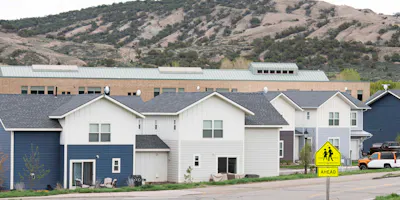
EAGLE COUNTY, Colo. — Carrie Rodgers gestures toward the silver medallion sitting atop her fridge, then waves it off.

It’s nothing really, she shrugs.

Still, she reaches for the disc and sets it on the kitchen counter for a closer look.

Two roofs and a pair of windows are etched into its center. Encircling the outline of those homes, the badge reads, “MAKE COLORADO AFFORDABLE 2022,” and below it, “IN GRATITUDE FOR YOUR LEADERSHIP.”

© Photo by Kelsey Brunner for EdSurge.

When Affordable Housing Is Scarce, So Are Educators
❌
❌