Normal view

There are new articles available, click to refresh the page.
Before yesterdayMain stream

How Urban and Rural School Districts Aim to Solve Alarmingly High Absentee Rates

20 November 2023 at 10:00

When you’re not sure where you’ll sleep, showing up to class isn’t what you’re worried about.

For educators, this makes for a daunting test.

“When families are dealing with not having basic necessities, school just isn’t a priority,” says Susanne Terry, coordinator for homeless education services in the San Diego County Office of Education. It’s worse for students who move around a lot, she says. They fall furthest behind.

Like in other major metro areas, privation exists alongside wealth in the Pacific coast city famous for its great weather and golden beaches. In San Diego, by some estimates the most expensive area in the entire country and a common vacation destination, about one-tenth of people live in poverty, according to a report from a grantmaker, the San Diego Foundation, published in late October. That’s 86,000 children experiencing poverty.

For students struggling to simply show up for school, this can translate to poor access to the basics. Housing is not always available, let alone stable access to food, a ride to and from school and the other conditions that have to be met for a student to really sink into learning, like internet access and a dedicated space for homework.

The absentee rates in San Diego — where, in 2021-2022, 30.4 percent of students were chronically absent, meaning they have missed at least 10 percent of school — are comparable to other large California cities. For homeless students, that rate is typically higher.

And the challenges are front of mind for many educators in the area, Terry says.

So how are they responding?

Attempting the Long Jump

Some districts say they’ve really tried to make lowering the rates at which homeless students miss school a priority.

Poway Unified School District, located in San Diego with more than 35,000 students, has a 15.7 percent chronic absentee rate, according to data from California’s Department of Education.

The district has truly made a concerted effort to make sure students are coming to school, says Mercedes Hubschmitt, director of learning support services and homeless liaison for the district.

Chronic absenteeism is not caused by the same problem for everybody, she says. It’s specific. So solving it requires the district to be mindful of students’ actual needs and to carefully plan steps to solve whatever hurdles those students face, she says.

How? Poway runs attendance reports and investigates why students aren’t showing up. District staff make “home visits,” sitting down with families to figure out what obstacles they have. What they’ve learned, Hubschmitt says, is that homeless students are missing the things that most people take for granted. The most common problem? It’s the physical part of getting kids to class. So the district attends to bus routes, gives out cards that provide free use of public transportation and, in some cases, provides gas reimbursement for families. Leaders are also working with companies like HopSkipDrive, a ridesharing company that gets students to school.

But Poway is also trying many similar approaches as other districts in San Diego. There are programs that provide limited time in hotels to stabilize housing. There are also attempts to get students access to clean clothes — for example, through access to laundry machines.

Other districts in San Diego tell EdSurge they are increasing training in trauma-informed care, providing more tutoring for homeless students, and focusing on college and career planning and guidance — sometimes including field trips to university campuses.

The hope is that these solutions will help cover the unique challenges faced by homeless students.

“Post-COVID, I think all of us went through different things. And I think that there are things that may have bubbled up that didn't exist before, around health, around priorities, around access. And so our team is really focused on trying to ensure that our kids have what they need to be successful,” Hubschmitt, of Poway, says.

Another stumbling block: health care.

Disparities in who has access to health care are cited in reports like the one by the San Diego Foundation as a reason why white people in the city live on average five years longer than Black people.

For homeless students, this can mean there’s more untreated sickness in the family.

Poway has tried to adapt. The district uses a grant to give out Uber gift cards that students’ families use for rides to doctor’s appointments, Hubschmitt says.

Think Small

For rural areas, the situation looks different.

Kellie Burns, district executive officer for Yavapai Accommodation School District #99, finds that her staff is able to connect with students personally.
Hers is a small district, in central Arizona, with only 90 students. The dozen staff in the district hand out their personal phone numbers to students and give them rides to school. When those students are missing, the staff calls and texts them, even showing up to their houses. Sometimes, Burns says, staff even track students down at their jobs.

The extra effort forges one-to-one connections with the students, Burns argues. It’s those relationships that can keep students trudging through the doors when they don’t want to, according to attendance experts. But it’s something that probably isn’t practical for large urban districts, Burns acknowledges.

During the pandemic, the number of chronically absent unhoused students in Burns’ district shot up. It was more than 50 percent in 2020. But it’s tapered off: Now, it’s only “slightly higher” than it was pre-pandemic, Burns says.
By percentage, the number of chronically absent students in Yavapai actually sits near the official figures of urban areas like San Diego. The chronic absentee rate for Yavapai has been 31.9 percent so far this year, according to figures sent to EdSurge in November.

But while the number of homeless students in the district has risen, only about 9 percent are chronically absent, Burns reports.

And others in rural areas have noticed a similar pattern.

Fewer homeless students are chronically absent in rural areas because it’s harder for them to hide, says Tina Goar, senior education specialist of rural initiatives for Generation Schools Network, a nonprofit that partners with schools to create “healthy school ecosystems.”

Rural areas tend to have fewer students overall, and that allows for the districts to really know the homeless students, she says, reflecting specifically on her own experience with rural Colorado schools.

What the rural districts she’s familiar with have a harder time doing is providing social services.

Rural areas rely on connections with big cities and towns to fund social support. When it comes to finding social workers, housing aid or job training, Goar says, “It’s challenging.” And that’s what the schools Goar works with say they want, as much as specific solutions to chronic absenteeism.

Playing Catch-Up

Yavapai, the district Burns works in, is an alternative school. It also only works with high schoolers, most of whom have lagged seriously behind in credits for graduation, usually by more than a year, Burns says.

These students also tend to have had trouble with the law, be caregivers, or have physical, emotional or mental issues they are dealing with, she adds. So they often aren’t very interested in school.

About 75 percent of the students who dropped out during the pandemic aged out of the system and never returned to school, Burns says.

When the pandemic hit, Burns says, most of those students got full-time jobs working in fast food, construction or landscaping. To the students, it can seem like good money, which makes them more reluctant to abandon those jobs to return to school, Burns says. These students tend not to come back for their diploma or GED.

But some other students are lured back.

They face another challenge, Burns says: They often don’t have the foundation they need to succeed in higher grades. They’ve missed a lot of class time. So even though they moved up, they now have to deal with the frustration of that missed learning. This can cause depression or defiance. Burns says she spends a lot of her time trying to catch these students up to where they would be if they had stayed in school.

“If they are told ‘you're not a failure just because you're behind,’ they have been more likely to try and to focus more on their school,” Burns says. But ultimately, it can depend on the support system the student has at home.

Are they permanently behind? Burns is optimistic. “They can all catch up. We'll get them there,” she says. It helps that Arizona doesn’t age out a student from school until 22, she adds. That can buy more time.

Burns says that showing compassion for these students and making a connection with them is critical. She tells them: “You've got extra time to do this. You're not a failure, just because you graduated later than what you thought you were going to graduate when you entered kindergarten.”

© Photo By 963 Creation/Shutterstock

How Urban and Rural School Districts Aim to Solve Alarmingly High Absentee Rates

School Makes Some Students Anxious. Is Physically Showing Up Necessary?

19 October 2023 at 10:00

Bradley loves baking lava cakes.

A high school senior with long curly hair who participates in a vocational program, Bradley spends about half the day at culinary school and then half in “at-home instruction” through a nearby high school run by a statewide public education service.

Perhaps what he loves most, even more than decadent molten chocolate, is the bustle.

It’s changed his attitude about school. When he was younger, he viewed school as a chore. Now, he views it as a way to do what he’s passionate about. “The culinary part of school has given me a really big rejuvenation in life,” he says.

Bradley needs to move around. Rather than being stuck at a desk, forced to sit still for long hours, shuffling boring papers, at culinary school he’s physically active. He’s running around the kitchen. He’s cooking, and his senses are engaged.

“I can feel. I can love. I can’t love an essay, but I can love my food,” he says.

It wasn’t always this way.

When the regular public school he attended several years ago closed during the pandemic, Bradley switched to remote learning. That meant that he didn’t have to wake up, get dressed or keep a schedule in the same way, he says.

“It was just people on my screen,” he says, dismissively. He would turn on the computer and fall back asleep.

For some students like Bradley — who spent much of his middle and high school career avoidant, a nonclinical term that denotes a visceral refusal to attend school — remote learning can be a way of extending their evasion of the classroom, according to several clinical psychologists who spoke with EdSurge. Virtual schooling, in those instances, allows students to keep away from physical school spaces. While that may offer students relief in the short term, the coping mechanism can have negative consequences, some experts say.

Yet mental health professionals also question the wisdom of “forcing” students to attend schools where they are clearly uncomfortable. Ultimately, experts advocate for alternative instruction that’s tailored to each student’s needs.

What’s the right kind of school for students suffering from anxiety? It’s complicated.

For Bradley, doing virtual school during the pandemic certainly deepened his sense of isolation.

“It definitely made things worse,” he says.

He wasn’t leaving the house much and became a shut in, he says. His friendships were completely online, and his buddies lived in faraway places like Oregon, Tennessee and Serbia. That meant that he kept odd hours, messaging friends at 4 a.m., then waking back up at 2 p.m.

It was lonely. “I just became this fool. Didn't leave the house for three months. Didn't talk to anyone outside of my family. Fully shut down,” Bradley says.

And when school returned in person, Bradley couldn’t bring himself to go back.

Becoming an Outsider

It would be hard to identify a single cause of Bradley’s school avoidance, according to his mother, Deirdre. (EdSurge is only using first names for members of the family out of concern for their privacy.) But it began in middle school, around the seventh grade.

When he was younger he had lots of friends, but as he aged he became an outsider, according to his mother.

Bradley would miss school here and there, but the growing tally of absences worried his mom. There were some great teachers who could connect with him, she recalls, but overall it was a losing struggle. The problem only grew.

Bradley’s eighth and ninth grade years were a blur of therapists, and county and crisis management services. Each one had their own diagnoses — from oppositional defiant disorder to autism — and to this day his own mother is frustratingly unclear on what condition he has. Bradley believes he has attention-deficit/hyperactivity disorder.

According to his mother, he was committed to a hospital for two weeks in the middle of the summer before 10th grade and assigned a probation officer through the “persons in need of supervision” program in family court, a program meant to wrangle “incorrigible” or “habitually disobedient” minors when their parents cannot.

Nothing worked in getting him back to school, or in engaging him with his life. By the time Bradley was in high school, he couldn’t connect socially. He would become enraged and punch holes in the wall.

“And then I was like, maybe he’s just difficult,” Deirdre says. “Some people are just difficult.”

His mother cried all the time. She fought with her son.

“I felt horrible about it. But I also was so desperate,” Deirdre says.

Special Supports

Youth like Bradley may do everything within their power to skip going to school in person.

Yet some psychologists argue that the goal should be to bring these avoidant students back into the physical building.

Sometimes, in a rush to help avoidant students, schools will put them in online school, says Anna Swan, a clinical psychologist. She says that approach is rarely the most helpful solution.

For certain subsets of school-avoidant kids, online school can at times become a way of furthering the avoidance by permanently removing them from the traditional developmental path, argues Michael Detweiler, an executive clinical director for Lumate Health, a cognitive behavioral telehealth platform that works with schools. It's important to get them back into the physical space of the building to reestablish that connection, he adds.

But solutions to school avoidance must meet the unique needs of each student.

In her advocacy, Monica Mandell, a social worker and family advocate for avoidant children in New York, usually takes a different tack.

Her work involves separating the student from the school where he or she is experiencing problems. For avoidant students, it’s crucial to move them into schools designed to handle significant mental health needs, she argues.

The onus for attendance tends to fall entirely on the parents, Mandell says. So she tries to shift the responsibility onto both the school and parent. That means getting special education classifications and individualized education plans (IEPs). It also may mean moving students to an “out of district,” a school that is designed to provide an education but that also has significant support staff who offer counseling and behavioral management and that allows for flexibility in the day, she says.

For a school-avoidant student, the best classification for is an emotional disturbance, Mandell argues, which requires some kind of diagnosis by a psychologist or psychiatrist. It can be a fight to make a school district understand that avoidance is a mental health need that denies the student the proper learning in a general education setting, Mandell says.

The process for securing these kinds of accommodations can take a couple of months. While the student is out of class, Mandell tries to get him or her assigned to at-home instruction, which has to be provided by the school system. It can be virtual, in person in the home or in a public space, she says. Usually, she adds, it’s taught by a teacher following the core curriculum.

So, in Mandell’s approach, students don't get coaxed back into the school building. Eventually, they're not going to see anybody from the building at all. They start fresh.

A Sense of Belonging

Some students are more hands-on, harder to be pigeonholed into the standard school models, and they have individual needs that must be met in order to succeed in education, says Anne Marie Albano, a clinical psychologist and professor at Columbia University. Those kids who white-knuckle it through the end of high school can end up miserable because their anxiety hasn't been addressed, she adds. They can get stuck at home, no longer avoiding only school, but now life in general. It’s worth asking, Albano says, if the school environment is right for the specific student.

Deirdre, the mother from New York, couldn’t put her finger on just a single factor that helped her son, she says. But the most significant certainly was finding somewhere he felt he belonged.

Eventually, Bradley connected with Mandell, and she got him an IEP and suggested he switch schools. He wasn’t sure at first but became convinced. While waiting to transfer somewhere new, he stayed home and took classes online for a few months. Initially, he says, this pulled him further into his stupor, eliminating even the limited interactions with his teachers he had during the coronavirus lockdowns.

In the long run, though, making a change paid off. When he finally got to River View High School, an alternative school with a focus on social, emotional and learning needs, in the middle of his sophomore year, the specialized support offered there helped him ease back into the world. Then, in September of last year, when he was a junior, Bradley joined the vocational program that let him go to culinary school.

That gave him a purpose, his mother says.

These days, Bradley has a future in mind. He plans to go to the Culinary Institute of America, a famous private institution in New York’s Hyde Park. He wants to be the manager of a restaurant, somewhere with people around him and minimal paperwork, he says. Often, he adds, there doesn’t seem to be much passion in those jobs. But that’s something he thinks he can bring to the table.

For his mother, Deirdre, the grief was worth it. One moment sticks out above the rest.

Late one night, Bradley came to her. He was a junior then, in culinary school, two months shy of his 17th birthday. Deirdre, who was working from home, had just finished her job duties for the day. Bradley was sitting there, waiting to talk — and said that he wanted to see a therapist.

This teenager, who she’d spent years fighting to see therapists, to simply go to school, was telling her that he wanted to do it.

It floored her, she says: “It had to be when he was ready.”

© Image By pimchawee/ Shutterstock

School Makes Some Students Anxious. Is Physically Showing Up Necessary?

How Can Colleges Close the Latino Graduation Gap?

17 October 2023 at 10:00

If colleges and universities want to close the graduation gap for their Latino students, their target goal is clear: help another 6.2 million Latinos earn a degree by 2030.

Parsing education data into snack-sized servings.

That’s according to the think tank Excelencia in Education, which focuses on research and policy on Latino achievement in higher education.

Its analysis on the 2021 college graduation rates of Latinos highlights some dismal statistics. Compared to their white, non-Hispanic counterparts, Latinos generally graduate from college at lower rates and drop out at higher rates. That’s even as the number of Hispanic students pursuing higher education has increased over the past 15 years.

Latino and white students enroll in higher education at roughly the same rates — 21 percent for Latinos and 23 percent for white students, according to the analysis.

The gaps become evident when looking at who graduates.

© Alphavector / Shutterstock

How Can Colleges Close the Latino Graduation Gap?

What to Know About the Relationship Between Teacher Turnover and Housing

26 September 2023 at 10:58

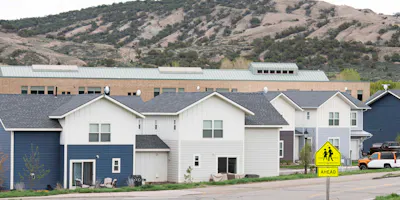
Today, a 20-acre stretch of green space known as the “Coy facility” remains an active school campus in East Austin. But soon, Austin Independent School District will convert it into an apartment complex to house teachers and staff who are increasingly getting priced out of the urban Texas district.

The goal is to create at least 500 new rental units on the site, alleviating — if not solving — the housing burden that so many of the district’s 10,000 staff members say they face.

A conceptual design for the apartment complex that will eventually be constructed for educators on district-owned land in East Austin, Texas. Photo courtesy of Austin Independent School District.

Scores of districts across the country are undertaking similar projects, as a lack of affordable housing in parts of the United States has led teachers to shoulder long commutes, decline job offers and vacate their positions altogether.

This year, EdSurge has been reporting on the relationship between America’s housing crisis and high teacher turnover rates in K-12 education.

In our first story, we explored the impact of rising housing costs on teacher shortages by visiting a rural mountain community where this crisis is playing out in real time. Then, we highlighted a school district in the San Francisco Bay Area where an affordable housing complex built on district-owned land and occupied exclusively by teachers and school-based staff is already showing signs of success.

Over the past six months, we have spoken with teachers and school support staff from rural and urban districts whose modest salaries are not keeping pace with the housing prices in their communities. We’ve interviewed education researchers, district leaders and economists about what both the data and anecdotal evidence reveal about this dynamic. We’ve scoured local and state news sources, case studies and reports to understand the different solutions being proposed and implemented. And we took two reporting trips to visit school districts that are considering — or have already begun — construction on housing projects for staff.

Here are the key takeaways from our reporting:

1. The rising cost of housing is driving teachers and support staff out of their schools and communities.

The costs of both renting and buying have increased dramatically since the pandemic, and teacher salaries have not been able to keep pace with that growth rate. In areas where housing prices and the cost of living are especially high, turnover rates have reached alarming levels.

Jefferson Union High School District, located in the San Francisco Bay Area, had been losing between 20 and 25 percent of staff annually before opening an apartment complex on district-owned land last year.

“We kept hearing, ‘It’s not because we don’t want to work here. It’s because we can’t live here,’” says Austin Worden, director of communication and staff housing for the district.

At Eagle County School District, in Colorado, turnover hovers around 20 percent annually. “We continue to be short-staffed in every department,” a district official shares.

In both districts, the median sales price for a home exceeds $1 million, and rental rates for a one-bedroom apartment can easily cost $2,000 a month or more.

Eagle County School District teacher Carrie Rodgers is among the educators who have faced repeated challenges finding adequate, affordable housing. Photo by Kelsey Brunner for EdSurge.

In Austin, Texas, as newcomers arrive to the city and housing prices balloon, many education staff are being pushed farther and farther into the suburbs. Some eventually may be forced to leave the district or find higher-paying professions.

More than half my paycheck goes to rent and living expenses. ... Many of us are resigning because of it.

— Teacher at Austin Independent School District

“More than half my paycheck goes to rent and living expenses… Many of us are resigning because of it,” one Austin ISD staff member shared in a district survey conducted earlier this year, which found that 74 percent of staff spend more than 30 percent of their salary on housing.

Another educator wrote that while their salary increased 8 percent the previous year, their rent went up 22 percent. “This is not sustainable and will eventually drive me out of the city I teach in.”

2. In many areas, teachers can’t afford to rent or buy — and the data supports the anecdotes.

Earlier this year, Patricia Saenz-Armstrong, senior economist at the National Council on Teacher Quality (NCTQ), analyzed housing costs in 69 large metropolitan areas across all 50 states against teacher salaries at the largest school districts in those areas, then published her findings in a report.

In 15 of the 69 metro areas, she found that renting a one-bedroom apartment would be unaffordable for an early-career teacher (where “affordability” is defined using the U.S. Department of Housing and Urban Development’s definition). And in six of those metro areas, it would take a teacher at least 20 years to save up enough money for the average down payment on a house.

A prohibitively high cost of living is not limited to cities. In regions across the country, from California to North Carolina — including resort communities such as Eagle County — renting and buying can be difficult endeavors, especially for public school teachers, for whom the national average salary is about $67,000.

3. The resulting turnover rates have an impact on students and school communities.

The stakes are high. When a school district must replace one in five of its staff members every year — as would be the case for a district with a 20 percent annual turnover rate — educators, students, families and the entire community are impacted.

“You lose your skill and capacity in a school when you keep bringing in new teachers who don’t have experience,” says Heather Peske, president of NCTQ. “When teachers leave, [their] knowledge and skills and the investments districts have made go out the door. The district has to start again with a new crop of teachers.”

We need to do what we can to attract and retain employees.

— Jeremy Striffler

Over time, students in high-turnover districts are often taught by less experienced, less qualified teachers. That has a cumulative impact — especially when research shows that teachers have a bigger influence on student achievement than any other school-based factor.

“If every year the campus staff looks different, that really impacts that campus and how it functions,” acknowledges Jeremy Striffler, director of real estate for Austin ISD. “We also know that if we can't fill positions, there's the threat of larger class sizes, there's the threat of school closures, etc. So we need to do what we can to attract and retain employees.”

4. Desperate to slow attrition, school districts are getting involved.

District leaders may not be prepared to spearhead housing development projects. But desperate times call for desperate measures.

“They don’t have the time or the luxury of thinking, ‘Is this my job?’” notes Peske, adding that district leaders’ responsibility is to ensure a stable, effective educator workforce.

Some have tried appealing to their communities. In Eagle County and elsewhere, district leaders have asked homeowners to open their homes to educators, letting them rent out spare rooms and lofted garages. A district in Arizona recently broke ground on a project to build tiny homes for teachers. One in Texas bought a motel, renting the rooms at a heavily discounted price to housing-strapped district staff.

The most popular response, though, is what the districts in Austin, Eagle County and the Bay Area are all doing: building housing complexes on district-owned land.

Many school districts are land-rich and are starting to make use of that asset. In California alone, at least 46 school districts were pursuing workforce housing projects as of March 2022.

I don’t know if it will ever be solved, but we will continue to chip away at it.

— Matthew Miano

Across the country, district-led efforts to provide housing for teachers are in varied stages. The housing complex for staff at Jefferson Union High School District opened more than a year ago. Early results indicate it’s working as designed; staff vacancies are down and retention is up. Through a lottery system, Eagle County Schools recently matched staff with units in its forthcoming apartment building, which will become available in phases, starting this fall. For those who were matched, it’s poised to be a game-changer. But there aren’t enough units to serve all of the educators who expressed need.

Austin’s plans are not quite as mature. Construction hasn’t yet begun, and Striffler estimates that staff are years away from being able to move into the eventual building.

“We just feel that we have these assets here — we have this underutilized land — and that we can put it to good use by building housing, which can hopefully keep our teachers and staff here in the community that they're serving,” Strifler says.

These efforts will help many educators’ housing woes, but they’re unlikely to remedy the problems entirely, district leaders admit.

“I don’t know if it will ever be solved,” says Matthew Miano, a spokesperson for Eagle County Schools, “but we will continue to chip away at it.”

© Photo by Kelsey Brunner for EdSurge

What to Know About the Relationship Between Teacher Turnover and Housing

How a Parking Lot Became a Panacea for This School District’s Housing Crisis

18 September 2023 at 14:58

Shirley Cruz used to pass an old parking lot on her way to and from work.

Adjacent to a former high school, the lot was wasted space back then, she says. Uber and Lyft drivers would congregate there, waiting to get assigned to their next rides, Cruz recalls. Otherwise, it sat empty.

In Daly City, California, just south of San Francisco city limits, that’s prime real estate. The owners of the abandoned parking lot and the land beneath it — the local school district — realized as much, and they hatched a plan.

Now, Cruz doesn’t drive past it. She lives on it — in a district-owned, newly constructed apartment complex occupied exclusively by the teachers and staff of Jefferson Union High School District.

It’s an approach that is gaining momentum among public school districts nationwide. Many are dealing with vacancies and educator attrition rates at levels that are not only inconvenient but actually harmful to the staff, students and families in their communities. In a number of places, including the San Francisco Bay Area, exorbitant housing costs are responsible for high teacher turnover rates. So districts, often sitting on vast swaths of underused and undeveloped land, are getting creative.

Jefferson Union High School District is among the first school districts in the country to see its affordable housing project through to completion — staff began moving in over a year ago, and today, the 122-unit complex is fully occupied — but scores of others are not far behind.

In California alone, at least 46 school districts were pursuing workforce housing projects on 83 sites statewide as of March 2022, according to research from the Center for Cities + Schools at the University of California, Berkeley. Projects in North Carolina, Texas, Missouri, Colorado, Illinois and elsewhere are also underway.

As more districts seek to address the housing crisis in their communities — an issue EdSurge explored in depth in a recent story — we wanted to look at the school district in Daly City that, at least for now, has solved its housing woes.

Drawing Up Plans

Before its employee housing program launched in 2022, JUHSD was losing between 20 and 25 percent of its staff every year.

“We kept hearing, ‘It’s not because we don’t want to work here. It’s because we can’t live here,’” says Austin Worden, director of communication and staff housing for the district.

Housing in the Bay Area is notoriously pricey, notes Worden, “but in recent years, the spike is just unreal — just through the roof,” he says. The average rent for apartments in Daly City in 2023 ranges between $2,344 and $3,692 a month, according to Rent.com. “What we’re giving in salary raises doesn’t even compete,” Worden adds.

JUHSD is the lowest-funded high school district in San Mateo County, California, which is one of the most expensive places to live in the United States. Teacher salaries in Jefferson Union range from around $62,000 to $107,000 a year, compared to nearby San Mateo Union High School District, where teachers can earn between $79,000 and $148,000 a year.

School districts sometimes raise money by selling bonds, but Jefferson Union leaders knew they wouldn’t be able to use bond funds to increase staff salaries. What they could do with a bond was build. The district had plenty of land and property ripe for development. If housing was the main driver of high turnover rates and district leaders couldn’t adjust salaries in line with housing costs, they thought, why not just build staff housing?

A $33 million voter-approved bond passed in June 2018. The remainder of the $75.5 million housing project was financed through a Certificate of Participation (COP).

The goal, says Worden, was for about a quarter of the district’s 530 staff members to live in the eventual apartment complex, and to price rent for the units about 50 percent below market rates.

In practice, the rental units are around 60 percent of market rates — between $1,350 and $1,580 a month for a one-bedroom apartment in the district-owned building, compared to about $2,400 a month elsewhere, Worden says — so a considerable discount.

By May 2022, staff were moving into the building, which has a mix of one-, two- and three-bedroom units and includes modern appliances and amenities such as a fitness center, common rooms with workspaces, playgrounds, community centers and parking.

© Photo courtesy of Jefferson Union High School District

How a Parking Lot Became a Panacea for This School District’s Housing Crisis

Colleges Are Missing Out on Students Who Start — But Don’t Finish — Their Applications

12 September 2023 at 10:06

Twice a week, Rofiat Olasunkanmi, 22, heads back to Brooklyn to her alma mater, Kurt Hahn Expeditionary Learning School. Now a senior at New York University, Olasunkanmi helps high school seniors navigate applying to college, a process she personally recalls being dominated by concern about finances and a general sense of anxiety because no one in her family did it in the United States before her.

Her older siblings received degrees in Nigeria, where her parents still live, so she’d had to figure out a lot on her own, a burden she now tries to alleviate for the students she works with. She aims to support them from start to finish, beginning with applications for the City University of New York at minimum and then moving on to the Common Application.

“But I’m not there every day, and Common App is very lengthy,” she said, “so they need to ensure that they’re doing the parts that they need to get done while I'm not there.”

Rofiat Olasunkanmi helps high school seniors apply to college. Photo courtesy of Olasunkanmi.

The Common Application was first created with the goal to simplify the college admissions process by allowing students to submit one application to multiple institutions. However, as Olasunkanmi mentioned, it takes significant time to complete, an estimated six to eight weeks, according to admissions counselors.

The COVID-19 pandemic complicated the application process further with disruptions to in-person advising, testing and extracurricular activities. But barriers to completion predate the pandemic.

During the last pre-pandemic college application cycle, 2018-19, nearly 1.2 million students accessed the Common App, created a profile and began working on at least one application. But a quarter of those students, almost 300,000, did not end up submitting any application through Common App, according to a working paper published this August.

Researchers characterized this subset of students as “non-submitters.”

“Non-submitters” were more likely than students who submitted applications to have lower educational-occupational aspirations, be racial minorities, have parents who completed lower levels of education and live in communities with lower socioeconomic status — but they were not less academically qualified.

Colleges across the country have doubled down on trying to attract students as enrollment numbers decline. Direct admission has proven to be an effective method of appealing to students who hadn’t already been planning to attend college. But the students who start applications without hitting the “send” button, the “non-submitters,” largely fall into a different category. They are presumably already interested in college.

So, why aren’t they completing applications?

Identifying ‘Non-Submitters’

During World War II, the U.S. military noticed that certain parts of the airplanes that returned from battle had more bullet holes than others. As a result, leaders decided to reinforce those areas, expecting that would help the planes better withstand enemy fire.

But this strategy had a fundamental error. It’s one relevant to past research about barriers preventing students from enrolling in college, said Taylor Odle, an assistant professor of educational policy studies at the University of Wisconsin-Madison and co-author of the “non-submitters” study.

The error, known as survival bias, directs focus on those entities that passed a selection process but overlooks others that didn’t make it through. The military focused on holes in the planes that survived enemy fire. But really, leaders should have considered the holes in the planes that did not make it home.

Likewise, higher education institutions have tried various strategies to boost student enrollment but haven’t stepped back to ask, “Who is not completing applications?” Odle said.

He and Preston Magouirk, chief data officer at the nonprofit DC College Access Program, took that step back. They outlined key factors that can predict non-submission, using data students put into their Common App profiles coupled with community indicators from the American Community Survey administered by the U.S. Census Bureau and school features from the Common Core of Data maintained by the U.S. Department of Education. (Magouirk was a senior manager of research and analytics at Common App while conducting the study.)

Overall, they found that 24 percent of students who started the Common App in 2018-19 did not complete it. The highest rates of non-submission were among American Indian, Alaska Native and Native Hawaiian students (as well as students who did not report their race or ethnicity on Common App), and the lowest rates were among white and Asian students. While students who identified as Black or African American and Latino represented a small fraction of all Common App users during the study year, both groups were overrepresented in the non-submitter population, with non-submission rates of 27 and 26 percent, respectively.

Submission rates also varied by community. The higher the unemployment rate in a ZIP code, the higher the likelihood of non-submission among students who lived there, the researchers found. Further, rates varied by school type. Students attending public high schools were more likely to not submit applications they’d started than students attending independent or private high schools. Students at Title I schools, which serve high numbers of low-income students, were more likely to not submit applications they’d started (28 percent) compared to students at non-Title I schools (22 percent). Compared to applicants, non-submitters were also less likely to report having a parent with a college degree.

Students who ultimately submitted the Common App visited the platform more frequently. The essay, in particular, appeared to be key in distinguishing between students who finished and didn’t finish their applications. Out of the students who eventually applied, 94 percent wrote at least 100 characters for their essay; whereas just 43 percent of students who did not write at least that much ended up applying.

What is most distinct about these findings, the researchers said, are the academic similarities between submitters and non-submitters.

“It would be so easy for people to just say, ‘well, they're probably not college material,’” Odle said, referring to non-submitters. This study shows otherwise. Students who submitted and students who did not submit applications had very similar GPAs and SAT/ACT scores.

Of course, there are other ways to apply to college beyond the Common App. While the platform connects students with more than 1,000 four-year colleges and universities, its data alone does not provide a comprehensive look at all pathways to higher ed.

Separate from the research by Odle and Magouirk, Common App conducted an internal analysis using National Student Clearinghouse records to track what happened to non-submitters beyond its own platform, said Mark Freeman, vice president of data analytics and research at Common App. The analysis found that the average Common App non-submitter is still likely to enroll in college after high school — but using another platform, such as applying directly to an institution.

This underscores the fact that people who access the Common App at all have a high baseline enrollment rate. For the 2017-18 academic season, for example, 71 percent of Common App users who did not submit an application through the platform still attended college within the next academic year, according to the analysis. More than half (56 percent) attended an institution that does not accept the Common App, but some students attended institutions that do (14.5 percent).

While this analysis looked at the year prior to Odle and Magouirk’s study, the results should look very similar, Freeman said.

However, Common App non-submission still seems to be related to college-going outcomes, Odle said. After all, the enrollment rate of students who completed the Common App — 88.4 percent — was higher than the enrollment rate of students who started but never finished it — 71 percent.

Counseling Students to Submit Applications

Dorma Lozada, a senior at John Jay College of Criminal Justice in Manhattan, recalls going through the college application process herself a few years ago. “I understood the language of the applications,” she said, which she attributed to her mother’s experience attending college in Puerto Rico. When filling out financial aid forms, her mother had the needed documents prepared, for example.

Lozada, 21, now assists students preparing for college at her high school alma mater, the Facing History School several blocks away from John Jay. Her work is supported through the same program that Olasunkanmi participates in, which trains college students to provide individualized support to high school seniors.

The high school students Lozada works with often do not receive the same insight from their parents that she did from her mother, she said. And many of her students’ parents do not speak English. She translates what she can, but it’s a challenge to alleviate families’ uncertainty about college, and specifically fears about affordability.

While Odle and Magouirk’s study focused on predictors of non-submission rather than strategies to support application completion, its findings point to possible solutions. Because submitters typically came to the Common App platform more times and completed the essay portion, for example, maybe more involved and sustained college counseling could help more students finish their applications.

The work that Olasunkanmi and Lozada do is an example of that counseling, which varies in quality and quantity across the country and in individual school districts. While the ratio of students to school counselors in the U.S. has narrowed over time, it remains well above what the American School Counselor Association recommends. These counselors assist with postsecondary planning but also boosting academic achievement and interpersonal skills. ASCA recommends a ratio of 250 students for every one school counselor. During the 2021-2022 school year, the latest year for which data is available, the nationwide average was 408-to-1.

High school seniors in 21 states shared how a lack of counseling affected their college application process in surveys conducted by the national nonprofit YouthTruth.

“I am almost done with my senior year and not once been talked to or notified about end of year requirements for graduation let alone college,” a male student reported. “Because of this I have decided that college is out of the picture and that I guess I'm just not good enough.”

Sometimes we have students that are very enthusiastic at the beginning of the application, but by the end, they're not.

— Rofiat Olasunkanmi

Others reported not knowing about application deadlines, and when they learned of them late in the application season, they assumed college was just off the table, said Jen de Forest, director of organizational learning and communications at YouthTruth.

“There were a lot of kids, particularly Latinx kids, who described not having social capital in the process, unless they had a sibling to guide them through,” de Forest said. “If they had a sibling, the sibling was a really crucial bridge.”

Olasunkanmi has found this to be the case with her students in New York, too.

While her older siblings did not go through the college application process in the U.S., they attended and completed college, so she had that example set for her. For her students at Kurt Hahn Expeditionary Learning School, many lack personal connections who chose the college pathway themselves. While these students may want to attend college and eagerly begin applications, they do not always follow through as they commonly see siblings and peers going straight to the workforce.

“Sometimes we have students that are very enthusiastic at the beginning of the application,” Olasunkanmi said, “but by the end, they're not.”

Like Lozada has seen, Olasunkanmi said this decreased buy-in from students is often contingent on the support they receive — or don’t receive — outside of the Bridge Coach program. Olasunkanmi knows from her own experience that a lack of parental input is not always an intentional choice. Some students’ parents are not familiar with the U.S. college admissions process, while others are busy juggling work or other responsibilities.

Setting Different Expectations

Yet Olasunkanmi’s parents did expect her to attend college. “African parents, they don't play with education,” she said. That meant her own college aspirations aligned with her family’s expectations.

Across the country, however, large aspiration-expectation mismatches have been found. YouthTruth's most recent survey of over 25,000 high school seniors in the class of 2023 found that 74 percent aspired to go to college but only 66 percent expected to go to college.

Olasunkanmi thinks this mismatch is at least in part due to a lack of diverse representation on college campuses. Overall, white students are the largest racial demographic in the U.S. college population, regardless of whether the institution is public or private, or a two- or four- year school (although public two-year institutions comparably have more minority students). Meanwhile, Kurt Hahn Expeditionary Learning School is composed of mostly Black students (81 percent), with 14 percent Latino and 3 percent white students.

Career expectations likely also contribute to the mismatch. In the Common App study, submission rates varied widely by students’ reported educational plans, with higher rates of non-submission found for those who aspired to attain an associate degree compared to higher degree levels. The non-submission rate essentially doubled for students who never selected any degree goals.

Rates also varied based on students’ intended career field, with students who reported aspiring to work in occupations that generally require advanced levels of education (engineers, policymakers, physicians, etc.) having high application submission rates, while students who reported aspiring to occupations that don’t typically require a postsecondary credential (homemaker, farmer, etc.) had low application submission rates.

While college may not be a match for everyone’s career goals, ruling out college as an option because of expected job plans at such a young age is limiting, given that research shows those aspirations often change over time, Odle cautioned.

This was true for both Olasunkanmi and Lozada. After graduating high school, Olasunkanmi started at the Borough of Manhattan Community College, before transferring to NYU. She thought she wanted to be a nurse before she had the chance to work closely with a counselor, who spoke with her about the multitude of career options there are in health care. Now, she plans to work as a health care manager in a hospital or medical center. Lozada, who is majoring in political science and minoring in economics, initially thought she’d be a lawyer, but she is now set on becoming an elected official.

Cost is easily the biggest barrier to enrollment for both the never-enrolled and the previously enrolled, according to the latest Gallup and Lumina Foundation State of Higher Education report for 2023. YouthTruth reports seeing students become more concerned about the return on investment for a college education.

Transparency in what students can expect from the college experience, particularly overall cost, is key to helping them feel more confident to enroll, according to Bryce McKibben, senior director of policy and advocacy at the Hope Center for College, Community, and Justice at Temple University. “It is so opaque,” McKibben said of the college price tag. “You don't necessarily know how much it's going to [cost] even in the next year, let alone over the length of your degree. As a result, it's very easy to make the conclusion that it may not be possible or that you're going to end up in loads of debt.”

The Hope Center regularly conducts surveys assessing students’ basic needs. The latest 2020 results from more than 195,000 students showed rates of basic needs insecurity increased among the general population, and intention to enroll in college dropped.

“We don't necessarily have data on the level of which those folks who never entered may have struggled with those challenges,” McKibben said, “but the fact that there are three-in-five students experiencing basic needs insecurity obviously presents huge warning signs of folks who are sort of at the margin.”

Odle and Magouirk hope that their research leads to changes that help more students successfully complete college applications. As for how the Common App plans to build on this work, Freeman said the organization will conduct a survey of non-submitters.

As Olasunkanmi and Lozada both begin their senior year of college, they’re thinking about how they can leverage their knowledge to beat back inequity in who makes it to college, and who succeeds beyond higher education, too.

Their advocacy work has already begun, one high school senior at a time.

“At the end of the year, they turn around and they're like, ‘thank you so much for helping me,’” Lozada said. “‘If it weren't for you, I would have not been able to complete these applications.’”

© Studio623 / Shutterstock

Colleges Are Missing Out on Students Who Start — But Don’t Finish — Their Applications

When Affordable Housing Is Scarce, So Are Educators

6 September 2023 at 10:54

EAGLE COUNTY, Colo. — Carrie Rodgers gestures toward the silver medallion sitting atop her fridge, then waves it off.

It’s nothing really, she shrugs.

Still, she reaches for the disc and sets it on the kitchen counter for a closer look.

Two roofs and a pair of windows are etched into its center. Encircling the outline of those homes, the badge reads, “MAKE COLORADO AFFORDABLE 2022,” and below it, “IN GRATITUDE FOR YOUR LEADERSHIP.”

© Photo by Kelsey Brunner for EdSurge.

When Affordable Housing Is Scarce, So Are Educators

Young Kids in Low-Income Families Get Less Exposure to Math. Can the Right Apps Help?

30 August 2023 at 22:03

Recent public debates have focused a spotlight on K-12 math pathways. But there’s been less attention paid to what math skills students need early in life, to set them up for elementary school in the first place.

For early learners, exposure to math concepts can be at the mercy of their family’s economic status or related factors like whether their parents are college-educated. That’s why one group of researchers asked what can be done to close the cognitive development distance that opens between children from high- and low-income families, which they argue is a watershed in equality of opportunity.

The resultant randomized controlled trial, “Boosting Parent-Child Math Engagement and Preschool Children’s Math Skills,” tried to hoist up the math skills of children ages 3 through 5 in Chicago. These 758 students — who were enrolled in Head Start programs or other publicly subsidized preschools — were from low-income families. Study participants were split into groups that received different educational materials. For some parents, researchers loaded up tablets with vetted apps designed to teach math skills, and then handed them to the families and walked away for six months, says Ariel Kalil, a professor at the University of Chicago Harris School of Public Policy and the director of the Center for Human Potential and Public Policy. Some parents received analog games designed to convey math skills, while others received a storybook. Researchers sent text reminders to some parents to use the materials they received.

The result? Some of it worked really well. There was no noted effect at the end of the original treatment, which lasted 12 weeks. But when researchers came back six months later, kids who had been using the apps saw math skills increase by 0.2 standard deviations, according to the report — an improvement bigger than students typically see after one year in a Head Start program. Groups that were given analog games and parental messaging saw improvements, too.

Another result: Girls got a bigger skills bump from the tablets than boys. That’s likely related to the fact that girls develop quicker in general, and can be able to self-regulate in younger years, Kalil speculates.

But there was another, unexpected finding.

The digital tools facilitated parent-child interactions, Kalil says in an interview, making the time spent more fun and efficient — just better overall.

While it’s common for parents to read bedtime stories to their children, it’s less common for them to solve bedtime equations.

In her work studying the differences in cognitive development between early learners from low-income families and their high-income counterparts, Kalil has noticed that the outcomes are more about the parents than the students. To improve children’s learning, interventions either have to increase the amount of time parents spend with their kids, or make the actual learning process more efficient, she says.

While it’s common for parents to read bedtime stories to their children, it’s less common for them to solve bedtime equations. Kalil came into this particular study believing that you can’t dramatically increase the amount of time parents devote to imparting math skills. But, in this latest research, parents reported spending more math time with their kids, thanks in part to the apps — “much to our surprise and great interest,” Kalil says.

In short, while the researchers thought that they were preparing the apps to substitute for the parents, they were actually preparing the tech tools to complement the efforts of parents.

The Price Is Right

By kindergarten, young children are supposed to learn quite a lot of math skills. That includes knowing how to count, understanding differences in quantities and knowing how to measure things. They also need to have some comprehension of shapes, spatial relations and patterns.

How well their young minds have managed to capture these concepts foretells whether they will be successful in their academic careers. In no small part, that’s because there’s a strong link between these skills and later-in-life math and reading abilities.

So the stakes are high.

For researchers like Kalil, the real question is: Will math apps actually prepare all early learners to be ready for kindergarten numeracy? Establishing that apps can help is only the first step in lifting math abilities.

Nevertheless, the kinds of solutions the researchers considered had another virtue: affordability. Apps are cheap and can be widely distributed, Kalil says, an important feature for any prospective solution to widespread inequalities. That’s exciting, she adds.

However, reliance on edtech introduces further questions.

Wheat and Chaff

The study required identifying effective apps. And the number of quality math apps available to the researchers — who chose to focus on apps in both English and Spanish, since Chicago has a high number of Spanish speakers — was limited. In the end, the researchers selected seven applications that they felt struck a balance between being engaging to students and also prompting them to learn. These largely focused on counting, number recognition and patterns.

Knowing what works in edtech is difficult. And in contrast to these researchers, the average early childhood education program, or the typical parent, may not be capable of rigorously appraising apps. That means that getting high-quality math apps in front of early learners will require more studies, to show which applications catalyze actual learning.

It’s something researchers such as Kalil are thinking about.

“There are shockingly few randomized controlled trials in a significantly meaningful population that really test what is working,” Kalil says, adding that there’s a lot of “nonsense that you just shouldn’t believe about what works and what doesn’t.”

Other researchers would agree. Previous studies have suggested that only 26 of the 100 most popular edtech apps have published research that aligns to federal standards from the Every Student Succeeds Act (ESSA). Far fewer of those reach the final tier, having “strong evidence.”

It’s also not clear whether these solutions would suffer from the edtech “drop off,” the phenomenon that sees learning benefits decline because people simply stop using the technology, Kalil says.

© Photo By Odua Images/ Shutterstock

Young Kids in Low-Income Families Get Less Exposure to Math. Can the Right Apps Help?
❌
❌