
Reading view

There are new articles available, click to refresh the page.

Easytis, 10 ans d’innovations dans les STIAM pour accompagner les pratiques dans les classes

Easytis a été créé il y a bientôt 10 ans par Patrice Ulles son fondateur. L’idée est d’apporter tout une variété de petites solutions numériques ou non numériques pour développer les compétences des élèves en classe. Du petit robot, à la salle d’éveil sensoriel, en passant par le studio vidéo complet, l’objectif est de répondre au enjeux des STIAM, compétences requises pour le XXIème siècle : Sciences, Technologies, Ingénierie, Arts et Mathématiques

On essaie de faire la promotion du numérique pour mettre en place une pédagogie active. Quand l’enseignant change de posture et va plus guider l’enfant dans les activités. Ces petits objets numériques permettent de développer à côté des grands équipements numériques déjà présents en classe comme les ENI par exemple.

Un atelier cuisine, des murs sonores, un atelier lecture pour mettre les élèves en activité sans pour autant être un expert en numérique.

Ces principes dans la classe, sont utilisables de la maternelle jusqu’au collège. « Même si la structure de classe en premier degré est la bonne méthode » précise Patrice Ulles. Un atelier cuisine, des murs sonores, un atelier lecture pour mettre les élèves en activité sans pour autant être un expert en numérique et le tour est joué.

Pour Easytis, l’école n’est pas uniquement un lieu, c’est aussi un état d’esprit qui peut utiliser l’apprentissage STIAM comme levier de croissance exponentiels des liens socio-émotionnels et comme fondation pour inspirer les innovateurs de demain.

Pour lutter contre les inégalités, les projets peuvent impliquer les élèves, l’équipe pédagogique, les autres acteurs de l’école ainsi que les familles.

Avec les propositions de matériels Easytis, une collaboration avec le périscolaire est possible car les solutions proposées permettent aussi BIEN des activités pédagogiques et ou ludiques.

Une offre intégrant des solutions de plusieurs fabricants leaders dans le domaine de l’innovation pédagogique.

Le but est avant le développement des compétences des enfants et pas forcément développer les usages du numérique. Avec un catalogue de plus de 3000 références Easytis est aujourd’hui un des principal fournisseur pour développer les STIAM dans sa classe en France.

L’article Easytis, 10 ans d’innovations dans les STIAM pour accompagner les pratiques dans les classes est apparu en premier sur Ludomag.
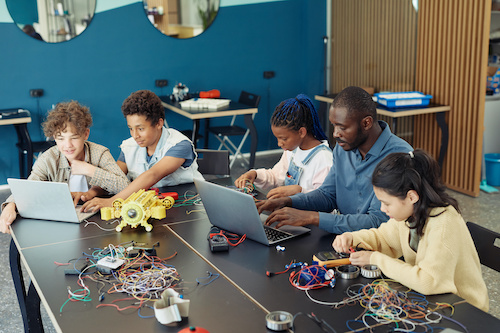
Here’s why STEM Career Days are a great idea

High school students who attended STEM Career Days were far more likely to pursue STEM-related careers than those who did not participate.

Key points:

A new study at the University of Missouri–in partnership with Harvard-Smithsonian researchers–shows that when colleges host ‘STEM Career Days,’ the students who attend are far more likely to pursue a career in a STEM (Science, Technology, Engineering and Math) related field.

The findings not only highlight the benefits of college recruiters introducing high school students to STEM-related opportunities, but they can also help increase and diversify the STEM workforce in the United States.

Michael Williams, an assistant professor in the MU College of Education and Human Development, analyzed a nation-wide survey conducted by Harvard University that asked nearly 16,000 college students if they attended a college-run STEM Career Day while in high school. He found that the students who attended were far more likely to have STEM-related career aspirations compared to the students who did not attend.

“Now that we have found that this type of intervention works for turning that potential interest in STEM into career aspirations in STEM, we can work on designing these interventions in a way to be even more effective and accessible to develop a more diverse STEM workforce,” said Williams, who is also a faculty fellow in the MU Division of Inclusion, Diversity & Equity. “If you want someone to be good at something, you want them to develop a sense of efficacy, which is about putting them in a position where they can see themselves doing it and succeeding at it, and seeing other people that look like them doing it as well.”

When Williams was pursing a master’s degree in computer information technology, he remembers being the only Black student in classes such as computer engineering and differential equations. He also remembers the classes being disproportionately made up of international students.

“The United States trails a lot of global competitors in the production of STEM talent, especially in areas like sophisticated technology and quantitative methodologies,” Williams said. “The National Science Foundation has pushed for broadening participation in STEM fields and increasing diversity for populations that have previously been excluded from STEM-related opportunities. So, I am passionate about reaching people earlier in the educational pipeline and seeing what interventions help turn interest into career aspiration.”

Williams added that MU is a land-grant university and has several community outreach initiatives to not only expose Missouri students to STEM topics at the high school level, but also at the middle and elementary school levels.

“STEM Cubs is a free STEM education program for students in kindergarten through eighth grade that is hosted by the MU Office of Academic Access and Leadership Development, MU College of Education and Human Development, and MU College of Engineering that emphasizes the importance of exposing all students to exploratory and experiential learning,” Williams said. “The program seeks to engage young students, particularly those historically underrepresented in STEM education and career fields, to hands-on STEM activities. By allowing them to learn about scientific concepts and how they relate to everyday life, the program helps them build interest in science and science-based careers.”

The study “A quasi-experimental study of the impact of college-run science, technology, engineering, and mathematics (STEM) career days on American students’ STEM career aspirations,” was published in International Journal of Science Education.

This press release originally appeared online.

❌