
Normal view

There are new articles available, click to refresh the page.
Before yesterdayMain stream

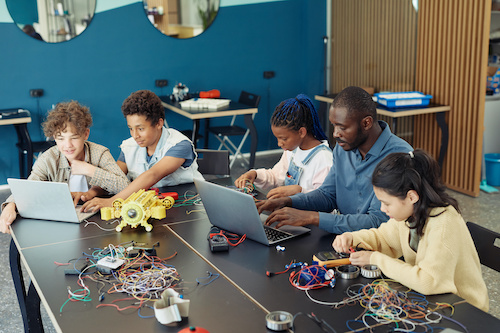
Here’s why STEM Career Days are a great idea

High school students who attended STEM Career Days were far more likely to pursue STEM-related careers than those who did not participate.

Key points:

A new study at the University of Missouri–in partnership with Harvard-Smithsonian researchers–shows that when colleges host ‘STEM Career Days,’ the students who attend are far more likely to pursue a career in a STEM (Science, Technology, Engineering and Math) related field.

The findings not only highlight the benefits of college recruiters introducing high school students to STEM-related opportunities, but they can also help increase and diversify the STEM workforce in the United States.

Michael Williams, an assistant professor in the MU College of Education and Human Development, analyzed a nation-wide survey conducted by Harvard University that asked nearly 16,000 college students if they attended a college-run STEM Career Day while in high school. He found that the students who attended were far more likely to have STEM-related career aspirations compared to the students who did not attend.

“Now that we have found that this type of intervention works for turning that potential interest in STEM into career aspirations in STEM, we can work on designing these interventions in a way to be even more effective and accessible to develop a more diverse STEM workforce,” said Williams, who is also a faculty fellow in the MU Division of Inclusion, Diversity & Equity. “If you want someone to be good at something, you want them to develop a sense of efficacy, which is about putting them in a position where they can see themselves doing it and succeeding at it, and seeing other people that look like them doing it as well.”

When Williams was pursing a master’s degree in computer information technology, he remembers being the only Black student in classes such as computer engineering and differential equations. He also remembers the classes being disproportionately made up of international students.

“The United States trails a lot of global competitors in the production of STEM talent, especially in areas like sophisticated technology and quantitative methodologies,” Williams said. “The National Science Foundation has pushed for broadening participation in STEM fields and increasing diversity for populations that have previously been excluded from STEM-related opportunities. So, I am passionate about reaching people earlier in the educational pipeline and seeing what interventions help turn interest into career aspiration.”

Williams added that MU is a land-grant university and has several community outreach initiatives to not only expose Missouri students to STEM topics at the high school level, but also at the middle and elementary school levels.

“STEM Cubs is a free STEM education program for students in kindergarten through eighth grade that is hosted by the MU Office of Academic Access and Leadership Development, MU College of Education and Human Development, and MU College of Engineering that emphasizes the importance of exposing all students to exploratory and experiential learning,” Williams said. “The program seeks to engage young students, particularly those historically underrepresented in STEM education and career fields, to hands-on STEM activities. By allowing them to learn about scientific concepts and how they relate to everyday life, the program helps them build interest in science and science-based careers.”

The study “A quasi-experimental study of the impact of college-run science, technology, engineering, and mathematics (STEM) career days on American students’ STEM career aspirations,” was published in International Journal of Science Education.

This press release originally appeared online.
How meta creativity prepares students for the future

16 November 2023 at 11:00
We must evolve our definitions of creativity to higher orders to stay relevant, including successfully using AI in and out of the classroom.

Key points:

  • AI is changing education–and these changes can be beneficial if handled correctly
  • Meta creativity–routines that help us engage fully with the hardest parts of creativity–can help with AI integration
  • See related article: 5 positive ways students can use AI
  • For more news on AI and creativity, visit eSN’s Digital Learning page

Nearly 40 percent of teachers expect to use AI in their classrooms by the end of the 2023-2024 academic year. This use of AI at school will impact how students learn and use their creativity as innovation, which will be increasingly necessary in the future as even higher-order thinking skills become standard. There will be long-term effects if the methods of teaching creativity are not adjusted, but if educators embrace AI mindfully, there will be long-term benefits.

In my experience observing educators and students, I started to see a need for more moments of reflection. The education space and other industries are quickly evolving because of AI, but humans, especially young students, aren’t yet hard-wired to adapt at the same pace. In response, educators need to take more time and enlist the help of tools to begin planting the seeds of mindful creativity in relation to AI, which will be a critical skill as young children grow into tomorrow’s workforce.

Moving forward, meta creativity–routines that help us engage fully with the hardest parts of creativity–and even higher-order thinking should be on every educator’s mind when building an environment conducive to both creativity and AI use.

The relationship between AI and creativity

When most people think of creativity, they relate it to the ability to ideate and express original ideas. However, the AI era we live in suggests that we should change this definition since AI can be trained on more information and has demonstrated the ability to make stronger creative connections than humans. We must evolve our definitions of creativity to higher orders to stay relevant, including successfully using AI in and out of the classroom.

One of the most challenging parts of creativity is resisting the impulse to give up when you meet failure or criticism of your ideas, which students commonly face at school when working on group projects or receiving grades. Failure and criticism can lead to students abandoning their own ideas and relying too heavily on AI to be their brains, so to speak. If this is regularly done during school, students will likely continue this habit at their future jobs or other parts of life. To avoid this dependency on AI and other technology, students need stronger self-awareness and reflective routines to engage in the full complexity of creativity.

What is meta-creativity?

Remaining creatively relevant requires self-awareness, adaptability of thinking, and impulse control during the creative process. New routines that help humans engage fully with the most challenging parts of creativity must be introduced. One example of such a routine is mindful breathing when a student faces a setback when working on a creative project. This routine will help students calm down and refocus on the task they’re working on without losing too much progress.

Routines like this are considered meta-cognitive functions, which can serve as solutions for students and teachers trying to remain creative and engaged in the classroom using AI.

How to foster meta creativity

Reflective tools–educational instruments or techniques that encourage students and educators to reflect on their learning experiences and outcomes–are an excellent way for educators to foster meta-creativity in their students. These tools are designed to prompt and support higher-order skills such as critical thinking, self-awareness, and continuous improvement, which are critical for education and life beyond the classroom.

In addition, reflective tools can help educators adapt to today’s rapidly changing world while fostering stronger attention, connection, and intrinsic motivation within their students. By using these tools, educators are taking a step to remove the stigma that schools stunt creativity with their strict rules and routines.

American society is built on the foundation of innovation–that mindset is what starts and operates businesses, creates new products, and continuously sets new standards of excellence worldwide. But where does this innovation come from? The contrast between the constraining creativity in the traditional education system and the defiant, independent culture of regular society may create this innovative thinking, which now translates to higher-order skills and meta-creativity. In addition, the ability to make something from nothing is now the baseline of creativity, and even higher-order thinking will be necessary to excel at this.

While many believe schools are one of many factors diminishing basic creativity, I think schools provide constraints that can actually build up students’ meta-creative capabilities in the long run. After years of structured school days, students are craving a freedom that they never had before. And all the creative and mindful muscles they spent 12 years building are ready to be unleashed as they enter society outside school. Their eagerness to showcase their unique skills will position them to have a positive impact in whatever sector they choose to enter.

AI and other technology have changed how humans think and live. For the education space, specifically, teachers must create a learning environment where students can reach a new level of creativity that allows collaboration with AI and requires even higher-order thinking skills to flourish. This is what will prepare students for the rest of their lives.

While it might be an adjustment at first, implementing meta-creativity and engaging with the most challenging parts of the creative process will result in the best outcomes for educators and students as the era of AI continues to gain momentum.

❌
❌