
Normal view

There are new articles available, click to refresh the page.
Before yesterdayMain stream

Here’s why STEM Career Days are a great idea

High school students who attended STEM Career Days were far more likely to pursue STEM-related careers than those who did not participate.

Key points:

A new study at the University of Missouri–in partnership with Harvard-Smithsonian researchers–shows that when colleges host ‘STEM Career Days,’ the students who attend are far more likely to pursue a career in a STEM (Science, Technology, Engineering and Math) related field.

The findings not only highlight the benefits of college recruiters introducing high school students to STEM-related opportunities, but they can also help increase and diversify the STEM workforce in the United States.

Michael Williams, an assistant professor in the MU College of Education and Human Development, analyzed a nation-wide survey conducted by Harvard University that asked nearly 16,000 college students if they attended a college-run STEM Career Day while in high school. He found that the students who attended were far more likely to have STEM-related career aspirations compared to the students who did not attend.

“Now that we have found that this type of intervention works for turning that potential interest in STEM into career aspirations in STEM, we can work on designing these interventions in a way to be even more effective and accessible to develop a more diverse STEM workforce,” said Williams, who is also a faculty fellow in the MU Division of Inclusion, Diversity & Equity. “If you want someone to be good at something, you want them to develop a sense of efficacy, which is about putting them in a position where they can see themselves doing it and succeeding at it, and seeing other people that look like them doing it as well.”

When Williams was pursing a master’s degree in computer information technology, he remembers being the only Black student in classes such as computer engineering and differential equations. He also remembers the classes being disproportionately made up of international students.

“The United States trails a lot of global competitors in the production of STEM talent, especially in areas like sophisticated technology and quantitative methodologies,” Williams said. “The National Science Foundation has pushed for broadening participation in STEM fields and increasing diversity for populations that have previously been excluded from STEM-related opportunities. So, I am passionate about reaching people earlier in the educational pipeline and seeing what interventions help turn interest into career aspiration.”

Williams added that MU is a land-grant university and has several community outreach initiatives to not only expose Missouri students to STEM topics at the high school level, but also at the middle and elementary school levels.

“STEM Cubs is a free STEM education program for students in kindergarten through eighth grade that is hosted by the MU Office of Academic Access and Leadership Development, MU College of Education and Human Development, and MU College of Engineering that emphasizes the importance of exposing all students to exploratory and experiential learning,” Williams said. “The program seeks to engage young students, particularly those historically underrepresented in STEM education and career fields, to hands-on STEM activities. By allowing them to learn about scientific concepts and how they relate to everyday life, the program helps them build interest in science and science-based careers.”

The study “A quasi-experimental study of the impact of college-run science, technology, engineering, and mathematics (STEM) career days on American students’ STEM career aspirations,” was published in International Journal of Science Education.

This press release originally appeared online.

Carnegie Learning Unveils ClearMath Elementary

12 October 2023 at 01:23

Pittsburgh, PA – In a groundbreaking move set to revolutionize elementary math education in the post-pandemic era, Carnegie Learning has launched ClearMath Elementary, its first core elementary math solution. Throughout four years of research in classrooms across the US, ClearMath Elementary has delivered exceptional results and, as it becomes widely available, is poised to become the most effective elementary math solution on the market today.

Play-Based Learning Develops Math Confidence

At the heart of this innovative blended learning approach is a simple yet revolutionary idea – play is central to learning. Through digital and print resources with highly engaging hands-on lessons, game-based software like the 2023 SIIA CODiE Award-winning MATHia® Adventure, and ready-made centers for collaboration, ClearMath Elementary empowers students to develop positive mindsets towards math, learn from each other, and focus on the journey of mathematics rather than just the solutions.

Helps Students Keep Up, Not Catch Up

A departure from the traditional “catch-up” approach, ClearMath Elementary uses a revolutionary “teach-teach-pause” method, giving students an opportunity to keep up with the material from the start and teachers the time to meet each student exactly where they are. Students are at the center of the learning process with classroom discussions, reflection prompts, and assessment check-ins, so teachers can monitor their progress in real time. With creative problem-solving and mental math routines, and imaginative MATHia Adventure digital games, mathematical thinking is intentionally interwoven throughout the day to make meaningful learning happen anytime – not just when it’s scheduled.

Tools Tailored to Teachers Makes Planning Easier

ClearMath Elementary offers a built-in comprehensive suite of instructional materials for teachers, so they can focus on teaching and student success, not planning. This “one-stop shop” was designed with teachers’ needs in mind, including implementation notes, interactive activities, embedded supports, hands-on learning materials, pacing guides, assessments, and more, all designed to empower teachers and boost their confidence in delivering high-quality instruction with ease.

“ClearMath Elementary is a continuation of our award-winning math solutions and a critical step in our ongoing commitment to redefining math education,” said Barry Malkin, CEO of Carnegie Learning. “Building on our 25 years of developing research-based instructional solutions, ClearMath Elementary is the most effective math solution for K-5 students on the market today. We are tapping into the power of play to foster inventive math thinkers and help students develop conceptual and procedural fluency, so they don’t just know what the answer is, they understand why it’s the answer.”

For more information on Carnegie Learning’s ClearMath Elementary, please visit carnegielearning.com/solutions/math/elementary-math-solution.

About Carnegie Learning, Inc.

Carnegie Learning is celebrating 25 years as a leader in AI-driven technology, curriculum, and professional learning solutions for K-12 education. Our award-winning math, literacy, world languages, professional learning, high-dosage tutoring, and MATHstream products deliver real and lasting results. Born from cognitive science research at Carnegie Mellon University, we are known for harnessing the power of data to improve student performance. Our range of products allows us to support more than 2 million students and educators in all 50 states and Canada. Named a Top Place to Work for seven years in a row, our employees are passionate about partnering with educators in the classroom. For more information, visit carnegielearning.com and follow us on LinkedIn, Twitter, and Instagram.

Teacher Q&A: Strengthening PD with AI

11 October 2023 at 12:00
Artificial intelligence and AI coaching in PD is guiding teachers through a self-coaching cycle aligned to common growth areas.

Key points:

Just like educational technology is continually advancing, so are best practices for supporting teachers in classrooms. Professional development needs to be relevant, engaging, and personalized.

Megan Schlagel, a high school math teacher in St. Vrain Valley Schools in Longmont, Colo., is an award-winning educator who is dedicated to the continuous improvement of her teaching practices. As part of this dedication, Schlagel, as well as a number of her colleagues, are turning to innovative new approaches to support their learning. This includes the use of AI-powered teacher coaching via the AI Coach by Edthena platform.

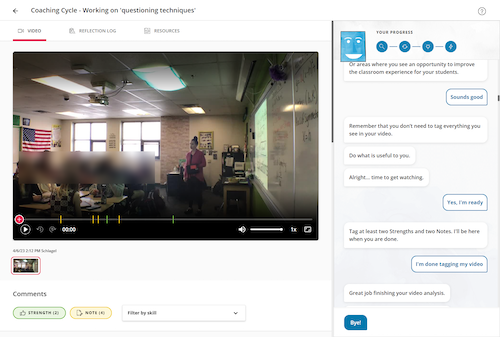
With the platform, teachers like Schlagel engage in personalized coaching cycles to further their development. The platform uses artificial intelligence to guide teachers through a self-coaching cycle aligned to common growth areas as they watch video of their classroom teaching in action.

We recently interviewed Schlagel about the use of this new technology and how her district prioritizes teacher development. 

What were your first thoughts when you heard about using AI for professional learning? Why did you decide to try it?

Last year, I was a mentor to a first-year teacher at my school, and my mentee had to record a lesson of her teaching as part of the induction program. I decided to also record myself conducting a similar lesson, so we could go over the lessons together, discuss what works and what doesn’t, and set goals for improvement.  

This was my first real introduction to video coaching. Admittedly, even as a mentor teacher, I was nervous to record myself. However, I quickly learned it wasn’t that bad seeing myself on screen and that this was a powerful way to reflect on my practice. My mentee and I both learned a lot.

So, when my district offered a new professional development course that would allow us to try out AI coaching, I signed up. I wasn’t sure exactly what I was getting into, but I was already benefiting from video coaching and wanted to see what the new AI aspect was all about. At the very least, I knew this opportunity would provide me more time for self-reflection.

How does the AI coaching process work?

During my first time using the AI Coach platform, I uploaded a video of one of my recent algebra lessons. Then, the platform’s computerized coach provided observation tips and asked me a number of questions to consider as I began to analyze my video. This helped me as I made a number of comments on the platform—both about areas I wanted to improve upon and areas I felt I was excelling in—as I watched my teaching play out.

The guidance from the virtual coach helped me think more critically about my practice (…and it also made me laugh – the coach can definitely be funny and sassy at times!).

This helped me set a goal for myself around increasing student discourse. I wanted to encourage my students to talk more in class, and the platform provided me with a number of instructional resources to help me get better at this skill.

At the end of the coaching cycle, after I incorporated these strategies in the classroom, I came back to the platform and reflected on what I learned. I thought about how these new strategies worked and created an action plan for my continued learning in the future.

How has AI-powered coaching impacted your teaching?

What surprised me most about the AI coaching process was that it opened my eyes to different things I could change (and might have missed) about my teaching. I was able to really reflect on how I was teaching and how my students were responding. 

Sometimes it can be daunting—or even feel less genuine—when a coach or administrator comes in to conduct a formal observation. You may be worried about how your students are acting or unknowingly teach differently than normal.

But, with the AI Coach process, I feel less pressure because it really is just myself reflecting on my teaching alongside a computerized coach. This gives me more freedom to try out a new instructional strategy or take a risk with how I deliver a lesson, without having the feeling of being evaluated.

Continuous reflection is so important, and I’m a firm believer that the best teachers have to be reflective—if you aren’t reflecting on your practice, you aren’t growing!

How do you and your colleagues plan to use AI Coach by Edthena moving forward?

In addition to supplementing in-person coaching, I think AI coaching will continue to be a great support for mentor and mentee teachers alike.

In chats with my administrative team, I’ve also suggested using the AI Coach platform for our school’s yearly peer observations or self-reflection observations. Traditionally for the self-reflection observation, teachers write a paper detailing their teaching and how it can improve, but I think this type of video-based reflection can be more impactful and feel more genuine. And, it will allow teachers to receive the benefits of ongoing coaching which is really about reflecting inward and trying to constantly improve.

My school and district always do a great job of supporting teachers’ growth and encouraging us to take on new and innovative professional learning opportunities. The use of AI Coach is just another example of this! 

❌
❌