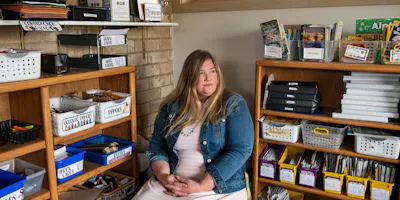
Celina Pierrottet remembers 2016 as the year when she and her colleagues at the middle school where they taught noted a pointed change among their students.
“We were just like, ‘Is it just me, or are kids really nervous?’” Pierrottet recalls. “That year we had a lot of kids who were displaying some sort of school avoidance and other behaviors that we hadn't quite seen as much. I remember my colleagues and I looking at each other like, ‘It's more this year’ — and then fast forward to the pandemic.”
The rise in mental health needs among students following the start of the COVID-19 pandemic catalyzed the U.S. Surgeon General to declare a youth mental health crisis, and the federal government has rolled out billions of dollars since then to help schools respond.
But Pierrottet, who now works as associate director of student wellness at the National Association of State Boards of Education, noted in a policy brief a major hurdle in getting students the help they need: an inadequate supply of mental health professionals, specifically those credentialed to work in schools.
Here’s what she found is standing in the way — and how states are finding solutions.
Slim Pickings
One issue is that growing the number of mental health professionals in schools takes time. Investments made into increasing the pipeline now won’t see results — in the form of hireable mental health workers — for several years.
During Pierrottet’s research, she found that officials on Nevada’s State Board of Education noted in April of last year that the state’s prep programs for mental health professionals only graduate 12 people each year. At the time, the state had a shortage of 2,863 school mental health professionals.
“It continues to be a challenge because it’s a profession that requires advanced coursework,” Pierrottet says. “No one’s saying they need to change those requirements, but it’s a slow investment.”
There’s also the need to ensure that school mental health professionals — be they school psychologists, social workers or counselors — reflect the demographics of the students they serve, she adds. One of the challenges is that, like their classroom teacher colleagues, mental health professionals-in-training have to complete hundreds of unpaid practicum hours.
Pierrottet points to Virginia and Ohio as examples of states that have responded to that hurdle by creating programs that pay graduate students studying mental health care to work in schools. The 2019 program in Virginia “placed graduate students in school district positions and provided 200 trainees with financial incentives to work in schools,” according to her report, and Ohio has a similar, decades-old program for school psychologist interns.
“Slow and steady wins the race here in making sure that schools are attracting candidates that are diverse, that meet the diverse needs of their students,” Pierrottet says.
Managing the Workload
But the immediate mental health needs have created crushing workloads for counselors.
Pierrottet writes in her policy paper that national trade organizations recommend student-to-professional ratios of 1:250 for school social workers, 1:250 for school counselors and 1:500 for school psychologists.
There’s a long way to go to ease workloads for all three types of positions. No states meet the recommended ratio for social workers, while Pierrottet found only New Hampshire and Vermont have better caseloads than the recommendations for counselors. For school psychologists, only Idaho and Washington D.C. do better than the recommended ratio.
Some states have gotten creative to increase the availability of mental health professionals in their schools, like turning to telehealth for counseling services.
It’s not just school staff anymore who are alerting counselors that students need mental health support. One of the forces driving the increased demand for services is simply that students are asking for them, she notes, as evidenced by the federal School Pulse Panel. The most recent results show that 69 percent of schools report an increase in students looking for mental health support since the COVID-19 pandemic began.
“Schools are saying there's actually just a growing demand for more mental health services in schools from students themselves who are just expressing more anxiety in schools,” Pierrottet says. “Sometimes it can be an issue if students are saying, ‘I need this,’ but they can't get that connection in the school or maybe even outside of the school.”
Footing the Bill
A win for increasing staff levels is that states have gotten funding for school mental health services from massive federal cash infusions, Pierrottet says, like $188 million from the 2022 Bipartisan Safer Communities Act. The U.S. Department of Education projects that one of its grants will lead to more than 14,000 more mental health professionals in schools, according to the policy paper, and new federal guidelines are making it easier for schools to bill mental health services to Medicaid rather than pulling money from their own budgets.
That doesn’t mean that getting states to fund mental health services has been easy. Yet Pierrottet says that the programs she highlights in her report have benefited from states having what one analysis called an “all-time high” of financial cushion due to budget surpluses — a result of factors including COVID-19 relief funds and higher-than-expected tax revenue. States like Michigan and Texas — both of which are looking at billions in surplus dollars — this year — are putting some of those funds toward mental health spending. Michigan has hired more than 2,700 full-time licensed behavioral health providers in schools since 2019, the report highlights, while Texas has set aside $280 million for telehealth counseling in schools starting in 2024.
“I think that right now there has been more success than in previous years because of this crisis, right?” Pierrottet offers. “It would be more difficult if there wasn't a surplus right now in the budget. I think right now, the stars are aligning. There is will, there's motivation, and so at least in the last year there was some movement toward funding.”
Pierrottet added that it’s important not to think about students’ mental health needs as something that can be solved with funding alone. Rather, she described it as an issue that needs to be addressed from multiple sides. For example, some teachers are enthusiastic about getting more training about how to support student mental health, she says, and those teachers likewise need support for their own mental well-being in order to be effective in the classroom.
“It's important to think of this holistically,” she says. “When students are healthy and when they're not having these anxious feelings, they're present, they're able to learn. So it's important for state leaders to think of this as not just, ‘Oh, we need to provide more mental health staff.’ It's about the whole continuum, the comprehensive school mental health system, and looking at it through a whole child” lens.
In September, a teacher in the Hamshire-Fannett Independent School District, in Southeast Texas, was fired when district leaders learned that an eighth grade class was reading a graphic novel based on the diary of Anne Frank.
The novel had not been approved and was deemed inappropriate, and the firing made headlines. It was an extreme example of the political strain public school teachers are under from parents and activists. Along with a rise in Holocaust denialism — fueled by misinformation, along with poor knowledge of the history — researchers have noted that disagreements over curriculum, book bans and politically contentious issues have ratcheted up the pressure on educators.
When schools are already suffering from severe staffing shortages, it’s a dynamic that may have dire consequences. At least one survey found that the majority of teachers have decided to limit talk of political and social issues in the classroom, with some being asked to do so by their school or district. But the real trouble for schools may come when those teachers decide to leave.
Political scraps may speed up teachers’ decisions to quit, according to Zachary Long. A former history teacher from Florida, Long left the classroom in 2019. Long and his wife Brittany Long, another ex-teacher, started Life After Teaching, a Facebook group meant to help others transition out of the profession. Since the pandemic, the group has exploded. Their group now has 107,500 members, with 6,700 members joining last month, Long says.
While politics wasn’t what pushed Long out, he has seen it impact some teachers. When added to the other issues — low pay, long hours and the increase in students’ social-emotional issues coming back from the pandemic — it makes the job just that much harder, he argues. That can make an exit more attractive.
Long says he notices the issue particularly in “hotbed states,” like Florida or Tennessee, where political battles are racking education. He also adds that other teachers often swear they will never move to those states, with teachers already living in the states warning others not to come.
It can be fierce. Outside of the classroom, the pushback against critical race theory and social-emotional learning has really affected teachers, says Mylien Duong, senior director of research for the institute. It’s a relatively small number of parents who are leading the charge, but they are outspoken and hard to engage in a constructive way, Duong adds.
A clinical psychologist with experience in school mental health, Duong conducted a qualitative study of how the increasing political tension is affecting teachers. She interviewed 14 teachers, mostly in English language arts and history, from around the country. The study found that the problems are especially notable when schools are deciding which textbooks to use and which curriculum standards to adopt. One teacher quoted in the report suggested that, during the review process, what state a book came from and how the community politics might influence its reception came up before the quality of the resources.
One of the history teachers Duong interviewed had hit a breaking point. When teaching about the Holocaust, including graphic depictions of its horrors, one student kept laughing. “The teacher was like, ‘I don't even know how to deal with this. I've not been trained for this and never come up before,’” Duong says. That teacher took a leave of absence. Intense interactions involving students, more than anything else, seem to shake teachers, she adds.
Confronting these trends means overcoming new realities.
It’s becoming easier to believe falsehoods because they are being confirmed by our immediate environment, Duong argues, since people no longer interact as much with others who disagree with them and it’s easier to seek out information that confirms your biases.
But this doesn’t only impact current teachers.
More Than Just Skin Color
For other observers, the pressure is worrisome because of what it might mean for future teachers.
District leaders say they want more diverse teachers, says Sharif El-Mekki, the founder of the Center for Black Educator Development, a teacher pipeline program based in Philadelphia. “But just in skin tone, not in thinking, not in curricula,” he says.
For El-Mekki, part of the reason there are so few Black teachers is that their experiences have been pushed out of the public school system for a long time. Feeling unable to speak openly and truthfully about their perspectives without fear of repercussions deters prospective Black and Indigenous teachers from joining the profession, El-Mekki argues.
In a report co-published by El-Mekki’s organization and Teach Plus, an organization trying to diversify the teaching force, Black and Indigenous high school students interested in becoming teachers highlighted inclusive curricula and a sense of agency in the classroom as crucial factors in making them want to teach. Political pushback against those gives them pause about joining the profession, El-Mekki argues.
For El-Mekki, this exposes a conflict in district priorities.
“They're basically saying, like, ‘yeah, we want diverse teachers, but we want you to erase yourself,’” El-Mekki says.
What should be done? Surprisingly, observers believe the antidote to divisive political rhetoric may be more and deeper political participation.
For El-Mekki, it’s about making sure families are aware of what’s happening and how that may shape student growth and development. For instance, he argues, more families of color should seek representation on school boards where they can influence policy decisions.
Duong, the Constructive Dialogue Institute researcher, thinks that broader political engagement could improve the situation.
The groups dominating school board fights right now are only a small percentage of the overall population, Duong says. There’s a much larger percentage, an “exhausted majority,” who are tired of the fighting and who support compromise, she argues: “I actually think that activating or engaging more people in politics more of the time would actually provide a level of moderation to our current discourse.” In school, that means parents and teachers coming together, trying to have constructive conversations with each other and with more members of the broader community.
It’s also vital, Duong says, that administrators are clear about the expectations for teachers around these issues, which can reduce the stress caused by these fights. She suggests that administrators give clear guidance that spells out how teachers can respond when they receive political pushback and how the administrators will support teachers who find themselves under fire.
Too often, teachers are rapidly elevated from the classroom to school leadership positions, whether to fill an unexpected vacancy, act as an interim administrator or to take on a permanent leadership role. But ushering teachers into administrator roles before they are prepared and without adequate support poses risk of burnout — or worse, opens up the possibility of causing harm to themselves or their school community, out of sheer lack of experience.
In my work at The Teaching Well, where I support teachers and administrators in wellness and sustainability, I hear about this issue regularly, and in the decade I spent working in schools, I saw it happen to colleagues frequently. I also understand the problem deeply on a personal level because it happened to me.
Early in my teaching career, when I was 26 years old, I was offered and accepted a position as a dean at an elementary school in East Oakland, California. The following school year, I was promoted to assistant principal, and a year into that role, I had to cover our principal while she was on maternity leave. None of these promotions came with special training or additional coaching; I wasn't even told to read any books in preparation. I found myself burning out and I didn’t have the language to advocate for my needs, let alone hold that space for the staff I was responsible for.
It is essential to recognize that the premature placement of teachers into leadership roles comes at a cost. If we’re going to elevate young teachers, the system owes it to them — and to their colleagues and the students they serve — to wrap them with empathy, support and comprehensive training.
When Elevating Teachers, Support Is Key
In the face of recent shortages and staff turnover in schools, I understand why many district leaders quickly move teachers into vacant administrative positions. In fact, I was a district leader who made this recommendation at times. With so many leaders leaving, we are in a hiring crisis and there is no surplus of candidates clamoring for these jobs. What could be a better solution than talent you know personally and can cultivate from within?
A talented teacher is often a natural leader. But there’s a difference between commanding presence with students and leading staff. I know because I’ve lived it.
I was a green educator catapulted into a leadership role. To a certain degree, I was open to the opportunity and maybe I even sought it out. At the time, I was grappling with the decision-making at my school, particularly when it came to serving our Black students, and I wanted to make a change. My proactive nature, my work as a peer observer and my facilitation of a professional learning community at our school is part of what opened up the opportunity to move into an administrator role.
Me in my final year as a teacher, just before becoming an administrator. Courtesy of Lindsey Fuller.
When I became a dean, I was thrust into a demanding position with a tremendous amount of responsibility. I quickly realized that holding space where educators can gather and share in a grade level team meeting isn’t the same as building a strategic professional development scope and sequence. Observing a peer isn’t the same as being able to provide a thorough evaluation. I had never formally supervised anyone, but was required to facilitate difficult conversations regularly. No one told me about the ugly parts of people management, like having to write folks up or design and implement support plans.
Fortunately, relationship-building came easily and when I made mistakes, I did my best to own them. It also helped that I was from the community I was serving, which enabled me to navigate many of the cultural nuances of working in our school. Even with these strengths, my learning curve was steep.
Physically, mentally and emotionally, this was one of the most challenging times of my life. At the time, I was pregnant with my first child and my husband was in law school. Eating balanced meals at work felt impossible. I was fainting regularly and developed insomnia. My inexperience caused ruptures with colleagues that I had to repair. In my role I was often called to support students with intensive needs, sometimes having to physically restrain them while breaking up fights or to prevent self-harm. When I got home, I was tapped out. It was hard to want to hug my partner or have my new baby crawling all over me. I had immense guilt as a parent and partner and overwhelming feelings of failure — and I felt isolated.
My healing work with school leaders today has helped me realize I wasn’t alone. The feelings I had were natural and many in the field experience similar emotions.
Over the years, I’ve worked with school leaders who are excelling and making it work despite unthinkable odds as they’ve unpacked the pressures they feel. I’ve also worked with leaders who have held their role for a few months or years before burning out and leaving as an act of self-preservation. Some have expressed that their reputation was damaged or that they developed an inner narrative of failure. I remind them that they opened their hearts to serve even though no one was serving them — that they are leaders who weren’t led.
We talk about our young people as the future, as liberatory agents, as the ones who will elevate our society. We should invest deeply in those leading our schools, especially new leaders. And when we promote teachers to leadership positions, we owe it to them to provide the support they need to do their jobs effectively.
I’ve spent more than a decade working as a teacher and principal. In 2015, I left the classroom for a year to try something different and it completely reshaped my work.
I took on a role as a teacher recruiter at Achievement First, where my focus was working with principals to hire teachers. At the time, I had just finished my Teach For America commitment at my placement school, Miami Northwestern Senior High School, where I had the benefit of working in a historically Black community at a public high school with a majority Black staff and leadership team with members who looked like me.
I assumed that all Black students experienced Black teachers in school. I was wrong.
When I became a teacher recruiter, part of my job was to visit each school, observe classrooms and talk to students to get a better understanding of the atmosphere and personality of each school community. There was one trend that was consistent across the majority of schools I worked with: Most of the students identified as Black, while the majority of the teachers were white.
As a recruiter, I saw this picture clear as day and I wasn’t the only one. In fact, one of the principals I was working with looked me straight in the eye during one of our check-ins and said, “Damen, I need Black teachers.”
I didn’t have an immediate solution for her, but I did have a community I could tap into to find strong Black teacher candidates. I had graduated from a historically Black college (Morehouse College), I am a member of a historically Black fraternity, and many of my family members had ties to the education profession.
I turned to my network for referrals and it started to work. Some of the principals I was working with began hiring more Black teachers. One of them — the principal at Achievement First Brooklyn high school — hired six Black teachers that year, including me.
When I went back to the classroom after my year of recruiting, I noticed the problem again. Our students were majority Black but (at that time) our staff was mostly white. Though my decision to return to the classroom was helping to change the narrative in my own school building, the gap persisted and I wasn’t in a position to change it systemically.
Now, eight years later, I am the principal of that same school and I’m proud to say that every student has multiple Black teachers each year, an anomaly given that in the United States, only 7 percent of public school teachers identify as Black according to data from the National Center for Education Statistics.
This change didn't happen overnight — it took years to ensure that our staff reflects the diversity of our student body. To get there, I had to shift my mindset towards equity and applying what I learned from my role as a recruiter to refining our hiring process. But before all of that, I had to turn to history for a deeper understanding of how we got here.
Turning to History
When I started this work, it felt critical to understand why there are so few Black teachers in American public schools. The 1954 Brown vs. Board of Education decision was revealing. Though the case nullified the Plessy vs. Ferguson doctrine of “separate but equal,” and created the landscape for racial integration in America's public schools, it decimated the Black teacher and administrator workforce. Widespread resistance to integration led to the firing, dismissal or demotion of 100,000 Black principals and teachers between 1952 and the late 1970s, according to Brookings Institution. Since the 1970's, the number of Black teachers has been on the decline.
While learning about the history of the problem, I reflected on my own journey as a Black student, teacher and administrator. I grew up in an upper-middle-class neighborhood where most of my neighbors were white, which had a big impact on my experience with race in school. I never lived in a majority-Black neighborhood or attended a majority-Black school. But I did have Black teachers and administrators in school and in my community who made me feel seen and valued in spaces where I was the minority. In fact, my first elementary school principal was a dynamic Black woman whose kindness and warmth I still feel and keep with me as a principal today.
I carry these memories as reminders of the tremendous impact Black educators had on my confidence, identity development and academic success. Their representation was validating, motivating and propelled me not only to pursue excellence in my own education but to build a career in the field.
Turning a Problem Into an Opportunity
Becoming a principal was a career-defining opportunity in a number of ways, but mostly because it positioned me to make even more change at my school by turning a challenge into an opportunity. At the top of my priority list was hiring a diverse and effective staff that represented our student body.
As principal, I interview and make the final hiring decision on all staff, so the buck starts and ends with me. I have the power to create the team I believe students need, but to do that, I’ve had to rethink our hiring practices, including our recruitment strategy and interview process. I’ve prioritized ensuring that every kid under my care has the teachers they deserve, and have revised our practices to make it happen.
I made a few significant shifts to our hiring process. First, I navigate the national teacher shortage by leaning on a lesson I learned from recruiting and turning to my staff for referrals. Excellent people know excellent people, so whenever there is an opening or a departure, I look to my community for support which has led to tremendous success. My operations team, instructional staff and leadership team have all been made stronger by turning to those who work in my organization for candidate recommendations.
Second, I always include members of my leadership team in interviews to widen my perspective and mitigate any unconscious bias that may be at play. I intentionally pick a hiring committee that reflects the existing role, skill and life diversity present in my school, and after each interview, we use a competency rubric, not just our gut, to assess each candidate objectively.
Finally, I explicitly ask interview questions about race and its impact on our work as educators of Black children in the public education system. I’ll pose a question like this: “Leading for racial equity is something we value here at my school. Given your identity and personal values, what do you believe your role is in leading for racial equity?” Or, “What do you think your role is in dismantling systemic racism given your role as a teacher?” These kinds of questions allow my team and I to assess a candidate’s value’s alignment and commitment to our mission. These questions also make clear where my school stands, showing the candidate we care about diversity and are not afraid to talk about it.
When I took a year off from teaching to become a recruiter, I never thought it would shape my career the way it has. It taught me to question the status quo, to lean on history for a clearer picture on how some of the complex problems in education came to be, and most importantly, it reminded me that the presence of Black educators and school leaders is more than just “nice to have” — it is critical to the success of all learners, particularly Black students.
Many schools and districts, including mine, scrambled to find quick fixes to keep the doors open during the height of the pandemic and in its wake.
In a deal struck between the New York City Department of Education and the United Federation of Teachers, a new position — paraprofessional classroom manager (PCM) — was created as a temporary solution to allow paraprofessionals (paras) like me to sub for classroom teachers. This gave paras an opportunity to step up and cover a class when needed, and it gave administrators a cushion to fall back on for coverages.
The role of PCM was an added responsibility for paras. A PCM maintained all of their responsibilities as a para while expanding their role in a critical way — they could teach a class without a supervising teacher in an emergency. The title came with a stipend and if the PCM was asked to do more than five emergency coverages in a term, there was additional compensation.
I applied for the role, was accepted and served as a PCM from October 2020 to June 2022. During that period, I continued my duties as a para, ensuring the students I worked with met the goals and mandates of their Individualized Education Plan (IEP). If there was a class to be covered, I was pulled to teach it. That happened frequently (according to logs I kept while I was PCM, I covered 97 classes).
I was excited about the new job. After all, it offered me a chance to see how I’d feel leading a classroom and it came with a pay raise. But I soon learned that the position came with little support and quickly led to burnout.
This experience gave me a glimpse inside the challenges facing substitute teachers and I’m convinced that things need to change. Education leaders need to reimagine what it means to be a substitute teacher, design systems and resources to support the people doing this important work, and take further steps to foster a sense of belonging and community for substitutes in our schools.
Subbing In
Navigating life as a para and a sub was difficult and the first year was the toughest. Health and safety guidelines were changing daily. Some teachers were leaving and others were calling out sick. Every day felt like we were putting out fires and there was no time to breathe.
Education leaders need to reimagine what it means to be a substitute teacher, design systems and resources to support the people doing this important work, and take further steps to foster a sense of belonging and community for substitutes in our schools.
But it wasn’t only difficult because of the pandemic. Even once the dust settled and we weren’t facing daily emergencies, the job had obstacles. I was expected to pivot my daily schedule with the drop of a hat, it was hard to set expectations with students when they knew I’d only be there for a short time and there was a real lack of support.
My time subbing gave me an inside look at the ways in which educators are thrust into situations they are not adequately equipped or prepared for. One of the first signs that this new role was going to be a taxing one was the fact that I rarely knew in advance if I would be covering a class. It was common to be notified that I was needed as a substitute the day of, and in many instances, just minutes before the kids were into the classroom. Every day was drastically different from the last, especially in that first year.
Fortunately, I had a number of factors working in my favor. First, I was able to draw from my experience being in classrooms as a para to inform my practices as a substitute teacher. Plus, I already had preexisting relationships with the majority of the students before I subbed in their classroom and knew what classroom management style worked with them. These are luxuries that are not afforded to most subs. Even still, I struggled to form deeper connections with students, to engage them while I was implementing lesson plans on-the-fly, and to hold them to high standards, when they knew it was likely that I wouldn’t be there the next day.
The thing that really struck me though, was even in this very specific case in which a role was created to solve a critical problem, there was a lack of preparation. I didn’t have to attend professional development or training to become a PCM. I remember wondering: How can schools and districts expect to retain subs if they are not equipping them with the tools necessary to set them up for success?
In the midst of the chaos of 2020 and its aftermath, I found reasons to come to work each day. Mostly, I found purpose in knowing that the teaching shortage was tough on students and I could help. If a sub couldn’t not be found, classes were often split; special classes that students loved like music, art and physical education were canceled; and too often, the special education teachers in co-teaching environments were being pulled for coverage and students were losing out. By stepping in, I was supporting the students and they were excited to have me there. Hearing them shout “We have Mr. Parra today!” when they realized I’d be subbing was what got me through the day.
My colleagues were also a source of comfort. I was at the end of my rope and in my conversations with my colleagues I began to understand that I was not alone in how I was feeling. Being under constant pressure to perform at pre-pandemic levels was proving to be too much. The world had changed and my job was fundamentally different. It felt as though the only ones who did not seem to get that memo were district leaders.
In Fall 2022, about a month into the school year, my principal told me that the PCM position was effectively dissolved. The additional compensation that I depended on to help support my family was taken away swiftly and without official notice, and my time teaching classes came to an end.
In my eight years as a paraprofessional, I’ve often felt undervalued, underpaid and too often, forgotten, but education is the field I’ve dreamed of working in for as long as I can remember. This opportunity gave me a taste of what it would be like to have my own classroom and it was eye-opening. Some days, I could picture myself becoming a teacher and other days I found myself questioning whether or not I can realistically continue on this path without substantive changes to workforce conditions.
Time for Change
After this experience, I can say it comes as no surprise that the substitute shortage has raged on for so long. As it exists today, it’s not a very enticing job.
If school and district leaders wish to retain the subs they already have and attract strong new candidates, they need to start thinking about bold changes that can lead to longer-term solutions. Those might include offering comprehensive training and ongoing professional development; increasing pay and benefits for substitute teachers; and putting a support system in place to foster a substitute teacher’s ability to develop stronger bonds with students and colleagues to better equip them to step into the classroom.
I often hear district leaders and education policymakers praising the work educators do day in and day out, and speaking about how our children deserve the most qualified teachers. My plea is for them to back their words with action. And my hope is that while they’re hard at work on solutions, they recognize that substitute teachers are an integral part of the education system and our children deserve the most qualified, prepared substitute teachers too.
Education wonks have long raised the alarm about how school discipline is applied unequally among students of different racial and ethnic groups, with Black students facing a disproportionate number of office discipline referrals (ODRs). The effects of such practices can reverberate throughout a student’s life, according to the American Psychological Association, leading to worse mental health and lower grades.
“We know Black students are punished more frequently and more harshly, but what we didn’t really know was how much all of this discipline was shared across educators versus perpetuated by just a few educators,” says Emily K. Penner, an associate professor of education in the School of Education at the University of California, Irvine.
Penner is part of a group of researchers who shed new light on this problem after they were able to pinpoint how a small number of teachers in one California district effectively doubled the discipline gap between white and Black students. The study on “frequent teacher referrers” was published in the journal Education Researcher this summer.
Jing Liu, assistant professor in education policy at the University of Maryland College Park, says that he and his fellow researchers were surprised by their findings. That’s in no small part because of what he says is a first in this field of research: access to data with a uniquely high level of detail that allowed the team to track how many office referrals were issued by individual teachers.
“It’s concerning that they’re just a small population of teachers [who are] much more likely to make a referral,” Liu says. “It points to our need to understand: Why are there such a small population of teachers making referrals, and how can we help them to stop this troubling pattern?”
The study also found that the ODR gap is being driven in particular by office referrals issued for interpersonal and defiance reasons, “which are arguably more likely to be subject to bias” compared to other less subjective circumstances, like fights.
Penner’s past policy work has examined the factors within education that harm students of certain races.
“We've just started to have this conversation about the role of educators, in particular, in school discipline,” she says. “A lot of the research about school discipline has really been on the student side, mostly thinking about outcomes for students. But really, it's not just a one-sided thing. There’s a whole institution with individuals in it that also contributes to what happens for school discipline for students.”
For Penner, the study’s findings open questions about the circumstances surrounding teachers who are high referrers. Is there a policy making them feel like they have to issue referrals, she offers, or are there particular school settings that lead to it? For instance, could their classrooms be in areas where more fights tend to break out?
The data covers four school years from fall 2016 through spring 2020 at a “large, diverse, urban-intensive school district in California,” as described in the paper. Liu says district leaders approached researchers with the data because of their desire to investigate inequity within student discipline at the school, and the conversation around referrals began with the district department that deals with student well-being.
“From reading the literature, we quickly find that lots of research on student discipline focuses on suspension, which is the end result of the discipline processes,” Liu says. “I really think that understanding the referrals — who are making them, who are receiving those referrals — can really help us to go a step further to understand the origins, the sources, of racial disparities in school discipline.”
Who Is in the Top 5 Percent?
Taking a step back to look at all the teachers who worked at the school district during the four years captured by the data, about one-third of them sent at least one student to the office with an ODR during any given school year. About half of those teachers issued five or fewer referrals during the time frame.
Researchers analyzed the gaps in the number of office referrals issued to white students and their peers in different racial and ethnic groups. (The data did not include suspension rates, which researchers describe as a disciplinary outcome of ODRs.) They were able to see the impact of teacher “top referrers” by starting the analysis with only teachers who issued one or two office referrals, then adding teachers who issued three to five referrals to the sample, watching how the number of referrals issued to each ethnic group changed as teachers who issued higher numbers of referrals became part of the sample.
When the top 5 percent of referrers — teachers who issued 46 or more ODRs in a school year — were added to the sample, the gaps in disciplinary action between student racial groups spiked.
The top 5 percent of referring teachers were responsible for creating the widest discipline gap between Black and white students. Before they were added to the sample, the data showed that Black students were issued 1.6 ODRs for every one ODR issued to white students. After the top 5 percent of referring teachers were added, that ratio jumped to 3.4 office referrals for Black students for every one issued to white students.
Top referrers gave Black and Hispanic students an outsized share of ODRs relative to the proportion of Black and Hispanic students in their classes, according to the study.
Black students made up only 7 percent of students in the district and 12 percent of students in top-referring teachers’ classrooms. However, the analysis found Black students made up 22 percent of all students who received ODRs and 27 percent of students sent to the office by top-referring teachers.
While still disproportionate, the racial gaps were less severe between white students and students from other groups, such as Hispanic and Asian students.
Researchers also found that teachers who were white, early in their careers, and teaching at middle schools to be “the ones who engage more in extensive referring,” the study says.
“I think in middle school, there's just a lot of new routines and developmental changes that are happening for students, lots of different kinds of boundary-testing and escalated expectations in terms of self- management,” Penner says. “A disproportionate number of folks in the top 5 percent were novice teachers, so it does underscore the need for continued support and in-service preparation around classroom management, around routines for supporting disruptive students and engaging with them.”
Black and Hispanic teachers were less likely than their white colleagues to both issue an office referral and to be in the ranks of top referrers. Asian teachers were even less likely to issue a referral but were just as likely as white teachers to rank among top-referring teachers, “suggesting varied referring behavior among Asian teachers.”
Liu says when it comes to teaching experience, teachers notably rely less on office disciplinary referrals once they reach 11 years in the profession. The data shows that the number of times teachers sent students to the office began to fall once they hit three years of experience.
There’s still work to be done to understand why some teachers are reaching for office referrals so frequently.
“We think it's very possible that new teachers are coached to follow a procedure around what happens with student discipline,” Penner explains. “A more veteran teacher would kind of know how to massage the situation or react to students in a way that could de-escalate things, and a [novice] teacher might not have that in their repertoire yet.”
Next Steps
Since the publication of the study, Liu says more school district leaders have reached out to ask the researchers for a similar analysis of their office referral data, including a partnership that’s in the works with a school district in North Carolina.
As for the California district that’s the subject of the recent study, Liu says that the research team is working with the school district to identify teachers in the top 5 percent of referrers — not to punish them, but to learn what’s contributing to their high rate of ODRs and find ways to support them.
“We may need to provide more support to junior teachers, [assign them] a less challenging student body, or more target PD for those teachers,” Liu says, “but by identifying this group of teachers who are more likely to be referrers, we’re more likely to reduce the number of referrals and racial gaps.”
Today, a 20-acre stretch of green space known as the “Coy facility” remains an active school campus in East Austin. But soon, Austin Independent School District will convert it into an apartment complex to house teachers and staff who are increasingly getting priced out of the urban Texas district.
The goal is to create at least 500 new rental units on the site, alleviating — if not solving — the housing burden that so many of the district’s 10,000 staff members say they face.
A conceptual design for the apartment complex that will eventually be constructed for educators on district-owned land in East Austin, Texas. Photo courtesy of Austin Independent School District.
Scores of districts across the country are undertaking similar projects, as a lack of affordable housing in parts of the United States has led teachers to shoulder long commutes, decline job offers and vacate their positions altogether.
This year, EdSurge has been reporting on the relationship between America’s housing crisis and high teacher turnover rates in K-12 education.
Over the past six months, we have spoken with teachers and school support staff from rural and urban districts whose modest salaries are not keeping pace with the housing prices in their communities. We’ve interviewed education researchers, district leaders and economists about what both the data and anecdotal evidence reveal about this dynamic. We’ve scoured local and state news sources, case studies and reports to understand the different solutions being proposed and implemented. And we took two reporting trips to visit school districts that are considering — or have already begun — construction on housing projects for staff.
Here are the key takeaways from our reporting:
1. The rising cost of housing is driving teachers and support staff out of their schools and communities.
The costs of both renting and buying have increased dramatically since the pandemic, and teacher salaries have not been able to keep pace with that growth rate. In areas where housing prices and the cost of living are especially high, turnover rates have reached alarming levels.
Jefferson Union High School District, located in the San Francisco Bay Area, had been losing between 20 and 25 percent of staff annually before opening an apartment complex on district-owned land last year.
“We kept hearing, ‘It’s not because we don’t want to work here. It’s because we can’t live here,’” says Austin Worden, director of communication and staff housing for the district.
At Eagle County School District, in Colorado, turnover hovers around 20 percent annually. “We continue to be short-staffed in every department,” a district official shares.
In both districts, the median sales price for a home exceeds $1 million, and rental rates for a one-bedroom apartment can easily cost $2,000 a month or more.
Eagle County School District teacher Carrie Rodgers is among the educators who have faced repeated challenges finding adequate, affordable housing. Photo by Kelsey Brunner for EdSurge.
In Austin, Texas, as newcomers arrive to the city and housing prices balloon, many education staff are being pushed farther and farther into the suburbs. Some eventually may be forced to leave the district or find higher-paying professions.
More than half my paycheck goes to rent and living expenses. ... Many of us are resigning because of it.
— Teacher at Austin Independent School District
“More than half my paycheck goes to rent and living expenses… Many of us are resigning because of it,” one Austin ISD staff member shared in a district survey conducted earlier this year, which found that 74 percent of staff spend more than 30 percent of their salary on housing.
Another educator wrote that while their salary increased 8 percent the previous year, their rent went up 22 percent. “This is not sustainable and will eventually drive me out of the city I teach in.”
2. In many areas, teachers can’t afford to rent or buy — and the data supports the anecdotes.
Earlier this year, Patricia Saenz-Armstrong, senior economist at the National Council on Teacher Quality (NCTQ), analyzed housing costs in 69 large metropolitan areas across all 50 states against teacher salaries at the largest school districts in those areas, then published her findings in a report.
In 15 of the 69 metro areas, she found that renting a one-bedroom apartment would be unaffordable for an early-career teacher (where “affordability” is defined using the U.S. Department of Housing and Urban Development’s definition). And in six of those metro areas, it would take a teacher at least 20 years to save up enough money for the average down payment on a house.
A prohibitively high cost of living is not limited to cities. In regions across the country, from California to North Carolina — including resort communities such as Eagle County — renting and buying can be difficult endeavors, especially for public school teachers, for whom the national average salary is about $67,000.
3. The resulting turnover rates have an impact on students and school communities.
The stakes are high. When a school district must replace one in five of its staff members every year — as would be the case for a district with a 20 percent annual turnover rate — educators, students, families and the entire community are impacted.
“You lose your skill and capacity in a school when you keep bringing in new teachers who don’t have experience,” says Heather Peske, president of NCTQ. “When teachers leave, [their] knowledge and skills and the investments districts have made go out the door. The district has to start again with a new crop of teachers.”
We need to do what we can to attract and retain employees.
— Jeremy Striffler
Over time, students in high-turnover districts are often taught by less experienced, less qualified teachers. That has a cumulative impact — especially when research shows that teachers have a bigger influence on student achievement than any other school-based factor.
“If every year the campus staff looks different, that really impacts that campus and how it functions,” acknowledges Jeremy Striffler, director of real estate for Austin ISD. “We also know that if we can't fill positions, there's the threat of larger class sizes, there's the threat of school closures, etc. So we need to do what we can to attract and retain employees.”
4. Desperate to slow attrition, school districts are getting involved.
District leaders may not be prepared to spearhead housing development projects. But desperate times call for desperate measures.
“They don’t have the time or the luxury of thinking, ‘Is this my job?’” notes Peske, adding that district leaders’ responsibility is to ensure a stable, effective educator workforce.
Some have tried appealing to their communities. In Eagle County and elsewhere, district leaders have asked homeowners to open their homes to educators, letting them rent out spare rooms and lofted garages. A district in Arizona recently broke ground on a project to build tiny homes for teachers. One in Texas bought a motel, renting the rooms at a heavily discounted price to housing-strapped district staff.
The most popular response, though, is what the districts in Austin, Eagle County and the Bay Area are all doing: building housing complexes on district-owned land.
Many school districts are land-rich and are starting to make use of that asset. In California alone, at least 46 school districts were pursuing workforce housing projects as of March 2022.
I don’t know if it will ever be solved, but we will continue to chip away at it.
— Matthew Miano
Across the country, district-led efforts to provide housing for teachers are in varied stages. The housing complex for staff at Jefferson Union High School District opened more than a year ago. Early results indicate it’s working as designed; staff vacancies are down and retention is up. Through a lottery system, Eagle County Schools recently matched staff with units in its forthcoming apartment building, which will become available in phases, starting this fall. For those who were matched, it’s poised to be a game-changer. But there aren’t enough units to serve all of the educators who expressed need.
Austin’s plans are not quite as mature. Construction hasn’t yet begun, and Striffler estimates that staff are years away from being able to move into the eventual building.
“We just feel that we have these assets here — we have this underutilized land — and that we can put it to good use by building housing, which can hopefully keep our teachers and staff here in the community that they're serving,” Strifler says.
These efforts will help many educators’ housing woes, but they’re unlikely to remedy the problems entirely, district leaders admit.
“I don’t know if it will ever be solved,” says Matthew Miano, a spokesperson for Eagle County Schools, “but we will continue to chip away at it.”
Shirley Cruz used to pass an old parking lot on her way to and from work.
Adjacent to a former high school, the lot was wasted space back then, she says. Uber and Lyft drivers would congregate there, waiting to get assigned to their next rides, Cruz recalls. Otherwise, it sat empty.
In Daly City, California, just south of San Francisco city limits, that’s prime real estate. The owners of the abandoned parking lot and the land beneath it — the local school district — realized as much, and they hatched a plan.
Now, Cruz doesn’t drive past it. She lives on it — in a district-owned, newly constructed apartment complex occupied exclusively by the teachers and staff of Jefferson Union High School District.
It’s an approach that is gaining momentum among public school districts nationwide. Many are dealing with vacancies and educator attrition rates at levels that are not only inconvenient but actually harmful to the staff, students and families in their communities. In a number of places, including the San Francisco Bay Area, exorbitant housing costs are responsible for high teacher turnover rates. So districts, often sitting on vast swaths of underused and undeveloped land, are getting creative.
Jefferson Union High School District is among the first school districts in the country to see its affordable housing project through to completion — staff began moving in over a year ago, and today, the 122-unit complex is fully occupied — but scores of others are not far behind.
In California alone, at least 46 school districts were pursuing workforce housing projects on 83 sites statewide as of March 2022, according to research from the Center for Cities + Schools at the University of California, Berkeley. Projects in North Carolina, Texas, Missouri, Colorado, Illinois and elsewhere are also underway.
As more districts seek to address the housing crisis in their communities — an issue EdSurge explored in depth in a recent story — we wanted to look at the school district in Daly City that, at least for now, has solved its housing woes.
Drawing Up Plans
Before its employee housing program launched in 2022, JUHSD was losing between 20 and 25 percent of its staff every year.
“We kept hearing, ‘It’s not because we don’t want to work here. It’s because we can’t live here,’” says Austin Worden, director of communication and staff housing for the district.
Housing in the Bay Area is notoriously pricey, notes Worden, “but in recent years, the spike is just unreal — just through the roof,” he says. The average rent for apartments in Daly City in 2023 ranges between $2,344 and $3,692 a month, according to Rent.com. “What we’re giving in salary raises doesn’t even compete,” Worden adds.
JUHSD is the lowest-funded high school district in San Mateo County, California, which is one of the most expensive places to live in the United States. Teacher salaries in Jefferson Union range from around $62,000 to $107,000 a year, compared to nearby San Mateo Union High School District, where teachers can earn between $79,000 and $148,000 a year.
School districts sometimes raise money by selling bonds, but Jefferson Union leaders knew they wouldn’t be able to use bond funds to increase staff salaries. What they could do with a bond was build. The district had plenty of land and property ripe for development. If housing was the main driver of high turnover rates and district leaders couldn’t adjust salaries in line with housing costs, they thought, why not just build staff housing?
A $33 million voter-approved bond passed in June 2018. The remainder of the $75.5 million housing project was financed through a Certificate of Participation (COP).
The goal, says Worden, was for about a quarter of the district’s 530 staff members to live in the eventual apartment complex, and to price rent for the units about 50 percent below market rates.
In practice, the rental units are around 60 percent of market rates — between $1,350 and $1,580 a month for a one-bedroom apartment in the district-owned building, compared to about $2,400 a month elsewhere, Worden says — so a considerable discount.
By May 2022, staff were moving into the building, which has a mix of one-, two- and three-bedroom units and includes modern appliances and amenities such as a fitness center, common rooms with workspaces, playgrounds, community centers and parking.
When a teacher called in sick one Thursday in July, administrator Holly Denman realized she’d have to close her center for the day. Then it was two days. Giggles & Wiggles Daycare Center was as short staffed as it could be: six teachers, including Denman, for 34 students with absolutely no reserves or substitutes to tap into. One teacher out meant automatic closure.
By the next Sunday, two more teachers called out sick with a stomach bug and another with a migraine. They’d have to close Monday, too.
Monday morning, owner Kristin Holman-Steffel received eight calls in one hour from parents concerned something was amiss at Giggles & Wiggles. The center, which Holman-Steffel started from her converted home, is one of only three in Lancaster, Wisconsin, a three-square-mile town of just under 4,000 people in the southwestern tip of the state.
Holman-Steffel called Denman, who was in tears.
The administrator had been working to hire more staff with $4,000 Giggles & Wiggles had been receiving monthly since 2022. That money came through a federal program that pumped $24 billion in grants to child care centers across the country to keep them running during the pandemic — part of the single largest investment in child care in American history.
In two months, Denman spent seven times her advertising budget to run sponsored ads on Indeed to try to attract candidates, but of the few prospects who applied, even fewer answered a follow-up call. She scheduled interviews for people who never showed. She even offered positions to three candidates, but only one ever came to the job. All of that amounted to one hire in almost two months of nonstop recruiting.
The pandemic child care money helped keep Giggles & Wiggles going. Combined with a tuition increase, the funds helped raise wages by $2 to about $14 an hour on average in the fall of 2022, but it still wasn’t nearly enough to attract job candidates to the center. Child care workers in Wisconsin and everywhere in the United States are in the bottom 2 percent of jobs in terms of pay, along with fast food cooks and theme park workers. The local McDonalds advertises $13 an hour — $12 at the Piggly Wiggly.
By June, the federal child care money that Giggles & Wiggles and all those other centers have been relying on started to run out. In Wisconsin, monthly payments were cut in half. Nationally, the entire $24 billion pot of money is set to expire September 30. The money was always meant to be temporary, but in an industry that has existed almost only in crisis mode, centers did whatever they could to keep their staff, keep their families and keep their doors open. Most used the money to raise wages and keep tuition flat, but now without the funding, that business model is about to blow up.
And so when Holman-Steffel called that Monday in late July, Denman already knew their options had been exhausted. Another staffer also called in that day to say she’d be leaving for another job with more pay. She was a single mom whose rent was rising.
It was Holman-Steffel who said the words first.
“I don’t want to close,” Denman replied. She could work every day, take no days off, no breaks, cover classrooms. But she was one person, Holman-Steffel pointed out, and they were short almost an entire staff.
“How is there any other way out of this?” Holman-Steffel asked her. “What more can we do?”
That afternoon, on July 24, they notified the 27 families they served that after 26 years in operation, Giggles & Wiggles would close permanently on August 31. “We have cared for generations of children and families,” the note to parents read.
In the weeks since, the impact of that decision has reverberated across Lancaster.
One of the two other day care centers in town, even smaller than Giggles & Wiggles, is already fully booked. The other is having to leave its building for an even tinier location and will have to downsize. A third is expected to open in January with initial capacity for 75 kids, and demand is already high.
Parents are putting their kids on waiting lists for care in neighboring cities. They’re considering reducing their work hours or asking grandparents to watch their kids. One family is going to try to care for their child indefinitely while they work from home. A mom told Holman-Steffel she was putting her plans for another child on hold. She had expected Giggles & Wiggles could care for them.
Giggles & Wiggles is a preview of what could happen to other centers in other towns after September 30. The day has been referred to as a “child care cliff,” but that’s something of a misnomer. The impact will play out over time, in parts. Classrooms will close first; day care hours will be cut to save on staff. States that have tried to add bits of additional child care funding might hold on longer. A 30 percent increase in the federal subsidy program for low-income children in child care, the Child Care and Development Block Grant, will help somewhat. So too will a second, much smaller pot of $15 billion in federal pandemic money that will run out at the end of September 2024.
But providers will close, said Lauren Hogan, the managing director of policy and professional advancement at the National Association for the Education of Young Children.
It’ll just be more like quicksand than a sudden drop-off.
“It is going to suck people under,” Hogan said. “The pervasive sense is one of fear and foreboding in the field.”
By one projection, there could be as many as 70,000 closures. 70,000 Giggles & Wiggles.
When a child care center closes, especially in a small town, it frays the ties that keep a community together. Children become scattered, separated from the only caregivers most had ever known. Families are left scrambling to find alternate care in a system known for years-long waiting lists. And working parents are stymied, making impossible decisions around leaving their jobs or cutting back hours.
For parents whose kids are in child care, there is little disagreement about the importance of funding the industry and paying teachers well. But at the state and federal level, child care has been treated like a political afterthought, cast aside as a nice-to-have in a country that has long viewed child care as a “family problem,” not a government one.
When Wisconsin’s Republican-led Joint Finance Committee decided not to permanently fund an extension of the federal funds earlier this year — what would’ve been a $340 million investment — its justification was that the COVID child care funds were just one-time funds, and the budget had to prioritize funding existing programs like K-12 education, even if Wisconsin has a projected $4 billion budget surplus in its general fund this year. Democratic Gov. Tony Evers has since called for a special session to address the child care issue — one of his top priorities — proposing adding that $340 million back into the budget to continue monthly payments for two more years. Ultimately, that is money that will also run out. Evers visited Giggles & Wiggles in August after news of the closure spread. But advocates hold little hope that the session will result in anything at all.
“It’s a political hot potato right now. I think part of it is a disbelief that things aren’t gonna get as bad as we anticipate they’ll get,’” said Ruth Schmidt, the executive director of the Wisconsin Early Childhood Association, an advocacy organization. “This industry is made up of, in Wisconsin, close to 98 percent women. Plain and simple: We take advantage of it.”
It’s a similar story across the country: As the federal funds dry up, long-term funding proposals are unlikely to pass at the federal level to fill that billion-dollar-sized gap, and only eight states have passed additional child care funding using their own funds. The child care workforce, largely women of color, is one of the most precarious in the country. While almost every industry has recovered to pre-pandemic numbers, child care is still short 5 percent of its early 2020 workforce.
The stabilization funds helped keep centers that were on the edge of closure open, but only just barely. More than half of workers reported getting pay bumps, money that kept them in industry instead of jumping ship to work at Walmart or Target or the local school district. The rest of the money went to help pay for rent and supplies, which also rose as inflation ballooned.
All of those problems remain, but soon the money will be gone. For centers that have staved off closure, most of the costs will get passed on to parents in the form of tuition hikes in the fall that could push the most vulnerable kids out of care. More than a third of programs serving infants and toddlers expect to raise rates after the funding runs out, according to a May survey of providers. Already, the annual cost of child care exceeds the cost of in-state public university tuition in 34 states, and that cost has been rising at a faster rate than inflation for three decades.
But before widespread closures, services will contract and costs to parents will increase. It’s already happening.
Deanne Patten, the owner of Firehouse Friends Childcare Center in Stanley, Wisconsin, has implemented a rate hike more than six times higher than her usual increase — the highest ever in the center’s nine years — because starting hourly wages for staff went up from as low as $9 to as high as $16 with the federal funds. The hike, $180 to $260 a month per child, went into effect this week. She waited to see if Wisconsin would implement additional funds for child care, but when it became clear it wasn’t happening, she had to raise tuition. The day she told parents about the changes, she watched the stress wash over their faces. Patten said she was so overwhelmed she stopped eating, lost weight. “It was probably the worst thing I have done in my life,” she said.
Rates at TLC for Tots in Nampa, Idaho, are rising by nearly $200 a month for infant care, and already families are leaving. Other parents have declined promotions to avoid earning too much money to disqualify them from their child care subsidies, said director Krystal McFarlane.
She had no choice in the tuition hikes, she said. Even the cost of a box of rubber gloves that providers use for diaper changes has tripled, shooting from $33 to $99. She already had to cut six positions over the summer, and staff bonuses ended in June along with the federal funding. McFarlane’s parents have owned the business for 17 years, taking no pay for themselves for two years during the pandemic. TLC for Tots was supposed to be her business one day — the future for the single mom and her two kids. Instead, in the next three months, she’ll have to decide if they have to close.
When Giggles & Wiggles’ owner and administrator made their decision in July, Heidi Nelson remembers the panic that she felt instantly. Two years ago, when she was looking for a day care that could take her now 3-year-old son, Alex, she “called everywhere and [Giggles & Wiggles] were really the only ones who were even willing to listen to us.” Alex has autism, and many of the centers would not accommodate him. If another didn’t take him, would she have to ask her husband, who just started a full-time job, to quit his? Would she have to consider changing her own work hours or asking her dad, who is 69, to take on more of Alex’s care?
When Denman took on Alex, she converted the day care for his safety. They put food labels on everything to ensure he did not eat anything that would trigger his dairy, soy and wheat allergies. Giggles & Wiggles changed its policy so kids could no longer bring their own breakfast — they would all wait to eat together so that Alex was safe. The families rallied. “We are a small town,” Nelson explained.
Alex is nonverbal, and the staff learned to pick up on his cues. They knew when he needed a break if the other kids were being too loud and set him up in a corner with a couple of toys away from the chaos.
After Nelson learned of the closure, it took three weeks of calling around before she finally found another private preschool in town that will take Alex in the afternoons after he has school — the director has a grandson with autism, but doesn’t normally serve children with autism.
“The first question was, ‘What are his behaviors?’” Nelson said. “It’s just a gut-wrenching question because 99 percent of the time he is a great kid. His behaviors stem from not being able to communicate his wants and needs.”
The week before Giggles & Wiggles closed, Alex had bitten a few kids and the staff had called right away to see if Nelson had some insight on what was causing it. She did. As the center prepared to close, parents had already pulled out their kids and the staff had consolidated everyone into one classroom. Alex was struggling to handle that change.
Nelson fully expects he may only last a couple of weeks in the new preschool before he’s kicked out.
“I just keep thinking about, ‘Are they going to give up on him too soon because they don’t know him and they aren’t going to take the time to get to know him?’” Nelson said.
It’s the top thing on Denman’s mind, too.
“I just think people are just going to see he’s high maintenance, but they are not going to enjoy that he is also super sweet and loves to snuggle and loves hugs and is just super goofy,” Denman said. “He’s been my boy for so long, now I worry somebody else isn’t going to love him the way he deserves,” she said.
Giggles & Wiggles hasn’t just been a job for Denman and Holman-Steffels. It’s been a community. It’s been about the back-to-school potlucks for all the parents and the Halloween open house, the library art show. It was about when a storm knocked down a tree and a dad offered to saw off the broken limb. Or the time parents chipped in to rent out an ice cream truck to deliver cones for all the kids.
“When you care for their children for 10 hours a day, you really get to be part of that family’s life,” Holman-Steffels said. Now that the center is closing, “you just feel like you’re letting everybody down.”
As the staff got ready for the final day, Denman said she couldn’t bring herself to throw a party. Instead she’d continue to let the kids do what they liked, pulling toys out of storage and rearranging the play area at the gray home that has housed more than enough giggles and wiggles to earn its name.
Denman has no plan for what’s next.
“I’m so heartbroken over losing my kids,” she said, “I don’t feel like I can walk in somewhere else and love other kids.”
EAGLE COUNTY, Colo. — Carrie Rodgers gestures toward the silver medallion sitting atop her fridge, then waves it off.
It’s nothing really, she shrugs.
Still, she reaches for the disc and sets it on the kitchen counter for a closer look.
Two roofs and a pair of windows are etched into its center. Encircling the outline of those homes, the badge reads, “MAKE COLORADO AFFORDABLE 2022,” and below it, “IN GRATITUDE FOR YOUR LEADERSHIP.”
When Gorgette Green-Hodnett wrapped up her 23-year career in K-12 education a couple years ago, her family members celebrated. Not only with well wishes for her new job coordinating an academic support program at a university in Maryland, but also with relief that she would no longer be working around the clock.
Her family had been glad each time she’d had a non-teaching role throughout her career, but this time her husband was excited at the prospect of finally taking a vacation outside the summer months.
“What I was told by my family is, ‘Thank God, because you come home and you grade papers. We have to go to your school and help you,’” she says. “I didn’t even realize the impact the work was having on my immediate family. Consciously or unconsciously, I allowed my work to manage and almost overtake areas of my life.”
That’s the kind of realization that teachers were coming to during the pandemic, Green-Hodnett says, when they were stretched to their limits juggling remote learning, their families, health concerns, and every other stressor brought on by the spread of COVID-19. While the country didn’t see the sudden mass exodus of teachers that some feared, the toll appeared clear — teachers reported experiencing depression at three times the rate of other adults.
And there was significant turnover in the workforce. A recent analysis by Chalkbeat found that, between the 2021 and 2022 school years, eight states — Hawaii, Louisiana, Maine, Maryland, Mississippi, North Carolina, South Carolina, and Washington — faced their highest teacher turnover rates in the past five years. Hawaii experienced a spike in retirements during the 2020-21 school year. And a recent Louisiana Educator Workforce Snapshot revealed that 26 percent of teachers who left their jobs in the 2020-2021 academic year had 21 or more years of experience.
Teacher quitting was at a 10-year high in 2021, consulting firm McKinsey & Company reports, and increased again in 2022. Quitting accounted for 61 percent of job “separations” among teachers in 2021, according to the data, and jumped to 64 percent in 2022.
Losing any teacher has ripple effects throughout a school, from eroding the sense of community to a potential knock on students’ academic progress.
But what happens, more specifically, when veteran teachers burn out and decide it’s time to say goodbye, walking out the door with all of their hard-earned experience? And what can schools change to get them to stay?
‘Ripple Effects’
When it comes to years of teaching experience, federal data divides U.S. teachers into four buckets. In the 2020-21 school year:
12.4 percent of teachers had three or less years
24.5 percent of teachers had four to nine years
16.6 percent had 10 to 14 years
46.5 percent had 15 or more years
That breakdown is similar to what it was three years earlier in the 2017-18 school year.
Data visualization by Nadia Tamez-Robledo. Source: National Center for Education Statistics
But for some teachers who have been in the profession for a long time, it feels like there has been a shift.
Around the time she moved on to higher education, Green-Hodnett was running the Real Talk, Real Time Educators Forum with fellow educator Chandra Joseph-Lacet, who is a new teacher instructional coach for Boston Public Schools. The Facebook group and podcast were sounding boards for teachers looking for a community amidst the hair-pulling stress of remote learning.
Struggling with mental health is nothing new for teachers, Green-Hodnett says, but the pandemic made it — and many crumbling edges and simmering inequities of the education system — visible to the outside public in a new way.
In Joseph-Lacet’s view, the praise heaped upon teachers in the early days of the pandemic hasn't translated into meaningful plans to help them manage the stress and pressure of the job. That’s partly why the duo created their podcast and forum — they were both in roles that supported teachers but they didn’t see a larger conversation about their mental health emerge.
“Everybody’s talking about teachers, but nobody’s talking to teachers,” Joseph-Lacet recalls thinking. “What are we going to do to protect and to heal ourselves? In a profession, and quite frankly, in a world that never really has valued teachers in the way that they really should have.”
For some experienced teachers, the answer was simple: Leave.
Data visualization by Nadia Tamez-Robledo. Source: Louisiana Department of Education
Teachers who have seen it all can bring a steady assurance to a staff team. Without them, schools can feel less stable.
“What happens when you don’t have folks with those years of expertise, someone who can help with, ‘I don’t understand this lesson, can you help me?’” Joseph-Lacet explains, “you see this withering of the environment in ways that you didn’t see before. This constant feeling of turnover because there’s no holding of the guard by the people who used to be there.”
Other experienced teachers don’t walk away, but hang on despite suffering from burnout. That, too, can have a negative ripple effect on their colleagues’ morale.
“A 10-year teacher is like the kingpin, because people are not staying in the profession like when we were younger,” Green-Hodnett says. “The veteran teachers are juggling all kinds of things because they also want good work. It’s this triangulation of trying to maintain themselves, manage classrooms that are not properly balanced in terms of what students need, and manage children who are not prepared emotionally” to follow directions.
While the pandemic exacerbated the external pain points, there’s also another culprit to the stress veteran teachers experience. There’s a certain self-sacrificing attitude that teachers have had for a long time now, Joseph-Lacet says, that comes from the expectations of their peers, administrators, all the way back to their training days in college. It’s the idea that, from the time that school starts in the fall to the final bell in summer, their lives revolve totally around work.
“I was guilty of saying, ‘Tell your friends you’ll see them in June,’” Joseph-Lacet says of conversations she used to have with new teachers.
She thinks of that attitude now as modeling bad behavior — total lack of self-care or work-life balance, in this case — something that veteran teachers are still at risk of doing as they deal with mental strain.
It all adds up to a sense that a lasting career in education is a tenuous prospect — or one that requires teachers who stick it out to give, and give, and give until there’s nothing left.
After all, Joseph-Lacet says that what earns teachers the reputation of being a “veteran” has changed during her career, from someone with 20 years of experience to someone who’s been in the profession for just three years.
Who Takes Care of Experienced Teachers?
A study of the impact of COVID-19 and its stressors on New Orleans teachers found that, when asked what the most helpful support during pandemic teaching had been, 42 percent of responders said “support from coworkers.”
We have to take care of the human being who is holding it together — or it’s all gonna crash.
— Danna Thomas
One teacher, for example, told researchers that “working with a group of coworkers that really cares” was key to feeling supported.
It’s an example of a trend that Danna Thomas observed while she was still a teacher in Baltimore. Thomas founded the teacher self-care organization Happy Teacher Revolution, which hosts gatherings in 21 states where educators talk and support each other through difficult times in the profession. She found that experienced teachers tend to shoulder an additional emotional toll as their peers lean on them for support, particularly new teachers who are finding their footing.
She believes schools are missing opportunities to invest in veteran teachers as leaders who can help to improve well-being for other staff members.
“There are people in leadership who support teachers with academics, but their phone calls or Zoom are [reserved for] just new teachers crying their eyes out with how overwhelmed they are,” Thomas says. “Teaching, it shouldn’t be getting harder as the years go on. If you have 10, 20 years under your belt, it should be less overwhelming. We have to take care of the human being who is holding it together — or it’s all gonna crash.”
In the absence of more school-based support for long-time teachers, groups like Happy Teacher Revolution try to fill the gap. One common topic of conversation among members is the power of resetting professional boundaries that crumbled during the remote leaning days of the COVID-19 pandemic. It’s a place where they can celebrate big wins like taking a sick day, actually eating lunch during their lunch breaks, and making it home from school before dark.
“I really want folks to feel it’s sustainable that they can do this for years and years,” Thomas says of her goal. “There’s nothing better than a happy veteran teacher who’s able to teach siblings, or those kids’ kids — it’s so cool. There’s been so much conversation about individual care, and we need community care. Who is making sure that the village collective is well?”
Green-Hodnett has also seen experienced teachers start to think more about what they want their lives to look like outside of work. She recalls one woman who was part of the Real Talk forum saying that one of the biggest regrets of her 40-year teaching career was all of the missed recitals and events that involved her daughter, sacrificed so she could keep up with school work.
Green-Hodnett also recalls a former colleague, who left the school district for a new job, had more than 200 hours of unused leave.
“Teachers have to be mindful of what their capacity is, use their voice, use their leave,” Green-Hodnett says. “Chandra’s talked about how we would wait and do all our doctor's appointments in the summer, or do all our doctor's appointments on spring break. No, you need to take [leave]. If you don't take care of those things, then you retire, and then you're not able to do what you wanna do in your retirement.”
Data visualization by Nadia Tamez-Robledo. Source: Hawaii State Department of Education
Revolving Door
Yet these support circles and changing attitudes may not be enough to make sure that today’s teachers hang in there to serve as tomorrow’s veterans.
Joseph-Lacet has seen a new trend among teachers that she fears will have negative consequences on the profession. Unlike the norm from earlier in her career, she says experienced teachers now are openly mulling, “How quickly can I retire?” Not necessarily to stop working completely, but to transition to another field.
“They're like, ‘I need to bounce from this profession because it has just gotten to be too much,’” she says, “‘because it has just gotten to the point where it is breaking me mentally and or physically.’ There’s so much more of that, as opposed to people riding into retirement, having these wonderful retirement parties like they did back in the day.”
Among teachers who are retiring after long careers, she adds, some are sharing advice to younger teachers that sums up to, “Y’all don't do like I did. Don't stay here for 20 years. You can make a change. Make that change right now.”
“If younger teachers do that, again, we’re adding to this newness and this revolving door that's happening, and your veteran teachers are going to be three- and five-year folk,” Joseph-Lacet says. “That is never going to be beneficial for anyone in the school environment, and most notably the children.”
Even so, and despite her own long career as a teacher and now a teacher coach, Joseph-Lacet says that she can’t find it in herself to be excited that her own daughter is in college studying elementary education.
“On social media there’s jokes of teachers being stressed because it’s August,” she says, “but under that, there’s depression, there’s anxiety, overwhelming dread of walking into the new school year.”
How would you react if you learned that one of your students felt that you don’t treat them like a full person, with a life and responsibilities beyond the classroom?
This is a real scenario we encountered during a focus group last school year with a group of high school students in Florida who were asked to provide feedback on their teachers. My colleagues at the Collaborative for Academic, Social and Emotional Learning (CASEL) were there to gather data on how teachers can help students thrive by focusing on the learning conditions they have the power to create within their classrooms.
One student candidly shared that he felt like his teachers weren’t invested in him as a human being, because the amount of homework that he was assigned didn't take into account his commitments outside the classroom and other barriers to studying.
But through the practices of social-emotional learning — specifically, SEL for adults — this challenge became an opportunity, and the teachers at this school leaned into a process of reflection, collaboration and ongoing feedback from students that supported a shift in their approach. They began to view assignments and learning holistically, and started taking into account the students' lives and external challenges.
We’ve seen time and time again that when we provide educators the support and tools they need ... they’re able to convert that into better outcomes for their students.
This may seem like a small change, but we’ve seen time and time again that when we provide educators the support and tools they need to form stronger relationships and build empathy, they’re able to convert that into better outcomes for their students.
The value of the implementation of SEL practices for children has become widely discussed and recognized. But if our goal is to help students reach their full potential, we must prioritize the health and well-being of our educators too. James Baldwin once aptly said, “Children have never been very good at listening to their elders, but they have never failed to imitate them.” During this back-to-school season, this quote serves as an important reminder. After all, teachers are the adults with whom children spend the most time outside of their homes. Building a comprehensive support system for adults in schools will require us to change how we think about and value educators. This year, let’s make progress on this front by implementing more SEL for adults to create a positive learning experience for students and educators alike.
So, what steps can we take to prioritize the well-being of our educators and put adult SEL into practice?
Building Community
One way is to invest time in building a strong and supportive community among teachers.
In recent years, many teachers have felt a sense of hopelessness and cynicism as they return to schools with limited resources to address the increased social, emotional and academic needs of students. Creating opportunities for educators to connect, build community and learn together during staff meetings or smaller group collaboratives can alleviate feelings of isolation and provide much-needed mutual support. Professional development can be about much more than just individual growth — it can also elevate our common humanity and celebrate our basic human need for connection, mentorship and accountability.
Even the simple practice of building in a welcome or opening activity in a meeting could go a long way. That kind of exercise allows time and space for a quick check-in among colleagues prior to jumping into the business of the day, which can strengthen the reality that we are human beings first, even before we are educators.
Practicing Mindfulness
Exercises to improve educator mindfulness can also be a game-changer, as they reduce job stress and burnout while promoting positive interactions with students. When educators can prioritize their well-being, they become even more effective at supporting their students' growth.
Educators can yield positive results by adding in opportunities for intentional reflection. Even just taking a few minutes at the beginning and end of each day to set intentions and consider what went well and what can be adjusted can help prevent emotional exhaustion. In addition, school and district leaders can incorporate mindfulness practices into professional development sessions to support a culture of well-being in educational environments. By dedicating time and effort to practices that center educators, they prioritize opportunities that enhance their quality of life and positively influence the overall classroom atmosphere.
Increasing Access to Resources
Although individual practices such as mindfulness can make a difference, to truly improve educators’ day-to-day experience, we need to build comprehensive networks of support, including access to resources.
Schools continue to struggle with chronic understaffing while educators are left to manage overwhelming workloads, burnout, low pay and unrealistic demands. These are problems that no educator can solve on their own, which is why it is crucial to prioritize time and space for open conversations between staff and leadership. By offering resources such as counseling and mental health support to staff, schools can create healthier environments for both students and teachers.
Picture this: a classroom filled with engaged students who feel seen, valued and supported to achieve their highest potential. What would it take to get there?
For one thing, it requires an educator with the knowledge of and access to tools to help students thrive, an educator whose passion for teaching is nurtured — not extinguished. It requires knowing each student's strengths, fears and dreams to better tailor instructional approaches and connect with them more deeply. It means having the emotional bandwidth and skillset to understand students on a more personal level, to model social-emotional competencies and equip students with the skills and knowledge they need to succeed.
This is the positive learning environment we can create if we introduce adults to SEL and help them implement it in their lives. And it isn’t confined by classroom walls. Adults can more easily foster effective learning environments for their students by integrating SEL practices into their routines and understanding their own social and emotional development as an ongoing journey.
Investments in adult SEL are investments in the heart of education — the educators themselves.
Adult SEL helps educators develop professionally, collaborate effectively with colleagues, and form authentic partnerships with caregivers and students, creating stronger communities. When we take action to improve the emotional well-being of educators, we support their personal growth, reaffirm their sense of self-worth and empower them to explore their identity to find deeper satisfaction in their profession, reinforcing their commitment to stay and continue to enrich the lives of their students. Investments in adult SEL are investments in the heart of education — the educators themselves — and create a brighter, more empathetic and fulfilling learning journey for everyone involved.
So this back-to-school season and beyond, let’s prioritize SEL — not just for our children, but for their educators and caregivers, too — and change how we think about and approach the well-being of our teachers and students.

 Login
Login