Celina Pierrottet remembers 2016 as the year when she and her colleagues at the middle school where they taught noted a pointed change among their students.
“We were just like, ‘Is it just me, or are kids really nervous?’” Pierrottet recalls. “That year we had a lot of kids who were displaying some sort of school avoidance and other behaviors that we hadn't quite seen as much. I remember my colleagues and I looking at each other like, ‘It's more this year’ — and then fast forward to the pandemic.”
The rise in mental health needs among students following the start of the COVID-19 pandemic catalyzed the U.S. Surgeon General to declare a youth mental health crisis, and the federal government has rolled out billions of dollars since then to help schools respond.
But Pierrottet, who now works as associate director of student wellness at the National Association of State Boards of Education, noted in a policy brief a major hurdle in getting students the help they need: an inadequate supply of mental health professionals, specifically those credentialed to work in schools.
Here’s what she found is standing in the way — and how states are finding solutions.
Slim Pickings
One issue is that growing the number of mental health professionals in schools takes time. Investments made into increasing the pipeline now won’t see results — in the form of hireable mental health workers — for several years.
During Pierrottet’s research, she found that officials on Nevada’s State Board of Education noted in April of last year that the state’s prep programs for mental health professionals only graduate 12 people each year. At the time, the state had a shortage of 2,863 school mental health professionals.
“It continues to be a challenge because it’s a profession that requires advanced coursework,” Pierrottet says. “No one’s saying they need to change those requirements, but it’s a slow investment.”
There’s also the need to ensure that school mental health professionals — be they school psychologists, social workers or counselors — reflect the demographics of the students they serve, she adds. One of the challenges is that, like their classroom teacher colleagues, mental health professionals-in-training have to complete hundreds of unpaid practicum hours.
Pierrottet points to Virginia and Ohio as examples of states that have responded to that hurdle by creating programs that pay graduate students studying mental health care to work in schools. The 2019 program in Virginia “placed graduate students in school district positions and provided 200 trainees with financial incentives to work in schools,” according to her report, and Ohio has a similar, decades-old program for school psychologist interns.
“Slow and steady wins the race here in making sure that schools are attracting candidates that are diverse, that meet the diverse needs of their students,” Pierrottet says.
Managing the Workload
But the immediate mental health needs have created crushing workloads for counselors.
Pierrottet writes in her policy paper that national trade organizations recommend student-to-professional ratios of 1:250 for school social workers, 1:250 for school counselors and 1:500 for school psychologists.
There’s a long way to go to ease workloads for all three types of positions. No states meet the recommended ratio for social workers, while Pierrottet found only New Hampshire and Vermont have better caseloads than the recommendations for counselors. For school psychologists, only Idaho and Washington D.C. do better than the recommended ratio.
Some states have gotten creative to increase the availability of mental health professionals in their schools, like turning to telehealth for counseling services.
It’s not just school staff anymore who are alerting counselors that students need mental health support. One of the forces driving the increased demand for services is simply that students are asking for them, she notes, as evidenced by the federal School Pulse Panel. The most recent results show that 69 percent of schools report an increase in students looking for mental health support since the COVID-19 pandemic began.
“Schools are saying there's actually just a growing demand for more mental health services in schools from students themselves who are just expressing more anxiety in schools,” Pierrottet says. “Sometimes it can be an issue if students are saying, ‘I need this,’ but they can't get that connection in the school or maybe even outside of the school.”
Footing the Bill
A win for increasing staff levels is that states have gotten funding for school mental health services from massive federal cash infusions, Pierrottet says, like $188 million from the 2022 Bipartisan Safer Communities Act. The U.S. Department of Education projects that one of its grants will lead to more than 14,000 more mental health professionals in schools, according to the policy paper, and new federal guidelines are making it easier for schools to bill mental health services to Medicaid rather than pulling money from their own budgets.
That doesn’t mean that getting states to fund mental health services has been easy. Yet Pierrottet says that the programs she highlights in her report have benefited from states having what one analysis called an “all-time high” of financial cushion due to budget surpluses — a result of factors including COVID-19 relief funds and higher-than-expected tax revenue. States like Michigan and Texas — both of which are looking at billions in surplus dollars — this year — are putting some of those funds toward mental health spending. Michigan has hired more than 2,700 full-time licensed behavioral health providers in schools since 2019, the report highlights, while Texas has set aside $280 million for telehealth counseling in schools starting in 2024.
“I think that right now there has been more success than in previous years because of this crisis, right?” Pierrottet offers. “It would be more difficult if there wasn't a surplus right now in the budget. I think right now, the stars are aligning. There is will, there's motivation, and so at least in the last year there was some movement toward funding.”
Pierrottet added that it’s important not to think about students’ mental health needs as something that can be solved with funding alone. Rather, she described it as an issue that needs to be addressed from multiple sides. For example, some teachers are enthusiastic about getting more training about how to support student mental health, she says, and those teachers likewise need support for their own mental well-being in order to be effective in the classroom.
“It's important to think of this holistically,” she says. “When students are healthy and when they're not having these anxious feelings, they're present, they're able to learn. So it's important for state leaders to think of this as not just, ‘Oh, we need to provide more mental health staff.’ It's about the whole continuum, the comprehensive school mental health system, and looking at it through a whole child” lens.
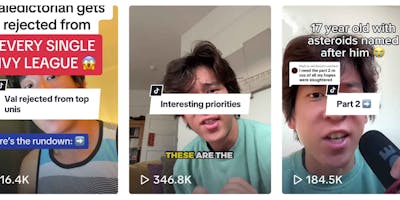
Daniel Lim reads through the resumes of prospective college students with the excited patter of a color commentator at an NFL game. On his popular TikTok channel, the Duke University senior highlights the seemingly endless number of ultra-achieving students who fail to land acceptances at selective colleges, or, more often, who win some bids and lose others.
“This valedictorian with a near-perfect SAT score got rejected by every single Ivy League school he applied to,” he says in one recent video, in a tone of disbelief. “Let’s look at his application and see what happened.”
It turns out that this anonymous student Lim’s describing — with an SAT score of 1570, trophies in state and regional championships for gymnastics, experience in concert band since fourth grade and membership in honor societies — says that he was rejected from Harvard, Princeton, Stanford, MIT, Columbia, Yale, Cornell, Duke, Carnegie Mellon, and the University of Michigan. The student says he got into Penn State University and the University of Maryland.
Lim, who has more than 200,000 followers, says that nearly 2,000 high school students have sent him their college applications — along with the list of institutions they applied to and the results of their attempts — for him to share and riff on in his videos.
He’s part of a genre of social media trying to make sense of who gets into which selective college — and why — at a time when landing a ‘Yes’ from a selective college is harder than ever.
Statistics show it really is harder to get into college these days, if you’re trying to get into a selective one. If you look at the top 100 universities and the top 50 top liberal arts colleges, the median SAT score it takes to get in has risen significantly since about 35 years ago, according to an analysis a couple years ago in Education Next.
College counselors work to emphasize that finding the right college should be about discovering the right fit — and the fact is that most U.S. colleges, especially community colleges, admit most of the students who apply. But regardless, many students and families perceive selective colleges as the ticket to more opportunity. And at a time of rising college costs, students strive to get into state flagship universities that offer high-quality offerings at a fraction of the cost of private colleges, or to land at Ivy League schools with big endowments that can afford to offer more-generous financial aid than other institutions.
So the process has high stakes. And yet it can seem like a game.
And the rules of that game keep changing.
The pandemic led more colleges to make SAT scores optional, putting more emphasis on so-called “holistic” reviews of candidates. And admissions officials say there’s widespread misperceptions about how that process works.
“A lot of people think if a school has a 5 percent admit rate, they have a one in 20 chance of getting in, which is not what it is,” says Nathan Mathabane, associate director of college counseling at Woodside Priory School, in California, and a former admissions officer at Princeton University. “Some students will have an 80 or 90 percent chance of getting in and many students will have a 0 percent chance of getting in.”
And a landmark U.S. Supreme Court ruling this summer striking down the consideration of race in college admissions has thrown even more uncertainty into the process, as even colleges themselves seek to quickly change their processes to comply with the law.
So students are turning to TikTok and other social media platforms to fill the information void about whether, why and how they’ve got a shot at landing a spot at a selective college.
Another example that Mathabane points to is a Reddit channel called “chance me,” where applicants post their credentials and ask the internet to predict what their chances are of getting into the college that they think works best for them. And some of the comments end up being unkind, or come filled with misinformation about the process.
“I think it’s super toxic,” Mathabane says of the site. “I don't think there's anything that you're going to get from these sites that is going to improve your college search, full stop, and it probably will only stress you out more.”
But Lim argues that his videos, which he also posts on YouTube and Instagram, can help students feel less alone in a stressful process. And he says he can relate, from the stress of his own college search.
For this week’s EdSurge Podcast, we talk with Lim about what he’s learned from seeing so many college applications and from the reactions to his videos, and we hear from Mathabane about how admissions is changing.
Listen to the episode on Apple Podcasts, Overcast, Spotify, Stitcher or wherever you listen to podcasts, or use the player on this page.
What a Popular TikTok Channel Reveals About the Stress of College Admissions
Get the latest news on student and staff well-being by visiting eSN’s SEL & Well-Being page
Belonging is a fundamental human need. We are all searching for a sense of connection with the people and places in our lives. Students and school staff are no different, so it’s crucial to ensure learning environments foster a sense of belonging.
When students have a strong sense of belonging, they are more likely to be engaged in school and to perform well academically. Unfortunately, new data shows that only 62 percent of high school students feel connected to others at school, and nearly one-third of students experience poor mental health.
In addition, the latest federal data found that 33 percent of school leaders noticed an uptick in violence amongst students and students experiencing anxiety and attention-deficit hyperactivity disorder over the last year–many attribute the increase to the pandemic and its lingering effects. There’s simply no time to waste; we must make our schools welcoming, safe spaces for students and staff alike.
Build trusting relationships with students to create a culture of belonging
Trust is the cornerstone of belonging. Students need us to be accessible, dependable, and trustworthy. When students trust us, they’ll be more willing to be honest about their struggles and help us stay in tune with what’s happening in the halls that we don’t see.
Celebrate student backgrounds and cultures
Celebrating cultures is more than just hosting an event; it’s about consistently honoring the ethnicity, background, and experiences of the students we serve. By recognizing the diverse backgrounds and cultural traditions of the school’s communities, we create avenues for students to share and celebrate their experiences openly.
Encouraging open dialogue and allowing students to lead discussions about their cultures fosters a climate of true inclusivity. Celebrating and embracing students’ lived experiences greatly increases students’–and their family’s–feelings of belonging.
Engage the community as a partner
Schools that focus on belonging recognize the power of community engagement. For example, when a community member talks openly about a challenging topic, such as their family’s experience with substance abuse, it can create a sense of belonging and validation for students coping with a similar situation. School advisory councils that involve students, families, and staff as decision-makers influence school operations and bridge the gap between students and their communities.
Empower school counselors through collaborative partnerships
Relationships take time to foster. Students need to be seen, and staff need the time to truly see them. When staff are overburdened, as many are nationwide, it hinders their ability to build meaningful relationships with students. And when a student needs care outside of the scope of school resources, staff are often tasked with finding the care they need. On average, it takes up to 60 phone calls to connect a student, family member, or staff member to the proper mental health resources.
That’s where partners providing mental health care coordination services come into play. Collaborations like this can alleviate the burden on school staff and save them countless hours of tedious work. What’s more, a third-party partner can also provide mental health support to school staff. School staff are the backbone of a school community, and their mental health and well-being are essential to a thriving school culture.
After a prolonged period of disconnection, building strong relationships is more important than ever. Dr. Bruce Perry, in his book The Boy Who Was Raised As a Dog: And Other Stories from a Child Psychiatrist’s Notebook says, “Relationships are the agents of change and the most powerful therapy is human love. People, not programs, change people.” As you reflect on the practices in your school community, remember that the trusting relationships we cultivate with students and staff members are the most powerful tool we have to create the sense of belonging.
Clad in a beanie, university sweatshirt and gold-rimmed glasses, a TikToker who goes by Mimi looks directly into the camera and speaks in a gentle tone as she addresses her viewers on the topics that flash in red-highlighted letters at the top of the video: “TW: Climate Anxiety & Doomism.”
The trigger warning is buttressed by a more hopeful message accentuated in green: “& TIPS on how to deal with that.”
Considering what the 24-year-old shares in the video about her experience as a climate activist and former environmental studies student in college, the need for a heads-up becomes apparent.
“As you come to the realization of how big an issue climate change is and how small it makes you feel, it really brings around this impending sense of doom,” she says. “It makes you feel super helpless, especially when you start acknowledging who gets affected.”
That is to say, people who are part of certain racial groups — likely a reference to the outsized impact climate change has on Black and Hispanic people — and low-income people. And that reality has made Mimi contemplate, “Wow, do people really think of my life as that worthless when it comes to making a buck?”
“I ended up in undergrad having to go to therapy partially because of my acceptance of what climate change is and how little and small and in-equipped it made me feel,” she says. “And ironically my therapist said, ‘I get a lot of you environmental studies majors in here,’ and she was very happy that I came to see her.”
There are plenty of factors affecting students’ mental health these days. Continuing reverberations from pandemic-era remote learning, gun violence and social media to name a few.
There appears to be yet another to add to the list.
There are signs that soaring temperatures, monster storms and aggressive floods are taking a mental toll on students. An international “climate anxiety” survey of 10,000 teens and young adults found that more than 45 percent of those who responded said “their feelings about climate change negatively affected their daily life and functioning.”
Climate anxiety isn’t a wholly new concept. Google saw a 565 percent increase in searches for the phrase a couple years ago.
Since then, researchers have taken closer looks at what role climate anxiety — also called climate doomism or eco-anxiety — plays in the overall mental health pressures that young people are facing.
Taking Action
Mimi is far from alone in her experiences with climate anxiety, if the myriad videos by other TikTokers on the platform talking about dealing with negative effects of the environment are any sign.
A study from the Yale School of Public Health found that climate anxiety is distinct from other mental health conditions like general anxiety disorder or major depressive disorder.
“Responses demonstrated how climate change anxiety can pose a barrier to engaging with goals typically salient in emerging adulthood such as education, career, and family-related goals, which may contribute to a loss of meaning or purpose,” researchers explain in the paper. “This may be of particular concern in the context of an emerging adult population that is already more vulnerable to mental health distress.
Yale researcher and clinical psychologist Sarah Lowe said in an Q&A earlier this year that climate anxiety tends to impact people who are already experiencing symptoms of general anxiety. Overall, Lowe explained, the number of college students who say they’re experiencing climate anxiety is fairly low.
“Our students were in the range of ‘rarely anxious’ to ‘sometimes anxious,’ and that to us was a bit surprising given what we’ve heard from students,” she said in the interview. “But it’s also important to note that the whole range of scale scores was represented in the survey results, so we did have some students who reported frequent or extreme anxiety about climate change.”
One potential source of relief for climate anxiety among youth might be doing something about climate change.
That can come in many forms. A Pew Research Center poll from 2021 found that adults in Generation Z were more likely than Americans belonging to older generations to have donated money, contacted an elected official, volunteered or attended a rally to try to help address climate change in the prior year.
The Yale survey of more than 300 undergrad and graduate students ages 18 to 35 found that students who participate in “collective action” — like involvement in advocacy groups or educating others about climate change — report lower levels of climate anxiety than those who only take part in individual actions like recycling or saving energy.
One notable recent example of youth taking collective action occurred last month, when 16 plaintiffs, ranging in age from 5 to 22, successfully won their court case claiming that state agencies in Montana were violating their constitutional right to a clean environment by allowing fossil fuel development. NPR called it “a first-of-its- kind trial in the U.S.” and one that “established a government duty to protect citizens from climate change.”
For her part, TikToker Mimi encourages her followers to remember that the answer to climate change does not rest on any one person. Rather, people who want to get involved can think about how their unique talents and skills can be put to use.
“How can I make the most ripples and the most effective change in the communities I reside within?” Mimi invites them to contemplate. “And no, it may not be this huge movement or this huge thing that I’m doing, but I am contributing. And I’m holding those who are part of the problem to the utmost accountability. Do what you can with what you can.”
Designing for Climate Education
Architects designed a rainwater collection system for Springdale Park Elementary School in Atlanta, where it is used as a teaching tool for the students. Photo courtesy of Perkins&Will.
Just because children and teens are taking action doesn’t mean they think grown-ups should be absolved of responsibility. The climate anxiety international survey found that “a perceived failure by governments to respond to the climate crisis is associated with increased distress” among youth.
Getting governments to change is a big task (although not impossible, as those young Montanans learned.) So what can adults whose work is closer to the daily experiences of children do to? For example, as educators and architects grapple with the challenge of adapting school buildings to design with climate resilience in mind, can they affect students’ climate change worries as well?
That answer is yes, according to one expert.
Shivani Langer, a senior project architect and senior regenerative design adviser at the firm Perkins&Will Austin, echoes other experts who say children are more vulnerable to climate change than adults. She previously spoke to EdSurge about how architects are making school buildings more resilient to rising temperatures and other effects of climate change.
That vulnerability includes their physical development and characteristics — young children literally inhale more air pollution because they breathe faster — to the interruptions to their education from more frequent natural disasters like wildfires and hurricanes.
Langer is also an expert on how buildings can impact their inhabitants’ health and well-being — having earned the rather aptly named credential of WELL accredited professional — and believes that architects can educate students and even assuage worries about climate change through their designs.
“Kids are seeing that things are happening, right? Whether it was a freeze here, or a hurricane somewhere, or a tornado somewhere,” she says. “Kids are the biggest proponent of sustainability. They understand that they will go through it because of our bad decisions over the years.”
Langer says colleagues at her company’s Atlanta firm designed a school’s rainwater collection system that is used to teach students about sustainability and gardening. Additionally, sustainability-minded architects encourage schools to include in their designs dashboard displays that show students how much energy or water is used in the building. The dashboard could be a screen near the entrance visible to students and visitors alike, she explains, or the usage data could be accessed via iPad as part of science lessons.
“We have even done competitions between different wings of schools to say, ‘Hey, how much electricity did you use?’ So in that way, they get excited about being better stewards of the environment,” Langer says. “And if we make these schools resilient and sustainable, informing and teaching through that actually helps relieve their stress, too, because they understand that there is something being done.”
HOUSTON — On a Tuesday in August, one day before the official start of the school year, the halls of Jefferson Early Learning Center were filled with the tinkling chatter of pre-K students who were escorted by their parents to meet the teachers.
But to reach those classrooms, families had to traverse the parking lot in the choking Texas heat, which rolled off the pavement in waves. That month, the temperature reached a record-breaking average high of 102.7 degrees.
Back inside, Glenn Jarrett pointed out features of the school building interior that might be easy for most people to overlook, but that stand out to him as the Alief Independent School District’s director of construction and facilities. Details like the use of earth tones throughout the school and light-colored wooden beams in the ceiling. Those beams support awning-like overhangs, which shield the temperature-treated glass windows of the cafeteria and the tiny, scaled-down furniture within from being beaten by direct sunlight.
In the hallway, Jarrett pointed at more windows strategically placed up high — too high for even the tallest grown-up to see through.
“You have all that light that's coming in naturally up above, and then you have the white walls that reflect it down,” Jarrett explained. He motioned to the lights overhead. “You don't even have to have those on to have light in the building.”
The LED lights are on, though, because it would make people nervous to walk around without them, he added.
The point of all these design choices is to reduce the impact of the scorching outside temperatures. They’re just a few of the ways Jarrett and other experts say excessive heat, along with other environmental issues brought on by climate change, are shifting the way schools are built and renovated.
Extreme heat waves recently caused some schools in the Northeast and Midwest to cancel classes, and rising temperatures are prompting some school districts in states like Utah to add air conditioning to campuses that didn’t need them in years past. More frequent and powerful natural disasters are adding tangible costs, too, pushing thousands more districts to shell out for insurance.
The Jefferson Early Learning Center in Houston was designed with covered walkways throughout campus to protect students, faculty and visitors from the heat. Photo courtesy of PBK.
A Long Time Coming
Dan Boggio, founder and executive chairman of national architectural firm PBK, says his company has been designing schools with extreme heat in mind for about 10 years. But it’s typically architects who bring up the need for climate-related features rather than a conversation initiated by district personnel, he adds.
“When we start a planning process for new schools and renovations, we have an entire list of things we bring forward as a result of climate change,” Boggio says, like the adoption of solar panels to cut down energy use or double-paned glass to keep out heat.
As Boggio explains how climate change has affected his firm’s approach to building schools, he describes changes that touch nearly every aspect of the process, from selection of a building site (preferably somewhere with lots of surrounding green space) to the choice of paint colors (nothing dark that will absorb heat).
“We don’t want to be in a sea of concrete, because that increases the temperature of the microenvironment — we call it a heat sink,” Boggio explains. “We’re saving more trees than ever on these sites. It used to be we would just typically mow down all the trees to get the baseball diamonds and the football practice fields in.”
Much of what Boggio describes about new construction and renovation deals points to a singular goal: reflect as much heat as possible.
His architects are using what he calls “high-performance glass,” once reserved for high-rise buildings, on schools to cut down on solar radiation. School attics are renovated with reflective material that will keep heat from penetrating further down. Brick buildings that are 70 or 80 years old are painted with an elastomeric coating — i.e., rubbery paint — to reflect sunlight that would normally be absorbed by the masonry and create what Boggio calls a “heat battery.”
The buildings themselves and mechanical equipment are being built higher up to protect them from flooding. In Texas, for example, “it used to be that we had to have them out of the 100-year floodplain; now they have to be a certain distance higher,” Boggio says. And for equipment that sits outside, like condensers, “we're raising them up on racks because [of] the increased amount of flooding that is a direct result of climate change.”
Windows at the Jefferson Early Learning Center are shielded from direct sunlight by overhangs. Wood was selected as the material for support beams to reduce the amount of heat absorbed by the school building. Photo courtesy of PBK.
Sites for Resiliency
Beyond their primary use for day-to-day education, schools are also likely to be used as either cooling centers or natural disaster shelters, Boggio adds, which means they need to be outfitted with bigger generators that can offer residents a reprieve from extreme heat in case of a power outage — not simply preserve thousands of dollars worth of food as was expected in years past.
Designing schools that can serve as what architects call “resiliency hubs'' could play a crucial role in protecting vulnerable communities from extreme weather, says Shivani Langer, a senior project architect and senior regenerative design adviser at the firm Perkins&Will Austin. She mentioned the deadly winter storm that knocked out power across Texas in 2021 as an example of a time when such a hub could benefit a whole town.
“Especially in this country, there is always a public school in every community, and the elementary schools are pretty close in distance to where the people live,” Langer says. “Why can't one school, at least, in each community be that place of shelter? If we do that, then we truly will serve all the communities, not just the communities that have the resources to get a true hub that can survive in a climate disaster.”
The design considerations of school-based resiliency hubs would center on keeping the people inside comfortable in the climate conditions of that particular community, Langer explains. In the case of extreme heat, that might mean having sufficient backup power to cool the building during a power outage or being able to collect condensation from the air conditioning system to run sinks and toilets during a water outage. A school cafeteria might even be designed with an exterior window counter, Langer says, where people could walk up and be served meals after a disaster.
Even as architects recommend climate-minded designs, the cost of implementing them can be a deterrent for school districts.
“It's all about survivability, which does mean power backup — which can be expensive,” Langer says. “That's why I think it needs to be something that, as a community, has to be decided.”
For example, she explains, a school district may opt to climate-proof only certain schools, rather than every single possible building. That’s not to say that schools are doing nothing if they don’t have a resiliency hub, she adds. Rather, they may be taking steps like making buildings more energy efficient or choosing landscaping that requires less water, which are better for the environment.
Ultimately, Langer says, it’s important to keep in mind that schools are designed for a vulnerable population: the children who will deal with the effects of climate change throughout their lives. She believes that better school design can be a teaching tool that encourages youth to be better stewards of the environment as they grow up.
“I know we rely a lot on the teachers to do the job for us, but as designers of education facilities, I think we have a big responsibility to also be the teachers for the users that will occupy our buildings,” she says. “These buildings are designed for 50 to 100 years. They are gonna see thousands and thousands of students. So our decisions are very important.”
Keeping the Heat at Bay
At Jefferson Early Learning Center, one of the school district’s newest buildings, adaptations to the heat and risk of flood are woven throughout the design. The large green space on the campus’ right side is planted with native grasses, a project done in partnership with the nonprofit The Nature Conservancy, and it will serve as a retention pond during heavy rains to fight off flooding, explains Jarrett, the district facilities leader.
Jarrett says there are other signs of the rising heat’s impact on schools in the district. The synthetic turf on the high school football field, which at times got as hot as 120 degrees, was replaced at the end of its lifecycle with new turf that didn’t hold onto heat. School visitors won’t find metal slides on playgrounds anymore, he points out, and wooden coverings have replaced canvas coverings as the need to shade students during outdoor activities became more permanent.
Outdoor temperatures have gotten so hot, Alief ISD Police Chief Dan Turner says, that dogs in his K-9 unit have to wear booties to protect their paws from scalding pavement.
Some of the biggest climate-related design changes have been to schools’ heating and cooling systems, says Jeff Delisle, Jarrett’s colleague at the school district and director of maintenance and operations. The systems were once built with the understanding that the highest average temperature outside would be 95 degrees, Delisle explains, but that standard has been increased to 100 degrees.
The black rubber roofs of 20 years ago are gone, he adds, replaced by white painted roofs and double the insulation.
“People that are much smarter than us have seen this coming for a long time,” Delisle says. “It’s the reason energy [standards] have been changing every six or seven years to get more and more stringent in terms of how we're going to conserve energy, how we're going to heat and cool our buildings, how we can do that in a way that's most efficient.”
Redesigning School Buildings to Stand Up to Climate Change
Since the pandemic, mental health strains on youth have been put in the spotlight.
Pandemic closures provided some students with a chance to notice how stressed they are at school, says Jayne Demsky, founder of School Avoidance Alliance, an advocacy group that provides professional training to schools.
The time away from physical classrooms gave children and teens an experience with which to contrast the regular anxiety of being at school. Now that in-person school is back in session, Demsky argues, schools now have to coax these students back into the building.
“Just like [adults] rethought our work-life balance, and our employers had to treat us kindly and reengage us and to show us why we should work for them — kids are the same,” Demsky says.
Many students are missing school completely, and the number of chronically absent students — defined as those who miss 10 percent or more of the school year — has increased. Since the pandemic, roughly 13.6 million students are chronically absent.
Some share of students missing from school are suffering from school avoidance, sometimes also called school refusal, which is when children experience severe emotional or physical distress about going to school.
These kids might be hiding in the corner crying under their covers, tantruming and glued to their beds, or holding onto a wall, so their parents can’t drive them to class.
— Jayne Demsky
Rather than just a distaste for school, refusal can be visceral.
“These kids might be hiding in the corner crying under their covers, tantruming and glued to their beds, or holding onto a wall, so their parents can’t drive them to class,” Demsky says.
Avoidance has become a crisis in recent years, one that schools aren’t prepared to handle, according to mental health experts. Long term, it can leave students unprepared for life. It can knock students off the traditional developmental path and leave them without crucial social and emotional skills, says Anne Marie Albano, a clinical psychologist with experience in school avoidance. Often, other psychologists who spoke with EdSurge noted, there are underlying conditions that can exacerbate anxiety around school as well.
The strain of mental health woes has ratcheted up pressure on schools to provide support. But schools are stretched thin for mental health staff, with as many as 100,000 more mental health professionals needed around the country.
Some districts have gotten creative. A school district in Virginia even constructed a middle school building with extra glass in the hopes that more natural light will serve as a palliative. But a more common approach has been to ink contracts with telehealth companies.
Still, for families and teachers trying to tackle school avoidance, it can mean that there are few resources for the specialized interventions students need.
There are no clinical diagnostic criteria for avoidance, which takes a different form for each child. But generally, it's marked by sustained absence, which gets harder to correct the longer the student is out of the classroom, Albano says. Unlike some other forms of absence, it won’t go away on its own but requires intervention that’s tailored to the student and can account for the deeper reasons a student is avoiding school, she adds. Those reasons tend to be highly specific to the individual students, she specifies.
But it’s hard to solve a problem you don’t know about.
Desperate Measures
Many parents have never heard of school avoidance, and educators aren’t comprehensively trained on it, according to activists and health care professionals. Not all clinicians even know how to treat school avoidance. For parents, “It’s scary,” says Demsky of School Avoidance Alliance.
Schools can conflate avoidance with truancy or other forms of absenteeism that fail to consider the anxiety causing it, Demsky says. (Demsky started her organization after her experiences with her own son’s school avoidance, which led the police to her doorstep and left her “on the verge of an emotional breakdown.”)
The nuance can get lost in efforts to get students back in physical classrooms.
Post-pandemic, legislatures have looked to increase penalties for students missing school. Penalties can range from fines to threats of jail time if the parents are found to have failed to get their kids to school. In Texas, for instance, lawmakers proposed hiking up the fines for truancy to cut down on absences earlier this year. It was controversial with family groups for penalizing missed school rather than remedying the root causes.
But treating refusal like truancy makes it harder to solve the problem, according to activists like Demsky. “I’ve spoken to families and they said, ‘hey, if I could pay $500 and go to jail for a week and have my kid get better and go to school, I would do it.’ So that just shows you how desperate families are,” she says.
Instead, Demsky calls for schools to recognize when refusal is occurring, and to follow evidence-based paths. That means psychological evaluations, finding out whether there’s an undiagnosed learning disability that’s making school acutely uncomfortable for the student, and other measures such as exposure therapy, she says.
In the schools she works with, that requires finding “a champion,” someone who has a connection with the student to help draw them back into the school, she says. In that, it’s similar to addressing chronic absenteeism in general, which Hedy Chang, executive director of the nonprofit Attendance Works, says boils down to meaningful relationships.
For beleaguered educators, it’s yet another hat they’re being asked to wear. But for some students, it may be crucial, activists say.
“Schools have to step in and take the place of those missing mental health professionals. And they really have to step up and become the support structure for these families,” Demsky says.
There are likely droves of educators who find themselves wishing they could take a peek inside their students’ minds to find out, “What the heck are you thinking?”
Some of those answers were made available last month when the Boys & Girls Clubs of America released its annual survey of kids and teens ages 9 to 18. The organization says that more than 130,000 young people at nearly 3,500 clubs around the country took part in the survey.
While there are generally some limitations when it comes to asking people to rate their own strengths and weaknesses — i.e. the temptation to pick the “right” answer — the survey reveals how kids view themselves and their desires for the future. They were asked to agree or disagree with statements about college and career plans, how they’re faring in school and with their mental health, among other topics.
Life After High School
Educators, employers, policymakers and others have been fretting over enrollment declines at colleges and whether students see the same value in a university diploma as their predecessors. In one recent example, thousands of high school students received a community college admission letter without ever applying in a bid by the State University of New York to attract potential freshmen.
Among the Boys & Girls Clubs of America kids, survey participants overwhelmingly had college aspirations, with 75 percent expecting to continue their education beyond high school.
Thirty percent said they want a bachelor’s degree, and another 26 percent plan to pursue a master’s or other advanced degrees. Amongst the high school seniors, most reported having applied to trade school, community college or a university along with federal financial aid.
The survey also took measure of kids’ interests in science, technology, education and math. Students by and large said they were excited by and successful in math and science, with 47 percent of reporting they agreed or strongly agreed they wanted a STEM career and 52 percent saying they know the “steps a student needs to take if they want to be in a science-related career.”
They also appear to be confident in their knowledge of how to reach their career goals and the accompanying price tag. Among high school juniors and seniors, more than 90 percent said they know what kind of education or vocational training they will need for the jobs they want and how much those plans will cost.
It’s an impressive stat considering the well-documented stressors that grads older than these youngsters who are yoked with student loan debt are facing, like worries about repayment or buying homes.
Despite the positive outlook, only 51 percent of participants in fifth through 12th grade said they were on track to graduate. Twenty-one percent said they were “on track with some risk,” while the remaining 28 percent said they were not on track to graduate from high school.
Are the Kids Alright?
It’s undoubtedly been a stressful few years for kids, and they’re still in the midst of what experts called a national youth mental health crisis. Schools and community groups alike are trying to figure out how to meet the demand for more mental health support among students, and crisis lines have reported an uptick in teens reaching out for help.
But the survey participants generally saw themselves as mentally strong.
About a two-thirds of the kids said it was either “very true” or “sort of true” that they can stay calm when stressed, and nearly half said they know how to calm themselves down.
Around 60 percent of students said it was “very true” that they can identify the emotions they feel and how their feelings influence their actions. Sixty-four percent believe it’s “very true” that they can accomplish most things if they try their best, and about the same amount said they don’t give up on something when they have trouble with a task.
They were also positive when it came to making mistakes. Just over 90 percent said it was either “very true” or “sort of true” that they try to figure out how to do better next time when something important in their lives goes wrong.
However, their responses revealed something more concerning when statements were phrased more negatively.
Forty percent said it was “very true” — and 30 percent said it was “sort of true” — that, “when something goes wrong in my life, I just can’t stop worrying about it.”
Another 38 percent said it was “very true” — 29 percent said it was “sort of true” — that they try to keep people from finding out when something goes wrong in their life.
Cool to Be Kind
Kids reported a fairly sunny outlook on their relationships and communities, responding positively to questions about how they treat others and their feelings about their community.
More than 90 percent said they try to help when they see someone in need or help when “I see someone having a problem.” Another 85 percent said they try to think about how others will be impacted by their decisions, and about the same percentage said they are good at making friends.
More than 80 percent of kids say they believe they can make a difference in their communities.
But on the receiving end of others’ behavior, 40 percent of kids said they had been bullied at school during the past year (62 percent of those students also said they told an adult). Another 18 percent said they had been “electronically bullied,” and those kids were less likely to tell an adult — 45 percent said they did.
The pandemic has largely changed public perceptions about the appropriate use of technology for young people, argues Katie Davis, associate professor in the information school at the University of Washington.
“The pandemic forced us to confront the fact that technology is absolutely essential in our lives, and especially during crises,” she says. Now, she says, discussion is shifting to questions of “When is technology good? When is it bad? What should its role be in young people's development at each stage of their progression, from toddlers all the way up to emerging adulthood and beyond?”
The EdSurge Podcast recently interviewed Davis, who has done research on the intersection of child development and technology for nearly 20 years. She lays out a framework for how to best match tech with each stage of growth in a new book, “Technology's Child: Digital Media’s Role in the Ages and Stages of Growing Up.” It celebrates when technology can help kids thrive — as well as cautions about when it can get in the way.
Sometimes the problems posed by gadgets can emerge in unexpected ways, she says, such as when literacy apps aimed at young readers feature too many bells and whistles, like a word’s meaning popping up on screen as children tap it, or rich sounds playing as children read.
“You think, that must be really good when learning to read, to hear the word being sounded out. And in theory, these do seem like good ways to enhance the learning experience,” Davis says. “However, we have to remember that especially for young children, there's a limit to their information-processing bandwidth. If you think of a computer, an analogy to a computer, they have just smaller CPUs than we do as adults.”
And she says there is a growing awareness of how some tech companies design their systems to do things that aren’t in the users’ best interest, a phenomenon referred to as “dark patterns.” A common example of a dark pattern, Davis says, is the autoplay feature on YouTube that often keeps viewers watching and can make it more difficult for a parent to convince their young child to put down a device.
Davis calls for increased regulation of tech companies to rein in such design features.
“Relying on the tech companies to regulate themselves doesn't work,” she argues, “because it's just not in their best interest financially to place user well-being front and center. Unfortunately, that's just not what makes them a lot of money.”
But she acknowledges that regulations can have unintended consequences that can be harmful as well. So she calls on academics to conduct more research to help inform best practices for tech tools, so that they foster well-being and are more effective for education.
Listen to the episode on Apple Podcasts, Overcast, Spotify or wherever you get your podcasts, or use the player on this page.
When Gorgette Green-Hodnett wrapped up her 23-year career in K-12 education a couple years ago, her family members celebrated. Not only with well wishes for her new job coordinating an academic support program at a university in Maryland, but also with relief that she would no longer be working around the clock.
Her family had been glad each time she’d had a non-teaching role throughout her career, but this time her husband was excited at the prospect of finally taking a vacation outside the summer months.
“What I was told by my family is, ‘Thank God, because you come home and you grade papers. We have to go to your school and help you,’” she says. “I didn’t even realize the impact the work was having on my immediate family. Consciously or unconsciously, I allowed my work to manage and almost overtake areas of my life.”
That’s the kind of realization that teachers were coming to during the pandemic, Green-Hodnett says, when they were stretched to their limits juggling remote learning, their families, health concerns, and every other stressor brought on by the spread of COVID-19. While the country didn’t see the sudden mass exodus of teachers that some feared, the toll appeared clear — teachers reported experiencing depression at three times the rate of other adults.
And there was significant turnover in the workforce. A recent analysis by Chalkbeat found that, between the 2021 and 2022 school years, eight states — Hawaii, Louisiana, Maine, Maryland, Mississippi, North Carolina, South Carolina, and Washington — faced their highest teacher turnover rates in the past five years. Hawaii experienced a spike in retirements during the 2020-21 school year. And a recent Louisiana Educator Workforce Snapshot revealed that 26 percent of teachers who left their jobs in the 2020-2021 academic year had 21 or more years of experience.
Teacher quitting was at a 10-year high in 2021, consulting firm McKinsey & Company reports, and increased again in 2022. Quitting accounted for 61 percent of job “separations” among teachers in 2021, according to the data, and jumped to 64 percent in 2022.
Losing any teacher has ripple effects throughout a school, from eroding the sense of community to a potential knock on students’ academic progress.
But what happens, more specifically, when veteran teachers burn out and decide it’s time to say goodbye, walking out the door with all of their hard-earned experience? And what can schools change to get them to stay?
‘Ripple Effects’
When it comes to years of teaching experience, federal data divides U.S. teachers into four buckets. In the 2020-21 school year:
12.4 percent of teachers had three or less years
24.5 percent of teachers had four to nine years
16.6 percent had 10 to 14 years
46.5 percent had 15 or more years
That breakdown is similar to what it was three years earlier in the 2017-18 school year.
Data visualization by Nadia Tamez-Robledo. Source: National Center for Education Statistics
But for some teachers who have been in the profession for a long time, it feels like there has been a shift.
Around the time she moved on to higher education, Green-Hodnett was running the Real Talk, Real Time Educators Forum with fellow educator Chandra Joseph-Lacet, who is a new teacher instructional coach for Boston Public Schools. The Facebook group and podcast were sounding boards for teachers looking for a community amidst the hair-pulling stress of remote learning.
Struggling with mental health is nothing new for teachers, Green-Hodnett says, but the pandemic made it — and many crumbling edges and simmering inequities of the education system — visible to the outside public in a new way.
In Joseph-Lacet’s view, the praise heaped upon teachers in the early days of the pandemic hasn't translated into meaningful plans to help them manage the stress and pressure of the job. That’s partly why the duo created their podcast and forum — they were both in roles that supported teachers but they didn’t see a larger conversation about their mental health emerge.
“Everybody’s talking about teachers, but nobody’s talking to teachers,” Joseph-Lacet recalls thinking. “What are we going to do to protect and to heal ourselves? In a profession, and quite frankly, in a world that never really has valued teachers in the way that they really should have.”
For some experienced teachers, the answer was simple: Leave.
Data visualization by Nadia Tamez-Robledo. Source: Louisiana Department of Education
Teachers who have seen it all can bring a steady assurance to a staff team. Without them, schools can feel less stable.
“What happens when you don’t have folks with those years of expertise, someone who can help with, ‘I don’t understand this lesson, can you help me?’” Joseph-Lacet explains, “you see this withering of the environment in ways that you didn’t see before. This constant feeling of turnover because there’s no holding of the guard by the people who used to be there.”
Other experienced teachers don’t walk away, but hang on despite suffering from burnout. That, too, can have a negative ripple effect on their colleagues’ morale.
“A 10-year teacher is like the kingpin, because people are not staying in the profession like when we were younger,” Green-Hodnett says. “The veteran teachers are juggling all kinds of things because they also want good work. It’s this triangulation of trying to maintain themselves, manage classrooms that are not properly balanced in terms of what students need, and manage children who are not prepared emotionally” to follow directions.
While the pandemic exacerbated the external pain points, there’s also another culprit to the stress veteran teachers experience. There’s a certain self-sacrificing attitude that teachers have had for a long time now, Joseph-Lacet says, that comes from the expectations of their peers, administrators, all the way back to their training days in college. It’s the idea that, from the time that school starts in the fall to the final bell in summer, their lives revolve totally around work.
“I was guilty of saying, ‘Tell your friends you’ll see them in June,’” Joseph-Lacet says of conversations she used to have with new teachers.
She thinks of that attitude now as modeling bad behavior — total lack of self-care or work-life balance, in this case — something that veteran teachers are still at risk of doing as they deal with mental strain.
It all adds up to a sense that a lasting career in education is a tenuous prospect — or one that requires teachers who stick it out to give, and give, and give until there’s nothing left.
After all, Joseph-Lacet says that what earns teachers the reputation of being a “veteran” has changed during her career, from someone with 20 years of experience to someone who’s been in the profession for just three years.
Who Takes Care of Experienced Teachers?
A study of the impact of COVID-19 and its stressors on New Orleans teachers found that, when asked what the most helpful support during pandemic teaching had been, 42 percent of responders said “support from coworkers.”
We have to take care of the human being who is holding it together — or it’s all gonna crash.
— Danna Thomas
One teacher, for example, told researchers that “working with a group of coworkers that really cares” was key to feeling supported.
It’s an example of a trend that Danna Thomas observed while she was still a teacher in Baltimore. Thomas founded the teacher self-care organization Happy Teacher Revolution, which hosts gatherings in 21 states where educators talk and support each other through difficult times in the profession. She found that experienced teachers tend to shoulder an additional emotional toll as their peers lean on them for support, particularly new teachers who are finding their footing.
She believes schools are missing opportunities to invest in veteran teachers as leaders who can help to improve well-being for other staff members.
“There are people in leadership who support teachers with academics, but their phone calls or Zoom are [reserved for] just new teachers crying their eyes out with how overwhelmed they are,” Thomas says. “Teaching, it shouldn’t be getting harder as the years go on. If you have 10, 20 years under your belt, it should be less overwhelming. We have to take care of the human being who is holding it together — or it’s all gonna crash.”
In the absence of more school-based support for long-time teachers, groups like Happy Teacher Revolution try to fill the gap. One common topic of conversation among members is the power of resetting professional boundaries that crumbled during the remote leaning days of the COVID-19 pandemic. It’s a place where they can celebrate big wins like taking a sick day, actually eating lunch during their lunch breaks, and making it home from school before dark.
“I really want folks to feel it’s sustainable that they can do this for years and years,” Thomas says of her goal. “There’s nothing better than a happy veteran teacher who’s able to teach siblings, or those kids’ kids — it’s so cool. There’s been so much conversation about individual care, and we need community care. Who is making sure that the village collective is well?”
Green-Hodnett has also seen experienced teachers start to think more about what they want their lives to look like outside of work. She recalls one woman who was part of the Real Talk forum saying that one of the biggest regrets of her 40-year teaching career was all of the missed recitals and events that involved her daughter, sacrificed so she could keep up with school work.
Green-Hodnett also recalls a former colleague, who left the school district for a new job, had more than 200 hours of unused leave.
“Teachers have to be mindful of what their capacity is, use their voice, use their leave,” Green-Hodnett says. “Chandra’s talked about how we would wait and do all our doctor's appointments in the summer, or do all our doctor's appointments on spring break. No, you need to take [leave]. If you don't take care of those things, then you retire, and then you're not able to do what you wanna do in your retirement.”
Data visualization by Nadia Tamez-Robledo. Source: Hawaii State Department of Education
Revolving Door
Yet these support circles and changing attitudes may not be enough to make sure that today’s teachers hang in there to serve as tomorrow’s veterans.
Joseph-Lacet has seen a new trend among teachers that she fears will have negative consequences on the profession. Unlike the norm from earlier in her career, she says experienced teachers now are openly mulling, “How quickly can I retire?” Not necessarily to stop working completely, but to transition to another field.
“They're like, ‘I need to bounce from this profession because it has just gotten to be too much,’” she says, “‘because it has just gotten to the point where it is breaking me mentally and or physically.’ There’s so much more of that, as opposed to people riding into retirement, having these wonderful retirement parties like they did back in the day.”
Among teachers who are retiring after long careers, she adds, some are sharing advice to younger teachers that sums up to, “Y’all don't do like I did. Don't stay here for 20 years. You can make a change. Make that change right now.”
“If younger teachers do that, again, we’re adding to this newness and this revolving door that's happening, and your veteran teachers are going to be three- and five-year folk,” Joseph-Lacet says. “That is never going to be beneficial for anyone in the school environment, and most notably the children.”
Even so, and despite her own long career as a teacher and now a teacher coach, Joseph-Lacet says that she can’t find it in herself to be excited that her own daughter is in college studying elementary education.
“On social media there’s jokes of teachers being stressed because it’s August,” she says, “but under that, there’s depression, there’s anxiety, overwhelming dread of walking into the new school year.”
WASHINGTON, D.C. — On a Friday morning in March, students and teachers gathered at a hip hotel here to reimagine what their high schools could be.
The delegation from Calvin Coolidge High School was thinking big — as in, global. For months, they’d been crafting plans to reframe their school’s curriculum around the United Nations sustainable development goals, 17 lofty targets that world leaders named as priorities in 2015 that include zero hunger, gender equality, and clean water and sanitation for everyone on Earth.
To explain this idea to the more than 100 people gathered in the hotel ballroom, students from Coolidge tossed around a colorful soccer ball. Each panel stitched to the ball represented one of the U.N. goals, which students referred to, casually, as “SDGs.” Each time someone caught the ball, he or she read aloud the SDG that landed face up, then reflected for a moment about what that global goal might mean locally, or personally.
A failing city is not a city, said one student.
No justice, no peace, added another.
If there is no community, there is no city, said a third.
This activity was part of a design workshop hosted by DC + XQ, a partnership between the city’s public schools and the nonprofit XQ Institute. Funded by Emerson Collective, a corporation that donates and invests money in social change efforts, XQ Institute currently supports programs intended to “rethink high school” at 30 schools and school districts nationwide. The organization describes its ultimate goal as graduating more students who have fundamental knowledge and skills, collaborate well, think creatively and are motivated to keep learning throughout their lives.
When I first came to this school, I felt as if student voices didn’t matter. It went from me feeling like my voice was never heard to me bringing out ideas that are constantly heard.
— Shamiyah McGee
XQ Institute hosts contests that award money and other resources to proposals for changing high schools, or for creating new ones. The organization helps teenagers, teachers and school leaders hone the visions they pitch over many months by guiding them through information-gathering activities like hosting focus-group conversations with parents and taking field trips to check out thriving schools in other cities.
The first two high schools to win the DC + XQ competition, in 2022, had embraced the themes of Afrofuturism and entrepreneurship. At this event in the hotel, representatives from other high schools in the city fine-tuned their own proposals, hoping to be selected into the second cohort of winners.
Although the verb keeps changing, D.C. is no stranger to attempts to “reform” or “rethink” its schools. Past efforts have yielded mixed results. And school district leaders here say they have encountered some skepticism about the DC + XQ campaign.
Yet as schools try to shake off the side effects of the COVID-19 pandemic, the need for fresh approaches to reach students seems clear. In the nation’s capital and nationwide, academic test scores are down and many students regularly bail on classes.
It’s a moment when XQ Institute’s agenda — that schools should offer more project-based learning, allow more flexibility in their schedules, and assign classwork more explicitly connected to career paths that interest students — may excite education leaders searching for solutions.
Yet measuring whether a redesigned high school is working as intended, and why, is difficult to do. And evidence about whether DC + XQ’s work makes a lasting difference in the lives of D.C. teens won’t arrive for a while.
In the meantime, the checkered history of school reform did not seem top of mind for students from Coolidge. Some said that simply being asked what they think about their high school had already improved their perceptions about education.
“When I first came to this school, I felt as if student voices didn’t matter,” said Shamiyah McGee, a rising junior who is participating in the redesign process. “It went from me feeling like my voice was never heard to me bringing out ideas that are constantly heard.”
Building Partnerships
XQ Institute launched with a bang. In 2015, it created the Super School Project, a contest to distribute millions of dollars to proposals for innovative high schools. In 2016, XQ Institute spent more millions on a public awareness campaign to promote its ideas about reforming education, papering its branding on buses and bus stops. In 2017, it advanced its message through a celebrity-studded network TV special, featuring Tom Hanks and James Corden doing karaoke on a school bus.
When wealthy donors and foundations have tried to improve schools by searching for a single innovation or intervention that will boost education — the way a new vaccine can dramatically improve public health — it usually hasn’t worked, said Phil Buchanan, president of the Center for Effective Philanthropy.
“If you look at the sum total of the efforts, I’m not sure you’d give them the highest grades,” he said. “Focusing on education, education reform — whatever you want to call it — achieving better educational outcomes, as a philanthropist, is a good way to become humble rather quickly, because it usually doesn’t go as folks hope.”
Yet he thinks that philanthropy leaders are exercising more humility lately, including about education. He has observed that donors and foundation executives are doing more listening to the people closest to the problems they hope to solve. He thinks philanthropists are realizing “that in fact there might be a lot of expertise and experience in communities, maybe even in families themselves that are affected.”
That’s the approach that D.C. school leaders said they’ve been taking for the past few years as they started their own efforts to rethink the city’s schools. In 2018, D.C. Public Schools created a design lab, which invited principals, teachers and staff to workshop solutions to problems.
Then the district grew the effort into a wholesale redesign process with two high schools in D.C. neighborhoods where average income levels are lower than in the rest of the city and where the vast majority of residents are Black. School leaders talked with thousands of community members there, according to Paige Hoffman, deputy chief for school improvement at D.C. Public Schools.
“Too often, the folks who are closest to the problems or issues that we’re trying to tackle are furthest from decision-making,” Hoffman said. “And we thought we should change that, and we should shake that up.”
In these conversations, D.C. residents reflected on questions like What do you want to see out of school? and Why has school not been working?
In February 2022, XQ Institute and D.C. Public Schools formed its partnership to redesign high schools in the city, which granted the school district up to $25 million. (For comparison, in its 2022 fiscal year, D.C. spent about $2 billion in local taxpayer dollars on public education.)
To Hoffman, the timing felt right. The COVID-19 pandemic had weakened the city’s social immune system, undermining institutions like schools that help to prevent the spread of contagions like crime and unemployment.
When XQ Institute came calling, Hoffman said, “I think it was in many ways exactly what we as a school district really needed.”
After all, she had heard D.C. residents express that “we have not been in community together in years, and we desperately need to rethink high school, especially when we think about all that our students lost over the previous years and also all of the opportunities that are to come for them.”
Leaders at Coolidge felt similarly. When DC + XQ collected and shared information with them about how their students had fared during the health crisis, “the data was really compelling to us,” said Kira Rowe, a school counselor at Coolidge. “It was definitely eye-opening.”
Students at Coolidge said they wanted more hands-on learning and a deeper understanding about how school prepared them for the real world. They reported being anxious and depressed at higher rates than before the pandemic. And they wanted to change what felt to them like segregation taking root in their school building, creating tension between the two-thirds of students who are Black and the fifth of students who are English language learners, most of whom are Hispanic.
Calvin Coolidge High School is participating in the DC + XQ competition. Photo by Brylie Christopher Oxley / Wikimedia Commons.
Coolidge administrators and educators decided to develop a proposal for the DC + XQ contest. They sought to blend student well-being, sustainable practices and academic rigor. Then they happened upon the United Nations sustainable development goals, Rowe said, “which we just instantly fell in love with.”
Coolidge students interviewed their classmates to find out whether the theme felt meaningful.
“A question I had to ask them was which one of these SDGs they cared about the most. There was never a time a student said, ‘I don’t care about any of them,’” McGee, the rising junior, recalled. “It showed these SDGs actually can have a heart to heart experience with the students.”
Her personal favorite? “Gender equality — SDG 5,” she said. “I can connect myself to that.”
Because the global goals emphasize universal values, Coolidge leaders thought that they might appeal to students and families who had immigrated to D.C. from elsewhere. One evening, the school invited families from African and Central American countries to share a meal of Ethiopian and Latin American food and to talk about which sustainable development goals resonated most with them. The response was enthusiastic, school leaders said.
All this feedback suggested that the theme had potential to improve the school curriculum.
“Sustainable practices seem to be the only way to at least continue to give back to our planet, make it healthy as well, and make our students healthy,” said Coolidge principal Semanthe Bright. “Why not rethink Coolidge? We can’t go back to doing the same thing we did before the pandemic. Now is the time.”
Engaging Students
William Hayes-Jerome is a rising junior at Coolidge. He described himself as a student-athlete — he plays football for the school team — and as an advocate for his classmates. He’s observed that many of them don’t much like being at school.
Maybe, he said in an interview, eight hours of lessons is just too long.
“Most students don’t have the right attention span to be sitting there in the classes,” Hayes-Jerome said.
He suggested that it might help to change the schedule of the school day, so that it offers more opportunities for students to move around, and, he explained, to “actually communicate with somebody about how the day is going.”
Student disengagement is not a totally new problem. In surveys of 230,000 students in grades three through 12 conducted from 2012 to 2017 by YouthTruth, an education research and consulting nonprofit, only 46 percent of high school respondents felt that what they were learning in class helped them outside of school. And only 52 percent of students across middle and high school agreed or strongly agreed that they enjoyed coming to school most of the time.
Data and anecdotes suggest that the pandemic has only made those trends worse.
Studies from DC + XQ found some of the city’s students reported being bored in class, as well as feeling unsure of why they were studying the assigned curriculum. This dissatisfaction is tied to high levels of truancy in schools, said Keith Dysarz, head of state and local partnerships for XQ Institute. For example, nearly half of D.C. students (48 percent) were absent for 10 percent or more of the 2021-2022 school year, according to a report from the D.C. Policy Center, a research organization.
While there is a lot of focus on grades and test scores coming out of the health crisis, “academic learning loss does not happen in a vacuum,” observed Jen Vorse Wilka, executive director of YouthTruth. To succeed intellectually and emotionally, she explained, students need “strong culture, engaging learning opportunities that feel relevant and connected to students’ lives, relationships, a sense of agency, and an opportunity to express their own opinions about their learning.”
If students aren’t engaged, they actually aren’t learning.
— Keith Dysarz
Those qualities align with what XQ Institute leaders said they advocate for in redesigned high schools.
“If students aren’t engaged, they actually aren’t learning,” Dysarz said in an interview. “For us, engagement isn’t just a lesson hook, or, you know, maybe an interesting topic that they care about. It’s also, quite honestly, about making it relevant and real world.”
At the DC + XQ design day in March, students and teachers from Coolidge worked in small groups to rearrange Post-it notes on large posters attached to the ballroom’s walls, brainstorming activities related to the sustainable development goals that they hoped would be both educational and enjoyable to their classmates.
Ideas surfaced about planning field trips to a hospital; asking students to create community service events; making more use of the school garden; and using gallery walks to prompt students to respond to each other’s work.
Students at Coolidge High School are learning about the United Nations sustainable development goals.
Then the small groups met up, and students offered each other feedback on their ideas. Teachers and administrators chimed in, too. One student wondered aloud whether certain activities would seem too ordinary to other teenagers. An adult suggested that rather than trying to make a school exercise feel “fun,” they instead aim to make it “engaging” and “interactive.”
An idea floated about using social media as part of a classroom activity. That might be too distracting, someone said. Teachers snapped their fingers in agreement.
An educator reminded the students to consider how to design experiences for all of their peers — not just the kinds of students who earn all A’s (or show up to extracurricular design workshops). They talked about whether a little competition helps to motivate participation in class. They thought about how upperclassmen can help set a good example for younger students. They discussed the value of creating multiple activity options for their peers to choose from.
As the students broke back up into smaller groups, the conversation at one table dove into assignment ideas about the importance of water. Students and educators talked about the public health crisis in Flint, Michigan, where the water supply is tainted with lead. They talked about the problem of plastic pollution in the ocean. Someone pulled up photos she had taken during a trip to Colombia of piles of waste she saw there.
By the lunch break, a seminar-style discussion about SDG 6 — clean water and sanitation — was well underway.
Coolidge students and educators participated at a DC + XQ design event. Photo courtesy of Kira Rowe.
Getting Flexible
Pulling off elaborate student projects requires a certain amount of flexibility in the curriculum and in the school day. And making schools more flexible is a top XQ Institute priority.
The prospect of more freedom appealed to science teacher Nikki Wallace when she joined the faculty of Crosstown High School, an XQ Institute partner and charter school in Memphis, Tennessee, which opened in 2018. The summer before the first school year, she collaborated with other teachers to design interdisciplinary projects relevant to real-world situations.
It was exciting. It was challenging. Wallace recalls the “struggle” of trying to devise a long-term assignment about traveling to Mars with a math teacher who wasn’t convinced that it would provide adequate math instruction.
“It wasn’t easy at all,” Wallace said. “It built up a lot of tension.”
Then she had to sell the idea to her students. The framing she used to introduce that project — what’s wrong here on Earth and why do we need to explore Mars? — didn’t land as well as she had hoped. She said that at first, her students got so stuck pondering earthly problems that their imaginations didn’t lift off into space.
And yet, she believes that project made a lasting impression. As those students progressed through high school, Wallace said, the one assignment they seemed to talk about most was the Mars project from that first year.
For a teacher like Wallace to take a risk and try a new instructional approach, she said, the education ecosystem has to have the right conditions to support her.
“You gotta have the willingness of the leadership team to be flexible,” she said. “If leadership sees the benefits, it allows for creativity to happen.”
In D.C., questions about how much flexibility educators and students really have to redesign their schools come up regularly, according to Hoffman, the district leader. After all, schools are governed by plenty of federal and district policies intended to ensure that they impart a rigorous education. School officials also must contend with budget constraints, the needs and interests of educator employees, and the logistics of keeping track of hundreds of teenagers from day to day.
Hoffman hears D.C. educators say, “You want me to dream big, but what parameters” — school rules and regulations — “are you going to pull down?”
So the district is experimenting with change. It’s running pilot programs that allow students to participate in internships during the school day. Leaders are also working to figure out whether certain career and technical courses can convey academic credit — like an engineering elective fulfilling a science requirement that counts toward a diploma.
“You have to figure out how to get comfortable with trying something, with failing, and then learning from that,” Hoffman said.
Creating Accountability
Will creativity in the classroom and flexibility in how students demonstrate their learning be enough to transform Coolidge?
In education, metamorphosis requires more than mere tinkering. So said Elizabeth Chu, executive director of the Center for Public Research and Leadership, an education research and consulting arm of Columbia University.
She argued that true change requires rewiring entire education governance structures, so that they stop delivering “uniform services” and instead prioritize “uniformly attending to the differences that kids and families present and meeting their unique needs.”
“When you're working with these schools, you have to be aware [that] classrooms are sitting within schools, are sitting within districts, are sitting within states, are sitting, obviously, within the federal structure,” Chu said. “And so it means rethinking the policies and procedures at every level of the system that allow for the flexibility and innovation that you need at the particular school level.”
And so, over time, XQ Institute has turned its attention toward influencing policy and reshaping whole school systems, not just individual schools. In 2018, it published a guide encouraging state leaders to adopt the nonprofit’s reform strategies. In 2022, Rhode Island approved new regulations for the state’s high schools after working closely with XQ Institute. Now, the nonprofit is leading an effort to change the national “seat time” requirements that mandate students spend a certain number of hours in the classroom to earn credits and credentials.
Spokespeople for XQ Institute emphasized the grassroots flavor of each school redesign effort. Yet these processes did not germinate totally organically.
The nonprofit’s guide for policymakers suggests a road map for how to prompt communities to change their schools. Step one: Announce a challenge, and make it “ambitious, inspiring, and different.” Step two: Move people to action, with incentives like money. Step three: Help guide the redesign process so that it focuses on “equity, innovation, and excellence,” perhaps by using the resources developed by XQ Institute.
Whether a reform effort emerged from the playbook of a philanthropy juggernaut might not matter much if it ends up working well for students and schools. But that’s not always easy to assess.
One reason why is that change can take a long time, and results can be uneven. For example, after philanthropists (including Mark Zuckerberg) gave $200 million in 2010 to reform public schools in Newark, New Jersey, student academic achievement actually declined for several years, according to the Center for Education Policy Research at Harvard University. Eventually, math scores recovered and English scores surpassed their original levels, but by then, of course, some of the students who experienced the initial shock to the school system had aged out. And researchers found that much of the improvement could be attributed to students enrolling in different schools, rather than achievement going up at existing schools.
Another is that metrics can tell contradictory stories. For example, the D.C. Policy Center report found that the on-time high school graduation rate in the city has been been rising —from 68 percent in the 2018-2019 school year to 75 percent in the 2021-2022 school year — ostensibly a positive development. Yet the college enrollment rate within six months of graduation has been falling — from 56 percent for the class of 2019 to 51 percent for the class of 2021.
Some of the same organizations that poured money into school reform have since supported studies about what actually works. For example, in June, research firm MDRC published an analysis funded by the Bill and Melinda Gates Foundation about which frequently used school reform strategies are linked to better outcomes. They include:
Strengthening principal leadership
Using student data to improve teaching
Setting high standards for academic rigor
Enabling students to build personal relationships with educators
Empowering teachers to set goals and make decisions
Organizing teachers into teams that provide mutual support
Providing students extra academic help
Extending classes to allow for longer instructional time
Measuring these kinds of interventions early and often makes a difference in education reform efforts, according to Chu.
“A lot of these redesign processes, especially ones that are very user-centered, are extremely attentive to the process and very intentional in monitoring how things are going. So it’s not five years down the road that you’d realize things aren’t on the right track,” Chu said. “Let’s assess — kind of every single day, every single month, every single semester — how things are going, so that we are serving kids in classrooms today to the best of our ability.”
XQ Institute does help schools conduct audits at the start of their partnerships to assess what’s been working and not working well. These measure quantitative factors like student transcript data as well as qualitative feedback from students about how prepared they feel for life after high school, whether their academic options align with their personal passions and how supportive they feel their teachers are.
Yet XQ Institute does not see itself as the party accountable for ensuring the success of the changes it sets in motion. After all, as a spokesperson put it, flatly, in writing, “XQ does not operate schools.”
However, the nonprofit did share through a spokesperson that “XQ gathers data directly from our schools to understand student experiences in real-time and is also working with a best-in-class third-party evaluator, MDRC, who is conducting a longitudinal study about XQ schools’ impact on their students.” The firm is about a year away from publishing quantitative data, the spokesperson said.
For now, XQ Institute readily shares statistics indicating successes from the high schools it has worked with across the country. For example, at Crosstown in Memphis, 75 percent of the graduating class of 2022 planned to enroll in four-year colleges, according to XQ Institute, higher than the national rate of 47 percent. And 95 percent of its seniors graduated, compared to 80 percent in the surrounding district and 90 percent in the state of Tennessee.
These data points don’t show that, in its short existence, Crosstown has experienced leadership turnover, as well as a walkout among students advocating for a bigger say in how the school functions.
Of course, even if a reform effort worked wonders, it could still raise questions. Like, who gets to attend a redesigned high school and who gets left out?
“You think back to charter school models that have been around for a long, long time. The idea is that they can be laboratories of innovation, and then those innovations can infiltrate the rest of the public schools in that city — and that transfer doesn’t necessarily happen,” said Vorse Wilka, of YouthTruth. “The intention is laudable. And my question would be to what extent it plays out, and to what extent it is broadly accessible.”
And what are the ethics of testing out new school models on students in real time?
“When we’re talking about redesign, we are talking about experimentation to some extent,” Chu acknowledged. But she countered that “when we don’t make changes, and we kind of try and try and try again the same method, you might argue that that’s a less responsible form of experimentation, because we already have an evidence base that indicates that future performance will likely follow past performance, to some extent.”
We need to hold elected officials accountable for the choices they make, and the decisions they make, and what influence they choose to give to others, and who they listen to, and who they take resources from.
— Phil Buchanan
And what are the implications of a private organization giving millions of dollars to shape the operations of a city’s public schools?
“I think it’s complicated and nuanced, and that the most effective philanthropic efforts engage with those questions, and engage with the people they seek to help, to make sure that those people see that help as the help that they want,” said Buchanan, of the Center for Effective Philanthropy. “But then, also, we need to hold elected officials accountable for the choices they make, and the decisions they make, and what influence they choose to give to others, and who they listen to, and who they take resources from.”
Hoffman, of D.C. Public Schools, said she has encountered some fear and skepticism that D.C.’s redesigned high schools won’t serve students well. Or that the district isn’t serious about seeing the effort through. Or that the project is too idealistic and unrealistic at a time when plenty of youth in the city are worried about life’s basics, like safety.
“I am very frank that we need to earn your trust and we need to be showing you. Don’t just listen to me sit up here and pitch a great vision for you. Hold us accountable, right?” Hoffman said.
But she hopes city residents won’t simply critique from the sidelines, either.
“We also need community members at the table with us along the way,” Hoffman said. “The work of strong schools is not just the work of the public school system alone. It’s the work of families, it’s the work of community partners, it’s the work of higher ed organizations. It’s really about the community and the city.”
Seeking Transformation
Soon after the DC + XQ design session at the hotel, educators took three dozen students from Coolidge to visit the United Nations headquarters in New York City. They saw the golden general assembly hall. They watched world leaders deliberate during hearings. And, undeterred by a winter storm, some students caught their first glimpse of Times Square and the Empire State Building.
In June, DC + XQ named Coolidge as one of four schools in its second cohort of partners.
Coolidge students visited the United Nations headquarters in New York City. Photo courtesy of of Kira Rowe.
This coming school year, the high school will continue to refine its new vision. Coolidge will offer a capstone research class based on the United Nations sustainable development goals, which will support students in working on projects with partners including the Smithsonian Institution, the Humane Society, an urban farm and local universities. Students will have more opportunities to travel internationally. Teachers will have more opportunities to learn how to incorporate place-based learning into their classrooms.
Students list the ways that joining in the redesign process has already changed high school for them. Daisy Garcia-Vasquez, a rising senior, said she now has closer relationships with her teachers, and she feels a new sense of school spirit that doesn’t revolve only around sports teams. Hayes-Jerome said he feels like he’s helping to create real change by speaking out on behalf of his classmates.
McGee said she’s been inspired by “seeing so many students come together” through the redesign process. By listening to her peers at Coolidge and students at other high schools across the city, she’s realized that all of their thoughts pooled together can be distilled into one potent drop.
“We all have the same idea: We want school to be more of a safe and interactive and engaging environment for us,” she said.
About three dozen students toured the UN headquarters. Photo courtesy of of Kira Rowe.
That single bead of water may ripple out, into the wider city. McGee wants D.C. to support healthier food options — that’s SDG 3. Hayes-Jerome wants to see less gun violence in the city — that’s SDG 16.
Garcia-Vasquez said she hadn’t paid much attention to the environment before she learned about the SDGs. After taking a pilot version of the new Coolidge capstone class, though, she realized she’s passionate about the natural world.
“Something I would love for D.C. to change is the littering,” she said. “If you see trash every day, it makes you feel like you’re in a nasty environment. It changes your mood. If you live in a clean environment, you will feel better.”
Principal Bright said she looks forward to the day she can track graduates and see what contributions they’re making to the wider world because of what they learned at Coolidge.
“I would like to see how they have taken their capstone experience, their travel, as well as their research on the United Nations sustainability goals, and transform wherever they are in society,” Bright said.
That transformation need not wait for some far-off future. Educators at Coolidge said they are advocating to start D.C.’s first voluntary local review committee, to push the city they call home to work toward achieving the sustainable development goals.
Incorporating social and emotional learning (SEL) throughout the school day has risen in popularity over the last few years, especially to counteract the increasing rates of anxiety and depression in students since the COVID-19 pandemic. Lost in the discussion, however, is the importance of before- and after-school programs–the bookends of the school day.
These before- and after-school programs dedicate a significant amount of time to activities that can help students develop social-emotional skills. In fact, a 2021 survey of program providers found that in addition to academic enrichment, 86 percent of programs give young people the time to interact with their peers and build social skills. Plus, students themselves report that 80 percent of the programs give the students time to talk with peers and adults about how they’re feeling. Yet, staff may not approach every interaction with intention to foster social and emotional growth.
Before- and after-school programs offer critical support, including caring and supportive mentors, as well as safe spaces where students build confidence and a sense of belonging. They also provide opportunities to work collaboratively, problem solve, and think critically. SEL skills are not separate from those activities–SEL is not sprinkled on the cupcake; it’s part of the cupcake. Before- and after-school programs must make every interaction more intentional to complement classroom learning.
These programs help children develop strong social skills, gain self-control and confidence, improve work habits and grades, and build healthy relationships with peers–all the things we want young people to have to be successful. But to ensure that these programs are set up for success, there are two essential questions every program coordinator should ask: “How well do I know my students?” and “How can I ensure my program meets their needs?”
Running an effective program
SEL should be embedded throughout every program, starting with students’ arrival. How do you greet students when they show up? When a student hears a caring adult say their name, it instills a sense of belonging, supporting self-awareness.
An overview of the schedule at the beginning of the program is important. Kids need to learn how to self-manage and regulate their emotions. For a young person who is excited for the craft part of the program, understanding what else is on the agenda is key to them mastering the skills of self-management and self-awareness.
The actual activity is when the rubber meets the road. As program directors and administrators, we need to analyze the activities–how much time are they alone, in small groups and in large groups. It is important to outline the program activities so students have an opportunity to participate in all three options and balance between them. As students develop, they must know how to interact at all three levels. If you find that some students don’t perform in large groups, you may have to reevaluate how well you know your students. For example, if behavior problems spike when you do large groups, maybe the answer is that you have too many students in these groups.
Finally, do you have a clearly defined dismissal policy? This is an ideal opportunity to introduce students to social awareness. When your program has an established system of welcoming and dismissing students, it demonstrates consistency. It also helps young people see how their individual behavior fits into the overall success of the program. This is a key component of social awareness, where students understand how they fit into the larger community in various ways. Additionally, it’s a way to model other ways they use social awareness for example while leaving a store or restaurant. It’s a reminder that the SEL skills developed in school are useful in all aspects of life.
For students, SEL is not just limited to the classroom. Before- and after-school programs play an equally important role. With every interaction between staff and students, these bookends to students’ days provide the opportunities to hone these competencies and grow, if there is consistency and intention in programs’ approach.

 Login
Login