
Normal view

There are new articles available, click to refresh the page.
Before yesterdayMain stream

What a Popular TikTok Channel Reveals About the Stress of College Admissions

24 October 2023 at 20:00

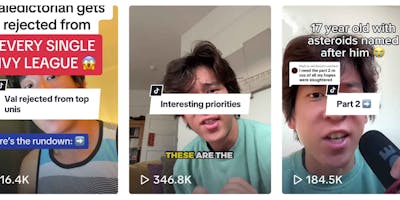
Daniel Lim reads through the resumes of prospective college students with the excited patter of a color commentator at an NFL game. On his popular TikTok channel, the Duke University senior highlights the seemingly endless number of ultra-achieving students who fail to land acceptances at selective colleges, or, more often, who win some bids and lose others.

“This valedictorian with a near-perfect SAT score got rejected by every single Ivy League school he applied to,” he says in one recent video, in a tone of disbelief. “Let’s look at his application and see what happened.”

It turns out that this anonymous student Lim’s describing — with an SAT score of 1570, trophies in state and regional championships for gymnastics, experience in concert band since fourth grade and membership in honor societies — says that he was rejected from Harvard, Princeton, Stanford, MIT, Columbia, Yale, Cornell, Duke, Carnegie Mellon, and the University of Michigan. The student says he got into Penn State University and the University of Maryland.

Lim, who has more than 200,000 followers, says that nearly 2,000 high school students have sent him their college applications — along with the list of institutions they applied to and the results of their attempts — for him to share and riff on in his videos.

He’s part of a genre of social media trying to make sense of who gets into which selective college — and why — at a time when landing a ‘Yes’ from a selective college is harder than ever.

Statistics show it really is harder to get into college these days, if you’re trying to get into a selective one. If you look at the top 100 universities and the top 50 top liberal arts colleges, the median SAT score it takes to get in has risen significantly since about 35 years ago, according to an analysis a couple years ago in Education Next.

College counselors work to emphasize that finding the right college should be about discovering the right fit — and the fact is that most U.S. colleges, especially community colleges, admit most of the students who apply. But regardless, many students and families perceive selective colleges as the ticket to more opportunity. And at a time of rising college costs, students strive to get into state flagship universities that offer high-quality offerings at a fraction of the cost of private colleges, or to land at Ivy League schools with big endowments that can afford to offer more-generous financial aid than other institutions.

So the process has high stakes. And yet it can seem like a game.

And the rules of that game keep changing.

The pandemic led more colleges to make SAT scores optional, putting more emphasis on so-called “holistic” reviews of candidates. And admissions officials say there’s widespread misperceptions about how that process works.

“A lot of people think if a school has a 5 percent admit rate, they have a one in 20 chance of getting in, which is not what it is,” says Nathan Mathabane, associate director of college counseling at Woodside Priory School, in California, and a former admissions officer at Princeton University. “Some students will have an 80 or 90 percent chance of getting in and many students will have a 0 percent chance of getting in.”

And a landmark U.S. Supreme Court ruling this summer striking down the consideration of race in college admissions has thrown even more uncertainty into the process, as even colleges themselves seek to quickly change their processes to comply with the law.

So students are turning to TikTok and other social media platforms to fill the information void about whether, why and how they’ve got a shot at landing a spot at a selective college.

Another example that Mathabane points to is a Reddit channel called “chance me,” where applicants post their credentials and ask the internet to predict what their chances are of getting into the college that they think works best for them. And some of the comments end up being unkind, or come filled with misinformation about the process.

“I think it’s super toxic,” Mathabane says of the site. “I don't think there's anything that you're going to get from these sites that is going to improve your college search, full stop, and it probably will only stress you out more.”

But Lim argues that his videos, which he also posts on YouTube and Instagram, can help students feel less alone in a stressful process. And he says he can relate, from the stress of his own college search.

For this week’s EdSurge Podcast, we talk with Lim about what he’s learned from seeing so many college applications and from the reactions to his videos, and we hear from Mathabane about how admissions is changing.

Listen to the episode on Apple Podcasts, Overcast, Spotify, Stitcher or wherever you listen to podcasts, or use the player on this page.

What a Popular TikTok Channel Reveals About the Stress of College Admissions

After Affirmative Action, My Black Daughter Wonders, ‘Do I Belong at a Top College?’

15 September 2023 at 10:00

My daughter recently called me in a panic. She said, “I’m not getting into Brown!” I wondered what she was talking about. She had just finished her junior year of high school and hadn’t applied to college yet. Then I realized why she was calling. Two days earlier the United States Supreme Court ruled to end affirmative action. On the heels of the ruling, multiple voices, from legal experts to the Biden administration, explained how colleges and universities can still consider how race affects an applicant’s life, but all my Black daughter heard was: “You don’t belong here.”

Millions of Black, Indigenous and Hispanic students are processing the news. The myth of American meritocracy was shattered for them. Because of our historical systems of structural racism, losing affirmative action laws will make it harder for college applicants from marginalized communities to get an equitable shot at attending their dream colleges — even for the most gifted students.

In these times of lost hope, what our young people need to hear are the same words I told my daughter when she called me: “You are an intelligent, caring, hard-working person with a remarkable story of perseverance. If a college doesn’t accept you, then it’s not where you are supposed to be and it’s their loss.”

In short, our young people need to know they belong.

I have dedicated my career to advancing equitable access to education, helping bring high potential students from historically marginalized communities to top colleges and universities. As a former teacher and in my roles as the executive director of two pre-college programs — the MITES program at Massachusetts Institute of Technology and Duke TIP at Duke University — I have seen firsthand how developing a strong sense of belonging is critical for student success.

Researchers have found that young people who experience disrespect, rejection or exclusion are absent from school more often, less engaged in class and earn lower grades — and Black, Hispanic and Indigenous students are at heightened risk of hearing these kinds of messages. The inverse is also true. Studies show that feelings of belonging increase engagement and performance, and reduce dropout rates.

Because young people from racially marginalized communities are more vulnerable to feeling like they don’t belong, it’s critical for these youth to hear that they deserve a high-quality education and are qualified to attend their choice of college.

The reality is that our country has work to do. We have a long way to go to make students of color feel like they belong and to get to a place where the student population at colleges and universities reflects our nation’s changing demographics. When you compare the U.S. population with the racial demographics of students at the top 20 American colleges, according to U.S. News & World Report Best National Rankings for the 2022-23 school year, the data reveals that students from racially marginalized communities, especially Black and Indigenous students, are grossly underrepresented at America’s top universities.

These results illustrate that current college admissions practices at top colleges are not yielding equitable admission opportunities. Further, the practices are not addressing inequities in American history that impact higher education institutions, including the colonization of Indigenous land and culture, the more than 250-year enslavement of Black people, and Jim Crow laws and redlining practices that still place many Black, Hispanic and Indigenous students in under-resourced neighborhoods and K-12 schools.

The Supreme Court decision will keep us on this unjust, inequitable path. We know this because it’s happened before.

In 1996, California banned race-based admissions policies at public universities with the passage of Proposition 209. Prior to that year, the student populations of California’s flagship universities, University of California, Berkeley (UC Berkeley) and University of California, Los Angeles (UCLA) were mostly representative of the state’s college-eligible population. After Proposition 209 was enacted, underrepresented minority students were 40 percent less likely to be admitted to UC Berkeley and UCLA, according to a study led by researcher Zachary Bleemer. The study also showed that the ban resulted in many Black and Hispanic students enrolled at less competitive campuses.

In an interview with NPR, Bleemer said “Black and Hispanic students saw substantially poorer long-run labor market prospects as a result of losing access to these very selective universities. But there was no commensurate gain in long-run outcomes for the white and Asian students who took their place.”

The long-term economic outcomes of Bleemer’s study are also concerning. The study found that Black and Hispanic students were less likely to earn graduate degrees or enter lucrative science, technology, engineering and mathematics (STEM) fields and these outcomes contributed to a 5 percent average annual decline in applicants’ wages in their 20s and early 30s.

Unless colleges proactively engage students from racially underrepresented communities through pre-college programming and other recruitment strategies that create a sense of belonging for our students and families as early as elementary and middle school, their fate could be the same.

Right now many universities are quietly determining how this Supreme Court ruling will impact their admissions practices. At the same time, our Black, Hispanic and Indigenous high school students are watching and deciding where they should apply to college. Like my daughter, these students are looking for messages and actions that restore their confidence and belief in an equitable review of their academic performance and lived experiences.

It’s time for families, teachers, guidance counselors, and colleges and universities that still believe in creating an equitable education system to send loud, clear, and repetitive messages to our beloved Black, Hispanic and Indigenous students: Yes! You belong.

© Volha Hlinskaya / Shutterstock

After Affirmative Action, My Black Daughter Wonders, ‘Do I Belong at a Top College?’

Mockumentary Explores College Admissions — and Post-Pandemic Student Life

12 September 2023 at 22:34

The college students who give campus tours for the admissions office may sound like confident ambassadors, but they sometimes have their own doubts about whether they’ve made the right college choice or are on the right life path.

That dramatic tension drives an independent mockumentary called “Admitted,” created by a group of undergraduates at Boston University.

The five-episode web series, whose final episode is scheduled to appear later this month, involved the work of more than 20 students, some crowdfunding and the use of free studio space on the campus. And it ends up making some timely observations about college admissions, and about student life after the pandemic — when students sometimes struggle to make social connections after high school experiences spent on lockdown. It’s set at the fictional Beacon Hill University — not to be confused with a nearby rival college in the world of the series, The University of Beacon Hill.

One student leading and acting in the production’s ensemble cast, Maggie Borgen, has spent plenty of time thinking through issues of college choice. When she was a high school senior in New Jersey during the pandemic, she made a podcast designed to give advice to other students going through the college admissions process during the health crisis, which limited campus tours and many of the usual rituals of high school. (EdSurge talked to her about that project at the time.)

Since starting as a student at BU, she ended up working at the admissions office there leading information sessions. And she thought it would make a great setting for a sitcom in the style of her favorite comedies, including “Parks and Recreation” and “Abbott Elementary.”

“A college admissions office seemed like a really good way to explore coming of age in college through a workplace setting, but also in a way that is relatable to a general audience, because most Americans are thinking about college in some sense because it's just such a big part of the zeitgeist,” Borgen says.

She was excited to try to examine that setting from the perspective of students today, during this unusual time.The high cost of college these days provides plenty of material for satire. In one scene, Borgen’s character, MC, is giving a campus tour and describing the new 10-story engineering building with a food court and gleaming library. She tells the students, “I figure if you’re going to go into student debt, you might as well go bankrupt for Beacon.”

The students started production last fall, meeting two or three times a week to write and film the series. It’s starting to get some recognition — it was recently named as a finalist in the Houston Comedy Film Festival.

EdSurge recently connected with Borgen to ask what insights she’s gleaned in making the show, and how students continue to struggle with the lingering impact of COVID-19.

Listen to the episode on Apple Podcasts, Overcast, Spotify or wherever you get your podcasts, or use the player on this page.

© Image courtesy of "Admitted"

Mockumentary Explores College Admissions — and Post-Pandemic Student Life
❌
❌