For high school students in search of a career pathway that combines the challenges of building a floating city with the difficulty of launching a rocket into space, there’s a relatively little-known college major that might float their boat — naval architecture.
Naval architecture first caught our attention in 2022, when it appeared in an EdSurge analysis of federal data about high-earning college majors. It stuck out among a slew of programs in the technology and medical fields. Then naval architecture topped our list of majors that yield high starting salaries for low-income students. (The U.S. Department of Education made a change in 2023 by classifying naval architecture in tandem with the related field of marine engineering.)
We set out to find out why a college major that pays dividends for students seemingly doesn’t have much name recognition.
What Is Naval Architecture, Anyway?
Naval architects are responsible for the entire design of a ship, says David J. Singer, the undergraduate program chair of naval architecture and marine engineering at the University of Michigan. Meanwhile, marine engineers are focused on the engine room.
“The reason it's called ‘naval architecture’ is because the profession existed thousands of years ago, before the word ‘engineer’ came around,” Singer explains. “And so naval architecture, historically, was the hull shape. It was the architecture of the ship in terms of the whole form’s resistance, its seakeeping, its stability, its motions, its maneuverability.”
The types of jobs students can get with a naval architecture degree vary widely, he says. They can specialize in the construction of military ships; go into oil and gas or renewable energy; design luxury cruise ships; pursue maritime law, research and development; or work for regulators that ensure ships are constructed safely.
“If you want to be in charge of something huge at a young age, like a multibillion-dollar program, and work on the cutting-edge hardest problems, then you go work for the Navy at one of the warfare centers” as a civilian, Singer says. “If you want more of that corporate trajectory and make a little bit more money, you go defense contractor. It's one of the few professions that truly is global by nature, and that provides huge opportunities.”
The job of a naval architect is, perhaps unsurprisingly, important to the U.S. Coast Guard. Elizabeth “Elisha” Garcia is a professor in the U.S. Coast Guard Academy’s naval architecture and marine engineering department. She says that understanding how to salvage ships is a big part of a naval architect’s job. That includes not just what to do with a boat that’s no longer usable, she adds, but how to safely modify boats for a new purpose — like transforming a river barge into one that can be used at sea.
“If your boat’s no longer floating upright for a variety of reasons, and you're trying to figure out what's next, are there human lives at stake that we need to get off? Are we gonna refloat the boat? Are we just gonna torpedo it and sink the boat?” Garcia says. “There's so many companies that work within that field, and they have to work with governments all around the world for that type of thing.”
Naval architects are highly sought-after, Singer says, because their expertise can’t be substituted by other types of engineers. Whether it’s a ship or oil rig, people work and live on the structures that naval architects create.
“I always tell my students that doctors can kill one person at a time. We can kill thousands, so the importance and the challenges we have are also commensurate with the dangers and the responsibility we have,” Singer explains. “I don't care if you're making an oil platform or you're making a military platform. You have lives and the environment under your purview as an engineer.”
Students can be excellent little actors in a traditional classroom, going through the motions of “studenting,” but not learning much. At that critical moment when a teacher chalks a problem on the board and asks everyone to write out an answer, for instance, one kid might stall by sharpening a pencil, another might doodle or feign writing, and another might stare into space — though not thinking about the problem at hand. Yet all seems well to the teacher at the front of the room, who, after a brief pause, reveals the answer.
That’s the argument of Peter Liljedahl, a professor of mathematics education at Simon Fraser University in Vancouver, who has spent years researching what works in teaching. And he’s found that in this common classroom format, very few students are actually thinking: maybe no more than 20 percent of them, and only 20 percent of the time, according to his experiments.
By thinking, he means actively engaging with the course material. The most problematic strategy that many students try instead, he argues, is what he calls “mimicking,” which he has especially found in the math classes he studies. These mimickers dutifully copy the problems presented in classes, but never grok the conceptual underpinnings, so they’re left able only to do problems that are nearly identical to what the teacher showed them.
These are the students who end up hitting a wall when math courses move from easier algebra to more advanced concepts in, say, calculus, he argues.
“At some point, mimicking runs out,” says Liljedahl. “And when that happens, students don't go from an A to a B, they go from an A to a D, because they haven't actually learned the things that they need to learn to set them up for success.” He argues that that’s why so many students get to college and have to repeat their first-year calculus course.
Liljedahl has developed a strategy for teaching that he says greatly improves how many students in a class are actually thinking about course material. He’s outlined the strategies in his book, “Building Thinking Classrooms in Mathematics.”
But he has decided not to try to convince schools and school systems to adopt his system. Instead, he’s spreading the word to teachers one by one, through the book and by tirelessly speaking at conferences and other education forums.
And his ideas appear to be going viral. A search of YouTube or TikTok shows seemingly endless videos of teachers sharing examples of their adoption of the approach in their courses. That has made the book an unusual bestseller for a title on teaching practice, with more than 200,000 copies sold and editions translated into a dozen languages.
EdSurge connected with Liljedahl recently to hear what he’s found and learn why what he sees as faulty teaching practices have stuck around for so long.
Some educators on Reddit discussion boards have pointed out that Liljedahl has not published research on whether his approach leads students to earn higher marks on standardized tests, focusing instead on student engagement. But the researcher says he has heard from hundreds of teachers who have reported improvements in test scores.
Listen to the episode on Apple Podcasts, Overcast, Spotify, Stitcher or wherever you listen to podcasts, or use the player on this page. Or read a partial transcript below, lightly edited for clarity.
EdSurge: Early in your teaching experiments, you tried a classroom with no furniture at all. How did that go?
Peter Liljedahl: So early on in the research, what we realized was we're going to have to break norms. And that kind of became the mandate: Break norms and see if it improves student thinking. Can we get more students thinking? Can we get them thinking for longer? And we were trying anything and everything.
And one of the things was, let's take the furniture out of the room. Let's see what effect that has. It was almost a lark.
The kids come in and there's no furniture — no desks, no teacher desk, no file cabinet, nothing, just blank. And we didn't really expect that much out of that.
Well, here's the problem: Thinking improved. We had more students thinking and thinking for longer. And it took a year and a half for me to understand why that was.
For those of you who are listening, I don't recommend taking out the furniture. Teachers don't like teaching in classrooms without furniture. Teachers hated it. And this actually raised an interesting tension in the research, because it was so participatory and collaborative, but one of the things I've learned is there's no point coming out with solutions that teachers don't want to implement. We don't need another socially engineered solution that nobody wants to do. It has to be something that's within reach, within feasibility and within approachability by teachers.
But at the same time, I'm not going to use their comfort level to limit the things that we explore. It just all has to work together.
So why did it work?
It actually comes from a theory from the 1970s. It's a theory called systems theory. So we have to think of any social situation, any sort of situation that we engage in, whether it's scouts or Brownies or a ski club or a track club or a book club or a classroom, any place that has an organization, any structure, think of that as a system. So what is a system? A system is a collection of agents and forces.
So in a classroom, who are the agents? There's a teacher and there's the students. Now what are the forces? Well, the teacher's applying force to the students and the students are applying forces on the teacher through their resistance or compliance and so on. But the students also apply forces on each other. And I don't mean every student applies a force on every student, but some students apply forces on some students and so on and so forth, but they're not the only agents in the system.
We also got colleagues pushing, putting forces on the system, and then parents and administrators and then the curriculum. So what you get is you have all these agents and they act like nodes. And then you have these forces and they act like edges, and they're pushing on each other. And then when you have all these forces and agents pushing on each other, eventually the system reaches a stable point, a stasis, right? It stabilizes and everything is sort of in harmony with each other. That doesn't mean that the forces have disappeared, they're still there, but everything's sort of balancing each other out.
Now, how do we change a system? Number one is when you try to change the system, the system will defend itself because you have all these forces that have now reached the stable point. If you now move one of these agents or introduce a new agent or increase a force from one of these agents, the system wants to restabilize and the most with all those forces and all those agents, it's more likely to restabilize back to the way it was.
And this is what we were seeing in the students in these ‘studenting’ behaviors we talked about earlier. When students’ studenting behaviors are just their habits, that's how they behave. And when a student walks into a classroom that looks like every other classroom they've ever walked into, they're going to invoke those same habits. If they're a slacker in this lesson, they're going to be a slacker in that lesson. They are constant in this regard.
So they bring these habits into the room, and then the room pretty much rewards that because it's got its own forces and those forces are more like every other room and so on and so forth.
So how do you achieve change in any setting if that's the case? Well, the way you affect change is you have to overwhelm the system. You either have to apply a single force or multiple forces in a way that overwhelms the stability of the system. So the system has to restabilize into a new form. And what taking the furniture out did was it was an overwhelming force. When those students walked into the classroom, this didn't look like anything they'd seen before. So they left their habits at the door and then they were willing to construct new habits inside this setting.
You don’t recommend taking out the furniture, but you do have a set of strategies you recommend for what you call a “thinking classroom.” What are the main aspects?
Well, for one, the workspace. What was the optimal workspace?
Before I tell you that, let me tell you what the worst workspace was. The worst workspace was having students sit and write in their notebooks. That one performed worse through a metric of thinking than any other workspace.
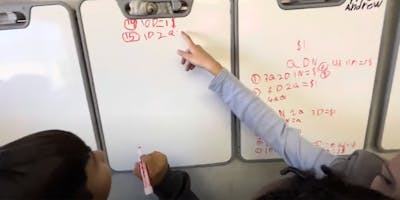
What was optimal? Having students work in groups at vertical whiteboards. Except it didn't have to be a whiteboard, it just had to be vertical and erasable. So like a window would work, the side of a file cabinet would work. … Blackboards worked. It just had to be vertical and erasable.
They stood in their groups.
Why standing?
It's not that standing is so good, it’s that sitting is so bad.
It turns out that when students are sitting, they feel anonymous, and the further they sit from the teacher, the more anonymous they feel. And when students feel anonymous, they disengage. And that's both a conscious and a subconscious act. And what standing up did was it took away their anonymity.
Just think back to the last time you went to a professional development workshop. Think about that. You were in this room and you were sitting down and you felt anonymous. And in fact, you may have put yourself in the back row of this room so that you could feel anonymous, so that you could disengage, right? This is not a phenomenon that's unique to kids. This is human nature.
So what was the optimal way to form a group? Well, it turns out that strategically constructing the groups like we see in a lot of elementary schools turned out to be a disaster. That was not conducive to thinking. Likewise, having students set their own groups was a dumpster fire — that was not conducive to thinking.
The optimal was to form groups at random. And it wasn't good enough that it was random. It had to be visibly random. They had to see that it was random, and it had to change frequently. About once every 60 to 75 minutes, we re-randomized.
And any task we give them had to be a thinking task. Thinking is what we do when we don't know what to do. If we already know how to do it, it's not a thinking task, it's an exercise.
Or busywork, I guess somebody might call it.
A thinking task had to be something that they don't know how to do — which means that if they're going to have to think, they're going to get stuck. But it also means that we can't pre-teach them how to do it.
So here we have in a thinking classroom: The students standing at the whiteboards in their random groups of three, one marker per group, working on these thinking tasks.
And that produced thinking classrooms. All of a sudden, overnight, we went from 20 percent of students thinking for 20 percent of the time to 80 percent of students thinking for 80 percent of the time.
You paint a pretty critical picture of common teaching practices. What are you doing to get the word out about these issues and your approach?
Building thinking classrooms is not a curriculum, first of all. It's a pedagogy, it's a framework for helping teachers enact whatever curriculum that they have to work with. Curriculum is mandated, pedagogy is professional. So this helps teachers enact whatever curriculum content that they have to get through.
And I respect teachers' professional autonomy. I think teachers should have the professional freedom to judge for themselves what's going to work for them. And if this is going to work for them, I'm there trying to support it. I don't want to mandate this because I don't believe that mandating pedagogy is an effective way to change pedagogy.
And it's like growing everywhere. … The projection for the number of teachers using it in Denmark is in the 90 percent [range]. It's starting to gain traction in Australia. And the book is also coming out in Mandarin. It's coming out in Korean, it's coming out in Greek and Turkish and Polish and French. And so we're starting to see this. It's all these exponential curves at different points of time.
Listen to the complete interview, including more details about what goes into a ‘thinking classroom,’ on the EdSurge Podcast.
The need to strengthen the science, technology, math and engineering (STEM) careers pipeline has received renewed interest lately.
Whether students can successfully flow through the pipeline to fill vital jobs in the country may have significance for the national interest, according to some observers.
So what would it take to make STEM truly open to would-be future scientists? A number of instructors say it’s partly reconsidering how calculus, a crucial step toward STEM careers and often a “weed out” course in higher ed, is taught.
With educators duking it out in the so-called “math wars” over the curriculum changes in California — which recommended delaying algebra, a critical juncture in the race to calculus in K-12 — the question rose to the fore this year. Noticing this, EdSurge traveled to Harvard this summer to observe one attempt at a more subtle revolution, meant to bring calculus instruction into the 21st century. The resultant piece — published in EdSurge and USA Today — struck a chord. And readers had a lot to say, both in favor and against the thesis.
Here are some of the more thoughtful responses.
Another Language
A reader from Utah: “For me the breakthrough was finding out math is just another language with its own grammar and syntax. It is a language that is very eloquent at describing what we see in the natural world, and like all languages conveys meaning and understanding. Memorizing formulas and equations is about as useful as memorizing poems as way of learning to write in English. Teach it as a language used to describe things and as a tool for real life problem solving.”
A teacher from Pennsylvania: “Been teaching calculus to HS seniors for 30 years. The issue is algebra skills. Those with strong algebra skills will excel at calculus. The weak algebra students weed themselves out. After all, if you understand what calculus is all about, you will realize that calculus is just algebra 1 ‘on steroids.’”
A parent from Iowa: “As it happens my daughter is a freshman in ME taking Calc 2 this semester and I was helping her study for her first big exam last night. While the content of the course has changed almost completely since I took it 40 years ago, in my opinion it is still way too based on memorizing dozens of formulas for the exams. No professional works that way. If you don’t happen to remember some formula or integral or whatever, (probably because you do it a lot), you just look it up and continue. Knowing *what* to do for a problem is a million times more important than having memorized some trivia about it along the way. IMO, this memorization-heavy approach is why so many of my fellow students flushed out of Engineering and why I never really understood it until my EE ‘waves and fields’ class let me see the ‘what and the why.’”
A reader from Illinois: “One of my favorite things about learning calculus the last year and half was the application to the real world. If anything, vectors and multi variable calculus should be taught sooner instead of last or not at all as it has the most applicability to the real world.”
The ‘Fail Out Course’
An educator from California: “This misses the bigger picture that the reason maths instruction like algebra keeps getting pushed to younger grades is because folks are trying to get the edge in getting into highly competitive universities. Get rid of the societal lies that everyone needs to go to college and everyone must strive to go to an Ivy League school rather than one that is their best fit. You will see more success all around.”
A reader from Minnesota: “A long time ago I was told my algebra was weak. I got As in middle school but soon as high school the teaching got muddled. Never got to master what I learned just basics but never felt confident in any math class from that point on. Can math be taught [or] is it just a gift. My college professor while he was teaching us announced to the class that math can’t be taught. So gave up on ever getting it. Great huh.”
A teacher from Kansas: “In college, calculus was a requirement for the business school. It was the fail out course. In MBA school it was only used in an economics course. That was it. In undergrad, when I switched out of music, I picked a new major by looking for something that I was interested in studying and didn't require calculus or organic chemistry. That was geography.”
A professor from Indiana: “I've taught calculus dozens of times, with diverse textbooks, quite successfully. Some texts overflow with fake ‘applications,’ but these hide the mathematical essence under a mountain of details. Students learn better from a straightforward treatment of the mathematical essence.”
Education is an indispensable profession in our world today, as teachers play a pivotal role in equipping students for the challenges of the future, enabling them to be successful at every stage in life. The positive impact of teachers has been extensively substantiated through years of research highlighting that teacher effectiveness is the most important school-based factor related to student achievement and outcomes. As a former teacher, I recognize that having the foundational resources and supports allows for greater effectiveness in the significant work of nurturing student success.
Enhancing Teacher Practice Through Professional Development
Students must have high-quality and engaging real-world applied learning experiences where they develop technical and employability skills that will set them up for success throughout school and beyond.
Project Lead The Way (PLTW) knows how important it is to support teachers so they are able to make a difference for students. That is why PLTW Core Training allows teachers to engage actively in their learning and collaborate with other educators. And it is making a difference: 74 percent of teachers reported that PLTW Core Training made them more effective as a teacher, and 68 percent of teachers reported that PLTW Core Training has had more of an impact on their teaching practice than other professional development. From PLTW research, 67 percent of teachers felt PLTW made them more satisfied with their careers.
Cultivating Students’ Lifelong Learning and Career Exploration
A core belief of PLTW is that students can’t be what they can’t see. Students must have high-quality and engaging real-world applied learning experiences where they develop technical and employability skills that will set them up for success throughout school and beyond. Additionally, students must be able to see themselves in the wide array of career opportunities that are out there. PLTW has heard from students regarding how valuable their courses are because they help expose them to and engage them in STEM subjects and prepare them for life beyond K-12.
There comes a point very early in a child’s educational experience where they self-select themselves in or out of subjects like math and science. Students who haven’t had experience with those content areas often self-select out. PLTW Launch curriculum for preK-5 students was created to address this. Studies indicate that early exposure to STEM is associated with increased interest in STEM and increased academic performance. PLTW strives for students to experience an engaging, hands-on way to learn about engineering, computer science and biomedical science. This provides students with opportunities to see what they like and what they are great at. One student shares, “If PLTW was never a thing, if it never existed…I would’ve not become the person I am right now. I wouldn’t have learned robotics. I would’ve not liked coding. I would’ve not discovered something I really love.”
In PLTW courses, students use the software, hardware and tools that are used in the industry, leveraging programs such as CAD, C++, Python and AutoDesk Inventor. This development of technical skills provides a foundation students can build upon in higher ed or the workplace. Additionally, students hone employability skills such as critical thinking, problem solving and collaboration in their PLTW classroom. "All of the skills I have gained in those aspects — collaboration, critical thinking, problem solving — come 100 percent from PLTW classes,” declares one student, “Without the PLTW classes, I would not be where I am now with being able to collaborate and solve problems.”
Developing and leveraging partnerships through a STEM ecosystem is how we can ensure students are equipped to be successful and how we can do this work at scale across our nation.
The Role of Partnerships in Advancing STEM Education
This underscores the significance of the work accomplished by PLTW, an organization created and led by educators to support teachers and students. But PLTW can’t do this work alone. Schools can’t do this work alone. Developing and leveraging partnerships through a STEM ecosystem is how we can ensure students are equipped to be successful and how we can do this work at scale across our nation. We need to ensure students have experiences that change their STEM identities and help them build a social network. This comes from immersive experiences — both inside and outside of the classroom.
It is important for teachers to have a STEM ally, providing them with an engaging curriculum to implement in the classroom, as well as professional learning that allows them to thrive in their careers. PLTW wants to play a role in shaping what is next for students: helping students develop relevant skills and giving students exposure and experience with potential career opportunities they might never have dreamed possible.
At Project Lead The Way, our goal is for all students to have access to STEM experiences and thrive in school, career and beyond. We know this is only possible if students have caring, engaged and equipped teachers to facilitate their learning. Therefore, our mission is to provide hands-on, immersive learning experiences for students and applicable, engaging professional development for teachers.
Calculus is a critical on-ramp to careers in science, technology, engineering and mathematics (STEM). But getting to those careers means surviving the academic journey.
While there’s been progress of late, it’s been “uneven” and Black, Hispanic and women workers are still underrepresented in some STEM fields. Traditional methods of calculus instruction may be knocking students off the path to these vital occupations, which is why advocates warn that getting diverse students into these careers may require instructional models more responsive to students. Meanwhile, the country is struggling to fill vacancies in related fields like semiconductor manufacturing, despite sizable investments — a feat that may require stabilizing the pipeline.
Good news: There's mounting evidence that changing calculus instruction works for the groups usually pushed out of STEM. At least, that’s according to a randomized study recently published in the peer-reviewed journal Science.
The study — which involved 811 undergraduate students at Florida International University, a large public university in Miami — is perhaps the biggest randomized study of active learning methods in calculus, says Laird Kramer, a physicist at the university and one of the study’s authors. Researchers tapped alternative models of calculus teaching that have shown evidence that they work, according to Kramer.
The study, which occurred over three semesters, randomly assigned students to either learning through lectures, the old-school way, or through “active” calculus instruction that emphasizes student engagement. Those active methods limited the amount of lecture time, instead focusing on small groups and using “learning assistants,” other undergraduates who were on the teaching team. Instead of sitting through lectures and working through procedural rules, students in the experimental groups were expected to focus on calculus concepts such as derivatives. Outside of class, they worked on problems on their own, while during class, they thought like mathematicians by reasoning out problems with limited guidance.
Its conclusion? That the traditional lecture method of teaching calculus isn’t as effective as active models. Those who learned from active methods did significantly better across race, gender and major, according to the study. (Students majoring in biology saw the biggest bump.) Over each of the three semesters of the experiment, there was a “medium/large effect size.”
It’s common for students who are used to learning math from lectures to be reluctant to think critically at first, learning assistants from the study say. But eventually, they get it. “[The students] move away from that algorithmic knowledge of mathematics, just following steps and just working like a little robot,” says Daniela Zamora Zuniga, a former economics student who was a learning assistant from 2019 through 2022.
Zuniga, now graduated, learned calculus through the active learning model, and it led her to pursue math courses outside of the degree requirements, she says.
That’s similar to something she noticed in other students who took the course. The students she’s kept up with, Zuniga says, report carrying an understanding of calculus forward into other STEM courses. That can relieve the pressure they feel around advanced math, freeing up mental space to devote to science, Zuniga adds.
Sometimes, in these classrooms, students who are apprehensive of calculus because they might have weak background knowledge can end up being the best students, says Juan Sanchez Quintana, a senior at Florida International University who was a learning assistant during the study. Quintana assisted the experimental classrooms, and says that his participation has fueled his desire to teach college math after he graduates. Quintana, a math education major, estimates that he’s been a learning assistant for about 120 class periods. In the end, he came away as a proponent of the model, because “I’ve seen it work.”
That these newer methods of teaching impart more learning isn’t surprising to the study authors. But, Kramer says, the research does serve a purpose by adding to the store of evidence that these methods work. He and his co-authors hope that bringing scientific rigor to the studies of these methods of teaching calculus might sway skeptical colleagues to change how they teach.
Widening the Gateway
As a gateway course to STEM, calculus can be seen as a make it or break it moment for students, especially ones who are typically excluded from these careers. “If you're struggling, it's a barrier for you,” Kramer says.
In conducting the study — funded by the National Science Foundation — researchers wanted to let students experience what it’s like to be a mathematician.
The researchers figured that Florida International, one of the largest public research universities in the country, had a unique chance to help students who are underrepresented in STEM disciplines better connect with the subject matter. The university has a lot of Hispanic and women students, two underrepresented groups, the study notes. Whether many of those students pass calculus varies: In the six semesters leading up to the study, the pass rates for introductory calculus — which included classes taught using some limited active learning methods — spanned from 13 to 88 percent. Failure could mean potential biologists, mathematicians or engineers being pushed out of the field.
Kramer and others have been experimenting with active teaching methods for a number of years, and wanted to break the notion that some students are born with natural abilities in calculus and that teachers are supposed to identify the gifted few. “Our study shows that [any] student can grow” under the right circumstances, Kramer says. “And that's really our responsibility as faculty, is to put students in environments where they can succeed, and [where] they are going to be able to achieve things that they might not have thought possible.”
Kramer projects certainty that these models are effective. These ways of teaching can be a lot more fun, too, Kramer says. But they break the preconceived notion of calculus as a weed-out course, he says, which can raise the hackles of professors skeptical of education research, and that increases the need for strong evidence.
Will this latest study be enough to convince colleagues to wander away from traditional lecturing methods?
“It should be very compelling evidence to anybody who looks at the study,” Kramer says. But people are messy. “My suspicion is that people will even be skeptical over this, even though it has a strong effect size, we've taken care of all the potential biases, as best as humanly possible, and it is published in Science, which is known to be an extremely rigorous process,” Kramer adds.
Instructors may still cling to lecture models, Kramer says, perhaps because “it helps their ego that they get to be the sage in front of a bunch of students professing how awesome they personally are.”
Nevertheless, there were possible limitations to the experiment that bear mentioning.
While the researchers say it was impossible to randomize the teachers, since the instruction relies on specialized knowledge, students were randomly assigned to either traditional classes or active learning classes. Randomizing the teachers could have raised more problems than it solved by introducing potential biases around active learning, Kramer argues.
But for some observers, this is a notable limitation. Jon Baron, a former chair of the National Board for Education Sciences and former vice president of evidence-based policy for Arnold Ventures, has called the study “encouraging but less than definitive” since it failed to randomly assign teachers.
A learning assistant noted another potential hindrance: These models don’t inspire as much enthusiasm when taught online.
When Quintana, the learning assistant, took calculus during the pandemic campus closures, the active learning methods were already in place, he says. But, Quintana notes, because students like himself were so fatigued by virtual learning, it didn’t really have as big of an effect. They didn’t interact in the breakout sessions as much, and didn’t really want to be there.
Still, to Quintana, it beat suffering through lectures.
“I can't even think how long it would have been for me to take calculus without any type of active learning, like, no learning assistance at all,” Quintana says.
CAMBRIDGE, Mass. — Math professor Martin Weissman is rethinking how his university teaches calculus.
Over the summer, the professor from the University of California at Santa Cruz spent a week at Harvard to learn how to redesign some of the math courses his institution offers related to life sciences. Right now, they are part of a “leaky pipeline,” Weissman said. Thousands of students go through these courses, he adds, but a lot of them don’t graduate with degrees in those fields.
Falling off that path can lock students out of science, technology, engineering and math (STEM) careers. And despite some “uneven” progress in recent years, STEM fields are just not as diverse as industry leaders would like. Some educators place a share of the blame on calculus courses, which can push out otherwise interested students.
That’s a phenomenon Weissman noticed at his university. “There are math requirements for those majors. And students slowly seep off and change majors because they have difficulty with the math,” he says.
UC Santa Cruz sees a lot of underrepresented students disproportionately drip out of that leaky pipeline, Weissman says. That includes a number of Black, American Indian, Alaska Native and Hispanic students. Biologists at the school look at the math taught in traditional calculus courses, he adds, and wonder why it’s even being taught, because the math isn’t practically useful for the field. Meanwhile, the calculus instruction has to be slowed down enough that it’s not as effective for math people as it could be.
“I think we're in an uncomfortable zone, where a lot of calculus classes are serving no one,” Weissman concludes.
Around the country, “math wars” are raging over attempts to increase equity by playing down calculus from the curriculum in favor of statistics or computer science, or by delaying when students take algebra. But there’s also a quieter revolution taking place that applies a different strategy to achieve the same principles. Its aim is not to abandon calculus, but rather to yank calculus instruction into the 21st century, by teaching students through the use of real-world problems. Changing the way calculus is taught, proponents argue, helps more students find math approachable and relevant, making them therefore more likely to succeed while studying it.
This is the more responsive approach that Weissman studied in July at Harvard, where he joined two dozen other college educators from around the country, tucked inside the air-conditioned, blackboard-walled rooms of Harvard’s Science Center. The week-long training ran from mornings into afternoons, with chummy lunch breaks in the faculty lounge, or the buzzing cafe in the Science Center lobby. The educators sat through lectures on pedagogy, the finer points of math and how to apply it to actual biological problems.
Sessions were prone to explanations such as how “physics-based simulations” became the buzzword in Hollywood, leading animation teams to use modeling techniques for hits like “Frozen,” “Brave” and “Toy Story,” which include life-like representations of walking through snow and bouncing curly hair. These digressions were placed alongside technical explanations of “cardiac defibrillation,” the rippling of electrical pulses as they move through the heart, as a way to show how to connect complicated math to the world outside of the classroom.
The training also had the educators plan, observe and teach classes based on these principles to eager high schoolers enrolled in a summer camp on campus.
The teaching experts who sponsored the training hope it will prepare college instructors to become “advocates,” empowering them to explain and defend the rigor of this way of teaching calculus to skeptical scientists from other departments. They expect it to be only the opening shot in an academic revolution.
But if calculus instruction is going to change, it may take some persuasion.
A Silent Revolution
The trouble with calculus is widely understood. The solution? Less so.
As these Harvard training sessions took place, the California State Board of Education finally approved a new framework that sets out to make math more culturally responsive and inquiry-based. It’s an attempt to respond to some of the pressures Weissman identified by kindling students’ math interest.
But it’s been controversial, causing “knock-down, drag-out math wars” that have included parent protests, threats and academic-on-academic social media spats about whether calculus should be reworked. That’s in part because the framework prioritized alternatives to calculus and also recommended delaying Algebra I, an onramp course to high school math and a critical juncture in the race to calculus, until ninth grade for most students. Critics have alleged the framework rejected rigor for “wokeism.”
In fact, many of recent attempts to keep calculus from being an obstacle to a STEM career focus on deemphasizing calculus, instead directing students to take other math courses like statistics or computer science.
The idea for the Harvard sessions came from a quieter attempt to revolutionize math instruction, relying on similar ideas, emanating from the University of California, Los Angeles.
Over the past decade, UCLA revamped its calculus for life sciences courses, focusing them more strictly on math concepts and real-world biological questions, rather than on procedural rules for derivatives and integrals — which its advocates describe as a paradigm shift for calculus instruction.
This idea is what drew instructors to sweaty Cambridge in July. UCLA’s model caught the attention of the Harvard math department, which decided to host a training over the summer for college instructors looking to refashion their own calculus courses. The session was meant to catalyze change, encouraging those instructors to open their own revised courses modeled on the ones being taught at UCLA.
A room of educators gets schooled on the rigors of mathematical modeling in the life sciences. Photo courtesy of the Harvard University Department of Mathematics.
As part of that, the college instructors observed and taught lessons to teenagers participating in a summer program being hosted at the same time at Harvard. It was meant to allow the educators to see these new methods in action, and to try them out personally.
In an early morning class, bleary-eyed and still vibrating from coffee, the instructors met with high school-aged students. The students had previously “warmed up” by grappling with datasets on COVID-19 mortality rates, trying to figure out what that data meant for policy.
“What’s your morning process?” the instructor asked.
The students, broken up into groups around tables, considered the question. “Brushing teeth” was the most common response.
The students then learned to map out the likely impact of teeth scrubbing on plaque growth, before pivoting to other possible applications of advanced concepts like vector spaces and differential equations.
During classes like this, instructors for the program studiously referred to these methods as “change equations,” a non-threatening phrase substituted to prevent the high schoolers from shying away from intimidating language like “differential calculus.” It’s connected to the claim that these classes can capture the rigor of advanced math, only without the anxiety it usually brings.
That’s a key part of the sales pitch for the course. “Our class has no prerequisites. Period,” says Alan Garfinkel, one of the UCLA professors who designed it, when asked by a teacher about talking to students about prerequisites in calculus.
That’s not typical. When this subject is usually taught, it’s done procedurally. Students are given a set of rules for solving these equations and then drilled on them, with the “why are we learning this?” question answered afterward. But students in these classrooms confronted the problems they wanted to solve first, only getting the equations after the curiosity had set in.
It left an impression. “Today I got to be a teacher again! Euler’s method to 20 amazing High School students with varying levels of mathematics background! Loved honoring that mathematics is a web of ideas as opposed to a linear trajectory filled with pre-requisites,” one instructor posted on social media.
Many of the educators at the event said they were attracted by the desire to increase student engagement and to make math more relevant to students’ lives.
But the impact the educators hope for reaches beyond the classroom, too. If high school and higher education can get more students to reason mathematically, it will make them productive thinkers, says Lindsey Henderson, a secondary math specialist at the Utah State Board of Education, who attended the training. That’s what the businesses in Utah’s Silicon Slopes, the state’s burgeoning tech sector, say they want, she adds.
For Weissman, of UC Santa Cruz, the fact that this course is being taught at a large institution already is important. When it comes to math instruction, he says, “There are always people promising revolutions.” But UCLA’s method does seem to work for large institutions, according to Weissman. The University of Arizona now offers a version of the class. A study of the course published by its creators suggests it’s been successful in engaging underrepresented students.
And Weissman doesn’t foresee much of a fight in implementing it: “I'm not beholden to a traditional textbook, so I don't have to make sure that I cover certain methods that I really do think just don't need to be taught anymore.”
Change Equations
At the same time the week-long workshop for instructors took place, Harvard also ran a two-week program for high school students based on the idea that high schoolers can be taught to solve problems using principles of advanced calculus.
The teacher workshop included designing and teaching classes to that class of 36 high schoolers, something the attendees weren’t warned about more than a day or two before.
“We wanted a way to have workshop participants see what's possible in the classroom,” says Brendan Kelly, the director of introductory math at Harvard and one of the event organizers. If you haven’t seen students thinking through the problems, it can be hard to vividly imagine what it might look like in your classroom, Kelly says.
The traditional sequence for math in middle school and high school is algebra I, geometry, algebra II/trigonometry and then pre-calculus, with advanced students making it to calculus. Increasingly, calculus is seen as a necessary bolster for competitive college applications.
For the high school summer program at Harvard, though, only algebra II was required. Students at the program had mostly taken AP Calculus, though not all of them had. One student said she had only taken pre-calculus before entering the course.
Student campers gave high marks to the experience.
“For me, like, I've honestly never considered a major in math,” says Judy Yen, a rising junior from the private Taipei American School in Taiwan. Yen wants to enter the medical profession, and the course left her considering a math double major or minor in her future, she adds.
For others, the lesson was that math can lead to benefits beyond school. “I can actually get jobs rather than just studying. Really, I can actually, maybe get a job that's related to math,” says Charles Sciarrino, a rising senior from Staten Island Academy, a college preparatory day school in New York. “And I just find that really cool,” he adds.
Still, it was a Harvard summer school class, implying that most students who participated not on scholarship had access to the funds to afford summer school in Massachusetts — which cost $5,300 for tuition and room and board for the two-week program — not to mention a prior interest in math. Will it translate to other schools and contexts?
There’s some privilege there, Kelly admits. But he firmly believes that the learning that happened there is possible anywhere: “I think it's a real deficit mindset to think that first-generation or low-income students wouldn’t have that same enthusiasm and curiosity. I just fundamentally disagree with that. Young people are curious about the world. And when you put compelling questions in front of them, they respond with excitement and engagement.”
The 28 educators at the workshop training seemed positive. “The course helps gain access for a broader range of student populations, for us to get students excited about math and cross-pollinate to all the other divisions as well,” says Steven LeMay, an associate professor at Curry College, a private college in Massachusetts, who attended the training.
LeMay was tasked with figuring out whether the revamped calculus will work for Curry, and he seemed generally optimistic. Curry College likely won’t have the fight that UCLA reported in attempting to transition its students, LeMay predicts. The college doesn’t have a standalone math major, and there’s been a push from LeMay’s colleagues to freshen the school’s technology use, LeMays says.
Other higher ed instructors, however, expressed concern over whether it would translate into their less resource-rich colleges. Their institutions, they say, were worried about whether their students would get transfer credits at other colleges for these courses, and they were skittish about possibly disrupting their own institutions’ math departments by keeping students from more traditional calculus classes.
In the end, Kelly of Harvard says, the dream is to have similar courses that integrate calculus concepts in life sciences, economics, social sciences, physical sciences and engineering taught at colleges and high schools. (Kelly has taught a similar modeling course for economics and social sciences for the last few years.)
But it’s hardly a foregone conclusion. One major challenge to spreading this method of math instruction more broadly? Money. The Harvard summer training was popular with potential teachers, but it was hard to get funding to support the program, Kelly says. He reports that he was unsuccessful twice in applying for a grant from the National Science Foundation — which Kelly attributes to a general lack of enthusiasm for attempts to alter calculus and a belief that it wasn’t a proper training course — but it was funded by a gift from an anonymous Harvard alumnus to the math department. Continuing the work will mean securing sustainable funding, he adds. That may be easier now that the first session has wrapped up, Kelly predicts.
But it’s still early days, Kelly says: “I think across the country, we are barely getting off the ground.”
 Login
Login