“Fueled by teacher shortages,” we’re told in a recent article in The74, “Zoom-in-a-Room” is making a comeback.
If this is the case, although it’s better than the alternative—no teacher at all—it’s also a missed opportunity for deeper innovation.
As reporter Linda Jacobson noted in the article, online learning has long been used in schools for subjects they couldn’t otherwise offer. She cited A.P. Calculus and Latin as examples. But even courses we think of as fundamental—physics, for example—have long been glaring areas where schools haven’t had qualified teachers. As I wrote nearly a decade ago, “less than two-thirds of high schools–63%–offer physics. Only about half of high schools offer calculus. Among high schools that serve large percentages of African-American and Latino students, one in four don’t offer Algebra II, and one in three don’t offer chemistry.”
According to Jacobsen, “as districts struggle to fill teaching vacancies, they are increasingly turning to companies like Proximity to teach core subjects.” The practice is one in which the teacher of record delivers whole-class learning virtually, and an in-person monitor—often a substitute teacher—tracks behavior and ensures students do their work.
In some ways, this use of online learning could be a classic case of a disruptive innovation, which begins as a primitive innovation. As a result, disruptive innovations typically start by serving areas of nonconsumption—where the alternative is nothing at all. By outperforming this alternative, disruptive innovations can take root and improve over time until they take over.
Back in 2008 when we published Disrupting Class, we suggested that teacher shortages could represent a significant area of nonconsumption into which online learning could make its mark and begin to transform classrooms from monolithic, one-size-fits-none environments to student-centered ones that customized for the individual needs of each and every learner.
But for this to occur, the use of online learning shouldn’t just be to pipe in a virtual teacher that delivers more one-size-fits-none, whole-group instruction. It would seem that there’s not a lot of room for improvement in that model.
Instead, schools ought to be taking these opportunities to do what Heather Staker and I described in Blended—offering a la carte online courses with great digital curriculum mixed with elements of the Flex or Individual Rotation models of blended learning that match the path and pace of each individual’s students’ learning needs.
Just as Teach to One uses a mix of in-person and online teachers to deliver a personalized-learning pathway for every student in middle-school math, so, too, could schools begin to assemble blended-learning options that leverage virtual teachers but do so in formats that move beyond standardized instruction and incorporate a variety of engaging learning modalities; ranging from direct instruction tailored to a novice learner’s level to rich, real-world projects that allow a student to apply their learning of knowledge and skills in real performances, and from heads-down, solo learning experiences with software, offline work, or virtual tutors to small-group conversations and explorations.
These sorts of models would take advantage of the online format by delivering a tailored learning experience for each student rather than beaming a remote teacher into classes to do the same old, same old that hasn’t been working—and, as we saw with “Zoom-in-a-room” during COVID, was likely even less effective.
As Mallory Dwinal wrote in 2015 when she explored the opportunity for innovating where there are teacher shortages, states could also help by allowing these experiences to move away from seat-time requirements to mastery- or competency-based learning and giving districts some resources to evaluate and select the appropriate learning models.
So here’s my challenge to districts: Next time you see a teacher shortage, don’t just sub in a virtual teacher and fill the seat. Instead, get creative with a clear and smart goal of boosting every child’s learning. Spend a bit of time thinking about how this could be an opportunity, not a threat. And use virtual talent to design a much more robust learning experience for all. That would be something worth talking about.
Most states (29 states and the District of Columbia) use a weak elementary teacher reading licensure test, meaning that they do not effectively measure teachers’ knowledge of scientifically based reading instruction prior to entering the classroom, according to a new analysis from the National Council on Teacher Quality (NCTQ).
In fact, one state, Iowa, requires no reading licensure test at all. This shortcoming means that, every year, nearly 100,000 elementary teachers across the country enter classrooms with false assurances that they are ready to teach reading.
More than 50 years of research has illuminated the most effective way to teach children to read. It requires systematic, explicit instruction in the five core components of the science of reading: phonemic awareness, phonics, fluency, vocabulary, and comprehension. Preparing teachers to teach these five components–known as scientifically-based reading instruction–can ensure more than 1 million additional students enter 4th grade able to read each year.
Unfortunately, far too often, states allow teachers into the classroom inadequately prepared to teach reading. Licensure exams, if rigorous and aligned to the science of reading, can serve as an important guardrail for making sure teachers have this critical knowledge. However, many licensure tests are weak in that they do not adequately assess teachers’ preparedness to teach reading. Far too many states are using these weak tests.
“Every child deserves great reading instruction, but far too many children aren’t receiving it,” said NCTQ President Heather Peske. “As part of a comprehensive strategy to improve reading instruction, states can help ensure teachers are prepared to teach reading effectively by requiring stronger licensure tests.”
Examining every elementary teacher reading licensure exam currently being used by states, NCTQ looked for evidence that the tests adequately address the five core components of reading. NCTQ also examined whether these tests devote undue attention to methods of reading instruction that have been debunked by research and can hinder students from becoming strong readers, such as three-cueing.
Additionally, NCTQ checked whether these tests combine reading with other subjects. This is important because if subjects are combined, the teacher’s understanding of reading could be masked. Using these criteria, NCTQ determined whether tests were strong, acceptable, weak, or unacceptable.
Key national findings:
Of the 25 elementary teacher reading licensure tests in use by states, the majority (15) are weak. Just six exams are rated “strong” and four are rated “acceptable.”
Across these 15 weak licensure tests: Ten do not adequately address all five components of the science of reading and five combine reading with other subjects, such as social studies or science. (Note, one test fits into both categories listed above.) One includes too much emphasis on content contrary to research-based practices.
The majority of states (29 states and the District of Columbia) use “weak” tests that do not signal whether teachers have the knowledge they need to teach students to read.
“Teachers who aren’t prepared in the most effective instructional practices for teaching reading unknowingly enter classrooms ill-prepared to help students become successful readers,” said Peske. “This lack of preparation has a profound impact on students’ literacy skills and future prospects, especially among students of color and those living in poverty.”
Roughly one-third of children in elementary classrooms across the country cannot read at even a basic level by the middle of the fourth grade. The situation is even bleaker for historically marginalized students, for whom inadequate reading instruction is yet another barrier to educational equity, with 56 percent of Black students, 50 percent of Hispanic students, 52 percent of students in poverty, 70 percent of students with disabilities, and 67 percent of English Learners reading below basic reading levels.
Students who are not proficient readers are four times more likely to drop out of high school, face lower lifetime earnings, and have higher rates of unemployment.
Recommendations
To address this pressing issue, the NCTQ recommends the following solutions.
State education leaders should:
Transition to a stronger reading licensure test: States select and approve the tests that their teachers must pass for licensure. Requiring a stronger test will likely lead to better reading instruction in elementary classrooms across the state as preparation programs will be motivated to align their courses with the components of reading addressed in a stronger test.
Require a strong reading test for anyone teaching students in the elementary grades. In some cases, states require reading tests for general education elementary teachers but not for special education teachers or for early childhood teachers who are licensed to teach lower elementary grades. These loopholes ultimately hurt the students who most need teachers capable of building a foundation in literacy.
Testing companies should:
Shore up weaknesses and clearly identify limitations in existing tests: Both major testing companies, ETS and Pearson, have strong and acceptable reading licensure tests on the market, but they also offer tests that omit numerous topics from the core components of reading, and that combine reading with other subjects, diluting the assessment’s ability to verify teachers’ reading knowledge.
Paula Stamey, a seventh-grade social studies teacher in Benton, Tennessee, taught for 20 years before her school became a Verizon Innovative Learning School and adopted one-to-one technology in 2017. Initially, she resisted this change, feeling it was unnecessary and distracting. “I felt I had a system that worked, and introducing this ‘nonsense’ wouldn’t add anything to my classroom and would only create more work for me and be a distraction for my students,” she said. She had her students put their devices away when they entered her classroom and continued teaching the same way she had for the last two decades.
But when the COVID-19 pandemic shut down schools in March 2020, Mrs. Stamey realized that everything she had been doing suddenly needed to become digital. She knew she had to prepare herself for what may come, so she thought back on what she had learned during her initial Verizon Innovative Learning Schools learning experiences and began diving into every professional development and certification opportunity she could find. “I wanted to have as many tools in my belt as possible when the new school year rolled around,” she said.
Educators often experience professional development as a patchwork of different providers and formats disconnected from district initiatives, characterized by a mostly passive delivery model with few opportunities to connect learning to the local context or to extend learning into meaningful classroom practice.
Mrs. Stamey is not alone in her initial reluctance to use technology in her classroom. While she had time to change her mindset and be intentional with how she added technology into her teaching, so many teachers have grappled with the rapid influx of technology since districts hastily adopted one-to-one programs in a scramble to offer distance learning solutions for students during the pandemic. The heroic accomplishments of district and school leaders, IT leaders, teachers and parents to keep learning happening amidst the unprecedented events revealed two essential truths about one-to-one programs:
The steady advances in educational technology — including devices, connectivity and software — affirm its tremendous potential to support teachers with powerful tools capable of reaching learners in vast and varied ways.
The challenges for implementing a one-to-one program effectively to maximize that potential are complex, intertwined and not easily solved.
As schools enter their third year post-pandemic, they face challenges like aging devices and the need for robust systems supporting device procurement, connectivity and maintenance. Educators require support in harnessing technology for diverse student needs, emphasizing digital competencies and 21st-century skills. To address this, comprehensive professional learning integrated into one-to-one programs is crucial for sustainable digital transformation. It aligns district and school leaders' vision with systems for implementation, ensures IT support for device access and equips educators for student-centered learning. This comprehensive approach aligns with Digital Promise’s soon-to-be-released Digital Equity Framework, fostering meaningful improvements in student outcomes.
Still, empirical research into what makes professional development effective at developing new skills and in changing instructional practices that impact student learning point to several effective practices that can inform the design and delivery of the type of professional learning that is needed for districts and schools to transform their one-to-one programs into high-impact models. Our experiences supporting districts to implement successful one-to-one programs through the Verizon Innovative Learning Schools program over the past 10 years revealed these evidence-based keys to effective professional learning:
Coherent and Sustained Duration. There is a consensus among researchers that educators benefit from sustained and ongoing professional learning that is connected to both district and school initiatives and grounded in a local context, with some suggesting approximately 50 hours in a specific area. Unlike one-off workshops that may spark interest in the short term, repeated opportunities to engage with concepts and develop related skills over time are essential for educators to transfer what they learn from professional development sessions into new classroom practices. The multi-year professional learning program for Verizon Innovative Learning Schools supports learning for multiple stakeholders responsible for the successful implementation of one-to-one programs. The scope and sequence of professional learning for each stakeholder ensures numerous hours of coherent and connected content intended to spiral the development of the high-leverage knowledge and skills for each role. The numerous touchpoints over time allow concepts to develop, prompting regular opportunities to practice and refine application across all aspects of implementation.
Active and Responsive Learning. An active learning model promotes deep cognitive engagement and opportunities to practice while remaining responsive to individual learning needs. Feedback from experts and peers is essential for an active and practice-rich professional learning model. Furthermore, offering learners agency and choice with regard to paths and pace increases active learning and can increase their engagement. We accomplish these goals in a number of ways as part of our instructional design process. First, we lean into designing learning for multiple modalities, both synchronous and asynchronous. Live synchronous sessions are rich in modeling and collaborative meaning-making. Asynchronous sessions are more flexible for learners who can explore concepts and examples based on their interests and areas for growth. Finally, we provide bite-sized practice opportunities in the classroom, enhanced by on-the-ground instructional technology coaching. This adds motivation and enables real-time feedback for reflection and skill improvement. Verizon Innovative Learning Schools coaches are the centerpiece for an active and responsive professional learning model, constantly connecting learning to the local context and supporting ongoing cycles of practice, feedback, reflection and sense-making.
Collective Participation. Being intentional about collective participation speaks to the benefit of pursuing professional learning with others from the same school or district, which can increase peer-to-peer support and spur ongoing learning outside of the structured professional development sessions. The cohort model of the Verizon Innovative Learning Schools program means that learners from different roles engage in professional learning tailored to their individual contributions for one-to-one implementation, which supports collective participation. This collaborative approach is heightened through our promotion of online professional learning communities. To this endeavor, we leverage community spaces, both online and through in-person and virtual events, to connect learners within districts, across districts and across cohorts in different stages of implementation.
Mrs. Stamey never went back to her old ways of teaching. “Once I allowed myself to finally give in to technology and I saw how much it increased student engagement, I began to let go of other ‘old school’ notions of what a classroom should look like and how a class should function,” she said. Thanks to insights gained from her professional development, Mrs. Stamey has created a classroom where students have a choice in what they work on and how they work on it. “I don’t think any of this would have been possible without Verizon Innovative Learning Schools… letting me see just how much more I could give to my students,” she said. “I feel more invested and engaged in my career than I have in a long time.”
In our increasingly digital world, educators recognize the significance of integrating AI tools in the classroom. AI integration can address diverse learning needs, promote data-driven decision-making, and spur class discussion. Leveraging AI in the classroom can enhance teaching while preparing students for a future where AI is integral to the workforce. It is essential for educators to tap into professional development (PD) opportunities to advance their understanding of how to use AI to improve the classroom experience.
ISTE U serves as a digital hub offering top-tier professional learning courses designed to assist educators in developing fundamental skills for teaching and learning in a digital world. Recently, EdSurge spoke with Chelsey McClelland, a third-year social studies teacher at Lawrence North High School in Indianapolis who recently completed the ISTE U course Artificial Intelligence Explorations for Educators.
EdSurge: Why did you decide to take the ISTE U AI course? What were your goals?
McClelland: One of the things that piqued my interest in the ISTE U course was that I didn't know much about using AI. I knew of ChatGPT from reading articles online, but I didn't know how it worked. I was just worried that my students would use this to write all their essays! And at first, our school blocked its use. I think all educators grew concerned.
I was at a crossroads; I didn't want students to use it because I didn't want academic dishonesty, but I also knew this technology would not go away. I thought it was really important to take the course because if I don't learn how to use it effectively and I don't learn what it is, then I won't be able to convey that to students. I'm doing them a disservice if I don’t learn about AI.
What elements of the course structure and content were particularly effective in facilitating your learning about AI?
The instructor was really supportive. The course seemed more focused on my outcomes — on my learning and applying the material — rather than meeting a deadline. I loved that the course was asynchronous and self-paced. As much as I love being a part of live PDs and collaborating with other educators across the country, it's really hard to do that weekly.
In the ISTE U course, we could regularly chat with classmates through posts and replies. I could still connect with educators but without having to be on a [video conference call], especially considering different time zones and start dates for school. My school started in early July, so I finished the course during the first few weeks of my school year. I appreciated having the flexibility to say, I'm super swamped this first week back at school and don’t have time in the evenings; I'm just going to sit down and do this on Sunday when I'm doing my lesson planning.
I think of it as levels of taxonomy: AI can give us a basic understanding, but then students need to analyze and create from there.
— Chelsey McClelland
I really loved that every module opened with a fun way that AI can be used — it's not just ChatGPT writing an essay or MagicSchool AI making your lesson plan. One of my favorite activities was giving prompts to different generative art AI bots, resulting in completely different designs. Even the AI tools that are trained using the same information could still give unique results! This later became a great discussion point with my students.
Another great example from the course was a whole lesson on deepfakes, which involve creating audio or video of situations that never actually happened. Being a government teacher and teaching about political elections, I'm really excited to apply what I’ve learned in my classroom. This will help me educate students on spotting deepfakes and discussing the possible implications.
The crux of what I got from the course, which has helped me a lot in approaching AI and how to use it in the classroom, is that there are so many things to learn. As educators, we often think that it’s bad for students to use ChatGPT and that it's going to lead to them not learning anything. But we can't knock students for not knowing how to use it properly if we don't know how to use it properly ourselves; we need to teach them in what context to use AI and how to do it in an academically honest way.
Watch to learn more about the ISTE U course Artificial Intelligence Explorations for Educators.
AI can teach kids content, but it doesn’t teach them how to apply it. That’s our job as teachers.
— McClelland
Can you share specific examples of how you integrated AI concepts or tools into your teaching practices as a result of taking this course?
I work in a school with an emerging multilingual population, and AI has been so beneficial in helping me scaffold resources to make them more accessible for my students. Especially in a social studies classroom where I’m working with a lot of primary sources, sometimes it's hard to figure out how to break down that language so that English learners are still accessing the same content but not losing the academic vocabulary.
In government class the other day, we used AI to gather background information on past political parties. Once students understood the basic points, we then discussed how those parties may have merged into modern political parties.
I have also held class discussions about how AI works and how it is trained with information from the internet. This leads to conversations around what problems could arise. I ask students, “Could AI be trained on bad information? What can we do about that?” We discuss how we can’t blindly trust AI; rather, we can use it as a baseline to build knowledge. I think of it as levels of taxonomy: AI can give us a basic understanding, but then students need to analyze and create from there.
What advice can you offer other educators looking to learn more about integrating AI in their classrooms?
If we as educators are trying to prepare students for the world of college and careers, we must train them to use AI tools responsibly.
— McClelland
Don’t be afraid of AI. It seems like there exists this fear that AI will replace teachers. AI can teach kids content, but it doesn’t teach them how to apply it. That’s our job as teachers. Our role is changing a bit, but for the better. Now, we don’t necessarily need to spend as much time teaching the baseline information. Instead, we can do more projects, engage in more class discussions, and help students apply that information.
I encourage teachers to find their online communities. I follow several edtech accounts that offer ideas on using AI in the classroom, and I adjust the ideas to my different classes. This doesn’t mean redoing everything in your lessons. Try revising a couple of lessons for each unit by integrating AI tools. You don’t have to totally change what you are doing to expose students to AI.
AI is going to become a more integral part of the workforce. If we as educators are trying to prepare students for the world of college and careers, we must train them to use AI tools responsibly.
ISTE U’s Artificial Intelligence Explorations for Educators course is offered each spring, summer and fall. Private cohorts are available for cohorts of 20 or more educators. Learn more at iste.org/AIcourse or reach out to isteu@iste.org for more information.
Mentorship is an essential aspect of professional growth and development for early childhood educators, but for many training programs, mentorship components are either not well supported or are missing altogether. Experience shows that it can be highly valuable for both the mentee and the mentor as well. Being a mentor to someone else is a rewarding leadership experience that allows one to give back to the profession and help shape the future of early childhood education.
If structured and designed well, a mentorship program can help early childhood educators grow and develop in their current careers by gaining new insights, knowledge, and skills from a more experienced colleague. The early childhood education field and its many training programs, certifications, specializations and professional training should invest in a quality mentorship component.
Mentorship programs are common across many industries and offer a structured and supportive approach to professional development. A mentor can provide guidance on best practices, share knowledge and experiences, and offer constructive feedback in the context of a deeper, more trusted relationship. Early childhood educators can benefit from a mentor’s expertise in areas such as child development, curriculum planning, and parent engagement, and often receive more practical and personal tips rooted in experience.
Mentorship can also provide crucial help to early childhood educators in navigating challenges and overcoming obstacles in their professional lives. A mentor can provide emotional support, helping educators deal with the stresses and challenges of their work. They can also provide guidance on career advancement, helping educators set goals and achieve their professional aspirations. These supports help to retain educators, many of whom leave the field after just a few years on the job.
Historically, one reason coaching and mentorship programs are not standardized is because of the high cost associated with this additional component. Cost cutting or cost avoidance is symptomatic of broader underinvestment in early childhood educators. Mentorship programs, however, are important to building the foundation of childhood education and should be viewed through the lens of overall benefit as opposed to just cost. They strengthen and amplify the content of instruction and should be viewed as a core component and a best practice – not a nice-to-have add-on.
Through partnerships with networks of schools, Bank Street College of Education has designed degree programs that add a mentoring component to the combination of coursework and coaching all aspiring teachers receive as part of their degree. Our report, Cultivating Powerful Mentorship in Educator Credential Programs, takes a close look at the different ways these programs were designed to identify key components critical to the development of an effective approach to mentoring. We found that:
1. Strong educators aren’t automatically strong mentors; they need training
Mentors are typically teachers who have been in the field for several years, but they may not be familiar with adult development or have experience working with a student teacher in their classroom. In order to make mentorship a powerful experience, programs need to provide sustained training to prepare mentor teachers to effectively support residents. Opportunities to reflect and learn with other mentors help them to continually grow their practice throughout the residency year.
2. Mentor training can provide experienced teachers access to the latest professional standards
The field of education moves quickly, with new concepts or philosophies guiding teacher preparation. One of our programs supported new teachers learning how to teach English as a second language. When introducing the concepts of translanguaging, mentors were able to learn alongside residents and deepen their own practice.
3. Mentoring can be designed as a paid leadership pathway to attract and retain highly qualified educators
Mentors should be well-compensated for their work in recognition of their time and the additional work required in the role. This should include paid time for training as well as mentoring hours – aligned with hourly rates for similar work. In addition, the opportunity to mentor a new educator needs to be valued and recognized as a leadership role to attract experienced educators to the role. If done effectively, this can create meaningful responsibilities for educators we want to retain in their teaching roles.
4. Set schedules and routines for mentor-resident engagement and collaboration are critical
Scheduled time during the day for co-planning, reflective discussions, and learning together is essential for mentoring to be impactful.
5. New teachers say a mentoring relationship kept them in the job
For many educators, the first few years of teaching are the most challenging. Given these obstacles, earlier career teachers are more likely to leave the field. Mentorship can support residents and prepare them to be lead teachers by providing them with real world experience. When in formal training programs, mentors can also help residents establish tangible connections between their coursework to experiences working with children.
Early childhood education is a profession that’s all about forging meaningful connections–between the educator and the child, social bonds among the children, bonds to new concepts and connections to communities, values, and new ideas. Mentoring builds those same meaningful connections between new and experienced early childhood educators–cementing lessons learned in coursework so they can be replicated in the classroom.
At a time of strained resources, burnout, and a teacher shortage, now is the time to invest in forging those connections through stronger, more personal approaches to professional development.
Education is an indispensable profession in our world today, as teachers play a pivotal role in equipping students for the challenges of the future, enabling them to be successful at every stage in life. The positive impact of teachers has been extensively substantiated through years of research highlighting that teacher effectiveness is the most important school-based factor related to student achievement and outcomes. As a former teacher, I recognize that having the foundational resources and supports allows for greater effectiveness in the significant work of nurturing student success.
Enhancing Teacher Practice Through Professional Development
Students must have high-quality and engaging real-world applied learning experiences where they develop technical and employability skills that will set them up for success throughout school and beyond.
Project Lead The Way (PLTW) knows how important it is to support teachers so they are able to make a difference for students. That is why PLTW Core Training allows teachers to engage actively in their learning and collaborate with other educators. And it is making a difference: 74 percent of teachers reported that PLTW Core Training made them more effective as a teacher, and 68 percent of teachers reported that PLTW Core Training has had more of an impact on their teaching practice than other professional development. From PLTW research, 67 percent of teachers felt PLTW made them more satisfied with their careers.
Cultivating Students’ Lifelong Learning and Career Exploration
A core belief of PLTW is that students can’t be what they can’t see. Students must have high-quality and engaging real-world applied learning experiences where they develop technical and employability skills that will set them up for success throughout school and beyond. Additionally, students must be able to see themselves in the wide array of career opportunities that are out there. PLTW has heard from students regarding how valuable their courses are because they help expose them to and engage them in STEM subjects and prepare them for life beyond K-12.
There comes a point very early in a child’s educational experience where they self-select themselves in or out of subjects like math and science. Students who haven’t had experience with those content areas often self-select out. PLTW Launch curriculum for preK-5 students was created to address this. Studies indicate that early exposure to STEM is associated with increased interest in STEM and increased academic performance. PLTW strives for students to experience an engaging, hands-on way to learn about engineering, computer science and biomedical science. This provides students with opportunities to see what they like and what they are great at. One student shares, “If PLTW was never a thing, if it never existed…I would’ve not become the person I am right now. I wouldn’t have learned robotics. I would’ve not liked coding. I would’ve not discovered something I really love.”
In PLTW courses, students use the software, hardware and tools that are used in the industry, leveraging programs such as CAD, C++, Python and AutoDesk Inventor. This development of technical skills provides a foundation students can build upon in higher ed or the workplace. Additionally, students hone employability skills such as critical thinking, problem solving and collaboration in their PLTW classroom. "All of the skills I have gained in those aspects — collaboration, critical thinking, problem solving — come 100 percent from PLTW classes,” declares one student, “Without the PLTW classes, I would not be where I am now with being able to collaborate and solve problems.”
Developing and leveraging partnerships through a STEM ecosystem is how we can ensure students are equipped to be successful and how we can do this work at scale across our nation.
The Role of Partnerships in Advancing STEM Education
This underscores the significance of the work accomplished by PLTW, an organization created and led by educators to support teachers and students. But PLTW can’t do this work alone. Schools can’t do this work alone. Developing and leveraging partnerships through a STEM ecosystem is how we can ensure students are equipped to be successful and how we can do this work at scale across our nation. We need to ensure students have experiences that change their STEM identities and help them build a social network. This comes from immersive experiences — both inside and outside of the classroom.
It is important for teachers to have a STEM ally, providing them with an engaging curriculum to implement in the classroom, as well as professional learning that allows them to thrive in their careers. PLTW wants to play a role in shaping what is next for students: helping students develop relevant skills and giving students exposure and experience with potential career opportunities they might never have dreamed possible.
At Project Lead The Way, our goal is for all students to have access to STEM experiences and thrive in school, career and beyond. We know this is only possible if students have caring, engaged and equipped teachers to facilitate their learning. Therefore, our mission is to provide hands-on, immersive learning experiences for students and applicable, engaging professional development for teachers.
Julie York, a computer science and media teacher at South Portland High School in Maine, was scouring the internet for discussion tools for her class when she found TeachFX. An AI tool that takes recorded audio from a classroom and turns it into data about who talked and for how long, it seemed like a cool way for York to discuss issues of data privacy, consent and bias with her students. But York soon realized that TeachFX was meant for much more.
York found that TeachFX listened to her very carefully, and generated a detailed feedback report on her specific teaching style. York was hooked, in part because she says her school administration simply doesn’t have the time to observe teachers while tending to several other pressing concerns.
“I rarely ever get feedback on my teaching style. This was giving me 100 percent quantifiable data on how many questions I asked and how often I asked them in a 90-minute class,” York says. “It’s not a rubric. It’s a reflection.”
TeachFX is easy to use, York says. It’s as simple as switching on a recording device.
“With other classroom tools, I have to collect the data myself. And the data usually boils down to student grades,” York explains. But TeachFX, she adds, is focused not on her students’ achievements, but instead on her performance as a teacher.
Generative AI has stormed into education. Most of its applications, though, are either geared toward students (better tutoring solutions, for instance), or aimed at making quick, on-the-spot lesson plans for teachers.
Bubbling right under the surface is a key question: Can AI help teachers teach better?
“Teaching is hard. Helping teachers be the best version of themselves takes a huge investment of time and energy, and schools just don't have the resources. So most teachers don’t get the support they deserve,” says Jamie Poskin, the teacher-turned-founder of TeachFX.
Poskin says most teachers know good teaching practices, but need a little revision (or reflection) from time to time. These practices are largely based on giving students more voice in the classroom, so the balance of “talk” between a teacher and their students isn’t heavily skewed toward the former. For instance, teachers may consider replacing one-sided lectures with more group discussion, or they may make sure to ask follow-up questions to students’ answers.
“For student outcomes to change, something has to change about what the teacher is doing in the classroom. That behavior change is very hard,” Poskin says.
For student outcomes to change, something has to change about what the teacher is doing in the classroom. That behavior change is very hard.
— Jamie Poskin
Poskin cites anecdotal evidence about teachers who, after using TeachFX, realized they were inadvertently calling on some students to discuss answers more than others. These students often tended to be white and fluent in English.
Poskin, who started TeachFX while still a graduate student, says he wanted to figure out how to help teachers improve their instruction in a scalable way. “When teachers make two recordings, we can already see them asking more open-ended questions in the second one. We’ve been able to create an inexpensive observer effect,” Poskin claims.
These observations generated by AI can take quick effect. Keara Phipps, an elementary school teacher from Atlanta, says that TeachFX showed her she “talked too much” in her classes. With that feedback, Phipps brought down the ratio of teacher-to-student talk to 50:50. “Students should be equal participants in their learning,” says Phipps.
Many teachers might be surprised to realize just how much they speak compared to their students.
“We did a study of 100,000 hours of audio of non-TeachFX users. You want to guess how much the average student spoke in one hour of class?” Poskin says. “Seven seconds, per hour.”
TeachFX is the visible front-end of a collective effort that’s using AI to scale effective, quick and completely personalized feedback to teachers. At the Institute of Cognitive Science at the University of Colorado Boulder, Jennifer Jacobs has put raw classroom audio through automated speech recognizers and then natural language processing to generate feedback that tells teachers how many times they followed a “good” classroom practice, like asking their students to give the evidence behind an answer. Her application is called TalkMoves, and a version of Jacob’s research is now being used by the tutoring company Saga Education to train first-time tutors.
This kind of personalized feedback, made possible by AI, isn’t place- or time-bound, and that’s what makes it scalable, says Yasemin Copur-Gencturk. A researcher at the University of Southern California, she has been working on AI-based professional development for math teachers for several years.
Initially, she claims, there was pushback. “Many did not see the need for this kind of PD,” she says.
Copur-Gencturk persisted, supported in part by a federal grant, to create a tutoring-style platform for teachers, as yet unnamed. It features a talking digital avatar that helps teachers unpack common misconceptions that their students carry in mathematics. “If teachers know how students are going to respond to a learning activity, they can tailor their instruction,” says Copur-Gencturk.
AI-based professional development is gaining traction at a time when a record number of teachers are feeling burned out, underpaid and demoralized about their profession. The makers of these AI tools believe that technology can help stem the tide out of the profession. While tools can’t necessarily replace human coaches or in-depth professional development that districts conduct, they can help teachers take stock, and correct course.
Copur-Gencturk says the frequency and quality of the feedback shouldn’t depend on how rich or poor a school district is. All teachers should have equal access to tools that can improve their teaching. Yet for that to happen, these fledgling tech solutions need to find a way to pay for themselves, or convince early adopters to shell out.
“I wanted to get TeachFX for my entire school. But even for a small cohort of 10 teachers, they were going to charge the school $5,000 per year,” York says — the average cost for a pilot package. That’s much more than a department’s annual budget in her school, says York.
AI tools will also have to have to reckon with teacher concerns about where all that data about their instruction ends up.
Peeking Into a Black Box
Providing teachers with one-on-one, personal feedback is an ambitious goal. But it’s humanly impossible to bring that level of attention to every teacher’s class. It’s time- and cost-intensive, and potentially intrusive to teachers who don’t want to feel judged for their teaching styles.
“This is why the computational power we have now is exciting. Large language models can analyze classroom discussions at scale. To get more evidence out of a classroom is a precursor to explain everything else, like [understanding] student outcomes,” says Dora Demszky. Demszky is an assistant professor in education data science at the Graduate School of Education at Stanford University, and she’s part of an expanding group of academics feeding classroom audio to large language models to generate automated feedback for teachers.
Large language models can analyze classroom discussions at scale. To get more evidence out of a classroom is a precursor to explain everything else.
— Dora Demszky
The audio-to-AI tool works like this: Recordings from a classroom, which include both teacher and student voices, are fed to a large language model. This has been trained, generally, on what “good” teaching practices sound like. For instance, if a teacher asks follow-up questions, or asks students to argue their point, the model is going to pick it up, identify it as an action, and show the teacher how many times they did that action in class. Both Poskin and Demszky say that the data itself doesn’t qualify their instruction style as a good or bad one, but rather offers a neutral report.
In May, Demszky and her colleague released findings from a study they conducted on more than 1,100 tutors who were teaching a free introductory coding course to about 12,000 students online. The tool they developed, M-Powering Teachers, led the tutors to reduce their own talk time by 5 percent in mentoring conversations, and their “uptake of student contributions” was up by 13 percent. “Uptake” here refers to a teacher revoicing a student’s contribution, elaborating on it or asking a follow-up question — teaching practices that give students more agency. These increased numbers, Demszky claims, offer good evidence that teachers can quickly respond to, and incorporate, objective feedback.
Evolving AI technology has made this feedback sharper. Poskin says the TeachFX application can pick out the richest teaching moments — like asking students follow-up questions, and affirming student responses — from classroom audio, and then show teachers how many times they employed these strategies. This feature wasn’t possible to add six months ago.
Jacobs, the researcher from the University of Colorado Boulder, conducted her own study in 2019 for an application that her team developed called TalkMoves. Jacobs has been working on a version of TalkMoves since 2017, thanks to a couple of grants she received from the National Science Foundation. Jacobs gave educators cameras to record videos in their classrooms, and then automated speech recognizers extracted audio, fed it to the natural language processing models and logged the teachers’ speech according to certain “discourse” markers that the model had been trained on. The TalkMoves application was one of the first apps of its kind to include a teacher interface that displays feedback in an accessible manner, claims Jacobs.
When COVID-19 hit during the study, in-person recordings had to stop, but Jacobs says some teachers continued to record their online classes. In the second year, when some of the instruction became hybrid, teachers recorded both online and offline instruction. The dataset shrunk from 21 to 12 teachers between the two years, but Jacobs observed an increase in teacher activities, or “moves,” like getting students to relate to each others’ answers — an improvement that researchers attribute to teachers using feedback from TalkMoves. Interestingly, says Jacobs, there wasn’t a significant difference between online and offline recordings when it came to the uptake of “good” talk moves by teachers.
Mandi Macias has personal experience with this kind of evolution. She’s taught fifth grade for 25 years in the Aurora Public School system in Colorado. After teachers there asked for better professional development tools, the principal at Macias’ old school introduced TeachFX. Macias used TeachFX every week last year and claims that she has since changed her whole teaching style from “lecturing” to “asking questions.”
“Students are also doing the heavy lifting with me in class. I’m not satisfied when they just agree or disagree with each other. They can now bring the best evidence for their answers,” Macias says.
Being able to listen to her class recordings — coupled with the TeachFX data dashboard — meant Macias could create a new model of conversational learning for her class. Currently Macias says she doesn’t have access to TeachFX since she switched schools.
Getting Personal With Professional Development
Not all teachers may need or have time to sift through the transcripts generated by TeachFX and similar tools. York, the teacher from South Portland High School and Macias, the teacher from Aurora Public School system, both agree that teachers have to put in the work to change, once they see the data.
“I’ve been in PD sessions where teachers fall asleep or walk out. Teachers often make the worst students,” says York.
But what’s undeniable about TeachFX’s feedback and Copur-Gencturk’s digital mentorship platform is that all this data is personal. This is why the one-on-one sessions work, says Copur-Gencturk.
Her solution involves a low-voiced AI mentor that pops up on one side of the screen (like a colleague in a Zoom call), and walks teachers through different problem sets. This kind of professional development looks most like what students might go through with an AI assistant. Teachers can either type or voice their responses.
Copur-Gencturk spent two years building the dataset that would eventually train the AI tutor. For this, she had to log every conceivable problem that students might encounter in a math lesson. For instance, students could have challenges moving from simple addition to the multiplicative reasoning that’s needed to study ratios. “Teachers need to know how students are approaching a math problem and what their responses indicate about their understanding. The program helps teachers ask the right questions to find out,” says Copur-Gencturk. The mentoring is punctuated with actual classroom videos that show teachers how these problems are solved.
The system has checks and balances, because the AI doesn’t let teachers move on to the next activity until their response meets the learning goals of the set activity, says Copur-Gencturk. This could feel limiting, except teachers have the option to pause and come back another time. This isn’t possible with in-person professional development.
A screenshot of Copur-Gencturk’s AI-tutoring platform.
Copur-Gencturk wants this AI program to become a part of pre-service teacher training, especially for math. What would be even better is to link student diagnostic tools with the kind of professional development she’s building. That way, says Copur-Gencturk, teachers will know what misconceptions to attack.
The Personal Is Also Private
Both TeachFX and the virtual assistant have common goals: make professional development personalized, safe and easily scalable. If it’s priced competitively — the AI mentor isn’t a commercial product right now — then personal professional development can also be accessible to every teacher.
Teachers, the target of all these innovations, have to be on board. York says she loved working with TeachFX, but when she sent it out to a group of 80 fellow teachers in her district, she got zero sign-ups. “There’s no judgment here. They may not have had the time. But some CS [computer science] teachers just didn’t want to know feedback about their instruction,” says York.
Teachers don’t always want to be recorded because, York claims, the data could become punitive in districts’ hands. Poskin, of TeachFX, asserts that the data the tool collects is only intended for the teachers’ personal use, unless they choose to share it with a mentor or observer.
The issue of data sharing is a sensitive one, says Demszky of Stanford, and rightfully so. Making sure that the classroom data is only shared with the right people is the first step.
Demszky admits there has been a mixed reception from school districts — some are more open to tech innovation than others. “Teachers are already using tons and tons of tools where their data is being shared. It’s happening in many contexts. This is a new context we are trying to share data in,” says Demszky.
Phipps, the teacher from Atlanta, says teachers may find it difficult to take constructive criticism from an app’s feedback. “This isn’t subjective. It’s taking a deeper look at your work. You’re going to have to change something when you look at this data,” Phipps says.
New personalized professional development tools will need their own champions and early adopters. Phipps says she’s open to observers looking at her classroom data, and she already has suggestions for TeachFX: a crossover app with Swivl, a classroom management tool that records teachers as they move around a classroom.
“Then I can see and hear what’s going on. It could spark new seating ideas, for example,” Phipps says.
York says she already had an open-door policy about her teaching style. She teaches a diverse set of students, some of whom are learning English, and she wonders whether TeachFX can evolve to better support them.
“It would be interesting if the app picked up the many languages spoken in class. Or if it picked up students translating for each other,” York says. “How many times is more than one person speaking? How many times are groups talking?”
But York is willing to give it more time before expecting these tools to become perfect.
After all, she says, “We didn’t expect Siri to pick up all our idiosyncrasies from day one.”
Just like educational technology is continually advancing, so are best practices for supporting teachers in classrooms. Professional development needs to be relevant, engaging, and personalized.
Megan Schlagel, a high school math teacher in St. Vrain Valley Schools in Longmont, Colo., is an award-winning educator who is dedicated to the continuous improvement of her teaching practices. As part of this dedication, Schlagel, as well as a number of her colleagues, are turning to innovative new approaches to support their learning. This includes the use of AI-powered teacher coaching via the AI Coach by Edthena platform.
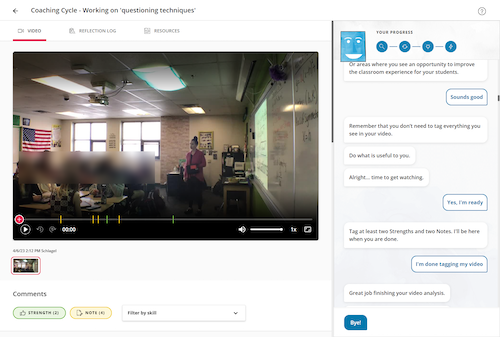
With the platform, teachers like Schlagel engage in personalized coaching cycles to further their development. The platform uses artificial intelligence to guide teachers through a self-coaching cycle aligned to common growth areas as they watch video of their classroom teaching in action.
We recently interviewed Schlagel about the use of this new technology and how her district prioritizes teacher development.
What were your first thoughts when you heard about using AI for professional learning? Why did you decide to try it?
Last year, I was a mentor to a first-year teacher at my school, and my mentee had to record a lesson of her teaching as part of the induction program. I decided to also record myself conducting a similar lesson, so we could go over the lessons together, discuss what works and what doesn’t, and set goals for improvement.
This was my first real introduction to video coaching. Admittedly, even as a mentor teacher, I was nervous to record myself. However, I quickly learned it wasn’t that bad seeing myself on screen and that this was a powerful way to reflect on my practice. My mentee and I both learned a lot.
So, when my district offered a new professional development course that would allow us to try out AI coaching, I signed up. I wasn’t sure exactly what I was getting into, but I was already benefiting from video coaching and wanted to see what the new AI aspect was all about. At the very least, I knew this opportunity would provide me more time for self-reflection.
How does the AI coaching process work?
During my first time using the AI Coach platform, I uploaded a video of one of my recent algebra lessons. Then, the platform’s computerized coach provided observation tips and asked me a number of questions to consider as I began to analyze my video. This helped me as I made a number of comments on the platform—both about areas I wanted to improve upon and areas I felt I was excelling in—as I watched my teaching play out.
The guidance from the virtual coach helped me think more critically about my practice (…and it also made me laugh – the coach can definitely be funny and sassy at times!).
This helped me set a goal for myself around increasing student discourse. I wanted to encourage my students to talk more in class, and the platform provided me with a number of instructional resources to help me get better at this skill.
At the end of the coaching cycle, after I incorporated these strategies in the classroom, I came back to the platform and reflected on what I learned. I thought about how these new strategies worked and created an action plan for my continued learning in the future.
How has AI-powered coaching impacted your teaching?
What surprised me most about the AI coaching process was that it opened my eyes to different things I could change (and might have missed) about my teaching. I was able to really reflect on how I was teaching and how my students were responding.
Sometimes it can be daunting—or even feel less genuine—when a coach or administrator comes in to conduct a formal observation. You may be worried about how your students are acting or unknowingly teach differently than normal.
But, with the AI Coach process, I feel less pressure because it really is just myself reflecting on my teaching alongside a computerized coach. This gives me more freedom to try out a new instructional strategy or take a risk with how I deliver a lesson, without having the feeling of being evaluated.
Continuous reflection is so important, and I’m a firm believer that the best teachers have to be reflective—if you aren’t reflecting on your practice, you aren’t growing!
How do you and your colleagues plan to use AI Coach by Edthena moving forward?
In addition to supplementing in-person coaching, I think AI coaching will continue to be a great support for mentor and mentee teachers alike.
In chats with my administrative team, I’ve also suggested using the AI Coach platform for our school’s yearly peer observations or self-reflection observations. Traditionally for the self-reflection observation, teachers write a paper detailing their teaching and how it can improve, but I think this type of video-based reflection can be more impactful and feel more genuine. And, it will allow teachers to receive the benefits of ongoing coaching which is really about reflecting inward and trying to constantly improve.
My school and district always do a great job of supporting teachers’ growth and encouraging us to take on new and innovative professional learning opportunities. The use of AI Coach is just another example of this!

 Login
Login