Normal view

There are new articles available, click to refresh the page.
Before yesterdayEdSurge Articles

How Urban and Rural School Districts Aim to Solve Alarmingly High Absentee Rates

20 November 2023 at 10:00

When you’re not sure where you’ll sleep, showing up to class isn’t what you’re worried about.

For educators, this makes for a daunting test.

“When families are dealing with not having basic necessities, school just isn’t a priority,” says Susanne Terry, coordinator for homeless education services in the San Diego County Office of Education. It’s worse for students who move around a lot, she says. They fall furthest behind.

Like in other major metro areas, privation exists alongside wealth in the Pacific coast city famous for its great weather and golden beaches. In San Diego, by some estimates the most expensive area in the entire country and a common vacation destination, about one-tenth of people live in poverty, according to a report from a grantmaker, the San Diego Foundation, published in late October. That’s 86,000 children experiencing poverty.

For students struggling to simply show up for school, this can translate to poor access to the basics. Housing is not always available, let alone stable access to food, a ride to and from school and the other conditions that have to be met for a student to really sink into learning, like internet access and a dedicated space for homework.

The absentee rates in San Diego — where, in 2021-2022, 30.4 percent of students were chronically absent, meaning they have missed at least 10 percent of school — are comparable to other large California cities. For homeless students, that rate is typically higher.

And the challenges are front of mind for many educators in the area, Terry says.

So how are they responding?

Attempting the Long Jump

Some districts say they’ve really tried to make lowering the rates at which homeless students miss school a priority.

Poway Unified School District, located in San Diego with more than 35,000 students, has a 15.7 percent chronic absentee rate, according to data from California’s Department of Education.

The district has truly made a concerted effort to make sure students are coming to school, says Mercedes Hubschmitt, director of learning support services and homeless liaison for the district.

Chronic absenteeism is not caused by the same problem for everybody, she says. It’s specific. So solving it requires the district to be mindful of students’ actual needs and to carefully plan steps to solve whatever hurdles those students face, she says.

How? Poway runs attendance reports and investigates why students aren’t showing up. District staff make “home visits,” sitting down with families to figure out what obstacles they have. What they’ve learned, Hubschmitt says, is that homeless students are missing the things that most people take for granted. The most common problem? It’s the physical part of getting kids to class. So the district attends to bus routes, gives out cards that provide free use of public transportation and, in some cases, provides gas reimbursement for families. Leaders are also working with companies like HopSkipDrive, a ridesharing company that gets students to school.

But Poway is also trying many similar approaches as other districts in San Diego. There are programs that provide limited time in hotels to stabilize housing. There are also attempts to get students access to clean clothes — for example, through access to laundry machines.

Other districts in San Diego tell EdSurge they are increasing training in trauma-informed care, providing more tutoring for homeless students, and focusing on college and career planning and guidance — sometimes including field trips to university campuses.

The hope is that these solutions will help cover the unique challenges faced by homeless students.

“Post-COVID, I think all of us went through different things. And I think that there are things that may have bubbled up that didn't exist before, around health, around priorities, around access. And so our team is really focused on trying to ensure that our kids have what they need to be successful,” Hubschmitt, of Poway, says.

Another stumbling block: health care.

Disparities in who has access to health care are cited in reports like the one by the San Diego Foundation as a reason why white people in the city live on average five years longer than Black people.

For homeless students, this can mean there’s more untreated sickness in the family.

Poway has tried to adapt. The district uses a grant to give out Uber gift cards that students’ families use for rides to doctor’s appointments, Hubschmitt says.

Think Small

For rural areas, the situation looks different.

Kellie Burns, district executive officer for Yavapai Accommodation School District #99, finds that her staff is able to connect with students personally.
Hers is a small district, in central Arizona, with only 90 students. The dozen staff in the district hand out their personal phone numbers to students and give them rides to school. When those students are missing, the staff calls and texts them, even showing up to their houses. Sometimes, Burns says, staff even track students down at their jobs.

The extra effort forges one-to-one connections with the students, Burns argues. It’s those relationships that can keep students trudging through the doors when they don’t want to, according to attendance experts. But it’s something that probably isn’t practical for large urban districts, Burns acknowledges.

During the pandemic, the number of chronically absent unhoused students in Burns’ district shot up. It was more than 50 percent in 2020. But it’s tapered off: Now, it’s only “slightly higher” than it was pre-pandemic, Burns says.
By percentage, the number of chronically absent students in Yavapai actually sits near the official figures of urban areas like San Diego. The chronic absentee rate for Yavapai has been 31.9 percent so far this year, according to figures sent to EdSurge in November.

But while the number of homeless students in the district has risen, only about 9 percent are chronically absent, Burns reports.

And others in rural areas have noticed a similar pattern.

Fewer homeless students are chronically absent in rural areas because it’s harder for them to hide, says Tina Goar, senior education specialist of rural initiatives for Generation Schools Network, a nonprofit that partners with schools to create “healthy school ecosystems.”

Rural areas tend to have fewer students overall, and that allows for the districts to really know the homeless students, she says, reflecting specifically on her own experience with rural Colorado schools.

What the rural districts she’s familiar with have a harder time doing is providing social services.

Rural areas rely on connections with big cities and towns to fund social support. When it comes to finding social workers, housing aid or job training, Goar says, “It’s challenging.” And that’s what the schools Goar works with say they want, as much as specific solutions to chronic absenteeism.

Playing Catch-Up

Yavapai, the district Burns works in, is an alternative school. It also only works with high schoolers, most of whom have lagged seriously behind in credits for graduation, usually by more than a year, Burns says.

These students also tend to have had trouble with the law, be caregivers, or have physical, emotional or mental issues they are dealing with, she adds. So they often aren’t very interested in school.

About 75 percent of the students who dropped out during the pandemic aged out of the system and never returned to school, Burns says.

When the pandemic hit, Burns says, most of those students got full-time jobs working in fast food, construction or landscaping. To the students, it can seem like good money, which makes them more reluctant to abandon those jobs to return to school, Burns says. These students tend not to come back for their diploma or GED.

But some other students are lured back.

They face another challenge, Burns says: They often don’t have the foundation they need to succeed in higher grades. They’ve missed a lot of class time. So even though they moved up, they now have to deal with the frustration of that missed learning. This can cause depression or defiance. Burns says she spends a lot of her time trying to catch these students up to where they would be if they had stayed in school.

“If they are told ‘you're not a failure just because you're behind,’ they have been more likely to try and to focus more on their school,” Burns says. But ultimately, it can depend on the support system the student has at home.

Are they permanently behind? Burns is optimistic. “They can all catch up. We'll get them there,” she says. It helps that Arizona doesn’t age out a student from school until 22, she adds. That can buy more time.

Burns says that showing compassion for these students and making a connection with them is critical. She tells them: “You've got extra time to do this. You're not a failure, just because you graduated later than what you thought you were going to graduate when you entered kindergarten.”

© Photo By 963 Creation/Shutterstock

How Urban and Rural School Districts Aim to Solve Alarmingly High Absentee Rates

Teachers Feel the Strain of Politics. Can Better Political Engagement Help?

6 November 2023 at 10:00

In September, a teacher in the Hamshire-Fannett Independent School District, in Southeast Texas, was fired when district leaders learned that an eighth grade class was reading a graphic novel based on the diary of Anne Frank.

The novel had not been approved and was deemed inappropriate, and the firing made headlines. It was an extreme example of the political strain public school teachers are under from parents and activists. Along with a rise in Holocaust denialism — fueled by misinformation, along with poor knowledge of the history — researchers have noted that disagreements over curriculum, book bans and politically contentious issues have ratcheted up the pressure on educators.

When schools are already suffering from severe staffing shortages, it’s a dynamic that may have dire consequences. At least one survey found that the majority of teachers have decided to limit talk of political and social issues in the classroom, with some being asked to do so by their school or district. But the real trouble for schools may come when those teachers decide to leave.

Political scraps may speed up teachers’ decisions to quit, according to Zachary Long. A former history teacher from Florida, Long left the classroom in 2019. Long and his wife Brittany Long, another ex-teacher, started Life After Teaching, a Facebook group meant to help others transition out of the profession. Since the pandemic, the group has exploded. Their group now has 107,500 members, with 6,700 members joining last month, Long says.

While politics wasn’t what pushed Long out, he has seen it impact some teachers. When added to the other issues — low pay, long hours and the increase in students’ social-emotional issues coming back from the pandemic — it makes the job just that much harder, he argues. That can make an exit more attractive.

Long says he notices the issue particularly in “hotbed states,” like Florida or Tennessee, where political battles are racking education. He also adds that other teachers often swear they will never move to those states, with teachers already living in the states warning others not to come.

Fierce Scrutiny

This all adds to teacher stress and attrition, according to “Political Polarization and Its Repercussions for Public School Teachers,” a report by the Constructive Dialogue Institute, a nonprofit devoted to encouraging civic dialogue.

It can be fierce. Outside of the classroom, the pushback against critical race theory and social-emotional learning has really affected teachers, says Mylien Duong, senior director of research for the institute. It’s a relatively small number of parents who are leading the charge, but they are outspoken and hard to engage in a constructive way, Duong adds.

A clinical psychologist with experience in school mental health, Duong conducted a qualitative study of how the increasing political tension is affecting teachers. She interviewed 14 teachers, mostly in English language arts and history, from around the country. The study found that the problems are especially notable when schools are deciding which textbooks to use and which curriculum standards to adopt. One teacher quoted in the report suggested that, during the review process, what state a book came from and how the community politics might influence its reception came up before the quality of the resources.

One of the history teachers Duong interviewed had hit a breaking point. When teaching about the Holocaust, including graphic depictions of its horrors, one student kept laughing. “The teacher was like, ‘I don't even know how to deal with this. I've not been trained for this and never come up before,’” Duong says. That teacher took a leave of absence. Intense interactions involving students, more than anything else, seem to shake teachers, she adds.

Confronting these trends means overcoming new realities.

It’s becoming easier to believe falsehoods because they are being confirmed by our immediate environment, Duong argues, since people no longer interact as much with others who disagree with them and it’s easier to seek out information that confirms your biases.

But this doesn’t only impact current teachers.

More Than Just Skin Color

For other observers, the pressure is worrisome because of what it might mean for future teachers.

District leaders say they want more diverse teachers, says Sharif El-Mekki, the founder of the Center for Black Educator Development, a teacher pipeline program based in Philadelphia. “But just in skin tone, not in thinking, not in curricula,” he says.

For El-Mekki, part of the reason there are so few Black teachers is that their experiences have been pushed out of the public school system for a long time. Feeling unable to speak openly and truthfully about their perspectives without fear of repercussions deters prospective Black and Indigenous teachers from joining the profession, El-Mekki argues.

In a report co-published by El-Mekki’s organization and Teach Plus, an organization trying to diversify the teaching force, Black and Indigenous high school students interested in becoming teachers highlighted inclusive curricula and a sense of agency in the classroom as crucial factors in making them want to teach. Political pushback against those gives them pause about joining the profession, El-Mekki argues.

For El-Mekki, this exposes a conflict in district priorities.

“They're basically saying, like, ‘yeah, we want diverse teachers, but we want you to erase yourself,’” El-Mekki says.

What should be done? Surprisingly, observers believe the antidote to divisive political rhetoric may be more and deeper political participation.

For El-Mekki, it’s about making sure families are aware of what’s happening and how that may shape student growth and development. For instance, he argues, more families of color should seek representation on school boards where they can influence policy decisions.

Duong, the Constructive Dialogue Institute researcher, thinks that broader political engagement could improve the situation.

The groups dominating school board fights right now are only a small percentage of the overall population, Duong says. There’s a much larger percentage, an “exhausted majority,” who are tired of the fighting and who support compromise, she argues: “I actually think that activating or engaging more people in politics more of the time would actually provide a level of moderation to our current discourse.” In school, that means parents and teachers coming together, trying to have constructive conversations with each other and with more members of the broader community.

It’s also vital, Duong says, that administrators are clear about the expectations for teachers around these issues, which can reduce the stress caused by these fights. She suggests that administrators give clear guidance that spells out how teachers can respond when they receive political pushback and how the administrators will support teachers who find themselves under fire.

© Photo By Lightspring/Shutterstock

Teachers Feel the Strain of Politics. Can Better Political Engagement Help?

School Makes Some Students Anxious. Is Physically Showing Up Necessary?

19 October 2023 at 10:00

Bradley loves baking lava cakes.

A high school senior with long curly hair who participates in a vocational program, Bradley spends about half the day at culinary school and then half in “at-home instruction” through a nearby high school run by a statewide public education service.

Perhaps what he loves most, even more than decadent molten chocolate, is the bustle.

It’s changed his attitude about school. When he was younger, he viewed school as a chore. Now, he views it as a way to do what he’s passionate about. “The culinary part of school has given me a really big rejuvenation in life,” he says.

Bradley needs to move around. Rather than being stuck at a desk, forced to sit still for long hours, shuffling boring papers, at culinary school he’s physically active. He’s running around the kitchen. He’s cooking, and his senses are engaged.

“I can feel. I can love. I can’t love an essay, but I can love my food,” he says.

It wasn’t always this way.

When the regular public school he attended several years ago closed during the pandemic, Bradley switched to remote learning. That meant that he didn’t have to wake up, get dressed or keep a schedule in the same way, he says.

“It was just people on my screen,” he says, dismissively. He would turn on the computer and fall back asleep.

For some students like Bradley — who spent much of his middle and high school career avoidant, a nonclinical term that denotes a visceral refusal to attend school — remote learning can be a way of extending their evasion of the classroom, according to several clinical psychologists who spoke with EdSurge. Virtual schooling, in those instances, allows students to keep away from physical school spaces. While that may offer students relief in the short term, the coping mechanism can have negative consequences, some experts say.

Yet mental health professionals also question the wisdom of “forcing” students to attend schools where they are clearly uncomfortable. Ultimately, experts advocate for alternative instruction that’s tailored to each student’s needs.

What’s the right kind of school for students suffering from anxiety? It’s complicated.

For Bradley, doing virtual school during the pandemic certainly deepened his sense of isolation.

“It definitely made things worse,” he says.

He wasn’t leaving the house much and became a shut in, he says. His friendships were completely online, and his buddies lived in faraway places like Oregon, Tennessee and Serbia. That meant that he kept odd hours, messaging friends at 4 a.m., then waking back up at 2 p.m.

It was lonely. “I just became this fool. Didn't leave the house for three months. Didn't talk to anyone outside of my family. Fully shut down,” Bradley says.

And when school returned in person, Bradley couldn’t bring himself to go back.

Becoming an Outsider

It would be hard to identify a single cause of Bradley’s school avoidance, according to his mother, Deirdre. (EdSurge is only using first names for members of the family out of concern for their privacy.) But it began in middle school, around the seventh grade.

When he was younger he had lots of friends, but as he aged he became an outsider, according to his mother.

Bradley would miss school here and there, but the growing tally of absences worried his mom. There were some great teachers who could connect with him, she recalls, but overall it was a losing struggle. The problem only grew.

Bradley’s eighth and ninth grade years were a blur of therapists, and county and crisis management services. Each one had their own diagnoses — from oppositional defiant disorder to autism — and to this day his own mother is frustratingly unclear on what condition he has. Bradley believes he has attention-deficit/hyperactivity disorder.

According to his mother, he was committed to a hospital for two weeks in the middle of the summer before 10th grade and assigned a probation officer through the “persons in need of supervision” program in family court, a program meant to wrangle “incorrigible” or “habitually disobedient” minors when their parents cannot.

Nothing worked in getting him back to school, or in engaging him with his life. By the time Bradley was in high school, he couldn’t connect socially. He would become enraged and punch holes in the wall.

“And then I was like, maybe he’s just difficult,” Deirdre says. “Some people are just difficult.”

His mother cried all the time. She fought with her son.

“I felt horrible about it. But I also was so desperate,” Deirdre says.

Special Supports

Youth like Bradley may do everything within their power to skip going to school in person.

Yet some psychologists argue that the goal should be to bring these avoidant students back into the physical building.

Sometimes, in a rush to help avoidant students, schools will put them in online school, says Anna Swan, a clinical psychologist. She says that approach is rarely the most helpful solution.

For certain subsets of school-avoidant kids, online school can at times become a way of furthering the avoidance by permanently removing them from the traditional developmental path, argues Michael Detweiler, an executive clinical director for Lumate Health, a cognitive behavioral telehealth platform that works with schools. It's important to get them back into the physical space of the building to reestablish that connection, he adds.

But solutions to school avoidance must meet the unique needs of each student.

In her advocacy, Monica Mandell, a social worker and family advocate for avoidant children in New York, usually takes a different tack.

Her work involves separating the student from the school where he or she is experiencing problems. For avoidant students, it’s crucial to move them into schools designed to handle significant mental health needs, she argues.

The onus for attendance tends to fall entirely on the parents, Mandell says. So she tries to shift the responsibility onto both the school and parent. That means getting special education classifications and individualized education plans (IEPs). It also may mean moving students to an “out of district,” a school that is designed to provide an education but that also has significant support staff who offer counseling and behavioral management and that allows for flexibility in the day, she says.

For a school-avoidant student, the best classification for is an emotional disturbance, Mandell argues, which requires some kind of diagnosis by a psychologist or psychiatrist. It can be a fight to make a school district understand that avoidance is a mental health need that denies the student the proper learning in a general education setting, Mandell says.

The process for securing these kinds of accommodations can take a couple of months. While the student is out of class, Mandell tries to get him or her assigned to at-home instruction, which has to be provided by the school system. It can be virtual, in person in the home or in a public space, she says. Usually, she adds, it’s taught by a teacher following the core curriculum.

So, in Mandell’s approach, students don't get coaxed back into the school building. Eventually, they're not going to see anybody from the building at all. They start fresh.

A Sense of Belonging

Some students are more hands-on, harder to be pigeonholed into the standard school models, and they have individual needs that must be met in order to succeed in education, says Anne Marie Albano, a clinical psychologist and professor at Columbia University. Those kids who white-knuckle it through the end of high school can end up miserable because their anxiety hasn't been addressed, she adds. They can get stuck at home, no longer avoiding only school, but now life in general. It’s worth asking, Albano says, if the school environment is right for the specific student.

Deirdre, the mother from New York, couldn’t put her finger on just a single factor that helped her son, she says. But the most significant certainly was finding somewhere he felt he belonged.

Eventually, Bradley connected with Mandell, and she got him an IEP and suggested he switch schools. He wasn’t sure at first but became convinced. While waiting to transfer somewhere new, he stayed home and took classes online for a few months. Initially, he says, this pulled him further into his stupor, eliminating even the limited interactions with his teachers he had during the coronavirus lockdowns.

In the long run, though, making a change paid off. When he finally got to River View High School, an alternative school with a focus on social, emotional and learning needs, in the middle of his sophomore year, the specialized support offered there helped him ease back into the world. Then, in September of last year, when he was a junior, Bradley joined the vocational program that let him go to culinary school.

That gave him a purpose, his mother says.

These days, Bradley has a future in mind. He plans to go to the Culinary Institute of America, a famous private institution in New York’s Hyde Park. He wants to be the manager of a restaurant, somewhere with people around him and minimal paperwork, he says. Often, he adds, there doesn’t seem to be much passion in those jobs. But that’s something he thinks he can bring to the table.

For his mother, Deirdre, the grief was worth it. One moment sticks out above the rest.

Late one night, Bradley came to her. He was a junior then, in culinary school, two months shy of his 17th birthday. Deirdre, who was working from home, had just finished her job duties for the day. Bradley was sitting there, waiting to talk — and said that he wanted to see a therapist.

This teenager, who she’d spent years fighting to see therapists, to simply go to school, was telling her that he wanted to do it.

It floored her, she says: “It had to be when he was ready.”

© Image By pimchawee/ Shutterstock

School Makes Some Students Anxious. Is Physically Showing Up Necessary?

Readers Respond: Does Fixing the Leaky STEM Pipeline Require Calculus To Adapt?

3 October 2023 at 10:00

The need to strengthen the science, technology, math and engineering (STEM) careers pipeline has received renewed interest lately.

Whether students can successfully flow through the pipeline to fill vital jobs in the country may have significance for the national interest, according to some observers.

So what would it take to make STEM truly open to would-be future scientists? A number of instructors say it’s partly reconsidering how calculus, a crucial step toward STEM careers and often a “weed out” course in higher ed, is taught.

With educators duking it out in the so-called “math wars” over the curriculum changes in California — which recommended delaying algebra, a critical juncture in the race to calculus in K-12 — the question rose to the fore this year. Noticing this, EdSurge traveled to Harvard this summer to observe one attempt at a more subtle revolution, meant to bring calculus instruction into the 21st century. The resultant piece — published in EdSurge and USA Today — struck a chord. And readers had a lot to say, both in favor and against the thesis.

Here are some of the more thoughtful responses.

Another Language

A reader from Utah: “For me the breakthrough was finding out math is just another language with its own grammar and syntax. It is a language that is very eloquent at describing what we see in the natural world, and like all languages conveys meaning and understanding. Memorizing formulas and equations is about as useful as memorizing poems as way of learning to write in English. Teach it as a language used to describe things and as a tool for real life problem solving.”

A teacher from Pennsylvania: “Been teaching calculus to HS seniors for 30 years. The issue is algebra skills. Those with strong algebra skills will excel at calculus. The weak algebra students weed themselves out. After all, if you understand what calculus is all about, you will realize that calculus is just algebra 1 ‘on steroids.’”

A parent from Iowa: “As it happens my daughter is a freshman in ME taking Calc 2 this semester and I was helping her study for her first big exam last night. While the content of the course has changed almost completely since I took it 40 years ago, in my opinion it is still way too based on memorizing dozens of formulas for the exams. No professional works that way. If you don’t happen to remember some formula or integral or whatever, (probably because you do it a lot), you just look it up and continue. Knowing *what* to do for a problem is a million times more important than having memorized some trivia about it along the way. IMO, this memorization-heavy approach is why so many of my fellow students flushed out of Engineering and why I never really understood it until my EE ‘waves and fields’ class let me see the ‘what and the why.’”

A reader from Illinois: “One of my favorite things about learning calculus the last year and half was the application to the real world. If anything, vectors and multi variable calculus should be taught sooner instead of last or not at all as it has the most applicability to the real world.”

The ‘Fail Out Course’

An educator from California: “This misses the bigger picture that the reason maths instruction like algebra keeps getting pushed to younger grades is because folks are trying to get the edge in getting into highly competitive universities. Get rid of the societal lies that everyone needs to go to college and everyone must strive to go to an Ivy League school rather than one that is their best fit. You will see more success all around.”

A reader from Minnesota: “A long time ago I was told my algebra was weak. I got As in middle school but soon as high school the teaching got muddled. Never got to master what I learned just basics but never felt confident in any math class from that point on. Can math be taught [or] is it just a gift. My college professor while he was teaching us announced to the class that math can’t be taught. So gave up on ever getting it. Great huh.”

A teacher from Kansas: “In college, calculus was a requirement for the business school. It was the fail out course. In MBA school it was only used in an economics course. That was it. In undergrad, when I switched out of music, I picked a new major by looking for something that I was interested in studying and didn't require calculus or organic chemistry. That was geography.”

A professor from Indiana: “I've taught calculus dozens of times, with diverse textbooks, quite successfully. Some texts overflow with fake ‘applications,’ but these hide the mathematical essence under a mountain of details. Students learn better from a straightforward treatment of the mathematical essence.”

© Photo By Dzianis Vasilyeu/ Shutterstock

Readers Respond: Does Fixing the Leaky STEM Pipeline Require Calculus To Adapt?

Evidence Is Mounting That Calculus Should Be Changed. Will Instructors Heed It?

20 September 2023 at 16:00

Calculus is a critical on-ramp to careers in science, technology, engineering and mathematics (STEM). But getting to those careers means surviving the academic journey.

While there’s been progress of late, it’s been “uneven” and Black, Hispanic and women workers are still underrepresented in some STEM fields. Traditional methods of calculus instruction may be knocking students off the path to these vital occupations, which is why advocates warn that getting diverse students into these careers may require instructional models more responsive to students. Meanwhile, the country is struggling to fill vacancies in related fields like semiconductor manufacturing, despite sizable investments — a feat that may require stabilizing the pipeline.

Good news: There's mounting evidence that changing calculus instruction works for the groups usually pushed out of STEM. At least, that’s according to a randomized study recently published in the peer-reviewed journal Science.

The study — which involved 811 undergraduate students at Florida International University, a large public university in Miami — is perhaps the biggest randomized study of active learning methods in calculus, says Laird Kramer, a physicist at the university and one of the study’s authors. Researchers tapped alternative models of calculus teaching that have shown evidence that they work, according to Kramer.

The study, which occurred over three semesters, randomly assigned students to either learning through lectures, the old-school way, or through “active” calculus instruction that emphasizes student engagement. Those active methods limited the amount of lecture time, instead focusing on small groups and using “learning assistants,” other undergraduates who were on the teaching team. Instead of sitting through lectures and working through procedural rules, students in the experimental groups were expected to focus on calculus concepts such as derivatives. Outside of class, they worked on problems on their own, while during class, they thought like mathematicians by reasoning out problems with limited guidance.

Its conclusion? That the traditional lecture method of teaching calculus isn’t as effective as active models. Those who learned from active methods did significantly better across race, gender and major, according to the study. (Students majoring in biology saw the biggest bump.) Over each of the three semesters of the experiment, there was a “medium/large effect size.”

It’s common for students who are used to learning math from lectures to be reluctant to think critically at first, learning assistants from the study say. But eventually, they get it. “[The students] move away from that algorithmic knowledge of mathematics, just following steps and just working like a little robot,” says Daniela Zamora Zuniga, a former economics student who was a learning assistant from 2019 through 2022.

Zuniga, now graduated, learned calculus through the active learning model, and it led her to pursue math courses outside of the degree requirements, she says.

That’s similar to something she noticed in other students who took the course. The students she’s kept up with, Zuniga says, report carrying an understanding of calculus forward into other STEM courses. That can relieve the pressure they feel around advanced math, freeing up mental space to devote to science, Zuniga adds.

Sometimes, in these classrooms, students who are apprehensive of calculus because they might have weak background knowledge can end up being the best students, says Juan Sanchez Quintana, a senior at Florida International University who was a learning assistant during the study. Quintana assisted the experimental classrooms, and says that his participation has fueled his desire to teach college math after he graduates. Quintana, a math education major, estimates that he’s been a learning assistant for about 120 class periods. In the end, he came away as a proponent of the model, because “I’ve seen it work.”

That these newer methods of teaching impart more learning isn’t surprising to the study authors. But, Kramer says, the research does serve a purpose by adding to the store of evidence that these methods work. He and his co-authors hope that bringing scientific rigor to the studies of these methods of teaching calculus might sway skeptical colleagues to change how they teach.

Widening the Gateway

As a gateway course to STEM, calculus can be seen as a make it or break it moment for students, especially ones who are typically excluded from these careers. “If you're struggling, it's a barrier for you,” Kramer says.

In conducting the study — funded by the National Science Foundation — researchers wanted to let students experience what it’s like to be a mathematician.

The researchers figured that Florida International, one of the largest public research universities in the country, had a unique chance to help students who are underrepresented in STEM disciplines better connect with the subject matter. The university has a lot of Hispanic and women students, two underrepresented groups, the study notes. Whether many of those students pass calculus varies: In the six semesters leading up to the study, the pass rates for introductory calculus — which included classes taught using some limited active learning methods — spanned from 13 to 88 percent. Failure could mean potential biologists, mathematicians or engineers being pushed out of the field.

Kramer and others have been experimenting with active teaching methods for a number of years, and wanted to break the notion that some students are born with natural abilities in calculus and that teachers are supposed to identify the gifted few. “Our study shows that [any] student can grow” under the right circumstances, Kramer says. “And that's really our responsibility as faculty, is to put students in environments where they can succeed, and [where] they are going to be able to achieve things that they might not have thought possible.”

Kramer projects certainty that these models are effective. These ways of teaching can be a lot more fun, too, Kramer says. But they break the preconceived notion of calculus as a weed-out course, he says, which can raise the hackles of professors skeptical of education research, and that increases the need for strong evidence.

Will this latest study be enough to convince colleagues to wander away from traditional lecturing methods?

“It should be very compelling evidence to anybody who looks at the study,” Kramer says. But people are messy. “My suspicion is that people will even be skeptical over this, even though it has a strong effect size, we've taken care of all the potential biases, as best as humanly possible, and it is published in Science, which is known to be an extremely rigorous process,” Kramer adds.

Instructors may still cling to lecture models, Kramer says, perhaps because “it helps their ego that they get to be the sage in front of a bunch of students professing how awesome they personally are.”

Nevertheless, there were possible limitations to the experiment that bear mentioning.

While the researchers say it was impossible to randomize the teachers, since the instruction relies on specialized knowledge, students were randomly assigned to either traditional classes or active learning classes. Randomizing the teachers could have raised more problems than it solved by introducing potential biases around active learning, Kramer argues.

But for some observers, this is a notable limitation. Jon Baron, a former chair of the National Board for Education Sciences and former vice president of evidence-based policy for Arnold Ventures, has called the study “encouraging but less than definitive” since it failed to randomly assign teachers.

A learning assistant noted another potential hindrance: These models don’t inspire as much enthusiasm when taught online.

When Quintana, the learning assistant, took calculus during the pandemic campus closures, the active learning methods were already in place, he says. But, Quintana notes, because students like himself were so fatigued by virtual learning, it didn’t really have as big of an effect. They didn’t interact in the breakout sessions as much, and didn’t really want to be there.

Still, to Quintana, it beat suffering through lectures.

“I can't even think how long it would have been for me to take calculus without any type of active learning, like, no learning assistance at all,” Quintana says.

© Photo By Ground Picture/ Shutterstock

Evidence Is Mounting That Calculus Should Be Changed. Will Instructors Heed It?

When Student Anxiety Gets in the Way of Attending School

13 September 2023 at 18:00

Since the pandemic, mental health strains on youth have been put in the spotlight.

Pandemic closures provided some students with a chance to notice how stressed they are at school, says Jayne Demsky, founder of School Avoidance Alliance, an advocacy group that provides professional training to schools.

The time away from physical classrooms gave children and teens an experience with which to contrast the regular anxiety of being at school. Now that in-person school is back in session, Demsky argues, schools now have to coax these students back into the building.

“Just like [adults] rethought our work-life balance, and our employers had to treat us kindly and reengage us and to show us why we should work for them — kids are the same,” Demsky says.

Many students are missing school completely, and the number of chronically absent students — defined as those who miss 10 percent or more of the school year — has increased. Since the pandemic, roughly 13.6 million students are chronically absent.

Some share of students missing from school are suffering from school avoidance, sometimes also called school refusal, which is when children experience severe emotional or physical distress about going to school.

These kids might be hiding in the corner crying under their covers, tantruming and glued to their beds, or holding onto a wall, so their parents can’t drive them to class.

— Jayne Demsky

Rather than just a distaste for school, refusal can be visceral.

“These kids might be hiding in the corner crying under their covers, tantruming and glued to their beds, or holding onto a wall, so their parents can’t drive them to class,” Demsky says.

Avoidance has become a crisis in recent years, one that schools aren’t prepared to handle, according to mental health experts. Long term, it can leave students unprepared for life. It can knock students off the traditional developmental path and leave them without crucial social and emotional skills, says Anne Marie Albano, a clinical psychologist with experience in school avoidance. Often, other psychologists who spoke with EdSurge noted, there are underlying conditions that can exacerbate anxiety around school as well.

The strain of mental health woes has ratcheted up pressure on schools to provide support. But schools are stretched thin for mental health staff, with as many as 100,000 more mental health professionals needed around the country.

Some districts have gotten creative. A school district in Virginia even constructed a middle school building with extra glass in the hopes that more natural light will serve as a palliative. But a more common approach has been to ink contracts with telehealth companies.

Still, for families and teachers trying to tackle school avoidance, it can mean that there are few resources for the specialized interventions students need.

There are no clinical diagnostic criteria for avoidance, which takes a different form for each child. But generally, it's marked by sustained absence, which gets harder to correct the longer the student is out of the classroom, Albano says. Unlike some other forms of absence, it won’t go away on its own but requires intervention that’s tailored to the student and can account for the deeper reasons a student is avoiding school, she adds. Those reasons tend to be highly specific to the individual students, she specifies.

But it’s hard to solve a problem you don’t know about.

Desperate Measures

Many parents have never heard of school avoidance, and educators aren’t comprehensively trained on it, according to activists and health care professionals. Not all clinicians even know how to treat school avoidance. For parents, “It’s scary,” says Demsky of School Avoidance Alliance.

Schools can conflate avoidance with truancy or other forms of absenteeism that fail to consider the anxiety causing it, Demsky says. (Demsky started her organization after her experiences with her own son’s school avoidance, which led the police to her doorstep and left her “on the verge of an emotional breakdown.”)

The nuance can get lost in efforts to get students back in physical classrooms.

Post-pandemic, legislatures have looked to increase penalties for students missing school. Penalties can range from fines to threats of jail time if the parents are found to have failed to get their kids to school. In Texas, for instance, lawmakers proposed hiking up the fines for truancy to cut down on absences earlier this year. It was controversial with family groups for penalizing missed school rather than remedying the root causes.

But treating refusal like truancy makes it harder to solve the problem, according to activists like Demsky. “I’ve spoken to families and they said, ‘hey, if I could pay $500 and go to jail for a week and have my kid get better and go to school, I would do it.’ So that just shows you how desperate families are,” she says.

Instead, Demsky calls for schools to recognize when refusal is occurring, and to follow evidence-based paths. That means psychological evaluations, finding out whether there’s an undiagnosed learning disability that’s making school acutely uncomfortable for the student, and other measures such as exposure therapy, she says.

In the schools she works with, that requires finding “a champion,” someone who has a connection with the student to help draw them back into the school, she says. In that, it’s similar to addressing chronic absenteeism in general, which Hedy Chang, executive director of the nonprofit Attendance Works, says boils down to meaningful relationships.

For beleaguered educators, it’s yet another hat they’re being asked to wear. But for some students, it may be crucial, activists say.

“Schools have to step in and take the place of those missing mental health professionals. And they really have to step up and become the support structure for these families,” Demsky says.

© Photo By fizkes/Shutterstock

When Student Anxiety Gets in the Way of Attending School

The Math Revolution You Haven’t Heard About

5 September 2023 at 12:50

CAMBRIDGE, Mass. — Math professor Martin Weissman is rethinking how his university teaches calculus.

Over the summer, the professor from the University of California at Santa Cruz spent a week at Harvard to learn how to redesign some of the math courses his institution offers related to life sciences. Right now, they are part of a “leaky pipeline,” Weissman said. Thousands of students go through these courses, he adds, but a lot of them don’t graduate with degrees in those fields.

This story also appeared in USA Today

Falling off that path can lock students out of science, technology, engineering and math (STEM) careers. And despite some “uneven” progress in recent years, STEM fields are just not as diverse as industry leaders would like. Some educators place a share of the blame on calculus courses, which can push out otherwise interested students.

That’s a phenomenon Weissman noticed at his university. “There are math requirements for those majors. And students slowly seep off and change majors because they have difficulty with the math,” he says.

UC Santa Cruz sees a lot of underrepresented students disproportionately drip out of that leaky pipeline, Weissman says. That includes a number of Black, American Indian, Alaska Native and Hispanic students. Biologists at the school look at the math taught in traditional calculus courses, he adds, and wonder why it’s even being taught, because the math isn’t practically useful for the field. Meanwhile, the calculus instruction has to be slowed down enough that it’s not as effective for math people as it could be.

“I think we're in an uncomfortable zone, where a lot of calculus classes are serving no one,” Weissman concludes.

Around the country, “math wars” are raging over attempts to increase equity by playing down calculus from the curriculum in favor of statistics or computer science, or by delaying when students take algebra. But there’s also a quieter revolution taking place that applies a different strategy to achieve the same principles. Its aim is not to abandon calculus, but rather to yank calculus instruction into the 21st century, by teaching students through the use of real-world problems. Changing the way calculus is taught, proponents argue, helps more students find math approachable and relevant, making them therefore more likely to succeed while studying it.

This is the more responsive approach that Weissman studied in July at Harvard, where he joined two dozen other college educators from around the country, tucked inside the air-conditioned, blackboard-walled rooms of Harvard’s Science Center. The week-long training ran from mornings into afternoons, with chummy lunch breaks in the faculty lounge, or the buzzing cafe in the Science Center lobby. The educators sat through lectures on pedagogy, the finer points of math and how to apply it to actual biological problems.

Sessions were prone to explanations such as how “physics-based simulations” became the buzzword in Hollywood, leading animation teams to use modeling techniques for hits like “Frozen,” “Brave” and “Toy Story,” which include life-like representations of walking through snow and bouncing curly hair. These digressions were placed alongside technical explanations of “cardiac defibrillation,” the rippling of electrical pulses as they move through the heart, as a way to show how to connect complicated math to the world outside of the classroom.

The training also had the educators plan, observe and teach classes based on these principles to eager high schoolers enrolled in a summer camp on campus.

The teaching experts who sponsored the training hope it will prepare college instructors to become “advocates,” empowering them to explain and defend the rigor of this way of teaching calculus to skeptical scientists from other departments. They expect it to be only the opening shot in an academic revolution.

But if calculus instruction is going to change, it may take some persuasion.

A Silent Revolution

The trouble with calculus is widely understood. The solution? Less so.

As these Harvard training sessions took place, the California State Board of Education finally approved a new framework that sets out to make math more culturally responsive and inquiry-based. It’s an attempt to respond to some of the pressures Weissman identified by kindling students’ math interest.

But it’s been controversial, causing “knock-down, drag-out math wars” that have included parent protests, threats and academic-on-academic social media spats about whether calculus should be reworked. That’s in part because the framework prioritized alternatives to calculus and also recommended delaying Algebra I, an onramp course to high school math and a critical juncture in the race to calculus, until ninth grade for most students. Critics have alleged the framework rejected rigor for “wokeism.”

In fact, many of recent attempts to keep calculus from being an obstacle to a STEM career focus on deemphasizing calculus, instead directing students to take other math courses like statistics or computer science.

The idea for the Harvard sessions came from a quieter attempt to revolutionize math instruction, relying on similar ideas, emanating from the University of California, Los Angeles.

Over the past decade, UCLA revamped its calculus for life sciences courses, focusing them more strictly on math concepts and real-world biological questions, rather than on procedural rules for derivatives and integrals — which its advocates describe as a paradigm shift for calculus instruction.

This idea is what drew instructors to sweaty Cambridge in July. UCLA’s model caught the attention of the Harvard math department, which decided to host a training over the summer for college instructors looking to refashion their own calculus courses. The session was meant to catalyze change, encouraging those instructors to open their own revised courses modeled on the ones being taught at UCLA.

A room of educators gets schooled on the rigors of mathematical modeling in the life sciences. Photo courtesy of the Harvard University Department of Mathematics.

As part of that, the college instructors observed and taught lessons to teenagers participating in a summer program being hosted at the same time at Harvard. It was meant to allow the educators to see these new methods in action, and to try them out personally.

In an early morning class, bleary-eyed and still vibrating from coffee, the instructors met with high school-aged students. The students had previously “warmed up” by grappling with datasets on COVID-19 mortality rates, trying to figure out what that data meant for policy.

“What’s your morning process?” the instructor asked.

The students, broken up into groups around tables, considered the question. “Brushing teeth” was the most common response.

The students then learned to map out the likely impact of teeth scrubbing on plaque growth, before pivoting to other possible applications of advanced concepts like vector spaces and differential equations.

During classes like this, instructors for the program studiously referred to these methods as “change equations,” a non-threatening phrase substituted to prevent the high schoolers from shying away from intimidating language like “differential calculus.” It’s connected to the claim that these classes can capture the rigor of advanced math, only without the anxiety it usually brings.

That’s a key part of the sales pitch for the course. “Our class has no prerequisites. Period,” says Alan Garfinkel, one of the UCLA professors who designed it, when asked by a teacher about talking to students about prerequisites in calculus.

That’s not typical. When this subject is usually taught, it’s done procedurally. Students are given a set of rules for solving these equations and then drilled on them, with the “why are we learning this?” question answered afterward. But students in these classrooms confronted the problems they wanted to solve first, only getting the equations after the curiosity had set in.

It left an impression. “Today I got to be a teacher again! Euler’s method to 20 amazing High School students with varying levels of mathematics background! Loved honoring that mathematics is a web of ideas as opposed to a linear trajectory filled with pre-requisites,” one instructor posted on social media.

Many of the educators at the event said they were attracted by the desire to increase student engagement and to make math more relevant to students’ lives.

But the impact the educators hope for reaches beyond the classroom, too. If high school and higher education can get more students to reason mathematically, it will make them productive thinkers, says Lindsey Henderson, a secondary math specialist at the Utah State Board of Education, who attended the training. That’s what the businesses in Utah’s Silicon Slopes, the state’s burgeoning tech sector, say they want, she adds.

For Weissman, of UC Santa Cruz, the fact that this course is being taught at a large institution already is important. When it comes to math instruction, he says, “There are always people promising revolutions.” But UCLA’s method does seem to work for large institutions, according to Weissman. The University of Arizona now offers a version of the class. A study of the course published by its creators suggests it’s been successful in engaging underrepresented students.

And Weissman doesn’t foresee much of a fight in implementing it: “I'm not beholden to a traditional textbook, so I don't have to make sure that I cover certain methods that I really do think just don't need to be taught anymore.”

Change Equations

At the same time the week-long workshop for instructors took place, Harvard also ran a two-week program for high school students based on the idea that high schoolers can be taught to solve problems using principles of advanced calculus.

The teacher workshop included designing and teaching classes to that class of 36 high schoolers, something the attendees weren’t warned about more than a day or two before.

“We wanted a way to have workshop participants see what's possible in the classroom,” says Brendan Kelly, the director of introductory math at Harvard and one of the event organizers. If you haven’t seen students thinking through the problems, it can be hard to vividly imagine what it might look like in your classroom, Kelly says.

The traditional sequence for math in middle school and high school is algebra I, geometry, algebra II/trigonometry and then pre-calculus, with advanced students making it to calculus. Increasingly, calculus is seen as a necessary bolster for competitive college applications.

For the high school summer program at Harvard, though, only algebra II was required. Students at the program had mostly taken AP Calculus, though not all of them had. One student said she had only taken pre-calculus before entering the course.

Student campers gave high marks to the experience.

“For me, like, I've honestly never considered a major in math,” says Judy Yen, a rising junior from the private Taipei American School in Taiwan. Yen wants to enter the medical profession, and the course left her considering a math double major or minor in her future, she adds.

For others, the lesson was that math can lead to benefits beyond school. “I can actually get jobs rather than just studying. Really, I can actually, maybe get a job that's related to math,” says Charles Sciarrino, a rising senior from Staten Island Academy, a college preparatory day school in New York. “And I just find that really cool,” he adds.

Still, it was a Harvard summer school class, implying that most students who participated not on scholarship had access to the funds to afford summer school in Massachusetts — which cost $5,300 for tuition and room and board for the two-week program — not to mention a prior interest in math. Will it translate to other schools and contexts?

There’s some privilege there, Kelly admits. But he firmly believes that the learning that happened there is possible anywhere: “I think it's a real deficit mindset to think that first-generation or low-income students wouldn’t have that same enthusiasm and curiosity. I just fundamentally disagree with that. Young people are curious about the world. And when you put compelling questions in front of them, they respond with excitement and engagement.”

The 28 educators at the workshop training seemed positive. “The course helps gain access for a broader range of student populations, for us to get students excited about math and cross-pollinate to all the other divisions as well,” says Steven LeMay, an associate professor at Curry College, a private college in Massachusetts, who attended the training.

LeMay was tasked with figuring out whether the revamped calculus will work for Curry, and he seemed generally optimistic. Curry College likely won’t have the fight that UCLA reported in attempting to transition its students, LeMay predicts. The college doesn’t have a standalone math major, and there’s been a push from LeMay’s colleagues to freshen the school’s technology use, LeMays says.

Other higher ed instructors, however, expressed concern over whether it would translate into their less resource-rich colleges. Their institutions, they say, were worried about whether their students would get transfer credits at other colleges for these courses, and they were skittish about possibly disrupting their own institutions’ math departments by keeping students from more traditional calculus classes.

In the end, Kelly of Harvard says, the dream is to have similar courses that integrate calculus concepts in life sciences, economics, social sciences, physical sciences and engineering taught at colleges and high schools. (Kelly has taught a similar modeling course for economics and social sciences for the last few years.)

But it’s hardly a foregone conclusion. One major challenge to spreading this method of math instruction more broadly? Money. The Harvard summer training was popular with potential teachers, but it was hard to get funding to support the program, Kelly says. He reports that he was unsuccessful twice in applying for a grant from the National Science Foundation — which Kelly attributes to a general lack of enthusiasm for attempts to alter calculus and a belief that it wasn’t a proper training course — but it was funded by a gift from an anonymous Harvard alumnus to the math department. Continuing the work will mean securing sustainable funding, he adds. That may be easier now that the first session has wrapped up, Kelly predicts.

But it’s still early days, Kelly says: “I think across the country, we are barely getting off the ground.”

© Photo courtesy of the Harvard University Department of Mathematics.

The Math Revolution You Haven’t Heard About

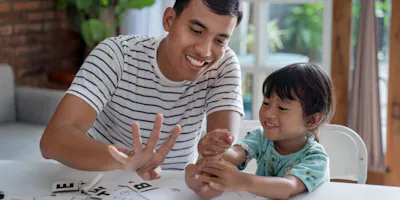
Young Kids in Low-Income Families Get Less Exposure to Math. Can the Right Apps Help?

30 August 2023 at 22:03

Recent public debates have focused a spotlight on K-12 math pathways. But there’s been less attention paid to what math skills students need early in life, to set them up for elementary school in the first place.

For early learners, exposure to math concepts can be at the mercy of their family’s economic status or related factors like whether their parents are college-educated. That’s why one group of researchers asked what can be done to close the cognitive development distance that opens between children from high- and low-income families, which they argue is a watershed in equality of opportunity.

The resultant randomized controlled trial, “Boosting Parent-Child Math Engagement and Preschool Children’s Math Skills,” tried to hoist up the math skills of children ages 3 through 5 in Chicago. These 758 students — who were enrolled in Head Start programs or other publicly subsidized preschools — were from low-income families. Study participants were split into groups that received different educational materials. For some parents, researchers loaded up tablets with vetted apps designed to teach math skills, and then handed them to the families and walked away for six months, says Ariel Kalil, a professor at the University of Chicago Harris School of Public Policy and the director of the Center for Human Potential and Public Policy. Some parents received analog games designed to convey math skills, while others received a storybook. Researchers sent text reminders to some parents to use the materials they received.

The result? Some of it worked really well. There was no noted effect at the end of the original treatment, which lasted 12 weeks. But when researchers came back six months later, kids who had been using the apps saw math skills increase by 0.2 standard deviations, according to the report — an improvement bigger than students typically see after one year in a Head Start program. Groups that were given analog games and parental messaging saw improvements, too.

Another result: Girls got a bigger skills bump from the tablets than boys. That’s likely related to the fact that girls develop quicker in general, and can be able to self-regulate in younger years, Kalil speculates.

But there was another, unexpected finding.

The digital tools facilitated parent-child interactions, Kalil says in an interview, making the time spent more fun and efficient — just better overall.

While it’s common for parents to read bedtime stories to their children, it’s less common for them to solve bedtime equations.

In her work studying the differences in cognitive development between early learners from low-income families and their high-income counterparts, Kalil has noticed that the outcomes are more about the parents than the students. To improve children’s learning, interventions either have to increase the amount of time parents spend with their kids, or make the actual learning process more efficient, she says.

While it’s common for parents to read bedtime stories to their children, it’s less common for them to solve bedtime equations. Kalil came into this particular study believing that you can’t dramatically increase the amount of time parents devote to imparting math skills. But, in this latest research, parents reported spending more math time with their kids, thanks in part to the apps — “much to our surprise and great interest,” Kalil says.

In short, while the researchers thought that they were preparing the apps to substitute for the parents, they were actually preparing the tech tools to complement the efforts of parents.

The Price Is Right

By kindergarten, young children are supposed to learn quite a lot of math skills. That includes knowing how to count, understanding differences in quantities and knowing how to measure things. They also need to have some comprehension of shapes, spatial relations and patterns.

How well their young minds have managed to capture these concepts foretells whether they will be successful in their academic careers. In no small part, that’s because there’s a strong link between these skills and later-in-life math and reading abilities.

So the stakes are high.

For researchers like Kalil, the real question is: Will math apps actually prepare all early learners to be ready for kindergarten numeracy? Establishing that apps can help is only the first step in lifting math abilities.

Nevertheless, the kinds of solutions the researchers considered had another virtue: affordability. Apps are cheap and can be widely distributed, Kalil says, an important feature for any prospective solution to widespread inequalities. That’s exciting, she adds.

However, reliance on edtech introduces further questions.

Wheat and Chaff

The study required identifying effective apps. And the number of quality math apps available to the researchers — who chose to focus on apps in both English and Spanish, since Chicago has a high number of Spanish speakers — was limited. In the end, the researchers selected seven applications that they felt struck a balance between being engaging to students and also prompting them to learn. These largely focused on counting, number recognition and patterns.

Knowing what works in edtech is difficult. And in contrast to these researchers, the average early childhood education program, or the typical parent, may not be capable of rigorously appraising apps. That means that getting high-quality math apps in front of early learners will require more studies, to show which applications catalyze actual learning.

It’s something researchers such as Kalil are thinking about.

“There are shockingly few randomized controlled trials in a significantly meaningful population that really test what is working,” Kalil says, adding that there’s a lot of “nonsense that you just shouldn’t believe about what works and what doesn’t.”

Other researchers would agree. Previous studies have suggested that only 26 of the 100 most popular edtech apps have published research that aligns to federal standards from the Every Student Succeeds Act (ESSA). Far fewer of those reach the final tier, having “strong evidence.”

It’s also not clear whether these solutions would suffer from the edtech “drop off,” the phenomenon that sees learning benefits decline because people simply stop using the technology, Kalil says.

© Photo By Odua Images/ Shutterstock

Young Kids in Low-Income Families Get Less Exposure to Math. Can the Right Apps Help?
❌
❌