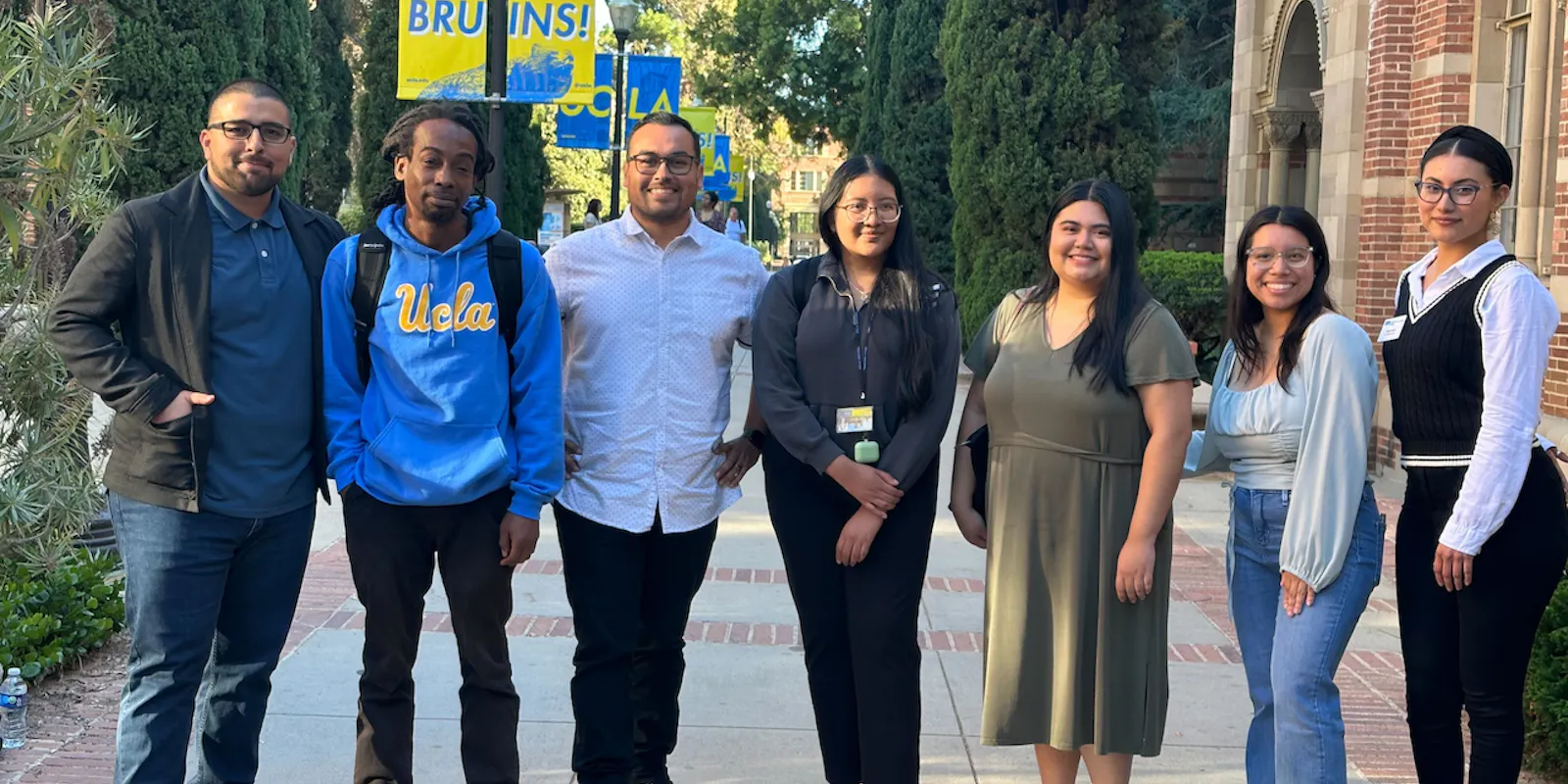
During his yearslong quest for a bachelor’s degree, José Del Real Viramontes encountered trials at four different California community colleges.
At his first college, right out of high school, the young man born in Zacatecas, Mexico, hoped to play for the football team. But Del Real Viramontes never made it to tryouts, he says, and when his best friend left the college, he decided to leave, too.
At his second college, close to his home in East Hollywood, he says that he had a bad experience with the instructor about an early assignment in a developmental English course. That, plus feeling like as the oldest child he should clock hours working to earn money to contribute to his family’s household, pushed Del Real Viramontes out of school again, this time for three years.
At his third college, his enrollment came as something of a surprise. A friend filled out an application and submitted it for him. This institution fit just right. Del Real Viramontes joined its Puente program, which embedded him in a cohort of students in a math and English course sequence. The group studied Chicano literature, offering him the opportunity to read about experiences that reflected his own.
“I think that program was the first program that really provided this idea of transferring to a university,” he says. “We were in a very supportive environment.”
A transfer counselor sat in on class sessions. He took students on tours of university campuses and helped them build connections there.
“It’s ironic,” Del Real Viramontes says, “because I remember going to UC Riverside, where I work now, visiting, and never in my wildest dreams did I think I was gonna be back as a professor.”
Looking back now, at age 40, as assistant professor of higher education administration and policy in the University of California system, Del Real Viramontes can see what his story shares in common with the experiences of so many students who start out at community colleges hoping to eventually earn a bachelor’s degree.
They may intend to earn two years’ worth of general education credits at more affordable rates before transferring to a four-year college or university. They may want to boost their grades before applying to a more selective institution. They may prefer to start out at an institution close to home, one with smaller class sizes and an environment that feels more approachable. Or, like Del Real Viramontes, they may be the first in their families to attempt college and lack information about where else to apply.
But data shows these strategies don’t actually work for most of the people who enroll at community college. Six years after they start out at what is called a two-year college, only about a third of students successfully transfer to a four-year college. And only about 16 percent end up earning a bachelor’s degree.
It’s a disappointing status quo. It’s really unacceptable.
— John Fink
“It’s a disappointing status quo. It’s really unacceptable,” says John Fink, a senior research associate and program lead at the Community College Research Center. “As a system, that’s just not really living up to its potential.”
The transfer outcomes are even worse for Black students, Latino students, and low-income students, he adds.
This week, the U.S. Department of Education is hosting a national summit about improving transfer outcomes. It’s a goal community colleges have been striving for in recent years. But they can’t do all the heavy lifting alone, experts say. To successfully hand students off from one campus to another also takes effort and resources from the colleges that students hope to transfer to: institutions that grant bachelor’s degrees.
Four-year colleges and universities need to take “co-ownership” for transfer students’ success, says Tania LaViolet, a director at the College Excellence Program at the Aspen Institute.
As higher ed enrollment declines, will that finally start to happen?
Partnership Required
Many barriers block students from transferring to a four-year college, according to Fink, including bachelor’s-degree programs that don’t accept transfer credits and a lack of adequate advising.
“Too many students are just left on their own to navigate this process,” he says.
Some students get stuck in remedial or entry-level courses at community colleges. That’s what happened to Del Real Viramontes. Even though he fit in at the Puente program at his third college, he struggled to pass English 101 there, having trouble completing a research paper assignment. He attempted it three times, and then had to find a different institution where he could take the course again, he says, due to rules about limits on the number of times students are allowed to retake the same course.
To address this, community colleges have been doing away with developmental prerequisite courses and creating “guided pathways” that blend advising, career exploration and straightforward guidance about what courses to take that will apply toward a bachelor’s degree.
But without participation from four-year colleges, community college efforts are like a bridge that only spans half of a river.
“Right now, the status quo is that supports and advising for transfer students is too little, and too late, and really too absent the presence of the four-year partner,” Fink says.
A few pressures might incentivize four-year colleges to step up their efforts. For example, if it’s part of the mission of a bachelor’s degree-granting institution to educate diverse students and facilitate economic mobility, then supporting transfer students from community colleges fits the bill, LaViolet says.
After all, according to analysis from the Community College Research Center, in the 2020-21 academic year, half of all Hispanic undergraduates were enrolled at community colleges, as were 42 percent of Asian undergrads, 40 percent of Black undergrads and 39 percent of white undergrads. In 2015-16, community colleges enrolled more than a third of dependent undergraduate students whose families earned less than $20,000 a year.
Some public flagships are paying attention to the transfer pipeline’s potential for educating people of varied backgrounds.
“It helps us fulfill our mission as a public university,” University of Virginia president James E. Ryan told The Washington Post in 2022, “which is to be a place of opportunity, a place of social mobility.”
But LaViolet says it’s unlikely that the recent ban on affirmative action will motivate most four-year colleges and universities to recruit and retain transfer students as an alternative to race-conscious admissions. That’s because only a small sliver of such institutions are affected by the U.S. Supreme Court’s decision this summer on the issue. The majority already admit most of the people who apply and so don’t need nuanced admissions criteria anyway. And the relatively few selective colleges and universities in the country could only enroll a tiny fraction of the students who start out at community colleges even if they tried to recruit more.
Instead, there’s a different force at play that might work in favor of transfer students.
Higher ed leaders are concerned about the fact that college enrollment is on the decline, not only coming out of the COVID-19 pandemic but also because of national demographic changes that will shrink the pool of 18-year-olds to a smaller size than admissions offices have gotten accustomed to fishing in. Recent years have seen some colleges close or consolidate because of enrollment problems.
Improved transfer pathways could yield better enrollment. The pressure four-year colleges are facing these days to boost student numbers — and shore up the bottom line — could spur some to take action on transfer students, LaViolet argues.
“When you support stronger partnerships and collaborations with a local community college, what that does is it increases your market share … in reaching students who would not have come to you otherwise,” she says. “In an enrollment-challenged context, that’s critical to your business operations.”
Collaborations might look like a university agreeing to admit all students from a certain community college who meet specific academic criteria, an arrangement known as guaranteed or dual admission. In such cases, the institutions work out which credits will transfer and apply to which majors, effectively telling students, LaViolet says, “here is a four-year map to complete your bachelor’s degree.”
“It’s the clarity of the pathway and certainty you’re providing students that is at the heart of the value proposition,” she adds.
Successful partnerships tend to be forged between one community college and one four-year institution, which are often physically close to each other, LaViolet says. Examples include the partnership between Northern Virginia Community College and George Mason University, called Advance, and a program that ties the University of Central Florida to half a dozen Florida community colleges, called DirectConnect. Most such partnerships are created between community colleges and public four-year colleges, LaViolet adds, but she sees an opportunity for more private institutions to do this, too.
LaViolet says top leaders help drive these collaborations, and Fink adds that academic departments and professors also have a role to play in doing outreach that helps transfer students. That might look like, for example, chemistry faculty at a university talking to chemistry faculty at a community college to align on course sequencing, instruction techniques and assessments of student learning.
“That really requires broad investment from faculty and other academic leaders at the university in particular, really reaching out to their colleagues to figure out what’s the right pathway to a specific major,” he says.
Policy might help, too. For example, new legislation in California will create a pilot program at the University of California, Los Angeles, to offer priority admission in certain major programs to students from some community colleges who earn an “associate degree for transfer.”
The Human Element
University outreach made the difference for Del Real Viramontes. One day, he visited the transfer center at his fourth community college, where he chatted with a peer mentor from UCLA. She eventually invited him to an opportunity at the four-year institution that she thought he might appreciate.
“That program,” Del Real Viramontes says, “changed my life.”
For six weeks, he could take a UCLA summer class and benefit from wraparound services. Del Real Viramontes applied, with a letter of recommendation from his English teacher at his fourth community college. He enrolled in a course about public policy — not knowing what public policy was. He says he received an A in the class.
Community college and transfer students, we are very resilient. We are very good at figuring things out.
— José Del Real Viramontes
“I think that’s one of the biggest reasons I am where I am today,” Del Real Viramontes says.
“Being able to be part of that program and doing well in the class, it allowed me to see myself at UCLA.”
He credits that experience with giving him the academic confidence he needed to transfer to a university. It exposed him to campus resources, so he knew where to go to find support. It offered him validation about his culture and background, and revealed how he could view the challenges he overcame at community college as preparation for bigger adventures.
It’s an example of how, as much as sorting out institutional policies and partnerships matter for transfer students, boosting students’ confidence and making sure they can access supportive advising are important elements, too.
“You could have the best major-specific articulation agreements, but if students aren’t using them or working with advisers to explore their options early on and develop a plan and change it as needed and keep progress along the way, all that great articulation work isn’t going to yield any fruit,” Fink says. “It’s not going to change the student experience.”
UCLA offers this kind of program for students through its Center for Community College Partnerships. Run by more than a dozen staff members and six dozen peer advisers, the center also trains community college staff and builds support among administrators and faculty at the university.
About a quarter of community college students who try to transfer to UCLA on their own succeed, according to Santiago Bernal, assistant director of the Center for Community College Partnerships. In contrast, about half of students who participate in the center’s programs are admitted.
For decades, the Center for Community College Partnerships “has been a national example of creating a transfer-receptive culture at a university, one that is affirming to Black and Latino [students] and men of color and women in STEM,” Fink says. “Staff have a regular presence at their partnering community colleges, to sort of help students plan and think about transfer to UCLA before they transfer.”
Del Real Viramontes ended up transferring to UCLA. He majored in Chicano studies, participated in the McNair Scholars program that prepares students for doctoral studies, and graduated with his bachelor’s degree. He went on to earn his Ph.D., and he now studies the college transfer experience, especially for Latino students.
It’s important to him to highlight the agency students exercise, and the cultural resources and relationships they draw on, when they face challenges along the transfer pathway.
“Community college and transfer students, we are very resilient. We are very good at figuring things out,” he says, describing the group as “very aspirational.”
Del Real Viramontes went back a few years ago to teach the summer program class that altered his own trajectory. He still keeps in touch with those summer students he taught.
In fact, he says, giving transfer students the chance to build relationships with other people who already successfully navigated similar paths is key to helping them feel like they belong at a university and can thrive there, too.
“Students involved in this class in the summer program,” he says, “they already see themselves at UCLA.”
Back in March of this year, EdSurge published my article outlining the nearly 400-year history of higher education in America, how that past shapes the way the country views colleges today, and why microcredentials, while critical to the future of the U.S. economy, are causing a dilemma for the academy. Since then, I have enjoyed serving on various panels like those with the Colorado Business Roundtable discussing the future of higher education and its intersection with economic and workforce needs.
Several critical themes have emerged from these conversations that create burdens for workforce partners and higher education institutions. For one, agreement around the purpose of higher education is fragmented. In 2019, Brandon Busteed penned an article for Forbes that beautifully describes what I have witnessed in these discussions. Busteed described a "decidedly false dichotomy" where some argue that higher education is about preparing a person for work versus, more broadly, preparing a person for success. While I have enjoyed the dialogue, the fact remains that this intellectual discourse is being held amongst some of the most privileged and well-credentialed persons in society.
In these conversations, another critical theme emerges: the need for more decision-makers to understand that U.S. population growth has nearly flatlined. It is vital to note that this trend is NOT a blip but the result of a steady decline, and that higher education as a whole must address it. One implication is a recent prediction by the Bureau of Labor Statistics that the labor force participation rate may fall from 62.2 percent in 2022 to 60.4 percent in 2032. A second implication is the absence of sufficient numbers of workers in professions such as health services, trade, and hospitality. According to the U.S. Chamber of Commerce, as of June 2023, the national labor force participation rate was 0.7 percentage points below pre-pandemic levels. That equates to 1.9 million workers who have left the workforce since the pandemic’s start in early spring 2020.
The lack of an available and prepared workforce in America adds unnecessary fuel to the fire of poverty that burns uncontrollably throughout our communities, and that leaders don’t seem to feel an urgency to extinguish. According to the U.S. Census Bureau’s Poverty in the United States: 2022 report, the supplemental poverty measure (SPM) rate in 2022 was 12.4 percent. This increase of 4.6 percentage points from 2021 represents the first increase in the overall SPM poverty rate since 2010. Furthermore, the SPM child poverty rate more than doubled, from 5.2 percent in 2021 to 12.4 percent in 2022.
To address our children’s hunger and our communities’ poverty, our educational system must be redesigned to remove the boundaries between high school, college and careers so that more Americans can train for and secure employment that will sustain them.
In 2021, Jobs for the Future outlined a pathway toward realizing such a revolution in The Big Blur report, which argues for a radical restructuring of education for grades 11 through 14 by erasing the arbitrary dividing line between high school and college. Ideas for accomplishing this include courses and work experiences for students designed for career preparation. Joel Vargas, contributing author to this report and JFF executive, spoke at length about his personal life story and reason for serving as an ambassador for educational redesign on my Discovering Your Mission podcast earlier this year. He said that, “We have to change the [educational] systems that students experience, because it is pretty obvious, our systems are designed to work against students as a whole.”
As a Policy Leadership Trust member of JFF, the Community College of Aurora (where I serve as president) has served as a national leader in the work to apply higher education to drive social and economic mobility in today’s society by aligning student learning outcomes directly with workforce needs. Such goals are achieved when the institution understands its responsibility in the fight to eliminate poverty and support equitable educational attainment by providing our students with key skills that are relevant and transferable throughout industries.
This commitment to student success is what students look for most, according to the Strada Education Foundation. In its most recent nationally representative study of more than 3,200 people who completed bachelor’s degrees since 2002, Strada found that graduates who reported they developed key skills during college earned $8,700 more in their first year after graduation than their peers who reported lower levels of skill development through college. As Americans’ confidence in higher education has fallen, and its students have amassed more than $1.7 trillion in student debt, institutions must focus on providing the tools critical to thrive in a skills-based economy.
This year, the Community College of Aurora hosted U.S. Secretary of Education Miguel Cardona, the Departments of Transportation, Energy, Commerce, and Labor, along with several national, state, and local officials for the Biden-Harris Administration’s nationwide Unlocking Pathways Summit series, which focused on helping young Americans access good-paying jobs. One component, Unlocking Career Success, is an interagency initiative that reimagines how our nation’s high schools prepare all students to thrive in their future careers. Guided by the four keys of dual enrollment, work-based learning, workforce credentials, and career advising and navigation, this initiative, in collaboration with JFF, aims to evangelize the need to revolutionize the American education and higher education systems.
The future of America depends on our ability as a community of educators, workforce partners, governmental agencies, and legislators to work together to develop seamless academic and career pathways for more students. Together, we can unlock upward social and economic mobility for our youth and for working adults. Failure is not an option; America is depending on us.
If colleges and universities want to close the graduation gap for their Latino students, their target goal is clear: help another 6.2 million Latinos earn a degree by 2030.
Parsing education data into snack-sized servings.
That’s according to the think tank Excelencia in Education, which focuses on research and policy on Latino achievement in higher education.
Its analysis on the 2021 college graduation rates of Latinos highlights some dismal statistics. Compared to their white, non-Hispanic counterparts, Latinos generally graduate from college at lower rates and drop out at higher rates. That’s even as the number of Hispanic students pursuing higher education has increased over the past 15 years.
Latino and white students enroll in higher education at roughly the same rates — 21 percent for Latinos and 23 percent for white students, according to the analysis.
The gaps become evident when looking at who graduates.
When Mayra Valtierrez talks about the students in New Mexico public schools who are learning English, one thing becomes clear: It’s an incredibly diverse population.
Parsing education data into snack-sized servings.
The New Mexico Public Education Department is tasked with serving not only students who have grown up speaking Spanish but also Native American children who are learning English and newcomers from other countries.
“We are a friendly state when it comes to taking any sort of refugees, or anyone who enters our state, so we have Spanish-dominant [English learner] students who come at any age, from being little to being youth,” says Valtierrez, the department’s director of language and culture. “We've been supporting some of our refugees from Afghanistan, for example, and from other places. Then we have the children of immigrants that were born here, and thus inherited a language from their family.”
Schools with English-learning students are tasked not just with ensuring that these children acquire the language but also, as with all other students, succeed academically and eventually graduate from high school.
But just how likely English learners are to graduate can vary widely depending on which state they live in.
Data from the U.S. Department of Education shows that students who are English learners — sometimes called emergent bilinguals — generally lag behind their peers when it comes to high school graduation rates.
The data covers 10 years, starting with 2010-11 through the 2019-20 school year. The paper notes that the onset of the COVID-19 pandemic may have caused difficulties for some states in collecting and reporting graduation data for the 2019-20 school year. Texas and Illinois did not provide information that year.
This article is the second of a two-part series covering key principles to consider when integrating a generative AI creativity tool into your academic setting. Read the first article here.
The first two principles focused on how to ensure that the AI tool not only fits with existing technology and workflows but equips students for their futures. These next three principles provide guidance on what to consider in your AI tool evaluation.
Navigate the ethics of generative AI in education.
Generative AI is incredibly exciting but also opens the door to new questions about ethics and responsibility in the digital age. Thankfully, school systems have made meaningful headway in the past decade by integrating new media literacy and digital citizenship skills into the curricula, such that responsible AI can be a new addition to existing modules.
When selecting a generative AI tool, examine creators, training methods and ethical transparency. Not all image generators are equal; Adobe’s generative AI tools, powered by Adobe Firefly, were trained on Adobe Stock images, openly licensed content and public domain content where copyright has expired. Firefly is designed to be safe for commercial use, and thanks to guardrails encouraging appropriate use, it is ready to be used in classrooms. Plus, Adobe continually tests its model to mitigate against perpetuating harmful stereotypes.
Educators are just beginning to discover the most exciting ways that generative AI can engage students, drive deeper learning, save time and streamline mundane tasks.
In a world rife with misinformation, students also need authentication skills and responsible creation ethics. That's why Adobe has set the transparency standard through the Content Authenticity Initiative (CAI). Part of CAI’s work includes ensuring all Firefly output is properly labeled with secure metadata Content Credentials, which show the provenance, or origins, of digital file types, including how they might have been edited along their journey from creation to publishing. When it comes to education, this level of transparency and responsibility are paramount for everyone in a learning community, including students, educators, staff and caretakers.
Get started by exploring these content authenticity curricula crafted to help students better navigate the ever-changing digital information landscape with essential media and visual literacy skills.
Promote inclusion, feedback and bias reduction.
AI tools must be inclusive and reflect diverse perspectives. It is important to understand the data used to train classroom tools to ensure inclusivity and minimize bias. When selecting tools, prioritize those open to feedback for ongoing improvement, which indicates a good educational partnership.
At Adobe, we use varied datasets and refine our generative AI models to mitigate bias. Our generative AI features, like Firefly and Adobe Express, offer easy feedback options, enhancing dialogue. It's crucial that companies and organizations engage with educators, fostering collaboration to develop and improve generative AI for all.
By prioritizing ethics, inclusivity, feedback and community, we can empower students with the skills and knowledge they need to thrive in a digitally driven world, ultimately shaping a brighter future for education.
Get support with professional development, curricula and educator communities.
As with any new technology or transformative change, educators and school leaders will need a lot of support, inspiration and a like-minded community to bounce around ideas and share inspiration. When selecting a generative AI tool for the classroom, look for a holistic solution being offered beyond the technology, including ongoing professional development, curricula, community and other support.
Educators are just beginning to discover the most exciting ways that generative AI can engage students, drive deeper learning, save time and streamline mundane tasks. As we embark on this journey of learning, Adobe is collaborating with educators in K-12 and higher education to develop free opportunities for professional growth. This includes professional learning, in-person and virtual events, and Adobe Creative Educator (ACE) community groups all focused on collectively exploring the innovative realm of creative generative AI within the classroom.
After all, together is better. That’s why Adobe also leads conversations on AI in education with global and cross-industry education partners like the World Economic Forum’s Education 4.0 Alliance. Adobe has also joined the advisory committee for the TeachAI initiative, led by ISTE, Code.org, Khan Academy and ETS. In these ways, we invest in a broader, global coalition to learn from and help advise educators, leaders and policymakers with guidance, policies and a vision for continual improvement in student learning and outcomes.
Plato once quoted Socrates lamenting that, “If men learn this, it will implant forgetfulness in their souls; they will cease to exercise memory because they rely on that which is written.”1 The ancient philosopher was speaking, of course, of the latest technology in the B.C. era: hand-written scrolls.
As humans, we’ve always had a somewhat complicated history with invention. On the one hand, we are driven to create tools that make our lives more efficient, but we also can’t help but feel a little uncertain of these new steps even as we are compelled to take them. With all new technology comes a great deal of trepidation that our previous ways of knowing are being lost. It goes with the territory, so to speak, whether we are living in ancient times or here in the 21st century.
With all new technology comes a great deal of trepidation that our previous ways of knowing are being lost.
Last spring, my university held an emergency faculty meeting about identifying papers written using artificial intelligence. Upon the release of ChatGPT in the fall of 2022, we noticed that some of our students had suddenly become “experts” at synthesizing research and organizing their term papers, often resulting in perfect scores on their written assignments. It was a bit of a dizzying experience trying to get ahead of the technology as we scrambled to find ways to cope with this impressive new platform, so seemingly well-equipped to help our students effortlessly complete their assignments.
We had been here before in the ’90s when we were all but certain that internet search engines had entirely ruined higher education. Despite those first days of insecurity, we decided to teach ourselves to lean in to technology rather than distance ourselves from it. Teachers and librarians began to integrate online formats into the learning experience, with great success and often with highly desired outcomes. It worked out perfectly!
But just as we were relaxing into a smug sense of mastery, AI happened, and it unexpectedly upended the whole deal.
With our lessons on leaning in not far behind us, we knew we had to embrace this new technology. We also knew that the detection software was not far behind, and in fact, it was released by the next term. The best way to harness a monster, after all, is to create a more powerful one.
Yet in our rush to control the technology, we may have initially overlooked the gifts that had been given to us via AI. In truth, this new invention can take us to next-level learning, and we are just now unlocking the full potential of this in our classrooms.
Ways that students and educators may benefit from using AI include:
Creating an opportunity to rethink gender equality in technology
Offering support for people learning English as a second language
Enabling alternative instruction techniques for atypical learning
Teaching students to share and sharpen their thoughts
An Opportunity to Rethink Gender Equality in Technology
Gender inequality in technology development and user design is a well-known challenge; expanding technology use is part of the solution. Melinda Gates has recently given a series of interviews sounding the alarm over the inherent male-centered bias of AI, among other concerns.
To shift AI toward being a more neutral, individual-oriented tool, educators can commit to teaching and supporting the use of gender decoders, which are algorithms that detect a lack of gender inclusivity, and other modalities aimed at achieving design balance.
On a grand scale, the United Nations is working on an agenda to address this and other concerns at the Global Digital Compact session in fall of 2024, which aims to “outline shared principles for an open, free and secure digital future for all.” At the individual level, though, we can each encourage and inspire the students in our classrooms to consider how to address such complex issues as gender bias in their own use (and design) of technology tools. The STEM gender gap remains an area of much-needed attention that we, as educators, can actively work on improving in our daily lessons.
Support for People Learning English as a Second Language
AI offers people who are learning English new and improved avenues for more effective communication. Language AI modeling tools can assist learners with pronunciation, grammar and translation, responding receptively in real time through simulated chats and quizzing techniques.
Some formats even allow learners to generate 3D images based on their written instructions, creating an instant multi-sensory experience as they work on their language skills. The benefit to our classrooms is immeasurable here as it can engage students at their proficiency level, helping students keep up with their peers and the flow of class material.
This technology can be reversed too, assisting English-speaking students in foreign language acquisition. Such tools set the foundation for meeting the needs of a 21st century economy, where global communication skills are essential for students and teachers alike.
Alternative Instruction for Atypical Learning
This is a game-changer for neurodivergent students or those with specialized educational needs. Visual or auditory challenges can effectively be addressed via AI, as programs can be coded to communicate via sign language or translate written words into speech. AI configurations can also provide students with audio, pictures, or project-driven materials according to personalized feedback.
One of the strengths of the software is that it can be prompted to explain the same concept in several different ways. This allows students the ability to repetitively work through difficult subjects until they locate an explanation of the material that resonates with them.
Additionally, researchers have found that some learners with autism or ADHD, for example, respond more positively to lessons provided by robots than other approaches that have been used. One of the key findings is that mechanized bots don’t demonstrate facial feedback that could be construed as unsupportive or judgmental. Broader research is currently underway, indicating that this is an area of growth investment for our schools.
Teaching Students to Share and Sharpen Their Thoughts
I’m learning to accept the setbacks that might come with such giant leaps forward, hopeful that AI will provide us with innovative tools to help every student reach their highest potential.
Students shouldn’t use AI to write their papers, but it can help them get started with the hardest part: organization. In my classrooms, I encourage some students to use ChatGPT for expediency in brainstorming paper topics. This includes using AI for designing outlines, learning about core foundational designs (like how to build a thesis), or integrating appropriate stylized citations. In this way, it is the starting point for research, and the heavy lifting comes on the other end of the information garnered from the software.
For example, since AI is hugely prone to internal factual flaws, students must fact-check and cross-reference every statement generated by the tool. Critical thinking comes into play as students must locate, read and determine the legitimacy of each original source. The next step is to formulate and express their own ideas on the subject matter. In this way, we encourage a healthy dose of skepticism in our learners, motivating them to take control of tech-generated content rather than be passive consumers of it.
While the future of AI is unclear, I am taking a lean in approach as we journey toward this frontier. As with all new inventions (from hand-written scrolls to talking robots), I’m learning to accept the setbacks that might come with such giant leaps forward, hopeful that AI will provide us with innovative tools to help every student reach their highest potential.
1 Plato (1952) [c. 360 B.C.E.]. Phaedrus. Translated by Reginald Hackfort. pp. 274c-275 b.
This article is the first of a two-part series covering key principles to consider when integrating a generative AI creativity tool into your academic setting. Read the second article here.
The 21st-century classroom is a dynamic, ever-evolving space where cutting-edge technologies, like artificial intelligence (AI), are pushing us all to rethink what students need to learn and how that learning can best be structured to prepare them for the future. One of the most exciting advancements is the emergence of generative AI, a technology that can help produce entirely new creations with just a few directives.
From creating realistic images and art to producing music and writing, generative AI's potential to help students learn and demonstrate their creative thinking skills in fundamentally new ways is truly awe-inspiring. What’s more, at a time when student engagement is more important than ever, creative AI tools can serve as powerful platforms for active, student-directed learning, motivating young learners to showcase their individuality and unique perspectives.
Of course, like with all new technology in education, the promise is coupled with uncertainty. Will generative AI tools like ChatGPT enable plagiarism or complicate assessment? How can schools stay fully informed about how generative AI models are built and trained? What safety and anti-bias measures are in place, especially for younger students?
Perhaps the biggest question on the minds of educators, caretakers and policymakers is this: How can we best integrate these new capabilities into our education system to set up students for success in the classroom and beyond?
The following principles can help ensure your education community is learning how to use generative AI responsibly with user-friendly tools made to enhance creativity and prepare students for the future.
Understand the value of creativity.
Creativity is often connected to the arts, but it’s an essential skill to all disciplines and fields because it teaches students how to solve problems in new ways, communicate ideas effectively, collaborate with others and find their voice through exploration and curiosity. ISTE recently outlined why it is more important than ever to teach creativity — how it motivates students to learn, lights up higher-order cognitive skills, sparks emotional development and inspires those who are hard to reach.
In the rapidly evolving job market, knowing how to use AI to fuel creative thinking and express ideas in powerful, creative ways will be essential for almost every job and career.
Even though 65 percent of students learn more effectively by doing and creating, the opportunities to do so are too rarely available. Imagine if every student learned how to apply creative thinking to every subject throughout their educational experience, from K-12 through college. By intentionally nurturing and scaffolding creativity and creative problem-solving throughout the curricula, educators can empower students with the critical skills they need to confidently navigate their lives and effectively apply them to emerging technologies, like AI.
Beyond academics, creativity is also essential for career success. According to the World Economic Forum, creative thinking is the second most in-demand skill organizations will prioritize in workforce development initiatives through 2027, followed by AI. In the rapidly evolving job market, knowing how to use AI to fuel creative thinking and express ideas in powerful, creative ways will be essential for almost every job and career.
This collective research tells us we need to transform teaching and learning experiences to help students master creative thinking and generative AI skills. And if students learn them with trusted, industry-standard tools, they will be readily equipped for the future.
Supercharge creative thinking, don’t replace it.
Calculators in the classroom finally shifted from controversial to commonplace when we saw how they enhance math skills without replacing them. Behind that success was a thoughtful, strategic implementation plan to use calculators at the right time for the right tasks, ensuring students become hyper-aware of the thinking processes calculators support.
Likewise, classroom generative AI tools should fit smoothly into current teaching methods, technology and creative skill-building. These tools enhance the creative learning journey across subjects, from idea formation to improvement and presentation. Encourage metacognition by prompting students to reflect on how generative AI tools shape their thinking and processes in various ways.
Classroom generative AI tools should fit smoothly into current teaching methods, technology and creative skill-building.
Adobe Express for Education is designed to integrate with existing technology and learning workflows, including rostering tools, learning management systems, safety and privacy features and the ability for K-12 administrators to toggle generative AI features on and off.
As we embark on the journey of integrating generative AI tools into our classrooms, it is clear that we are on the precipice of a transformative era in education. There is immense potential for generative AI to foster creativity, engagement and critical skills among students. The questions and uncertainties surrounding the responsible use of generative AI are valid, but they should not deter us from harnessing this powerful technology. Instead, they should motivate us to adopt a thoughtful and strategic approach.
As we move forward, it is crucial that school leaders, educators, caregivers and policy-makers fully recognize the value of creativity as an essential skill. Creativity transcends subject boundaries and prepares students for the future job market, where creative thinking and expression are highly prized. The integration of generative AI, when done with trusted industry-standard tools, equips students with the essential skills they need to thrive in an ever-evolving world. Together, we can embrace this technology's potential to transform classrooms into hubs of creativity, innovation and preparation for the challenges of the future.
Together, let’s enable Creativity for All. As the creativity company, Adobe is uniquely committed to supporting creators of all ages, backgrounds and skill levels so they can express themselves, tell their stories, build great careers and make an impact. That’s why Adobe Express for Education is free for K12 . Our goal is to equip every educator with everything they need to open up career pathways and opportunities for all of their students.
Twice a week, Rofiat Olasunkanmi, 22, heads back to Brooklyn to her alma mater, Kurt Hahn Expeditionary Learning School. Now a senior at New York University, Olasunkanmi helps high school seniors navigate applying to college, a process she personally recalls being dominated by concern about finances and a general sense of anxiety because no one in her family did it in the United States before her.
Her older siblings received degrees in Nigeria, where her parents still live, so she’d had to figure out a lot on her own, a burden she now tries to alleviate for the students she works with. She aims to support them from start to finish, beginning with applications for the City University of New York at minimum and then moving on to the Common Application.
“But I’m not there every day, and Common App is very lengthy,” she said, “so they need to ensure that they’re doing the parts that they need to get done while I'm not there.”
Rofiat Olasunkanmi helps high school seniors apply to college. Photo courtesy of Olasunkanmi.
The Common Application was first created with the goal to simplify the college admissions process by allowing students to submit one application to multiple institutions. However, as Olasunkanmi mentioned, it takes significant time to complete, an estimated six to eight weeks, according to admissions counselors.
The COVID-19 pandemic complicated the application process further with disruptions to in-person advising, testing and extracurricular activities. But barriers to completion predate the pandemic.
During the last pre-pandemic college application cycle, 2018-19, nearly 1.2 million students accessed the Common App, created a profile and began working on at least one application. But a quarter of those students, almost 300,000, did not end up submitting any application through Common App, according to a working paper published this August.
Researchers characterized this subset of students as “non-submitters.”
“Non-submitters” were more likely than students who submitted applications to have lower educational-occupational aspirations, be racial minorities, have parents who completed lower levels of education and live in communities with lower socioeconomic status — but they were not less academically qualified.
Colleges across the country have doubled down on trying to attract students as enrollment numbers decline. Direct admission has proven to be an effective method of appealing to students who hadn’t already been planning to attend college. But the students who start applications without hitting the “send” button, the “non-submitters,” largely fall into a different category. They are presumably already interested in college.
So, why aren’t they completing applications?
Identifying ‘Non-Submitters’
During World War II, the U.S. military noticed that certain parts of the airplanes that returned from battle had more bullet holes than others. As a result, leaders decided to reinforce those areas, expecting that would help the planes better withstand enemy fire.
But this strategy had a fundamental error. It’s one relevant to past research about barriers preventing students from enrolling in college, said Taylor Odle, an assistant professor of educational policy studies at the University of Wisconsin-Madison and co-author of the “non-submitters” study.
The error, known as survival bias, directs focus on those entities that passed a selection process but overlooks others that didn’t make it through. The military focused on holes in the planes that survived enemy fire. But really, leaders should have considered the holes in the planes that did not make it home.
Likewise, higher education institutions have tried various strategies to boost student enrollment but haven’t stepped back to ask, “Who is not completing applications?” Odle said.
He and Preston Magouirk, chief data officer at the nonprofit DC College Access Program, took that step back. They outlined key factors that can predict non-submission, using data students put into their Common App profiles coupled with community indicators from the American Community Survey administered by the U.S. Census Bureau and school features from the Common Core of Data maintained by the U.S. Department of Education. (Magouirk was a senior manager of research and analytics at Common App while conducting the study.)
Overall, they found that 24 percent of students who started the Common App in 2018-19 did not complete it. The highest rates of non-submission were among American Indian, Alaska Native and Native Hawaiian students (as well as students who did not report their race or ethnicity on Common App), and the lowest rates were among white and Asian students. While students who identified as Black or African American and Latino represented a small fraction of all Common App users during the study year, both groups were overrepresented in the non-submitter population, with non-submission rates of 27 and 26 percent, respectively.
Submission rates also varied by community. The higher the unemployment rate in a ZIP code, the higher the likelihood of non-submission among students who lived there, the researchers found. Further, rates varied by school type. Students attending public high schools were more likely to not submit applications they’d started than students attending independent or private high schools. Students at Title I schools, which serve high numbers of low-income students, were more likely to not submit applications they’d started (28 percent) compared to students at non-Title I schools (22 percent). Compared to applicants, non-submitters were also less likely to report having a parent with a college degree.
Students who ultimately submitted the Common App visited the platform more frequently. The essay, in particular, appeared to be key in distinguishing between students who finished and didn’t finish their applications. Out of the students who eventually applied, 94 percent wrote at least 100 characters for their essay; whereas just 43 percent of students who did not write at least that much ended up applying.
What is most distinct about these findings, the researchers said, are the academic similarities between submitters and non-submitters.
“It would be so easy for people to just say, ‘well, they're probably not college material,’” Odle said, referring to non-submitters. This study shows otherwise. Students who submitted and students who did not submit applications had very similar GPAs and SAT/ACT scores.
Of course, there are other ways to apply to college beyond the Common App. While the platform connects students with more than 1,000 four-year colleges and universities, its data alone does not provide a comprehensive look at all pathways to higher ed.
Separate from the research by Odle and Magouirk, Common App conducted an internal analysis using National Student Clearinghouse records to track what happened to non-submitters beyond its own platform, said Mark Freeman, vice president of data analytics and research at Common App. The analysis found that the average Common App non-submitter is still likely to enroll in college after high school — but using another platform, such as applying directly to an institution.
This underscores the fact that people who access the Common App at all have a high baseline enrollment rate. For the 2017-18 academic season, for example, 71 percent of Common App users who did not submit an application through the platform still attended college within the next academic year, according to the analysis. More than half (56 percent) attended an institution that does not accept the Common App, but some students attended institutions that do (14.5 percent).
While this analysis looked at the year prior to Odle and Magouirk’s study, the results should look very similar, Freeman said.
However, Common App non-submission still seems to be related to college-going outcomes, Odle said. After all, the enrollment rate of students who completed the Common App — 88.4 percent — was higher than the enrollment rate of students who started but never finished it — 71 percent.
Counseling Students to Submit Applications
Dorma Lozada, a senior at John Jay College of Criminal Justice in Manhattan, recalls going through the college application process herself a few years ago. “I understood the language of the applications,” she said, which she attributed to her mother’s experience attending college in Puerto Rico. When filling out financial aid forms, her mother had the needed documents prepared, for example.
Lozada, 21, now assists students preparing for college at her high school alma mater, the Facing History School several blocks away from John Jay. Her work is supported through the same program that Olasunkanmi participates in, which trains college students to provide individualized support to high school seniors.
The high school students Lozada works with often do not receive the same insight from their parents that she did from her mother, she said. And many of her students’ parents do not speak English. She translates what she can, but it’s a challenge to alleviate families’ uncertainty about college, and specifically fears about affordability.
While Odle and Magouirk’s study focused on predictors of non-submission rather than strategies to support application completion, its findings point to possible solutions. Because submitters typically came to the Common App platform more times and completed the essay portion, for example, maybe more involved and sustained college counseling could help more students finish their applications.
The work that Olasunkanmi and Lozada do is an example of that counseling, which varies in quality and quantity across the country and in individual school districts. While the ratio of students to school counselors in the U.S. has narrowed over time, it remains well above what the American School Counselor Association recommends. These counselors assist with postsecondary planning but also boosting academic achievement and interpersonal skills. ASCA recommends a ratio of 250 students for every one school counselor. During the 2021-2022 school year, the latest year for which data is available, the nationwide average was 408-to-1.
High school seniors in 21 states shared how a lack of counseling affected their college application process in surveys conducted by the national nonprofit YouthTruth.
“I am almost done with my senior year and not once been talked to or notified about end of year requirements for graduation let alone college,” a male student reported. “Because of this I have decided that college is out of the picture and that I guess I'm just not good enough.”
Sometimes we have students that are very enthusiastic at the beginning of the application, but by the end, they're not.
— Rofiat Olasunkanmi
Others reported not knowing about application deadlines, and when they learned of them late in the application season, they assumed college was just off the table, said Jen de Forest, director of organizational learning and communications at YouthTruth.
“There were a lot of kids, particularly Latinx kids, who described not having social capital in the process, unless they had a sibling to guide them through,” de Forest said. “If they had a sibling, the sibling was a really crucial bridge.”
Olasunkanmi has found this to be the case with her students in New York, too.
While her older siblings did not go through the college application process in the U.S., they attended and completed college, so she had that example set for her. For her students at Kurt Hahn Expeditionary Learning School, many lack personal connections who chose the college pathway themselves. While these students may want to attend college and eagerly begin applications, they do not always follow through as they commonly see siblings and peers going straight to the workforce.
“Sometimes we have students that are very enthusiastic at the beginning of the application,” Olasunkanmi said, “but by the end, they're not.”
Like Lozada has seen, Olasunkanmi said this decreased buy-in from students is often contingent on the support they receive — or don’t receive — outside of the Bridge Coach program. Olasunkanmi knows from her own experience that a lack of parental input is not always an intentional choice. Some students’ parents are not familiar with the U.S. college admissions process, while others are busy juggling work or other responsibilities.
Setting Different Expectations
Yet Olasunkanmi’s parents did expect her to attend college. “African parents, they don't play with education,” she said. That meant her own college aspirations aligned with her family’s expectations.
Across the country, however, large aspiration-expectation mismatches have been found. YouthTruth's most recent survey of over 25,000 high school seniors in the class of 2023 found that 74 percent aspired to go to college but only 66 percent expected to go to college.
Olasunkanmi thinks this mismatch is at least in part due to a lack of diverse representation on college campuses. Overall, white students are the largest racial demographic in the U.S. college population, regardless of whether the institution is public or private, or a two- or four- year school (although public two-year institutions comparably have more minority students). Meanwhile, Kurt Hahn Expeditionary Learning School is composed of mostly Black students (81 percent), with 14 percent Latino and 3 percent white students.
Career expectations likely also contribute to the mismatch. In the Common App study, submission rates varied widely by students’ reported educational plans, with higher rates of non-submission found for those who aspired to attain an associate degree compared to higher degree levels. The non-submission rate essentially doubled for students who never selected any degree goals.
Rates also varied based on students’ intended career field, with students who reported aspiring to work in occupations that generally require advanced levels of education (engineers, policymakers, physicians, etc.) having high application submission rates, while students who reported aspiring to occupations that don’t typically require a postsecondary credential (homemaker, farmer, etc.) had low application submission rates.
While college may not be a match for everyone’s career goals, ruling out college as an option because of expected job plans at such a young age is limiting, given that research shows those aspirations often change over time, Odle cautioned.
This was true for both Olasunkanmi and Lozada. After graduating high school, Olasunkanmi started at the Borough of Manhattan Community College, before transferring to NYU. She thought she wanted to be a nurse before she had the chance to work closely with a counselor, who spoke with her about the multitude of career options there are in health care. Now, she plans to work as a health care manager in a hospital or medical center. Lozada, who is majoring in political science and minoring in economics, initially thought she’d be a lawyer, but she is now set on becoming an elected official.
Cost is easily the biggest barrier to enrollment for both the never-enrolled and the previously enrolled, according to the latest Gallup and Lumina Foundation State of Higher Education report for 2023. YouthTruth reports seeing students become more concerned about the return on investment for a college education.
Transparency in what students can expect from the college experience, particularly overall cost, is key to helping them feel more confident to enroll, according to Bryce McKibben, senior director of policy and advocacy at the Hope Center for College, Community, and Justice at Temple University. “It is so opaque,” McKibben said of the college price tag. “You don't necessarily know how much it's going to [cost] even in the next year, let alone over the length of your degree. As a result, it's very easy to make the conclusion that it may not be possible or that you're going to end up in loads of debt.”
The Hope Center regularly conducts surveys assessing students’ basic needs. The latest 2020 results from more than 195,000 students showed rates of basic needs insecurity increased among the general population, and intention to enroll in college dropped.
“We don't necessarily have data on the level of which those folks who never entered may have struggled with those challenges,” McKibben said, “but the fact that there are three-in-five students experiencing basic needs insecurity obviously presents huge warning signs of folks who are sort of at the margin.”
Odle and Magouirk hope that their research leads to changes that help more students successfully complete college applications. As for how the Common App plans to build on this work, Freeman said the organization will conduct a survey of non-submitters.
As Olasunkanmi and Lozada both begin their senior year of college, they’re thinking about how they can leverage their knowledge to beat back inequity in who makes it to college, and who succeeds beyond higher education, too.
Their advocacy work has already begun, one high school senior at a time.
“At the end of the year, they turn around and they're like, ‘thank you so much for helping me,’” Lozada said. “‘If it weren't for you, I would have not been able to complete these applications.’”
CAMBRIDGE, Mass. — Math professor Martin Weissman is rethinking how his university teaches calculus.
Over the summer, the professor from the University of California at Santa Cruz spent a week at Harvard to learn how to redesign some of the math courses his institution offers related to life sciences. Right now, they are part of a “leaky pipeline,” Weissman said. Thousands of students go through these courses, he adds, but a lot of them don’t graduate with degrees in those fields.
Falling off that path can lock students out of science, technology, engineering and math (STEM) careers. And despite some “uneven” progress in recent years, STEM fields are just not as diverse as industry leaders would like. Some educators place a share of the blame on calculus courses, which can push out otherwise interested students.
That’s a phenomenon Weissman noticed at his university. “There are math requirements for those majors. And students slowly seep off and change majors because they have difficulty with the math,” he says.
UC Santa Cruz sees a lot of underrepresented students disproportionately drip out of that leaky pipeline, Weissman says. That includes a number of Black, American Indian, Alaska Native and Hispanic students. Biologists at the school look at the math taught in traditional calculus courses, he adds, and wonder why it’s even being taught, because the math isn’t practically useful for the field. Meanwhile, the calculus instruction has to be slowed down enough that it’s not as effective for math people as it could be.
“I think we're in an uncomfortable zone, where a lot of calculus classes are serving no one,” Weissman concludes.
Around the country, “math wars” are raging over attempts to increase equity by playing down calculus from the curriculum in favor of statistics or computer science, or by delaying when students take algebra. But there’s also a quieter revolution taking place that applies a different strategy to achieve the same principles. Its aim is not to abandon calculus, but rather to yank calculus instruction into the 21st century, by teaching students through the use of real-world problems. Changing the way calculus is taught, proponents argue, helps more students find math approachable and relevant, making them therefore more likely to succeed while studying it.
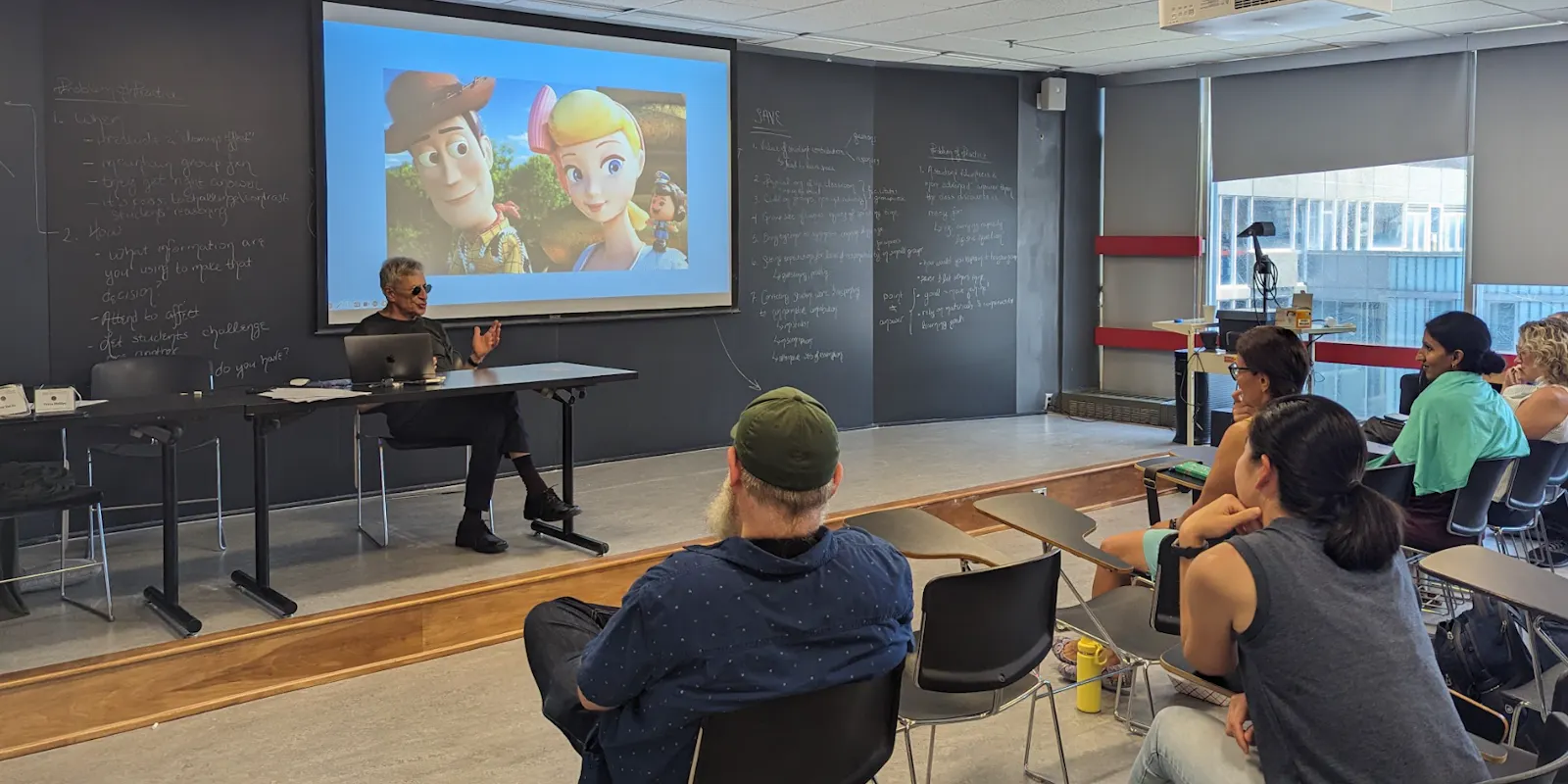
This is the more responsive approach that Weissman studied in July at Harvard, where he joined two dozen other college educators from around the country, tucked inside the air-conditioned, blackboard-walled rooms of Harvard’s Science Center. The week-long training ran from mornings into afternoons, with chummy lunch breaks in the faculty lounge, or the buzzing cafe in the Science Center lobby. The educators sat through lectures on pedagogy, the finer points of math and how to apply it to actual biological problems.
Sessions were prone to explanations such as how “physics-based simulations” became the buzzword in Hollywood, leading animation teams to use modeling techniques for hits like “Frozen,” “Brave” and “Toy Story,” which include life-like representations of walking through snow and bouncing curly hair. These digressions were placed alongside technical explanations of “cardiac defibrillation,” the rippling of electrical pulses as they move through the heart, as a way to show how to connect complicated math to the world outside of the classroom.
The training also had the educators plan, observe and teach classes based on these principles to eager high schoolers enrolled in a summer camp on campus.
The teaching experts who sponsored the training hope it will prepare college instructors to become “advocates,” empowering them to explain and defend the rigor of this way of teaching calculus to skeptical scientists from other departments. They expect it to be only the opening shot in an academic revolution.
But if calculus instruction is going to change, it may take some persuasion.
A Silent Revolution
The trouble with calculus is widely understood. The solution? Less so.
As these Harvard training sessions took place, the California State Board of Education finally approved a new framework that sets out to make math more culturally responsive and inquiry-based. It’s an attempt to respond to some of the pressures Weissman identified by kindling students’ math interest.
But it’s been controversial, causing “knock-down, drag-out math wars” that have included parent protests, threats and academic-on-academic social media spats about whether calculus should be reworked. That’s in part because the framework prioritized alternatives to calculus and also recommended delaying Algebra I, an onramp course to high school math and a critical juncture in the race to calculus, until ninth grade for most students. Critics have alleged the framework rejected rigor for “wokeism.”
In fact, many of recent attempts to keep calculus from being an obstacle to a STEM career focus on deemphasizing calculus, instead directing students to take other math courses like statistics or computer science.
The idea for the Harvard sessions came from a quieter attempt to revolutionize math instruction, relying on similar ideas, emanating from the University of California, Los Angeles.
Over the past decade, UCLA revamped its calculus for life sciences courses, focusing them more strictly on math concepts and real-world biological questions, rather than on procedural rules for derivatives and integrals — which its advocates describe as a paradigm shift for calculus instruction.
This idea is what drew instructors to sweaty Cambridge in July. UCLA’s model caught the attention of the Harvard math department, which decided to host a training over the summer for college instructors looking to refashion their own calculus courses. The session was meant to catalyze change, encouraging those instructors to open their own revised courses modeled on the ones being taught at UCLA.
A room of educators gets schooled on the rigors of mathematical modeling in the life sciences. Photo courtesy of the Harvard University Department of Mathematics.
As part of that, the college instructors observed and taught lessons to teenagers participating in a summer program being hosted at the same time at Harvard. It was meant to allow the educators to see these new methods in action, and to try them out personally.
In an early morning class, bleary-eyed and still vibrating from coffee, the instructors met with high school-aged students. The students had previously “warmed up” by grappling with datasets on COVID-19 mortality rates, trying to figure out what that data meant for policy.
“What’s your morning process?” the instructor asked.
The students, broken up into groups around tables, considered the question. “Brushing teeth” was the most common response.
The students then learned to map out the likely impact of teeth scrubbing on plaque growth, before pivoting to other possible applications of advanced concepts like vector spaces and differential equations.
During classes like this, instructors for the program studiously referred to these methods as “change equations,” a non-threatening phrase substituted to prevent the high schoolers from shying away from intimidating language like “differential calculus.” It’s connected to the claim that these classes can capture the rigor of advanced math, only without the anxiety it usually brings.
That’s a key part of the sales pitch for the course. “Our class has no prerequisites. Period,” says Alan Garfinkel, one of the UCLA professors who designed it, when asked by a teacher about talking to students about prerequisites in calculus.
That’s not typical. When this subject is usually taught, it’s done procedurally. Students are given a set of rules for solving these equations and then drilled on them, with the “why are we learning this?” question answered afterward. But students in these classrooms confronted the problems they wanted to solve first, only getting the equations after the curiosity had set in.
It left an impression. “Today I got to be a teacher again! Euler’s method to 20 amazing High School students with varying levels of mathematics background! Loved honoring that mathematics is a web of ideas as opposed to a linear trajectory filled with pre-requisites,” one instructor posted on social media.
Many of the educators at the event said they were attracted by the desire to increase student engagement and to make math more relevant to students’ lives.
But the impact the educators hope for reaches beyond the classroom, too. If high school and higher education can get more students to reason mathematically, it will make them productive thinkers, says Lindsey Henderson, a secondary math specialist at the Utah State Board of Education, who attended the training. That’s what the businesses in Utah’s Silicon Slopes, the state’s burgeoning tech sector, say they want, she adds.
For Weissman, of UC Santa Cruz, the fact that this course is being taught at a large institution already is important. When it comes to math instruction, he says, “There are always people promising revolutions.” But UCLA’s method does seem to work for large institutions, according to Weissman. The University of Arizona now offers a version of the class. A study of the course published by its creators suggests it’s been successful in engaging underrepresented students.
And Weissman doesn’t foresee much of a fight in implementing it: “I'm not beholden to a traditional textbook, so I don't have to make sure that I cover certain methods that I really do think just don't need to be taught anymore.”
Change Equations
At the same time the week-long workshop for instructors took place, Harvard also ran a two-week program for high school students based on the idea that high schoolers can be taught to solve problems using principles of advanced calculus.
The teacher workshop included designing and teaching classes to that class of 36 high schoolers, something the attendees weren’t warned about more than a day or two before.
“We wanted a way to have workshop participants see what's possible in the classroom,” says Brendan Kelly, the director of introductory math at Harvard and one of the event organizers. If you haven’t seen students thinking through the problems, it can be hard to vividly imagine what it might look like in your classroom, Kelly says.
The traditional sequence for math in middle school and high school is algebra I, geometry, algebra II/trigonometry and then pre-calculus, with advanced students making it to calculus. Increasingly, calculus is seen as a necessary bolster for competitive college applications.
For the high school summer program at Harvard, though, only algebra II was required. Students at the program had mostly taken AP Calculus, though not all of them had. One student said she had only taken pre-calculus before entering the course.
Student campers gave high marks to the experience.
“For me, like, I've honestly never considered a major in math,” says Judy Yen, a rising junior from the private Taipei American School in Taiwan. Yen wants to enter the medical profession, and the course left her considering a math double major or minor in her future, she adds.
For others, the lesson was that math can lead to benefits beyond school. “I can actually get jobs rather than just studying. Really, I can actually, maybe get a job that's related to math,” says Charles Sciarrino, a rising senior from Staten Island Academy, a college preparatory day school in New York. “And I just find that really cool,” he adds.
Still, it was a Harvard summer school class, implying that most students who participated not on scholarship had access to the funds to afford summer school in Massachusetts — which cost $5,300 for tuition and room and board for the two-week program — not to mention a prior interest in math. Will it translate to other schools and contexts?
There’s some privilege there, Kelly admits. But he firmly believes that the learning that happened there is possible anywhere: “I think it's a real deficit mindset to think that first-generation or low-income students wouldn’t have that same enthusiasm and curiosity. I just fundamentally disagree with that. Young people are curious about the world. And when you put compelling questions in front of them, they respond with excitement and engagement.”
The 28 educators at the workshop training seemed positive. “The course helps gain access for a broader range of student populations, for us to get students excited about math and cross-pollinate to all the other divisions as well,” says Steven LeMay, an associate professor at Curry College, a private college in Massachusetts, who attended the training.
LeMay was tasked with figuring out whether the revamped calculus will work for Curry, and he seemed generally optimistic. Curry College likely won’t have the fight that UCLA reported in attempting to transition its students, LeMay predicts. The college doesn’t have a standalone math major, and there’s been a push from LeMay’s colleagues to freshen the school’s technology use, LeMays says.
Other higher ed instructors, however, expressed concern over whether it would translate into their less resource-rich colleges. Their institutions, they say, were worried about whether their students would get transfer credits at other colleges for these courses, and they were skittish about possibly disrupting their own institutions’ math departments by keeping students from more traditional calculus classes.
In the end, Kelly of Harvard says, the dream is to have similar courses that integrate calculus concepts in life sciences, economics, social sciences, physical sciences and engineering taught at colleges and high schools. (Kelly has taught a similar modeling course for economics and social sciences for the last few years.)
But it’s hardly a foregone conclusion. One major challenge to spreading this method of math instruction more broadly? Money. The Harvard summer training was popular with potential teachers, but it was hard to get funding to support the program, Kelly says. He reports that he was unsuccessful twice in applying for a grant from the National Science Foundation — which Kelly attributes to a general lack of enthusiasm for attempts to alter calculus and a belief that it wasn’t a proper training course — but it was funded by a gift from an anonymous Harvard alumnus to the math department. Continuing the work will mean securing sustainable funding, he adds. That may be easier now that the first session has wrapped up, Kelly predicts.
But it’s still early days, Kelly says: “I think across the country, we are barely getting off the ground.”
WASHINGTON, D.C. — On a Friday morning in March, students and teachers gathered at a hip hotel here to reimagine what their high schools could be.
The delegation from Calvin Coolidge High School was thinking big — as in, global. For months, they’d been crafting plans to reframe their school’s curriculum around the United Nations sustainable development goals, 17 lofty targets that world leaders named as priorities in 2015 that include zero hunger, gender equality, and clean water and sanitation for everyone on Earth.
To explain this idea to the more than 100 people gathered in the hotel ballroom, students from Coolidge tossed around a colorful soccer ball. Each panel stitched to the ball represented one of the U.N. goals, which students referred to, casually, as “SDGs.” Each time someone caught the ball, he or she read aloud the SDG that landed face up, then reflected for a moment about what that global goal might mean locally, or personally.
A failing city is not a city, said one student.
No justice, no peace, added another.
If there is no community, there is no city, said a third.
This activity was part of a design workshop hosted by DC + XQ, a partnership between the city’s public schools and the nonprofit XQ Institute. Funded by Emerson Collective, a corporation that donates and invests money in social change efforts, XQ Institute currently supports programs intended to “rethink high school” at 30 schools and school districts nationwide. The organization describes its ultimate goal as graduating more students who have fundamental knowledge and skills, collaborate well, think creatively and are motivated to keep learning throughout their lives.
When I first came to this school, I felt as if student voices didn’t matter. It went from me feeling like my voice was never heard to me bringing out ideas that are constantly heard.
— Shamiyah McGee
XQ Institute hosts contests that award money and other resources to proposals for changing high schools, or for creating new ones. The organization helps teenagers, teachers and school leaders hone the visions they pitch over many months by guiding them through information-gathering activities like hosting focus-group conversations with parents and taking field trips to check out thriving schools in other cities.
The first two high schools to win the DC + XQ competition, in 2022, had embraced the themes of Afrofuturism and entrepreneurship. At this event in the hotel, representatives from other high schools in the city fine-tuned their own proposals, hoping to be selected into the second cohort of winners.
Although the verb keeps changing, D.C. is no stranger to attempts to “reform” or “rethink” its schools. Past efforts have yielded mixed results. And school district leaders here say they have encountered some skepticism about the DC + XQ campaign.
Yet as schools try to shake off the side effects of the COVID-19 pandemic, the need for fresh approaches to reach students seems clear. In the nation’s capital and nationwide, academic test scores are down and many students regularly bail on classes.
It’s a moment when XQ Institute’s agenda — that schools should offer more project-based learning, allow more flexibility in their schedules, and assign classwork more explicitly connected to career paths that interest students — may excite education leaders searching for solutions.
Yet measuring whether a redesigned high school is working as intended, and why, is difficult to do. And evidence about whether DC + XQ’s work makes a lasting difference in the lives of D.C. teens won’t arrive for a while.
In the meantime, the checkered history of school reform did not seem top of mind for students from Coolidge. Some said that simply being asked what they think about their high school had already improved their perceptions about education.
“When I first came to this school, I felt as if student voices didn’t matter,” said Shamiyah McGee, a rising junior who is participating in the redesign process. “It went from me feeling like my voice was never heard to me bringing out ideas that are constantly heard.”
Building Partnerships
XQ Institute launched with a bang. In 2015, it created the Super School Project, a contest to distribute millions of dollars to proposals for innovative high schools. In 2016, XQ Institute spent more millions on a public awareness campaign to promote its ideas about reforming education, papering its branding on buses and bus stops. In 2017, it advanced its message through a celebrity-studded network TV special, featuring Tom Hanks and James Corden doing karaoke on a school bus.
When wealthy donors and foundations have tried to improve schools by searching for a single innovation or intervention that will boost education — the way a new vaccine can dramatically improve public health — it usually hasn’t worked, said Phil Buchanan, president of the Center for Effective Philanthropy.
“If you look at the sum total of the efforts, I’m not sure you’d give them the highest grades,” he said. “Focusing on education, education reform — whatever you want to call it — achieving better educational outcomes, as a philanthropist, is a good way to become humble rather quickly, because it usually doesn’t go as folks hope.”
Yet he thinks that philanthropy leaders are exercising more humility lately, including about education. He has observed that donors and foundation executives are doing more listening to the people closest to the problems they hope to solve. He thinks philanthropists are realizing “that in fact there might be a lot of expertise and experience in communities, maybe even in families themselves that are affected.”
That’s the approach that D.C. school leaders said they’ve been taking for the past few years as they started their own efforts to rethink the city’s schools. In 2018, D.C. Public Schools created a design lab, which invited principals, teachers and staff to workshop solutions to problems.
Then the district grew the effort into a wholesale redesign process with two high schools in D.C. neighborhoods where average income levels are lower than in the rest of the city and where the vast majority of residents are Black. School leaders talked with thousands of community members there, according to Paige Hoffman, deputy chief for school improvement at D.C. Public Schools.
“Too often, the folks who are closest to the problems or issues that we’re trying to tackle are furthest from decision-making,” Hoffman said. “And we thought we should change that, and we should shake that up.”
In these conversations, D.C. residents reflected on questions like What do you want to see out of school? and Why has school not been working?
In February 2022, XQ Institute and D.C. Public Schools formed its partnership to redesign high schools in the city, which granted the school district up to $25 million. (For comparison, in its 2022 fiscal year, D.C. spent about $2 billion in local taxpayer dollars on public education.)
To Hoffman, the timing felt right. The COVID-19 pandemic had weakened the city’s social immune system, undermining institutions like schools that help to prevent the spread of contagions like crime and unemployment.
When XQ Institute came calling, Hoffman said, “I think it was in many ways exactly what we as a school district really needed.”
After all, she had heard D.C. residents express that “we have not been in community together in years, and we desperately need to rethink high school, especially when we think about all that our students lost over the previous years and also all of the opportunities that are to come for them.”
Leaders at Coolidge felt similarly. When DC + XQ collected and shared information with them about how their students had fared during the health crisis, “the data was really compelling to us,” said Kira Rowe, a school counselor at Coolidge. “It was definitely eye-opening.”
Students at Coolidge said they wanted more hands-on learning and a deeper understanding about how school prepared them for the real world. They reported being anxious and depressed at higher rates than before the pandemic. And they wanted to change what felt to them like segregation taking root in their school building, creating tension between the two-thirds of students who are Black and the fifth of students who are English language learners, most of whom are Hispanic.
Calvin Coolidge High School is participating in the DC + XQ competition. Photo by Brylie Christopher Oxley / Wikimedia Commons.
Coolidge administrators and educators decided to develop a proposal for the DC + XQ contest. They sought to blend student well-being, sustainable practices and academic rigor. Then they happened upon the United Nations sustainable development goals, Rowe said, “which we just instantly fell in love with.”
Coolidge students interviewed their classmates to find out whether the theme felt meaningful.
“A question I had to ask them was which one of these SDGs they cared about the most. There was never a time a student said, ‘I don’t care about any of them,’” McGee, the rising junior, recalled. “It showed these SDGs actually can have a heart to heart experience with the students.”
Her personal favorite? “Gender equality — SDG 5,” she said. “I can connect myself to that.”
Because the global goals emphasize universal values, Coolidge leaders thought that they might appeal to students and families who had immigrated to D.C. from elsewhere. One evening, the school invited families from African and Central American countries to share a meal of Ethiopian and Latin American food and to talk about which sustainable development goals resonated most with them. The response was enthusiastic, school leaders said.
All this feedback suggested that the theme had potential to improve the school curriculum.
“Sustainable practices seem to be the only way to at least continue to give back to our planet, make it healthy as well, and make our students healthy,” said Coolidge principal Semanthe Bright. “Why not rethink Coolidge? We can’t go back to doing the same thing we did before the pandemic. Now is the time.”
Engaging Students
William Hayes-Jerome is a rising junior at Coolidge. He described himself as a student-athlete — he plays football for the school team — and as an advocate for his classmates. He’s observed that many of them don’t much like being at school.
Maybe, he said in an interview, eight hours of lessons is just too long.
“Most students don’t have the right attention span to be sitting there in the classes,” Hayes-Jerome said.
He suggested that it might help to change the schedule of the school day, so that it offers more opportunities for students to move around, and, he explained, to “actually communicate with somebody about how the day is going.”
Student disengagement is not a totally new problem. In surveys of 230,000 students in grades three through 12 conducted from 2012 to 2017 by YouthTruth, an education research and consulting nonprofit, only 46 percent of high school respondents felt that what they were learning in class helped them outside of school. And only 52 percent of students across middle and high school agreed or strongly agreed that they enjoyed coming to school most of the time.
Data and anecdotes suggest that the pandemic has only made those trends worse.
Studies from DC + XQ found some of the city’s students reported being bored in class, as well as feeling unsure of why they were studying the assigned curriculum. This dissatisfaction is tied to high levels of truancy in schools, said Keith Dysarz, head of state and local partnerships for XQ Institute. For example, nearly half of D.C. students (48 percent) were absent for 10 percent or more of the 2021-2022 school year, according to a report from the D.C. Policy Center, a research organization.
While there is a lot of focus on grades and test scores coming out of the health crisis, “academic learning loss does not happen in a vacuum,” observed Jen Vorse Wilka, executive director of YouthTruth. To succeed intellectually and emotionally, she explained, students need “strong culture, engaging learning opportunities that feel relevant and connected to students’ lives, relationships, a sense of agency, and an opportunity to express their own opinions about their learning.”
If students aren’t engaged, they actually aren’t learning.
— Keith Dysarz
Those qualities align with what XQ Institute leaders said they advocate for in redesigned high schools.
“If students aren’t engaged, they actually aren’t learning,” Dysarz said in an interview. “For us, engagement isn’t just a lesson hook, or, you know, maybe an interesting topic that they care about. It’s also, quite honestly, about making it relevant and real world.”
At the DC + XQ design day in March, students and teachers from Coolidge worked in small groups to rearrange Post-it notes on large posters attached to the ballroom’s walls, brainstorming activities related to the sustainable development goals that they hoped would be both educational and enjoyable to their classmates.
Ideas surfaced about planning field trips to a hospital; asking students to create community service events; making more use of the school garden; and using gallery walks to prompt students to respond to each other’s work.
Students at Coolidge High School are learning about the United Nations sustainable development goals.
Then the small groups met up, and students offered each other feedback on their ideas. Teachers and administrators chimed in, too. One student wondered aloud whether certain activities would seem too ordinary to other teenagers. An adult suggested that rather than trying to make a school exercise feel “fun,” they instead aim to make it “engaging” and “interactive.”
An idea floated about using social media as part of a classroom activity. That might be too distracting, someone said. Teachers snapped their fingers in agreement.
An educator reminded the students to consider how to design experiences for all of their peers — not just the kinds of students who earn all A’s (or show up to extracurricular design workshops). They talked about whether a little competition helps to motivate participation in class. They thought about how upperclassmen can help set a good example for younger students. They discussed the value of creating multiple activity options for their peers to choose from.
As the students broke back up into smaller groups, the conversation at one table dove into assignment ideas about the importance of water. Students and educators talked about the public health crisis in Flint, Michigan, where the water supply is tainted with lead. They talked about the problem of plastic pollution in the ocean. Someone pulled up photos she had taken during a trip to Colombia of piles of waste she saw there.
By the lunch break, a seminar-style discussion about SDG 6 — clean water and sanitation — was well underway.
Coolidge students and educators participated at a DC + XQ design event. Photo courtesy of Kira Rowe.
Getting Flexible
Pulling off elaborate student projects requires a certain amount of flexibility in the curriculum and in the school day. And making schools more flexible is a top XQ Institute priority.
The prospect of more freedom appealed to science teacher Nikki Wallace when she joined the faculty of Crosstown High School, an XQ Institute partner and charter school in Memphis, Tennessee, which opened in 2018. The summer before the first school year, she collaborated with other teachers to design interdisciplinary projects relevant to real-world situations.
It was exciting. It was challenging. Wallace recalls the “struggle” of trying to devise a long-term assignment about traveling to Mars with a math teacher who wasn’t convinced that it would provide adequate math instruction.
“It wasn’t easy at all,” Wallace said. “It built up a lot of tension.”
Then she had to sell the idea to her students. The framing she used to introduce that project — what’s wrong here on Earth and why do we need to explore Mars? — didn’t land as well as she had hoped. She said that at first, her students got so stuck pondering earthly problems that their imaginations didn’t lift off into space.
And yet, she believes that project made a lasting impression. As those students progressed through high school, Wallace said, the one assignment they seemed to talk about most was the Mars project from that first year.
For a teacher like Wallace to take a risk and try a new instructional approach, she said, the education ecosystem has to have the right conditions to support her.
“You gotta have the willingness of the leadership team to be flexible,” she said. “If leadership sees the benefits, it allows for creativity to happen.”
In D.C., questions about how much flexibility educators and students really have to redesign their schools come up regularly, according to Hoffman, the district leader. After all, schools are governed by plenty of federal and district policies intended to ensure that they impart a rigorous education. School officials also must contend with budget constraints, the needs and interests of educator employees, and the logistics of keeping track of hundreds of teenagers from day to day.
Hoffman hears D.C. educators say, “You want me to dream big, but what parameters” — school rules and regulations — “are you going to pull down?”
So the district is experimenting with change. It’s running pilot programs that allow students to participate in internships during the school day. Leaders are also working to figure out whether certain career and technical courses can convey academic credit — like an engineering elective fulfilling a science requirement that counts toward a diploma.
“You have to figure out how to get comfortable with trying something, with failing, and then learning from that,” Hoffman said.
Creating Accountability
Will creativity in the classroom and flexibility in how students demonstrate their learning be enough to transform Coolidge?
In education, metamorphosis requires more than mere tinkering. So said Elizabeth Chu, executive director of the Center for Public Research and Leadership, an education research and consulting arm of Columbia University.
She argued that true change requires rewiring entire education governance structures, so that they stop delivering “uniform services” and instead prioritize “uniformly attending to the differences that kids and families present and meeting their unique needs.”
“When you're working with these schools, you have to be aware [that] classrooms are sitting within schools, are sitting within districts, are sitting within states, are sitting, obviously, within the federal structure,” Chu said. “And so it means rethinking the policies and procedures at every level of the system that allow for the flexibility and innovation that you need at the particular school level.”
And so, over time, XQ Institute has turned its attention toward influencing policy and reshaping whole school systems, not just individual schools. In 2018, it published a guide encouraging state leaders to adopt the nonprofit’s reform strategies. In 2022, Rhode Island approved new regulations for the state’s high schools after working closely with XQ Institute. Now, the nonprofit is leading an effort to change the national “seat time” requirements that mandate students spend a certain number of hours in the classroom to earn credits and credentials.
Spokespeople for XQ Institute emphasized the grassroots flavor of each school redesign effort. Yet these processes did not germinate totally organically.
The nonprofit’s guide for policymakers suggests a road map for how to prompt communities to change their schools. Step one: Announce a challenge, and make it “ambitious, inspiring, and different.” Step two: Move people to action, with incentives like money. Step three: Help guide the redesign process so that it focuses on “equity, innovation, and excellence,” perhaps by using the resources developed by XQ Institute.
Whether a reform effort emerged from the playbook of a philanthropy juggernaut might not matter much if it ends up working well for students and schools. But that’s not always easy to assess.
One reason why is that change can take a long time, and results can be uneven. For example, after philanthropists (including Mark Zuckerberg) gave $200 million in 2010 to reform public schools in Newark, New Jersey, student academic achievement actually declined for several years, according to the Center for Education Policy Research at Harvard University. Eventually, math scores recovered and English scores surpassed their original levels, but by then, of course, some of the students who experienced the initial shock to the school system had aged out. And researchers found that much of the improvement could be attributed to students enrolling in different schools, rather than achievement going up at existing schools.
Another is that metrics can tell contradictory stories. For example, the D.C. Policy Center report found that the on-time high school graduation rate in the city has been been rising —from 68 percent in the 2018-2019 school year to 75 percent in the 2021-2022 school year — ostensibly a positive development. Yet the college enrollment rate within six months of graduation has been falling — from 56 percent for the class of 2019 to 51 percent for the class of 2021.
Some of the same organizations that poured money into school reform have since supported studies about what actually works. For example, in June, research firm MDRC published an analysis funded by the Bill and Melinda Gates Foundation about which frequently used school reform strategies are linked to better outcomes. They include:
Strengthening principal leadership
Using student data to improve teaching
Setting high standards for academic rigor
Enabling students to build personal relationships with educators
Empowering teachers to set goals and make decisions
Organizing teachers into teams that provide mutual support
Providing students extra academic help
Extending classes to allow for longer instructional time
Measuring these kinds of interventions early and often makes a difference in education reform efforts, according to Chu.
“A lot of these redesign processes, especially ones that are very user-centered, are extremely attentive to the process and very intentional in monitoring how things are going. So it’s not five years down the road that you’d realize things aren’t on the right track,” Chu said. “Let’s assess — kind of every single day, every single month, every single semester — how things are going, so that we are serving kids in classrooms today to the best of our ability.”
XQ Institute does help schools conduct audits at the start of their partnerships to assess what’s been working and not working well. These measure quantitative factors like student transcript data as well as qualitative feedback from students about how prepared they feel for life after high school, whether their academic options align with their personal passions and how supportive they feel their teachers are.
Yet XQ Institute does not see itself as the party accountable for ensuring the success of the changes it sets in motion. After all, as a spokesperson put it, flatly, in writing, “XQ does not operate schools.”
However, the nonprofit did share through a spokesperson that “XQ gathers data directly from our schools to understand student experiences in real-time and is also working with a best-in-class third-party evaluator, MDRC, who is conducting a longitudinal study about XQ schools’ impact on their students.” The firm is about a year away from publishing quantitative data, the spokesperson said.
For now, XQ Institute readily shares statistics indicating successes from the high schools it has worked with across the country. For example, at Crosstown in Memphis, 75 percent of the graduating class of 2022 planned to enroll in four-year colleges, according to XQ Institute, higher than the national rate of 47 percent. And 95 percent of its seniors graduated, compared to 80 percent in the surrounding district and 90 percent in the state of Tennessee.
These data points don’t show that, in its short existence, Crosstown has experienced leadership turnover, as well as a walkout among students advocating for a bigger say in how the school functions.
Of course, even if a reform effort worked wonders, it could still raise questions. Like, who gets to attend a redesigned high school and who gets left out?
“You think back to charter school models that have been around for a long, long time. The idea is that they can be laboratories of innovation, and then those innovations can infiltrate the rest of the public schools in that city — and that transfer doesn’t necessarily happen,” said Vorse Wilka, of YouthTruth. “The intention is laudable. And my question would be to what extent it plays out, and to what extent it is broadly accessible.”
And what are the ethics of testing out new school models on students in real time?
“When we’re talking about redesign, we are talking about experimentation to some extent,” Chu acknowledged. But she countered that “when we don’t make changes, and we kind of try and try and try again the same method, you might argue that that’s a less responsible form of experimentation, because we already have an evidence base that indicates that future performance will likely follow past performance, to some extent.”
We need to hold elected officials accountable for the choices they make, and the decisions they make, and what influence they choose to give to others, and who they listen to, and who they take resources from.
— Phil Buchanan
And what are the implications of a private organization giving millions of dollars to shape the operations of a city’s public schools?
“I think it’s complicated and nuanced, and that the most effective philanthropic efforts engage with those questions, and engage with the people they seek to help, to make sure that those people see that help as the help that they want,” said Buchanan, of the Center for Effective Philanthropy. “But then, also, we need to hold elected officials accountable for the choices they make, and the decisions they make, and what influence they choose to give to others, and who they listen to, and who they take resources from.”
Hoffman, of D.C. Public Schools, said she has encountered some fear and skepticism that D.C.’s redesigned high schools won’t serve students well. Or that the district isn’t serious about seeing the effort through. Or that the project is too idealistic and unrealistic at a time when plenty of youth in the city are worried about life’s basics, like safety.
“I am very frank that we need to earn your trust and we need to be showing you. Don’t just listen to me sit up here and pitch a great vision for you. Hold us accountable, right?” Hoffman said.
But she hopes city residents won’t simply critique from the sidelines, either.
“We also need community members at the table with us along the way,” Hoffman said. “The work of strong schools is not just the work of the public school system alone. It’s the work of families, it’s the work of community partners, it’s the work of higher ed organizations. It’s really about the community and the city.”
Seeking Transformation
Soon after the DC + XQ design session at the hotel, educators took three dozen students from Coolidge to visit the United Nations headquarters in New York City. They saw the golden general assembly hall. They watched world leaders deliberate during hearings. And, undeterred by a winter storm, some students caught their first glimpse of Times Square and the Empire State Building.
In June, DC + XQ named Coolidge as one of four schools in its second cohort of partners.
Coolidge students visited the United Nations headquarters in New York City. Photo courtesy of of Kira Rowe.
This coming school year, the high school will continue to refine its new vision. Coolidge will offer a capstone research class based on the United Nations sustainable development goals, which will support students in working on projects with partners including the Smithsonian Institution, the Humane Society, an urban farm and local universities. Students will have more opportunities to travel internationally. Teachers will have more opportunities to learn how to incorporate place-based learning into their classrooms.
Students list the ways that joining in the redesign process has already changed high school for them. Daisy Garcia-Vasquez, a rising senior, said she now has closer relationships with her teachers, and she feels a new sense of school spirit that doesn’t revolve only around sports teams. Hayes-Jerome said he feels like he’s helping to create real change by speaking out on behalf of his classmates.
McGee said she’s been inspired by “seeing so many students come together” through the redesign process. By listening to her peers at Coolidge and students at other high schools across the city, she’s realized that all of their thoughts pooled together can be distilled into one potent drop.
“We all have the same idea: We want school to be more of a safe and interactive and engaging environment for us,” she said.
About three dozen students toured the UN headquarters. Photo courtesy of of Kira Rowe.
That single bead of water may ripple out, into the wider city. McGee wants D.C. to support healthier food options — that’s SDG 3. Hayes-Jerome wants to see less gun violence in the city — that’s SDG 16.
Garcia-Vasquez said she hadn’t paid much attention to the environment before she learned about the SDGs. After taking a pilot version of the new Coolidge capstone class, though, she realized she’s passionate about the natural world.
“Something I would love for D.C. to change is the littering,” she said. “If you see trash every day, it makes you feel like you’re in a nasty environment. It changes your mood. If you live in a clean environment, you will feel better.”
Principal Bright said she looks forward to the day she can track graduates and see what contributions they’re making to the wider world because of what they learned at Coolidge.
“I would like to see how they have taken their capstone experience, their travel, as well as their research on the United Nations sustainability goals, and transform wherever they are in society,” Bright said.
That transformation need not wait for some far-off future. Educators at Coolidge said they are advocating to start D.C.’s first voluntary local review committee, to push the city they call home to work toward achieving the sustainable development goals.
 Login
Login