
 Login
Login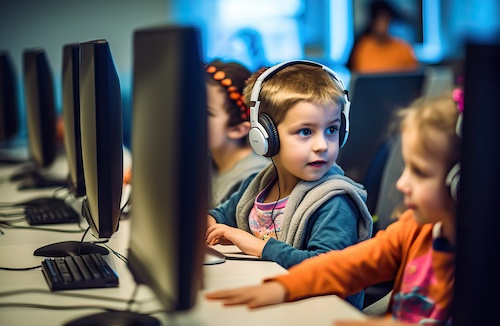


Schoolwork shouldn’t double as screentime

This story was originally published by Chalkbeat. Sign up for their newsletters at ckbe.at/newsletters.
Children get one childhood, and time is one of the most precious resources we have in schools. For these reasons, I am increasingly frustrated that I have next to no power to stop my own children from wasting their time in front of a computer screen.
That’s because screens are where they are expected to access and complete their schoolwork and homework. My children are assigned to watch online videos and answer questions about them in an online form. Their grades reflect their responses.
No doubt, this assigned screen time probably comes from a good place. Teachers want to provide students with experiences they will enjoy. Why give students a reading that they may not do when you could give them a video they are more likely to watch?
Watch enough videos and students begin to believe that learning must be passively entertaining and that the best way to take in new information is through streaming content. The most compelling story is often not the most truthful one, but the one that is the most slickly produced.
I don’t want that for my children. I want my children to enjoy the challenges of learning, to take in multiple sources, and to ask good questions about everything they engage with. I don’t want them on autopilot, screening their way through childhood.
UNESCO recently published a book titled “An Ed-Tech Tragedy?” and it is sobering. This book spells out how pandemic school shutdowns resulted in massive learning losses. It also highlights the costs, in terms of mental health, of spending so much time on screens.
For years, educational technologists have cast personalized online learning as an answer to what plagues education. But even when ed tech was needed most, these tools did not always rise to the occasion. They couldn’t take the place of teachers, peers, and classroom conversations. And our reliance on them has instilled terrible habits in teachers and students.
Parents were rightly frustrated and angry when their children were robbed of the opportunity to attend school because of pandemic lockdowns. It is not good for a child to be away from their peers and in front of screens. Key social, emotional, and intellectual skills are lost when this happens. That’s why we must not replicate the worst aspects of school lockdowns now that children are back in school. Children should spend time engaging their teacher and each other–making eye contact and appreciating what can only be learned through human presence–not retreating back into the safe, solitary spaces of their devices.
Their schoolwork should have them engaging with what is best in our culture, not what is most convenient or entertaining. This means reading challenging texts with students and doing the work of helping them develop their voices in relation to these texts. However, educators seem to be having a hard time remembering that distance learning was the best we could think to do during the lockdown, not a best practice that we should continue.
I am not afraid to mourn all that was lost because of the pandemic. Children suffered tremendously, and schools across the country will be dealing with the academic, social, and emotional fallout for years to come. My grieving process involves honoring my hopes and fears from the middle of the pandemic. I promised myself then that if we ever got back to normal, I wouldn’t take the physical presence of my students for granted. I would look at their unmasked faces and try to communicate how much I appreciated that we were together.
Screens, and the illusion of engagement they offer, get in the way of this type of lived gratitude, and they distract us from what matters.
To be clear, teachers’ lives in schools are often tremendously difficult. Many educators are demoralized and under-appreciated, but an over-reliance on screens will not make the work of teaching more rewarding or valued. It’s human connections that make teaching an endlessly rewarding calling. I know this from my own classrooms and my experience training future teachers.
As much as I may internally complain about having to pick up all the little Lego pieces, Magna-Tiles, and wooden blocks that my boys leave scattered around the house at the end of a long day, I know that this type of embodied play is the foundation of a good childhood. And as hard as it might be to listen–really listen–to the stories my daughters tell as they process their day at school (and not just let my mind wander to all the items on my to-do list), there is no greater gift we can give children than our fullest attention.
I am not a perfect parent or teacher, but I do know that I am at my best when I am present. And I know that screens keep me from offering my full presence. I wish I had more power to keep them out of schools because I know my children–and all of our children–deserve better.
For more news on teaching trends, visit eSN’s Innovative Teaching page.
Chalkbeat is a nonprofit news organization covering public education.