Normal view

There are new articles available, click to refresh the page.
Before yesterdayMain stream

Schoolwork shouldn’t double as screentime

16 November 2023 at 10:02
Learning on screens was the best could do during school closures--not a best practice in screen time that we should continue for students.

This story was originally published by Chalkbeat. Sign up for their newsletters at ckbe.at/newsletters.

Children get one childhood, and time is one of the most precious resources we have in schools. For these reasons, I am increasingly frustrated that I have next to no power to stop my own children from wasting their time in front of a computer screen.

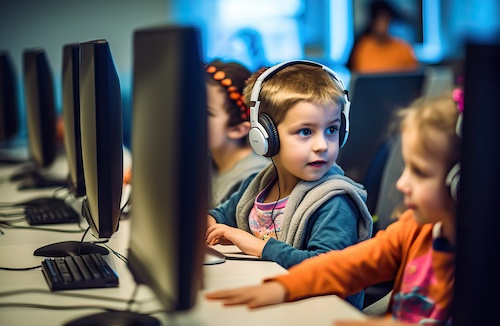
That’s because screens are where they are expected to access and complete their schoolwork and homework. My children are assigned to watch online videos and answer questions about them in an online form. Their grades reflect their responses.  

No doubt, this assigned screen time probably comes from a good place. Teachers want to provide students with experiences they will enjoy. Why give students a reading that they may not do when you could give them a video they are more likely to watch?

Watch enough videos and students begin to believe that learning must be passively entertaining and that the best way to take in new information is through streaming content. The most compelling story is often not the most truthful one, but the one that is the most slickly produced. 

I don’t want that for my children. I want my children to enjoy the challenges of learning, to take in multiple sources, and to ask good questions about everything they engage with. I don’t want them on autopilot, screening their way through childhood. 

UNESCO recently published a book titled “An Ed-Tech Tragedy?” and it is sobering. This book spells out how pandemic school shutdowns resulted in massive learning losses. It also highlights the costs, in terms of mental health, of spending so much time on screens. 

For years, educational technologists have cast personalized online learning as an answer to what plagues education. But even when ed tech was needed most, these tools did not always rise to the occasion. They couldn’t take the place of teachers, peers, and classroom conversations. And our reliance on them has instilled terrible habits in teachers and students.

Parents were rightly frustrated and angry when their children were robbed of the opportunity to attend school because of pandemic lockdowns. It is not good for a child to be away from their peers and in front of screens. Key social, emotional, and intellectual skills are lost when this happens. That’s why we must not replicate the worst aspects of school lockdowns now that children are back in school. Children should spend time engaging their teacher and each other–making eye contact and appreciating what can only be learned through human presence–not retreating back into the safe, solitary spaces of their devices.

Their schoolwork should have them engaging with what is best in our culture, not what is most convenient or entertaining. This means reading challenging texts with students and doing the work of helping them develop their voices in relation to these texts. However, educators seem to be having a hard time remembering that distance learning was the best we could think to do during the lockdown, not a best practice that we should continue.

I am not afraid to mourn all that was lost because of the pandemic. Children suffered tremendously, and schools across the country will be dealing with the academic, social, and emotional fallout for years to come. My grieving process involves honoring my hopes and fears from the middle of the pandemic. I promised myself then that if we ever got back to normal, I wouldn’t take the physical presence of my students for granted. I would look at their unmasked faces and try to communicate how much I appreciated that we were together. 

Screens, and the illusion of engagement they offer, get in the way of this type of lived gratitude, and they distract us from what matters.

To be clear, teachers’ lives in schools are often tremendously difficult. Many educators are demoralized and under-appreciated, but an over-reliance on screens will not make the work of teaching more rewarding or valued. It’s human connections that make teaching an endlessly rewarding calling. I know this from my own classrooms and my experience training future teachers. 

As much as I may internally complain about having to pick up all the little Lego pieces, Magna-Tiles, and wooden blocks that my boys leave scattered around the house at the end of a long day, I know that this type of embodied play is the foundation of a good childhood. And as hard as it might be to listen–really listen–to the stories my daughters tell as they process their day at school (and not just let my mind wander to all the items on my to-do list), there is no greater gift we can give children than our fullest attention.

I am not a perfect parent or teacher, but I do know that I am at my best when I am present. And I know that screens keep me from offering my full presence. I wish I had more power to keep them out of schools because I know my children–and all of our children–deserve better.

For more news on teaching trends, visit eSN’s Innovative Teaching page.

Chalkbeat is a nonprofit news organization covering public education.
OpenAI releases ChatGPT teaching guide

19 October 2023 at 11:13
Teaching with ChatGPT doesn't have to be challenging--educators can embrace the AI tool and also show students how to create original work

Key points:

  • OpenAI, maker of ChatGPT, is releasing a guide to help educators incorporate the AI tool in their instruction
  • The guide includes use examples and answers frequently-asked questions
  • See related article: An AI to-do list for educators
  • Get the latest news on AI in education by visiting eSN’s Digital Learning page

Educators face myriad dilemmas in the wake of ChatGPT’s explosion, with some of the most popular including teaching with ChatGPT and how to address student use of AI chatbots in assignments.

OpenAI, the maker of ChatGPT, has released a new guide to help educators navigate the many ways AI can be used in teaching and learning. The guide contains examples of how some educators are teaching with ChatGPT, along with a series of frequently-asked questions that may help guide teachers as they seek to strike a balance between accepting AI’s presence and an over-reliance on such tools.

As outlined in OpenAI’s guide, here’s how some instructors are teaching with ChatGPT:

Role playing challenging conversations: Dr. Helen Crompton, Professor of Instructional Technology at Old Dominion University, encourages her education graduate students to use ChatGPT as a stand-in for a particular persona—like a debate partner who will point out weaknesses in their arguments, a recruiter who’s interviewing them for a job, or a new boss who might deliver feedback in a specific way. She says exploring information in a conversational setting helps students understand their material with added nuance and new perspective.

Building quizzes, tests, and lesson plans from curriculum materials: Fran Bellas, a professor at Universidade da Coruña in Spain, recommends teachers use ChatGPT as an assistant in crafting quizzes, exams and lesson plans for classes. He says to first share the curriculum to ChatGPT and then ask for things like fresh quiz and lesson plan ideas that use modern or culturally relevant examples. Bellas also turns to ChatGPT to help teachers make sure questions they write themselves are inclusive and accessible for the students’ learning level. “If you go to ChatGPT and ask it to create 5 question exams about electric circuits, the results are very fresh. You can take these ideas and make them your own.”

Reducing friction for non-English speakers: Dr. Anthony Kaziboni, the Head of Research at the University of Johannesburg, teaches students who mostly don’t speak English outside of the classroom. Kaziboni believes that command of English is a tremendous advantage in the academic world, and that misunderstandings of even small details of English grammar can hold back students from recognition and opportunity. He encourages his students to use ChatGPT for translation assistance, to improve their English writing, and to practice conversation.

Teaching students about critical thinking: Geetha Venugopal, a high school computer science teacher at the American International School in Chennai, India, likens teaching students about AI tools to teaching students how to use the internet responsibly. In her classroom, she advises students to remember that the answers that ChatGPT gives may not be credible and accurate all the time, and to think critically about whether they should trust the answer, and then confirm the information through other primary resources. The goal is to help them “understand the importance of constantly working on their original critical thinking, problem solving and creativity skills.”

Some of the common questions around teaching with ChatGPT include:

  1. How can educators respond to students presenting AI-generated content as their own?
  2. How can ChatGPT be used for assessment and feedback?
  3. How can educators get started with ChatGPT?

Related: Coming out of the AI closet: A scholar’s embrace of ChatGPT-4

5 spooky Halloween videos for students of all ages

9 October 2023 at 12:00
Use these fun Halloween-themed TED-Ed Lessons and videos to engage students in classroom learning and capture their attention.

Key points:

  • TED-Ed Lessons are a great way to inject some fun into learning a new topic
  • During October, take advantage of creepy decorations and Halloween and use these videos to teach students some new facts
  • See related article: 9 TED-Ed Lessons about different holiday origins

It’s October, and for many students, that means pumpkins, scary decorations, and trick-or-treating on Halloween. What better way to celebrate October than to incorporate some fun and spooky videos to engage students, while also teaching them some fun facts?

Teachers with students of all ages can use TED-Ed Lessons to leverage October’s fun events (Friday the 13th in October, anyone?) and speak to students’ different interests.

The TED-Ed platform lets educators build lessons around any TED-Ed Original, TED Talk, or YouTube video. Once teachers find the video they want to use, they can use the TED-Ed Lessons editor to add questions, discussion prompts, and additional resources.

Use these TED-Ed Lessons and videos for brain breaks, to introduce new lessons, or to give students some fun and age-appropriate spooky experiences into your classroom:

1. Where do superstitions come from? Are you afraid of black cats? Would you open an umbrella indoors? How do you feel about the number 13? Whether or not you believe in them, you’re probably familiar with a few of these superstitions. But where did they come from? Stuart Vyse shares the weird and specific origins of some of our favorite superstitions.

2. Why is being scared so fun? At this very moment, people are lining up somewhere to scare themselves, be it with a thrill-ride or a horror movie. In fact, in October of 2015 alone, about 28 million people visited a haunted house in the US. But you might wonder: What could possibly be fun about being scared? Margee Kerr examines the biology and psychology behind what makes fear so fun.

3. The fascinating history of cemeteries: Spindly trees, rusted gates, crumbling stone, a solitary mourner: these things come to mind when we think of cemeteries. But not long ago, many burial grounds were lively places, with gardens and crowds of people — and for much of human history, we didn’t bury our dead at all. How did cemeteries become what they are today? Keith Eggener delves into our ever-evolving rituals for honoring the dead.

4. What can you learn from ancient skeletons? Ancient skeletons can tell us a great deal about the past, including the age, gender and even the social status of its former owner. But how can we know all of these details simply by examining some old, soil-caked bones? Farnaz Khatibi examines a fascinating branch of science known as biological anthropology.

5. A video that terrifies while it teaches? There’s a TED-Ed Lesson for that: Pick your poison: Blood hungry vampires. Zombies on a mission for your tasty brain. Creepy crawlies. No matter your (fictional or real) fright of choice, TED-Ed has a lesson for all of your Halloween needs. So pick out your favorite candy (more on that later), choose a few videos, and have a very happy Halloween.

❌
❌