 Login
Login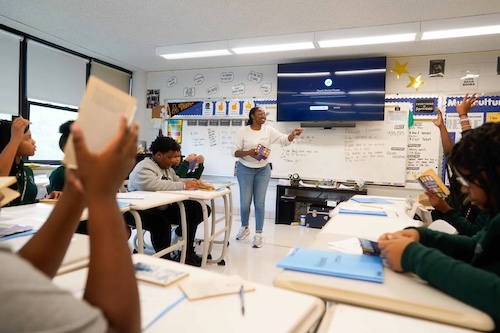


The pandemic is over–but American schools still aren’t the same

This story was originally published by Chalkbeat. Sign up for their newsletters at ckbe.at/newsletters.
On a recent Friday at Gary Comer Middle School in Chicago, you had to squint to see signs of the pandemic that upended American education just a few years ago.
Only a handful of students wore face masks, and even then, some put them on to cover up pimples, staff said. The hand sanitizer stations outside every classroom mostly went unused, and some were empty. Students stopped to hug in the hallway and ate lunch side by side in the cafeteria.
“I don’t think it’s a big deal as much as it was before,” said 12-year-old Evelyn Harris, an eighth grader at Comer, whose lasting memory of pandemic schooling is that online classes were easier, so she got better grades. “The pandemic didn’t really affect me in a big way.”
But inside Nikhil Bhatia’s classroom, the evidence was on the whiteboard, where the math teacher was shading in slices of a pie to illustrate how to find a common denominator. That day, his seventh graders were working to add and subtract fractions — a skill students usually learn in fourth grade.
Maybe you learned this before, Bhatia began. “Or, during the pandemic, you might have been on Zoom,” — a few students laughed as he dragged out the words — “put your screen on black, went to go play a couple video games. Snap if that sounds familiar?”
Clicking fingers filled the room. “That’s OK!” Bhatia responded. “That’s why we’re going to do the review.”
As the new school year begins at Comer and elsewhere, many students and educators say school is feeling more normal than it has in over three years. COVID health precautions have all but vanished. There’s less social awkwardness. Students say they’re over the novelty of seeing their classmates in person.
But beneath the surface, profound pandemic-era consequences persist. More students are missing school, and educators are scrambling to keep kids engaged in class. Many students remain behind academically, leaving teachers like Bhatia to fill in gaps even while trying to move students forward. Rebuilding students’ shaken confidence in their abilities is especially important right now.
“It’s OK that you don’t know this,” Bhatia tells his students. “It’s normal right now.”
Nationally, many students remain far behind in math and reading where they would have been if not for the pandemic. There have been especially steep learning drops at schools that taught virtually for most of the 2020-21 school year, as schools did across Chicago and within the Noble charter network, which includes Comer. It’s an issue that’s even more pressing for older students, who have less time to fill in those holes.
At Comer, 28% of eighth graders met or exceeded Illinois math standards the year before the pandemic, not far off from the state’s average of 33%. But by spring 2022, that had fallen to just 2%, compared with 23% for the state.
In reading, meanwhile, 9% of Comer eighth graders met or exceeded state standards pre-pandemic, and that dipped to 4% in spring 2022, when the state’s average was 30%.
The school made gains they’re proud of last school year, with 10% of eighth graders hitting the state’s bar for math and 22% hitting it for reading, though school leaders say they know there is still work to be done.
“If you don’t have some foundational skills and basic skills, it will be almost impossible to keep up with the curriculum as the kids get older,” said Mary Avalos, a research professor of teaching and learning at the University of Miami, who has studied how COVID affected middle school teachers. “That’s a big issue that needs to be addressed.”
How teachers are addressing pandemic learning gaps
Most of Bhatia’s students missed key skills in fourth and fifth grades — the years that school was remote, then interrupted by waves of COVID — but they mastered more advanced concepts in sixth grade last year.
That’s left Bhatia, like many teachers across the country, with the tricky task of coming up with mini lessons to fill in those elementary gaps, without spending so much time on prior concepts that students fall behind in middle school.
On a day like Friday, that meant to get students ready to add negative fractions, a seventh grade skill, Bhatia first had to teach a short lesson on adding fractions, a fourth grade skill. At first, some students mistakenly thought they should use the technique for dividing fractions they learned last year.
“They’ll say: ‘Oh is this keep, change, flip’?” Bhatia said. “The gap isn’t exactly what you would expect it to be.”
This kind of teaching happened “once in a while” pre-pandemic, Bhatia said, but “now it’s like day by day I have to be really critical in thinking about: ‘OK what might be the gap that surfaces today?’”
Aubria Myers, who teaches sixth grade English at Comer, sees ways the familiar rhythms of school are just now returning, four months after federal health officials declared an official end to the COVID-19 emergency.
“This year, for me, feels the most normal,” Myers said. Students are saying: “Oh wait, what’s the homework again, can I get another copy?” she said. Last year when she mentioned homework, “they were like: ‘What is that?’”
On that recent Friday, Myers led an activity in her multicultural literature class that would have been impossible two years ago when students had to stay seated in pods of color-coded desks.
Her sixth graders huddled close to one another as they tried to hop across the classroom, an exercise designed to give her fidgety students a chance to move around, while exemplifying the communication and teamwork skills that would be at the center of Seedfolks, the novel they were about to read in class.
Still, Myers had chosen the book, with its short chapters and lines full of metaphors and irony, to meet the needs of this crop of sixth graders, who spent all of third grade learning online. Many, Myers knows, never logged on. They have shorter attention spans and doubts about their reading skills but love class discussions, she said.
“They remember that time in their life when they were stuck talking to only people in their house,” Myers said. “They’re in class wanting to engage with each other.”
Myers has tried to prevent her students from getting discouraged by their learning gaps. At the start of this school year, for example, she’s pointing out spelling and punctuation errors, but not docking points yet. She wants to make sure her students first have time to learn some of the key skills they missed in earlier grades.
“We have kids who don’t understand how to put a period somewhere in your sentence, or how to put spaces between their words,” Myers said. “I see these very beautifully strung together ideas, these really well thought-out explanations, but they’re missing some of those key mechanics.”
Student mental health and engagement still top of mind
Comer has responded to students’ post-pandemic needs in other ways, too. The school expanded its team of social workers and other staff who work with students to resolve conflicts and address mental health needs, a trend that’s been observed nationwide.
The school has long felt the effects of neighborhood gun violence and student trauma, but staff say having more adults focused on those issues has helped students open up and seek help. Now, more students are requesting verbal mediations to head off physical fights, staff say.
“If you follow us through the building, you’ll see,” said Stephanie Williams, a former reading teacher who now directs Comer’s social and emotional learning team. “Kids will seek you out, or find you, and let you know: ‘Hey, I need this.’”
And this is the second year the school has scheduled all core classes earlier in the week, so that students can spend part of Friday practicing math and reading skills on the computer, and the rest of the day taking two special electives. It’s a strategy meant to keep students engaged — and showing up to school.
The school offers classes that pique students’ interests, such as the history of hip hop, hair braiding, and creative writing. Brandon Hall, a seventh grader at Comer, blended his first smoothie in a “foodies” class and bonded with his basketball coach through chess. He came to see similarities between making plays on the court and moving pawns across the board.
“I learned a lot from him,” he said.
On “Freedom Fridays,” attendance is higher and student conflicts are rarer, school officials say. That’s been important as the school, like many others, has seen higher chronic absenteeism rates over the last two years. At Comer, 1 in 3 sixth graders missed 18 or more days of school last year. Before the pandemic, that number sat closer to 1 in 5.
The approach runs counter to the calls some education experts have made for schools to double down on academics and add more instructional time — not take it away.
A recent report by the Center on Reinventing Public Education, for example, spells out the numerous ways students are still struggling, and calls for “a greater urgency to address learning gaps before students graduate.” Harvard education researcher Thomas Kane noted that few districts have lengthened the school day or year and warned that, “The academic recovery effort following the pandemic has been undersized from the beginning.”
But JuDonne Hemingway, the principal of Comer, said devoting time to enrichment activities during the school day is worth it to ensure all students have access to them. These classes, she added, are helping students develop interests they may pursue in college or as part of a career.
“They’re not just random experiences for kids,” Hemingway said. “We think they are just as important as any traditional academic class.”
Chalkbeat is a nonprofit news organization covering public education.
For more news on COVID in schools, visit eSN’s Educational Leadership page.