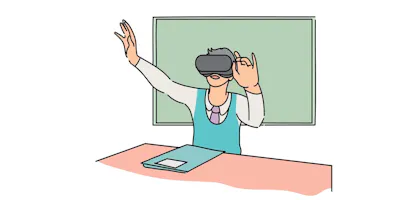
Podcast Laurent Di Pasquale est Professeur de sciences humaines dans l’enseignement secondaire décrit sa pédagogie comme profondément positiviste, humaine, innovante et numérique. Ses débuts dans l’enseignement spécialisé (école du chêneux à Amay) l’ont obligé à faire preuve de créativité dans ses pratiques et à intégrer des outils numériques afin de répondre aux besoins spécifiques des élèves. Aujourd’hui on évoque avec lui une expérience de sensibilisation aux usages des Intelligences Artificielles génératives en classe qu’il a effectué avec ses élèves ; comprendre les biais, les limites, les dangers ce ces nouveaux outils qui vont inonder les salles de classes et les pratiques des élèves et des enseignants dans un futur proche.
A l’Athénée Royal de l’Air Pur de Seraing, où il a, ensuite, intégré la réalité virtuelle dans le cadre d’un cours de géographie ou la réalisation de vidéos sur fond vert. Double lauréat école numérique 2019, il initie la cellule numérique de son établissement et devient référent pédagogique pour la formation de l’utilisation de la plateforme Office 365.
It has been a year since the release of ChatGPT, and educators are still scrambling to respond to this new kind of AI tool.
Much of the conversation has revolved around the double-edged nature of AI chatbots for educators. On the one hand teachers worry that students will suddenly cheat on homework with abandon, since chatbots can write essays in ways that are difficult to detect. On the other hand, though, educators see the potential of the tools to save them time on administrative tasks like writing lesson plans.
But in a recent working paper, a trio of education scholars say that these discussions are far too “parochial” and short-sighted. They argue that if the technologists building these new AI chatbots are right that the tools will quickly improve, then the technology will likely lead to massive shifts in knowledge work — including in academic research and the white-collar workforce — and therefore raise profound questions about the purpose of education.
“It just raises all these issues about what on earth are schools for?” says one of the paper’s authors, Dylan Wiliam, an emeritus professor of educational assessment at University College of London’s Institute of Education.
The paper imagines four possible scenarios for how generative AI, as the technology behind ChatGPT is called, might change society — and what those changes could mean for schools and colleges.
The goal behind the thought exercise is to get ahead of a rapidly changing technology, and to avoid what the scholars call the “worst-case scenarios” that could result. With that in mind, they close with a list of recommendations for how education and technology leaders can respond to try to best harness the benefits of the technology.
At times the paper is intentionally provocative. For instance, it imagines a scenario in which AI becomes so good at instantly creating learning tutorial videos and entertainment that people stop learning how to read.
“Literacy has been a relatively recent thing … and it’s actually really hard,” says Arran Hamilton, a director at the consulting firm Cognition Learning Group. “We have to co-opt a part of our brain that actually is generally used for facial recognition and we're borrowing that to use for literacy.”
After all, the scholars note, some research shows that the recent rise of GPS technology and mapping apps on smartphones have led people to become less able to read maps without the tools. Could it be possible that within a few short decades reading may, as the paper imagines, “become as quaint as Latin and the Classics—things that we learn for bragging rights and the conferment of social status, but not in the least essential (or even useful) for day-to-day living”?
For this week’s EdSurge Podcast, we connected with Wiliam and Hamilton to talk through what this AI-infused world might look like, and how educators can start preparing. They argue that the recent executive order by the Biden administration on the safe development of AI is a good start, but that it will take more big-picture thinking to respond to this technology.
Students can be excellent little actors in a traditional classroom, going through the motions of “studenting,” but not learning much. At that critical moment when a teacher chalks a problem on the board and asks everyone to write out an answer, for instance, one kid might stall by sharpening a pencil, another might doodle or feign writing, and another might stare into space — though not thinking about the problem at hand. Yet all seems well to the teacher at the front of the room, who, after a brief pause, reveals the answer.
That’s the argument of Peter Liljedahl, a professor of mathematics education at Simon Fraser University in Vancouver, who has spent years researching what works in teaching. And he’s found that in this common classroom format, very few students are actually thinking: maybe no more than 20 percent of them, and only 20 percent of the time, according to his experiments.
By thinking, he means actively engaging with the course material. The most problematic strategy that many students try instead, he argues, is what he calls “mimicking,” which he has especially found in the math classes he studies. These mimickers dutifully copy the problems presented in classes, but never grok the conceptual underpinnings, so they’re left able only to do problems that are nearly identical to what the teacher showed them.
These are the students who end up hitting a wall when math courses move from easier algebra to more advanced concepts in, say, calculus, he argues.
“At some point, mimicking runs out,” says Liljedahl. “And when that happens, students don't go from an A to a B, they go from an A to a D, because they haven't actually learned the things that they need to learn to set them up for success.” He argues that that’s why so many students get to college and have to repeat their first-year calculus course.
Liljedahl has developed a strategy for teaching that he says greatly improves how many students in a class are actually thinking about course material. He’s outlined the strategies in his book, “Building Thinking Classrooms in Mathematics.”
But he has decided not to try to convince schools and school systems to adopt his system. Instead, he’s spreading the word to teachers one by one, through the book and by tirelessly speaking at conferences and other education forums.
And his ideas appear to be going viral. A search of YouTube or TikTok shows seemingly endless videos of teachers sharing examples of their adoption of the approach in their courses. That has made the book an unusual bestseller for a title on teaching practice, with more than 200,000 copies sold and editions translated into a dozen languages.
EdSurge connected with Liljedahl recently to hear what he’s found and learn why what he sees as faulty teaching practices have stuck around for so long.
Some educators on Reddit discussion boards have pointed out that Liljedahl has not published research on whether his approach leads students to earn higher marks on standardized tests, focusing instead on student engagement. But the researcher says he has heard from hundreds of teachers who have reported improvements in test scores.
Listen to the episode on Apple Podcasts, Overcast, Spotify, Stitcher or wherever you listen to podcasts, or use the player on this page. Or read a partial transcript below, lightly edited for clarity.
EdSurge: Early in your teaching experiments, you tried a classroom with no furniture at all. How did that go?
Peter Liljedahl: So early on in the research, what we realized was we're going to have to break norms. And that kind of became the mandate: Break norms and see if it improves student thinking. Can we get more students thinking? Can we get them thinking for longer? And we were trying anything and everything.
And one of the things was, let's take the furniture out of the room. Let's see what effect that has. It was almost a lark.
The kids come in and there's no furniture — no desks, no teacher desk, no file cabinet, nothing, just blank. And we didn't really expect that much out of that.
Well, here's the problem: Thinking improved. We had more students thinking and thinking for longer. And it took a year and a half for me to understand why that was.
For those of you who are listening, I don't recommend taking out the furniture. Teachers don't like teaching in classrooms without furniture. Teachers hated it. And this actually raised an interesting tension in the research, because it was so participatory and collaborative, but one of the things I've learned is there's no point coming out with solutions that teachers don't want to implement. We don't need another socially engineered solution that nobody wants to do. It has to be something that's within reach, within feasibility and within approachability by teachers.
But at the same time, I'm not going to use their comfort level to limit the things that we explore. It just all has to work together.
So why did it work?
It actually comes from a theory from the 1970s. It's a theory called systems theory. So we have to think of any social situation, any sort of situation that we engage in, whether it's scouts or Brownies or a ski club or a track club or a book club or a classroom, any place that has an organization, any structure, think of that as a system. So what is a system? A system is a collection of agents and forces.
So in a classroom, who are the agents? There's a teacher and there's the students. Now what are the forces? Well, the teacher's applying force to the students and the students are applying forces on the teacher through their resistance or compliance and so on. But the students also apply forces on each other. And I don't mean every student applies a force on every student, but some students apply forces on some students and so on and so forth, but they're not the only agents in the system.
We also got colleagues pushing, putting forces on the system, and then parents and administrators and then the curriculum. So what you get is you have all these agents and they act like nodes. And then you have these forces and they act like edges, and they're pushing on each other. And then when you have all these forces and agents pushing on each other, eventually the system reaches a stable point, a stasis, right? It stabilizes and everything is sort of in harmony with each other. That doesn't mean that the forces have disappeared, they're still there, but everything's sort of balancing each other out.
Now, how do we change a system? Number one is when you try to change the system, the system will defend itself because you have all these forces that have now reached the stable point. If you now move one of these agents or introduce a new agent or increase a force from one of these agents, the system wants to restabilize and the most with all those forces and all those agents, it's more likely to restabilize back to the way it was.
And this is what we were seeing in the students in these ‘studenting’ behaviors we talked about earlier. When students’ studenting behaviors are just their habits, that's how they behave. And when a student walks into a classroom that looks like every other classroom they've ever walked into, they're going to invoke those same habits. If they're a slacker in this lesson, they're going to be a slacker in that lesson. They are constant in this regard.
So they bring these habits into the room, and then the room pretty much rewards that because it's got its own forces and those forces are more like every other room and so on and so forth.
So how do you achieve change in any setting if that's the case? Well, the way you affect change is you have to overwhelm the system. You either have to apply a single force or multiple forces in a way that overwhelms the stability of the system. So the system has to restabilize into a new form. And what taking the furniture out did was it was an overwhelming force. When those students walked into the classroom, this didn't look like anything they'd seen before. So they left their habits at the door and then they were willing to construct new habits inside this setting.
You don’t recommend taking out the furniture, but you do have a set of strategies you recommend for what you call a “thinking classroom.” What are the main aspects?
Well, for one, the workspace. What was the optimal workspace?
Before I tell you that, let me tell you what the worst workspace was. The worst workspace was having students sit and write in their notebooks. That one performed worse through a metric of thinking than any other workspace.
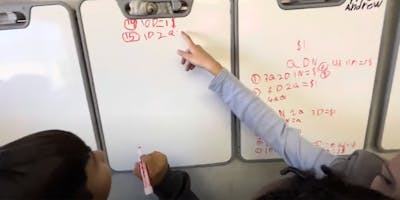
What was optimal? Having students work in groups at vertical whiteboards. Except it didn't have to be a whiteboard, it just had to be vertical and erasable. So like a window would work, the side of a file cabinet would work. … Blackboards worked. It just had to be vertical and erasable.
They stood in their groups.
Why standing?
It's not that standing is so good, it’s that sitting is so bad.
It turns out that when students are sitting, they feel anonymous, and the further they sit from the teacher, the more anonymous they feel. And when students feel anonymous, they disengage. And that's both a conscious and a subconscious act. And what standing up did was it took away their anonymity.
Just think back to the last time you went to a professional development workshop. Think about that. You were in this room and you were sitting down and you felt anonymous. And in fact, you may have put yourself in the back row of this room so that you could feel anonymous, so that you could disengage, right? This is not a phenomenon that's unique to kids. This is human nature.
So what was the optimal way to form a group? Well, it turns out that strategically constructing the groups like we see in a lot of elementary schools turned out to be a disaster. That was not conducive to thinking. Likewise, having students set their own groups was a dumpster fire — that was not conducive to thinking.
The optimal was to form groups at random. And it wasn't good enough that it was random. It had to be visibly random. They had to see that it was random, and it had to change frequently. About once every 60 to 75 minutes, we re-randomized.
And any task we give them had to be a thinking task. Thinking is what we do when we don't know what to do. If we already know how to do it, it's not a thinking task, it's an exercise.
Or busywork, I guess somebody might call it.
A thinking task had to be something that they don't know how to do — which means that if they're going to have to think, they're going to get stuck. But it also means that we can't pre-teach them how to do it.
So here we have in a thinking classroom: The students standing at the whiteboards in their random groups of three, one marker per group, working on these thinking tasks.
And that produced thinking classrooms. All of a sudden, overnight, we went from 20 percent of students thinking for 20 percent of the time to 80 percent of students thinking for 80 percent of the time.
You paint a pretty critical picture of common teaching practices. What are you doing to get the word out about these issues and your approach?
Building thinking classrooms is not a curriculum, first of all. It's a pedagogy, it's a framework for helping teachers enact whatever curriculum that they have to work with. Curriculum is mandated, pedagogy is professional. So this helps teachers enact whatever curriculum content that they have to get through.
And I respect teachers' professional autonomy. I think teachers should have the professional freedom to judge for themselves what's going to work for them. And if this is going to work for them, I'm there trying to support it. I don't want to mandate this because I don't believe that mandating pedagogy is an effective way to change pedagogy.
And it's like growing everywhere. … The projection for the number of teachers using it in Denmark is in the 90 percent [range]. It's starting to gain traction in Australia. And the book is also coming out in Mandarin. It's coming out in Korean, it's coming out in Greek and Turkish and Polish and French. And so we're starting to see this. It's all these exponential curves at different points of time.
Listen to the complete interview, including more details about what goes into a ‘thinking classroom,’ on the EdSurge Podcast.
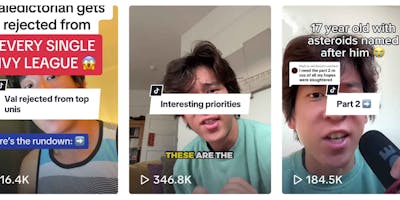
Daniel Lim reads through the resumes of prospective college students with the excited patter of a color commentator at an NFL game. On his popular TikTok channel, the Duke University senior highlights the seemingly endless number of ultra-achieving students who fail to land acceptances at selective colleges, or, more often, who win some bids and lose others.
“This valedictorian with a near-perfect SAT score got rejected by every single Ivy League school he applied to,” he says in one recent video, in a tone of disbelief. “Let’s look at his application and see what happened.”
It turns out that this anonymous student Lim’s describing — with an SAT score of 1570, trophies in state and regional championships for gymnastics, experience in concert band since fourth grade and membership in honor societies — says that he was rejected from Harvard, Princeton, Stanford, MIT, Columbia, Yale, Cornell, Duke, Carnegie Mellon, and the University of Michigan. The student says he got into Penn State University and the University of Maryland.
Lim, who has more than 200,000 followers, says that nearly 2,000 high school students have sent him their college applications — along with the list of institutions they applied to and the results of their attempts — for him to share and riff on in his videos.
He’s part of a genre of social media trying to make sense of who gets into which selective college — and why — at a time when landing a ‘Yes’ from a selective college is harder than ever.
Statistics show it really is harder to get into college these days, if you’re trying to get into a selective one. If you look at the top 100 universities and the top 50 top liberal arts colleges, the median SAT score it takes to get in has risen significantly since about 35 years ago, according to an analysis a couple years ago in Education Next.
College counselors work to emphasize that finding the right college should be about discovering the right fit — and the fact is that most U.S. colleges, especially community colleges, admit most of the students who apply. But regardless, many students and families perceive selective colleges as the ticket to more opportunity. And at a time of rising college costs, students strive to get into state flagship universities that offer high-quality offerings at a fraction of the cost of private colleges, or to land at Ivy League schools with big endowments that can afford to offer more-generous financial aid than other institutions.
So the process has high stakes. And yet it can seem like a game.
And the rules of that game keep changing.
The pandemic led more colleges to make SAT scores optional, putting more emphasis on so-called “holistic” reviews of candidates. And admissions officials say there’s widespread misperceptions about how that process works.
“A lot of people think if a school has a 5 percent admit rate, they have a one in 20 chance of getting in, which is not what it is,” says Nathan Mathabane, associate director of college counseling at Woodside Priory School, in California, and a former admissions officer at Princeton University. “Some students will have an 80 or 90 percent chance of getting in and many students will have a 0 percent chance of getting in.”
And a landmark U.S. Supreme Court ruling this summer striking down the consideration of race in college admissions has thrown even more uncertainty into the process, as even colleges themselves seek to quickly change their processes to comply with the law.
So students are turning to TikTok and other social media platforms to fill the information void about whether, why and how they’ve got a shot at landing a spot at a selective college.
Another example that Mathabane points to is a Reddit channel called “chance me,” where applicants post their credentials and ask the internet to predict what their chances are of getting into the college that they think works best for them. And some of the comments end up being unkind, or come filled with misinformation about the process.
“I think it’s super toxic,” Mathabane says of the site. “I don't think there's anything that you're going to get from these sites that is going to improve your college search, full stop, and it probably will only stress you out more.”
But Lim argues that his videos, which he also posts on YouTube and Instagram, can help students feel less alone in a stressful process. And he says he can relate, from the stress of his own college search.
For this week’s EdSurge Podcast, we talk with Lim about what he’s learned from seeing so many college applications and from the reactions to his videos, and we hear from Mathabane about how admissions is changing.
Listen to the episode on Apple Podcasts, Overcast, Spotify, Stitcher or wherever you listen to podcasts, or use the player on this page.
What a Popular TikTok Channel Reveals About the Stress of College Admissions
After Carl Wieman won the Nobel Prize for physics in 2001 for, as he puts it, “shining lasers on atoms” in a new way that gave experimental proof to a theory by Albert Einstein, Wieman decided to shift his research focus. He devoted the bulk of his time and energy to studying how to improve teaching.
“I just could make a bigger difference in education,” he says.
Education research wasn’t new to Wieman, who these days is an emeritus professor of physics and of education at Stanford University. In fact he had been pursuing research to improve physics teaching for years, as a parallel area of work that people hadn’t paid much attention to. But with the fame brought by the Nobel, he hoped to raise the profile of educational research.
He argues that the traditional lecture method for teaching physics and other STEM fields has been proven ineffective, and that shifts to more active methods can greatly improve learning outcomes to make sure the next generation of researchers can make the next Nobel-worthy breakthroughs.
So what has he learned in more than 20 years from applying his persistence (and much of the money he won from the Nobel) to studying teaching?
EdSurge connected with Wieman to find out, and to hear about his more recent efforts to improve how teaching evaluations are done at colleges to make them more useful — and more equitable.
Listen to the episode on Apple Podcasts, Overcast, Spotify, Stitcher or wherever you listen to podcasts, or use the player on this page. Or read a partial transcript below, lightly edited for clarity.
EdSurge: What was it that got you started in doing research on effective teaching?
Carl Wieman: It was really started by sort of a puzzle that I saw, which was that I had these graduate students come in to work in my research lab doing physics, and they'd had many years of great success in physics courses, but they really didn't seem to know how to do physics when they came in to work for me.
There wasn't anything fundamentally wrong with them, because after they worked for me for a couple years, they turned into expert physicists. And so after I saw this happening over and over again, and I saw actually sort of a correlation, that the really top students in coursework never turned out to be the better physicists, I decided there was some fundamental question here about learning and thinking.
And so I just tackled this as a science question, and I started reading the research on how people learn — how people learn physics. … And it showed me there were much better ways to teach than what was being used in most of our courses.
Did you feel there has been something lacking in the teaching you had in physics when you were a student?
Well, I always hesitate to use myself as data. But in fact there were some pretty unique aspects in my education that is in the back of my mind when I'm looking at what's happening with other students. And in my case, I in fact got involved in doing physics research at a very early stage in my first year in college, and got heavily involved in it and decided this was a whole lot more interesting and worthwhile than taking courses.
And so I really spent my whole college career devoted to research and doing the minimal coursework I could get away with, essentially. And I managed to get lots of loopholes, to get away with a lot. And so for me, my education was overwhelmingly just actually doing research, interacting with other research students and graduate students in the lab. And the coursework, I never felt I learned terribly much from any of my classes, but it was very much secondary.
You talk about needing to change the paradigm of teaching physics and other STEM fields. Broadly, what do you think should change?
So the norm is really this paradigm of, you've got a brain, and it's a sort of fixed thing, and you fill it up with knowledge. And how well it can absorb that knowledge is just determined by the characteristics of that brain. And so colleges spend lots of time focusing on, ‘OK, how do we select the brains that'll absorb the most with admissions and tests and such?’ And then, ‘What material are we going to try and pour into them? What things do we cover?’ That's the old and still largely pervasive paradigm.
But I'd say what research shows us is a very different picture, which is that the brain is very, what we call plastic, it changes. So really you need to think about that these student brains come into the classroom ready to be transformed by their educational experience. And the better their educational experience, the more their brains are changed. And what's really happening is you're rewiring how the neurons are hooked up, and that's developing new capabilities in those brains. And so it's very much not an idea of a fixed brain with its capacity, it's how much new capability you can develop in a brain through proper education.
And the best form of that education that essentially does the best transformation of the brain is really having the brain practice the thinking you want it to learn. And so rather than sitting, listening to somebody, drone away, giving information where the brain is doing very little — essentially just taking in sounds — it needs to be actively thinking about ideas, solving problems, figuring things out with feedback and guidance as it's practicing. That it's strengthening, essentially, through the right kind of mental exercise. And so that's really the different paradigm, is how do you exercise the brain in the right way to best develop new capabilities in it.
You’ve famously compared lecturing to bloodletting. It sounds like you stand by that pretty harsh critique.
Yes. This was my soundbite, but it was effective, that lectures are the pedagogical equivalent to bloodletting. And this isn't just flippant. I mean if you look at it, for 2000 years people felt bloodletting was the treatment of choice and you could justify it because well, you let blood from people and look, they got better. And so obviously it was working.
And so much of the same thing is happening with lectures. You give lectures to a bunch of students, and some of those students actually turn out to be pretty good. And so obviously that means the lecture was effective and the students who weren't successful, their brains weren't very good. And so that's how you could continue to justify lectures as effective in very similar ways to how you justified that bloodletting was good. Yeah, it didn't work for all the people, but that was just the fault of those people who had poor systems.
I hear you even tested the value of your own lectures on students to show this?
One little study I did was, I sort of picked some important but non-obvious fact and lectured about it and then tested students on it half an hour later. And 10 percent of them actually remembered it. So 90 percent didn't get this.
And then actually later on I repeated this, but I presented this material in what we call an active learning environment, where rather than just telling students that they had to answer a question, they had to figure out a question about how something behaved and then get feedback on that. And then I tested them on that and overwhelmingly they all remembered it. So that was just a very simple but clear demonstration of what I thought was pretty good lecturing was not very effective.
You’ve led many efforts to reform college teaching and written a book on it. Are you frustrated that that hasn’t led to more change than it has?
I'm always frustrated because I'm an impatient sort of person. But at the same time, I have to admit that you're dealing with something that's very entrenched culturally and historically, and that's just hard to make big changes in things like that.
And there really has been quite a bit of change. I mean, you see aspects like the [Association of American Universities] launched a big program and its STEM education initiative six or seven years ago that is devoted to changing the teaching of introductory science courses. It represents the 60 or so leading research universities in North America, and it's calling on its members to change how they teach. That sort of thing would've been unheard of not very long ago.
One thing you’ve focused on more recently is teaching evaluation at colleges. Why that topic?
We’re trying to solve what I see as a really fundamental issue in improving education. And that's the methods for evaluating teaching, particularly at the university level, where I think everybody realizes that we don't have good ways of doing that.
The things that almost every university uses is student evaluations. And those have tremendous flaws to them. They're very biased, and they don't capture effective teaching practices at all. And everybody knows that they're highly flawed and they're probably going to be illegal because there's such good evidence that they are very biased against, for example, if you're a underrepresented minority or a female instructor in a white-dominated field, you just get lower evaluations even if you do this exactly the same as a white male does. So anyway, so it's a real problem.
People always say you can't tell [faculty] what to do. I'm convinced they really are doing what they get rewarded for. And right now the teaching evaluations are so meaningless. They really are counted appropriately, counted very little in the incentive and reward promotion system. So what you need is something that's a good meaningful evaluation that then could be taken seriously in how you hire and promote people, and then it'll make a big difference.
AAU has run a competition that then provided grants to I think five or six departments to come up with demonstration projects of better evaluation systems. So we'll see how that works out.
Listen to the full discussion, including examples of active learning methods shown to work and how Wieman thinks the pandemic has impacted teaching on the EdSurge Podcast.
ST. PAUL, Minn. — Robert Groven, director of the Minnesota Urban Debate League, has been coaching high school debate competitions for more than 30 years, and he’s noticed a marked shift in student behavior in the past decade or so.
During debate exercises, there’s been a “consolidation” around points of view that are more left-leaning, he says, and a reluctance to make the case for extreme right-leaning positions.
“I have a friend of mine from the University of Chicago who likes to say, ‘We do a great job of preparing conservative students to leave high school and college and go defend their views in the world, but we don't do such a great job of teaching left-of-center students how to defend those points of view, because we don't challenge them as often,’” says Groven. “To me, that's a problem from a pedagogical perspective.”
Groven made the point during a recent panel discussion about how best to encourage viewpoint diversity in classrooms, hosted by the Free Speech Project, a nonpartisan initiative run by Georgetown University. EdSurge was asked to moderate the session, which took place on the campus of Hamline University here.
The discussion tackled plenty of thorny issues facing K-12 and college instructors these days, including how to respond to pressures to ban books in schools, how to make classrooms a welcoming place for debate as schools and colleges grow more diverse, and how to respond to misinformation that students bring to classroom conversations.
The panelists were:
Groven, who is also an assistant dean of faculty development and associate professor of communication studies at Augsburg University
Kathryn Kay Coquemont, vice president for student affairs and dean of students at Macalester College
Deborah Appleman, a professor of educational studies at Carleton College, and author of the book, “Literature and the New Culture Wars,” which asks the question: “Can educators continue to teach troubling but worthwhile texts?”
Listen to the episode on Apple Podcasts, Overcast, Spotify, Stitcher or wherever you listen to podcasts, or use the player on this page. Or read a partial transcript below, lightly edited for clarity.
What is different now when it comes to viewpoint diversity than a few years ago?
Deborah Appleman: I [used to be] a high school English teacher, but at Carleton I'm in the educational studies department. So my big concern for what's happening to the teaching of literature has to do with the people that I call my ‘thinking partners’ all over the country — secondary teachers, middle school teachers, even elementary school teachers, who are really under threat. That includes librarians as well.
If I think about what's changed at Carleton in the 37 years that I've been there, there are both external forces and internal forces. The external forces have to do with the conversation that the culture is having about cancellation, about what authors are OK, about what books are OK and what content is OK. And this seeps into the college culture within the context of a classroom.
And I need to preface it by saying I love my students, I'm here for my students. They're the most important thing that I think about. But so much has changed. One of the things that has changed is something that some of us call ‘the discourse of harm.’ So students come into the classroom extremely vulnerable and at the same time armed with a readiness to defend themselves against any perceived harm. And I cannot tell you how many conversations I've had with colleagues who are rethinking what they're teaching. People are anticipating moments of difficulty [and avoiding assigning books that might cause controversy.]
So on one hand we teachers have our own version of the Hippocratic oath: ‘First do no harm.’ None of us ever wants to cause harm for our students. On the other hand, we believe that learning is and should be uncomfortable.
So on the first day of my educational psychology class, I say … my job isn't to make sure that you're never uncomfortable. Actually my job is to make sure that you get uncomfortable intellectually with that kind of cognitive dissonance that will help you grow. That's become harder to do.
Kathryn Kay Coquemont: I want to compare something that happened in my formal education with what I think is happening with our current traditional-age college students' education. So it wasn't until I was a Ph.D. student in my 30s that I learned about the origins of racism toward Asians in our country. That’s where I learned about how Asian immigrants weren't allowed a pathway to citizenship. About how after the Civil War when Southern plantation owners wanted to underpay their Black former-enslaved people, so instead they brought in Asian immigrants from the West Coast who had been pushed out of those towns because of the anti-Asian sentiment, and how it bred discord amongst those two communities of color. I didn't know about the history of Hawaii and what we had done to have it become part of the United States.
When I learned this in my 30s, my brain was hopefully fully developed by that time. I had a lot of life experience on how to deal with these things that felt so personal and hard to grapple with and I was so angry about. And in high school I wasn't taught those things.
The cool thing right now is our students are coming with a totally different K-12 education. They might have been in AP African American history. They might have already learned about what oppression is on a short-term basis through TikTok. The ways that they're learning about these things and are starting to grapple with what that means for society and what that means for who they [are] as an individual is totally different than how I came into a classroom as a college student. And we should be rethinking what curricula is calling to them and challenging them.
Why do you think these changes have happened?
Appleman: One of the things … is what I call a pandemic hangover. For the students who did their first couple of years of college in their childhood bedroom with their stuffed animals behind them, there was a way of infantilizing that made them feel more vulnerable. They didn't come with a lot of the social interaction skills that you would expect people between the ages of 18 and 22 to already have.
Groven: I would say there's probably three things rolling there. One is simply that as a society, as conservative columnist George Will has said, that you can sort of write the history of America by looking at how more people are given a seat at the table of American democracy. And I think that's essentially what we see continuing to happen, that more people are getting a seat at the table, and as a result their views need to be included, and that's happening at all levels of society, including in education, higher education, and in debate.
I think a second is the diversification of the country. So just from a demographic perspective, and in particular the diversification of higher education, because a huge number of the issues we see now are really driven by who is in the classroom. If you roll the clock back 100, 150 years, higher ed was overwhelmingly white and male. And as a result, a lot of these issues simply didn't [seem] relevant, because it wasn't part of their experience. But now we have at Augsburg, we have, I think we're like 67 percent of students of color now. That means that if we are not talking about those issues, we are not talking about those students' lives.
And then the third piece is that there has been a development of a large body of research and scholarship and theory which talks about why these things should matter, not just to education, to pedagogy, but also to all the different realms in which we make decisions collectively as a society.
How can educators respond to these changes?
Appleman: So a couple of decades ago, a professor of literature, Gerald Graff, talked about ‘teaching the controversy’ — saying what's at stake, presenting both sides. So when you're teaching a book because the author has been censored. So recently I've been working with some students and teachers at Henry High School in Minneapolis, and they were going to offer a book written by Sherman Alexie, who's been ‘canceled’ because of his sexual misconduct allegations and admissions thereof. He's a wonderful writer, and in many ways irreplaceable for some of the work that he can do with kids.
So what the teacher did was to say, ‘OK, we have these books. We have another class set of this book or this book or this book, and here's what I want to tell you. Some people think that this book shouldn't be taught and here's a couple articles about why. And then here's a couple articles about what this book is and some reviews and let's read them, let's talk about them, and then let's have a discussion and then vote.’
Coquemont: The other thing I think about a lot is, ‘Who is built up and who has had a legacy of being built up in who they are, and who hasn't?’ … ‘Who has always had a mirror reflected back at them, and who has only ever had windows?’ And I think that's really sometimes the crux of it, is you're now giving options that are still inequitable, not because we are trying to reinforce inequity, but because the society they've lived in has been inequitable to them. And so one of the things I think about a controversial book is, can you deal with that controversy? Are you a healthier person to have that conversation when you've already had things that reflect who you are?
And I really worry about the state of K-12 education, by state, because it's going to be even harder, especially for those working in private colleges that have students from all different states where people have had very, very different experiences. That's always been true, but I feel like it's just furthered.
But maybe don't start with the controversy because maybe some of our students now have only had to deal with the controversy and been taught the controversy. Maybe start first with the things that uplift and reflect.
One of the things with controversy that I've noticed is the way sometimes we've also said that the emotion that's brought into spaces is somehow bad. And I do a lot of my work is de-escalation of emotion. There's a lot of that that's needed. But I also think about how do we even set up the conversation to say, ‘It's OK to bring emotion into this, but let's talk a little bit more about what place that has, because the emotion is really connected to the lived experiences that we want to honor.’
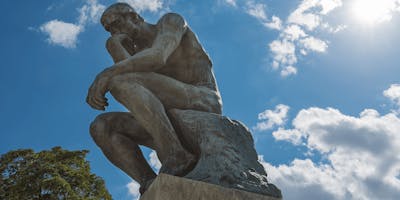
When people think about thinking, they typically conceive of the brain as a kind of machine or muscle that is strictly confined to our skulls. As Rodin’s famous sculpture of the thinking man propping his chin on his hand, we imagine the mind as all in our heads.
But what if those typical metaphors for our brains are limiting our capacities to think and learn?
That’s the question posed by science journalist Annie Murphy Paul, who points to research emphasizing the many ways that thinking is influenced not just by what’s inside our skull, but by cues from our body movements, by our surroundings, and by other people we’re interacting with.
Paul, who says she reads academic journal articles for fun, first encountered this argument when she came across a 1998 paper by philosophers Andy Clark and David Chalmers, who argued that the human mind extends into the world around it. And that sparked her interest in digging into learning science research that she’s gathered into a recent book, “The Extended Mind: The Power of Thinking Outside the Brain.”
Those who design our tech, she argues, are particularly prone to a brain-bound vision of the mind, forgetting that users of smartphone apps and computers are situated in bodies and move about the world in physical space with others.
EdSurge recently sat down with Paul to dig into her arguments about rethinking how we think, and what educators can learn from the research.
Listen to the episode on Apple Podcasts, Overcast, Spotify or wherever you get your podcasts, or use the player on this page. Or read a partial transcript below, lightly edited for clarity.
EdSurge: What is it that you think is missed in popular notions of our mind?
Annie Murphy Paul: Our education system is very much dominated by what you might call a brain-bound model, which is the idea that thinking happens inside the brain. It's sort of sealed inside the skull. And moreover, that intelligence is the kind of lump of stuff that's either bigger or smaller, and we can weigh it through tests and assessments.
And that's challenged by the notion of the extended mind, which as I mentioned comes from philosophy. … It was an article by philosophers David Chalmers and Andy Clark, and they started off that article by saying, ‘Where does the mind end and the rest of the world begin?’
And that to me was a really provocative question, a potentially generative question, in part because it seems like it has an obvious answer or a conventional answer, which is that, ‘Well, the mind stops at the skull, right? The mind is sort of identical with the brain.’ And that's the kind of model that dominates our education system.
But what Chalmers and Clark were saying was that the mind extends beyond the head into the rest of our bodies, into our physical surroundings, into our relationships with other people, into the use of our devices, our technologies. And that to me was a really exciting idea because it meant that if we could improve the quality of those raw materials that we do our thinking with — and if we could improve our skills and abilities at using those outside-the-brain resources — that was a kind of new way to get smarter. It didn't mean that our only option was to exercise the brain or make the brain smarter or stronger. We actually could improve the quality and our use of all these outside-the-brain resources as a way to get smarter and more effective.
You talk about three main ways that the mind can be thought of as extended, and I’m hoping to go through them one by one. The first you talk about is “embodied cognition.” What is that and why is it important?
Embodied cognition is the idea that we don't just think with our brains, we think with the sensations and movements and gestures of our bodies. So I'll just start with that first one — sensations. That actually has a less jargony name, which goes by our gut feeling.
We all know what that means, that there's a kind of wisdom or a kind of informed sense that our bodies seem to have that might elude our conscious minds. And there's a term called interoception that describes that flow of internal sensations and cues that our educational system and our culture more generally tends to tell us to ignore. But what embodied cognition suggests is that we should actually be tuning in a lot more to those interoceptive sensations through meditative practices like the body scan, and that those interoceptive sensations actually have a lot to tell us about the situations that we find ourselves in.
How does that play out in classrooms?
Yeah, so the brain-bound approach to thinking and learning, which is dominant in our education system, suggests that all we need is our heads. And these days, especially when we're in Zoom meetings, we can actually feel just like we're heads, or a brain and a vat. But in fact, the human organism thinks with our whole bodies, which includes our internal sensations and our physical movements and our gestures. So the more we can bring the body into learning, the better. I find that we are good at doing that with young children with early education, we think it's okay for them to run around and to interact with materials and use manipulatives. But as students get older, we have this notion that they should put all that away and start doing things just in their head.
But what the science of embodied cognition shows is that the more we can sort of externalize our thoughts and our thinking processes, get them out of our head and express them through our bodies or learn through our bodies and our senses, the better our learning will be. So I think we need to bring some of that early education spirit of having the body be part of learning into middle school, high school, college, all of that, because we are embodied creatures. We can't be anything but embodied creatures, even as adults. And so embodied cognition suggests that this head-first or brain-bound approach to learning is really misguided.
What about the second category of research you tackle in the book, which is known as situated cognition?
Situated cognition is the idea that where we are, our physical environment, affects the way that we think. And that's one way in which our brains are really different from, say, a computer, which works exactly the same way. My laptop works the same way in my home office as it does if I were to take it out to a park and sit on a park bench. But human brains are not like that. They're exquisitely sensitive to context, and we think differently, say, in the outdoors than we do in an interior space. So given that it's a good idea for us to be aware of how our physical spaces are affecting the way that we think, and we can intentionally use them in the sense of going outside to restore our attention and replenish our attention, or we can design our interior spaces, our learning and working spaces to support intelligent thought in ways that the brain-bound model doesn't really allow.
The third area you explore in the book, it's distributed cognition. What's that look like?
That pushes against another really strong current in our culture, which is this idea of this individualistic streak — that ideas and thoughts belong to one brain, that they're sealed inside an individual head, when really we are such fundamentally social creatures that we learn to think and we learn to speak language in a social context. And thinking and learning is always irreducibly social and shared and collective.
So that's another way of thinking about intelligence is that it's not a lump of stuff sealed inside one person's brain. It's really a collective enterprise that we need to think about in social terms.
Some of these ideas that you've talked about sound a bit like common sense. Why has it taken so long to, or why many people may still not, realize these things that you're talking about?
Yeah, I agree. The extended mind, which is a relatively new idea in philosophy, is just reminding us of what was always true, which is that human beings have bodies. We're embedded in physical spaces, and we're a part of these dense social networks that describe us as full human beings. And, unfortunately, in a lot of settings, including educational settings, but also work settings, we're encouraged to think of ourselves as just brains, as just heads. And so the extended mind kind of invites us to remember what we have forgotten as a culture.
What are some takeaways for educators at older levels to do differently based on this research?
I’ll take one from each area of research.
One is bringing the body into learning — bringing physical movement and gesture as much as possible into the classroom.
The second one would be thinking really carefully about the spaces in which we were having kids learn, and trying to get them outside as much as possible. And then when they are inside, thinking about what kind of cues and signals are present in the physical environment that I think are particularly important are cues of identity. Kids should be able to look around and see cues that remind them of who they are in that particular environment, what role they're playing as scholar or artist or thinker. So I think it's useful for teachers and others to look around and see, ‘What are my kids seeing when they enter their classroom or their school?’
And then the third is this social piece. I think now that we're all back together in person and not doing remote schooling so much anymore, we can really take advantage of what psychologists called ‘groupiness.’ That's an actual scientific term. And that refers to a sense that a group of people isn't just an assemblage of individuals. They're really an entity unto themselves: a group. And that sense of groupiness tends to get people on the same page, people learn better, think better, and remember things better when they do it together with other people in that kind of cohesive, connected way.
You note that there are equity issues in education that stem from this research.
One of the exciting things to me about the extended mind is that it's another way of looking at issues of equity and equality. We have this idea that we can rank people according to how much intelligence they have in their brains, but if you shift to looking at things through an extended mind lens, then it's really about, well, what is the quality and the accessibility of the outside-the-brain resources that this person has?
Because our students don't have anything like equal access to, say, the freedom to move their bodies, or access to green spaces, or to safe spaces, to quiet spaces. They don't have equal access to helpful mentors or really skilled teachers or motivated peers. And if all of those things really matter for how effectively intelligent, how successful academically a person can be, then we need to shift away from thinking that intelligence is something sealed inside a person's head — it's more out here, in the world.
For students at a new Florida-based charter school, entering the classroom means strapping on a VR headset.
While plenty of schools have experimented with short lessons conducted in virtual reality, this new school, called Optima Academy Online, has embraced the technology as a primary mode of course delivery. That means participants log a lot of time in VR most every school day: Students in third through eighth grade are given a Meta Quest 2 VR headset and wear the devices for about 30 to 40 minutes at a time for three or four sessions, spaced out over the course of a day. (Younger children in the school take courses using more-traditional online tools, including Microsoft Teams.)
The school’s founder, Erika Donalds, hopes this cutting-edge technology can help spread an educational approach that is decidedly old-fashioned. She’s a champion of a model of education that favors students reading classical texts and otherwise focusing on the traditional canons of arts, literature and culture. And, ironically, she thinks that the latest VR technology provides a unique way for students to hold socratic dialogues and engage with ancient texts in ways that can’t be done in other formats.
“With our approach to classical education,” the school’s website says, “students learn about historical events, characters, stories, fables, myths, scientific facts, and mathematical proofs in the locations where these educational advances were made.”
Emma Green, a staff writer for the New Yorker, has been spending time visiting these VR classrooms and researching the company for the magazine. Her article, published earlier this month, digs into how the school’s backers hope it will lead to the next frontier in the school choice movement. Because it turns out that Donalds, Optima Academy Online’s founder, is a longtime Republican activist pushing for ways for parents to opt out of public schools..
For this week’s EdSurge Podcast, we connected with Green to find out what she learned about the school, about why some edtech experts are concerned about the amount of time its students are spending in VR, and about how the high-tech experiment fits within broader debates about the future of public education.
Listen to the episode on Apple Podcasts, Overcast, Spotify or wherever you get your podcasts, or use the player on this page. Or read a partial transcript below, lightly edited for clarity.
EdSurge: So you saw some demos of this VR school with their sixth graders and eighth graders. What did the VR classroom look like?
Emma Green: It felt to me a little bit like I was in a video game when I was in these environments. Teachers are able to spawn all of these different tools, like big [virtual] Post-it notes that they can put in the air, or a blackboard that they can use to project images or write words. They can decorate these scenes to try to be more historically accurate. So there's a lot of adaptability in the setting that they use.
They use Engage as their platform, which gives them a lot of flexibility to be able to design their own landscapes. So it's very interesting and seems very flexible in terms of how the teacher wants to create different formats for different age groups.
So everyone is doing this from their own homes instead of a school building, right?
The teachers are all over the country. I talked to the headmaster, who is in North Carolina. The person who's the chief technology officer lives in Mississippi. Over the past year, all of the students who participated in Optima Academy Online lived in Florida, but they're now expanding their offerings so that it's possible that students might be in a classroom setting with kids who are actually in different states.
And indeed, when I talked to Erika Donalds, who's the woman who founded OptimaEd, the company that runs the school, her vision is that ultimately their academy can be not bounded by geography — that students could put on their headset and they could be in a classroom with kids who live thousands of miles away from them, but still have the same curriculum, have access to the same field trips to Mars or to the ancient world of the dinosaurs and not have distance or the setting where you live be a limiter on your ability to access this kind of education.
How did you come to even hear about this school?
I first heard of OptimaEd through a story that I was reporting on about a college in Michigan called Hillsdale College, which is a conservative school. It's a pretty central node of the intellectual conservative movement. And in recent years, Hillsdale has started to champion charter schools — and, specifically, classical charter schools, schools that use a curriculum that emphasizes the liberal arts, the teaching of language, ancient languages, the teaching of “Great Books” and original texts, like actually reading the Constitution instead of just reading about the Constitution. And these classical schools, which have sprung up across the country with Hillsdale’s support, are really flourishing and growing. There's a lot of demand for them.
And one of the hubs for this growth is Florida. Erika Donalds, who lives in southwest Florida and is the wife of [Republican] Congressman Byron Donalds, has been an education activist. And one of her projects has been to work with Hillsdale to launch charter schools in this classical model. And she's helped to do that for brick-and-mortar charter schools in Florida. And then during the pandemic, she had this opportunity to launch a virtual school, which ultimately led to Optima Academy Online. It's claiming to be the first ever all-virtual, virtual reality classical school.
Typically VR efforts are associated with Silicon Valley, which is known for some liberal and progressive values. But in this case it sounds like a Republican activist is using this technology to advance a conservative agenda. That’s kind of a surprising contrast.
It is. And her activism, as you said, very much has been within conservative education movement. She's a big school choice advocate going back all the way to the anti-Common Core movement.
And what was so interesting to me talking to her about her vision is that she sees virtual reality school as a logical extension of the work that she has done in the school choice movement because fundamentally, the school choice movement is about giving parents and families the flexibility to be able to access a free, publicly funded education, but to do so on their own terms, not to just be wedded to their local zoned public school.
And to her, the option to have your kids stay at home anywhere in the state of Florida or anywhere in the country for that matter, if her great plans succeed, and be able to access their school through a headset that you have at home and then later in the afternoon be able to do their homework and do the rest of their schoolwork on their own terms, at their own pace to accommodate the rest of their family's schedule or maybe a sports schedule — that to her is ultimately school choice.
This is an unusual amount of VR use for a school. I understand that has raised some concerns.
I talked with an expert at Stanford named Jeremy Bailenson, who really is the guy when it comes to understanding VR and the consequences of VR use over time. He's done some research on VR and education as well. And he told me that he finds it hard to imagine having VR as the main delivery mechanism for full-time school in which kids as young as maybe 8 or 9 or 10 having on a headset for multiple hours over multiple days of a week over multiple weeks in a year.
He actually had the opportunity during the pandemic to run this experiment. He took students at Stanford where he teaches and created through the pandemic these virtual reality classrooms, and they ran experiments on what was useful to do in the classroom setting in VR and what wasn't useful, how long did they want to stay in, how did they put parameters on the use of the technology in order to keep people from experiencing the fatigue that is common from using these headsets over long periods of time.
It's kind of like getting car sick or being on a boat and feeling nauseous. ‘Simulator sickness’ is what it's called. That's one possible consequence. And what he found after having multiple rounds of these classes that were set in VR is that he really felt strongly about placing boundaries of limits on the amount of time that anyone was in VR, let alone people who are still developing in their brains and their eyes as kids. His rule in his lab is 30 minutes at a time, so you do 30 minutes, you set aside the headset, maybe you come back later in the day, but 30 minutes is kind of the outer edge of it.
So from his perspective … there are some real downsides to trying to make VR an all-the-time platform. And that researchers just don't know what happens when you try to put kids into a headset for multiple hours over a sustained period of time.
So what does Erika Donaldson say, the founder of this school, when presented with that kind of concern about the overuse of this format for students?
I talked to Erika about this, and it was very clear to me that she's up in the literature because she was citing to me some of the Stanford studies. And she said that they do have some limits in place, so it's not all day. They typically will have the headset on for maybe three to four, potentially five sessions in a day. There are those time limits, 30 to 40 minutes of a session. And so they are setting some boundaries around it. They encourage students to do the same things that Jeremy Bailenson encourages his students to do, which is to talk to a regular person, have a glass of water, take a walk around when you take the headset off so that you can get grounded in reality.
She thinks that the benefits outweigh the costs and that it's worth doing what they're doing. I think that in some ways, they're running the experiment. They are trying to pioneer something that hasn't been tried before. And I think for researchers who are in this world, they're a really interesting potential case study to see what does happen.
Why use VR instead of other forms of virtual education?
She made the case to me that you can't really do classical school on Zoom — that for whatever reason, these platforms that are two dimensional just feel flat. It's not really possible to engage in the same way. They had an experience with their brick-and-mortar charter schools over the pandemic trying to do classical school in a Zoom setting, which was good. I think there was interest in it, and she said it was really successful, but it ultimately left her feeling like you couldn't have the kind of engagement that you need. So she made the case that VR really does add something that goes above and beyond, being able to go to these places and have that kind of tactile engagement. She says there's more opportunity for robust learning.
Hear the complete interview, including more details on what it looks like when a group of kids do a lesson in a VR simulation of the moon, on the EdSurge Podcast.
The college students who give campus tours for the admissions office may sound like confident ambassadors, but they sometimes have their own doubts about whether they’ve made the right college choice or are on the right life path.
That dramatic tension drives an independent mockumentary called “Admitted,” created by a group of undergraduates at Boston University.
The five-episode web series, whose final episode is scheduled to appear later this month, involved the work of more than 20 students, some crowdfunding and the use of free studio space on the campus. And it ends up making some timely observations about college admissions, and about student life after the pandemic — when students sometimes struggle to make social connections after high school experiences spent on lockdown. It’s set at the fictional Beacon Hill University — not to be confused with a nearby rival college in the world of the series, The University of Beacon Hill.
One student leading and acting in the production’s ensemble cast, Maggie Borgen, has spent plenty of time thinking through issues of college choice. When she was a high school senior in New Jersey during the pandemic, she made a podcast designed to give advice to other students going through the college admissions process during the health crisis, which limited campus tours and many of the usual rituals of high school. (EdSurge talked to her about that project at the time.)
Since starting as a student at BU, she ended up working at the admissions office there leading information sessions. And she thought it would make a great setting for a sitcom in the style of her favorite comedies, including “Parks and Recreation” and “Abbott Elementary.”
“A college admissions office seemed like a really good way to explore coming of age in college through a workplace setting, but also in a way that is relatable to a general audience, because most Americans are thinking about college in some sense because it's just such a big part of the zeitgeist,” Borgen says.
She was excited to try to examine that setting from the perspective of students today, during this unusual time.The high cost of college these days provides plenty of material for satire. In one scene, Borgen’s character, MC, is giving a campus tour and describing the new 10-story engineering building with a food court and gleaming library. She tells the students, “I figure if you’re going to go into student debt, you might as well go bankrupt for Beacon.”
The students started production last fall, meeting two or three times a week to write and film the series. It’s starting to get some recognition — it was recently named as a finalist in the Houston Comedy Film Festival.
EdSurge recently connected with Borgen to ask what insights she’s gleaned in making the show, and how students continue to struggle with the lingering impact of COVID-19.
Listen to the episode on Apple Podcasts, Overcast, Spotify or wherever you get your podcasts, or use the player on this page.
The pandemic has largely changed public perceptions about the appropriate use of technology for young people, argues Katie Davis, associate professor in the information school at the University of Washington.
“The pandemic forced us to confront the fact that technology is absolutely essential in our lives, and especially during crises,” she says. Now, she says, discussion is shifting to questions of “When is technology good? When is it bad? What should its role be in young people's development at each stage of their progression, from toddlers all the way up to emerging adulthood and beyond?”
The EdSurge Podcast recently interviewed Davis, who has done research on the intersection of child development and technology for nearly 20 years. She lays out a framework for how to best match tech with each stage of growth in a new book, “Technology's Child: Digital Media’s Role in the Ages and Stages of Growing Up.” It celebrates when technology can help kids thrive — as well as cautions about when it can get in the way.
Sometimes the problems posed by gadgets can emerge in unexpected ways, she says, such as when literacy apps aimed at young readers feature too many bells and whistles, like a word’s meaning popping up on screen as children tap it, or rich sounds playing as children read.
“You think, that must be really good when learning to read, to hear the word being sounded out. And in theory, these do seem like good ways to enhance the learning experience,” Davis says. “However, we have to remember that especially for young children, there's a limit to their information-processing bandwidth. If you think of a computer, an analogy to a computer, they have just smaller CPUs than we do as adults.”
And she says there is a growing awareness of how some tech companies design their systems to do things that aren’t in the users’ best interest, a phenomenon referred to as “dark patterns.” A common example of a dark pattern, Davis says, is the autoplay feature on YouTube that often keeps viewers watching and can make it more difficult for a parent to convince their young child to put down a device.
Davis calls for increased regulation of tech companies to rein in such design features.
“Relying on the tech companies to regulate themselves doesn't work,” she argues, “because it's just not in their best interest financially to place user well-being front and center. Unfortunately, that's just not what makes them a lot of money.”
But she acknowledges that regulations can have unintended consequences that can be harmful as well. So she calls on academics to conduct more research to help inform best practices for tech tools, so that they foster well-being and are more effective for education.
Listen to the episode on Apple Podcasts, Overcast, Spotify or wherever you get your podcasts, or use the player on this page.
If you’ve ever been a student, then you’ve probably done a group project at some point. And you most likely also have a horror story about a group project that went terribly wrong.
That trend was clear when EdSurge recently took a microphone to one campus and asked several students to share their group project horror stories. Every student we talked to had one.
But teaching experts say it doesn’t have to be that way. Yet fixing group projects isn’t easy, since many instructors tend to repeat the same flawed methods that their own teachers used when they were students.
For this week’s EdSurge Podcast, we connected with John Warner, a longtime writing instructor at colleges and a teaching consultant for Eyler Warner & Associates. He’s written books on improving writing, including “Why They Can’t Write,” as well as an essay on how to fix group projects. But he says he has trouble getting educators interested in his advice, in part because many see traditional group projects as a way to save time.
What he suggests may indeed take more time than other types of teaching, Warner says, involving more effort from teachers in setting up groups, teaching students about successful group processes and checking in on their progress.
“It's not sort of ‘set it and forget it,’” he stresses. “Because that’s asking for trouble on the backend for the instructor, to clean up the mess when a student shows up with nothing on a group project day and you have to figure out how you're going to grade them.”
We ran the student group project tales we heard by Warner to get his reaction and advice. And we addressed some big questions about what it means to teach — and to learn.
Listen to the episode on Apple Podcasts, Overcast, Spotify or wherever you get your podcasts, or use the player on this page.
Group Project Horror Stories — and How to Avoid Them
Podcast : Aujourd’hui nous recevons, Laurence Géri, enseignante en premier degré et ERUN des circonscription d’Aubagne et La Ciotat avec qui nous allons parler d’un projet « du FabLab des Calanques»Laurence a utilisé le numérique en classe pendant quelques années et aujourd’hui de par sa fonction d’ERUN détachée à 100% son rôle est de transmettre les usages aux autres collègues dans l’académie de Aix-Marseille, et notamment dans ces deux circonscription.
On va évoquer un projet que Laurence Géri a présenté à LUDOVIA qui s’intitule « le FabLab des Calanques», il s’agit au démarrage de l’ambition de réaliser l’étude de la Faune et de las Flore des Calanques grâce à une tablette numérique qui sen terminera par l’utilisation d’un véritable laboratoire numérique.
Pouvez vous nous en dire plus et détailler la démarche, ce projet fait-il partie d’un programme académique, fait en collaboration avec la Mairie de la Ciotat ?
Objectif était l’étude de la faune et de la flore des calanques « sensoriellement » sous la forme d’un Jeux de piste grâce à l’ipad. Sortie en nature avec prise d’informations (sons, images…) avec l’ipad.
Travail avec des loupes numériques et l’ipad pour étudier la faune et flore microscopique du bord de mer. Travail sur le paysage en extérieur grâce à l’ipad.
Création par groupe d’un animal inventé, création de sa fiche d’identité et présentation filmée sur fond vert dans le milieu de vie de l’animal. Création en arts visuels de cet animal à partir de deux animaux existants.
Dessin et impression 3D de l’animal inventé. Le suivi du projet est effectué tout le long de l’année sur un livre numérique book creator. (Trace…)
Création d’une visite virtuelle du parc.
Passage du virtuel au réel tout au long du projet. Invention d’un animal, projet pluridisciplinaire, intervention, découverte de l’imprimante 3D,
Puis tout ceci s’est transformé en la création d’un véritable « Fablab numérique » grâce à la disponibilité de deux salles de classes dédiées aux activités numériques, pour cause de déprise démographique dans la circonscription.
Les usages et impacts du Fablab et des activités mises en place avec quelques exemples et notamment l’ambition de faire monter en compétences les autres profs.
Utilisation de l’ipad en tant qu’outils « couteau suisse » , les élèves ont découvert plusieurs utilisations de l’outil numérique même en extérieur.
« Garde mémoire » et production d’écrit avec book cretor (texte, image, son…)
Film sur fond vert avec touchcast studio
Dessin 3d avec gravity sketch et/ou thinkercad
Impression 3D
Observation du microscopique en nature avec les easyscopes et xploview.
Jeux de pistes avec pegaselab
Découverte de visite virtuelle.
L’intégration de plusieurs outils numériques disponibles dans le Fablab, ouverture aux autres classes de la ville, car le budget de la ville a permis tout ça ; l’organisation entre les écoles avec transport scolaire et proximité de mon lieu de travail et les bus gratuit
Dans le livre de restitution book creator, les consignes sont écrites et orales, des activités avec des tâches variées. (Dessiner, déplacer des étiquettes, enregistrer du sons…) Les élèves peuvent taper le texte de leur production ou le dicter à la tablette. Pour la compréhension, possibilité permanente toute l’année de revenir sur les connaissances antérieures. Travail de groupe, tutorat, collaboration. Les élèves travaillent à leur rythme grâce à l’outil numérique.
liberté de l’élève donnée par le fablabs ça facilite les choses, les classes Ulysse et simplifié par le numérique pour les besoins particulier.
La réplicabilité du projet :
Pas de souci avec le matériel car en France c’est possible en prêt par CANOPE avec des Kits Fablab. Ou en collaboration avec une mairie avec des budgets issus de politiques de projets innovants.
Quelques sources d’inspiration qui pourrait aider vos collègues à faire le cheminement et mettre en place la démarche dans leur classe ou un collègue eRun ?
ma source d’inspiration vient des élèves et les enfants nous poussent et nous font monter en com, j’avais vu le reportage sur LUDOMAG aussi sur le Lab de Clair au Canada il y a 6 ans
Laurence a été récompensée avec son projet dans le cadre du Concours ERUN MAN en 2023
 Login
Login


 Laurent Di Pasquale est Professeur de sciences humaines dans l’enseignement secondaire décrit sa pédagogie comme profondément positiviste, humaine, innovante et numérique. Ses débuts dans l’enseignement spécialisé (école du chêneux à Amay) l’ont obligé à faire preuve de créativité dans ses pratiques et à intégrer des outils numériques afin de répondre aux besoins spécifiques des élèves. Aujourd’hui on évoque avec lui une expérience de sensibilisation aux usages des Intelligences Artificielles génératives en classe qu’il a effectué avec ses élèves ; comprendre les biais, les limites, les dangers ce ces nouveaux outils qui vont inonder les salles de classes et les pratiques des élèves et des enseignants dans un futur proche.