Normal view

There are new articles available, click to refresh the page.
Before yesterdayMain stream

Are Local Efforts the Secret to Supporting Early Care and Education in Red States?

16 November 2023 at 10:09

In one Idaho town, in the southeastern part of the state, families strive to “read, talk, play” with their children every day while the wider community marches toward its goal of achieving universal preschool.

In another, located outside of Boise, a host of once-unavailable services — a food pantry, a Head Start preschool, a health center, and a migrant family liaison — are now housed under a single roof near the center of town, readily accessible to families in need.

In the northern panhandle, where early learning programs tend to operate in isolation, providers are convening in person and online to share ideas, participate in training and build connections.

These are among the dozens of tailor-made programs, called “early learning collaboratives,” that have sprung up in communities all across Idaho in recent years. It’s part of a coordinated yet bottom-up approach, fueled by early learning advocates but led by locals, to build a system of early care and education in a state where it would not otherwise exist.

Idaho is one of the last remaining states that does not provide any funding for public preschool. In fact, it is unconstitutional for K-12 schools there to spend their state funding on children under age 5.

Even as many states, including politically conservative ones, have begun to invest in early learning, Idaho has resisted, with some far-right lawmakers arguing that more government intervention in education would only harm children and erode “traditional” values including the nuclear family.

Yet that doesn’t reflect the reality of Idahoans. More than half of children under age 6 require some sort of care arrangement because their parents work. And an estimated 28 percent of families need child care but can’t access it, a gap that prevents some parents from working and bolstering the economic well-being of their families. (It’s estimated that Idaho’s economy misses out on nearly half-a-billion dollars annually due to its inadequate child care infrastructure.)

Since neither the federal government nor the state of Idaho are stepping in to support young children and families, despite this tremendous need, early learning advocates across the state have organized a patchwork of local programs that simultaneously solve the problems communities are facing right now while also generating support for future endeavors. Other red states have adopted the collaborative model, but Idaho’s approach is unique in that it lacks funding from the state.

The success of locally devised early learning solutions in the Gem State, advocates believe, could serve as a roadmap for other parts of the country where elected leaders decline to invest in early care and education.

‘Community Spirit Trumps Anyone’s Political Agenda’

The first of the collaboratives launched in 2018.

Leaders at the Idaho Association for the Education of Young Children, a nonprofit advocacy group, were not making progress persuading lawmakers at the statehouse. Yet they knew that children were struggling, showing up to kindergarten having missed all sorts of academic and developmental milestones and expected to somehow catch up. Low-income families, meanwhile, were being crushed by the cost of care and the lack of high-quality options.

Beth Oppenheimer, executive director of Idaho AEYC, believed that Idahoans needed support. She and her colleagues had the idea to go ahead and start providing it to families, with or without backing from state leaders.

“Let's start building a system. Let's just start to do something,” Oppenheimer remembers thinking.

With a grant from the W.K. Kellogg Foundation, Idaho AEYC funded the creation of 10 early learning collaboratives across the state, with a goal of increasing access to high-quality, affordable early care and education opportunities. Those programs would bring together local leaders in the education, business and nonprofit sectors, as well as parents and community members, to ask: What problem are we trying to solve in early childhood, right here where we live?

In the five years since its inception, the program has grown from 10 local collaboratives to 25. Many have been established in deep-red, rural communities represented by some of the same state lawmakers who have been vocally opposed to early learning investments.

The need is so great for investment in early childhood education ... that locals are continuing to ignore the culture wars in Idaho.”

— Martin Balben

But that’s the beauty of bringing neighbors together to create their own solutions, backers say.

Tennille Call, interim director of education at the United Way of Southeastern Idaho, a nonprofit that serves as a backbone support for collaboratives in the region, notes that conservatives — of which Idaho has many — love to champion local control of policies and programs rather than state or federal mandates. “This is local control,” she says of the collaborative model.

In the small agricultural town of American Falls, it was the district superintendent who promoted the message of “read, talk, play” that has caught on widely with families, making early learning a point of pride.

“Here, the community can get behind it because it’s a community thing,” Call says of American Falls. “Community spirit trumps anyone’s political agenda.”


Read about how American Falls, a one-stoplight farming community in conservative Idaho, embraced a goal that backers describe as progressive: universal preschool.


Martin Balben, the early learning collaborative project director for Idaho AEYC, says the uptake of the local collaboratives, as well as the scale and strength of them, underscores the desperation so many families feel.

“The story here,” Balben says, “is that the need is so great for investment in early childhood education, particularly birth through age 5, that locals are continuing to ignore the culture wars in Idaho.”

Heather Lee, who is the director of operations for the early learning collaborative project at Idaho AEYC, notes that parents’ desire for their children to thrive transcends ideology.

“You don’t hear bitter partisanship” from families the way you do at the state Capitol, Lee says. “You hear stories of struggle.”

Inherent in the model is an understanding that a one-size-fits-all approach won’t work in a state as geographically, politically, religiously and culturally diverse as Idaho, which runs nearly 500 miles from its tip at the Canadian border to its base abutting Nevada and Utah.

Cathy Kowalski, owner and director of The Learning Garden, an early learning program in Post Falls, a small city in northern Idaho, feels that the community-driven nature of these efforts honors the uniqueness of each region in the state.

“Our communities are so different. It’s hard for individuals in Boise to truly understand what’s going on in North Idaho,” Kowalski shares. “That’s what I love about the early learning collaboratives — we’re bringing it back to local.”

Playing the Long Game, With Short-Term Results

Idaho didn’t invent the idea of local early learning collaboratives. Mississippi has used the model for a decade. Arkansas is launching a similar program.

The difference is those states fund their collaboratives.

“We’re having to do it in reverse,” says Oppenheimer. “We’re having to build the system for the state to fund, whereas the other states figured out how to build the system and fund it at the same time.”

For now, the experiment is working. Every day, thousands of families across Idaho benefit from the programs that have been created in their communities.

In American Falls, families have united around a campaign to “read, talk, play” with their children every day. The message is now ubiquitous across the small, rural community. Photo by Prisma Flores.

In American Falls, families have become more involved in their children’s learning and development. That includes dads, who proponents say are noticeably more engaged in raising their kids than fathers in the region used to be. About three-quarters of the town’s 3- and 4-year-olds are enrolled in high-quality preschool now, compared to about a quarter five years ago. Tests measuring children’s early literacy rates have continually improved since the collaborative’s launch.

In North Idaho, a five-county region where child care is as hard for families to afford as it is for them to find, child care scholarships have helped more than 500 families pay for their children’s care in just the last two years. Many of the recipients are single parents who work full time.

“When I saw that we were awarded the scholarship … a huge weight was lifted off my shoulders,” one parent told the leaders of the North Idaho collaborative. “I went from constantly wondering how I was going to be able to keep up with providing for my family to knowing that we were going to be OK.”

“Having a few extra hundred dollars in our bank account has made a world of difference in what we can provide for our children,” the parent shared.

Longer term, Oppenheimer hopes that the collaboratives’ success will be undeniable, and that if locals and early learning advocates build the system, the funding — and with it, sustainability — will follow.

“Our goal is not to fund this forever,” Oppenheimer says of Idaho AEYC. “We're a nonprofit. We can't be responsible for funding early childhood education in Idaho.”

That future funding doesn’t have to come from the state, although that would be a welcome surprise to early learning advocates. It could come from businesses, too, or public-private partnerships.

Already, some collaboratives are so deeply rooted in their communities that if Oppenheimer’s group were to disappear, she says, those programs would continue.

In American Falls, a number of businesses have sponsored the community’s early learning programming. A car dealership in town covered the costs of a family game night once, and a local hospital provided materials for another family engagement event.

Lamb Weston, a major potato producer based in Idaho, operates a processing plant in American Falls. The company has joined the local collaborative and has helped fund scholarships to expand preschool access for children in town.

“Businesses like to fund things in their backyard, especially in rural Idaho,” Oppenheimer says.

But it’s more than just charity for companies like Lamb Weston, she adds: “They've noticed that employees aren't calling out sick as often because they have child care. They have more people that are going to work every day that want to work. Their employee base in American Falls has been consistent and thriving.”

Though American Falls is the “gold star” of Idaho’s collaborative model, as Oppenheimer puts it, other towns are not far behind. Their programs’ existence — not to mention their success — proves that local, homegrown efforts can be an avenue for building early care and education infrastructure despite a dearth of government support.

“It’s hard,” Oppenheimer says, “and you have to play the long game. But we’re in it for the long game.”

© Photo by Prisma Flores


Are Local Efforts the Secret to Supporting Early Care and Education in Red States?

Desperate to Support Youth, States Spend to Stop Leaks in Mental Health Care Pipeline

14 November 2023 at 19:38

Celina Pierrottet remembers 2016 as the year when she and her colleagues at the middle school where they taught noted a pointed change among their students.

“We were just like, ‘Is it just me, or are kids really nervous?’” Pierrottet recalls. “That year we had a lot of kids who were displaying some sort of school avoidance and other behaviors that we hadn't quite seen as much. I remember my colleagues and I looking at each other like, ‘It's more this year’ — and then fast forward to the pandemic.”

The rise in mental health needs among students following the start of the COVID-19 pandemic catalyzed the U.S. Surgeon General to declare a youth mental health crisis, and the federal government has rolled out billions of dollars since then to help schools respond.

But Pierrottet, who now works as associate director of student wellness at the National Association of State Boards of Education, noted in a policy brief a major hurdle in getting students the help they need: an inadequate supply of mental health professionals, specifically those credentialed to work in schools.

Here’s what she found is standing in the way — and how states are finding solutions.

Slim Pickings

One issue is that growing the number of mental health professionals in schools takes time. Investments made into increasing the pipeline now won’t see results — in the form of hireable mental health workers — for several years.

During Pierrottet’s research, she found that officials on Nevada’s State Board of Education noted in April of last year that the state’s prep programs for mental health professionals only graduate 12 people each year. At the time, the state had a shortage of 2,863 school mental health professionals.

“It continues to be a challenge because it’s a profession that requires advanced coursework,” Pierrottet says. “No one’s saying they need to change those requirements, but it’s a slow investment.”

There’s also the need to ensure that school mental health professionals — be they school psychologists, social workers or counselors — reflect the demographics of the students they serve, she adds. One of the challenges is that, like their classroom teacher colleagues, mental health professionals-in-training have to complete hundreds of unpaid practicum hours.

Pierrottet points to Virginia and Ohio as examples of states that have responded to that hurdle by creating programs that pay graduate students studying mental health care to work in schools. The 2019 program in Virginia “placed graduate students in school district positions and provided 200 trainees with financial incentives to work in schools,” according to her report, and Ohio has a similar, decades-old program for school psychologist interns.

“Slow and steady wins the race here in making sure that schools are attracting candidates that are diverse, that meet the diverse needs of their students,” Pierrottet says.

Managing the Workload

But the immediate mental health needs have created crushing workloads for counselors.

Pierrottet writes in her policy paper that national trade organizations recommend student-to-professional ratios of 1:250 for school social workers, 1:250 for school counselors and 1:500 for school psychologists.

There’s a long way to go to ease workloads for all three types of positions. No states meet the recommended ratio for social workers, while Pierrottet found only New Hampshire and Vermont have better caseloads than the recommendations for counselors. For school psychologists, only Idaho and Washington D.C. do better than the recommended ratio.

Some states have gotten creative to increase the availability of mental health professionals in their schools, like turning to telehealth for counseling services.

It’s not just school staff anymore who are alerting counselors that students need mental health support. One of the forces driving the increased demand for services is simply that students are asking for them, she notes, as evidenced by the federal School Pulse Panel. The most recent results show that 69 percent of schools report an increase in students looking for mental health support since the COVID-19 pandemic began.

“Schools are saying there's actually just a growing demand for more mental health services in schools from students themselves who are just expressing more anxiety in schools,” Pierrottet says. “Sometimes it can be an issue if students are saying, ‘I need this,’ but they can't get that connection in the school or maybe even outside of the school.”

Footing the Bill

A win for increasing staff levels is that states have gotten funding for school mental health services from massive federal cash infusions, Pierrottet says, like $188 million from the 2022 Bipartisan Safer Communities Act. The U.S. Department of Education projects that one of its grants will lead to more than 14,000 more mental health professionals in schools, according to the policy paper, and new federal guidelines are making it easier for schools to bill mental health services to Medicaid rather than pulling money from their own budgets.

That doesn’t mean that getting states to fund mental health services has been easy. Yet Pierrottet says that the programs she highlights in her report have benefited from states having what one analysis called an “all-time high” of financial cushion due to budget surpluses — a result of factors including COVID-19 relief funds and higher-than-expected tax revenue. States like Michigan and Texas — both of which are looking at billions in surplus dollars — this year — are putting some of those funds toward mental health spending. Michigan has hired more than 2,700 full-time licensed behavioral health providers in schools since 2019, the report highlights, while Texas has set aside $280 million for telehealth counseling in schools starting in 2024.

“I think that right now there has been more success than in previous years because of this crisis, right?” Pierrottet offers. “It would be more difficult if there wasn't a surplus right now in the budget. I think right now, the stars are aligning. There is will, there's motivation, and so at least in the last year there was some movement toward funding.”

Pierrottet added that it’s important not to think about students’ mental health needs as something that can be solved with funding alone. Rather, she described it as an issue that needs to be addressed from multiple sides. For example, some teachers are enthusiastic about getting more training about how to support student mental health, she says, and those teachers likewise need support for their own mental well-being in order to be effective in the classroom.

“It's important to think of this holistically,” she says. “When students are healthy and when they're not having these anxious feelings, they're present, they're able to learn. So it's important for state leaders to think of this as not just, ‘Oh, we need to provide more mental health staff.’ It's about the whole continuum, the comprehensive school mental health system, and looking at it through a whole child” lens.

© Alphavector / Shutterstock

Desperate to Support Youth, States Spend to Stop Leaks in Mental Health Care Pipeline

How a Small Town in a Red State Rallied Around Universal Preschool

30 October 2023 at 08:02

AMERICAN FALLS, Idaho — After reading a book about the five senses to a semicircle of rapt 4-year-olds, Abi Hawker tells the children in her afternoon preschool class that she has a surprise for them.

This story was published in collaboration with The Associated Press.

She drags a small popcorn maker onto the carpet and asks them to consider: Which of their senses might be activated when she pours the kernels into the machine? When the kernels heat up? When the popcorn begins to pop?

Moments later, the children shriek with joy as the corn kernels burst.

While Hawker explains what the kids are seeing, she asks them questions that connect back to the day’s lesson. From the activity, the class transitions to snack time, stimulating two more senses: touch and taste.

A few years ago, this experience would’ve been inaccessible to nearly half of the children in Hawker’s classroom. Their families don’t make enough money to afford early childhood education. Other kids come from families who may have the means but, until recently, didn’t make early learning a priority.

Today, though, American Falls is a town transformed.

This one-stoplight farming community on the banks of the Snake River has seen marked improvements in family engagement, preschool access and kindergarten readiness in just the last few years — the results of a grassroots effort to support children and families in this enclave of southeastern Idaho.

Hillcrest teacher Abi Hawker, left, leads preschoolers in a sensory-based learning activity involving popcorn on Thursday, Sept. 28, 2023. Photo by Kyle Green for The Associated Press.

It could not have come at a more critical time. As President Joe Biden’s efforts to expand child care support have faltered, states have been the next-best hope for addressing a nationwide crisis in early childhood education. Some, such as New Mexico, Minnesota and Vermont, have invested heavily. But others have made clear they view early care and education as an individual, not government, responsibility.

In reliably conservative Idaho, lawmakers have gone a step further. They’ve withheld statewide support for early learners — Idaho is one of the few states that does not provide funding for preschool — and rejected federal grants to improve early childhood education. Some have expressed open hostility toward early learning, including one Republican lawmaker who said he opposed any bill that makes it easier “for mothers to come out of the home.”

American Falls swings conservative, too. Yet the town has proudly embraced a goal that backers describe as “progressive”: universal preschool. Residents have rallied around a simple mantra — “read, talk, play” — and turned it into a movement.

Hawker leads children in a breathing exercise, the kind of lesson designed to help them manage emotions. Photo by Kyle Green for The Associated Press.

That homegrown success has been fueled by a broader experiment spreading across the state, where communities build their own systems for early childhood education. These ad hoc projects are known as “collaboratives,” and they bring together educators, school district leaders, and nonprofit and business executives to identify and dismantle barriers to early childhood development. It’s known here as early learning done “the Idaho way.”

“The bottom-up approach is critical to its success,” says Beth Oppenheimer, executive director of the Idaho Association for the Education of Young Children, a nonprofit that champions the collaborative model.

A town of 4,500, American Falls has seen marked improvements in family engagement, preschool access and kindergarten readiness in just the last few years — the results of a grassroots effort to support children and families. Photo by Kyle Green for The Associated Press.

These local partnerships offer hope to families in the 25 Idaho communities and counting that have launched them. The goal: for the success of these self-determined efforts to prove to state lawmakers that early learning programs are good for all Idahoans and worthy of state money.

“We’re building something that they can see, feel, touch, experience in their backyards. We’re showing them it can work in their community,” Oppenheimer says. “So if you invest in early childhood, you are going to see better fall kindergarten [readiness] rates. You’re going to see families who know where to go for resources. You’re going to see children thriving.”

That’s what is on display in American Falls, the darling of Idaho’s early learning enterprise.

It started with Randy Jensen, who became superintendent of the American Falls school district in 2017. At the time, he says, kindergarten readiness rates “were like, whew, rock bottom.” To turn things around, he encouraged families to read to their children, talk with their children and play with their children every single day.

“In the world today, everyone's so divided. ‘Read, talk, play’ is something the whole community could support,” says Randy Jensen, the superintendent of American Falls School District since 2017. “Who can argue with it?” Photo by Kyle Green for The Associated Press.

Six years later, after a community-wide campaign, the concept is ubiquitous in the 4,500-person town, where half of residents identify as Hispanic. At the bank, in the grocery store, at the mayor’s office, people in town wear their “read, talk, play” shirts with pride. The message, sometimes translated to the Spanish “leer, hablar, jugar,” can be found also on decals in shop windows, pinned to office bulletin boards and on banners hung from light poles.

“It’s just part of the culture here now,” says Tennille Call, the interim director of education at United Way of Southeastern Idaho. The nonprofit supports early learning in American Falls financially and by hosting regular events where parents and children participate together in learning activities.

A preschool push started in 2019.

A small number of families in town could afford to pay out of pocket. Others qualified for free Head Start or child care subsidies.

But the majority fell into an overlooked middle category.

“They don’t have money for preschool,” Jensen says, noting his rural district has one of the highest poverty rates in the state. “They’re living paycheck to paycheck.”

The United Way stepped forward with scholarships that today support nearly 40 percent of the children who attend preschool in American Falls, which now has five programs — a mix of private and public.

“But then, we didn’t just want kids in preschool,” Jensen adds. “We wanted them in a high-quality preschool.”

As the 3-year-olds in Honi Allen’s class grab their seats and get started on the art activity, she notices a few grip their crayons like one might stir a cauldron, fists closed tightly. She reminds them to “pinch, pinch, pinch” the utensil. They adjust their grips.

© Photo by Kyle Green for The Associated Press.

How a Small Town in a Red State Rallied Around Universal Preschool

How schools can help students overcome the digital divide

20 October 2023 at 11:18
Schools and school leaders can help students and families achieve digital equity by pursuing at-home internet connectivity.

Key points:

When it comes to digital equity, U.S. schools are well-positioned to help families get online with low-cost, high-speed internet options through the federal government’s Affordable Connectivity Program (ACP), according to a new study from Discovery Education and Comcast.

However, the study also found that educators lack centralized resources and direct support necessary to successfully overcome barriers to the digital divide. Released to help support this year’s Digital Inclusion Week theme of “Building Connected Communities,” key findings include: 

  • Nearly all educators surveyed feel strongly that digital equity is more important today than ever before. 
  • 82 percent of families and 80 percent of educators surveyed feel strongly that high-speed Internet at home is extremely important to fulfilling learning outcomes. 
  • While two-thirds of families and educators acknowledge their school’s interest in closing the digital divide, only one-third are aware of actionable measures being taken by the school district.  
  • Only 39 percent of parents were aware of the ACP, and of those that were aware, just 13 percent of parents have signed up. What’s more, only 22 percent of educators surveyed strongly agree that administrators in their school districts are equipped with the necessary information to communicate options for high-speed internet access at home. 
  • Data shows multiple disconnects between what parents pointed to as actual barriers to broadband adoption versus what teachers perceived as parents’ barriers to adoption. Addressing these will be critical to ensuring that school districts and digital navigator programs are effective in closing the digital divide for students. 
  • There was a 52-percentage-point difference between the share of teachers who thought that cost of service was the primary barrier to adoption for families versus the actual share of parents who pointed to cost as a barrier. 
  • Significantly larger shares of teachers thought that families did not live in buildings that were wired for broadband, did not know how to set up the Internet, and did not have devices than the share of parents who raised these barriers. 
  • Findings from the study also support a recommendation for school systems to partner with proven and trusted programs such as those that include support from Digital Navigators — to help streamline communication, advocacy, and adoption strategies that lead to equitable opportunities for all students. Ensuring all ACP-eligible families are signed up is equally important in supporting district connectivity goals. 

To help further address these issues, Comcast is helping school administrators more quickly and easily access additional resources to get more households enrolled in the ACP during the back-to-school season through the Online For All Back to School Challenge, led by the U.S. Department of Education and Civic Nation. 

A new online tool from Comcast is designed to help administrators quickly and easily assess ACP eligibility in their school districts. They can also learn about which schools have the lowest broadband adoption rates in their area. This valuable data will enable school leaders to better tailor communications around the ACP and direct families to resources that can assist in supporting Internet adoption. 

“Ensuring every student in America has access to reliable, high-speed Internet in the classroom and at home is a top priority for Comcast’s Project UP. The combination of historic investments in universal broadband, public-private collaboration, and private industry support will together ensure that neither availability nor affordability stand in the way of achieving connectivity for everyone,” said Broderick Johnson, EVP of Public Policy and EVP of Digital Equity, Comcast Corporation. 

“At Discovery Education, we are on a mission to prepare learners for tomorrow by creating innovative classrooms connected to today’s world. Today, no matter where learning takes place, access to and adoption of high-speed Internet is an essential ingredient for student success. As Comcast’s education partner in this work, we’re proud to support efforts to ensure students and families have the tools necessary to meet the demands of the modern learning environment,” said Amy Nakamoto, EVP of Social Impact, Discovery Education. 

“Today, 17 million unconnected households are eligible for low-cost, high-speed Internet under the Affordable Connectivity Program. Civic Nation is partnering with the U.S. Department of Education, school districts, and organizations across the country through Online For All to close this gap and ensure every student and family has equitable access to learning, both at home and in the classroom,” said Kyle Lierman, CEO of Civic Nation. 

Additional key findings from the study include: 

  • While educators believe their school district leaders are aware of the negative impacts the digital divide has on learning outcomes, there are numerous other factors being prioritized over home Internet adoption. 
  • 86 percent of educators surveyed elevated student well-being as the most important issue for schools to address, followed by school safety, and equity and inclusion more broadly. This places more emphasis on policymakers, school officials, institutions, and the private sector to show how digital equity and home broadband adoption facilitate broader equity issues and level the playing field for families seeking opportunities for their children. 
  • Further, coupling Internet access and adoption with an ability to address other school concerns, such as providing supports for student well-being and growth, has the ability to keep digital equity as a top priority for school leaders and help them serve broader needs for their students. 

There is widespread agreement that the pandemic forcefully evolved and rapidly closed gaps in the digital divide as schools moved swiftly to remote learning. This cultural shift was met with success stories of connectivity and technological advancements, but also shined a light on students and families who did not experience equitable access to learning because of lack of connectivity or devices, or other barriers that made remote learning cumbersome. 

This study and partnerships were made possible by Project UP, Comcast’s comprehensive initiative to advance digital equity and help build a future of unlimited possibilities. Part of Comcast’s $1 billion commitment is prioritizing Internet connectivity and its impact on education. In addition, through providing low-cost broadband through Internet Essentials to families and the Internet Essentials Partner Program (IEPP) for schools, Comcast continues to ensure there are no barriers to home connectivity that could impede learning. 

This press release originally appeared online.

More States Are Screening for Dyslexia. We Need a Plan for What Happens Next.

22 September 2023 at 10:00

Researchers estimate that dyslexia affects one in five individuals. Yet, it is often misdiagnosed or missed entirely. Even more common than a misdiagnosis is the likelihood that a student with dyslexia will find themself in a classroom without the resources to become a successful reader. In fact, according to the International Dyslexia Association, only about 5 percent of students who have dyslexia are properly identified and given support.

Fortunately, we already have the tools to change these realities. For the last 18 years, I have trained teachers and paraprofessionals to effectively administer screening tools. I have walked teachers and administrators through how to use the screening data to inform their instruction. In addition to screening support, I have trained thousands of teachers across multiple states and districts to use structured literacy, an approach rooted in the science of reading. And I have seen the impact of this work firsthand, from boosting student confidence in the classroom to improving lackluster reading scores.

If states and districts commit to properly training teachers in the science of reading and leverage effective and efficient screening tools, we can help ensure all students with dyslexia learn how to read.

Screening Mandates Are Not Enough

In recent months, more states across the country have begun to mandate universal dyslexia screening for children in kindergarten through second grade. Last month, California joined the list of 40 other states that have legislation requiring dyslexia screenings in early education. But of these states, only 30 legally require an intervention for students with this extremely common learning disability. These universal screeners, mostly for students in kindergarten through second grade, also exclude a crucial group — students in third through fifth grade who have not been properly identified in a timely manner.

According to the National Center for Improving Literacy, a partnership between literacy experts, researchers and technical assistance providers focused on increasing evidence-based approaches to serving students with literacy-related disabilities, the term screening refers to a brief evaluation — no more than five minutes — to identify the risk of performing below a benchmark on a specified literacy outcome, such as segmenting words. These screenings serve as a risk indicator and not a formal diagnosis. They are just the first step in a process that prompts educators to do further diagnostic assessments to determine foundational skill gaps for students. Then if gaps are identified, students should receive a research-based reading intervention that is systematic and explicit in targeting the identified skill gaps.

The rise in legislation surrounding dyslexia screeners for students in kindergarten through second grade is a wonderful step in the right direction. Still, without training, support and resources to effectively provide interventions for these students, the impact of these screeners will end at that initial red flag. As students continue to struggle with reading nationally and dyslexia remains prevalent, the importance of research-based literacy training for all teachers should become a top priority.

How the Science of Reading Supports Students with Dyslexia

The National Reading Panel, a national panel formed to assess the effectiveness of different approaches to literacy instruction, has identified five pillars of literacy essential to every effective reading instruction program:

  • Phonemic Awareness — The ability to identify the different sounds that make up speech
  • Phonics — The ability to decode new words by matching sounds to letters
  • Fluency — The ability to read accurately and quickly
  • Vocabulary — The ability to recognize words and understand them
  • Comprehension — The ability to construct meaning from text

Programs with these foundational skills at their core are proven to support all students, including struggling readers and those with dyslexia. Research from the International Dyslexia Association, a nonprofit focused on professionals, advocates, individuals and families impacted by dyslexia, is clear that systematic, explicit instruction that is part of the science of reading is an approach that helps not only students with dyslexia, but all readers. As of July 2023, 32 states and Washington, D.C. have passed legislation mandating evidence-based literacy instruction — and this number continues to grow.

We Need to Prepare Teachers to Address Dyslexia

Unfortunately, a majority of teacher preparation programs do not include research-based literacy instruction. According to the National Council on Teacher Quality (NCTQ), only 25 percent of teacher preparation programs cover all five of the essential components of reading. Even more alarming is that these programs provide minimal instruction on how to teach students with diverse needs, such as those with dyslexia. Even with a high prevalence of struggling readers nationwide, NCTQ found that nearly 60 percent of teacher preparation programs spend less than two hours of instructional time teaching candidates to support struggling readers, and 81 percent of programs do not require a practice opportunity focused on this group of students.

Research shows that 90 percent of students could learn to read with teachers who employ scientifically-based approaches to literacy instruction. In order to give teachers all the resources they need to support struggling readers, states can’t stop with universal screeners. We need to train teachers in the best practices of literacy instruction. We know the science of how students learn to read. Our pre-service teachers deserve to learn that science in their teacher preparation programs.

A change of this size may seem daunting. And in order for it to succeed, we must also help educators who are already in the classroom. That’s why states must allocate time and resources to train teachers in the science of reading. Once teachers have the necessary knowledge to serve their students with dyslexia, they must be given the resources and support to implement effective interventions.

Over the last three years, our students and teachers have been through immense challenges. If they are going to succeed, they need a higher level of support from their administrators, districts and states to access tools, resources and training.

Districts Don’t Need to Wait for Mandates to Make an Impact

School districts don’t need to wait for state mandates to take the first step toward supporting struggling readers. They can respond to low reading scores by implementing dyslexia screeners and training teachers without mandates in place — and many districts have. I applaud those districts taking a proactive approach.

The most important thing educators, administrators and legislators everywhere can do is to stay in tune with the needs of their students. If one in five of our students struggle to learn to read, we must act with urgency. If we want all students to learn how to read, educators need more than screeners. And once teachers identify students with dyslexia, they need training to provide the most efficient and effective instruction possible. Our students can’t wait!

© Lithiumphoto / Shutterstock

More States Are Screening for Dyslexia. We Need a Plan for What Happens Next.

Will Virtual Reality Lead More Families to Opt Out of Traditional Public Schools?

19 September 2023 at 23:01

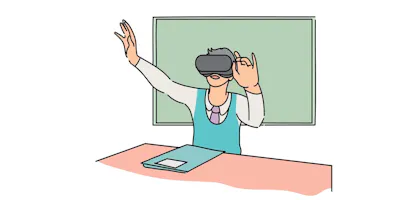
For students at a new Florida-based charter school, entering the classroom means strapping on a VR headset.

While plenty of schools have experimented with short lessons conducted in virtual reality, this new school, called Optima Academy Online, has embraced the technology as a primary mode of course delivery. That means participants log a lot of time in VR most every school day: Students in third through eighth grade are given a Meta Quest 2 VR headset and wear the devices for about 30 to 40 minutes at a time for three or four sessions, spaced out over the course of a day. (Younger children in the school take courses using more-traditional online tools, including Microsoft Teams.)

The school’s founder, Erika Donalds, hopes this cutting-edge technology can help spread an educational approach that is decidedly old-fashioned. She’s a champion of a model of education that favors students reading classical texts and otherwise focusing on the traditional canons of arts, literature and culture. And, ironically, she thinks that the latest VR technology provides a unique way for students to hold socratic dialogues and engage with ancient texts in ways that can’t be done in other formats.

“With our approach to classical education,” the school’s website says, “students learn about historical events, characters, stories, fables, myths, scientific facts, and mathematical proofs in the locations where these educational advances were made.”

Emma Green, a staff writer for the New Yorker, has been spending time visiting these VR classrooms and researching the company for the magazine. Her article, published earlier this month, digs into how the school’s backers hope it will lead to the next frontier in the school choice movement. Because it turns out that Donalds, Optima Academy Online’s founder, is a longtime Republican activist pushing for ways for parents to opt out of public schools..

For this week’s EdSurge Podcast, we connected with Green to find out what she learned about the school, about why some edtech experts are concerned about the amount of time its students are spending in VR, and about how the high-tech experiment fits within broader debates about the future of public education.

Listen to the episode on Apple Podcasts, Overcast, Spotify or wherever you get your podcasts, or use the player on this page. Or read a partial transcript below, lightly edited for clarity.

EdSurge: So you saw some demos of this VR school with their sixth graders and eighth graders. What did the VR classroom look like?

Emma Green: It felt to me a little bit like I was in a video game when I was in these environments. Teachers are able to spawn all of these different tools, like big [virtual] Post-it notes that they can put in the air, or a blackboard that they can use to project images or write words. They can decorate these scenes to try to be more historically accurate. So there's a lot of adaptability in the setting that they use.

They use Engage as their platform, which gives them a lot of flexibility to be able to design their own landscapes. So it's very interesting and seems very flexible in terms of how the teacher wants to create different formats for different age groups.

So everyone is doing this from their own homes instead of a school building, right?

The teachers are all over the country. I talked to the headmaster, who is in North Carolina. The person who's the chief technology officer lives in Mississippi. Over the past year, all of the students who participated in Optima Academy Online lived in Florida, but they're now expanding their offerings so that it's possible that students might be in a classroom setting with kids who are actually in different states.

And indeed, when I talked to Erika Donalds, who's the woman who founded OptimaEd, the company that runs the school, her vision is that ultimately their academy can be not bounded by geography — that students could put on their headset and they could be in a classroom with kids who live thousands of miles away from them, but still have the same curriculum, have access to the same field trips to Mars or to the ancient world of the dinosaurs and not have distance or the setting where you live be a limiter on your ability to access this kind of education.

How did you come to even hear about this school?

I first heard of OptimaEd through a story that I was reporting on about a college in Michigan called Hillsdale College, which is a conservative school. It's a pretty central node of the intellectual conservative movement. And in recent years, Hillsdale has started to champion charter schools — and, specifically, classical charter schools, schools that use a curriculum that emphasizes the liberal arts, the teaching of language, ancient languages, the teaching of “Great Books” and original texts, like actually reading the Constitution instead of just reading about the Constitution. And these classical schools, which have sprung up across the country with Hillsdale’s support, are really flourishing and growing. There's a lot of demand for them.

And one of the hubs for this growth is Florida. Erika Donalds, who lives in southwest Florida and is the wife of [Republican] Congressman Byron Donalds, has been an education activist. And one of her projects has been to work with Hillsdale to launch charter schools in this classical model. And she's helped to do that for brick-and-mortar charter schools in Florida. And then during the pandemic, she had this opportunity to launch a virtual school, which ultimately led to Optima Academy Online. It's claiming to be the first ever all-virtual, virtual reality classical school.

Typically VR efforts are associated with Silicon Valley, which is known for some liberal and progressive values. But in this case it sounds like a Republican activist is using this technology to advance a conservative agenda. That’s kind of a surprising contrast.

It is. And her activism, as you said, very much has been within conservative education movement. She's a big school choice advocate going back all the way to the anti-Common Core movement.

And what was so interesting to me talking to her about her vision is that she sees virtual reality school as a logical extension of the work that she has done in the school choice movement because fundamentally, the school choice movement is about giving parents and families the flexibility to be able to access a free, publicly funded education, but to do so on their own terms, not to just be wedded to their local zoned public school.

And to her, the option to have your kids stay at home anywhere in the state of Florida or anywhere in the country for that matter, if her great plans succeed, and be able to access their school through a headset that you have at home and then later in the afternoon be able to do their homework and do the rest of their schoolwork on their own terms, at their own pace to accommodate the rest of their family's schedule or maybe a sports schedule — that to her is ultimately school choice.

This is an unusual amount of VR use for a school. I understand that has raised some concerns.

I talked with an expert at Stanford named Jeremy Bailenson, who really is the guy when it comes to understanding VR and the consequences of VR use over time. He's done some research on VR and education as well. And he told me that he finds it hard to imagine having VR as the main delivery mechanism for full-time school in which kids as young as maybe 8 or 9 or 10 having on a headset for multiple hours over multiple days of a week over multiple weeks in a year.

He actually had the opportunity during the pandemic to run this experiment. He took students at Stanford where he teaches and created through the pandemic these virtual reality classrooms, and they ran experiments on what was useful to do in the classroom setting in VR and what wasn't useful, how long did they want to stay in, how did they put parameters on the use of the technology in order to keep people from experiencing the fatigue that is common from using these headsets over long periods of time.

It's kind of like getting car sick or being on a boat and feeling nauseous. ‘Simulator sickness’ is what it's called. That's one possible consequence. And what he found after having multiple rounds of these classes that were set in VR is that he really felt strongly about placing boundaries of limits on the amount of time that anyone was in VR, let alone people who are still developing in their brains and their eyes as kids. His rule in his lab is 30 minutes at a time, so you do 30 minutes, you set aside the headset, maybe you come back later in the day, but 30 minutes is kind of the outer edge of it.

So from his perspective … there are some real downsides to trying to make VR an all-the-time platform. And that researchers just don't know what happens when you try to put kids into a headset for multiple hours over a sustained period of time.

So what does Erika Donaldson say, the founder of this school, when presented with that kind of concern about the overuse of this format for students?

I talked to Erika about this, and it was very clear to me that she's up in the literature because she was citing to me some of the Stanford studies. And she said that they do have some limits in place, so it's not all day. They typically will have the headset on for maybe three to four, potentially five sessions in a day. There are those time limits, 30 to 40 minutes of a session. And so they are setting some boundaries around it. They encourage students to do the same things that Jeremy Bailenson encourages his students to do, which is to talk to a regular person, have a glass of water, take a walk around when you take the headset off so that you can get grounded in reality.

She thinks that the benefits outweigh the costs and that it's worth doing what they're doing. I think that in some ways, they're running the experiment. They are trying to pioneer something that hasn't been tried before. And I think for researchers who are in this world, they're a really interesting potential case study to see what does happen.

Why use VR instead of other forms of virtual education?

She made the case to me that you can't really do classical school on Zoom — that for whatever reason, these platforms that are two dimensional just feel flat. It's not really possible to engage in the same way. They had an experience with their brick-and-mortar charter schools over the pandemic trying to do classical school in a Zoom setting, which was good. I think there was interest in it, and she said it was really successful, but it ultimately left her feeling like you couldn't have the kind of engagement that you need. So she made the case that VR really does add something that goes above and beyond, being able to go to these places and have that kind of tactile engagement. She says there's more opportunity for robust learning.

Hear the complete interview, including more details on what it looks like when a group of kids do a lesson in a VR simulation of the moon, on the EdSurge Podcast.

© Pita Design / Shutterstock

Will Virtual Reality Lead More Families to Opt Out of Traditional Public Schools?

Today’s Kids Are Inundated With Tech. When Does It Help — and Hurt?

5 September 2023 at 23:07

The pandemic has largely changed public perceptions about the appropriate use of technology for young people, argues Katie Davis, associate professor in the information school at the University of Washington.

“The pandemic forced us to confront the fact that technology is absolutely essential in our lives, and especially during crises,” she says. Now, she says, discussion is shifting to questions of “When is technology good? When is it bad? What should its role be in young people's development at each stage of their progression, from toddlers all the way up to emerging adulthood and beyond?”

The EdSurge Podcast recently interviewed Davis, who has done research on the intersection of child development and technology for nearly 20 years. She lays out a framework for how to best match tech with each stage of growth in a new book, “Technology's Child: Digital Media’s Role in the Ages and Stages of Growing Up.” It celebrates when technology can help kids thrive — as well as cautions about when it can get in the way.

Sometimes the problems posed by gadgets can emerge in unexpected ways, she says, such as when literacy apps aimed at young readers feature too many bells and whistles, like a word’s meaning popping up on screen as children tap it, or rich sounds playing as children read.

“You think, that must be really good when learning to read, to hear the word being sounded out. And in theory, these do seem like good ways to enhance the learning experience,” Davis says. “However, we have to remember that especially for young children, there's a limit to their information-processing bandwidth. If you think of a computer, an analogy to a computer, they have just smaller CPUs than we do as adults.”

And she says there is a growing awareness of how some tech companies design their systems to do things that aren’t in the users’ best interest, a phenomenon referred to as “dark patterns.” A common example of a dark pattern, Davis says, is the autoplay feature on YouTube that often keeps viewers watching and can make it more difficult for a parent to convince their young child to put down a device.

Davis calls for increased regulation of tech companies to rein in such design features.

“Relying on the tech companies to regulate themselves doesn't work,” she argues, “because it's just not in their best interest financially to place user well-being front and center. Unfortunately, that's just not what makes them a lot of money.”

But she acknowledges that regulations can have unintended consequences that can be harmful as well. So she calls on academics to conduct more research to help inform best practices for tech tools, so that they foster well-being and are more effective for education.

Listen to the episode on Apple Podcasts, Overcast, Spotify or wherever you get your podcasts, or use the player on this page.

© Ollyy / Shutterstock

Today’s Kids Are Inundated With Tech. When Does It Help — and Hurt?
❌
❌