Normal view

There are new articles available, click to refresh the page.
Before yesterdayMain stream

3 ways educators leverage gamification strategies

23 November 2023 at 11:00
Gamification helps students dive into learning--and it helps educators present challenging topics in engaging ways.

Key points:

Students don’t have to be video game fanatics to appreciate a gamified classroom lesson. When teachers turn a lesson or tough-to-teach concept into a motivational gamed or use a fun competition to teach new concepts, students become immersed in their learning and are often more engaged–meaning they’re more likely to retain information.

Still, there’s an art to gamifying a lesson and ensuring that students are actually learning instead of just playing a game for points.

Here’s how educators across the country are using tools–from Minecraft: Education Edition to Roblox and easy-to-access online resources–to gamify their lessons and help students engage with learning.

1. Carrie Rosenberg, a fourth grade teacher at Community Christian School, notes that gamification is one of the biggest education trends right now. According to ISTE, “gamification is about transforming the classroom environment and regular activities into a game.” Many students want more than just good grades from school–they want something physical or immediate. Rosenberg uses Gimkit, Kahoot!, and Prodigy to gamify her instruction and motivate students. Learn more about her instructional strategies.

2. Games are part of many people’s lives–so why not use them to benefit students when teaching? Abigail Beran, a fifth grade teacher enrolled in a masters program in education technology, knows that her students are more likely to engage in an educational activity when it is gamified–and that they’re even more likely to do so when the activity is gamified with technology. There are a variety of reading and math apps and websites that cater to gamification, and even provide the opportunity for differentiation. Beran uses tools including Raz KidsDreamscapesProdigy English, and IXL language arts for English/language arts gamification, and uses Prodigy MathMath PlaygroundPet BingoSushi Monster, and IXL math for gamifying math. Discover how she integrates these gamified tools into her classroom.

3. As an educator for more 27 years and a digital learning specialist (social studies) for the past 7 years in Atlanta Public Schools, Felisa Ford has supported educators across the district and beyond as they purposefully integrate technology in the classroom to promote engagement and 21st century skill development. While there are many tools and resources available to educators to support their efforts to create dynamic digital learning environments, one of the most engaging is Minecraft Education Edition (M:EE). Popular among students (and teachers!), M:EE is a game-based learning platform that promotes creativity, collaboration, and problem-solving in an immersive digital environment. Read about five ways Ford has helped the district’s teachers use M:EE into classroom instruction.

Acceleration Academies Appoints Kelli Campbell as New Chief Executive Officer

22 November 2023 at 20:41

Chicago, IL – Acceleration Academies, the nation’s leading provider of tech-enabled flexible education, announced today that Kelli Campbell will assume the role of Chief Executive Officer to accelerate growth and broaden impact to school districts and students.

Campbell spent 17 years at Discovery Education, the global leader in standards-based digital content for K-12 school districts, and most recently served as President of the company. As a career EdTech executive, she brings a demonstrated history of success leading the sales and marketing, product development and operations functions for pioneering educational technology organizations. 

“After thorough succession planning and a comprehensive search process, the board is pleased to have found the best individual to take Acceleration Academies into its next stage of growth and expansion,” said Steve King, co-founder of Daniels & King Ventures, the main funding source for Acceleration Academies. “Kelli has a track record of strong leadership in the EdTech industry, established relationships with K-12 school districts, and success in private equity value creation. We are confident that Kelli is the right leader to accelerate the company’s growth opportunities.”

The change in leadership comes as Acceleration Academies is rapidly expanding its school district partnerships nationwide to provide a flexible, supportive and personalized program for students who are not experiencing success in a traditional high school.

“As our organization has matured and we are serving a record number of students, we are excited to welcome additional leadership expertise to help us reach the next level. We must support our accelerated growth so that we can serve more students and school districts, while maintaining the efficacy and integrity of our model,” states current CEO and co-founder Steve Campbell.

Co-founders Steve Campbell and Dr. Joseph Wise will remain actively involved in the business.

“Acceleration Academies is an extraordinary company that is positively impacting the lives of young adults who struggle in a traditional school setting,” said Kelli Campbell, Acceleration Academies’ incoming CEO. “Throughout my career I have championed equity in education. Acceleration Academies provides the necessary supports to help remove obstacles so that students can not only graduate from high school but be prepared for post-secondary and job success. I am tremendously excited for the opportunity to support the mission and help expand the number of students that we serve.”

About Acceleration Academies

Founded in 2014, Acceleration Academies is a national leader in re-engaging young adults not experiencing success in a traditional high school setting. We partner with school districts across the U.S. to offer dropout recovery and re-engagement services, credit recovery and a flexible, personalized alternative for students (and former students) to earn a customary district issued high school diploma. Our hybrid learning model and Cognia-accredited web-based curriculum allows students to receive in-person support at academy locations and work online anytime from anywhere. Students receive a dedicated social and emotional support system to remove impediments that have caused them to struggle in a traditional setting. Currently, Acceleration Academies has more than 5,000 students enrolled in 19 academies in seven states.

For more information visit: accelerationacademies.org

5 essential digital learning reads

22 November 2023 at 11:00
Digital learning is an essential element in today's connected and evolving classrooms--here's what you need to know.

Key points:

  • Digital learning is a key part of students’ school experiences
  • As technology evolves, so, too, do students’ learning opportunities
  • See related article: Is AI the future of education?
  • For more news on edtech trends, visit eSN’s Digital Learning page

Digital learning is a critical component of what happens in today’s classrooms. Edtech tools, connected learning experiences, and 21st-century skills all play a role in preparing students for the future.

But digital learning trends and technologies change so quickly that sometimes, it’s difficult to know where to focus or where to invest funding, time, and resources.

Here are 5 must-read stories about digital learning trends and developments to help your school leadership team determine which digital learning resources and edtech tools can best benefit students:

1. Digital learning requires digital research skills: Right now is the perfect time to start a research project with your students, as it will help them develop skills they will use for the rest of their lives. While your students, who have grown up in the Information Age and think they already know everything, any classroom teacher knows that our students need help more than they think. Our students’ belief that everything they need to know is online can, without the right skillset, leave them prey to misinformation. Let’s teach our students to steer through the online ocean of data to be both effective researchers and responsible digital citizens.

2. Digital escape rooms merge creativity with student engagement and skill development: Escape rooms are engaging for people of all ages–they require durable skills such as creativity, critical thinking, determination, and the ability to work in groups to solve challenges. It makes sense that educators would craft their lessons around the concept of an escape room–and that’s just what high school educator Lynn Thomas has done. In this Q&A with eSchool News, Thomas details how she found inspiration to create escape room learning opportunities and the benefits she sees for her students–and she offers a look at a new ChatGPT challenge she’s created.

3. Esports can engage even the youngest of students, and these programs help students develop critical skills no matter what paths they pursue: Scholastic esports is rapidly growing, and many schools are starting to incorporate esports programs into their curriculum. The benefits of esports make a compelling case for creating a program: Research shows that students who participate in scholastic esports experience social and emotional benefits, increased academic achievement, and higher graduation rates. These positive learning outcomes make esports popular in secondary grades, with both students and educators advocating for the addition and growth of scholastic esports in their middle and high schools. But esports isn’t just for the older kids, and starting an esports program in early elementary school can be an effective way to lay the groundwork for esports participation as students make their way into higher grade levels.

4. In an AI-driven world, how can students maintain their own voices? Now, more than ever, students’ future success in an ever-changing world requires that they learn how to think critically and creatively while collaborating with others to solve complex problems. But the unwritten curriculum of most schools—instilling process perfectionism through rewarding flawless performance—is probably doing more harm than good. Against this backdrop, there’s a lurking concern that AI is just going to help students find mindless shortcuts for cheating their way to good grades. But that’s only a risk if schools and teachers hold a low bar for what they expect of their students.

5. Effective digital learning means educators must know how to leverage digital tools correctly: When properly integrated, AI can amplify the work of teachers, shrink equity and accessibility gaps, and provide unrestricted access to information. But for technology to make a meaningful change in K-12 education, we need to address the true source of the problem: broken instructional models. Even though countless technology tools have been introduced into the market, classroom practice looks eerily similar to how it did a hundred years ago. That’s because educators are still equipped with an antiquated model of teaching that isn’t designed to be responsive to students’ learning styles. By leveraging AI and technology to rethink traditional teaching methodologies, we can level-set our classrooms to more effectively empower educators and personalize student learning.

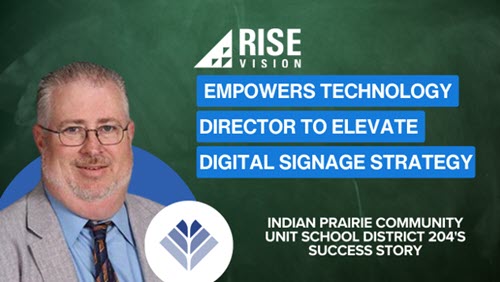
Indian Prairie Community Unit School District 204 Uses Rise Vision for Digital Signage Across District

21 November 2023 at 19:59

Rise Vision, the #1 digital signage software, is excited to announce the release of its newest case study featuring Indian Prairie Community Unit School District 204 (CUSD 204). Indian Prairie CUSD 204, a large school district in Illinois, uses Rise Vision to bolster its school communication strategy and increase student engagement. This case study highlights how Indian Prairie has successfully implemented digital signage to communicate with its student body population.

Efficient communication to reach students effectively and engage them in critical announcements, events, and activities is a challenge in any school – but it’s even more challenging in a large school district with over 34 sites. Digital signage is a tool that makes disseminating information across any sized campus simple. Brian Grinstead, the Director of Technical Support Services, was looking for a cost-effective, user-friendly, and feature-rich solution to meet their evolving needs.

Indian Prairie CUSD 204 is a large, one-to-one school district with over 26,00 students and a significant number of devices to manage. Brian needed to ensure that the digital signage solution the district implemented wouldn’t be a burden on his team. Implementing digital signage through Rise Vision was a solution that didn’t require extensive management from the technology department and could be handled by the individual schools after the initial deployment was completed.

One notable aspect of the implementation was the seamless transition from the previous digital signage solution to Rise Vision. Brian Grinstead said, “The deployment was remarkably smooth, requiring minimal time and effort.”

This large school district has leveraged Rise Vision’s capabilities to improve the efficiency and effectiveness of its digital signage. While they have currently deployed Rise Vision in their four high schools, Brian commented that they would be extending digital signage to their middle and elementary schools in the future.

“Indian Prairie is a great testament to our goal of being simple to deploy and easy to use,” remarked Brian Loosbrock, CEO of Rise Vision, “The district needed a solution they could deploy and scale but that wouldn’t be a burden to their technology team.”

For more information about Rise Vision and how it can revolutionize communication within school, visit the company’s website.


ABOUT RISE VISION

Rise Vision is the #1 digital signage software solution for schools. Rise Vision helps schools improve communication, increase student involvement, celebrate student achievements, and create a positive school culture.

Is generative AI a beacon for more accessible education?

20 November 2023 at 11:00
Despite low levels of preparedness and barriers to adoption in education, there is a belief in generative AI's potential to empower learners.

Key points:

  • Many educators look forward to the opportunity afforded by AI, but few feel ready to use it
  • Other educators wonder if they have proper district support for AI use
  • See related article: 5 positive ways students can use AI
  • For more news on AI in education, visit eSN’s Digital Learning page

A resounding 90 percent of educators in a recent survey said they believe that AI has the potential to make education more accessible. 

Teachers are recognizing that when implemented ethically and with thoughtful consideration, AI can help students with special needs, learning disabilities, and language barriers, for example, and experience more effective, personalized learning methods, according to the 2023 Educator AI Report: Perceptions, Practices, and Potential from digital curriculum solution provider Imagine Learning.

With generative AI emerging as a pivotal element in the dynamic educational landscape of 2023, Imagine Learning conducted the survey to explore the perceptions, current practices, and future aspirations of educators who have already embraced technology in the classroom. The inaugural report showcases a comprehensive exploration of AI’s current and future role in K-12 classrooms.

When it comes to readiness, however, only 15 percent of educators feel “prepared” or “very prepared” to oversee the use of generative AI in the classroom, with over twice that number (32 percent) expressing they are completely unprepared to do so. What’s more, educators indicate a disparity when it comes to the likelihood of using Generative AI in the classroom, with district and school leaders perceived as less likely to embrace new AI tools when compared to educators and students.

On top of this, only one-third (33 percent) of surveyed educators feel that they have the support they need from their district and school leadership to successfully implement generative AI into their teaching.

Other key findings from Imagine Learning’s report include:

  • Almost half of educators (44 percent) who have used generative AI believe that its use has alleviated the burden of their workload and made their jobs easier.
  • Of the respondents who reported they have not used AI in the classroom, 65 percent cite a lack of familiarity as the primary obstacle to the future utilization of generative AI, with 48 percent also expressing ethical concerns.
  • 72 percent of educators are most concerned about plagiarism and cheating due to generative AI, highlighting the need for clear guidelines for students for using AI with academic integrity.

“Generative AI is a blend of promise and prudence. Its transformative potential is undeniable, but the journey forward requires thoughtful consideration,” said Sari Factor, Vice Chair and Chief Strategy Officer, of Imagine Learning. “Learning is above all a human endeavor. With generative AI as a tool to simplify lesson planning, reduce administrative tasks, and enhance personalized learning, we can empower the potential of teachers and students and improve learning outcomes.”

This press release originally appeared online.

5 ways I’ve leveraged AI in my English classroom

ChatGPT stormed into our lives and our classrooms, and it’s a mess. But my students and I are jumping in with AI in our English classroom.

Key points:

  • Students will be immersed in an AI world—they need to learn about it
  • One English teacher brainstormed creative ways to get students talking about, and working with, AI
  • See related article: 5 positive ways students can use AI
  • For more news on AI in education, visit eSN’s Digital Learning page

Last spring, a few weeks after I started using ChatGPT, I challenged my high school English students: “Artificial intelligence can do any of your class assignments,” I told them flatly. “Now prove me wrong.”

I wanted to provoke them, to get them to ask questions, and to start using these tools—not to cheat—but to flip their learning on its head. I knew we needed to learn this together. And since that day, we didn’t just shift the paradigms—we sent them into somersaults.

1. Putting ChatGPT on trial

I first became aware of ChatGPT last February when I began reading mind-blowing comments of several progressive educators. As a teacher who strives to help students uncover their interests and stretch their imaginations, I wanted to ensure they were participating in this new technology. We were about to begin our unit on The Crucible and I began wondering how we could leverage ChatGPT.

Typically, at the end of the unit, I ask my students to put various characters on trial, backing up their ideas with plenty of original evidence. This time around, I wanted them to also put ChatGPT on trial. What are its strengths and opportunities, its weaknesses and threats?

So I created a project-based scenario: The students were attorneys for a law firm, and I was their client, bringing them this challenge: I was thinking about investing in ChatGPT. Based on their understanding and the research they’d conduct during The Crucible unit, should I? What would be the implications? The upsides and the down?

So the students began, first reading The Crucible, relying only on their human intelligence. Then, after a week, they opened up their understanding of the classic play through ChatGPT. And it was astonishing: ChatGPT helped students discover subtle nuances and character traits they’d missed initially, created authentic-sounding trial documents that outlined their arguments, provided historical information about the Salem witch trials, and prompted students to explore the play’s themes and messages. It also generated hypothetical conversations between characters, providing fresh insights into how characters evolved throughout the play.

At the unit’s completion, the students had glimpsed AI’s potential—and its potential problems. Many students were concerned about cheating, about bias, about invented “facts,” and about privacy. But, ultimately, the majority of students advised that I, as their client, should invest in AI, finding that it increased efficiencies, helped with workload, sped up research, improved grammar, relieved deadline stress, and more.

2. Using ChatGPT as a creative partner

When they returned from spring break, students found that I’d taken their advice to heart: I’d invested $20 on a premium version of ChatGPT and had created an AI workspace in our classroom. Now I invited them to use ChatGPT during our final inquiry unit, during which they’d ask questions, come up with a plan, leverage their research, and then go public with their findings. Soon they found they could use ChatGPT as a creative, brainstorming, spit-balling partner—with great results: generating open-ended questions, discovering and exploring their interests, creating a day-by-day calendar to reach goals, ideating original art pieces, and augmenting lyrics for songs and scripts. To say they were wowed by ChatGPT’s ability to take their own thinking and creativity further would be an understatement.

3. Considering what’s next

During that inquiry unit, I wanted to better understand—and for my students to better understand—what might be ahead of us in terms of AI. So I invited our school librarians to visit our class, presenting glimmers of what’s ahead: the good, from conducting medical research to solving complex global problems; the bad, from impersonating someone’s speech to waging war with AI; and the surprising, from saving bees to predicting earthquakes.

Impressively, the librarians also fielded questions, addressing ethical considerations of AI, detailing the importance of vocabulary when it comes to writing powerful prompts, and reminding students that they need to be thinkers themselves and not just settle for what ChatGPT generates.  

4. Going from zero to hero

Just days before our fall semester started, I learned that I’d been assigned mythology—a subject I’d not taught before and one without a syllabus. But, like my students during their inquiry unit, I knew I could turn to ChatGPT as my creative partner. To begin, I wrote a thorough prompt, telling it: “You’re a high school English teacher who wants to teach an inquiry-based mythology class with self-directed learning. You have questions and you’re looking for answers. (That’s so the hero’s journey à la Joseph Campbell.) Now create a syllabus, complete with readings.” Less than a minute later, there it was, in all its mind-boggling near perfection. Next, I asked ChatGPT to create a hero’s journey chart with student checkpoints along the way. Once again, in 20 seconds, there it was. In class, I’ve stuck with these materials mostly and, so far, so good.

5. Clubbing—AI style

Most recently, I’ve teamed up with a school librarian to create an extracurricular AI club. We’re not totally clear on our mission or our goals—we’re in the early days. But we do want students to understand what’s happening with AI and to be, if not prepared, at least thinking about AI and how it may impact not only their careers but their lives.

As for that first challenge I presented—the one about AI being able to do any schoolwork—unfortunately, it proved true: AI can do pretty much any class assignment. And that made us all squirm. In fact, that feels scary. But that’s all the more reason to delve into AI. As Bill Gates said last spring, “You definitely want the good guys to have strong AI.” You don’t want only the “bad guys” to be using it, manipulating it to deceive or to swindle or to gain power or to wage war. That’s why we must keep talking about AI with our students. We can’t run away.

Soon AI will be a common tool in myriad fields. That’s why we as educators need to help our students use it, become familiar with it, and think for themselves about its implications. Yes, it’s threatening. It’s also exciting. And it’s going to be their world.

Poptential™ High School Economics Curriculum by Certell Offers Free Stock Market Investment Lessons

20 October 2023 at 14:00

INDIANAPOLIS, Ind. — October historically has been a month of notable volatility in the stock market, with historic crashes like the 1929 Great Depression and Black Monday in 1987. These events have given rise to a sense of “Octoberphobia” among some investors. Lessons on these events and others are included in Common Sense Economics from Poptential™, a comprehensive and free high school digital curriculum. Click to tweet.

“It’s never too early for teachers to engage students in discussions about the history of the stock market, its impact on economic growth or decline, and how it can potentially empower students to invest in their own futures,” said Julie Smitherman, a former social studies teacher and director of content at Certell, Inc., the nonprofit behind Poptential.

Poptential course packages boost student engagement by using a variety of pop culture media to illustrate concepts, including those taken from sitcoms, movies, animations, cartoons, late-night shows, and other sources. Lessons on the history of the stock market and how to invest in stocks are covered in the new 2023 Poptential Common Sense Economics e-book, including:

Investing for the future: Students can learn about the two broad categories of equity mutual funds—managed and indexed funds—in a chapter on investing. The material covers how a diverse holding of stocks over the long term can mitigate risk and offer attractive returns. This underscores the wisdom of using stock market investments as a retirement strategy.

The stock market is for small investors too: The Poptential November 15 Bell Ringer showcases that Investing in the stock market need not be intimidating. Investing in mutual funds or exchange-traded funds (ETFs) offers individuals a pathway to participate in the stock market. A video clip explains the difference between these two investment vehicles.

Understanding stock market crashes: Poptential’s October 19 Bell Ringer explains how companies raise capital by selling stock and underscores that owning a company’s stock allows individuals to participate in the performance of that company, whether positive or negative. A video clip delves into historical market crashes, including their role in the 1929 Great Depression and the global recession of 2008.

Professionals profiting from market collapses: Throughout history, astute investment professionals have capitalized on market crashes. Those who can gauge the fragility of the financial markets and trade accordingly can profit from market downturns. This video clip from the movie “The Big Short,” featured in the Poptential March 16 Bell Ringer, highlights how investment professionals try to predict market swings and discuss strategies for profiting from market downturns.

Poptential course packages include everything instructors need to teach a subject, including lessons, e-books, bell ringers, quizzes, and tests. The curriculum is standards-based and developed by teachers.

Poptential is available via a digital platform that allows students to access lessons even in poor bandwidth environments. Course packages in American History, World History, U.S. Government/Civics, and Economics are available free at www.poptential.org.

About Certell, Inc.

Certell is a 501(c)(3) nonprofit dedicated to fostering a generation of independent thinkers. With over 100,000 users across the United States, Certell’s Poptential™ family of free social studies courses has garnered numerous awards, including recognition from EdTech Digest Awards, Tech&Learning, Tech Edvocate Awards, the National Association of Economics Educators, and Civvys Awards. For more information about Poptential™ and Certell’s mission, please visit www.poptential.org.

How schools can help students overcome the digital divide

20 October 2023 at 11:18
Schools and school leaders can help students and families achieve digital equity by pursuing at-home internet connectivity.

Key points:

When it comes to digital equity, U.S. schools are well-positioned to help families get online with low-cost, high-speed internet options through the federal government’s Affordable Connectivity Program (ACP), according to a new study from Discovery Education and Comcast.

However, the study also found that educators lack centralized resources and direct support necessary to successfully overcome barriers to the digital divide. Released to help support this year’s Digital Inclusion Week theme of “Building Connected Communities,” key findings include: 

  • Nearly all educators surveyed feel strongly that digital equity is more important today than ever before. 
  • 82 percent of families and 80 percent of educators surveyed feel strongly that high-speed Internet at home is extremely important to fulfilling learning outcomes. 
  • While two-thirds of families and educators acknowledge their school’s interest in closing the digital divide, only one-third are aware of actionable measures being taken by the school district.  
  • Only 39 percent of parents were aware of the ACP, and of those that were aware, just 13 percent of parents have signed up. What’s more, only 22 percent of educators surveyed strongly agree that administrators in their school districts are equipped with the necessary information to communicate options for high-speed internet access at home. 
  • Data shows multiple disconnects between what parents pointed to as actual barriers to broadband adoption versus what teachers perceived as parents’ barriers to adoption. Addressing these will be critical to ensuring that school districts and digital navigator programs are effective in closing the digital divide for students. 
  • There was a 52-percentage-point difference between the share of teachers who thought that cost of service was the primary barrier to adoption for families versus the actual share of parents who pointed to cost as a barrier. 
  • Significantly larger shares of teachers thought that families did not live in buildings that were wired for broadband, did not know how to set up the Internet, and did not have devices than the share of parents who raised these barriers. 
  • Findings from the study also support a recommendation for school systems to partner with proven and trusted programs such as those that include support from Digital Navigators — to help streamline communication, advocacy, and adoption strategies that lead to equitable opportunities for all students. Ensuring all ACP-eligible families are signed up is equally important in supporting district connectivity goals. 

To help further address these issues, Comcast is helping school administrators more quickly and easily access additional resources to get more households enrolled in the ACP during the back-to-school season through the Online For All Back to School Challenge, led by the U.S. Department of Education and Civic Nation. 

A new online tool from Comcast is designed to help administrators quickly and easily assess ACP eligibility in their school districts. They can also learn about which schools have the lowest broadband adoption rates in their area. This valuable data will enable school leaders to better tailor communications around the ACP and direct families to resources that can assist in supporting Internet adoption. 

“Ensuring every student in America has access to reliable, high-speed Internet in the classroom and at home is a top priority for Comcast’s Project UP. The combination of historic investments in universal broadband, public-private collaboration, and private industry support will together ensure that neither availability nor affordability stand in the way of achieving connectivity for everyone,” said Broderick Johnson, EVP of Public Policy and EVP of Digital Equity, Comcast Corporation. 

“At Discovery Education, we are on a mission to prepare learners for tomorrow by creating innovative classrooms connected to today’s world. Today, no matter where learning takes place, access to and adoption of high-speed Internet is an essential ingredient for student success. As Comcast’s education partner in this work, we’re proud to support efforts to ensure students and families have the tools necessary to meet the demands of the modern learning environment,” said Amy Nakamoto, EVP of Social Impact, Discovery Education. 

“Today, 17 million unconnected households are eligible for low-cost, high-speed Internet under the Affordable Connectivity Program. Civic Nation is partnering with the U.S. Department of Education, school districts, and organizations across the country through Online For All to close this gap and ensure every student and family has equitable access to learning, both at home and in the classroom,” said Kyle Lierman, CEO of Civic Nation. 

Additional key findings from the study include: 

  • While educators believe their school district leaders are aware of the negative impacts the digital divide has on learning outcomes, there are numerous other factors being prioritized over home Internet adoption. 
  • 86 percent of educators surveyed elevated student well-being as the most important issue for schools to address, followed by school safety, and equity and inclusion more broadly. This places more emphasis on policymakers, school officials, institutions, and the private sector to show how digital equity and home broadband adoption facilitate broader equity issues and level the playing field for families seeking opportunities for their children. 
  • Further, coupling Internet access and adoption with an ability to address other school concerns, such as providing supports for student well-being and growth, has the ability to keep digital equity as a top priority for school leaders and help them serve broader needs for their students. 

There is widespread agreement that the pandemic forcefully evolved and rapidly closed gaps in the digital divide as schools moved swiftly to remote learning. This cultural shift was met with success stories of connectivity and technological advancements, but also shined a light on students and families who did not experience equitable access to learning because of lack of connectivity or devices, or other barriers that made remote learning cumbersome. 

This study and partnerships were made possible by Project UP, Comcast’s comprehensive initiative to advance digital equity and help build a future of unlimited possibilities. Part of Comcast’s $1 billion commitment is prioritizing Internet connectivity and its impact on education. In addition, through providing low-cost broadband through Internet Essentials to families and the Internet Essentials Partner Program (IEPP) for schools, Comcast continues to ensure there are no barriers to home connectivity that could impede learning. 

This press release originally appeared online.

OpenAI releases ChatGPT teaching guide

19 October 2023 at 11:13
Teaching with ChatGPT doesn't have to be challenging--educators can embrace the AI tool and also show students how to create original work

Key points:

  • OpenAI, maker of ChatGPT, is releasing a guide to help educators incorporate the AI tool in their instruction
  • The guide includes use examples and answers frequently-asked questions
  • See related article: An AI to-do list for educators
  • Get the latest news on AI in education by visiting eSN’s Digital Learning page

Educators face myriad dilemmas in the wake of ChatGPT’s explosion, with some of the most popular including teaching with ChatGPT and how to address student use of AI chatbots in assignments.

OpenAI, the maker of ChatGPT, has released a new guide to help educators navigate the many ways AI can be used in teaching and learning. The guide contains examples of how some educators are teaching with ChatGPT, along with a series of frequently-asked questions that may help guide teachers as they seek to strike a balance between accepting AI’s presence and an over-reliance on such tools.

As outlined in OpenAI’s guide, here’s how some instructors are teaching with ChatGPT:

Role playing challenging conversations: Dr. Helen Crompton, Professor of Instructional Technology at Old Dominion University, encourages her education graduate students to use ChatGPT as a stand-in for a particular persona—like a debate partner who will point out weaknesses in their arguments, a recruiter who’s interviewing them for a job, or a new boss who might deliver feedback in a specific way. She says exploring information in a conversational setting helps students understand their material with added nuance and new perspective.

Building quizzes, tests, and lesson plans from curriculum materials: Fran Bellas, a professor at Universidade da Coruña in Spain, recommends teachers use ChatGPT as an assistant in crafting quizzes, exams and lesson plans for classes. He says to first share the curriculum to ChatGPT and then ask for things like fresh quiz and lesson plan ideas that use modern or culturally relevant examples. Bellas also turns to ChatGPT to help teachers make sure questions they write themselves are inclusive and accessible for the students’ learning level. “If you go to ChatGPT and ask it to create 5 question exams about electric circuits, the results are very fresh. You can take these ideas and make them your own.”

Reducing friction for non-English speakers: Dr. Anthony Kaziboni, the Head of Research at the University of Johannesburg, teaches students who mostly don’t speak English outside of the classroom. Kaziboni believes that command of English is a tremendous advantage in the academic world, and that misunderstandings of even small details of English grammar can hold back students from recognition and opportunity. He encourages his students to use ChatGPT for translation assistance, to improve their English writing, and to practice conversation.

Teaching students about critical thinking: Geetha Venugopal, a high school computer science teacher at the American International School in Chennai, India, likens teaching students about AI tools to teaching students how to use the internet responsibly. In her classroom, she advises students to remember that the answers that ChatGPT gives may not be credible and accurate all the time, and to think critically about whether they should trust the answer, and then confirm the information through other primary resources. The goal is to help them “understand the importance of constantly working on their original critical thinking, problem solving and creativity skills.”

Some of the common questions around teaching with ChatGPT include:

  1. How can educators respond to students presenting AI-generated content as their own?
  2. How can ChatGPT be used for assessment and feedback?
  3. How can educators get started with ChatGPT?

Related: Coming out of the AI closet: A scholar’s embrace of ChatGPT-4

Fixing the K-12 cybersecurity problem

CISA’s Secure by Design pledge commits manufacturers to improving K-12 cybersecurity and strengthening networks.

Key points:

In early September, the Cybersecurity and Infrastructure Security Agency (CISA) announced a voluntary pledge for K-12 education technology software manufacturers to commit to designing products with a greater focus on security. In the announcement, CISA mentioned that six leaders in the education software industry had already committed to the pledge: PowerSchool, ClassLink, Clever, GG4L, Instructure, and D2L.

“We need to address K-12 cybersecurity issues at its foundation by ensuring schools and administrators have access to technology and software that is safe and secure right out of the box,” said CISA director Jen Easterly. “I want to thank ClassLink, Clever, D2L, GG4L, Instructure, and PowerSchool, who have already signed this pledge and for their leadership in this area. We need all K-12 software manufacturers to help us improve cybersecurity for the education sector by committing to prioritize security as a critical element of product development.”

CISA’s principles for K-12 cybersecurity

This action brings a spotlight to the ongoing issue of K-12 cybersecurity. CISA’s goal is to persuade more K-12 software and hardware manufacturers to commit to its pledge. Signing the pledge demonstrates that the manufacturer is committing to three principles:

  • Taking ownership of customer security outcomes: Includes offering Single Sign On (SSO) and security audit logs and no extra charge
  • Embracing radical transparency and accountability: Includes publishing a secure by design roadmap, a vulnerability disclosure policy and security-relevant statistics and trends
  • Leading from the top by making secure technology a key priority for company leadership: Includes naming a C-level leader at the company who is charged with overseeing security

Secure by design explained

What does secure by design mean? In typical software design and manufacturing, the focus is on the product’s reason for being. For example, the developers of reading improvement software are focused on building a product that delivers measurable improvements to student reading speed and comprehension. The security of the software and its user data are an afterthought. Any security considerations are made late in the development process or bolted on afterward.

In contrast, a secure by design approach means that developers bake security into the design of the product from the beginning. This has proven to be a much more effective approach to protecting software than trying to patch security holes after the fact. Secure by design was popularized by the European Union’s General Data Protection Regulation (GDPR), which went into effect in May 2018. Today, this is a more common approach to software design, but it is relatively new to K-12 education.

Ongoing K-12 cybersecurity threats

While the K-12 education industry strives for improved protection in its schools, fresh examples of security holes continue to appear on a regular basis. Most recently, Prince George’s County Public Schools was the victim of a ransomware attack on August 14 that impacted about 4,500 user accounts, mostly staff, according to the district. Cybersecurity breaches such as this can have a detrimental impact on K-12 schools, threatening both reputation and financial well-being.

Unfortunately, successful ransomware attacks can hinge on exploiting a single vulnerability hidden among the dozens of software applications running in most school districts. By following CISA’s guidance and committing to a secure by design approach to software development, developers can further reduce potential vulnerabilities and keep staff and student data more secure.

Related: Education suffers the highest rate of ransomware attacks

Navigating generative AI: Promoting academic integrity

Educators should advocate for responsible generative AI usage that aligns with their values of academic integrity.

Editor’s note: This story on how to manage academic integrity as generative AI moves into classrooms originally appeared on CoSN’s blog and is reposted here with permission.

With AI dominating conversations among education leaders, the importance of managing expectations and academic integrity is now more critical than ever as the new school year commences. Most districts are realizing that straightforward banning of ChatGPT and other tools only keeps the students without home access and data plans from using A toolsets. Certainly, none of us want to create additional digital inequities. However, as students leverage generative AI for assignments and “Cheat detectors” prove ineffective in detecting AI-generated output, school administrators must take proactive measures to safeguard the authenticity of student assignments and promote ethical use.

Since AI-detection tools are being shown to fall short in detecting AI-generated output, it becomes crucial for school administrators to be proactive to ensure ethical use and safeguard the authenticity of student assignments. The best way to manage assignments and ethical use is to set expectations and put them front and center in the assignments themselves. Teachers need training on how to rework assignments to incorporate and evaluate the AI generated output.  Academic Integrity Statements are a good place to start with districts setting expectations for students. Academic Integrity Statements allow educators to put ethics first and teach essential tenets to students up front. They should be integrated into the framework of every project and report while emphasizing the importance of honest work and original thinking. By encouraging students to pledge their commitment to academic integrity, we instill in them a sense of responsibility and respect for the academic process. Can students just give this lip service? Yes, of course, But that does not reduce their importance. We also have a board approved RUPs (AUPs) that set expectations on tech use that may get circumvented. They set the standard, much like a speed limit sign does on a city street. As educational leaders, we must emphasize the significance of academic integrity, not just as a set of rules but as a core value that fosters a positive learning environment. By making it a focal point, we reinforce the notion that authentic learning experiences and personal growth come from genuine effort and creativity.

This may beg the question of the need for school board policies around Generative AI. Although this may initially seem like a good idea, The rapid pace of change in AI and the slow change of policy may indicate otherwise. I think that it may be better to couch AI management under administrative guidelines and let them fall under the RUP (AUP) or other existing policies. We found this to be true in our district as well with Social Media several years ago and issued Guidelines under our RUP.

The concerns surrounding Generative AI’s impact on academic integrity, among larger issues, have not gone unnoticed in the tech industry. Prominent voices, including Sam Altman of OpenAI, have urged AI regulation to ensure ethical and responsible use. As educational leaders, we must lead the call for action to protect the integrity of our academic institutions.

With at least 15 states already considering bills related to Generative AI and its potential impact on various industries, it’s not far-fetched to envision education as the next area of focus. As pioneers in the educational sector, we should proactively engage with policymakers and advocate for responsible AI usage that aligns with our values of integrity, fairness, and inclusivity. As we anticipate the evolving landscape of AI in education, it’s crucial to equip our schools and educators with the necessary knowledge and resources. Professional development programs should include training on identifying AI-generated content, how to adjust assignments to encourage prompt development/ evaluation, and best practices for fostering academic integrity.

As we embrace the digital age with Generative AI, promoting and managing academic integrity is a shared responsibility among our educational communities. We are taking steps like these to help ensure that our schools remain beacons of authentic learning in the digital age.

❌
❌