Normal view

There are new articles available, click to refresh the page.
Before yesterdayMain stream

Teacher shortages bring to mind the saying ‘necessity is the mother of invention’

In a teacher shortage, don't just be to pipe in a virtual teacher that delivers more one-size-fits-none, whole-group instruction.

This article originally appeared on the Clayton Christensen Institute’s blog and is reposted here with permission.

Key points:

“Fueled by teacher shortages,” we’re told in a recent article in The74, “Zoom-in-a-Room” is making a comeback.

If this is the case, although it’s better than the alternative—no teacher at all—it’s also a missed opportunity for deeper innovation.

As reporter Linda Jacobson noted in the article, online learning has long been used in schools for subjects they couldn’t otherwise offer. She cited A.P. Calculus and Latin as examples. But even courses we think of as fundamental—physics, for example—have long been glaring areas where schools haven’t had qualified teachers. As I wrote nearly a decade ago, “less than two-thirds of high schools–63%–offer physics. Only about half of high schools offer calculus. Among high schools that serve large percentages of African-American and Latino students, one in four don’t offer Algebra II, and one in three don’t offer chemistry.”

According to Jacobsen, “as districts struggle to fill teaching vacancies, they are increasingly turning to companies like Proximity to teach core subjects.” The practice is one in which the teacher of record delivers whole-class learning virtually, and an in-person monitor—often a substitute teacher—tracks behavior and ensures students do their work.

In some ways, this use of online learning could be a classic case of a disruptive innovation, which begins as a primitive innovation. As a result, disruptive innovations typically start by serving areas of nonconsumption—where the alternative is nothing at all. By outperforming this alternative, disruptive innovations can take root and improve over time until they take over.

Back in 2008 when we published Disrupting Class, we suggested that teacher shortages could represent a significant area of nonconsumption into which online learning could make its mark and begin to transform classrooms from monolithic, one-size-fits-none environments to student-centered ones that customized for the individual needs of each and every learner.

But for this to occur, the use of online learning shouldn’t just be to pipe in a virtual teacher that delivers more one-size-fits-none, whole-group instruction. It would seem that there’s not a lot of room for improvement in that model.

Instead, schools ought to be taking these opportunities to do what Heather Staker and I described in Blended—offering a la carte online courses with great digital curriculum mixed with elements of the Flex or Individual Rotation models of blended learning that match the path and pace of each individual’s students’ learning needs.

Just as Teach to One uses a mix of in-person and online teachers to deliver a personalized-learning pathway for every student in middle-school math, so, too, could schools begin to assemble blended-learning options that leverage virtual teachers but do so in formats that move beyond standardized instruction and incorporate a variety of engaging learning modalities; ranging from direct instruction tailored to a novice learner’s level to rich, real-world projects that allow a student to apply their learning of knowledge and skills in real performances, and from heads-down, solo learning experiences with software, offline work, or virtual tutors to small-group conversations and explorations.

These sorts of models would take advantage of the online format by delivering a tailored learning experience for each student rather than beaming a remote teacher into classes to do the same old, same old that hasn’t been working—and, as we saw with “Zoom-in-a-room” during COVID, was likely even less effective.

As Mallory Dwinal wrote in 2015 when she explored the opportunity for innovating where there are teacher shortages, states could also help by allowing these experiences to move away from seat-time requirements to mastery- or competency-based learning and giving districts some resources to evaluate and select the appropriate learning models.

So here’s my challenge to districts: Next time you see a teacher shortage, don’t just sub in a virtual teacher and fill the seat. Instead, get creative with a clear and smart goal of boosting every child’s learning. Spend a bit of time thinking about how this could be an opportunity, not a threat. And use virtual talent to design a much more robust learning experience for all. That would be something worth talking about.

The pandemic is over–but American schools still aren’t the same

21 November 2023 at 11:00
Many students and educators say school feels closer to normal than it has in over three years, but profound pandemic-era consequences persist.

This story was originally published by Chalkbeat. Sign up for their newsletters at ckbe.at/newsletters.

On a recent Friday at Gary Comer Middle School in Chicago, you had to squint to see signs of the pandemic that upended American education just a few years ago.

Only a handful of students wore face masks, and even then, some put them on to cover up pimples, staff said. The hand sanitizer stations outside every classroom mostly went unused, and some were empty. Students stopped to hug in the hallway and ate lunch side by side in the cafeteria. 

“I don’t think it’s a big deal as much as it was before,” said 12-year-old Evelyn Harris, an eighth grader at Comer, whose lasting memory of pandemic schooling is that online classes were easier, so she got better grades. “The pandemic didn’t really affect me in a big way.”

But inside Nikhil Bhatia’s classroom, the evidence was on the whiteboard, where the math teacher was shading in slices of a pie to illustrate how to find a common denominator. That day, his seventh graders were working to add and subtract fractions — a skill students usually learn in fourth grade.

Maybe you learned this before, Bhatia began. “Or, during the pandemic, you might have been on Zoom,” — a few students laughed as he dragged out the words — “put your screen on black, went to go play a couple video games. Snap if that sounds familiar?”

Clicking fingers filled the room. “That’s OK!” Bhatia responded. “That’s why we’re going to do the review.”

As the new school year begins at Comer and elsewhere, many students and educators say school is feeling more normal than it has in over three years. COVID health precautions have all but vanished. There’s less social awkwardness. Students say they’re over the novelty of seeing their classmates in person.

But beneath the surface, profound pandemic-era consequences persist. More students are missing school, and educators are scrambling to keep kids engaged in class. Many students remain behind academically, leaving teachers like Bhatia to fill in gaps even while trying to move students forward. Rebuilding students’ shaken confidence in their abilities is especially important right now.

“It’s OK that you don’t know this,” Bhatia tells his students. “It’s normal right now.”

Nationally, many students remain far behind in math and reading where they would have been if not for the pandemic. There have been especially steep learning drops at schools that taught virtually for most of the 2020-21 school year, as schools did across Chicago and within the Noble charter network, which includes Comer. It’s an issue that’s even more pressing for older students, who have less time to fill in those holes.

At Comer, 28% of eighth graders met or exceeded Illinois math standards the year before the pandemic, not far off from the state’s average of 33%. But by spring 2022, that had fallen to just 2%, compared with 23% for the state. 

In reading, meanwhile, 9% of Comer eighth graders met or exceeded state standards pre-pandemic, and that dipped to 4% in spring 2022, when the state’s average was 30%. 

The school made gains they’re proud of last school year, with 10% of eighth graders hitting the state’s bar for math and 22% hitting it for reading, though school leaders say they know there is still work to be done.

“If you don’t have some foundational skills and basic skills, it will be almost impossible to keep up with the curriculum as the kids get older,” said Mary Avalos, a research professor of teaching and learning at the University of Miami, who has studied how COVID affected middle school teachers. “That’s a big issue that needs to be addressed.”

How teachers are addressing pandemic learning gaps

Most of Bhatia’s students missed key skills in fourth and fifth grades — the years that school was remote, then interrupted by waves of COVID — but they mastered more advanced concepts in sixth grade last year.

That’s left Bhatia, like many teachers across the country, with the tricky task of coming up with mini lessons to fill in those elementary gaps, without spending so much time on prior concepts that students fall behind in middle school.

On a day like Friday, that meant to get students ready to add negative fractions, a seventh grade skill, Bhatia first had to teach a short lesson on adding fractions, a fourth grade skill. At first, some students mistakenly thought they should use the technique for dividing fractions they learned last year.

“They’ll say: ‘Oh is this keep, change, flip’?” Bhatia said. “The gap isn’t exactly what you would expect it to be.” 

This kind of teaching happened “once in a while” pre-pandemic, Bhatia said, but “now it’s like day by day I have to be really critical in thinking about: ‘OK what might be the gap that surfaces today?’”

Aubria Myers, who teaches sixth grade English at Comer, sees ways the familiar rhythms of school are just now returning, four months after federal health officials declared an official end to the COVID-19 emergency.

“This year, for me, feels the most normal,” Myers said. Students are saying: “Oh wait, what’s the homework again, can I get another copy?” she said. Last year when she mentioned homework, “they were like: ‘What is that?’”

On that recent Friday, Myers led an activity in her multicultural literature class that would have been impossible two years ago when students had to stay seated in pods of color-coded desks. 

Her sixth graders huddled close to one another as they tried to hop across the classroom, an exercise designed to give her fidgety students a chance to move around, while exemplifying the communication and teamwork skills that would be at the center of Seedfolks, the novel they were about to read in class.

Still, Myers had chosen the book, with its short chapters and lines full of metaphors and irony, to meet the needs of this crop of sixth graders, who spent all of third grade learning online. Many, Myers knows, never logged on. They have shorter attention spans and doubts about their reading skills but love class discussions, she said.

“They remember that time in their life when they were stuck talking to only people in their house,” Myers said. “They’re in class wanting to engage with each other.”

Myers has tried to prevent her students from getting discouraged by their learning gaps. At the start of this school year, for example, she’s pointing out spelling and punctuation errors, but not docking points yet. She wants to make sure her students first have time to learn some of the key skills they missed in earlier grades.

“We have kids who don’t understand how to put a period somewhere in your sentence, or how to put spaces between their words,” Myers said. “I see these very beautifully strung together ideas, these really well thought-out explanations, but they’re missing some of those key mechanics.”

Student mental health and engagement still top of mind

Comer has responded to students’ post-pandemic needs in other ways, too. The school expanded its team of social workers and other staff who work with students to resolve conflicts and address mental health needs, a trend that’s been observed nationwide.

The school has long felt the effects of neighborhood gun violence and student trauma, but staff say having more adults focused on those issues has helped students open up and seek help. Now, more students are requesting verbal mediations to head off physical fights, staff say.

“If you follow us through the building, you’ll see,” said Stephanie Williams, a former reading teacher who now directs Comer’s social and emotional learning team. “Kids will seek you out, or find you, and let you know: ‘Hey, I need this.’”

And this is the second year the school has scheduled all core classes earlier in the week, so that students can spend part of Friday practicing math and reading skills on the computer, and the rest of the day taking two special electives. It’s a strategy meant to keep students engaged — and showing up to school.

The school offers classes that pique students’ interests, such as the history of hip hop, hair braiding, and creative writing. Brandon Hall, a seventh grader at Comer, blended his first smoothie in a “foodies” class and bonded with his basketball coach through chess. He came to see similarities between making plays on the court and moving pawns across the board.

“I learned a lot from him,” he said.

On “Freedom Fridays,” attendance is higher and student conflicts are rarer, school officials say. That’s been important as the school, like many others, has seen higher chronic absenteeism rates over the last two years. At Comer, 1 in 3 sixth graders missed 18 or more days of school last year. Before the pandemic, that number sat closer to 1 in 5.

The approach runs counter to the calls some education experts have made for schools to double down on academics and add more instructional time — not take it away. 

A recent report by the Center on Reinventing Public Education, for example, spells out the numerous ways students are still struggling, and calls for “a greater urgency to address learning gaps before students graduate.” Harvard education researcher Thomas Kane noted that few districts have lengthened the school day or year and warned that, “The academic recovery effort following the pandemic has been undersized from the beginning.”

But JuDonne Hemingway, the principal of Comer, said devoting time to enrichment activities during the school day is worth it to ensure all students have access to them. These classes, she added, are helping students develop interests they may pursue in college or as part of a career.

“They’re not just random experiences for kids,” Hemingway said. “We think they are just as important as any traditional academic class.”

Chalkbeat is a nonprofit news organization covering public education.

For more news on COVID in schools, visit eSN’s Educational Leadership page.

Most states don’t actually know if teachers are qualified to teach reading

20 November 2023 at 10:29
Requiring stronger elementary teacher reading licensure tests can improve teacher preparedness and the quality of reading instruction.

Key points:

  • States are using inadequate elementary reading licensure tests
  • States should transition to stronger tests and test providers should clearly identify weaknesses in tests
  • See related article: Teacher Q&A: Strengthening PD with AI
  • For more news on teacher prep, visit eSN’s Educational Leadership page

Most states (29 states and the District of Columbia) use a weak elementary teacher reading licensure test, meaning that they do not effectively measure teachers’ knowledge of scientifically based reading instruction prior to entering the classroom, according to a new analysis from the National Council on Teacher Quality (NCTQ).

In fact, one state, Iowa, requires no reading licensure test at all. This shortcoming means that, every year, nearly 100,000 elementary teachers across the country enter classrooms with false assurances that they are ready to teach reading.

The data brief, False Assurances: Many states’ licensure tests don’t signal whether elementary teachers understand reading instruction, provides the most up-to-date analysis on the quality of elementary reading teacher licensure exams being used by each state.

More than 50 years of research has illuminated the most effective way to teach children to read. It requires systematic, explicit instruction in the five core components of the science of reading: phonemic awareness, phonics, fluency, vocabulary, and comprehension. Preparing teachers to teach these five components–known as scientifically-based reading instruction–can ensure more than 1 million additional students enter 4th grade able to read each year.

Unfortunately, far too often, states allow teachers into the classroom inadequately prepared to teach reading. Licensure exams, if rigorous and aligned to the science of reading, can serve as an important guardrail for making sure teachers have this critical knowledge. However, many licensure tests are weak in that they do not adequately assess teachers’ preparedness to teach reading. Far too many states are using these weak tests.

“Every child deserves great reading instruction, but far too many children aren’t receiving it,” said NCTQ President Heather Peske. “As part of a comprehensive strategy to improve reading instruction, states can help ensure teachers are prepared to teach reading effectively by requiring stronger licensure tests.”

Examining every elementary teacher reading licensure exam currently being used by states, NCTQ looked for evidence that the tests adequately address the five core components of reading. NCTQ also examined whether these tests devote undue attention to methods of reading instruction that have been debunked by research and
can hinder students from becoming strong readers, such as three-cueing.

Additionally, NCTQ checked whether these tests combine reading with other subjects. This is important because if subjects are combined, the teacher’s understanding of reading could be masked. Using these criteria, NCTQ determined whether tests were strong, acceptable, weak, or unacceptable.

Key national findings:

  • Of the 25 elementary teacher reading licensure tests in use by states, the majority (15) are weak. Just six exams are rated “strong” and four are rated “acceptable.”
  • Across these 15 weak licensure tests: Ten do not adequately address all five components of the science of reading and five combine reading with other subjects, such as social studies or science. (Note, one test fits into both categories listed above.) One includes too much emphasis on content contrary to research-based practices.
  • The majority of states (29 states and the District of Columbia) use “weak” tests that do not signal whether teachers have the knowledge they need to teach students to read.

“Teachers who aren’t prepared in the most effective instructional practices for teaching reading unknowingly enter classrooms ill-prepared to help students become successful readers,” said Peske. “This lack of preparation has a profound impact on students’ literacy skills and future prospects, especially among students of color and
those living in poverty.”

Roughly one-third of children in elementary classrooms across the country cannot read at even a basic level by the middle of the fourth grade. The situation is even bleaker for historically marginalized students, for whom inadequate reading instruction is yet another barrier to educational equity, with 56 percent of Black students, 50 percent of Hispanic students, 52 percent of students in poverty, 70 percent of students with disabilities, and 67 percent of English Learners reading below basic reading levels.

Students who are not proficient readers are four times more likely to drop out of high school, face lower lifetime earnings, and have higher rates of unemployment.

Recommendations

To address this pressing issue, the NCTQ recommends the following solutions.

State education leaders should:

  • Transition to a stronger reading licensure test: States select and approve the tests that their teachers must pass for licensure. Requiring a stronger test will likely lead to better reading instruction in elementary classrooms across the state as preparation programs will be motivated to align their courses with the components of reading addressed in a stronger test.
  • Require a strong reading test for anyone teaching students in the elementary grades. In some cases, states require reading tests for general education elementary teachers but not for special education teachers or for early childhood teachers who are licensed to teach lower elementary grades. These loopholes ultimately hurt the students who most need teachers capable of building a foundation in literacy.

Testing companies should:

  • Shore up weaknesses and clearly identify limitations in existing tests: Both major testing companies, ETS and Pearson, have strong and acceptable reading licensure tests on the market, but they also offer tests that omit numerous topics from the core components of reading, and that combine reading with other subjects, diluting the assessment’s ability to verify teachers’ reading knowledge.

This press release originally appeared online.

How schools can help students overcome the digital divide

20 October 2023 at 11:18
Schools and school leaders can help students and families achieve digital equity by pursuing at-home internet connectivity.

Key points:

When it comes to digital equity, U.S. schools are well-positioned to help families get online with low-cost, high-speed internet options through the federal government’s Affordable Connectivity Program (ACP), according to a new study from Discovery Education and Comcast.

However, the study also found that educators lack centralized resources and direct support necessary to successfully overcome barriers to the digital divide. Released to help support this year’s Digital Inclusion Week theme of “Building Connected Communities,” key findings include: 

  • Nearly all educators surveyed feel strongly that digital equity is more important today than ever before. 
  • 82 percent of families and 80 percent of educators surveyed feel strongly that high-speed Internet at home is extremely important to fulfilling learning outcomes. 
  • While two-thirds of families and educators acknowledge their school’s interest in closing the digital divide, only one-third are aware of actionable measures being taken by the school district.  
  • Only 39 percent of parents were aware of the ACP, and of those that were aware, just 13 percent of parents have signed up. What’s more, only 22 percent of educators surveyed strongly agree that administrators in their school districts are equipped with the necessary information to communicate options for high-speed internet access at home. 
  • Data shows multiple disconnects between what parents pointed to as actual barriers to broadband adoption versus what teachers perceived as parents’ barriers to adoption. Addressing these will be critical to ensuring that school districts and digital navigator programs are effective in closing the digital divide for students. 
  • There was a 52-percentage-point difference between the share of teachers who thought that cost of service was the primary barrier to adoption for families versus the actual share of parents who pointed to cost as a barrier. 
  • Significantly larger shares of teachers thought that families did not live in buildings that were wired for broadband, did not know how to set up the Internet, and did not have devices than the share of parents who raised these barriers. 
  • Findings from the study also support a recommendation for school systems to partner with proven and trusted programs such as those that include support from Digital Navigators — to help streamline communication, advocacy, and adoption strategies that lead to equitable opportunities for all students. Ensuring all ACP-eligible families are signed up is equally important in supporting district connectivity goals. 

To help further address these issues, Comcast is helping school administrators more quickly and easily access additional resources to get more households enrolled in the ACP during the back-to-school season through the Online For All Back to School Challenge, led by the U.S. Department of Education and Civic Nation. 

A new online tool from Comcast is designed to help administrators quickly and easily assess ACP eligibility in their school districts. They can also learn about which schools have the lowest broadband adoption rates in their area. This valuable data will enable school leaders to better tailor communications around the ACP and direct families to resources that can assist in supporting Internet adoption. 

“Ensuring every student in America has access to reliable, high-speed Internet in the classroom and at home is a top priority for Comcast’s Project UP. The combination of historic investments in universal broadband, public-private collaboration, and private industry support will together ensure that neither availability nor affordability stand in the way of achieving connectivity for everyone,” said Broderick Johnson, EVP of Public Policy and EVP of Digital Equity, Comcast Corporation. 

“At Discovery Education, we are on a mission to prepare learners for tomorrow by creating innovative classrooms connected to today’s world. Today, no matter where learning takes place, access to and adoption of high-speed Internet is an essential ingredient for student success. As Comcast’s education partner in this work, we’re proud to support efforts to ensure students and families have the tools necessary to meet the demands of the modern learning environment,” said Amy Nakamoto, EVP of Social Impact, Discovery Education. 

“Today, 17 million unconnected households are eligible for low-cost, high-speed Internet under the Affordable Connectivity Program. Civic Nation is partnering with the U.S. Department of Education, school districts, and organizations across the country through Online For All to close this gap and ensure every student and family has equitable access to learning, both at home and in the classroom,” said Kyle Lierman, CEO of Civic Nation. 

Additional key findings from the study include: 

  • While educators believe their school district leaders are aware of the negative impacts the digital divide has on learning outcomes, there are numerous other factors being prioritized over home Internet adoption. 
  • 86 percent of educators surveyed elevated student well-being as the most important issue for schools to address, followed by school safety, and equity and inclusion more broadly. This places more emphasis on policymakers, school officials, institutions, and the private sector to show how digital equity and home broadband adoption facilitate broader equity issues and level the playing field for families seeking opportunities for their children. 
  • Further, coupling Internet access and adoption with an ability to address other school concerns, such as providing supports for student well-being and growth, has the ability to keep digital equity as a top priority for school leaders and help them serve broader needs for their students. 

There is widespread agreement that the pandemic forcefully evolved and rapidly closed gaps in the digital divide as schools moved swiftly to remote learning. This cultural shift was met with success stories of connectivity and technological advancements, but also shined a light on students and families who did not experience equitable access to learning because of lack of connectivity or devices, or other barriers that made remote learning cumbersome. 

This study and partnerships were made possible by Project UP, Comcast’s comprehensive initiative to advance digital equity and help build a future of unlimited possibilities. Part of Comcast’s $1 billion commitment is prioritizing Internet connectivity and its impact on education. In addition, through providing low-cost broadband through Internet Essentials to families and the Internet Essentials Partner Program (IEPP) for schools, Comcast continues to ensure there are no barriers to home connectivity that could impede learning. 

This press release originally appeared online.

Investing in mentorship can help the teacher retention crisis

Mentorship can help teachers and residents establish tangible connections between their coursework to experiences working with children.

Key points:

  • While mentorship is key for professional growth, it is often missing from training programs
  • Mentorship can provide crucial help to early childhood educators in navigating challenges and overcoming obstacles
  • See related article: Empowering educators through holistic teacher PD
  • Get the latest news on teacher PD by visiting eSN’s Educational Leadership page

Mentorship is an essential aspect of professional growth and development for early childhood educators, but for many training programs, mentorship components are either not well supported or are missing altogether. Experience shows that it can be highly valuable for both the mentee and the mentor as well. Being a mentor to someone else is a rewarding leadership experience that allows one to give back to the profession and help shape the future of early childhood education.

If structured and designed well, a mentorship program can help early childhood educators grow and develop in their current careers by gaining new insights, knowledge, and skills from a more experienced colleague. The early childhood education field and its many training programs, certifications, specializations and professional training should invest in a quality mentorship component.

Mentorship programs are common across many industries and offer a structured and supportive approach to professional development. A mentor can provide guidance on best practices, share knowledge and experiences, and offer constructive feedback in the context of a deeper, more trusted relationship. Early childhood educators can benefit from a mentor’s expertise in areas such as child development, curriculum planning, and parent engagement, and often receive more practical and personal tips rooted in experience. 

Mentorship can also provide crucial help to early childhood educators in navigating challenges and overcoming obstacles in their professional lives. A mentor can provide emotional support, helping educators deal with the stresses and challenges of their work. They can also provide guidance on career advancement, helping educators set goals and achieve their professional aspirations. These supports help to retain educators, many of whom leave the field after just a few years on the job.

Historically, one reason coaching and mentorship programs are not standardized is because of the high cost associated with this additional component. Cost cutting or cost avoidance is symptomatic of broader underinvestment in early childhood educators. Mentorship programs, however, are important to building the foundation of childhood education and should be viewed through the lens of overall benefit as opposed to just cost. They strengthen and amplify the content of instruction and should be viewed as a core component and a best practice – not a nice-to-have add-on. 

Through partnerships with networks of schools, Bank Street College of Education has designed degree programs that add a mentoring component to the combination of coursework and coaching all aspiring teachers receive as part of their degree. Our report, Cultivating Powerful Mentorship in Educator Credential Programs, takes a close look at the different ways these programs were designed to identify key components critical to the development of an effective approach to mentoring. We found that:

1. Strong educators aren’t automatically strong mentors; they need training

Mentors are typically teachers who have been in the field for several years, but they may not be familiar with adult development or have experience working with a student teacher in their classroom. In order to make mentorship a powerful experience, programs need to provide sustained training to prepare mentor teachers to effectively support residents. Opportunities to reflect and learn with other mentors help them to continually grow their practice throughout the residency year. 

2. Mentor training can provide experienced teachers access to the latest professional standards

The field of education moves quickly, with new concepts or philosophies guiding teacher preparation. One of our programs supported new teachers learning how to teach English as a second language. When introducing the concepts of translanguaging, mentors were able to learn alongside residents and deepen their own practice. 

3. Mentoring can be designed as a paid leadership pathway to attract and retain highly qualified educators

Mentors should be well-compensated for their work in recognition of their time and the additional work required in the role. This should include paid time for training as well as mentoring hours – aligned with hourly rates for similar work. In addition, the opportunity to mentor a new educator needs to be valued and recognized as a leadership role to attract experienced educators to the role. If done effectively, this can create meaningful responsibilities for educators we want to retain in their teaching roles.

4. Set schedules and routines for mentor-resident engagement and collaboration are critical 

Scheduled time during the day for co-planning, reflective discussions, and learning together is essential for mentoring to be impactful. 

5. New teachers say a mentoring relationship kept them in the job

For many educators, the first few years of teaching are the most challenging. Given these obstacles, earlier career teachers are more likely to leave the field. Mentorship can support residents and prepare them to be lead teachers by providing them with real world experience. When in formal training programs, mentors can also help residents establish tangible connections between their coursework to experiences working with children.

Early childhood education is a profession that’s all about forging meaningful connections–between the educator and the child, social bonds among the children, bonds to new concepts and connections to communities, values, and new ideas. Mentoring builds those same meaningful connections between new and experienced early childhood educators–cementing lessons learned in coursework so they can be replicated in the classroom.

At a time of strained resources, burnout, and a teacher shortage, now is the time to invest in forging those connections through stronger, more personal approaches to professional development.

How to start solving your school bullying problem

To solve your school bullying problem, it will take a real commitment by leadership and parents to make a change to create a safe environment.

Key points:

Student bullying is a nationwide problem. Parents are outraged and demand that school administrators evaluate their campus security protocols to keep all students alive and safe.

A southern California school district agreed to pay $27 million to settle a lawsuit brought by the family of a 13-year-old boy who died after he was assaulted at school. On Sept. 16, 2019, two 14-year-old boys were videotaped attacking the victim outside classrooms at the school. One boy struck the teenager in the head from behind and he fell, hitting his head against a pillar. The boys then continued punching the boy, who died nine days later from a brain injury.

Last school year, a 14-year-old female student at a high school in New Jersey died by suicide two days after a video of her being viciously attacked by her bullies at school was uploaded online. The school district’s superintendent has resigned, and four girls have been criminally charged in connection with the assault.

Bullying at schools is pervasive across the country. According to a recent national survey report by the Boys and Girls Clubs of America, 130,000 kids and teens ages 9-18 reported some form of bullying.

This survey revealed that in the past year, 40 percent of youth said they were bullied on school property and 18 percent of youth say they have experienced cyberbullying. Unfortunately, 37 percent of youth say they have skipped a day of school in the last month.

Research has found that students who are bullied are more likely to experience depression and anxiety, have more health complaints, and skip or drop out of school.

Is there anything school administrators or parents can do to control this problem? The answer is yes, but it will take a real commitment by leadership and parents to make a change to create a safe environment.

Recommendations for school administrators

A comprehensive security risk assessment of each campus is needed and is designed to reduce incidents, pinpoint critical areas of vulnerability, and identify the school’s overall strengths and weaknesses. It also helps schools review existing crisis response plans to address and tackle problems such as bullying.

  1. Admit you have a bullying problem: To begin with, educators need to admit the situation occurs on their campuses.
  2. Provide training to teachers: Teachers and staff will need training on what bullying is, what the school’s policies and rules are, and how to enforce the rules.
  3. Work with parents: Schools must work with parents to help them understand that bullying is a severe problem and that they should talk with their children about it.
  4. Develop student awareness: Similarly, students must be made more aware of the effects that this problem can have on their classmates.
  5. Support LGBTQ students: Lesbian, gay, bisexual, transgender, queer, and questioning students should not be discriminated against due to their sexual orientation and their gender identity.
  6. Cyberbullying: Students need to be aware that cyberbullying includes sending, posting, or sharing negative, harmful, false, or mean content about someone else. Some cyberbullying crosses the line into unlawful or criminal behavior.
  7. Install security cameras: Cameras need to be installed, especially in areas where bullying is most likely to take place: hallways, near restrooms, inside the lunchroom, gymnasium, on the playground and on school buses.
  8. Having direct evidence is important: Many parents insist their child would never bully another student. However, when they are shown the video evidence, most promise to work with their child at home. The video also makes it easier for the school to enforce detentions and suspensions.
  9. Provide adult supervision: Keep an adult–ideally a teacher or administrator–in the lunchroom during mealtimes, on the playgrounds during recess and in the hallways during passing periods. Most bullies are cowards and will not act up when they know they are being watched.
  10. Set up an anonymous tip line: Have a tip line or other means of communication (text, online, etc.) that allows students, parents, teachers, staff and the community to anonymously report incidents.
  11. Empower teachers: Teachers have concerns that if they report bullying, they might face severe repercussions from their administration. There needs to be a mechanism for teachers to share information about incidents and concerns outside of the normal reporting structure.

It takes planning and the will to act, but bullying can be brought under control. It takes collaboration from all individuals in the school community.

My thoughts and prayers go out to families, friends, and the community who have been impacted by bullying.

Related: 5 ways bullying changed during the pandemic

The advent of AI

12 October 2023 at 23:12

What’s better than watching a lively and substantive conversation thread develop on LinkedIn as a result of your recent posting on the hottest topic in edtech today? Getting the participants to follow up with a real live conversation of their own. So it was that I was able to snag a Zoom session with Jerry Crisci, founding co-director of the Center for Innovation for the Scarsdale Public Schools in Scarsdale, NY; Mark Loundy, instructional technology specialist for the Cupertino Union School District, CA; and Gary Stager, a pioneer in 1:1 computing, online learning, and computer science for all students, to weigh in on their perspectives. 

In an inspired and somewhat provocative go around, we touch on topics including AI’s influence on the education sector, concerns about cheating, the need for educational reform, and the potential for AI to enhance learning. Give it a listen and maybe chime in yourself! To read more about Gary Stger’s work regarding AI click here; for Jerry Crisci, click here; and for Mark Loundy, click here.

.Three Key Takeaways:

  • AI in Education and Ethical Concerns: The panelists highlight the emergence of generative AI and its potential to transform education. However, ethical concerns are raised, particularly regarding the use of AI to detect cheating and plagiarism. The speakers argue that the focus should shift from using technology for enforcement to enhancing the quality of education itself.
  • Rethinking Education: All three advocate for a fundamental reevaluation of education, emphasizing the need to revise teaching methods and assessments. They stress the importance of preparing students for a future where AI can assist with procedural tasks, such as writing and calculations. This shift involves teaching students how to be effective learners and thinkers, rather than memorizing content.
  • AI as a Tool for Learning: AI is recognized as a powerful tool for expanding students’ horizons, allowing them to explore topics in depth. The conversation also suggests that AI can help students build systems and understand how AI operates, promoting critical thinking and problem-solving skills. Their emphasis is on enabling students to use AI as a resource to better understand the world.

Teacher Q&A: Strengthening PD with AI

11 October 2023 at 12:00
Artificial intelligence and AI coaching in PD is guiding teachers through a self-coaching cycle aligned to common growth areas.

Key points:

Just like educational technology is continually advancing, so are best practices for supporting teachers in classrooms. Professional development needs to be relevant, engaging, and personalized.

Megan Schlagel, a high school math teacher in St. Vrain Valley Schools in Longmont, Colo., is an award-winning educator who is dedicated to the continuous improvement of her teaching practices. As part of this dedication, Schlagel, as well as a number of her colleagues, are turning to innovative new approaches to support their learning. This includes the use of AI-powered teacher coaching via the AI Coach by Edthena platform.

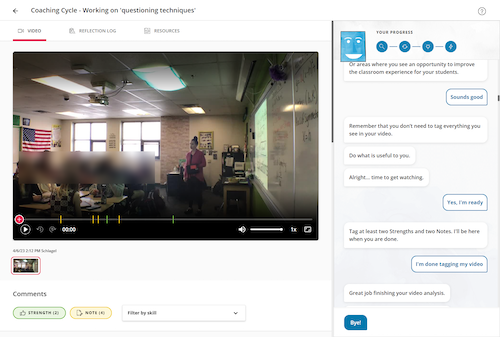
With the platform, teachers like Schlagel engage in personalized coaching cycles to further their development. The platform uses artificial intelligence to guide teachers through a self-coaching cycle aligned to common growth areas as they watch video of their classroom teaching in action.

We recently interviewed Schlagel about the use of this new technology and how her district prioritizes teacher development. 

What were your first thoughts when you heard about using AI for professional learning? Why did you decide to try it?

Last year, I was a mentor to a first-year teacher at my school, and my mentee had to record a lesson of her teaching as part of the induction program. I decided to also record myself conducting a similar lesson, so we could go over the lessons together, discuss what works and what doesn’t, and set goals for improvement.  

This was my first real introduction to video coaching. Admittedly, even as a mentor teacher, I was nervous to record myself. However, I quickly learned it wasn’t that bad seeing myself on screen and that this was a powerful way to reflect on my practice. My mentee and I both learned a lot.

So, when my district offered a new professional development course that would allow us to try out AI coaching, I signed up. I wasn’t sure exactly what I was getting into, but I was already benefiting from video coaching and wanted to see what the new AI aspect was all about. At the very least, I knew this opportunity would provide me more time for self-reflection.

How does the AI coaching process work?

During my first time using the AI Coach platform, I uploaded a video of one of my recent algebra lessons. Then, the platform’s computerized coach provided observation tips and asked me a number of questions to consider as I began to analyze my video. This helped me as I made a number of comments on the platform—both about areas I wanted to improve upon and areas I felt I was excelling in—as I watched my teaching play out.

The guidance from the virtual coach helped me think more critically about my practice (…and it also made me laugh – the coach can definitely be funny and sassy at times!).

This helped me set a goal for myself around increasing student discourse. I wanted to encourage my students to talk more in class, and the platform provided me with a number of instructional resources to help me get better at this skill.

At the end of the coaching cycle, after I incorporated these strategies in the classroom, I came back to the platform and reflected on what I learned. I thought about how these new strategies worked and created an action plan for my continued learning in the future.

How has AI-powered coaching impacted your teaching?

What surprised me most about the AI coaching process was that it opened my eyes to different things I could change (and might have missed) about my teaching. I was able to really reflect on how I was teaching and how my students were responding. 

Sometimes it can be daunting—or even feel less genuine—when a coach or administrator comes in to conduct a formal observation. You may be worried about how your students are acting or unknowingly teach differently than normal.

But, with the AI Coach process, I feel less pressure because it really is just myself reflecting on my teaching alongside a computerized coach. This gives me more freedom to try out a new instructional strategy or take a risk with how I deliver a lesson, without having the feeling of being evaluated.

Continuous reflection is so important, and I’m a firm believer that the best teachers have to be reflective—if you aren’t reflecting on your practice, you aren’t growing!

How do you and your colleagues plan to use AI Coach by Edthena moving forward?

In addition to supplementing in-person coaching, I think AI coaching will continue to be a great support for mentor and mentee teachers alike.

In chats with my administrative team, I’ve also suggested using the AI Coach platform for our school’s yearly peer observations or self-reflection observations. Traditionally for the self-reflection observation, teachers write a paper detailing their teaching and how it can improve, but I think this type of video-based reflection can be more impactful and feel more genuine. And, it will allow teachers to receive the benefits of ongoing coaching which is really about reflecting inward and trying to constantly improve.

My school and district always do a great job of supporting teachers’ growth and encouraging us to take on new and innovative professional learning opportunities. The use of AI Coach is just another example of this! 

Nothing but winning: Edtech honors announced by eSchool, IEI, and Classlink

6 October 2023 at 22:54

When did October become awards season in the world of edtech? This week’s newsfeeds are stuffed with announcements for finalists and honorees for both educators and vendors on the best and brightest developments for teaching and learning.

The winners:

Of course, we need to start with the most prestigious! The eSchool News Hero Awards, honors educators for their exemplary use of innovative edtech to support student learning:

  • John Arthur, 6th grade teacher at Meadowlark Elementary School in Salt Lake City, Utah
  • Dr. Jesus Jara, superintendent of Clark County School District (CCSD) in Nevada
  • Tom Lamont, painting and design technology instructor at Blackstone Valley Regional Vocational Technical High School (BVT) in Massachusetts 

Winners were chosen for their commitment to education despite obstacles–including achievement gaps, teacher burnout, and funding–and their creativity and innovation in helping all students continue learning while ensuring students felt safe, empowered, and engaged.

Nominations were judged by a panel of education experts, including Laura Ascione, eSchool News editorial director, and Eileen Belastock, CETL, Belastock Consulting. I look forward to interviewing them in the coming days for the podcast. Here’s one of my favorites from years past.


The Institute for Education Innovation, a national school superintendent think tank that serves as the bridge between district leaders and the K-12 industry to develop solutions to the greatest challenges in education, also this week announced the finalists for the third annual Supes’ Choice Awards. The Supes’ Choice Awards honor the most innovative education products and solutions, and are the only education industry awards judged exclusively by school district superintendents.

“Now in its third year, the Supes’ Choice Awards have become known in the education industry as one of the top honors recognizing forward-thinking edtech companies,” said Doug Roberts, founder and CEO of the Institute for Education Innovation (IEI). “Judged by the country’s most innovative superintendents, the awards provide edtech company founders and CEOs with valuable insights to help them create more meaningful and impactful learning experiences for students. In fact, students and teachers alike benefit the most when edtech companies partner with administrators on the front lines of K-12 education to perfect their products and solutions.”

Finalists for the Supes’ Choice Awards are chosen based on a demonstrated commitment to student outcomes, innovation and ingenuity, client support, interactivity, and engagement. The finalists for each category include:

  • AI-Powered Education Solution: Scrible, Navigate360
  • Best Gamification in Learning: Giant Steps, ExploreLearning – Reflex
  • Excellence in Special Education: Stages Learning – Language Builder: Academic Readiness Intervention System (ARIS), TouchMath
  • Tutoring Platform: FEV Tutor, Tutor.com and The Princeton Review
  • College and Career Readiness Solution: Find Your Grind, Credentialate by Edalex
  • Communications and Family Engagement: AllHere, TalkingPoints
  • Equity Champion: Clayful Health, Raz-Plus Espanol by Learning A-Z
  • K-12 Newcomer: Kognity for High School Science, FrenalyticsEDU
  • Keeping Kids Safe: Navigate360 – ALICE, Navigate360 – P3 Campus
  • Learning Management System: Jupiter, D2L – Brightspace
  • Literacy Instructional Solution: NoRedInk, Phonics, Reading, and Me, Read Naturally
  • Math Instructional Solution: TouchMath, Magma Math
  • Most Innovative PD Solution: Lexia LETRS, Lexia Aspire Professional Learning and thinkLaw
  • Operations/Finance/HR Solution: Operoo, Upbeat and iiQ Facilities
  • SEL Solution of the Year: Sown to Grow, Care Solace
  • STEM/STEAM Instructional Solution: Kide Science, ExploreLearning Gizmos
  • Virtual Instructional Experience: Proximity Learning, Tutored by Teachers

Winners will be revealed at the 2023 Supes’ Choice Awards Gala taking place on Friday, December 8 in New York City. The Gala is a celebration honoring the finalists and winners that includes dinner, an awards ceremony, and live entertainment.


ClassLink celebrated the exceptional achievements of individuals and teams during the closing session of their annual ClassLink Learning Analytics Summit, CLAS 2023, on October 5th.

THE CLAS Awards of Excellence celebrate the innovative ways individuals and teams use data to better serve their district’s learners, recognizing the educational impacts of institutions, leaders, and experts.

Data Storyteller Award

  • Winner: Connie Chin (Bibb County School District, GA)
  • This award recognizes an individual who expertly uses data analysis to inform strategy and drive teaching and learning in their organization.

Data Bridge Builders Award

  • Winner: Tonja Brun & Team (Savannah Chatham Public Schools, GA)
  • This award recognizes an organization that excels at collaborating and building toward a data-driven culture to improve teaching and learning.

Data Security Champions Award

  • Winner: Keith Price & Team (Vestavia Hills Schools, AL)
  • This award recognizes an organization using analytics/security insights to inform their data security strategy implementation.

“We established the CLAS Awards of Excellence as a tribute to the remarkable individuals and teams leading the charge in advancing digital learning through innovative data utilization. All of us at ClassLink are deeply honored to witness the inventive applications of our Analytics tools by the showcased winners. Their efforts inspire us all!”

Berj Akian
Founder & CEO, ClassLink

❌
❌