Normal view

There are new articles available, click to refresh the page.
Before yesterdayMain stream

The pandemic is over–but American schools still aren’t the same

21 November 2023 at 11:00
Many students and educators say school feels closer to normal than it has in over three years, but profound pandemic-era consequences persist.

This story was originally published by Chalkbeat. Sign up for their newsletters at ckbe.at/newsletters.

On a recent Friday at Gary Comer Middle School in Chicago, you had to squint to see signs of the pandemic that upended American education just a few years ago.

Only a handful of students wore face masks, and even then, some put them on to cover up pimples, staff said. The hand sanitizer stations outside every classroom mostly went unused, and some were empty. Students stopped to hug in the hallway and ate lunch side by side in the cafeteria. 

“I don’t think it’s a big deal as much as it was before,” said 12-year-old Evelyn Harris, an eighth grader at Comer, whose lasting memory of pandemic schooling is that online classes were easier, so she got better grades. “The pandemic didn’t really affect me in a big way.”

But inside Nikhil Bhatia’s classroom, the evidence was on the whiteboard, where the math teacher was shading in slices of a pie to illustrate how to find a common denominator. That day, his seventh graders were working to add and subtract fractions — a skill students usually learn in fourth grade.

Maybe you learned this before, Bhatia began. “Or, during the pandemic, you might have been on Zoom,” — a few students laughed as he dragged out the words — “put your screen on black, went to go play a couple video games. Snap if that sounds familiar?”

Clicking fingers filled the room. “That’s OK!” Bhatia responded. “That’s why we’re going to do the review.”

As the new school year begins at Comer and elsewhere, many students and educators say school is feeling more normal than it has in over three years. COVID health precautions have all but vanished. There’s less social awkwardness. Students say they’re over the novelty of seeing their classmates in person.

But beneath the surface, profound pandemic-era consequences persist. More students are missing school, and educators are scrambling to keep kids engaged in class. Many students remain behind academically, leaving teachers like Bhatia to fill in gaps even while trying to move students forward. Rebuilding students’ shaken confidence in their abilities is especially important right now.

“It’s OK that you don’t know this,” Bhatia tells his students. “It’s normal right now.”

Nationally, many students remain far behind in math and reading where they would have been if not for the pandemic. There have been especially steep learning drops at schools that taught virtually for most of the 2020-21 school year, as schools did across Chicago and within the Noble charter network, which includes Comer. It’s an issue that’s even more pressing for older students, who have less time to fill in those holes.

At Comer, 28% of eighth graders met or exceeded Illinois math standards the year before the pandemic, not far off from the state’s average of 33%. But by spring 2022, that had fallen to just 2%, compared with 23% for the state. 

In reading, meanwhile, 9% of Comer eighth graders met or exceeded state standards pre-pandemic, and that dipped to 4% in spring 2022, when the state’s average was 30%. 

The school made gains they’re proud of last school year, with 10% of eighth graders hitting the state’s bar for math and 22% hitting it for reading, though school leaders say they know there is still work to be done.

“If you don’t have some foundational skills and basic skills, it will be almost impossible to keep up with the curriculum as the kids get older,” said Mary Avalos, a research professor of teaching and learning at the University of Miami, who has studied how COVID affected middle school teachers. “That’s a big issue that needs to be addressed.”

How teachers are addressing pandemic learning gaps

Most of Bhatia’s students missed key skills in fourth and fifth grades — the years that school was remote, then interrupted by waves of COVID — but they mastered more advanced concepts in sixth grade last year.

That’s left Bhatia, like many teachers across the country, with the tricky task of coming up with mini lessons to fill in those elementary gaps, without spending so much time on prior concepts that students fall behind in middle school.

On a day like Friday, that meant to get students ready to add negative fractions, a seventh grade skill, Bhatia first had to teach a short lesson on adding fractions, a fourth grade skill. At first, some students mistakenly thought they should use the technique for dividing fractions they learned last year.

“They’ll say: ‘Oh is this keep, change, flip’?” Bhatia said. “The gap isn’t exactly what you would expect it to be.” 

This kind of teaching happened “once in a while” pre-pandemic, Bhatia said, but “now it’s like day by day I have to be really critical in thinking about: ‘OK what might be the gap that surfaces today?’”

Aubria Myers, who teaches sixth grade English at Comer, sees ways the familiar rhythms of school are just now returning, four months after federal health officials declared an official end to the COVID-19 emergency.

“This year, for me, feels the most normal,” Myers said. Students are saying: “Oh wait, what’s the homework again, can I get another copy?” she said. Last year when she mentioned homework, “they were like: ‘What is that?’”

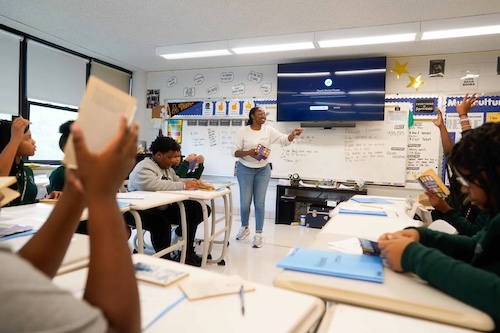
On that recent Friday, Myers led an activity in her multicultural literature class that would have been impossible two years ago when students had to stay seated in pods of color-coded desks. 

Her sixth graders huddled close to one another as they tried to hop across the classroom, an exercise designed to give her fidgety students a chance to move around, while exemplifying the communication and teamwork skills that would be at the center of Seedfolks, the novel they were about to read in class.

Still, Myers had chosen the book, with its short chapters and lines full of metaphors and irony, to meet the needs of this crop of sixth graders, who spent all of third grade learning online. Many, Myers knows, never logged on. They have shorter attention spans and doubts about their reading skills but love class discussions, she said.

“They remember that time in their life when they were stuck talking to only people in their house,” Myers said. “They’re in class wanting to engage with each other.”

Myers has tried to prevent her students from getting discouraged by their learning gaps. At the start of this school year, for example, she’s pointing out spelling and punctuation errors, but not docking points yet. She wants to make sure her students first have time to learn some of the key skills they missed in earlier grades.

“We have kids who don’t understand how to put a period somewhere in your sentence, or how to put spaces between their words,” Myers said. “I see these very beautifully strung together ideas, these really well thought-out explanations, but they’re missing some of those key mechanics.”

Student mental health and engagement still top of mind

Comer has responded to students’ post-pandemic needs in other ways, too. The school expanded its team of social workers and other staff who work with students to resolve conflicts and address mental health needs, a trend that’s been observed nationwide.

The school has long felt the effects of neighborhood gun violence and student trauma, but staff say having more adults focused on those issues has helped students open up and seek help. Now, more students are requesting verbal mediations to head off physical fights, staff say.

“If you follow us through the building, you’ll see,” said Stephanie Williams, a former reading teacher who now directs Comer’s social and emotional learning team. “Kids will seek you out, or find you, and let you know: ‘Hey, I need this.’”

And this is the second year the school has scheduled all core classes earlier in the week, so that students can spend part of Friday practicing math and reading skills on the computer, and the rest of the day taking two special electives. It’s a strategy meant to keep students engaged — and showing up to school.

The school offers classes that pique students’ interests, such as the history of hip hop, hair braiding, and creative writing. Brandon Hall, a seventh grader at Comer, blended his first smoothie in a “foodies” class and bonded with his basketball coach through chess. He came to see similarities between making plays on the court and moving pawns across the board.

“I learned a lot from him,” he said.

On “Freedom Fridays,” attendance is higher and student conflicts are rarer, school officials say. That’s been important as the school, like many others, has seen higher chronic absenteeism rates over the last two years. At Comer, 1 in 3 sixth graders missed 18 or more days of school last year. Before the pandemic, that number sat closer to 1 in 5.

The approach runs counter to the calls some education experts have made for schools to double down on academics and add more instructional time — not take it away. 

A recent report by the Center on Reinventing Public Education, for example, spells out the numerous ways students are still struggling, and calls for “a greater urgency to address learning gaps before students graduate.” Harvard education researcher Thomas Kane noted that few districts have lengthened the school day or year and warned that, “The academic recovery effort following the pandemic has been undersized from the beginning.”

But JuDonne Hemingway, the principal of Comer, said devoting time to enrichment activities during the school day is worth it to ensure all students have access to them. These classes, she added, are helping students develop interests they may pursue in college or as part of a career.

“They’re not just random experiences for kids,” Hemingway said. “We think they are just as important as any traditional academic class.”

Chalkbeat is a nonprofit news organization covering public education.

For more news on COVID in schools, visit eSN’s Educational Leadership page.
Empowering staff and students with a sense of belonging

The relationships we cultivate are the most powerful tool we have to create a sense of belonging with students and staff members.

Key points:

  • When students feel supported, they’re more likely to share their struggles
  • Mental health partnerships can better support students and staff
  • See related article: How to build relationships with students
  • Get the latest news on student and staff well-being by visiting eSN’s SEL & Well-Being page

Belonging is a fundamental human need. We are all searching for a sense of connection with the people and places in our lives. Students and school staff are no different, so it’s crucial to ensure learning environments foster a sense of belonging.

When students have a strong sense of belonging, they are more likely to be engaged in school and to perform well academically. Unfortunately, new data shows that only 62 percent of high school students feel connected to others at school, and nearly one-third of students experience poor mental health.

In addition, the latest federal data found that 33 percent of school leaders noticed an uptick in violence amongst students and students experiencing anxiety and attention-deficit hyperactivity disorder over the last year–many attribute the increase to the pandemic and its lingering effects. There’s simply no time to waste; we must make our schools welcoming, safe spaces for students and staff alike.

Build trusting relationships with students to create a culture of belonging

Trust is the cornerstone of belonging. Students need us to be accessible, dependable, and trustworthy. When students trust us, they’ll be more willing to be honest about their struggles and help us stay in tune with what’s happening in the halls that we don’t see.

Celebrate student backgrounds and cultures

Celebrating cultures is more than just hosting an event; it’s about consistently honoring the ethnicity, background, and experiences of the students we serve. By recognizing the diverse backgrounds and cultural traditions of the school’s communities, we create avenues for students to share and celebrate their experiences openly.

Encouraging open dialogue and allowing students to lead discussions about their cultures fosters a climate of true inclusivity.  Celebrating and embracing students’ lived experiences greatly increases students’–and their family’s–feelings of belonging.

Engage the community as a partner

Schools that focus on belonging recognize the power of community engagement. For example, when a community member talks openly about a challenging topic, such as their family’s experience with substance abuse, it can create a sense of belonging and validation for students coping with a similar situation.  School advisory councils that involve students, families, and staff as decision-makers influence school operations and bridge the gap between students and their communities.

Empower school counselors through collaborative partnerships

Relationships take time to foster. Students need to be seen, and staff need the time to truly see them. When staff are overburdened, as many are nationwide, it hinders their ability to build meaningful relationships with students. And when a student needs care outside of the scope of school resources, staff are often tasked with finding the care they need. On average, it takes up to 60 phone calls to connect a student, family member, or staff member to the proper mental health resources.

That’s where partners providing mental health care coordination services come into play. Collaborations like this can alleviate the burden on school staff and save them countless hours of tedious work. What’s more, a third-party partner can also provide mental health support to school staff. School staff are the backbone of a school community, and their mental health and well-being are essential to a thriving school culture.

After a prolonged period of disconnection, building strong relationships is more important than ever. Dr. Bruce Perry, in his book The Boy Who Was Raised As a Dog: And Other Stories from a Child Psychiatrist’s Notebook says, “Relationships are the agents of change and the most powerful therapy is human love. People, not programs, change people.” As you reflect on the practices in your school community, remember that the trusting relationships we cultivate with students and staff members are the most powerful tool we have to create the sense of belonging.

About Sarah Mathew

The advent of AI

12 October 2023 at 23:12

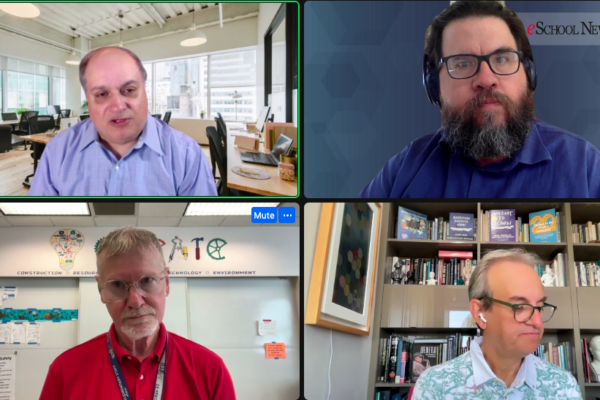
What’s better than watching a lively and substantive conversation thread develop on LinkedIn as a result of your recent posting on the hottest topic in edtech today? Getting the participants to follow up with a real live conversation of their own. So it was that I was able to snag a Zoom session with Jerry Crisci, founding co-director of the Center for Innovation for the Scarsdale Public Schools in Scarsdale, NY; Mark Loundy, instructional technology specialist for the Cupertino Union School District, CA; and Gary Stager, a pioneer in 1:1 computing, online learning, and computer science for all students, to weigh in on their perspectives. 

In an inspired and somewhat provocative go around, we touch on topics including AI’s influence on the education sector, concerns about cheating, the need for educational reform, and the potential for AI to enhance learning. Give it a listen and maybe chime in yourself! To read more about Gary Stger’s work regarding AI click here; for Jerry Crisci, click here; and for Mark Loundy, click here.

.Three Key Takeaways:

  • AI in Education and Ethical Concerns: The panelists highlight the emergence of generative AI and its potential to transform education. However, ethical concerns are raised, particularly regarding the use of AI to detect cheating and plagiarism. The speakers argue that the focus should shift from using technology for enforcement to enhancing the quality of education itself.
  • Rethinking Education: All three advocate for a fundamental reevaluation of education, emphasizing the need to revise teaching methods and assessments. They stress the importance of preparing students for a future where AI can assist with procedural tasks, such as writing and calculations. This shift involves teaching students how to be effective learners and thinkers, rather than memorizing content.
  • AI as a Tool for Learning: AI is recognized as a powerful tool for expanding students’ horizons, allowing them to explore topics in depth. The conversation also suggests that AI can help students build systems and understand how AI operates, promoting critical thinking and problem-solving skills. Their emphasis is on enabling students to use AI as a resource to better understand the world.

How to keep hackers off your school attendance list with object storage

Object storage is a great partner for education as it enables versioning and object lock, rendering itself ransomware-proof.

Key points:

As the 2023-2024 school year commences, focus on education is accompanied by a pressing concern for better cybersecurity. Cybercriminals are poised to exploit educational institutions, seeking access to personal, financial, and health records. Recent incidents, such as New Haven School System’s $6 million breach and Prince George County schools attack, highlight potential risks facing schools today. There is a critical need for robust cybersecurity measures for protection against attacks, inclusive of a comprehensive plan to keep hackers at bay.

What’s sending hackers to schools for the ultimate ransomware field day? Educational institutions hold a wealth of valuable information but lack IT budgets and updated cybersecurity tools, making them prime targets. In a perfect world, ransomware could always be stopped at the “front door” before it enters a school’s network premises, but this is hardly the case. Detection and prevention measures such as monitoring network traffic, establishing strict permission guidelines, and implementing multi-factor authentication (MFA) to confirm identities are continuously evolving, but attackers are becoming increasingly sophisticated, often finding ways to bypass these defense measures.

Understanding why schools are prime targets is the first step to building a healthy cybersecurity ecosystem. The next step is looking at what tools are in place and considering how to optimize their performance and functionality–not only for security, but recoverability and restoration. Emphasizing backup as a key component of security strategy may be the low-effort, cost-effective solution schools need to achieve cyber-resiliency.

Stay aware: Students aren’t the only ones preparing to go back to school

We’ve witnessed an alarming surge in ransomware attacks on educational institutions. At least 120 schools have suffered a ransomware attack compared to 188 in all of 2022. Despite their crucial role in shaping the future, schools often grapple with small IT budgets, limited staff, and outdated technology, making them lucrative targets for threat actors.

With these obstacles in mind, schools are more likely to endure consequences of an attack stemming from human error from students and overly complex tech that IT staff are too strapped to manage properly. This often opens them up to the possibility of data theft, followed by extremely long recovery times. For instance, in April, Alabama-based Jefferson County Schools suffered prolonged disruptions from an attack that occurred during the end of spring break in March, and an incident at Colorado public schools in June led to data exposure of student mental health records.

Stay prepared to stay protected

A crucial part of staying ahead of ransomware is staying informed. Currently, there are types of ransomware that are intelligent enough to commit an acoustic attack by listening to your keystrokes and predicting what someone is typing with 95 percent accuracy. Hackers can listen in to text chats or leak sensitive information, which is tough to manage in a school setting given the multitude of devices and connectivity options.

Though backup typically falls second to other defense measures, its impact can be outstanding. Consider The New Haven School system, which tried to alleviate getting data back up and running by paying ransom to the attackers. The biggest concern here is there is no guarantee that stolen data will be returned post-payment.

Veeam’s 2023 Ransomware Trends Report found that while 59 percent of organizations paid the ransom and were able to recover data, 21 percent that paid the ransom still didn’t get their data back. Additionally, only 16 percent of organizations avoided paying ransom because they were able to recover from backups. The truth is, no security plan is foolproof, and schools should consider quality versus quantity when it comes to which tools to bring to the battle against cyber threats. While implementing standard security measures is highly encouraged, the reality is that nothing will keep schools completely void of ransomware attacks.

This is where data backup comes to the forefront of cybersecurity strategies. This includes conducting regular backups of school data and following the 3-2-1-1-0 strategy, comprised of three copies of data saved on two types of media, with one copy offsite and one copy offline. Should a disruption occur, this makes the difference in guaranteed availability. Incorporating strong security measures like these into backup and management practices boosts the overall resilience of a school’s data infrastructure.

Stay ahead with immutable backup storage

It’s worth noting, targeting primary data and backups is well within the realm of possibility as ransomware rises. Although criminal hackers actively target backups, these remain the best defense against ransomware. Schools must ensure they take regular backups that are immutable, stored off-site, or, ideally, both. Immutable backup storage is a type of data storage system designed to prevent unauthorized or accidental modifications, deletions, or alterations to backed-up data for a specified period. Therefore, once data is written or stored, it cannot be changed or deleted until the predefined retention period expires.

Object storage is a great partner for education as it enables versioning and object lock, rendering itself ransomware-proof. Schools should incorporate backups with hardened security and an appropriate level of redundancy for constrained IT. What’s more, it’s a simple, powerful, and secure tool that schools can use to guarantee recovery. It is generally affordable compared to file or block storage solutions, further accommodating a limited budget for school IT.

Back to school with better protection

To prepare for potential attacks, schools must establish clear roles and responsibilities for key stakeholders. With the value of data continually on the rise, it’s not a question of if a school will face an attack, but when. Cybersecurity awareness among students and staff is paramount in keeping our leaders of tomorrow and their data safe. Furthermore, aligning with the U.S. Department of Education’s Cybersecurity Resilience Efforts can provide additional resources and support.

Data should be stored in a separate system to ensure availability in case of disruption. Combat attacks on primary storage with built-in immunity as an extra layer of protection against tampering. Keep school in session with a low-effort and cost-efficient solution like on-premises object-based backup storage–a tool built for low maintenance and constrained IT.

5 spooky Halloween videos for students of all ages

9 October 2023 at 12:00
Use these fun Halloween-themed TED-Ed Lessons and videos to engage students in classroom learning and capture their attention.

Key points:

  • TED-Ed Lessons are a great way to inject some fun into learning a new topic
  • During October, take advantage of creepy decorations and Halloween and use these videos to teach students some new facts
  • See related article: 9 TED-Ed Lessons about different holiday origins

It’s October, and for many students, that means pumpkins, scary decorations, and trick-or-treating on Halloween. What better way to celebrate October than to incorporate some fun and spooky videos to engage students, while also teaching them some fun facts?

Teachers with students of all ages can use TED-Ed Lessons to leverage October’s fun events (Friday the 13th in October, anyone?) and speak to students’ different interests.

The TED-Ed platform lets educators build lessons around any TED-Ed Original, TED Talk, or YouTube video. Once teachers find the video they want to use, they can use the TED-Ed Lessons editor to add questions, discussion prompts, and additional resources.

Use these TED-Ed Lessons and videos for brain breaks, to introduce new lessons, or to give students some fun and age-appropriate spooky experiences into your classroom:

1. Where do superstitions come from? Are you afraid of black cats? Would you open an umbrella indoors? How do you feel about the number 13? Whether or not you believe in them, you’re probably familiar with a few of these superstitions. But where did they come from? Stuart Vyse shares the weird and specific origins of some of our favorite superstitions.

2. Why is being scared so fun? At this very moment, people are lining up somewhere to scare themselves, be it with a thrill-ride or a horror movie. In fact, in October of 2015 alone, about 28 million people visited a haunted house in the US. But you might wonder: What could possibly be fun about being scared? Margee Kerr examines the biology and psychology behind what makes fear so fun.

3. The fascinating history of cemeteries: Spindly trees, rusted gates, crumbling stone, a solitary mourner: these things come to mind when we think of cemeteries. But not long ago, many burial grounds were lively places, with gardens and crowds of people — and for much of human history, we didn’t bury our dead at all. How did cemeteries become what they are today? Keith Eggener delves into our ever-evolving rituals for honoring the dead.

4. What can you learn from ancient skeletons? Ancient skeletons can tell us a great deal about the past, including the age, gender and even the social status of its former owner. But how can we know all of these details simply by examining some old, soil-caked bones? Farnaz Khatibi examines a fascinating branch of science known as biological anthropology.

5. A video that terrifies while it teaches? There’s a TED-Ed Lesson for that: Pick your poison: Blood hungry vampires. Zombies on a mission for your tasty brain. Creepy crawlies. No matter your (fictional or real) fright of choice, TED-Ed has a lesson for all of your Halloween needs. So pick out your favorite candy (more on that later), choose a few videos, and have a very happy Halloween.

❌
❌