Normal view

There are new articles available, click to refresh the page.
Before yesterdayMain stream

5 ways I’ve leveraged AI in my English classroom

ChatGPT stormed into our lives and our classrooms, and it’s a mess. But my students and I are jumping in with AI in our English classroom.

Key points:

  • Students will be immersed in an AI world—they need to learn about it
  • One English teacher brainstormed creative ways to get students talking about, and working with, AI
  • See related article: 5 positive ways students can use AI
  • For more news on AI in education, visit eSN’s Digital Learning page

Last spring, a few weeks after I started using ChatGPT, I challenged my high school English students: “Artificial intelligence can do any of your class assignments,” I told them flatly. “Now prove me wrong.”

I wanted to provoke them, to get them to ask questions, and to start using these tools—not to cheat—but to flip their learning on its head. I knew we needed to learn this together. And since that day, we didn’t just shift the paradigms—we sent them into somersaults.

1. Putting ChatGPT on trial

I first became aware of ChatGPT last February when I began reading mind-blowing comments of several progressive educators. As a teacher who strives to help students uncover their interests and stretch their imaginations, I wanted to ensure they were participating in this new technology. We were about to begin our unit on The Crucible and I began wondering how we could leverage ChatGPT.

Typically, at the end of the unit, I ask my students to put various characters on trial, backing up their ideas with plenty of original evidence. This time around, I wanted them to also put ChatGPT on trial. What are its strengths and opportunities, its weaknesses and threats?

So I created a project-based scenario: The students were attorneys for a law firm, and I was their client, bringing them this challenge: I was thinking about investing in ChatGPT. Based on their understanding and the research they’d conduct during The Crucible unit, should I? What would be the implications? The upsides and the down?

So the students began, first reading The Crucible, relying only on their human intelligence. Then, after a week, they opened up their understanding of the classic play through ChatGPT. And it was astonishing: ChatGPT helped students discover subtle nuances and character traits they’d missed initially, created authentic-sounding trial documents that outlined their arguments, provided historical information about the Salem witch trials, and prompted students to explore the play’s themes and messages. It also generated hypothetical conversations between characters, providing fresh insights into how characters evolved throughout the play.

At the unit’s completion, the students had glimpsed AI’s potential—and its potential problems. Many students were concerned about cheating, about bias, about invented “facts,” and about privacy. But, ultimately, the majority of students advised that I, as their client, should invest in AI, finding that it increased efficiencies, helped with workload, sped up research, improved grammar, relieved deadline stress, and more.

2. Using ChatGPT as a creative partner

When they returned from spring break, students found that I’d taken their advice to heart: I’d invested $20 on a premium version of ChatGPT and had created an AI workspace in our classroom. Now I invited them to use ChatGPT during our final inquiry unit, during which they’d ask questions, come up with a plan, leverage their research, and then go public with their findings. Soon they found they could use ChatGPT as a creative, brainstorming, spit-balling partner—with great results: generating open-ended questions, discovering and exploring their interests, creating a day-by-day calendar to reach goals, ideating original art pieces, and augmenting lyrics for songs and scripts. To say they were wowed by ChatGPT’s ability to take their own thinking and creativity further would be an understatement.

3. Considering what’s next

During that inquiry unit, I wanted to better understand—and for my students to better understand—what might be ahead of us in terms of AI. So I invited our school librarians to visit our class, presenting glimmers of what’s ahead: the good, from conducting medical research to solving complex global problems; the bad, from impersonating someone’s speech to waging war with AI; and the surprising, from saving bees to predicting earthquakes.

Impressively, the librarians also fielded questions, addressing ethical considerations of AI, detailing the importance of vocabulary when it comes to writing powerful prompts, and reminding students that they need to be thinkers themselves and not just settle for what ChatGPT generates.  

4. Going from zero to hero

Just days before our fall semester started, I learned that I’d been assigned mythology—a subject I’d not taught before and one without a syllabus. But, like my students during their inquiry unit, I knew I could turn to ChatGPT as my creative partner. To begin, I wrote a thorough prompt, telling it: “You’re a high school English teacher who wants to teach an inquiry-based mythology class with self-directed learning. You have questions and you’re looking for answers. (That’s so the hero’s journey à la Joseph Campbell.) Now create a syllabus, complete with readings.” Less than a minute later, there it was, in all its mind-boggling near perfection. Next, I asked ChatGPT to create a hero’s journey chart with student checkpoints along the way. Once again, in 20 seconds, there it was. In class, I’ve stuck with these materials mostly and, so far, so good.

5. Clubbing—AI style

Most recently, I’ve teamed up with a school librarian to create an extracurricular AI club. We’re not totally clear on our mission or our goals—we’re in the early days. But we do want students to understand what’s happening with AI and to be, if not prepared, at least thinking about AI and how it may impact not only their careers but their lives.

As for that first challenge I presented—the one about AI being able to do any schoolwork—unfortunately, it proved true: AI can do pretty much any class assignment. And that made us all squirm. In fact, that feels scary. But that’s all the more reason to delve into AI. As Bill Gates said last spring, “You definitely want the good guys to have strong AI.” You don’t want only the “bad guys” to be using it, manipulating it to deceive or to swindle or to gain power or to wage war. That’s why we must keep talking about AI with our students. We can’t run away.

Soon AI will be a common tool in myriad fields. That’s why we as educators need to help our students use it, become familiar with it, and think for themselves about its implications. Yes, it’s threatening. It’s also exciting. And it’s going to be their world.

Let’s regain ground on the toxic web ! – Framasoft’s 2023 report

By: Framasoft
14 November 2023 at 09:15

A year ago, we launched our 2022-2025 roadmap, « Collectivising the Internet, Convivialising the Internet ». The aim : to encourage the adoption of user-friendly web tools by groups that share the values of Free/Libre culture.

🦆 VS 😈 : Let’s take back some ground from the tech giants !

Thanks to your donations to our not-for-profit, Framasoft is taking action to advance the ethical, user-friendly web. Find a summary of our progress in 2023 on our Support Framasoft page.

➡️ Read the series of articles from this campaign (Nov. – Dec. 2023)

One year on, we are proud and delighted to present this first full update on our activities, funded (as always) by your donations.


drawing of Coin-coin, the duck mascot of the Framasoft campaign. He is in a karateka position

Click on Coin-Coin to support Framasoft – Illustration CC-By David Revoy


Changing the world, one web corner at a time

Drawing of Datavöre, a dripping monster made up of 5 heads, each bearing a GAFAM logo.

Click to support us and push Datavöre away – Illustration CC-By David Revoy

The actions of Collectivise / Convivialise Internet (« Collectivisons Internet / Convivialisons Internet » aka « Coin-coin » (qwack qwack, in French), hence the mascot) complement and add to the maintenance of our historical actions : online services and software tools, sharing experience, various contributions and collaborations.

As we wrote last year on this blog, the goal remains the same : to ensure that there are more and more bubbles of ethical web, in order to regain ground on the toxic digital world occupied by the tech giants.

This blogpost is a very quick summary of our end-of-year campaign. It aims to give you a general idea of what your donations are going towards. If you’re interested, we’ll be posting details of the key actions in this report on this blog every Tuesday (if everything goes well©) until the end of the year.


Support Framasoft


Framaspace, solidarity collectives get to grips with this convivial cloud

We said it back in 2022 : Framaspace is our most ambitious project in this new roadmap. By the end of 2025, we aim to provide up to 10,000 collaborative cloud spaces based on Nextcloud software for small groups of people to work together.

We’ll be covering Framaspace news in detail during the week of Nov. 21st :

Illustration of DemonDrive, a ghostly monster adorned with the Google Workspace logo

Push back Demondrive by supporting Framasoft – Illustration CC-By David Revoy

  • The first year of Framaspace
    • A high demand, already almost 700 Framaspaces open ;
    • …and even more if you ask here for one for your (French-speaking only) collective ;
    • Lessons learned from this beta release ;
    • the first needs expressed by the beneficiaries ;
    • technical improvements, updates, maintenance, etc.
  • In the pipeline for next year(s)
    • Preparation of tools to make it easier for newcomers to use the system ;
    • Ideas for « tutorials where you are the hero » (or « schemes where you are the heroine » ?) ;
    • future explorations : the possibility of publishing websites, or even managing members and accounts ?


Support Framasoft


PeerTube : a v6 based on your ideas

We’ve been developing this software for six years, and once it’s installed on a server, it can be used to create an ethical alternative to YouTube, Twitch, Vimeo and so on.

The technical possibilities offered by PeerTube all serve the same purpose : to allow you to host and distribute your videos and live streams, even (and especially) if you don’t have the money of Google or the server farms of Amazon.


The features that we will describe in detail during the week of Nov. 28th have been selected from your ideas :

Illustration of Videoraptor, an insectoid monster whose three heads bear the logos of YouTube, Vimeo and Twitch.

Click to support us and push Videoraptor away – Illustration CC-By David Revoy

  • Version 5.1 (March 2023)
    • Moderation of account requests ;
    • Back to live.
  • Version 5.2 (June 2023)
    • Major work on transcoding that can be offloaded to a remote server ;
    • Replay visibility ;
    • RSS feed adapted for podcasts.
  • Version 6 (end of November 2023)
    • Improved accessibility ;
    • Image preview in progress bar ;
    • Videos chapters ;
    • Uploading a new version of a video ;
    • Password protection for videos ;
    • Live load & stress tests (report to be published later).


Support Framasoft


Mobilizon, the final countdown of the battle…

…for Framasoft !

After 4 years of development, we feel we’ve completed our vision for Mobilizon. Once this v4 is released, we hope that your groups will have the features they need to organise themselves around their events, and emancipate themselves from Facebook or Meetup.

That’s why during the week of Dec. 5th, we’ll be talking in detail about :

Illustration of Face Ghoûl, a dripping, clawed monster adorned with the Facebook logo

Click to support us and push Face Ghoûl away – Illustration CC-By David Revoy

  • Version 3.1 (March 2023)
    • Ability to enter an unlisted address ;
    • Anti-spam tools.
  • Version 4 (December 2023)
    • Import events from other platforms (MeetUp, Facebook, etc.) ;
    • Message from organisers to participants.
  • The future
    • We will provide security updates ;
    • We will maintain the French-speaking instance Mobilizon.fr ;
    • Other groups already have plans to develop Mobilizon with new ambitions…
    • …and there is always room for your own vision !


Support Framasoft


PeerTube (yes, again ! but…) in 2024 : we’re betting big on its success

The toxicity of YouTube, Twitch and the like is becoming increasingly visible… More and more groups, institutions and content creators discover and use PeerTube. In 2023, we’ve been working hard internally to better support this burgeoning success and give PeerTube every chance to succeed.

That’s why, during the week of Dec. 12th, we’ll be talking specifically about :

Illustration of Yetube, a Yeti-like monster with the YouTube Premium logo.

Click to support us and push Yetube away – Illustration CC-By David Revoy

  • The roadmap to PeerTube v7 (end 2024)
    • Export and import tool for your account ;
    • Accessibility audit and recommendations integration ;
    • Comment moderation tool (for admins and video-makers) ;
    • Keyword list moderation tool ;
    • Separation of audio and video streams (opens up future possibilities) ;
    • Addition of « zero pixel » resolution (receive audio only) ;
    • Recategorisation of sensitive content (more detailed than SFW/NSFW) ;
    • Redesign of the video management area ;
    • Redesigning the interface following a user experience (UX) audit.
  • Investing even more in PeerTube to give it a better chance of growing its audience, starting in 2024
    • Promote the PeerTube ecosystem (newsletter, social media, etc.) ;
    • Work on a « showcase » instance of PeerTube ;
    • Hire a second developer (from September 2023) ;
      • Threefold goal : master 270,000 lines of code, encourage contributions, but above all…
  • Official PeerTube mobile application (end of 2024)
    • Based on design work (survey, mock-ups, etc.) ;
    • For Android, iOS (🤞)… and ideally AndroidTV ;
    • First version : discover and watch videos (search, playlists, subscriptions, notifications).


Support Framasoft


Émancip’Asso : professional training, MOOC, website…

Conceived in partnership with Animafac, the Émancip’Asso project aims to train service providers to understand and support associations in their transition to ethical web tools.

A lot of work has already been done this year and we’ll be talking about it during the week of Dec. 19th :

Illustration of Toxicloud, a steamy, toxic monster with the Amazon Web Services logo.

Click to support us and push Toxicloud away – Illustration CC-By David Revoy

  • Organisation of face-to-face professional training (January 2023)
  • Publication of the MOOC « Developing a range of services to support associations in their ethical digital transition », the extended version of the face-to-face professional training course, aimed at anyone wishing to start or improve their support skills.
    • MOOC with free and independent participation ;
    • Understand the non-profit sector and its digital applications ;
    • To master the support methods used by non-profit organisations ;
    • Design and promote a range of services tailored to this ecosystem ;
    • Not forgetting networking in order to work together more effectively.
  • Design and publication of the Émancip’Asso website
    • A list of service providers who can support associations in their transition process ;
    • A space for associations to help each other ;
    • Access to additional resources ;
  • What’s next for 2024
    • To increase the number of support services listed ;
    • A campaign to promote the system to associations ;
    • Active community management.


Support Framasoft


Digital empowerment with practical tools

To end the year on a high note, we’d like to talk about the hard work we’re doing on the practical, concrete tools we offer.

Whether it’s our « De-google-ify internet » services or our historical directory of free software, these tools enable more than 1.5 million people every month to break free from the tech giants and their toxic tools.

During the week of Dec. 26th, if you’ve been good (or naughty), we’ll announce :

Illustration of MS Blue Scream, a blue blob-like monster adorned with the Windows logo

Click to support us and push MS Blue Scream away – Illustration CC-By David Revoy

  • Framalibre, the free software directory
    • Complete overhaul of the directory following design surveys ;
    • Still collaborative, with a priori moderation (to fight spam) ;
    • (under the hood) New static engine, easy to use entries ;
    • Fluid and simplified interface, adapted to mobile phones ;
    • Simple search (search bar, tags) ;
    • Software recommendations ;
    • « Small sites » tool : create your own pages to recommend your favorite FOSSes.
    Illustration of Hydroffice, a serpentine monster with five heads and fangs, adorned with the logos of Google Suite tools.

    Click to support us and push Hydroffice away – Illustration CC-By David Revoy

  • « De-google-ify internet » services
    • Almost 10 years of existence !
    • Our annual usage statistics ;
    • Maintenance, backups, updates ;
    • Huge work to fight spam ;
    • The success of Framagroupes…
    • …and the campaign to renew the services (we have lots of ideas !)


Support Framasoft


All the work we can’t describe in 7 weeks…

If you’ve read through the 94 pages of our 2022 Activity Report (FR), you’ve already guessed : it’s very difficult to summarize everything our small association is doing.

But just because we won’t be devoting a week to each of the following projects doesn’t mean that nothing has happened…

So here’s what we won’t have time to go into until the end of the year :

  • CHATONS Collective (ethical web service providers)
    • Framasoft has been dedicating paid time to the collective for 6 years now ;
    • Organisation of the CHATONS camp (August 2023) ;
    • This is our last year of coordinating the collective ;
    • Major transmission and support work, allowing it to become autonomous ;
    • Self-managed internal debates have already taken place ;
    • Framasoft remains a member of the collective, we just stop coordinating it.
  • ECHO Network (European exchange project on ethical digital support for citizens)
    • Co-organisation of the inaugural seminar in Paris (January 2023) ;
    • Study visit to Berlin (March 2023) ;
    • Brussels study visit (June 2023) ;
    • Rome study visit (September 2023) ;
    • Zagreb study visit planned for early December 2023 ;
    • In 2024, pooling shared experiences into practical tools.
  • Peer.Tube (showcase of quality content broadcast on PeerTube)
    • Prioritized the development of PeerTube in 2023 ;
    • Work planned for 2024 (content promotion, showcase, community of curators, etc.).


Support Framasoft

Drawing in the style of a fighting video game, featuring a karateka duck and a monster with GAFAM logos.

« Coin-Coin VS Datavöre » – Illustration CC-By David Revoy

Seven weeks to balance our budget for 2024

If Framasoft is able to employ not 10 but 11 people, to rent nearly 57 servers, to travel all over France (and beyond), and to finance everything it does in the digital commons… It is all thanks to your donations.

Your donations are and will remain our main source of funding, allowing us to act freely and in complete independence.

This year again, we need you, your support, your sharing, to help us regain ground on the toxic GAFAM web, and multiply ethical digital spaces.

So we’ve asked David Revoy to help us present this off on our « Support Framasoft » page, which we invite you to visit (because it’s beautiful) and above all to share as widely as possible :

Click to support us – Illustration CC-By David Revoy

If we want to complete our budget for 2024, we have seven weeks left to raise 200 000 € : we won’t make it without your help !


Support Framasoft


We sincerely hope that this report and outlook will inspire you and (if you can) make you proud to support Framasoft.

Brussels,june 2023 : Diary of the second ECHO Network study visit

By: Framasoft
18 October 2023 at 08:58


As a reminder, the participants in the ECHO Network exchange come from 7 different organisations in 5 European countries : Ceméa France, Ceméa Federzione Italia, Ceméa Belgium, Willi Eichler Academy (Germany), Solidar Foundation (European network), Centar Za Mirovne Studije (Croatia), Framasoft (France).


Report on the week in Brussels.


Cliquez ici pour lire l’article en français.


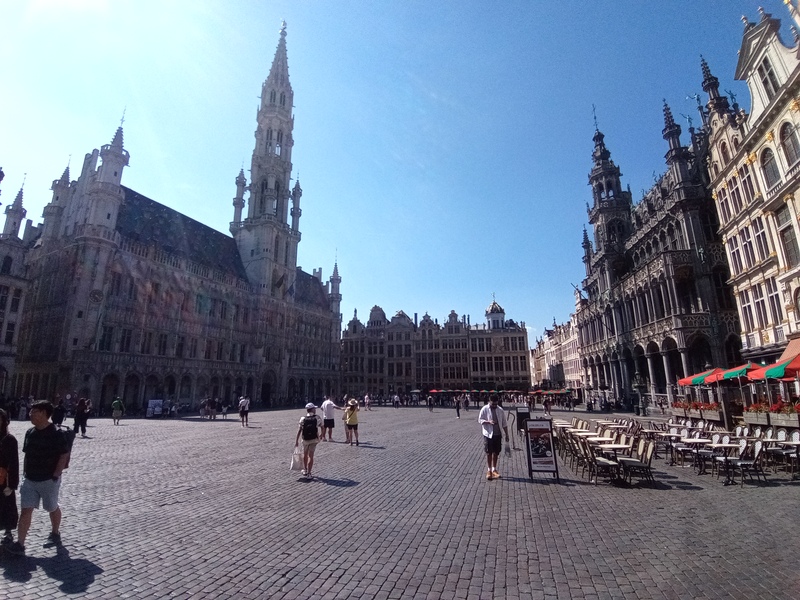
Brussels’ Grand Place under the sun

TLDR (too long, I didn’t read it) : It was just too much fun ! You can feel that the bonds between participants are getting stronger, and that the methods of popular/permanent/active/new education (place the term of your choice before education) are bearing fruit !


That week, from June 12 to 17, 2023, Brussels was bathed in sunshine.

A crosswalk in LGBT+ colors leading to parliament.

We were two Framasoft members : Fred and Booteille.

In ECHO Network meetings, Mondays and Fridays are dedicated to travel, since the various people are more or less far from the meeting place.

But our Belgian pals had planned a debate evening for Monday evening, so we had to arrive not too late.

Luckily, we both had trains that allowed us to arrive around noon, so we met up at the Gare du… Midi and set off together to explore the city center of the European capital in search of our hotel.


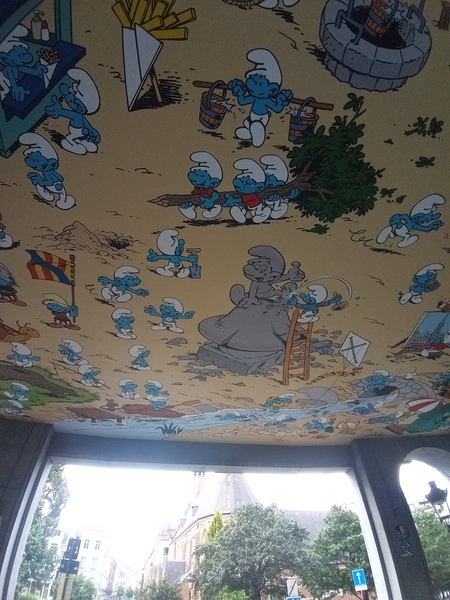
Smurf ceiling in Brussels. Comics are everywhere.


Once we’d packed up, we took a quick stroll to find a place to eat.

Brussels is a great city, where you can go from an upmarket district to a working-class one just by crossing the street. I’m sure that’s true elsewhere, but it struck us. Fred’s tip : if you want to be offered something to smoke, walk around with a guy who looks like Bob Marley.

After that, Fred wandered off while Booteille recuperated from his three nights of 3-4h in a row (he’d just come from another association’s AGM and a few parties).

So we met up directly at the DK workshop, a very nice association bar, where we were going to discuss what Framasoft is with a few dozen members of the public. The invitation had been extended by Tactic (which supports and hosts ethical digital services) and Neutrinet (a Belgian non-profit ISP) ; Tactic being one of the Belgian partners who co-organized some of the activities during our stay in Brussels.

The time, the people and the place were really nice. We were made to feel very welcome, and it was a pleasure to be with so many allies we didn’t know.

A journalist was at the party for a documentary he’s preparing on privacy. He wants to sell it to RTBF. He took video captures of the discussion.

Gerben, who works for NLnet, was there. NLNet is a foundation that funds a lot of digital projects that contribute to improving our society. PeerTube is one of these projects.

On the first evening, we had a meal downtown with the ECHO partners. For Booteille, who was bursting with fatigue, it was particularly difficult to start exchanging in English that evening.


On Tuesday, we kicked off the first day of activities at Maxima, a very nice third-party association.

Everyone had arrived, despite a few people’s transport problems. There were members of Solidar Foundation, CÉMÉA Italy, CÉMÉA France, Willi Eichler Akademy, La Ligue des Familles in Belgium, Tactic, Framasoft…

It’s important to note that the theme of the week was « active education practices to raise awareness of ethical tools ».

So we started by doing some activities to get us into the spirit of the week, to start building links between participants, based – as will be the case for almost all activities – on active/permanent/popular/new education methods ; choose your favorite term among these. While not everyone agreed on the name (and some didn’t necessarily mean the same thing as others), everyone validated their interest, and that’s the important thing !

Next, we got into groups to discuss what we thought active education and popular education were and were not. We had to draw our interpretations on panels. In a few years’ time, our work may be found again, and the world may mistake it for a painting by Leonardo da Vinci. Expect the foundations of what we call « art » to change after that. There will have been a before and an after. :)

After the small-group discussions, we watched a video on Joseph Jacotot, « Peut-on enseigner sans savoir ? » (Can we teach without knowing ?).

We then presented our panels and had a large-group discussion.


In the afternoon, we did an activity based on key digital figures : money, quantity of data, pollution, place the figures given opposite the right question. Not an easy task, even for geeks. Quite a few people made corrections to the figures given after the activity, as the cards were three or four years old. This highlighted the speed at which digital technology is evolving, which is quite staggering.

Then we had a meeting with people from Code du Numérique. An ultra-cool project. They are working to build coherent legislative proposals to put to elected representatives – particularly on issues of inclusion. These proposals are developed through workshops with a wide range of people, both those who are comfortable with digital technology and those who are not. You don’t like legal issues : go and talk to these people !

There are some great videos on their website, which we recommend !

We also suggested that they be interviewed on the Framablog, because we were so enthusiastic about it.

The day ended with a review of the activities carried out. As always with popular education, you get the impression that the hours have just flown by and that you haven’t made any effort, but when you look back you realise how rich the exchanges have been and how much work has been done.

We then went for a drink and a bite to eat with some of the group. And to answer the question on your lips, yes, some people had chips !

The next day, we had a date at another venue, the PianoFabriek, in Saint-Gilles.

We had a beautiful (dance) hall with an outdoor area.

In the morning, Cécile and Annie, from the Ligue des Familles, suggested « the hidden side of clicking » as a theme, where we would discuss the attention economy.

But before that, we played a little presentation game, where each pair had to find something in common that the others didn’t have. Contrary to what you might think, many people have been on roadtrips to Spain and would like to listen to opera.

Annie and Cécile then asked us to answer 12 yes or no questions. These 12 statements are designed to help identify an addiction (see an example here) and have been adapted for use with smartphones. For example : « I feel nervous or anxious if I’ve left my smartphone at home ».

Several people in the group were a little « shocked » by the results of their answers.

Answering two (2 !) of the statements with « yes » underlines addictive behaviour. Suffice it to say that the geeks have hit the roof.


In Belgium, Fred’s addiction to Speculoos is reawakening.


We then watched the Dopamine episode on Facebook, which many people were just discovering, and discussed it with our respective small groups.

The next activity was cognitive bias bingo. The names of several biases and their descriptions were posted around the room, and a randomly selected pair of us were asked to write down the name of the bias for each description on an index card.

After this activity, we discovered Ardoino’s grid in which we had to place, first on our own and then with our groups, solutions to the problems raised by digital technology.

Were these solutions of an individual, interpersonal, group, organizational or institutional nature ? Let’s think about it !

The aim was to highlight the fact that many impactful actions are not just individual matters (you know, peeing, showering, etc.).

We ended our activities at PianoFabriek with a moving debate.

Individually, we wrote answers to « For me, active pedagogy is… » and « For me, active pedagogy is not… » on sticky notes.


After which, Alain, from CÉMÉA Belgium (who co-hosted most of the week with Sarah, also from CÉMÉA Belgium), chose a few answers and had us move around the space to indicate « I agree » or « I disagree ».

Once positioned, we were able to speak up and discuss the reasons for our position. At any moment, we could change our position, physically showing the evolution of our thinking.

We really enjoyed this form of debate.

Incidentally, we haven’t noted it yet, but it’s important to know that we mainly exchanged ideas in English, and translated into English what people who spoke in French were saying. Most people seemed to understand enough English not to translate systematically from English into French, and would indicate when there was a need for translation in that direction.

The translation work was a considerable effort, but for the people in charge of the animation, it was even more exhausting. At the ECHO Network session in Paris, those able to express themselves in English had formed a group which spent the whole week exchanging in that language. In Brussels, this was not possible. European project, European constraints !

After the PianoFabriek, we joined members of EDRI and Technopolice Brussels for an exploratory walk in public spaces (notably the Gare du Midi) in search of CCTV cameras.


These two people helped us to better understand the thinking behind the installation of cameras : « Which locations with which lenses ? » In the Gare du Midi, for example, each door is necessarily equipped with a dedicated camera. There’s also a camera in front of every staircase leading up to the platforms, so that faces can be clearly identified. Not to mention the store, where a camera is also pointed… at the cashier’s hands !

We noticed that there are far more cameras in the poorer neighborhoods (including Molenbeek-Saint-Jean)  than in the richer ones. One fact that impressed us : a camera was located in front of a subway station in a working-class neighborhood. Residents didn’t like it, and it was damaged. Another camera was placed much further down the street, but it monitored the same subway exit. These cameras have an impressive zoom capability.

The cost of installing a camera is estimated at €20,000, and cities are installing hundreds of them, although their effectiveness in combating crime has not been proven in the slightest.


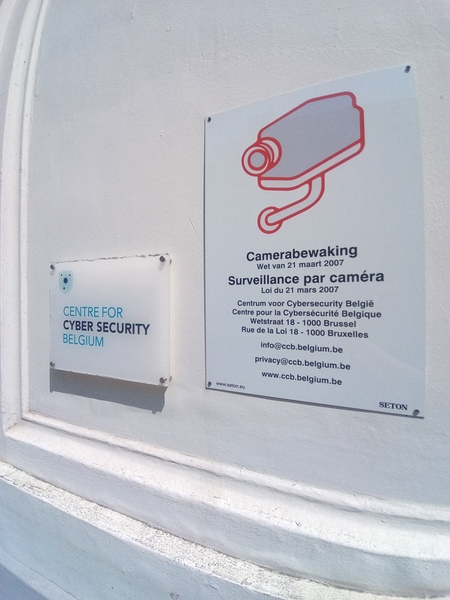
The premises of the Belgian Cyber Security Center are packed with surveillance cameras. No, nothing. All is well.


Ha, I think it’s time to ask this but… HOW IS IT THAT IN BRUSSELS YOU HAVE TO PAY FOR BOTTLED WATER IN ALL RESTAURANTS ! NO FREE TAP WATER ! JUST WATER ! RAAAAAAAAAAAAAAAAAAAAAAAAAAH ! LET’S BURN CAPITALISM !


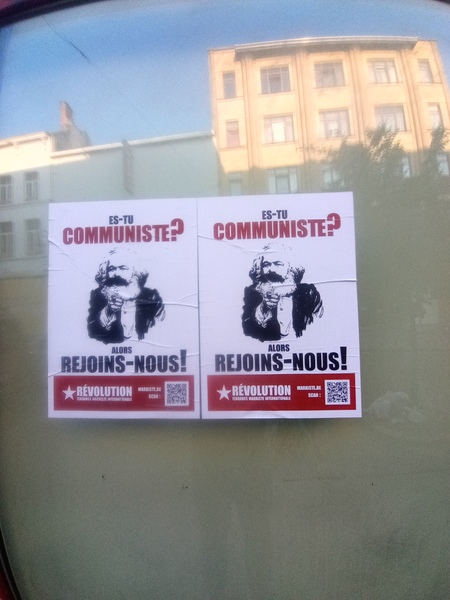
A poster « Are you a communist ? Join us ! » we came across while wandering around Brussels.

Sorry for the outburst, it’s okay now.

For the last day, we were back at Maxima, where a number of digital, image (video) and radio players presented their projects to us, including RadioPanik, a free radio station (which makes fascinating impossible programs) and ZinTV, an organization close to social movements.

After the presentation of their projects, we had a large-group discussion on the difficulties of migrating to open-source solutions for certain structures.

During the day, we had to join either ZinTV to learn how to make video recordings, or RadioPanik to learn how to make radio.

We learned how an ultra-light portable radio transmitter works, or how to use OBS to broadcast live TV.

At the end of the day, there was a PeerTube presentation from someone who learned a little late that she had to do it, poor thing. Luckily, Booteille was on hand to answer any questions.

After that, the ECHO Network core group and I took stock of the week.

The results were really positive. The partners who didn’t really see the value of popular education methods during the first session in Paris are now convinced. The links between the different members and structures were further strengthened.

We had the feeling that we were really starting to form a body, a real group, and that we were all really moving in the same direction, which for a pan-European project like this is really motivating.

In the evening, before dinner, we attended a conference on Tyler Reigeluth‘s book, « The Intelligence of Cities, Critique of Endless Transparency ».

Before the conference, Booteille spoke on behalf of Framasoft alongside Morgane (co-organizer of the ECHO project, member of CÉMÉA France), Sarah (who was co-organizing the trip to Belgium) and Célo (member of Tactic and Neutrinet, who played an important part in organizing the activities), into the microphone of RadioPanik, which was broadcasting live.

We gave a brief presentation of our structures and the ECHO Network project.

The conference then got under way, and to be honest, we weren’t very good at it. Our ECHO Network accomplices, who had learned how to make radio and TV that very afternoon, were broadcasting the conference over the airwaves, and we couldn’t help but give them a helping hand. The PeerTube streaming of the rebroadcast had a problem, and Booteille had to get his hands dirty (Booteille’s note : In truth, they managed just fine without me, haha !).

Right after the conference, we went out to eat, drink and chat until late.

Antonio, our Croatian colleague (from Center for Peace Studies), hosted the evening. He’ll be part of the host team in Zagreb, and he’s quite a character !


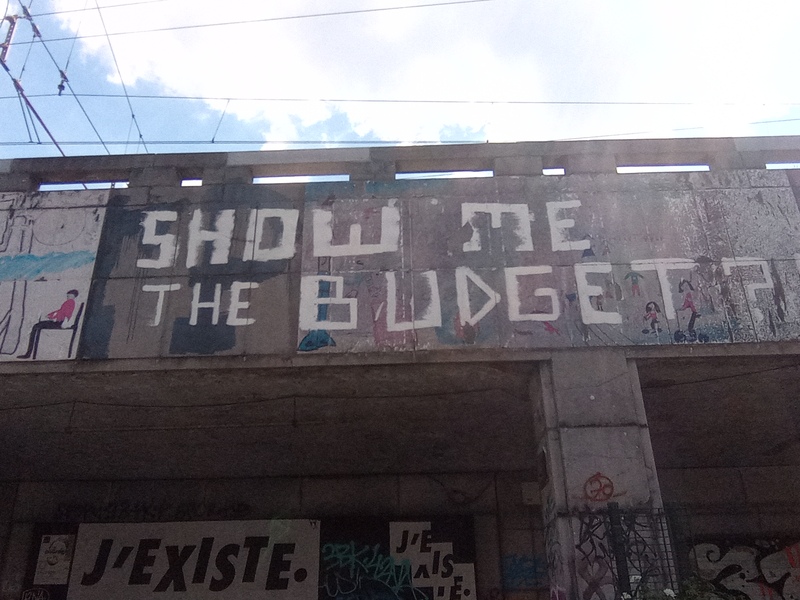
Ce graffiti « Montrez-moi le budget » près de la Gare du Midi est la preuve indiscutable que pyg est passé à Bruxelles.


This « Show Me The Budget » graffiti near the Gare du Midi is indisputable proof that pyg has been to Brussels.
How AI could save–or sink–creative writing in schools

AI can be a powerful tool for rapid feedback and iterative prototyping, reshaping the future of education--and of creative writing.

Key points

This story originally appeared on the Christensen Institute’s blog and is reposted here with permission.

Ninth-grade English was a paradox for me—both the best and worst year for helping me learn to write. 

Every month, my Advanced English teacher, Mr. Johnson, assigned our class one of the classics of English literature and expected us to demonstrate what we had learned with an accompanying essay. He set a high bar for clearly articulated theses, well-structured paragraphs, well-crafted sentences, and supporting quotes from the text. I credit Mr. Johnson’s class for eventually helping me pass the AP Writing exam my senior year without ever taking an AP-level English class.

However, that same 9th-grade English class also planted the seeds of debilitating habits and mindsets in my writing process. Mr. Johnson was willing to provide feedback on drafts. But the demands of all my other classes and activities rarely afforded me the time to take him up on his offer. Consequently, I found myself in a pressure cooker each month, drafting essays in the final days and hours before they were due. The ticking clock and the weight of a looming grade forced me into a mindset where every sentence had to be near-perfect in my desperation to maintain my academic record. Writing became less of an exploration of ideas and more of a high-stakes gamble.

Fortunately, schools and society seem to be entering an era in which AI could completely upend the dysfunctional part of my 9th-grade English experience.

The damaging mindsets forged by conventional grading

The pressure I felt to craft near-perfect drafts on the first attempt is hardly unique to me—it’s symptomatic of a broader issue common across US K–12 education. In most classrooms, students don’t iterate on their work. With all the volumes of content to be covered, there just isn’t time in either the class period or the school year for cycles of feedback. Instead, teachers give assignments, students complete those assignments, teachers grade students’ work, and each assignment grade leaves an indelible impact on a students’ final grade for that class. Grades from individual classes then get averaged together, semester by semester, into GPAs that permanently carry the marks of any prior failures and shortcomings in a students’ learning. 

I suspect these norms of practice are major cultivators of what Stanford psychologist Carol Dweck would term a ‘fixed mindset.’ They create a stifling atmosphere where failure is a brand to be avoided rather than an experience to learn from. The binary of ‘success’ and ‘failure’ prevails, leaving little room for trial and error, an invaluable aspect of the learning process. The emphasis on the end product over the process perpetuates the fear of failure, curbing creativity, curiosity, and the potential for new discoveries. The outcome? A learning experience that prioritizes safe choices and known paths over innovative thinking and problem-solving.

Now, more than ever, students’ future success in an ever-changing world requires that they learn how to think critically and creatively while collaborating with others to solve complex problems. But the unwritten curriculum of most schools—instilling process perfectionism through rewarding flawless performance—is probably doing more harm than good.

The threat and opportunity of AI

Against this backdrop, there’s a lurking concern that AI is just going to help students find mindless shortcuts for cheating their way to good grades. But that’s only a risk if schools and teachers hold a low bar for what they expect of their students. Wharton professor, Ethan Mollick, made a compelling argument in his ASU+GSV talk last April that ChatGPT should really mean the end of lousy student writing. “I don’t accept papers that aren’t good anymore because the minimum you can do is turn in a good paper. So, why am I going to force you to write a bad one? … [With AI] we can increase our standards of what we can accomplish.” Knowing the minimum bar that tools like ChatGPT can produce, he expects students to prove that they’ve developed their ideas beyond what the AI can generate.

Journalist Adam Davidson noted on a recent Freakonomics podcast episode that he’s taken to calling ChatGPT “the ‘B-minus at everything’ program.” If schools set low expectations for the quality of students’ essays, then AI will enable those who so desire to cheat their education. But if schools and teachers want to elevate expectations for their students, AI can be a powerful tool for rapid feedback and iterative prototyping. 

Breaking 9th-grade writing mindsets and habits

I think my 9th-grade self would have loved having a tool like ChatGPT to help with my essay assignments. But the real reason why is probably not what you’re thinking.

I relish the first part of writing—coming up with ideas worth sharing—and I find satisfaction in the final part of writing—polishing my prose for persuasive power. But the middle part—hammering out a lousy first draft—is a painful process given my bad habit of perfectionistic editing as I write. But over the last few months, I’ve found two amazing things that ChatGPT can do for me as a writer.

First, ChatGPT allows me to do what my colleague, Bob Moesta, calls “rapid prototyping.” I feed the AI my ideas—often through verbal dictation using its mobile app—and then it hands me back an outline for organizing those ideas into a blog post. We do some back and forth on the outline, then I ask it to write me the first draft, one headings-worth at a time. I’m not giving it a topic and then asking it to do the work of coming up with what to say on that topic. I’m doing the thinking, then it’s doing the initial writing. 

Are the first drafts written by ChatGPT up to par with what I expect of my own writing? No. They look like they were written by an average high school student following all the formal conventions they’ve been trained to mimic. The structure is so predictable that it’s boring, and the sentences are full of cliche turns of phrase.

But with this leg up from ChatGPT, a process that has typically taken me around four to six hours gets cut down to about an hour. What’s even more important is that this collaboration between me and the machine has been easing my dread of writing the first draft.

Second, ChatGPT gives me quick and convenient access to an outside perspective on my work. When I’m not sure if my structure is working, or I’m struggling to come up with a concise and catchy way to convey my ideas, outside feedback is often the best remedy. Unfortunately, the turnaround time for collegial feedback is typically a day or more, and when my colleagues are pressed for time, asking for feedback can feel like an imposition. Meanwhile, ChatGPT can often give me just what I need: a little bit of new insight to break me out of the rut I’m stuck in. Are its insights as good as those of a colleague? No. But what it lacks in quality it compensates for in on-demand responsiveness.

In short, while AI can handle the ‘how’ of writing, it falls short in understanding the ‘why’ and ‘what’—the substance that gives a piece of writing its rigor and depth. Nonetheless, I’ve experienced first hand how tools like ChatGPT can facilitate cycles of writing, revising, and refining, all while helping me foster low-stress, fail-forward mindsets.

Harnessing AI’s potential to revolutionize educational feedback

I think we’re on the verge of a future where AI dramatically reshapes how students experience learning to write. With the help of AI, students will be able to see more clearly that the most important part of writing isn’t what happens when your fingers hit the keyboard—it’s the learning and the thinking that happens before you ever pull up a blank page. Once they do their thinking, AI can help them translate what they’ve discovered into written text. Then, as they learn to work with that text to hone in on what they really want to communicate, sophisticated algorithms can help them sharpen their intuitions for that medium by providing real-time feedback on not only grammatical errors but also argument coherence, evidence use, and rhetorical strategy.

When schools and educators see AI as an ally rather than an adversary, I suspect they’ll discover an unprecedented opportunity to both raise the bar on what they expect from their students as well as make the learning experience more enjoyable and meaningful. Did I mention that I used AI to write the first draft of this piece?

This post was written with assistance from ChatGPT. For anyone interested in how the post was crafted, here’s a link to the ChatGPT conversation that helped produce this post.

❌
❌