Normal view

There are new articles available, click to refresh the page.
Before yesterdayMain stream

Capstone Names Haygood Poundstone as Chief Revenue Officer

23 November 2023 at 13:00

MINNEAPOLIS, Minn. – Capstone, an innovative learning company merging children’s content with easy-to-use edtech tools for K-5 classrooms, libraries, and homes, has named Haygood Poundstone as Chief Revenue Officer. Poundstone brings over 20 years of experience in the edtech market in business development, revenue growth, sales strategies, and operations management to this newly created role at Capstone. Poundstone will oversee Capstone’s revenue generating sales including direct to schools, library, distribution, trade, and international business units in executing the publisher’s growth strategy.

Throughout his career, Poundstone has led top-tier sales teams to drive organizational revenue, performance, and profit. Most recently, he served as the Area Vice President of the East at Renaissance Learning where he led a large team of regional vice presidents, sales leaders, and direct sales professionals to reach aggressive goals.

After six years away, Poundstone rejoins Capstone where he was one of the founding employees of its business unit myON. Prior to his time at Capstone, Poundstone held a variety of leadership positions at Lightspan and PLATO (now Edmentum).

“We’re thrilled to welcome Haygood back to Capstone. He is a visionary leader with a commitment to leveraging technology and learning resources to enhance the lives of children. His insights and strategic thinking will be invaluable as we continue to expand our reach and impact at Capstone,” said Randi Economou, Capstone CEO. “Beyond his professional accomplishments, Haygood is known for his people focused leadership style. He believes in fostering a collaborative and inclusive work environment, where every team member is valued and empowered. His dedication to nurturing talent and cultivating a culture of excellence will propel Capstone forward.”

“Inspiring successful and engaging learning experiences is at the heart of Capstone. That resonates strongly with me and reflects both the value Capstone brings to schools and industry partners as well as the motivation and passion of the entire Sales team. I’m looking forward to leading the effort to expand Capstone’s reach as we share the good news about what Capstone can help educators accomplish and learners can achieve,” said Poundstone.

Poundstone earned a Bachelor of Science degree in Business Administration at Auburn University at Montgomery where he was an active member of Omicron Delta Kappa and Lambda Chi Alpha.

Poundstone began his new position on November 13 and reports directly to the Capstone CEO.

About Capstone

Capstone is the nation’s leading educational publisher of K-5 digital solutions, children’s books, and literacy programs for school libraries, classrooms, and at-home reading. Through print books, interactive eBooks, or the curriculum-connected learning tool PebbleGo™, Capstone has a passion for inspiring students to learn and their communities to thrive. As a publisher of content for children, Capstone embraces the responsibility to celebrate and share the diverse voices and perspectives of our readers and communities. Capstone supports great teaching and learning with engaging content that values the work that educators do every day—helping students succeed. CapstonePub.com #LearningIsForEveryone  

5 essential digital learning reads

22 November 2023 at 11:00
Digital learning is an essential element in today's connected and evolving classrooms--here's what you need to know.

Key points:

  • Digital learning is a key part of students’ school experiences
  • As technology evolves, so, too, do students’ learning opportunities
  • See related article: Is AI the future of education?
  • For more news on edtech trends, visit eSN’s Digital Learning page

Digital learning is a critical component of what happens in today’s classrooms. Edtech tools, connected learning experiences, and 21st-century skills all play a role in preparing students for the future.

But digital learning trends and technologies change so quickly that sometimes, it’s difficult to know where to focus or where to invest funding, time, and resources.

Here are 5 must-read stories about digital learning trends and developments to help your school leadership team determine which digital learning resources and edtech tools can best benefit students:

1. Digital learning requires digital research skills: Right now is the perfect time to start a research project with your students, as it will help them develop skills they will use for the rest of their lives. While your students, who have grown up in the Information Age and think they already know everything, any classroom teacher knows that our students need help more than they think. Our students’ belief that everything they need to know is online can, without the right skillset, leave them prey to misinformation. Let’s teach our students to steer through the online ocean of data to be both effective researchers and responsible digital citizens.

2. Digital escape rooms merge creativity with student engagement and skill development: Escape rooms are engaging for people of all ages–they require durable skills such as creativity, critical thinking, determination, and the ability to work in groups to solve challenges. It makes sense that educators would craft their lessons around the concept of an escape room–and that’s just what high school educator Lynn Thomas has done. In this Q&A with eSchool News, Thomas details how she found inspiration to create escape room learning opportunities and the benefits she sees for her students–and she offers a look at a new ChatGPT challenge she’s created.

3. Esports can engage even the youngest of students, and these programs help students develop critical skills no matter what paths they pursue: Scholastic esports is rapidly growing, and many schools are starting to incorporate esports programs into their curriculum. The benefits of esports make a compelling case for creating a program: Research shows that students who participate in scholastic esports experience social and emotional benefits, increased academic achievement, and higher graduation rates. These positive learning outcomes make esports popular in secondary grades, with both students and educators advocating for the addition and growth of scholastic esports in their middle and high schools. But esports isn’t just for the older kids, and starting an esports program in early elementary school can be an effective way to lay the groundwork for esports participation as students make their way into higher grade levels.

4. In an AI-driven world, how can students maintain their own voices? Now, more than ever, students’ future success in an ever-changing world requires that they learn how to think critically and creatively while collaborating with others to solve complex problems. But the unwritten curriculum of most schools—instilling process perfectionism through rewarding flawless performance—is probably doing more harm than good. Against this backdrop, there’s a lurking concern that AI is just going to help students find mindless shortcuts for cheating their way to good grades. But that’s only a risk if schools and teachers hold a low bar for what they expect of their students.

5. Effective digital learning means educators must know how to leverage digital tools correctly: When properly integrated, AI can amplify the work of teachers, shrink equity and accessibility gaps, and provide unrestricted access to information. But for technology to make a meaningful change in K-12 education, we need to address the true source of the problem: broken instructional models. Even though countless technology tools have been introduced into the market, classroom practice looks eerily similar to how it did a hundred years ago. That’s because educators are still equipped with an antiquated model of teaching that isn’t designed to be responsive to students’ learning styles. By leveraging AI and technology to rethink traditional teaching methodologies, we can level-set our classrooms to more effectively empower educators and personalize student learning.

Is generative AI a beacon for more accessible education?

20 November 2023 at 11:00
Despite low levels of preparedness and barriers to adoption in education, there is a belief in generative AI's potential to empower learners.

Key points:

  • Many educators look forward to the opportunity afforded by AI, but few feel ready to use it
  • Other educators wonder if they have proper district support for AI use
  • See related article: 5 positive ways students can use AI
  • For more news on AI in education, visit eSN’s Digital Learning page

A resounding 90 percent of educators in a recent survey said they believe that AI has the potential to make education more accessible. 

Teachers are recognizing that when implemented ethically and with thoughtful consideration, AI can help students with special needs, learning disabilities, and language barriers, for example, and experience more effective, personalized learning methods, according to the 2023 Educator AI Report: Perceptions, Practices, and Potential from digital curriculum solution provider Imagine Learning.

With generative AI emerging as a pivotal element in the dynamic educational landscape of 2023, Imagine Learning conducted the survey to explore the perceptions, current practices, and future aspirations of educators who have already embraced technology in the classroom. The inaugural report showcases a comprehensive exploration of AI’s current and future role in K-12 classrooms.

When it comes to readiness, however, only 15 percent of educators feel “prepared” or “very prepared” to oversee the use of generative AI in the classroom, with over twice that number (32 percent) expressing they are completely unprepared to do so. What’s more, educators indicate a disparity when it comes to the likelihood of using Generative AI in the classroom, with district and school leaders perceived as less likely to embrace new AI tools when compared to educators and students.

On top of this, only one-third (33 percent) of surveyed educators feel that they have the support they need from their district and school leadership to successfully implement generative AI into their teaching.

Other key findings from Imagine Learning’s report include:

  • Almost half of educators (44 percent) who have used generative AI believe that its use has alleviated the burden of their workload and made their jobs easier.
  • Of the respondents who reported they have not used AI in the classroom, 65 percent cite a lack of familiarity as the primary obstacle to the future utilization of generative AI, with 48 percent also expressing ethical concerns.
  • 72 percent of educators are most concerned about plagiarism and cheating due to generative AI, highlighting the need for clear guidelines for students for using AI with academic integrity.

“Generative AI is a blend of promise and prudence. Its transformative potential is undeniable, but the journey forward requires thoughtful consideration,” said Sari Factor, Vice Chair and Chief Strategy Officer, of Imagine Learning. “Learning is above all a human endeavor. With generative AI as a tool to simplify lesson planning, reduce administrative tasks, and enhance personalized learning, we can empower the potential of teachers and students and improve learning outcomes.”

This press release originally appeared online.

Most states don’t actually know if teachers are qualified to teach reading

20 November 2023 at 10:29
Requiring stronger elementary teacher reading licensure tests can improve teacher preparedness and the quality of reading instruction.

Key points:

  • States are using inadequate elementary reading licensure tests
  • States should transition to stronger tests and test providers should clearly identify weaknesses in tests
  • See related article: Teacher Q&A: Strengthening PD with AI
  • For more news on teacher prep, visit eSN’s Educational Leadership page

Most states (29 states and the District of Columbia) use a weak elementary teacher reading licensure test, meaning that they do not effectively measure teachers’ knowledge of scientifically based reading instruction prior to entering the classroom, according to a new analysis from the National Council on Teacher Quality (NCTQ).

In fact, one state, Iowa, requires no reading licensure test at all. This shortcoming means that, every year, nearly 100,000 elementary teachers across the country enter classrooms with false assurances that they are ready to teach reading.

The data brief, False Assurances: Many states’ licensure tests don’t signal whether elementary teachers understand reading instruction, provides the most up-to-date analysis on the quality of elementary reading teacher licensure exams being used by each state.

More than 50 years of research has illuminated the most effective way to teach children to read. It requires systematic, explicit instruction in the five core components of the science of reading: phonemic awareness, phonics, fluency, vocabulary, and comprehension. Preparing teachers to teach these five components–known as scientifically-based reading instruction–can ensure more than 1 million additional students enter 4th grade able to read each year.

Unfortunately, far too often, states allow teachers into the classroom inadequately prepared to teach reading. Licensure exams, if rigorous and aligned to the science of reading, can serve as an important guardrail for making sure teachers have this critical knowledge. However, many licensure tests are weak in that they do not adequately assess teachers’ preparedness to teach reading. Far too many states are using these weak tests.

“Every child deserves great reading instruction, but far too many children aren’t receiving it,” said NCTQ President Heather Peske. “As part of a comprehensive strategy to improve reading instruction, states can help ensure teachers are prepared to teach reading effectively by requiring stronger licensure tests.”

Examining every elementary teacher reading licensure exam currently being used by states, NCTQ looked for evidence that the tests adequately address the five core components of reading. NCTQ also examined whether these tests devote undue attention to methods of reading instruction that have been debunked by research and
can hinder students from becoming strong readers, such as three-cueing.

Additionally, NCTQ checked whether these tests combine reading with other subjects. This is important because if subjects are combined, the teacher’s understanding of reading could be masked. Using these criteria, NCTQ determined whether tests were strong, acceptable, weak, or unacceptable.

Key national findings:

  • Of the 25 elementary teacher reading licensure tests in use by states, the majority (15) are weak. Just six exams are rated “strong” and four are rated “acceptable.”
  • Across these 15 weak licensure tests: Ten do not adequately address all five components of the science of reading and five combine reading with other subjects, such as social studies or science. (Note, one test fits into both categories listed above.) One includes too much emphasis on content contrary to research-based practices.
  • The majority of states (29 states and the District of Columbia) use “weak” tests that do not signal whether teachers have the knowledge they need to teach students to read.

“Teachers who aren’t prepared in the most effective instructional practices for teaching reading unknowingly enter classrooms ill-prepared to help students become successful readers,” said Peske. “This lack of preparation has a profound impact on students’ literacy skills and future prospects, especially among students of color and
those living in poverty.”

Roughly one-third of children in elementary classrooms across the country cannot read at even a basic level by the middle of the fourth grade. The situation is even bleaker for historically marginalized students, for whom inadequate reading instruction is yet another barrier to educational equity, with 56 percent of Black students, 50 percent of Hispanic students, 52 percent of students in poverty, 70 percent of students with disabilities, and 67 percent of English Learners reading below basic reading levels.

Students who are not proficient readers are four times more likely to drop out of high school, face lower lifetime earnings, and have higher rates of unemployment.

Recommendations

To address this pressing issue, the NCTQ recommends the following solutions.

State education leaders should:

  • Transition to a stronger reading licensure test: States select and approve the tests that their teachers must pass for licensure. Requiring a stronger test will likely lead to better reading instruction in elementary classrooms across the state as preparation programs will be motivated to align their courses with the components of reading addressed in a stronger test.
  • Require a strong reading test for anyone teaching students in the elementary grades. In some cases, states require reading tests for general education elementary teachers but not for special education teachers or for early childhood teachers who are licensed to teach lower elementary grades. These loopholes ultimately hurt the students who most need teachers capable of building a foundation in literacy.

Testing companies should:

  • Shore up weaknesses and clearly identify limitations in existing tests: Both major testing companies, ETS and Pearson, have strong and acceptable reading licensure tests on the market, but they also offer tests that omit numerous topics from the core components of reading, and that combine reading with other subjects, diluting the assessment’s ability to verify teachers’ reading knowledge.

This press release originally appeared online.

5 ways I’ve leveraged AI in my English classroom

ChatGPT stormed into our lives and our classrooms, and it’s a mess. But my students and I are jumping in with AI in our English classroom.

Key points:

  • Students will be immersed in an AI world—they need to learn about it
  • One English teacher brainstormed creative ways to get students talking about, and working with, AI
  • See related article: 5 positive ways students can use AI
  • For more news on AI in education, visit eSN’s Digital Learning page

Last spring, a few weeks after I started using ChatGPT, I challenged my high school English students: “Artificial intelligence can do any of your class assignments,” I told them flatly. “Now prove me wrong.”

I wanted to provoke them, to get them to ask questions, and to start using these tools—not to cheat—but to flip their learning on its head. I knew we needed to learn this together. And since that day, we didn’t just shift the paradigms—we sent them into somersaults.

1. Putting ChatGPT on trial

I first became aware of ChatGPT last February when I began reading mind-blowing comments of several progressive educators. As a teacher who strives to help students uncover their interests and stretch their imaginations, I wanted to ensure they were participating in this new technology. We were about to begin our unit on The Crucible and I began wondering how we could leverage ChatGPT.

Typically, at the end of the unit, I ask my students to put various characters on trial, backing up their ideas with plenty of original evidence. This time around, I wanted them to also put ChatGPT on trial. What are its strengths and opportunities, its weaknesses and threats?

So I created a project-based scenario: The students were attorneys for a law firm, and I was their client, bringing them this challenge: I was thinking about investing in ChatGPT. Based on their understanding and the research they’d conduct during The Crucible unit, should I? What would be the implications? The upsides and the down?

So the students began, first reading The Crucible, relying only on their human intelligence. Then, after a week, they opened up their understanding of the classic play through ChatGPT. And it was astonishing: ChatGPT helped students discover subtle nuances and character traits they’d missed initially, created authentic-sounding trial documents that outlined their arguments, provided historical information about the Salem witch trials, and prompted students to explore the play’s themes and messages. It also generated hypothetical conversations between characters, providing fresh insights into how characters evolved throughout the play.

At the unit’s completion, the students had glimpsed AI’s potential—and its potential problems. Many students were concerned about cheating, about bias, about invented “facts,” and about privacy. But, ultimately, the majority of students advised that I, as their client, should invest in AI, finding that it increased efficiencies, helped with workload, sped up research, improved grammar, relieved deadline stress, and more.

2. Using ChatGPT as a creative partner

When they returned from spring break, students found that I’d taken their advice to heart: I’d invested $20 on a premium version of ChatGPT and had created an AI workspace in our classroom. Now I invited them to use ChatGPT during our final inquiry unit, during which they’d ask questions, come up with a plan, leverage their research, and then go public with their findings. Soon they found they could use ChatGPT as a creative, brainstorming, spit-balling partner—with great results: generating open-ended questions, discovering and exploring their interests, creating a day-by-day calendar to reach goals, ideating original art pieces, and augmenting lyrics for songs and scripts. To say they were wowed by ChatGPT’s ability to take their own thinking and creativity further would be an understatement.

3. Considering what’s next

During that inquiry unit, I wanted to better understand—and for my students to better understand—what might be ahead of us in terms of AI. So I invited our school librarians to visit our class, presenting glimmers of what’s ahead: the good, from conducting medical research to solving complex global problems; the bad, from impersonating someone’s speech to waging war with AI; and the surprising, from saving bees to predicting earthquakes.

Impressively, the librarians also fielded questions, addressing ethical considerations of AI, detailing the importance of vocabulary when it comes to writing powerful prompts, and reminding students that they need to be thinkers themselves and not just settle for what ChatGPT generates.  

4. Going from zero to hero

Just days before our fall semester started, I learned that I’d been assigned mythology—a subject I’d not taught before and one without a syllabus. But, like my students during their inquiry unit, I knew I could turn to ChatGPT as my creative partner. To begin, I wrote a thorough prompt, telling it: “You’re a high school English teacher who wants to teach an inquiry-based mythology class with self-directed learning. You have questions and you’re looking for answers. (That’s so the hero’s journey à la Joseph Campbell.) Now create a syllabus, complete with readings.” Less than a minute later, there it was, in all its mind-boggling near perfection. Next, I asked ChatGPT to create a hero’s journey chart with student checkpoints along the way. Once again, in 20 seconds, there it was. In class, I’ve stuck with these materials mostly and, so far, so good.

5. Clubbing—AI style

Most recently, I’ve teamed up with a school librarian to create an extracurricular AI club. We’re not totally clear on our mission or our goals—we’re in the early days. But we do want students to understand what’s happening with AI and to be, if not prepared, at least thinking about AI and how it may impact not only their careers but their lives.

As for that first challenge I presented—the one about AI being able to do any schoolwork—unfortunately, it proved true: AI can do pretty much any class assignment. And that made us all squirm. In fact, that feels scary. But that’s all the more reason to delve into AI. As Bill Gates said last spring, “You definitely want the good guys to have strong AI.” You don’t want only the “bad guys” to be using it, manipulating it to deceive or to swindle or to gain power or to wage war. That’s why we must keep talking about AI with our students. We can’t run away.

Soon AI will be a common tool in myriad fields. That’s why we as educators need to help our students use it, become familiar with it, and think for themselves about its implications. Yes, it’s threatening. It’s also exciting. And it’s going to be their world.

Real Talk about AI

16 November 2023 at 19:33

As the hoopla surrounding emerging AI technologies and their impact on education endures, we need to get past whether or not to use ChatGPT—Pandora’s box is officially open—and focus instead on how best to use it. Despite OpenAI recently releasing a guide for ChatGPT in the classroom that demonstrates how teachers can use the large language model software to enhance learning, Zarek Dozda, director of UChicago’s Data Science 4 Everyone, does not think it goes as far as it should to address educators’ concerns about the growth of this emerging tech in classrooms.

In this insightful conversation, Zarek breaks down several particulars he feels need to be addressed, including:

  • More research – OpenAI’s guidance focuses on anecdotal evidence of ChatGPT in classrooms but has little to say about best practices when using ChatGPT as an educational tool.
  • Focus on mechanics – Instead of highlighting education tactics that utilize ChatGPT, OpenAI should provide a more thorough explanation of large language models and how they work.
  • Training for teachers – The specific teachers mentioned in OpenAI’s guidance should be applauded for embracing emerging tech, but there needs to be greater resources for teachers just trying to keep up with AI.

Data Science for Everyone is a coalition advancing data science education so that every K-12 student has the data literacy skills needed to succeed in our modern world. Equitable access to data science education is an opportunity to open doors to higher education, high-paying careers, and an engaged community. Created by the University of Chicago Center for RISC and organized in partnership with The Learning Agency and the Concord Consortium, the group supports a growing community that knows that the data revolution has transformed modern life and we need to prepare our students. 

Other highlights from the conversation include:

Responsibility in AI Usage: Zarek emphasizes the importance of instilling responsible and efficient AI usage in students, preparing them for a future where digital skills are integral to various careers.

Changing Perceptions: The discussion challenges preconceived notions about AI, acknowledging shifts in attitudes among educators and students toward embracing technology as a valuable supplement to traditional teaching methods.

Educator Empowerment: Teachers are encouraged to view AI as an opportunity for professional development, using tools like ChatGPT 4 to create lesson plans and assessments, fostering a collaborative approach to interdisciplinary solutions.

Foundational Skills Remain Crucial: While AI tools advance, Zarek emphasizes the continued significance of foundational skills, asserting that students should still learn mathematics, coding, and critical thinking to understand and address AI-generated errors.

Balanced Implementation: Zarek advocates for a measured approach to AI integration, steering clear of extremes such as outright bans or complete reliance on AI for educational planning. Instead, a gradual introduction with teacher guidance is recommended.

Global Talent Race: The conversation concludes with a call for policymakers to recognize the urgency of upskilling educators, framing education as critical for future economic and international success in a rapidly evolving digital landscape.

How meta creativity prepares students for the future

16 November 2023 at 11:00
We must evolve our definitions of creativity to higher orders to stay relevant, including successfully using AI in and out of the classroom.

Key points:

  • AI is changing education–and these changes can be beneficial if handled correctly
  • Meta creativity–routines that help us engage fully with the hardest parts of creativity–can help with AI integration
  • See related article: 5 positive ways students can use AI
  • For more news on AI and creativity, visit eSN’s Digital Learning page

Nearly 40 percent of teachers expect to use AI in their classrooms by the end of the 2023-2024 academic year. This use of AI at school will impact how students learn and use their creativity as innovation, which will be increasingly necessary in the future as even higher-order thinking skills become standard. There will be long-term effects if the methods of teaching creativity are not adjusted, but if educators embrace AI mindfully, there will be long-term benefits.

In my experience observing educators and students, I started to see a need for more moments of reflection. The education space and other industries are quickly evolving because of AI, but humans, especially young students, aren’t yet hard-wired to adapt at the same pace. In response, educators need to take more time and enlist the help of tools to begin planting the seeds of mindful creativity in relation to AI, which will be a critical skill as young children grow into tomorrow’s workforce.

Moving forward, meta creativity–routines that help us engage fully with the hardest parts of creativity–and even higher-order thinking should be on every educator’s mind when building an environment conducive to both creativity and AI use.

The relationship between AI and creativity

When most people think of creativity, they relate it to the ability to ideate and express original ideas. However, the AI era we live in suggests that we should change this definition since AI can be trained on more information and has demonstrated the ability to make stronger creative connections than humans. We must evolve our definitions of creativity to higher orders to stay relevant, including successfully using AI in and out of the classroom.

One of the most challenging parts of creativity is resisting the impulse to give up when you meet failure or criticism of your ideas, which students commonly face at school when working on group projects or receiving grades. Failure and criticism can lead to students abandoning their own ideas and relying too heavily on AI to be their brains, so to speak. If this is regularly done during school, students will likely continue this habit at their future jobs or other parts of life. To avoid this dependency on AI and other technology, students need stronger self-awareness and reflective routines to engage in the full complexity of creativity.

What is meta-creativity?

Remaining creatively relevant requires self-awareness, adaptability of thinking, and impulse control during the creative process. New routines that help humans engage fully with the most challenging parts of creativity must be introduced. One example of such a routine is mindful breathing when a student faces a setback when working on a creative project. This routine will help students calm down and refocus on the task they’re working on without losing too much progress.

Routines like this are considered meta-cognitive functions, which can serve as solutions for students and teachers trying to remain creative and engaged in the classroom using AI.

How to foster meta creativity

Reflective tools–educational instruments or techniques that encourage students and educators to reflect on their learning experiences and outcomes–are an excellent way for educators to foster meta-creativity in their students. These tools are designed to prompt and support higher-order skills such as critical thinking, self-awareness, and continuous improvement, which are critical for education and life beyond the classroom.

In addition, reflective tools can help educators adapt to today’s rapidly changing world while fostering stronger attention, connection, and intrinsic motivation within their students. By using these tools, educators are taking a step to remove the stigma that schools stunt creativity with their strict rules and routines.

American society is built on the foundation of innovation–that mindset is what starts and operates businesses, creates new products, and continuously sets new standards of excellence worldwide. But where does this innovation come from? The contrast between the constraining creativity in the traditional education system and the defiant, independent culture of regular society may create this innovative thinking, which now translates to higher-order skills and meta-creativity. In addition, the ability to make something from nothing is now the baseline of creativity, and even higher-order thinking will be necessary to excel at this.

While many believe schools are one of many factors diminishing basic creativity, I think schools provide constraints that can actually build up students’ meta-creative capabilities in the long run. After years of structured school days, students are craving a freedom that they never had before. And all the creative and mindful muscles they spent 12 years building are ready to be unleashed as they enter society outside school. Their eagerness to showcase their unique skills will position them to have a positive impact in whatever sector they choose to enter.

AI and other technology have changed how humans think and live. For the education space, specifically, teachers must create a learning environment where students can reach a new level of creativity that allows collaboration with AI and requires even higher-order thinking skills to flourish. This is what will prepare students for the rest of their lives.

While it might be an adjustment at first, implementing meta-creativity and engaging with the most challenging parts of the creative process will result in the best outcomes for educators and students as the era of AI continues to gain momentum.

Fixing the K-12 cybersecurity problem

CISA’s Secure by Design pledge commits manufacturers to improving K-12 cybersecurity and strengthening networks.

Key points:

In early September, the Cybersecurity and Infrastructure Security Agency (CISA) announced a voluntary pledge for K-12 education technology software manufacturers to commit to designing products with a greater focus on security. In the announcement, CISA mentioned that six leaders in the education software industry had already committed to the pledge: PowerSchool, ClassLink, Clever, GG4L, Instructure, and D2L.

“We need to address K-12 cybersecurity issues at its foundation by ensuring schools and administrators have access to technology and software that is safe and secure right out of the box,” said CISA director Jen Easterly. “I want to thank ClassLink, Clever, D2L, GG4L, Instructure, and PowerSchool, who have already signed this pledge and for their leadership in this area. We need all K-12 software manufacturers to help us improve cybersecurity for the education sector by committing to prioritize security as a critical element of product development.”

CISA’s principles for K-12 cybersecurity

This action brings a spotlight to the ongoing issue of K-12 cybersecurity. CISA’s goal is to persuade more K-12 software and hardware manufacturers to commit to its pledge. Signing the pledge demonstrates that the manufacturer is committing to three principles:

  • Taking ownership of customer security outcomes: Includes offering Single Sign On (SSO) and security audit logs and no extra charge
  • Embracing radical transparency and accountability: Includes publishing a secure by design roadmap, a vulnerability disclosure policy and security-relevant statistics and trends
  • Leading from the top by making secure technology a key priority for company leadership: Includes naming a C-level leader at the company who is charged with overseeing security

Secure by design explained

What does secure by design mean? In typical software design and manufacturing, the focus is on the product’s reason for being. For example, the developers of reading improvement software are focused on building a product that delivers measurable improvements to student reading speed and comprehension. The security of the software and its user data are an afterthought. Any security considerations are made late in the development process or bolted on afterward.

In contrast, a secure by design approach means that developers bake security into the design of the product from the beginning. This has proven to be a much more effective approach to protecting software than trying to patch security holes after the fact. Secure by design was popularized by the European Union’s General Data Protection Regulation (GDPR), which went into effect in May 2018. Today, this is a more common approach to software design, but it is relatively new to K-12 education.

Ongoing K-12 cybersecurity threats

While the K-12 education industry strives for improved protection in its schools, fresh examples of security holes continue to appear on a regular basis. Most recently, Prince George’s County Public Schools was the victim of a ransomware attack on August 14 that impacted about 4,500 user accounts, mostly staff, according to the district. Cybersecurity breaches such as this can have a detrimental impact on K-12 schools, threatening both reputation and financial well-being.

Unfortunately, successful ransomware attacks can hinge on exploiting a single vulnerability hidden among the dozens of software applications running in most school districts. By following CISA’s guidance and committing to a secure by design approach to software development, developers can further reduce potential vulnerabilities and keep staff and student data more secure.

Related: Education suffers the highest rate of ransomware attacks

How to start solving your school bullying problem

To solve your school bullying problem, it will take a real commitment by leadership and parents to make a change to create a safe environment.

Key points:

Student bullying is a nationwide problem. Parents are outraged and demand that school administrators evaluate their campus security protocols to keep all students alive and safe.

A southern California school district agreed to pay $27 million to settle a lawsuit brought by the family of a 13-year-old boy who died after he was assaulted at school. On Sept. 16, 2019, two 14-year-old boys were videotaped attacking the victim outside classrooms at the school. One boy struck the teenager in the head from behind and he fell, hitting his head against a pillar. The boys then continued punching the boy, who died nine days later from a brain injury.

Last school year, a 14-year-old female student at a high school in New Jersey died by suicide two days after a video of her being viciously attacked by her bullies at school was uploaded online. The school district’s superintendent has resigned, and four girls have been criminally charged in connection with the assault.

Bullying at schools is pervasive across the country. According to a recent national survey report by the Boys and Girls Clubs of America, 130,000 kids and teens ages 9-18 reported some form of bullying.

This survey revealed that in the past year, 40 percent of youth said they were bullied on school property and 18 percent of youth say they have experienced cyberbullying. Unfortunately, 37 percent of youth say they have skipped a day of school in the last month.

Research has found that students who are bullied are more likely to experience depression and anxiety, have more health complaints, and skip or drop out of school.

Is there anything school administrators or parents can do to control this problem? The answer is yes, but it will take a real commitment by leadership and parents to make a change to create a safe environment.

Recommendations for school administrators

A comprehensive security risk assessment of each campus is needed and is designed to reduce incidents, pinpoint critical areas of vulnerability, and identify the school’s overall strengths and weaknesses. It also helps schools review existing crisis response plans to address and tackle problems such as bullying.

  1. Admit you have a bullying problem: To begin with, educators need to admit the situation occurs on their campuses.
  2. Provide training to teachers: Teachers and staff will need training on what bullying is, what the school’s policies and rules are, and how to enforce the rules.
  3. Work with parents: Schools must work with parents to help them understand that bullying is a severe problem and that they should talk with their children about it.
  4. Develop student awareness: Similarly, students must be made more aware of the effects that this problem can have on their classmates.
  5. Support LGBTQ students: Lesbian, gay, bisexual, transgender, queer, and questioning students should not be discriminated against due to their sexual orientation and their gender identity.
  6. Cyberbullying: Students need to be aware that cyberbullying includes sending, posting, or sharing negative, harmful, false, or mean content about someone else. Some cyberbullying crosses the line into unlawful or criminal behavior.
  7. Install security cameras: Cameras need to be installed, especially in areas where bullying is most likely to take place: hallways, near restrooms, inside the lunchroom, gymnasium, on the playground and on school buses.
  8. Having direct evidence is important: Many parents insist their child would never bully another student. However, when they are shown the video evidence, most promise to work with their child at home. The video also makes it easier for the school to enforce detentions and suspensions.
  9. Provide adult supervision: Keep an adult–ideally a teacher or administrator–in the lunchroom during mealtimes, on the playgrounds during recess and in the hallways during passing periods. Most bullies are cowards and will not act up when they know they are being watched.
  10. Set up an anonymous tip line: Have a tip line or other means of communication (text, online, etc.) that allows students, parents, teachers, staff and the community to anonymously report incidents.
  11. Empower teachers: Teachers have concerns that if they report bullying, they might face severe repercussions from their administration. There needs to be a mechanism for teachers to share information about incidents and concerns outside of the normal reporting structure.

It takes planning and the will to act, but bullying can be brought under control. It takes collaboration from all individuals in the school community.

My thoughts and prayers go out to families, friends, and the community who have been impacted by bullying.

Related: 5 ways bullying changed during the pandemic

Carnegie Learning Unveils ClearMath Elementary

12 October 2023 at 01:23

Pittsburgh, PA – In a groundbreaking move set to revolutionize elementary math education in the post-pandemic era, Carnegie Learning has launched ClearMath Elementary, its first core elementary math solution. Throughout four years of research in classrooms across the US, ClearMath Elementary has delivered exceptional results and, as it becomes widely available, is poised to become the most effective elementary math solution on the market today.

Play-Based Learning Develops Math Confidence

At the heart of this innovative blended learning approach is a simple yet revolutionary idea – play is central to learning. Through digital and print resources with highly engaging hands-on lessons, game-based software like the 2023 SIIA CODiE Award-winning MATHia® Adventure, and ready-made centers for collaboration, ClearMath Elementary empowers students to develop positive mindsets towards math, learn from each other, and focus on the journey of mathematics rather than just the solutions.

Helps Students Keep Up, Not Catch Up

A departure from the traditional “catch-up” approach, ClearMath Elementary uses a revolutionary “teach-teach-pause” method, giving students an opportunity to keep up with the material from the start and teachers the time to meet each student exactly where they are. Students are at the center of the learning process with classroom discussions, reflection prompts, and assessment check-ins, so teachers can monitor their progress in real time. With creative problem-solving and mental math routines, and imaginative MATHia Adventure digital games, mathematical thinking is intentionally interwoven throughout the day to make meaningful learning happen anytime – not just when it’s scheduled.

Tools Tailored to Teachers Makes Planning Easier

ClearMath Elementary offers a built-in comprehensive suite of instructional materials for teachers, so they can focus on teaching and student success, not planning. This “one-stop shop” was designed with teachers’ needs in mind, including implementation notes, interactive activities, embedded supports, hands-on learning materials, pacing guides, assessments, and more, all designed to empower teachers and boost their confidence in delivering high-quality instruction with ease.

“ClearMath Elementary is a continuation of our award-winning math solutions and a critical step in our ongoing commitment to redefining math education,” said Barry Malkin, CEO of Carnegie Learning. “Building on our 25 years of developing research-based instructional solutions, ClearMath Elementary is the most effective math solution for K-5 students on the market today. We are tapping into the power of play to foster inventive math thinkers and help students develop conceptual and procedural fluency, so they don’t just know what the answer is, they understand why it’s the answer.”

For more information on Carnegie Learning’s ClearMath Elementary, please visit carnegielearning.com/solutions/math/elementary-math-solution.

About Carnegie Learning, Inc.

Carnegie Learning is celebrating 25 years as a leader in AI-driven technology, curriculum, and professional learning solutions for K-12 education. Our award-winning math, literacy, world languages, professional learning, high-dosage tutoring, and MATHstream products deliver real and lasting results. Born from cognitive science research at Carnegie Mellon University, we are known for harnessing the power of data to improve student performance. Our range of products allows us to support more than 2 million students and educators in all 50 states and Canada. Named a Top Place to Work for seven years in a row, our employees are passionate about partnering with educators in the classroom. For more information, visit carnegielearning.com and follow us on LinkedIn, Twitter, and Instagram.

Teacher Q&A: Strengthening PD with AI

11 October 2023 at 12:00
Artificial intelligence and AI coaching in PD is guiding teachers through a self-coaching cycle aligned to common growth areas.

Key points:

Just like educational technology is continually advancing, so are best practices for supporting teachers in classrooms. Professional development needs to be relevant, engaging, and personalized.

Megan Schlagel, a high school math teacher in St. Vrain Valley Schools in Longmont, Colo., is an award-winning educator who is dedicated to the continuous improvement of her teaching practices. As part of this dedication, Schlagel, as well as a number of her colleagues, are turning to innovative new approaches to support their learning. This includes the use of AI-powered teacher coaching via the AI Coach by Edthena platform.

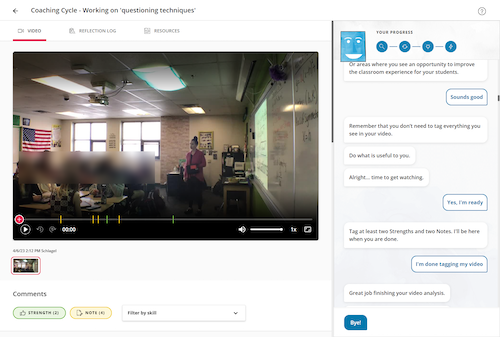
With the platform, teachers like Schlagel engage in personalized coaching cycles to further their development. The platform uses artificial intelligence to guide teachers through a self-coaching cycle aligned to common growth areas as they watch video of their classroom teaching in action.

We recently interviewed Schlagel about the use of this new technology and how her district prioritizes teacher development. 

What were your first thoughts when you heard about using AI for professional learning? Why did you decide to try it?

Last year, I was a mentor to a first-year teacher at my school, and my mentee had to record a lesson of her teaching as part of the induction program. I decided to also record myself conducting a similar lesson, so we could go over the lessons together, discuss what works and what doesn’t, and set goals for improvement.  

This was my first real introduction to video coaching. Admittedly, even as a mentor teacher, I was nervous to record myself. However, I quickly learned it wasn’t that bad seeing myself on screen and that this was a powerful way to reflect on my practice. My mentee and I both learned a lot.

So, when my district offered a new professional development course that would allow us to try out AI coaching, I signed up. I wasn’t sure exactly what I was getting into, but I was already benefiting from video coaching and wanted to see what the new AI aspect was all about. At the very least, I knew this opportunity would provide me more time for self-reflection.

How does the AI coaching process work?

During my first time using the AI Coach platform, I uploaded a video of one of my recent algebra lessons. Then, the platform’s computerized coach provided observation tips and asked me a number of questions to consider as I began to analyze my video. This helped me as I made a number of comments on the platform—both about areas I wanted to improve upon and areas I felt I was excelling in—as I watched my teaching play out.

The guidance from the virtual coach helped me think more critically about my practice (…and it also made me laugh – the coach can definitely be funny and sassy at times!).

This helped me set a goal for myself around increasing student discourse. I wanted to encourage my students to talk more in class, and the platform provided me with a number of instructional resources to help me get better at this skill.

At the end of the coaching cycle, after I incorporated these strategies in the classroom, I came back to the platform and reflected on what I learned. I thought about how these new strategies worked and created an action plan for my continued learning in the future.

How has AI-powered coaching impacted your teaching?

What surprised me most about the AI coaching process was that it opened my eyes to different things I could change (and might have missed) about my teaching. I was able to really reflect on how I was teaching and how my students were responding. 

Sometimes it can be daunting—or even feel less genuine—when a coach or administrator comes in to conduct a formal observation. You may be worried about how your students are acting or unknowingly teach differently than normal.

But, with the AI Coach process, I feel less pressure because it really is just myself reflecting on my teaching alongside a computerized coach. This gives me more freedom to try out a new instructional strategy or take a risk with how I deliver a lesson, without having the feeling of being evaluated.

Continuous reflection is so important, and I’m a firm believer that the best teachers have to be reflective—if you aren’t reflecting on your practice, you aren’t growing!

How do you and your colleagues plan to use AI Coach by Edthena moving forward?

In addition to supplementing in-person coaching, I think AI coaching will continue to be a great support for mentor and mentee teachers alike.

In chats with my administrative team, I’ve also suggested using the AI Coach platform for our school’s yearly peer observations or self-reflection observations. Traditionally for the self-reflection observation, teachers write a paper detailing their teaching and how it can improve, but I think this type of video-based reflection can be more impactful and feel more genuine. And, it will allow teachers to receive the benefits of ongoing coaching which is really about reflecting inward and trying to constantly improve.

My school and district always do a great job of supporting teachers’ growth and encouraging us to take on new and innovative professional learning opportunities. The use of AI Coach is just another example of this! 

5 spooky Halloween videos for students of all ages

9 October 2023 at 12:00
Use these fun Halloween-themed TED-Ed Lessons and videos to engage students in classroom learning and capture their attention.

Key points:

  • TED-Ed Lessons are a great way to inject some fun into learning a new topic
  • During October, take advantage of creepy decorations and Halloween and use these videos to teach students some new facts
  • See related article: 9 TED-Ed Lessons about different holiday origins

It’s October, and for many students, that means pumpkins, scary decorations, and trick-or-treating on Halloween. What better way to celebrate October than to incorporate some fun and spooky videos to engage students, while also teaching them some fun facts?

Teachers with students of all ages can use TED-Ed Lessons to leverage October’s fun events (Friday the 13th in October, anyone?) and speak to students’ different interests.

The TED-Ed platform lets educators build lessons around any TED-Ed Original, TED Talk, or YouTube video. Once teachers find the video they want to use, they can use the TED-Ed Lessons editor to add questions, discussion prompts, and additional resources.

Use these TED-Ed Lessons and videos for brain breaks, to introduce new lessons, or to give students some fun and age-appropriate spooky experiences into your classroom:

1. Where do superstitions come from? Are you afraid of black cats? Would you open an umbrella indoors? How do you feel about the number 13? Whether or not you believe in them, you’re probably familiar with a few of these superstitions. But where did they come from? Stuart Vyse shares the weird and specific origins of some of our favorite superstitions.

2. Why is being scared so fun? At this very moment, people are lining up somewhere to scare themselves, be it with a thrill-ride or a horror movie. In fact, in October of 2015 alone, about 28 million people visited a haunted house in the US. But you might wonder: What could possibly be fun about being scared? Margee Kerr examines the biology and psychology behind what makes fear so fun.

3. The fascinating history of cemeteries: Spindly trees, rusted gates, crumbling stone, a solitary mourner: these things come to mind when we think of cemeteries. But not long ago, many burial grounds were lively places, with gardens and crowds of people — and for much of human history, we didn’t bury our dead at all. How did cemeteries become what they are today? Keith Eggener delves into our ever-evolving rituals for honoring the dead.

4. What can you learn from ancient skeletons? Ancient skeletons can tell us a great deal about the past, including the age, gender and even the social status of its former owner. But how can we know all of these details simply by examining some old, soil-caked bones? Farnaz Khatibi examines a fascinating branch of science known as biological anthropology.

5. A video that terrifies while it teaches? There’s a TED-Ed Lesson for that: Pick your poison: Blood hungry vampires. Zombies on a mission for your tasty brain. Creepy crawlies. No matter your (fictional or real) fright of choice, TED-Ed has a lesson for all of your Halloween needs. So pick out your favorite candy (more on that later), choose a few videos, and have a very happy Halloween.

❌
❌