

Normal view

There are new articles available, click to refresh the page.
Before yesterdayMain stream

3 ways educators leverage gamification strategies

23 November 2023 at 11:00
Gamification helps students dive into learning--and it helps educators present challenging topics in engaging ways.

Key points:

Students don’t have to be video game fanatics to appreciate a gamified classroom lesson. When teachers turn a lesson or tough-to-teach concept into a motivational gamed or use a fun competition to teach new concepts, students become immersed in their learning and are often more engaged–meaning they’re more likely to retain information.

Still, there’s an art to gamifying a lesson and ensuring that students are actually learning instead of just playing a game for points.

Here’s how educators across the country are using tools–from Minecraft: Education Edition to Roblox and easy-to-access online resources–to gamify their lessons and help students engage with learning.

1. Carrie Rosenberg, a fourth grade teacher at Community Christian School, notes that gamification is one of the biggest education trends right now. According to ISTE, “gamification is about transforming the classroom environment and regular activities into a game.” Many students want more than just good grades from school–they want something physical or immediate. Rosenberg uses Gimkit, Kahoot!, and Prodigy to gamify her instruction and motivate students. Learn more about her instructional strategies.

2. Games are part of many people’s lives–so why not use them to benefit students when teaching? Abigail Beran, a fifth grade teacher enrolled in a masters program in education technology, knows that her students are more likely to engage in an educational activity when it is gamified–and that they’re even more likely to do so when the activity is gamified with technology. There are a variety of reading and math apps and websites that cater to gamification, and even provide the opportunity for differentiation. Beran uses tools including Raz KidsDreamscapesProdigy English, and IXL language arts for English/language arts gamification, and uses Prodigy MathMath PlaygroundPet BingoSushi Monster, and IXL math for gamifying math. Discover how she integrates these gamified tools into her classroom.

3. As an educator for more 27 years and a digital learning specialist (social studies) for the past 7 years in Atlanta Public Schools, Felisa Ford has supported educators across the district and beyond as they purposefully integrate technology in the classroom to promote engagement and 21st century skill development. While there are many tools and resources available to educators to support their efforts to create dynamic digital learning environments, one of the most engaging is Minecraft Education Edition (M:EE). Popular among students (and teachers!), M:EE is a game-based learning platform that promotes creativity, collaboration, and problem-solving in an immersive digital environment. Read about five ways Ford has helped the district’s teachers use M:EE into classroom instruction.

How meta creativity prepares students for the future

16 November 2023 at 11:00
We must evolve our definitions of creativity to higher orders to stay relevant, including successfully using AI in and out of the classroom.

Key points:

  • AI is changing education–and these changes can be beneficial if handled correctly
  • Meta creativity–routines that help us engage fully with the hardest parts of creativity–can help with AI integration
  • See related article: 5 positive ways students can use AI
  • For more news on AI and creativity, visit eSN’s Digital Learning page

Nearly 40 percent of teachers expect to use AI in their classrooms by the end of the 2023-2024 academic year. This use of AI at school will impact how students learn and use their creativity as innovation, which will be increasingly necessary in the future as even higher-order thinking skills become standard. There will be long-term effects if the methods of teaching creativity are not adjusted, but if educators embrace AI mindfully, there will be long-term benefits.

In my experience observing educators and students, I started to see a need for more moments of reflection. The education space and other industries are quickly evolving because of AI, but humans, especially young students, aren’t yet hard-wired to adapt at the same pace. In response, educators need to take more time and enlist the help of tools to begin planting the seeds of mindful creativity in relation to AI, which will be a critical skill as young children grow into tomorrow’s workforce.

Moving forward, meta creativity–routines that help us engage fully with the hardest parts of creativity–and even higher-order thinking should be on every educator’s mind when building an environment conducive to both creativity and AI use.

The relationship between AI and creativity

When most people think of creativity, they relate it to the ability to ideate and express original ideas. However, the AI era we live in suggests that we should change this definition since AI can be trained on more information and has demonstrated the ability to make stronger creative connections than humans. We must evolve our definitions of creativity to higher orders to stay relevant, including successfully using AI in and out of the classroom.

One of the most challenging parts of creativity is resisting the impulse to give up when you meet failure or criticism of your ideas, which students commonly face at school when working on group projects or receiving grades. Failure and criticism can lead to students abandoning their own ideas and relying too heavily on AI to be their brains, so to speak. If this is regularly done during school, students will likely continue this habit at their future jobs or other parts of life. To avoid this dependency on AI and other technology, students need stronger self-awareness and reflective routines to engage in the full complexity of creativity.

What is meta-creativity?

Remaining creatively relevant requires self-awareness, adaptability of thinking, and impulse control during the creative process. New routines that help humans engage fully with the most challenging parts of creativity must be introduced. One example of such a routine is mindful breathing when a student faces a setback when working on a creative project. This routine will help students calm down and refocus on the task they’re working on without losing too much progress.

Routines like this are considered meta-cognitive functions, which can serve as solutions for students and teachers trying to remain creative and engaged in the classroom using AI.

How to foster meta creativity

Reflective tools–educational instruments or techniques that encourage students and educators to reflect on their learning experiences and outcomes–are an excellent way for educators to foster meta-creativity in their students. These tools are designed to prompt and support higher-order skills such as critical thinking, self-awareness, and continuous improvement, which are critical for education and life beyond the classroom.

In addition, reflective tools can help educators adapt to today’s rapidly changing world while fostering stronger attention, connection, and intrinsic motivation within their students. By using these tools, educators are taking a step to remove the stigma that schools stunt creativity with their strict rules and routines.

American society is built on the foundation of innovation–that mindset is what starts and operates businesses, creates new products, and continuously sets new standards of excellence worldwide. But where does this innovation come from? The contrast between the constraining creativity in the traditional education system and the defiant, independent culture of regular society may create this innovative thinking, which now translates to higher-order skills and meta-creativity. In addition, the ability to make something from nothing is now the baseline of creativity, and even higher-order thinking will be necessary to excel at this.

While many believe schools are one of many factors diminishing basic creativity, I think schools provide constraints that can actually build up students’ meta-creative capabilities in the long run. After years of structured school days, students are craving a freedom that they never had before. And all the creative and mindful muscles they spent 12 years building are ready to be unleashed as they enter society outside school. Their eagerness to showcase their unique skills will position them to have a positive impact in whatever sector they choose to enter.

AI and other technology have changed how humans think and live. For the education space, specifically, teachers must create a learning environment where students can reach a new level of creativity that allows collaboration with AI and requires even higher-order thinking skills to flourish. This is what will prepare students for the rest of their lives.

While it might be an adjustment at first, implementing meta-creativity and engaging with the most challenging parts of the creative process will result in the best outcomes for educators and students as the era of AI continues to gain momentum.

Learning Through Play Is Powerful – and Students and Teachers Agree!

12 October 2023 at 23:28

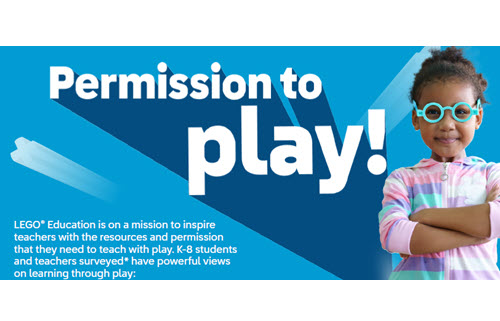
BILLUND, Denmark — To celebrate the second annual World Play Day, LEGO® Education is inspiring teachers to experience purposeful play firsthand by giving students and teachers Permission to Play. 

Play is not just for the playground. It is a powerful tool for teaching that naturally engages students in the learning and builds the skills they’ll need in and outside the classroom like creativity, communication, critical thinking, and collaboration.  

A new survey of K-8 teachers and students from LEGO Education found that nearly all (98%) of students say purposeful play helps them learn and the majority (96%) of teachers believe it’s more effective than traditional methods like lectures or textbooks. On top of that, almost 80% of students want more playful learning experiences in the classroom. 

Despite these benefits, 40% of teachers are incorporating play only once a week or less, and nearly half (47%) think they spend too much time on it.  

“Many teachers feel they can’t easily incorporate play into the classroom, so LEGO Education created the Permission to Play kit as that first step. Once you see students engaged and learning through play, it clicks and the question goes from how to how do we add more?” said Dr. Jenny Nash, Head of Education Impact, U.S. for LEGO Education. 

Whether you are a teacher, administrator, or parent, get Permission to Play by visiting  Rebuild The World, where you can: 

  • Take the Pledge: Commit to adding purposeful play to your own classroom or encourage teachers you know to add more play. 
  • Download free activities: Bring purposeful play into your classroom with activities for you and your students to join in on the fun (can be used with or without LEGO Education products). 
  • Track your play: Get your student(s) involved to see how much progress you’re making with a Color-By-Number template and “Learning in Progress” poster. 

“For nearly three decades, I used purposeful play in my classroom and have seen firsthand the impact it has on both students and teachers,” said Alicia Miller, a retired elementary school teacher from Evans, GA. “There are a lot of trends and products that have their place, but the biggest gamechanger for education is hands-on, playful learning. I encourage every teacher, principal, and parent to try a play-based learning activity with their students and see what joyful and meaningful learning should look like. Our students and teachers deserve to love learning again.” 

Take the pledge and download the Permission to Play Kit at  LEGOeducation.com/RebuildTheWorld.  

*The LEGO Education Survey was conducted by  Wakefield Research among 1,000 US K-8 students and 1,000 US K-8 teachers, split between those who teach/are enrolled in grade K-5 (500) and those who teach/are enrolled in grades 6-8 (500), between Sept. 13th and Sept. 19th, 2023, using an email invitation and an online survey. Data has been weighted. Results from the full survey have a margin of error of +/- 3.1 percentage points. 

About

LEGO® Education offers a range of playful, hands-on STEAM learning experiences based on its comprehensive learning system for students in early learning, primary and secondary education, as well as through after-school programs and competitions. From the Early Learning portfolio to the LEGO® Learning System, these solutions create an active and collaborative environment where learners of all levels and abilities build their confidence, future-proof their skills and spark a lifelong love of learning.  

LEGO, the LEGO logo, the Minifigure and the SPIKE logo are trademarks and/or copyrights of the LEGO Group. ©2023 The LEGO Group. All rights reserved.  

❌
❌