
 Login
Login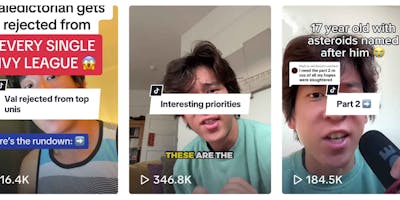


What a Popular TikTok Channel Reveals About the Stress of College Admissions
Daniel Lim reads through the resumes of prospective college students with the excited patter of a color commentator at an NFL game. On his popular TikTok channel, the Duke University senior highlights the seemingly endless number of ultra-achieving students who fail to land acceptances at selective colleges, or, more often, who win some bids and lose others.
“This valedictorian with a near-perfect SAT score got rejected by every single Ivy League school he applied to,” he says in one recent video, in a tone of disbelief. “Let’s look at his application and see what happened.”
It turns out that this anonymous student Lim’s describing — with an SAT score of 1570, trophies in state and regional championships for gymnastics, experience in concert band since fourth grade and membership in honor societies — says that he was rejected from Harvard, Princeton, Stanford, MIT, Columbia, Yale, Cornell, Duke, Carnegie Mellon, and the University of Michigan. The student says he got into Penn State University and the University of Maryland.
Lim, who has more than 200,000 followers, says that nearly 2,000 high school students have sent him their college applications — along with the list of institutions they applied to and the results of their attempts — for him to share and riff on in his videos.
He’s part of a genre of social media trying to make sense of who gets into which selective college — and why — at a time when landing a ‘Yes’ from a selective college is harder than ever.
Statistics show it really is harder to get into college these days, if you’re trying to get into a selective one. If you look at the top 100 universities and the top 50 top liberal arts colleges, the median SAT score it takes to get in has risen significantly since about 35 years ago, according to an analysis a couple years ago in Education Next.
College counselors work to emphasize that finding the right college should be about discovering the right fit — and the fact is that most U.S. colleges, especially community colleges, admit most of the students who apply. But regardless, many students and families perceive selective colleges as the ticket to more opportunity. And at a time of rising college costs, students strive to get into state flagship universities that offer high-quality offerings at a fraction of the cost of private colleges, or to land at Ivy League schools with big endowments that can afford to offer more-generous financial aid than other institutions.
So the process has high stakes. And yet it can seem like a game.
And the rules of that game keep changing.
The pandemic led more colleges to make SAT scores optional, putting more emphasis on so-called “holistic” reviews of candidates. And admissions officials say there’s widespread misperceptions about how that process works.
“A lot of people think if a school has a 5 percent admit rate, they have a one in 20 chance of getting in, which is not what it is,” says Nathan Mathabane, associate director of college counseling at Woodside Priory School, in California, and a former admissions officer at Princeton University. “Some students will have an 80 or 90 percent chance of getting in and many students will have a 0 percent chance of getting in.”
And a landmark U.S. Supreme Court ruling this summer striking down the consideration of race in college admissions has thrown even more uncertainty into the process, as even colleges themselves seek to quickly change their processes to comply with the law.
So students are turning to TikTok and other social media platforms to fill the information void about whether, why and how they’ve got a shot at landing a spot at a selective college.
Another example that Mathabane points to is a Reddit channel called “chance me,” where applicants post their credentials and ask the internet to predict what their chances are of getting into the college that they think works best for them. And some of the comments end up being unkind, or come filled with misinformation about the process.
“I think it’s super toxic,” Mathabane says of the site. “I don't think there's anything that you're going to get from these sites that is going to improve your college search, full stop, and it probably will only stress you out more.”
But Lim argues that his videos, which he also posts on YouTube and Instagram, can help students feel less alone in a stressful process. And he says he can relate, from the stress of his own college search.
For this week’s EdSurge Podcast, we talk with Lim about what he’s learned from seeing so many college applications and from the reactions to his videos, and we hear from Mathabane about how admissions is changing.
Listen to the episode on Apple Podcasts, Overcast, Spotify, Stitcher or wherever you listen to podcasts, or use the player on this page.