
Normal view

There are new articles available, click to refresh the page.
Before yesterdayeSchool News

Is generative AI a beacon for more accessible education?

20 November 2023 at 11:00
Despite low levels of preparedness and barriers to adoption in education, there is a belief in generative AI's potential to empower learners.

Key points:

  • Many educators look forward to the opportunity afforded by AI, but few feel ready to use it
  • Other educators wonder if they have proper district support for AI use
  • See related article: 5 positive ways students can use AI
  • For more news on AI in education, visit eSN’s Digital Learning page

A resounding 90 percent of educators in a recent survey said they believe that AI has the potential to make education more accessible. 

Teachers are recognizing that when implemented ethically and with thoughtful consideration, AI can help students with special needs, learning disabilities, and language barriers, for example, and experience more effective, personalized learning methods, according to the 2023 Educator AI Report: Perceptions, Practices, and Potential from digital curriculum solution provider Imagine Learning.

With generative AI emerging as a pivotal element in the dynamic educational landscape of 2023, Imagine Learning conducted the survey to explore the perceptions, current practices, and future aspirations of educators who have already embraced technology in the classroom. The inaugural report showcases a comprehensive exploration of AI’s current and future role in K-12 classrooms.

When it comes to readiness, however, only 15 percent of educators feel “prepared” or “very prepared” to oversee the use of generative AI in the classroom, with over twice that number (32 percent) expressing they are completely unprepared to do so. What’s more, educators indicate a disparity when it comes to the likelihood of using Generative AI in the classroom, with district and school leaders perceived as less likely to embrace new AI tools when compared to educators and students.

On top of this, only one-third (33 percent) of surveyed educators feel that they have the support they need from their district and school leadership to successfully implement generative AI into their teaching.

Other key findings from Imagine Learning’s report include:

  • Almost half of educators (44 percent) who have used generative AI believe that its use has alleviated the burden of their workload and made their jobs easier.
  • Of the respondents who reported they have not used AI in the classroom, 65 percent cite a lack of familiarity as the primary obstacle to the future utilization of generative AI, with 48 percent also expressing ethical concerns.
  • 72 percent of educators are most concerned about plagiarism and cheating due to generative AI, highlighting the need for clear guidelines for students for using AI with academic integrity.

“Generative AI is a blend of promise and prudence. Its transformative potential is undeniable, but the journey forward requires thoughtful consideration,” said Sari Factor, Vice Chair and Chief Strategy Officer, of Imagine Learning. “Learning is above all a human endeavor. With generative AI as a tool to simplify lesson planning, reduce administrative tasks, and enhance personalized learning, we can empower the potential of teachers and students and improve learning outcomes.”

This press release originally appeared online.

Teacher helps implement the science of reading ‘one bite at a time’

Indiana is in the midst of a statewide push to train more teachers in the science of reading with the goal of improving literacy rates.

This story was originally published by Chalkbeat. Sign up for their newsletters at ckbe.at/newsletters.

Indiana is in the midst of an enormous undertaking to improve literacy rates. The approach: Align state standards, curriculum, and teacher training programs with practices rooted in the science of reading, which emphasizes phonics to help students decode words.

Literacy coach Mika Frame has a memorable mantra for accomplishing big goals. 

“My current principal always tells me, ‘Eat an elephant one bite at a time,’” she said. “Through this saying, he always encourages me to seek change in our staff by taking small steps, as opposed to expecting my teachers to change all at once or in drastic measures.”

A K-2 literacy coach at Rose Hamilton Elementary School in Centerville, Frame is part of the first cohort of educators that trained in reading science practices as part of the Indiana Literacy Cadre. Now she co-teaches, analyzes student data to see who needs more help, and leads her colleagues through the state’s new requirements.

Frame told Chalkbeat about her work as Indiana looks to bring more literacy coaches like her to its schools.

What drew you to a career in education?

My favorite part of high school was when I was a cadet teacher and worked with elementary students. I still love working with children today. I enjoy the energy, enthusiasm, and curiosity of young learners. Witnessing the progress and achievements of students, seeing them overcome challenges, and helping them reach their potential brings me a deep sense of satisfaction.

What does your typical day look like?

My typical day at Rose Hamilton includes working alongside teachers in their classrooms. Co-teaching is my favorite aspect of working with my colleagues. An additional responsibility I have most days involves disaggregating learning data. This data often presents patterns and helps teachers identify subgroups of students who need additional interventions. Each month, I also lead professional learning community meetings and offer new ideas and strategies to our teachers. Finally, coordinating testing is an important part of my position; I help ensure testing protocols are executed with fidelity and testing deadlines are met.

What’s your favorite lesson to teach and why?

My favorite lessons to teach are phonics lessons. Phonics plays a vital role in children’s literacy development by providing them with the tools to decode words, read fluently, and comprehend written materials effectively. It sets the stage for their future academic success. Phonics empowers children to read independently and with confidence. When children can decode words accurately, they can read books and other written materials on their own. This opens up a world of knowledge and imagination. I love seeing children’s eyes light up when they start sounding out words. 

When did you first learn about the ideas of reading science? How have you been able to apply those recently with fellow educators or students?

I first learned in depth about the science of reading when I was accepted into the Literacy Cadre program. In the Summer of 2022, I attended a weeklong training that dove into the science of reading. I have been able to apply these strategies by leading professional learning community meetings. During this time, I’ve encouraged teachers in the building to present to one another about the science of reading instructional practices they are doing in their classrooms. 

Tell us about your own experience with school and how it affects your work today.

I grew up in Modoc, Indiana. My community was rural and consisted of approximately 160 people. I graduated with only 18 students in my class, and that included a few foreign exchange students. It was a close-knit community in which everyone knew each other. This background helps me understand that every single child matters, and no matter the size of the district, helping all students succeed academically and helping them reach their full potential is the ultimate goal in education.

What’s the best advice you’ve ever received, and how have you put it into practice?

My current principal always tells me, “Eat an elephant one bite at a time.” Through this saying, he always encourages me to seek change in our staff by taking small steps, as opposed to expecting my teachers to change all at once or in drastic measures. I have used this advice frequently as our school has been going through new initiatives in the last year. Our next step this coming school year is to look into a new phonics program. We are slowly looking into the programs we are using and making small changes, if needed. Again, small steps that lead to changes are important! 

What’s one thing you’ve read that has made you a better educator?

This past year I read “Shifting the Balance” by Jan Miller Burkins and Kari Yates with my colleagues in the literacy cohort. It really helped me understand the aspects of science of reading. After reading the book, my superintendent was kind enough to buy a set for my teachers, and I led a book study at Rose Hamilton. It was great to meet after school with the teachers and reflect on each chapter, as well as what we do or possibly could do better.

Chalkbeat is a nonprofit news organization covering public education.

Related: The intersection of the science of reading and edtech

Teacher Q&A: Strengthening PD with AI

11 October 2023 at 12:00
Artificial intelligence and AI coaching in PD is guiding teachers through a self-coaching cycle aligned to common growth areas.

Key points:

Just like educational technology is continually advancing, so are best practices for supporting teachers in classrooms. Professional development needs to be relevant, engaging, and personalized.

Megan Schlagel, a high school math teacher in St. Vrain Valley Schools in Longmont, Colo., is an award-winning educator who is dedicated to the continuous improvement of her teaching practices. As part of this dedication, Schlagel, as well as a number of her colleagues, are turning to innovative new approaches to support their learning. This includes the use of AI-powered teacher coaching via the AI Coach by Edthena platform.

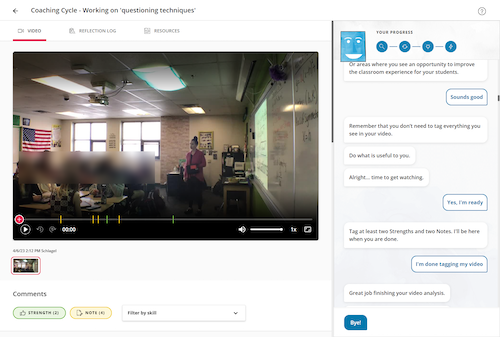
With the platform, teachers like Schlagel engage in personalized coaching cycles to further their development. The platform uses artificial intelligence to guide teachers through a self-coaching cycle aligned to common growth areas as they watch video of their classroom teaching in action.

We recently interviewed Schlagel about the use of this new technology and how her district prioritizes teacher development. 

What were your first thoughts when you heard about using AI for professional learning? Why did you decide to try it?

Last year, I was a mentor to a first-year teacher at my school, and my mentee had to record a lesson of her teaching as part of the induction program. I decided to also record myself conducting a similar lesson, so we could go over the lessons together, discuss what works and what doesn’t, and set goals for improvement.  

This was my first real introduction to video coaching. Admittedly, even as a mentor teacher, I was nervous to record myself. However, I quickly learned it wasn’t that bad seeing myself on screen and that this was a powerful way to reflect on my practice. My mentee and I both learned a lot.

So, when my district offered a new professional development course that would allow us to try out AI coaching, I signed up. I wasn’t sure exactly what I was getting into, but I was already benefiting from video coaching and wanted to see what the new AI aspect was all about. At the very least, I knew this opportunity would provide me more time for self-reflection.

How does the AI coaching process work?

During my first time using the AI Coach platform, I uploaded a video of one of my recent algebra lessons. Then, the platform’s computerized coach provided observation tips and asked me a number of questions to consider as I began to analyze my video. This helped me as I made a number of comments on the platform—both about areas I wanted to improve upon and areas I felt I was excelling in—as I watched my teaching play out.

The guidance from the virtual coach helped me think more critically about my practice (…and it also made me laugh – the coach can definitely be funny and sassy at times!).

This helped me set a goal for myself around increasing student discourse. I wanted to encourage my students to talk more in class, and the platform provided me with a number of instructional resources to help me get better at this skill.

At the end of the coaching cycle, after I incorporated these strategies in the classroom, I came back to the platform and reflected on what I learned. I thought about how these new strategies worked and created an action plan for my continued learning in the future.

How has AI-powered coaching impacted your teaching?

What surprised me most about the AI coaching process was that it opened my eyes to different things I could change (and might have missed) about my teaching. I was able to really reflect on how I was teaching and how my students were responding. 

Sometimes it can be daunting—or even feel less genuine—when a coach or administrator comes in to conduct a formal observation. You may be worried about how your students are acting or unknowingly teach differently than normal.

But, with the AI Coach process, I feel less pressure because it really is just myself reflecting on my teaching alongside a computerized coach. This gives me more freedom to try out a new instructional strategy or take a risk with how I deliver a lesson, without having the feeling of being evaluated.

Continuous reflection is so important, and I’m a firm believer that the best teachers have to be reflective—if you aren’t reflecting on your practice, you aren’t growing!

How do you and your colleagues plan to use AI Coach by Edthena moving forward?

In addition to supplementing in-person coaching, I think AI coaching will continue to be a great support for mentor and mentee teachers alike.

In chats with my administrative team, I’ve also suggested using the AI Coach platform for our school’s yearly peer observations or self-reflection observations. Traditionally for the self-reflection observation, teachers write a paper detailing their teaching and how it can improve, but I think this type of video-based reflection can be more impactful and feel more genuine. And, it will allow teachers to receive the benefits of ongoing coaching which is really about reflecting inward and trying to constantly improve.

My school and district always do a great job of supporting teachers’ growth and encouraging us to take on new and innovative professional learning opportunities. The use of AI Coach is just another example of this! 

❌
❌