Normal view

There are new articles available, click to refresh the page.
Before yesterdayMain stream

Real Talk about AI

16 November 2023 at 19:33

As the hoopla surrounding emerging AI technologies and their impact on education endures, we need to get past whether or not to use ChatGPT—Pandora’s box is officially open—and focus instead on how best to use it. Despite OpenAI recently releasing a guide for ChatGPT in the classroom that demonstrates how teachers can use the large language model software to enhance learning, Zarek Dozda, director of UChicago’s Data Science 4 Everyone, does not think it goes as far as it should to address educators’ concerns about the growth of this emerging tech in classrooms.

In this insightful conversation, Zarek breaks down several particulars he feels need to be addressed, including:

  • More research – OpenAI’s guidance focuses on anecdotal evidence of ChatGPT in classrooms but has little to say about best practices when using ChatGPT as an educational tool.
  • Focus on mechanics – Instead of highlighting education tactics that utilize ChatGPT, OpenAI should provide a more thorough explanation of large language models and how they work.
  • Training for teachers – The specific teachers mentioned in OpenAI’s guidance should be applauded for embracing emerging tech, but there needs to be greater resources for teachers just trying to keep up with AI.

Data Science for Everyone is a coalition advancing data science education so that every K-12 student has the data literacy skills needed to succeed in our modern world. Equitable access to data science education is an opportunity to open doors to higher education, high-paying careers, and an engaged community. Created by the University of Chicago Center for RISC and organized in partnership with The Learning Agency and the Concord Consortium, the group supports a growing community that knows that the data revolution has transformed modern life and we need to prepare our students. 

Other highlights from the conversation include:

Responsibility in AI Usage: Zarek emphasizes the importance of instilling responsible and efficient AI usage in students, preparing them for a future where digital skills are integral to various careers.

Changing Perceptions: The discussion challenges preconceived notions about AI, acknowledging shifts in attitudes among educators and students toward embracing technology as a valuable supplement to traditional teaching methods.

Educator Empowerment: Teachers are encouraged to view AI as an opportunity for professional development, using tools like ChatGPT 4 to create lesson plans and assessments, fostering a collaborative approach to interdisciplinary solutions.

Foundational Skills Remain Crucial: While AI tools advance, Zarek emphasizes the continued significance of foundational skills, asserting that students should still learn mathematics, coding, and critical thinking to understand and address AI-generated errors.

Balanced Implementation: Zarek advocates for a measured approach to AI integration, steering clear of extremes such as outright bans or complete reliance on AI for educational planning. Instead, a gradual introduction with teacher guidance is recommended.

Global Talent Race: The conversation concludes with a call for policymakers to recognize the urgency of upskilling educators, framing education as critical for future economic and international success in a rapidly evolving digital landscape.

Vernier Science Education Launches New Resources to Engage Students in Phenomena-Based Learning During Upcoming Eclipses 

13 October 2023 at 14:00

BEAVERTON, Oregon — Vernier Science Education recently launched new resources to help science and STEM educators leverage the two upcoming eclipses—the “Ring of Fire” annular eclipse on October 14, 2023 and the total solar eclipse on April 8, 2024—to create engaging learning experiences for students. In addition to sharing tips and best practices for collecting data during the celestial events, the company is offering certified eclipse viewing glasses so educators and students alike can safely observe the eclipses taking place.    

“The eclipses provide a perfect—and rare—opportunity for educators to teach students of all ages about real-world, scientific concepts related to light, temperature, electromagnetic radiation, and more,” said David Vernier, Co-Founder of Vernier Science Education. “During the eclipses, educators and students can use our glasses to observe the moon pass between the sun and earth, and they can use our technology to collect data and better understand what is happening in the world around them.”

The CE-certified eclipse viewing glasses can be purchased in class packs of 50 glasses (EC-GL50) on the Vernier website for $25.

Vernier Science Education is offering an array of helpful tips on how to collect data during the eclipse. This includes information on how to use applicable sensors, such as the wireless Go Direct® Light and Color Sensor, Go Direct Weather System, Go Direct PAR (Photosynthetically Active Radiation) Sensor, Go Direct Pyranometer, and Go Direct Surface Temperature Sensor, as well as a number of wired sensors designed specifically for the LabQuest® interface.

Educators are encouraged to share data and pictures from their eclipse experiences on social media using the hashtag #VernierEclipse.

Educators can also access a compilation of reference materials about the eclipse from respected organizations such as NSTA and NASA, as well as safety recommendations and more on the Vernier Science Education website.

To learn more about eclipse resources from Vernier Science Education, visit https://www.vernier.com/eclipse.

About Vernier Science Education

For more than 40 years, Vernier Science Education has been committed to using our experience, knowledge, and passion to create the best and most reliable solutions for STEM education. Our comprehensive solutions include hardware, software, content, assessment, professional development, and technical support. At the heart of Vernier is our deep commitment to being an authentic and trusted partner to STEM educators. We are dedicated to partnering with educators and communities to build a STEM-literate society where students grow up to become knowledgeable citizens who can solve problems, fully contribute to their communities, and drive innovation. For more information, visit www.vernier.com.

Teacher Q&A: Strengthening PD with AI

11 October 2023 at 12:00
Artificial intelligence and AI coaching in PD is guiding teachers through a self-coaching cycle aligned to common growth areas.

Key points:

Just like educational technology is continually advancing, so are best practices for supporting teachers in classrooms. Professional development needs to be relevant, engaging, and personalized.

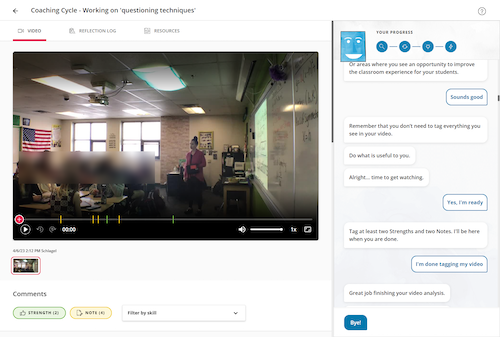
Megan Schlagel, a high school math teacher in St. Vrain Valley Schools in Longmont, Colo., is an award-winning educator who is dedicated to the continuous improvement of her teaching practices. As part of this dedication, Schlagel, as well as a number of her colleagues, are turning to innovative new approaches to support their learning. This includes the use of AI-powered teacher coaching via the AI Coach by Edthena platform.

With the platform, teachers like Schlagel engage in personalized coaching cycles to further their development. The platform uses artificial intelligence to guide teachers through a self-coaching cycle aligned to common growth areas as they watch video of their classroom teaching in action.

We recently interviewed Schlagel about the use of this new technology and how her district prioritizes teacher development. 

What were your first thoughts when you heard about using AI for professional learning? Why did you decide to try it?

Last year, I was a mentor to a first-year teacher at my school, and my mentee had to record a lesson of her teaching as part of the induction program. I decided to also record myself conducting a similar lesson, so we could go over the lessons together, discuss what works and what doesn’t, and set goals for improvement.  

This was my first real introduction to video coaching. Admittedly, even as a mentor teacher, I was nervous to record myself. However, I quickly learned it wasn’t that bad seeing myself on screen and that this was a powerful way to reflect on my practice. My mentee and I both learned a lot.

So, when my district offered a new professional development course that would allow us to try out AI coaching, I signed up. I wasn’t sure exactly what I was getting into, but I was already benefiting from video coaching and wanted to see what the new AI aspect was all about. At the very least, I knew this opportunity would provide me more time for self-reflection.

How does the AI coaching process work?

During my first time using the AI Coach platform, I uploaded a video of one of my recent algebra lessons. Then, the platform’s computerized coach provided observation tips and asked me a number of questions to consider as I began to analyze my video. This helped me as I made a number of comments on the platform—both about areas I wanted to improve upon and areas I felt I was excelling in—as I watched my teaching play out.

The guidance from the virtual coach helped me think more critically about my practice (…and it also made me laugh – the coach can definitely be funny and sassy at times!).

This helped me set a goal for myself around increasing student discourse. I wanted to encourage my students to talk more in class, and the platform provided me with a number of instructional resources to help me get better at this skill.

At the end of the coaching cycle, after I incorporated these strategies in the classroom, I came back to the platform and reflected on what I learned. I thought about how these new strategies worked and created an action plan for my continued learning in the future.

How has AI-powered coaching impacted your teaching?

What surprised me most about the AI coaching process was that it opened my eyes to different things I could change (and might have missed) about my teaching. I was able to really reflect on how I was teaching and how my students were responding. 

Sometimes it can be daunting—or even feel less genuine—when a coach or administrator comes in to conduct a formal observation. You may be worried about how your students are acting or unknowingly teach differently than normal.

But, with the AI Coach process, I feel less pressure because it really is just myself reflecting on my teaching alongside a computerized coach. This gives me more freedom to try out a new instructional strategy or take a risk with how I deliver a lesson, without having the feeling of being evaluated.

Continuous reflection is so important, and I’m a firm believer that the best teachers have to be reflective—if you aren’t reflecting on your practice, you aren’t growing!

How do you and your colleagues plan to use AI Coach by Edthena moving forward?

In addition to supplementing in-person coaching, I think AI coaching will continue to be a great support for mentor and mentee teachers alike.

In chats with my administrative team, I’ve also suggested using the AI Coach platform for our school’s yearly peer observations or self-reflection observations. Traditionally for the self-reflection observation, teachers write a paper detailing their teaching and how it can improve, but I think this type of video-based reflection can be more impactful and feel more genuine. And, it will allow teachers to receive the benefits of ongoing coaching which is really about reflecting inward and trying to constantly improve.

My school and district always do a great job of supporting teachers’ growth and encouraging us to take on new and innovative professional learning opportunities. The use of AI Coach is just another example of this! 

How AI could save–or sink–creative writing in schools

AI can be a powerful tool for rapid feedback and iterative prototyping, reshaping the future of education--and of creative writing.

Key points

This story originally appeared on the Christensen Institute’s blog and is reposted here with permission.

Ninth-grade English was a paradox for me—both the best and worst year for helping me learn to write. 

Every month, my Advanced English teacher, Mr. Johnson, assigned our class one of the classics of English literature and expected us to demonstrate what we had learned with an accompanying essay. He set a high bar for clearly articulated theses, well-structured paragraphs, well-crafted sentences, and supporting quotes from the text. I credit Mr. Johnson’s class for eventually helping me pass the AP Writing exam my senior year without ever taking an AP-level English class.

However, that same 9th-grade English class also planted the seeds of debilitating habits and mindsets in my writing process. Mr. Johnson was willing to provide feedback on drafts. But the demands of all my other classes and activities rarely afforded me the time to take him up on his offer. Consequently, I found myself in a pressure cooker each month, drafting essays in the final days and hours before they were due. The ticking clock and the weight of a looming grade forced me into a mindset where every sentence had to be near-perfect in my desperation to maintain my academic record. Writing became less of an exploration of ideas and more of a high-stakes gamble.

Fortunately, schools and society seem to be entering an era in which AI could completely upend the dysfunctional part of my 9th-grade English experience.

The damaging mindsets forged by conventional grading

The pressure I felt to craft near-perfect drafts on the first attempt is hardly unique to me—it’s symptomatic of a broader issue common across US K–12 education. In most classrooms, students don’t iterate on their work. With all the volumes of content to be covered, there just isn’t time in either the class period or the school year for cycles of feedback. Instead, teachers give assignments, students complete those assignments, teachers grade students’ work, and each assignment grade leaves an indelible impact on a students’ final grade for that class. Grades from individual classes then get averaged together, semester by semester, into GPAs that permanently carry the marks of any prior failures and shortcomings in a students’ learning. 

I suspect these norms of practice are major cultivators of what Stanford psychologist Carol Dweck would term a ‘fixed mindset.’ They create a stifling atmosphere where failure is a brand to be avoided rather than an experience to learn from. The binary of ‘success’ and ‘failure’ prevails, leaving little room for trial and error, an invaluable aspect of the learning process. The emphasis on the end product over the process perpetuates the fear of failure, curbing creativity, curiosity, and the potential for new discoveries. The outcome? A learning experience that prioritizes safe choices and known paths over innovative thinking and problem-solving.

Now, more than ever, students’ future success in an ever-changing world requires that they learn how to think critically and creatively while collaborating with others to solve complex problems. But the unwritten curriculum of most schools—instilling process perfectionism through rewarding flawless performance—is probably doing more harm than good.

The threat and opportunity of AI

Against this backdrop, there’s a lurking concern that AI is just going to help students find mindless shortcuts for cheating their way to good grades. But that’s only a risk if schools and teachers hold a low bar for what they expect of their students. Wharton professor, Ethan Mollick, made a compelling argument in his ASU+GSV talk last April that ChatGPT should really mean the end of lousy student writing. “I don’t accept papers that aren’t good anymore because the minimum you can do is turn in a good paper. So, why am I going to force you to write a bad one? … [With AI] we can increase our standards of what we can accomplish.” Knowing the minimum bar that tools like ChatGPT can produce, he expects students to prove that they’ve developed their ideas beyond what the AI can generate.

Journalist Adam Davidson noted on a recent Freakonomics podcast episode that he’s taken to calling ChatGPT “the ‘B-minus at everything’ program.” If schools set low expectations for the quality of students’ essays, then AI will enable those who so desire to cheat their education. But if schools and teachers want to elevate expectations for their students, AI can be a powerful tool for rapid feedback and iterative prototyping. 

Breaking 9th-grade writing mindsets and habits

I think my 9th-grade self would have loved having a tool like ChatGPT to help with my essay assignments. But the real reason why is probably not what you’re thinking.

I relish the first part of writing—coming up with ideas worth sharing—and I find satisfaction in the final part of writing—polishing my prose for persuasive power. But the middle part—hammering out a lousy first draft—is a painful process given my bad habit of perfectionistic editing as I write. But over the last few months, I’ve found two amazing things that ChatGPT can do for me as a writer.

First, ChatGPT allows me to do what my colleague, Bob Moesta, calls “rapid prototyping.” I feed the AI my ideas—often through verbal dictation using its mobile app—and then it hands me back an outline for organizing those ideas into a blog post. We do some back and forth on the outline, then I ask it to write me the first draft, one headings-worth at a time. I’m not giving it a topic and then asking it to do the work of coming up with what to say on that topic. I’m doing the thinking, then it’s doing the initial writing. 

Are the first drafts written by ChatGPT up to par with what I expect of my own writing? No. They look like they were written by an average high school student following all the formal conventions they’ve been trained to mimic. The structure is so predictable that it’s boring, and the sentences are full of cliche turns of phrase.

But with this leg up from ChatGPT, a process that has typically taken me around four to six hours gets cut down to about an hour. What’s even more important is that this collaboration between me and the machine has been easing my dread of writing the first draft.

Second, ChatGPT gives me quick and convenient access to an outside perspective on my work. When I’m not sure if my structure is working, or I’m struggling to come up with a concise and catchy way to convey my ideas, outside feedback is often the best remedy. Unfortunately, the turnaround time for collegial feedback is typically a day or more, and when my colleagues are pressed for time, asking for feedback can feel like an imposition. Meanwhile, ChatGPT can often give me just what I need: a little bit of new insight to break me out of the rut I’m stuck in. Are its insights as good as those of a colleague? No. But what it lacks in quality it compensates for in on-demand responsiveness.

In short, while AI can handle the ‘how’ of writing, it falls short in understanding the ‘why’ and ‘what’—the substance that gives a piece of writing its rigor and depth. Nonetheless, I’ve experienced first hand how tools like ChatGPT can facilitate cycles of writing, revising, and refining, all while helping me foster low-stress, fail-forward mindsets.

Harnessing AI’s potential to revolutionize educational feedback

I think we’re on the verge of a future where AI dramatically reshapes how students experience learning to write. With the help of AI, students will be able to see more clearly that the most important part of writing isn’t what happens when your fingers hit the keyboard—it’s the learning and the thinking that happens before you ever pull up a blank page. Once they do their thinking, AI can help them translate what they’ve discovered into written text. Then, as they learn to work with that text to hone in on what they really want to communicate, sophisticated algorithms can help them sharpen their intuitions for that medium by providing real-time feedback on not only grammatical errors but also argument coherence, evidence use, and rhetorical strategy.

When schools and educators see AI as an ally rather than an adversary, I suspect they’ll discover an unprecedented opportunity to both raise the bar on what they expect from their students as well as make the learning experience more enjoyable and meaningful. Did I mention that I used AI to write the first draft of this piece?

This post was written with assistance from ChatGPT. For anyone interested in how the post was crafted, here’s a link to the ChatGPT conversation that helped produce this post.

Nothing but winning: Edtech honors announced by eSchool, IEI, and Classlink

6 October 2023 at 22:54

When did October become awards season in the world of edtech? This week’s newsfeeds are stuffed with announcements for finalists and honorees for both educators and vendors on the best and brightest developments for teaching and learning.

The winners:

Of course, we need to start with the most prestigious! The eSchool News Hero Awards, honors educators for their exemplary use of innovative edtech to support student learning:

  • John Arthur, 6th grade teacher at Meadowlark Elementary School in Salt Lake City, Utah
  • Dr. Jesus Jara, superintendent of Clark County School District (CCSD) in Nevada
  • Tom Lamont, painting and design technology instructor at Blackstone Valley Regional Vocational Technical High School (BVT) in Massachusetts 

Winners were chosen for their commitment to education despite obstacles–including achievement gaps, teacher burnout, and funding–and their creativity and innovation in helping all students continue learning while ensuring students felt safe, empowered, and engaged.

Nominations were judged by a panel of education experts, including Laura Ascione, eSchool News editorial director, and Eileen Belastock, CETL, Belastock Consulting. I look forward to interviewing them in the coming days for the podcast. Here’s one of my favorites from years past.


The Institute for Education Innovation, a national school superintendent think tank that serves as the bridge between district leaders and the K-12 industry to develop solutions to the greatest challenges in education, also this week announced the finalists for the third annual Supes’ Choice Awards. The Supes’ Choice Awards honor the most innovative education products and solutions, and are the only education industry awards judged exclusively by school district superintendents.

“Now in its third year, the Supes’ Choice Awards have become known in the education industry as one of the top honors recognizing forward-thinking edtech companies,” said Doug Roberts, founder and CEO of the Institute for Education Innovation (IEI). “Judged by the country’s most innovative superintendents, the awards provide edtech company founders and CEOs with valuable insights to help them create more meaningful and impactful learning experiences for students. In fact, students and teachers alike benefit the most when edtech companies partner with administrators on the front lines of K-12 education to perfect their products and solutions.”

Finalists for the Supes’ Choice Awards are chosen based on a demonstrated commitment to student outcomes, innovation and ingenuity, client support, interactivity, and engagement. The finalists for each category include:

  • AI-Powered Education Solution: Scrible, Navigate360
  • Best Gamification in Learning: Giant Steps, ExploreLearning – Reflex
  • Excellence in Special Education: Stages Learning – Language Builder: Academic Readiness Intervention System (ARIS), TouchMath
  • Tutoring Platform: FEV Tutor, Tutor.com and The Princeton Review
  • College and Career Readiness Solution: Find Your Grind, Credentialate by Edalex
  • Communications and Family Engagement: AllHere, TalkingPoints
  • Equity Champion: Clayful Health, Raz-Plus Espanol by Learning A-Z
  • K-12 Newcomer: Kognity for High School Science, FrenalyticsEDU
  • Keeping Kids Safe: Navigate360 – ALICE, Navigate360 – P3 Campus
  • Learning Management System: Jupiter, D2L – Brightspace
  • Literacy Instructional Solution: NoRedInk, Phonics, Reading, and Me, Read Naturally
  • Math Instructional Solution: TouchMath, Magma Math
  • Most Innovative PD Solution: Lexia LETRS, Lexia Aspire Professional Learning and thinkLaw
  • Operations/Finance/HR Solution: Operoo, Upbeat and iiQ Facilities
  • SEL Solution of the Year: Sown to Grow, Care Solace
  • STEM/STEAM Instructional Solution: Kide Science, ExploreLearning Gizmos
  • Virtual Instructional Experience: Proximity Learning, Tutored by Teachers

Winners will be revealed at the 2023 Supes’ Choice Awards Gala taking place on Friday, December 8 in New York City. The Gala is a celebration honoring the finalists and winners that includes dinner, an awards ceremony, and live entertainment.


ClassLink celebrated the exceptional achievements of individuals and teams during the closing session of their annual ClassLink Learning Analytics Summit, CLAS 2023, on October 5th.

THE CLAS Awards of Excellence celebrate the innovative ways individuals and teams use data to better serve their district’s learners, recognizing the educational impacts of institutions, leaders, and experts.

Data Storyteller Award

  • Winner: Connie Chin (Bibb County School District, GA)
  • This award recognizes an individual who expertly uses data analysis to inform strategy and drive teaching and learning in their organization.

Data Bridge Builders Award

  • Winner: Tonja Brun & Team (Savannah Chatham Public Schools, GA)
  • This award recognizes an organization that excels at collaborating and building toward a data-driven culture to improve teaching and learning.

Data Security Champions Award

  • Winner: Keith Price & Team (Vestavia Hills Schools, AL)
  • This award recognizes an organization using analytics/security insights to inform their data security strategy implementation.

“We established the CLAS Awards of Excellence as a tribute to the remarkable individuals and teams leading the charge in advancing digital learning through innovative data utilization. All of us at ClassLink are deeply honored to witness the inventive applications of our Analytics tools by the showcased winners. Their efforts inspire us all!”

Berj Akian
Founder & CEO, ClassLink

❌
❌