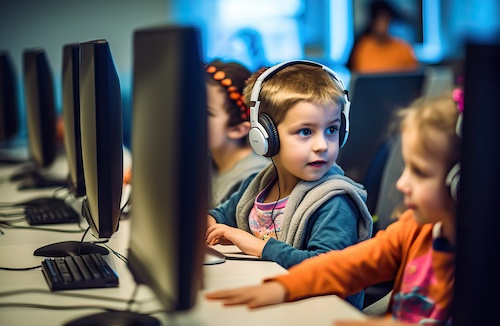
Children get one childhood, and time is one of the most precious resources we have in schools. For these reasons, I am increasingly frustrated that I have next to no power to stop my own children from wasting their time in front of a computer screen.
That’s because screens are where they are expected to access and complete their schoolwork and homework. My children are assigned to watch online videos and answer questions about them in an online form. Their grades reflect their responses.
No doubt, this assigned screen time probably comes from a good place. Teachers want to provide students with experiences they will enjoy. Why give students a reading that they may not do when you could give them a video they are more likely to watch?
Watch enough videos and students begin to believe that learning must be passively entertaining and that the best way to take in new information is through streaming content. The most compelling story is often not the most truthful one, but the one that is the most slickly produced.
I don’t want that for my children. I want my children to enjoy the challenges of learning, to take in multiple sources, and to ask good questions about everything they engage with. I don’t want them on autopilot, screening their way through childhood.
UNESCO recently published a book titled “An Ed-Tech Tragedy?” and it is sobering. This book spells out how pandemic school shutdowns resulted in massive learning losses. It also highlights the costs, in terms of mental health, of spending so much time on screens.
For years, educational technologists have cast personalized online learning as an answer to what plagues education. But even when ed tech was needed most, these tools did not always rise to the occasion. They couldn’t take the place of teachers, peers, and classroom conversations. And our reliance on them has instilled terrible habits in teachers and students.
Parents were rightly frustrated and angry when their children were robbed of the opportunity to attend school because of pandemic lockdowns. It is not good for a child to be away from their peers and in front of screens. Key social, emotional, and intellectual skills are lost when this happens. That’s why we must not replicate the worst aspects of school lockdowns now that children are back in school. Children should spend time engaging their teacher and each other–making eye contact and appreciating what can only be learned through human presence–not retreating back into the safe, solitary spaces of their devices.
Their schoolwork should have them engaging with what is best in our culture, not what is most convenient or entertaining. This means reading challenging texts with students and doing the work of helping them develop their voices in relation to these texts. However, educators seem to be having a hard time remembering that distance learning was the best we could think to do during the lockdown, not a best practice that we should continue.
I am not afraid to mourn all that was lost because of the pandemic. Children suffered tremendously, and schools across the country will be dealing with the academic, social, and emotional fallout for years to come. My grieving process involves honoring my hopes and fears from the middle of the pandemic. I promised myself then that if we ever got back to normal, I wouldn’t take the physical presence of my students for granted. I would look at their unmasked faces and try to communicate how much I appreciated that we were together.
Screens, and the illusion of engagement they offer, get in the way of this type of lived gratitude, and they distract us from what matters.
To be clear, teachers’ lives in schools are often tremendously difficult. Many educators are demoralized and under-appreciated, but an over-reliance on screens will not make the work of teaching more rewarding or valued. It’s human connections that make teaching an endlessly rewarding calling. I know this from my own classrooms and my experience training future teachers.
As much as I may internally complain about having to pick up all the little Lego pieces, Magna-Tiles, and wooden blocks that my boys leave scattered around the house at the end of a long day, I know that this type of embodied play is the foundation of a good childhood. And as hard as it might be to listen–really listen–to the stories my daughters tell as they process their day at school (and not just let my mind wander to all the items on my to-do list), there is no greater gift we can give children than our fullest attention.
I am not a perfect parent or teacher, but I do know that I am at my best when I am present. And I know that screens keep me from offering my full presence. I wish I had more power to keep them out of schools because I know my children–and all of our children–deserve better.
Get the latest news about digital learning by going to eSN’s Digital Learning page
Right now is the perfect time to start a research project with your students, as it will help them develop skills they will use for the rest of their lives. While your students, who have grown up in the Information Age and think they already know everything, any classroom teacher knows that our students need help more than they think.
As a school librarian for the past 11 years, my primary focus has been on helping students become adept navigators of the sea of information they live in. By the time students reach me in high school, they are already juggling multiple social media accounts and unknowingly driving many business and political decisions through their media consumption.
Our students’ belief that everything they need to know is online can, without the right skillset, leave them prey to misinformation. So how do we teach our students to steer through the online ocean of data to be both effective researchers and responsible digital citizens?
Here are 4 must-have resources for teaching high school students how to research:
Digital encyclopedias like Britannica School or Credo Referenceare still important, and vetted, sources of basic information. Each provides students with a credible resource and gives them helpful notation and citation tools. But don’t settle for just one. Take students on a tour of both databases and explore the differences. Britannica School is user-friendly and comprehensive, which makes it an ideal tool for building student confidence in their research skills. Even if your students are literal social media influencers, they may be apprehensive or overwhelmed navigating a database, and we do not want them to give up and turn to Google. They need to develop their research skills before they are ready to evaluate content from across the world wide web. The bold, colorful text features and differentiation of reading levels make Britannica School engaging and easy to use, and it is a trusted source of information.
Although both databases offer similar content, Credo Reference has a unique feature called Visual Exploration that you and your students will love. The database will retrieve your search results in the form of a mind map, which links your search term to related terms that are hyperlinked to vetted content. Articles related to the original search term appear alongside the mind map. Visual Exploration is an effective and interactive tool for teaching students about choosing search terms and narrowing their research topics. Credo Reference also has a series of short research tip videos for students on topics such as “what to do when your topic is too broad.”
Upper-level courses require students to navigate and analyze more complex sources than a standard encyclopedia entry, which can often be just a list of facts. Whether you are teaching U.S. Government or A.P. Language and Composition, your students are learning to evaluate persuasive writing and identify propaganda, because these are key information literacy skills. Gale In Context: Opposing Viewpoints not only provides students with curated sources and all the tools of an online encyclopedia but also introduces students to well-researched writing from various perspectives. A huge part of research is thinking critically about the credibility and intent of the source, and this database provides a safe space to analyze and examine issues from multiple angles. Gale In Context: Opposing Viewpoints is both visually appealing and has a unique feature for visual learners. The Topic Finder retrieves results as your choice of a tile or a wheel that displays terms at various sizes depending on the number of results for that term. For example, a Topic Finder search for “Artificial intelligence” displays “mental health” among the largest clusters of the tile or section of the wheel, which lets me know I can find significant content in the database related to A.I. and mental health. There is a curriculum search and an Educator Resources page with helpful tip sheets and worksheets, including one for students to create their own concept map.
Before you dive into an encyclopedia head first, you may want to go to Discovery Education Experience and gather some tools for teaching research effectively. You do not need to build a lesson from scratch. There’s a wealth of media within the platform to help you activate prior knowledge, develop assignments and create interactive lessons on any topic. The Discover Data channel, which is the result of a partnership between the Nielsen Foundation, Discovery Education, and the National Afterschool Association, has interactive, relevant lessons that you can adapt for your students. One of my favorites is the “Social Media and Misinformation” presentation. You can use it as an introduction to information literacy or assign the presentation as a self-paced lesson for students. In fact, you can use the Build an Activity feature with this or another presentation from Discovery Education to create an assignment and share it directly to Google Classroom, Microsoft Teams, Schoology or Canvas.
With these essentials in your toolbox, you will be able to equip your students with research skills that will help them unlock success in and out of the classroom.
Study.com released new survey data last month that sheds light on parents’ evolving attitudes towards the role of schools as students head into the third school year post-pandemic. The education platform surveyed parents in California and Texas to understand their perspectives on their children’s education. Notably, 55 percent and 47 percent of parents in California and Texas, respectively, support extending the school year to provide students with increased learning time, and 46 percent of California parents and 43 percent of Texas parents favor the use of A.I. tools like ChatGPT for academic help in schools.
Across both states, a significant number of respondents believe in a shared responsibility between parents and schools to foster academic growth. Over a third assign a major or complete responsibility to schools in this regard. However, a large percentage of parents in California (28 percent) and Texas (27 percent) feel that schools are taking minimal or no responsibility post-pandemic to help their child catch-up academically. A significant number of parents demonstrated dedication to improving their child’s education through the utilization of district and schoolwide resources as well as support in the home:
37 percent of California parents and 41 percent of Texas parents have sought external educational support, such as tutoring or counseling, for their children.
In California, most parents have sought tutoring or study sessions (26 percent), homework help or after-school programs (23 percent), or educational online platforms (20 percent).
In Texas, most parents have sought tutoring or study sessions (31 percent), homework help or after-school programs (19 percent) educational online platforms (16 percent).
The enduring consequences of academic disruptions caused by the COVID-19 pandemic underpin the motivations driving parents to seek additional support tools for their children’s education. In both states, more than a third of parents reported a substantial negative impact on their child’s academic performance due to the pandemic and related social-emotional challenges.
46 percent of California parents and 40 percent of Texas parents say their child faced social-emotional challenges impacting their academics.
65 percent of California parents and 69 percent of Texas parents are very or somewhat concerned about the long-term impact of learning loss on their child’s academic, career, and socioeconomic success.
The third school year post-pandemic emerges as a pivotal moment for parents to incorporate effective learning resources into their children’s academic journeys, such as A.I. or tutoring, to help mitigate the wide-ranging negative effects of the pandemic.
“Despite most parents feeling like they have the resources available to assist their child, the majority of them struggle with specific subjects, especially math,” said Rachel Mead, Director of Tutoring at Study.com. “The start of the school year is an ideal time for parents to implement additional learning supports such as supplemental online resources or the formulation of a structured home learning plan.”
Teachers across Canada say it’s time to embrace new teaching models to better align with the realities, opportunities and challenges of today’s classroom and tomorrow’s workplace. In a new survey from Microsoft of over 500 Canadian teachers and school leaders, most said schools need to do more to adapt to the evolving needs of students. Teachers are calling for changes that make classrooms more engaging, inclusive and relevant for a new digital era.
New models for a new era of digital innovation
From AI to interconnected smart devices, teachers recognize that the rapid pace of technological innovation is changing the workforce students will be joining, but few classrooms are teaching the skills students need to succeed in the new digital world. In fact, ninety percent of teachers surveyed agree it’s important to teach students the digital skills they’ll need for modern life, but only half of teachers (52 percent) say students are taught in ways that are relevant to the skills they need for the future.
Strikingly, the survey revealed an overwhelming majority of teachers (79 percent) felt data literacy and digital citizenship were essential skills for today’s students, but these topics were only taught in 22 and 53 percent of classrooms respectively. While teachers have just begun to consider the implications of AI in education, 41 percent of teachers believe that students should learn about generative AI to better equip them for life outside school and in their careers. That number rose to 50 percent among teachers of grades 7-12.
“It’s crucial that we listen to teachers so we can better empower students in their learning and be prepared to contribute to Canada’s economic future” said Elka Walsh, Associate Vice President, Learning & Teaching, at Microsoft Canada. “We have a responsibility to address these gaps, reignite a love of learning, and help students thrive in a digital world.”
Digital tools more prevalent since the pandemic, but not used effectively
For many teachers, the pandemic spurred the adoption of digitally enhanced learning in the classroom. Eighty-two percent of teachers surveyed said their school’s use of digital tools started or increased with the pandemic. But only 35 percent of respondents said most teachers are equipped with the best digital tools to help them teach and a similar number (34 percent) said teachers receive the training needed to use these tools effectively. Six out of ten respondents said teaching methods should change to make the most of these tools. Among the most promising use cases for teachers, according to the survey, was time management. Eighty percent of teachers agree they need more tools to help them manage their time more productively – an unsurprising stat given that 86 percent of teachers rate their workload as high or very high.
The results also indicated a clear difference in approach to technology in the classroom between those schools with an established sustainable digital strategy and those without. When asked if students were more engaged when digital tools are used in the classroom, three quarters of respondents with a digital strategy agreed. Among teachers in schools without a digital strategy, fewer than half agreed technology helped to increase engagement.
Engagement and inclusion need a boost
It is apparent that teachers are struggling to keep students engaged, particularly when faced with the emotional and wellbeing challenges related to the pandemic. Only half of teachers surveyed (51 percent) said students are taught in ways that engage them and keep their interest and only a third (35 percent) agree schools are succeeding in helping to address students mental and emotional wellbeing.
Today’s teachers know inclusion and accessibility is crucial to help every student reach their potential. Ninety-five percent said inclusive and accessible teaching resources are somewhat or very important. But only 48 percent say current teaching methods are inclusive and only 46 percent feel students are taught in ways that are responsive to their individual needs. Teachers also want schools to do more to address the mental and emotional wellbeing of students (74 percent) and feel students are still emotionally challenged by the disruption of the pandemic (72 percent).
“Canada’s teachers are telling us we need revitalized learning models so their students don’t get left behind” said Marc Seaman, Vice President, Education Segment for Microsoft Canada. “New models are critical to improve outcomes for all students and prepare them for the digital future.”
The objective of this report is to inform and inspire the EdTech community – including educators, policymakers, entrepreneurs, and investors – by synthesizing the views of innovators who are active across a wide range of EdTech segments and educational institutions.
This report aims to provide insights and guidance for EdTech companies seeking to achieve product-market fit in a post-pandemic blended learning environment. It does so through a combination of qualitative interviews with EdTech leaders and quantitative data analysis to address the challenges and opportunities in the EdTech sector.
The report emphasizes the importance of EdTech in nurturing the intellect and character of future generations and highlights the significant impact it can have when it succeeds in its mission. Achieving product-market fit in EdTech is not just about creating a successful app or platform; it’s about equipping learners with the tools they need to thrive, understand the world critically, and face life’s challenges with resilience.
By providing a holistic understanding of EdTech’s transformative potential and the dynamics of the sector during the pandemic, the report aims to help EdTech companies make informed decisions and execute thoughtful strategies. It underlines the need for strategic planning and execution to ensure that EdTech products are aligned with the needs of learners and educators.
EdTech innovators must also navigate various challenges, including diverse educational needs, institutional norms, and cultural considerations. The education sector operates differently from the tech world, leading to potential tensions among stakeholders. Aligning timing and planning is essential to ensure that EdTech products meet the evolving needs of both learners and the broader community.
Practicality often trumps high-end features in the EdTech industry, as schools seek tools to address everyday challenges like grading and classroom management. As classroom sizes increase, there’s a growing demand for solutions that can manage larger groups and ease teacher workloads. The focus is on technologies that integrate seamlessly into education to enhance the learning process.
The shift to online and blended learning models, accelerated by the pandemic, is likely to continue. Institutions see these models as opportunities to reduce costs, increase enrollment, and provide flexibility to students. However, maintaining the quality of education and socio-emotional skill development remains crucial.
Accessibility, flexibility, and inclusivity are key considerations in EdTech. Accommodating diverse learning styles, facilitating asynchronous learning, and ensuring equitable access to tools are priorities. Personalizing education to individual student needs is a prominent trend.
Collaboration with educational institutions and the public sector is often essential for EdTech growth. Navigating bureaucratic procedures and bridging gaps can lead to successful partnerships.
EdTech should enhance the learning experience rather than replace it. While technology can amplify effective teaching, it cannot compensate for poor teaching. The human element, including social connections and mental well-being, remains vital in education.
Balancing analog and digital content is an ongoing conversation, but the pandemic emphasized digital access as a fundamental right. A surge in funding has led to the launch or expansion of many new platforms and tools, requiring those in the EdTech industry to assess their position in education budgets.
Preparing for profound changes in the EdTech ecosystem is crucial. Supporting educators, upskilling deployment teams, and ensuring organizations have the resources to sustain digital progress are integral to future growth. Additionally, the potential of AI to drive alternative assessment methods could reshape educational practices and outcomes.
This report will provide answers to the following questions:
How can EdTech providers best achieve product-market fit?
What are popular views on blended learning environments?
How has the pandemic impacted the reputation and viability of EdTech?
Which areas of EdTech are being overlooked?
What are the benefits and risks of gamification and other digital trends?
What strategies and trends signify potential growth trajectories for EdTech?
BEAVERTON, Oregon — Vernier Science Education recently launched new resources to help science and STEM educators leverage the two upcoming eclipses—the “Ring of Fire” annular eclipse on October 14, 2023 and the total solar eclipse on April 8, 2024—to create engaging learning experiences for students. In addition to sharing tips and best practices for collecting data during the celestial events, the company is offering certified eclipse viewing glasses so educators and students alike can safely observe the eclipses taking place.
“The eclipses provide a perfect—and rare—opportunity for educators to teach students of all ages about real-world, scientific concepts related to light, temperature, electromagnetic radiation, and more,” said David Vernier, Co-Founder of Vernier Science Education. “During the eclipses, educators and students can use our glasses to observe the moon pass between the sun and earth, and they can use our technology to collect data and better understand what is happening in the world around them.”
The CE-certified eclipse viewing glasses can be purchased in class packs of 50 glasses (EC-GL50) on the Vernier website for $25.
Vernier Science Education is offering an array of helpful tips on how to collect data during the eclipse. This includes information on how to use applicable sensors, such as the wireless Go Direct® Light and Color Sensor, Go Direct Weather System, Go Direct PAR (Photosynthetically Active Radiation) Sensor, Go Direct Pyranometer, and Go Direct Surface Temperature Sensor, as well as a number of wired sensors designed specifically for the LabQuest® interface.
Educators are encouraged to share data and pictures from their eclipse experiences on social media using the hashtag #VernierEclipse.
Educators can also access a compilation of reference materials about the eclipse from respected organizations such as NSTA and NASA, as well as safety recommendations and more on the Vernier Science Education website.
For more than 40 years, Vernier Science Education has been committed to using our experience, knowledge, and passion to create the best and most reliable solutions for STEM education. Our comprehensive solutions include hardware, software, content, assessment, professional development, and technical support. At the heart of Vernier is our deep commitment to being an authentic and trusted partner to STEM educators. We are dedicated to partnering with educators and communities to build a STEM-literate society where students grow up to become knowledgeable citizens who can solve problems, fully contribute to their communities, and drive innovation. For more information, visit www.vernier.com.
 Login
Login