Normal view

There are new articles available, click to refresh the page.
Before yesterdayMain stream

3 ways educators leverage gamification strategies

23 November 2023 at 11:00
Gamification helps students dive into learning--and it helps educators present challenging topics in engaging ways.

Key points:

Students don’t have to be video game fanatics to appreciate a gamified classroom lesson. When teachers turn a lesson or tough-to-teach concept into a motivational gamed or use a fun competition to teach new concepts, students become immersed in their learning and are often more engaged–meaning they’re more likely to retain information.

Still, there’s an art to gamifying a lesson and ensuring that students are actually learning instead of just playing a game for points.

Here’s how educators across the country are using tools–from Minecraft: Education Edition to Roblox and easy-to-access online resources–to gamify their lessons and help students engage with learning.

1. Carrie Rosenberg, a fourth grade teacher at Community Christian School, notes that gamification is one of the biggest education trends right now. According to ISTE, “gamification is about transforming the classroom environment and regular activities into a game.” Many students want more than just good grades from school–they want something physical or immediate. Rosenberg uses Gimkit, Kahoot!, and Prodigy to gamify her instruction and motivate students. Learn more about her instructional strategies.

2. Games are part of many people’s lives–so why not use them to benefit students when teaching? Abigail Beran, a fifth grade teacher enrolled in a masters program in education technology, knows that her students are more likely to engage in an educational activity when it is gamified–and that they’re even more likely to do so when the activity is gamified with technology. There are a variety of reading and math apps and websites that cater to gamification, and even provide the opportunity for differentiation. Beran uses tools including Raz KidsDreamscapesProdigy English, and IXL language arts for English/language arts gamification, and uses Prodigy MathMath PlaygroundPet BingoSushi Monster, and IXL math for gamifying math. Discover how she integrates these gamified tools into her classroom.

3. As an educator for more 27 years and a digital learning specialist (social studies) for the past 7 years in Atlanta Public Schools, Felisa Ford has supported educators across the district and beyond as they purposefully integrate technology in the classroom to promote engagement and 21st century skill development. While there are many tools and resources available to educators to support their efforts to create dynamic digital learning environments, one of the most engaging is Minecraft Education Edition (M:EE). Popular among students (and teachers!), M:EE is a game-based learning platform that promotes creativity, collaboration, and problem-solving in an immersive digital environment. Read about five ways Ford has helped the district’s teachers use M:EE into classroom instruction.

Reaching edtech harmony in your classroom

Teachers and students thrive with a comprehensive classroom ecosystem--here's how to integrate essential tools like smart boards.

Key points:

In today’s dynamic educational landscape, technology has become an integral part of teaching and learning, but it presents a paradox. While diverse edtech products promise innovation, they simultaneously pose challenges. Educators, learners, instructional technology coaches, and IT/edtech staff are grappling with the complexities of managing an ever-expanding arsenal of disconnected digital tools. It’s important to understand the challenges more closely and how an integrated, interoperable, and effective educational technology ecosystem can meet the evolving landscape of learning for more efficient, impactful, and secure learning experiences.

There are several prominent shifts that are driving the future of learning, therefore making a comprehensive and interoperable ecosystem essential. First is the permanence of a remote and/or hybrid learning structure. Solutions like interactive displays, cloud whiteboarding, screen sharing, and video conferencing tools have helped schools embrace and succeed in this new learning format. Second is the need to create a 21st century learning environment that is accessible for all students, encourages engagement and collaboration, and can be more easily tailored for different learning levels and needs. For example, smart board tools such as text to speech, translation, or word prediction can help students overcome language barriers and unique challenges. For increased engagement and collaboration, teachers are relying on new teaching methods such as microlearning and gamification. Finally, there’s also a drive toward more community and outreach.

All these initiatives have meant an increase in digital tools and apps that must be properly monitored and managed. What’s more, they need to be interoperable and accessible not only on laptops and mobile devices but also on smart boards. According to Lightspeed’s Edtech App Report, which examined the use of edtech in more than 100 school districts during the 2021-2022 school year, there is an astounding number of apps in use. It found that districts surveyed use more than 2,000 apps and that 300 of those account for 99 percent of use. It also found that much of learning time is digital, with 56 percent of students actively engaged in digital learning for more than two hours per day. This highlights that while beneficial, the digital toolbox has become more complex and essential. It emphasizes the importance for a unified and interoperable ecosystem that can blend these diverse elements into a seamless and effective educational experience.

Another challenge is security. With more and more devices being introduced into classrooms, IT administrators will have to consider how to safeguard them in order to prevent possible security risks and data leaks. Outdated firmware and apps may create security loopholes that are vulnerable to attacks and data leaks. Keeping your system up-to-date is one of the best ways to ensure optimal device performance and data security.

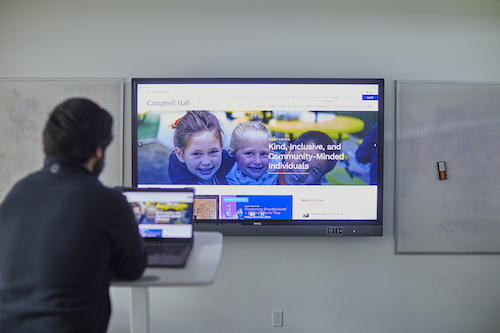
In the realm of modern classrooms, one of the most notable advancements is the integration of smart board technology. Over the years, smart boards have evolved significantly from the early days of interactive whiteboards. However, it’s only recently that we’ve witnessed all-in-one solutions that effectively address contemporary trends in education as well as the challenges associated with managing these tools. Their use has become so significant that they actually lie at the heart of the ecosystem topic.

The key to this evolution lies in the operating systems that power smart boards, equipped with pre-installed software such as whiteboarding apps and web browsers. Some providers even offer the flexibility to download additional educational software from app stores, catering to the diverse needs of teachers. Smart boards have proven to be invaluable tools for educators seeking to foster active participation and enhance learning retention among students, especially with those that are compatible with their favorite interactive apps.

By combining a digital whiteboard with a wide array of educational apps, educators now have the capability to conduct entire lessons using just a smart board. This integrated approach allows teachers to seamlessly access digital content from their cloud storage or local drives, or download materials directly from the internet. Even when faced with non-digitized content, teachers have the option to wirelessly share their laptop screens or connect document cameras to the board. This technology represents a significant shift in modern education, offering educators a versatile and adaptable solution to meet the evolving needs of the classroom.

Smart boards play a vital role in meeting the app management and technology security needs of schools. As educational institutions introduce a growing number of devices into their classrooms, safeguarding these assets and protecting student and teacher data becomes a paramount concern. Smart boards rise to this challenge by implementing a range of robust security measures, ensuring a safe and secure educational environment. These measures include compliance with international data privacy standards such as the GDPR and CCPA, offering regular over-the-air (OTA) updates with the latest security patches, and leveraging secure cloud services hosted on trusted servers like Amazon and Google Firebase.

In today’s dynamic educational landscape, technology presents both promises and challenges. Educators, students, and IT professionals grapple with managing an ever-expanding array of disconnected digital tools, underscoring the need for an integrated, interoperable educational technology ecosystem. This ecosystem is vital to meet the evolving landscape of learning efficiently and effectively. Interactive classroom solutions, similar to smart boards, have the potential to play a pivotal role in shaping the future of education technology by seamlessly combining digital whiteboards with a wide array of educational apps. Educators can conduct entire lessons through such solutions, accessing digital content, sharing screens, and connecting document cameras effortlessly. Furthermore, data privacy and security are paramount, with a focus on compliance with international data privacy standards, timely security updates, and flexible network security options, including multi-factor authentication, password protection, compartmentalized user accounts, and secure user modes.

In the modern classroom, where technology has become indispensable, these solutions empower educators and institutions to navigate the complexities of the digital age with confidence, creating engaging, secure, and effective learning experiences for students.

SETDA Launches Cybersecurity Resource Focused on Small, Rural, and Under-resourced Districts

18 October 2023 at 19:24

Washington, D.C. — Today, SETDA is pleased to announce the release of a cybersecurity resource focused on small, rural, and under-resourced districts. Developed by SETDA’s Cybersecurity & Privacy Collaborative—an active professional learning community consisting of state edtech leaders, affiliates, and corporate members—this resource is designed to identify essential resources, assess state-level K-12 cybersecurity advocacy initiatives, and craft policy recommendations to enhance cybersecurity readiness within these districts. 

In collaboration with Microsoft and the K12 Security Information eXchange (K12 SIX), this initiative underscores SETDA’s commitment to providing essential tools and guidance to support state educational agencies.

The publication, titled Small Districts, Big Hurdles: Cybersecurity Support for Small, Rural, and Under-resourced Districts, offers details on how state agencies and other support organizations are empowering their smallest districts to secure their data and networks. From detailing various funding sources to providing insights into statewide and regional partnerships and offering practical examples of cybersecurity training, the document is a must-read for everyone involved in helping districts improve their cybersecurity posture. It is the newest addition to SETDA’s Cybersecurity & Privacy Collection, available for access in their OER Commons site.

“As technology continues to reshape education, ensuring the safety and security of students’ data and school networks has never been more crucial. This publication is a testament to SETDA’s dedication to supporting state education agencies’ technology initiatives and equips state edtech leaders with the resources and tools needed to guide districts, especially those facing the greatest challenges,” said Julia Fallon, Executive Director, SETDA. “The Cybersecurity & Privacy Collaborative hopes that this document will help prevent breaches of student and educator data while offering strategies to support and improve cybersecurity readiness for small and rural schools.”

“The human impact of breaches is greater than lost time and money for districts, with potential life-long consequences for young people whose data may be compromised. Microsoft is committed to increasing access to cybersecurity tools to help schools address this challenge. I commend SEDTA for this focus on small, rural, and under-resourced districts ensuring that all students—regardless of location or context—can learn in safe and secure environments,” said Paige Johnson, Vice President Education Marketing, Microsoft.

About SETDA
SETDA is the principal association representing U.S. state and territorial educational technology and digital learning leaders. Through a broad array of programs and advocacy, SETDA builds member capacity and engages partners to empower the education community in leveraging technology for learning, teaching, and school operations. For more information, please visit www.setda.org.

Learning Through Play Is Powerful – and Students and Teachers Agree!

12 October 2023 at 23:28

BILLUND, Denmark — To celebrate the second annual World Play Day, LEGO® Education is inspiring teachers to experience purposeful play firsthand by giving students and teachers Permission to Play. 

Play is not just for the playground. It is a powerful tool for teaching that naturally engages students in the learning and builds the skills they’ll need in and outside the classroom like creativity, communication, critical thinking, and collaboration.  

A new survey of K-8 teachers and students from LEGO Education found that nearly all (98%) of students say purposeful play helps them learn and the majority (96%) of teachers believe it’s more effective than traditional methods like lectures or textbooks. On top of that, almost 80% of students want more playful learning experiences in the classroom. 

Despite these benefits, 40% of teachers are incorporating play only once a week or less, and nearly half (47%) think they spend too much time on it.  

“Many teachers feel they can’t easily incorporate play into the classroom, so LEGO Education created the Permission to Play kit as that first step. Once you see students engaged and learning through play, it clicks and the question goes from how to how do we add more?” said Dr. Jenny Nash, Head of Education Impact, U.S. for LEGO Education. 

Whether you are a teacher, administrator, or parent, get Permission to Play by visiting  Rebuild The World, where you can: 

  • Take the Pledge: Commit to adding purposeful play to your own classroom or encourage teachers you know to add more play. 
  • Download free activities: Bring purposeful play into your classroom with activities for you and your students to join in on the fun (can be used with or without LEGO Education products). 
  • Track your play: Get your student(s) involved to see how much progress you’re making with a Color-By-Number template and “Learning in Progress” poster. 

“For nearly three decades, I used purposeful play in my classroom and have seen firsthand the impact it has on both students and teachers,” said Alicia Miller, a retired elementary school teacher from Evans, GA. “There are a lot of trends and products that have their place, but the biggest gamechanger for education is hands-on, playful learning. I encourage every teacher, principal, and parent to try a play-based learning activity with their students and see what joyful and meaningful learning should look like. Our students and teachers deserve to love learning again.” 

Take the pledge and download the Permission to Play Kit at  LEGOeducation.com/RebuildTheWorld.  

*The LEGO Education Survey was conducted by  Wakefield Research among 1,000 US K-8 students and 1,000 US K-8 teachers, split between those who teach/are enrolled in grade K-5 (500) and those who teach/are enrolled in grades 6-8 (500), between Sept. 13th and Sept. 19th, 2023, using an email invitation and an online survey. Data has been weighted. Results from the full survey have a margin of error of +/- 3.1 percentage points. 

About

LEGO® Education offers a range of playful, hands-on STEAM learning experiences based on its comprehensive learning system for students in early learning, primary and secondary education, as well as through after-school programs and competitions. From the Early Learning portfolio to the LEGO® Learning System, these solutions create an active and collaborative environment where learners of all levels and abilities build their confidence, future-proof their skills and spark a lifelong love of learning.  

LEGO, the LEGO logo, the Minifigure and the SPIKE logo are trademarks and/or copyrights of the LEGO Group. ©2023 The LEGO Group. All rights reserved.  

❌
❌