For more news on AI in education, visit eSN’s Digital Learning page
Aresounding 90 percent of educators in a recent survey said they believe that AI has the potential to make education more accessible.
Teachers are recognizing that when implemented ethically and with thoughtful consideration, AI can help students with special needs, learning disabilities, and language barriers, for example, and experience more effective, personalized learning methods, according to the 2023 Educator AI Report: Perceptions, Practices, and Potential from digital curriculum solution provider Imagine Learning.
With generative AI emerging as a pivotal element in the dynamic educational landscape of 2023, Imagine Learning conducted the survey to explore the perceptions, current practices, and future aspirations of educators who have already embraced technology in the classroom. The inaugural report showcases a comprehensive exploration of AI’s current and future role in K-12 classrooms.
When it comes to readiness, however, only 15 percent of educators feel “prepared” or “very prepared” to oversee the use of generative AI in the classroom, with over twice that number (32 percent) expressing they are completely unprepared to do so. What’s more, educators indicate a disparity when it comes to the likelihood of using Generative AI in the classroom, with district and school leaders perceived as less likely to embrace new AI tools when compared to educators and students.
On top of this, only one-third (33 percent) of surveyed educators feel that they have the support they need from their district and school leadership to successfully implement generative AI into their teaching.
Other key findings from Imagine Learning’s report include:
Almost half of educators (44 percent) who have used generative AI believe that its use has alleviated the burden of their workload and made their jobs easier.
Of the respondents who reported they have not used AI in the classroom, 65 percent cite a lack of familiarity as the primary obstacle to the future utilization of generative AI, with 48 percent also expressing ethical concerns.
72 percent of educators are most concerned about plagiarism and cheating due to generative AI, highlighting the need for clear guidelines for students for using AI with academic integrity.
“Generative AI is a blend of promise and prudence. Its transformative potential is undeniable, but the journey forward requires thoughtful consideration,” said Sari Factor, Vice Chair and Chief Strategy Officer, of Imagine Learning. “Learning is above all a human endeavor. With generative AI as a tool to simplify lesson planning, reduce administrative tasks, and enhance personalized learning, we can empower the potential of teachers and students and improve learning outcomes.”
If you’re a history buff, you may already know that Cleopatra had a substantial amount of rizz. King Henry VIII, on the other hand, could be considered the Tom Sandoval of his time. Meanwhile, Czar Nicholas II struggled to, well, pick a struggle.
History teacher Lauren Cella's "Gen Z Teaches History" series has earned about 30 million views on Instagram and TikTok combined.
All three of these historic royals have been the subject of “Gen Z Teaches History,” a viral video series created by Lauren Cella, who teaches 10th grade history. In it, the California educator assumes the persona of a Gen Z teacher from the future, delivering overviews of historical figures and events using a hilarious mix of opaque (if you’re a Millennial or older) slang and Taylor Swift lyrics.
“A positive compliment that I hear sometimes from my students or from people on the internet is like, ‘Oh my goodness, you make history so interesting,’” Cella explains. “And I always say, ‘History is interesting.’ I think other people make it boring. I'm not making it interesting. I'm just telling you what happened.”
What began on a lark on social media has earned Cella millions of views across TikTok and Instagram, along with the admiration of students and commenters who appreciate how much they learn from each installment.
I’ve had teachers of different ages that were able to break it down in a way that we could understand, and that made me fall in love with history. So the series is really just an homage to that.
— Lauren Cella
“Thank you for helping me get my PhD in 20th century history,” wrote a commenter about Cella’s explanation of the Cold War.
Behind the lighthearted series is Cella’s real love of history and desire to make it more accessible, just as her own teachers did for her.
“I think other people make it inaccessible,” she says. “I think other people purposely want to not tell different sides of the story, they want it to be an easier narrative, they purposely use vocabulary that only encompasses upper academia. They don't want other types of people to be able to have access to the curriculum, and that's done on purpose — especially in social studies.”
How It Started
Cella loves a good story.
It's why she studied history and journalism as an undergrad, and why teaching history appeals to her. Before that, Cella grew up hearing stories from her paternal Hawaiian grandparents — who are also of Chinese and Puerto Rican heritage, which Cella says is a common “hapa” mix of backgrounds — about their lives and the family’s history. They shared stories about what they witnessed during the bombing of Pearl Harbor, and they also regaled her with the history of Puerto Rico’s indigenous Taino people.
“Then on my mom's side of the family, all the elders would tell stories about how the family came from Mexico,” Cella recalls. “From a really young age, I was really interested in Liberty's Kids and the American Girl series. I should have known I was going to be a history teacher.”
It’s a lack of connection to the past that Cella sees as a barrier to students finding their own love for history.
“A lot of these things were 100 years ago, 200 years ago, and maybe if you're reading about it from a primary source, it can be really difficult to understand,” Cella explains. “I’ve had teachers of different ages that were able to break it down in a way that we could understand, and that made me fall in love with history. So the series is really just an homage to that.”
It was Cella’s students who encouraged her to start posting history lessons online, and she finally gave it a try during the pandemic.
“I was like, ‘No, I'm too old. Nobody does that,’” Cella recalls thinking about the notion of taking to social media to teach lessons. “And they're like, ‘No, Miss, they do. You can actually learn a lot of stuff. People go on it to learn.’ So I started kind of posting more and just experimenting, and I noticed that my stories about teaching or my reels about history were getting a lot more engagement than anything else I was posting.”
Her first viral hit was a Gen Z history lesson on the Russian Revolution, which gained 1 million views on Instagram and then another million views on TikTok. Cella says that she chalked it up to luck, but then her next video on the French Revolution reached 2 million views. Subsequent history videos continued to perform well.
Most of her online audience is made up of people her age or older, Cella says. While they might not understand all of the slang, she muses, they’re drawn in by the format and pleasantly surprised to end the videos knowing more than when they started.
“Literally have never understood WW1 until right now,” a commenter wrote on her most popular TikTok video to date.
Cella likes to “trick” people into learning when they think they’re just watching a funny social media post.
“Of course, it's an oversimplification. The videos are a minute long, but it gets people interested,” she says. “I'm really just doing the same thing on TikTok and reels that every great teacher does, and that's just connecting with their students and breaking it down into a language that they could understand in a way that is inclusive and maybe a little bit fun.”
Fun can be hard to come by for teachers these days. Cella hopes that her videos offer an example to fellow educators about how, despite the difficulties of the profession, they need not always let worry dominate.
“If you're worried that you're not doing enough, you probably are. Because the good teachers that I know are always trying to do the best for our students,” she says. “So if that's where your heart is, 99 percent of the time, you're probably already doing enough.”
Behind the Scenes
There are a few recurring elements to Cella’s Gen Z history videos: She’s sitting behind a desk or podium, sunglasses perched atop her head, iced coffee in hand.
Cella says she never intended for the iced coffee in particular to become a staple of the format, but there’s no going back now. That’s because it signals a pivotal moment in her videos, when she shakes the ice-filled cup, switches hands, and introduces important context for the story with a pointed, “Meanwhile…”
“This is so embarrassing, but sometimes it takes me a few takes and the ice would melt, and then I would have water. And I'm like, ‘What do you do?’” she recounts. “I would go buy another one, but then I was all hyped up on coffee. So I have fake ice in the iced coffee now.”
Cella is a student of her time. As a high schooler, she was a fan of comedy history shows like Drunk History and Epic Rap Battles of History — series that approached dry subject matter with a comedic slant that earned them wide appeal.
But her influences now include her students, who give her ideas for new slang to incorporate and keep her up-to-date on the ever-evolving Gen Z — and now Gen Alpha — lexicon.
It was her students' frank way of speaking about the world that inspired the character Cella plays. Cella says that if she’s making fun of anyone, it’s herself and not the kids.
“The way we were taught [history] was so boring and so dry and only told one side of the story, and Gen Z is not about that,” Cella says. “So when they actually get to be the history teachers, that was the inspiration. They're going to really give us the tea, they're really going to tell us how it is.”
‘Gen Z Teaches History’ Is a Viral TikTok Series That Mixes Learning and Humor
Indiana is in the midst of an enormous undertaking to improve literacy rates. The approach: Align state standards, curriculum, and teacher training programs with practices rooted in the science of reading, which emphasizes phonics to help students decode words.
Literacy coach Mika Frame has a memorable mantra for accomplishing big goals.
“My current principal always tells me, ‘Eat an elephant one bite at a time,’” she said. “Through this saying, he always encourages me to seek change in our staff by taking small steps, as opposed to expecting my teachers to change all at once or in drastic measures.”
A K-2 literacy coach at Rose Hamilton Elementary School in Centerville, Frame is part of the first cohort of educators that trained in reading science practices as part of the Indiana Literacy Cadre. Now she co-teaches, analyzes student data to see who needs more help, and leads her colleagues through the state’s new requirements.
Frame told Chalkbeat about her work as Indiana looks to bring more literacy coaches like her to its schools.
What drew you to a career in education?
My favorite part of high school was when I was a cadet teacher and worked with elementary students. I still love working with children today. I enjoy the energy, enthusiasm, and curiosity of young learners. Witnessing the progress and achievements of students, seeing them overcome challenges, and helping them reach their potential brings me a deep sense of satisfaction.
What does your typical day look like?
My typical day at Rose Hamilton includes working alongside teachers in their classrooms. Co-teaching is my favorite aspect of working with my colleagues. An additional responsibility I have most days involves disaggregating learning data. This data often presents patterns and helps teachers identify subgroups of students who need additional interventions. Each month, I also lead professional learning community meetings and offer new ideas and strategies to our teachers. Finally, coordinating testing is an important part of my position; I help ensure testing protocols are executed with fidelity and testing deadlines are met.
What’s your favorite lesson to teach and why?
My favorite lessons to teach are phonics lessons. Phonics plays a vital role in children’s literacy development by providing them with the tools to decode words, read fluently, and comprehend written materials effectively. It sets the stage for their future academic success. Phonics empowers children to read independently and with confidence. When children can decode words accurately, they can read books and other written materials on their own. This opens up a world of knowledge and imagination. I love seeing children’s eyes light up when they start sounding out words.
When did you first learn about the ideas of reading science? How have you been able to apply those recently with fellow educators or students?
I first learned in depth about the science of reading when I was accepted into the Literacy Cadre program. In the Summer of 2022, I attended a weeklong training that dove into the science of reading. I have been able to apply these strategies by leading professional learning community meetings. During this time, I’ve encouraged teachers in the building to present to one another about the science of reading instructional practices they are doing in their classrooms.
Tell us about your own experience with school and how it affects your work today.
I grew up in Modoc, Indiana. My community was rural and consisted of approximately 160 people. I graduated with only 18 students in my class, and that included a few foreign exchange students. It was a close-knit community in which everyone knew each other. This background helps me understand that every single child matters, and no matter the size of the district, helping all students succeed academically and helping them reach their full potential is the ultimate goal in education.
What’s the best advice you’ve ever received, and how have you put it into practice?
My current principal always tells me, “Eat an elephant one bite at a time.” Through this saying, he always encourages me to seek change in our staff by taking small steps, as opposed to expecting my teachers to change all at once or in drastic measures. I have used this advice frequently as our school has been going through new initiatives in the last year. Our next step this coming school year is to look into a new phonics program. We are slowly looking into the programs we are using and making small changes, if needed. Again, small steps that lead to changes are important!
What’s one thing you’ve read that has made you a better educator?
This past year I read “Shifting the Balance” by Jan Miller Burkins and Kari Yates with my colleagues in the literacy cohort. It really helped me understand the aspects of science of reading. After reading the book, my superintendent was kind enough to buy a set for my teachers, and I led a book study at Rose Hamilton. It was great to meet after school with the teachers and reflect on each chapter, as well as what we do or possibly could do better.
Chalkbeat is a nonprofit news organization covering public education.
When Gorgette Green-Hodnett wrapped up her 23-year career in K-12 education a couple years ago, her family members celebrated. Not only with well wishes for her new job coordinating an academic support program at a university in Maryland, but also with relief that she would no longer be working around the clock.
Her family had been glad each time she’d had a non-teaching role throughout her career, but this time her husband was excited at the prospect of finally taking a vacation outside the summer months.
“What I was told by my family is, ‘Thank God, because you come home and you grade papers. We have to go to your school and help you,’” she says. “I didn’t even realize the impact the work was having on my immediate family. Consciously or unconsciously, I allowed my work to manage and almost overtake areas of my life.”
That’s the kind of realization that teachers were coming to during the pandemic, Green-Hodnett says, when they were stretched to their limits juggling remote learning, their families, health concerns, and every other stressor brought on by the spread of COVID-19. While the country didn’t see the sudden mass exodus of teachers that some feared, the toll appeared clear — teachers reported experiencing depression at three times the rate of other adults.
And there was significant turnover in the workforce. A recent analysis by Chalkbeat found that, between the 2021 and 2022 school years, eight states — Hawaii, Louisiana, Maine, Maryland, Mississippi, North Carolina, South Carolina, and Washington — faced their highest teacher turnover rates in the past five years. Hawaii experienced a spike in retirements during the 2020-21 school year. And a recent Louisiana Educator Workforce Snapshot revealed that 26 percent of teachers who left their jobs in the 2020-2021 academic year had 21 or more years of experience.
Teacher quitting was at a 10-year high in 2021, consulting firm McKinsey & Company reports, and increased again in 2022. Quitting accounted for 61 percent of job “separations” among teachers in 2021, according to the data, and jumped to 64 percent in 2022.
Losing any teacher has ripple effects throughout a school, from eroding the sense of community to a potential knock on students’ academic progress.
But what happens, more specifically, when veteran teachers burn out and decide it’s time to say goodbye, walking out the door with all of their hard-earned experience? And what can schools change to get them to stay?
‘Ripple Effects’
When it comes to years of teaching experience, federal data divides U.S. teachers into four buckets. In the 2020-21 school year:
12.4 percent of teachers had three or less years
24.5 percent of teachers had four to nine years
16.6 percent had 10 to 14 years
46.5 percent had 15 or more years
That breakdown is similar to what it was three years earlier in the 2017-18 school year.
Data visualization by Nadia Tamez-Robledo. Source: National Center for Education Statistics
But for some teachers who have been in the profession for a long time, it feels like there has been a shift.
Around the time she moved on to higher education, Green-Hodnett was running the Real Talk, Real Time Educators Forum with fellow educator Chandra Joseph-Lacet, who is a new teacher instructional coach for Boston Public Schools. The Facebook group and podcast were sounding boards for teachers looking for a community amidst the hair-pulling stress of remote learning.
Struggling with mental health is nothing new for teachers, Green-Hodnett says, but the pandemic made it — and many crumbling edges and simmering inequities of the education system — visible to the outside public in a new way.
In Joseph-Lacet’s view, the praise heaped upon teachers in the early days of the pandemic hasn't translated into meaningful plans to help them manage the stress and pressure of the job. That’s partly why the duo created their podcast and forum — they were both in roles that supported teachers but they didn’t see a larger conversation about their mental health emerge.
“Everybody’s talking about teachers, but nobody’s talking to teachers,” Joseph-Lacet recalls thinking. “What are we going to do to protect and to heal ourselves? In a profession, and quite frankly, in a world that never really has valued teachers in the way that they really should have.”
For some experienced teachers, the answer was simple: Leave.
Data visualization by Nadia Tamez-Robledo. Source: Louisiana Department of Education
Teachers who have seen it all can bring a steady assurance to a staff team. Without them, schools can feel less stable.
“What happens when you don’t have folks with those years of expertise, someone who can help with, ‘I don’t understand this lesson, can you help me?’” Joseph-Lacet explains, “you see this withering of the environment in ways that you didn’t see before. This constant feeling of turnover because there’s no holding of the guard by the people who used to be there.”
Other experienced teachers don’t walk away, but hang on despite suffering from burnout. That, too, can have a negative ripple effect on their colleagues’ morale.
“A 10-year teacher is like the kingpin, because people are not staying in the profession like when we were younger,” Green-Hodnett says. “The veteran teachers are juggling all kinds of things because they also want good work. It’s this triangulation of trying to maintain themselves, manage classrooms that are not properly balanced in terms of what students need, and manage children who are not prepared emotionally” to follow directions.
While the pandemic exacerbated the external pain points, there’s also another culprit to the stress veteran teachers experience. There’s a certain self-sacrificing attitude that teachers have had for a long time now, Joseph-Lacet says, that comes from the expectations of their peers, administrators, all the way back to their training days in college. It’s the idea that, from the time that school starts in the fall to the final bell in summer, their lives revolve totally around work.
“I was guilty of saying, ‘Tell your friends you’ll see them in June,’” Joseph-Lacet says of conversations she used to have with new teachers.
She thinks of that attitude now as modeling bad behavior — total lack of self-care or work-life balance, in this case — something that veteran teachers are still at risk of doing as they deal with mental strain.
It all adds up to a sense that a lasting career in education is a tenuous prospect — or one that requires teachers who stick it out to give, and give, and give until there’s nothing left.
After all, Joseph-Lacet says that what earns teachers the reputation of being a “veteran” has changed during her career, from someone with 20 years of experience to someone who’s been in the profession for just three years.
Who Takes Care of Experienced Teachers?
A study of the impact of COVID-19 and its stressors on New Orleans teachers found that, when asked what the most helpful support during pandemic teaching had been, 42 percent of responders said “support from coworkers.”
We have to take care of the human being who is holding it together — or it’s all gonna crash.
— Danna Thomas
One teacher, for example, told researchers that “working with a group of coworkers that really cares” was key to feeling supported.
It’s an example of a trend that Danna Thomas observed while she was still a teacher in Baltimore. Thomas founded the teacher self-care organization Happy Teacher Revolution, which hosts gatherings in 21 states where educators talk and support each other through difficult times in the profession. She found that experienced teachers tend to shoulder an additional emotional toll as their peers lean on them for support, particularly new teachers who are finding their footing.
She believes schools are missing opportunities to invest in veteran teachers as leaders who can help to improve well-being for other staff members.
“There are people in leadership who support teachers with academics, but their phone calls or Zoom are [reserved for] just new teachers crying their eyes out with how overwhelmed they are,” Thomas says. “Teaching, it shouldn’t be getting harder as the years go on. If you have 10, 20 years under your belt, it should be less overwhelming. We have to take care of the human being who is holding it together — or it’s all gonna crash.”
In the absence of more school-based support for long-time teachers, groups like Happy Teacher Revolution try to fill the gap. One common topic of conversation among members is the power of resetting professional boundaries that crumbled during the remote leaning days of the COVID-19 pandemic. It’s a place where they can celebrate big wins like taking a sick day, actually eating lunch during their lunch breaks, and making it home from school before dark.
“I really want folks to feel it’s sustainable that they can do this for years and years,” Thomas says of her goal. “There’s nothing better than a happy veteran teacher who’s able to teach siblings, or those kids’ kids — it’s so cool. There’s been so much conversation about individual care, and we need community care. Who is making sure that the village collective is well?”
Green-Hodnett has also seen experienced teachers start to think more about what they want their lives to look like outside of work. She recalls one woman who was part of the Real Talk forum saying that one of the biggest regrets of her 40-year teaching career was all of the missed recitals and events that involved her daughter, sacrificed so she could keep up with school work.
Green-Hodnett also recalls a former colleague, who left the school district for a new job, had more than 200 hours of unused leave.
“Teachers have to be mindful of what their capacity is, use their voice, use their leave,” Green-Hodnett says. “Chandra’s talked about how we would wait and do all our doctor's appointments in the summer, or do all our doctor's appointments on spring break. No, you need to take [leave]. If you don't take care of those things, then you retire, and then you're not able to do what you wanna do in your retirement.”
Data visualization by Nadia Tamez-Robledo. Source: Hawaii State Department of Education
Revolving Door
Yet these support circles and changing attitudes may not be enough to make sure that today’s teachers hang in there to serve as tomorrow’s veterans.
Joseph-Lacet has seen a new trend among teachers that she fears will have negative consequences on the profession. Unlike the norm from earlier in her career, she says experienced teachers now are openly mulling, “How quickly can I retire?” Not necessarily to stop working completely, but to transition to another field.
“They're like, ‘I need to bounce from this profession because it has just gotten to be too much,’” she says, “‘because it has just gotten to the point where it is breaking me mentally and or physically.’ There’s so much more of that, as opposed to people riding into retirement, having these wonderful retirement parties like they did back in the day.”
Among teachers who are retiring after long careers, she adds, some are sharing advice to younger teachers that sums up to, “Y’all don't do like I did. Don't stay here for 20 years. You can make a change. Make that change right now.”
“If younger teachers do that, again, we’re adding to this newness and this revolving door that's happening, and your veteran teachers are going to be three- and five-year folk,” Joseph-Lacet says. “That is never going to be beneficial for anyone in the school environment, and most notably the children.”
Even so, and despite her own long career as a teacher and now a teacher coach, Joseph-Lacet says that she can’t find it in herself to be excited that her own daughter is in college studying elementary education.
“On social media there’s jokes of teachers being stressed because it’s August,” she says, “but under that, there’s depression, there’s anxiety, overwhelming dread of walking into the new school year.”
Just like educational technology is continually advancing, so are best practices for supporting teachers in classrooms. Professional development needs to be relevant, engaging, and personalized.
Megan Schlagel, a high school math teacher in St. Vrain Valley Schools in Longmont, Colo., is an award-winning educator who is dedicated to the continuous improvement of her teaching practices. As part of this dedication, Schlagel, as well as a number of her colleagues, are turning to innovative new approaches to support their learning. This includes the use of AI-powered teacher coaching via the AI Coach by Edthena platform.
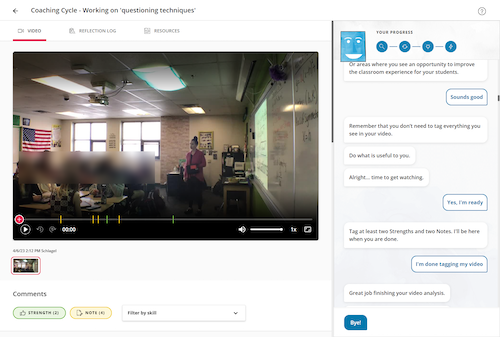
With the platform, teachers like Schlagel engage in personalized coaching cycles to further their development. The platform uses artificial intelligence to guide teachers through a self-coaching cycle aligned to common growth areas as they watch video of their classroom teaching in action.
We recently interviewed Schlagel about the use of this new technology and how her district prioritizes teacher development.
What were your first thoughts when you heard about using AI for professional learning? Why did you decide to try it?
Last year, I was a mentor to a first-year teacher at my school, and my mentee had to record a lesson of her teaching as part of the induction program. I decided to also record myself conducting a similar lesson, so we could go over the lessons together, discuss what works and what doesn’t, and set goals for improvement.
This was my first real introduction to video coaching. Admittedly, even as a mentor teacher, I was nervous to record myself. However, I quickly learned it wasn’t that bad seeing myself on screen and that this was a powerful way to reflect on my practice. My mentee and I both learned a lot.
So, when my district offered a new professional development course that would allow us to try out AI coaching, I signed up. I wasn’t sure exactly what I was getting into, but I was already benefiting from video coaching and wanted to see what the new AI aspect was all about. At the very least, I knew this opportunity would provide me more time for self-reflection.
How does the AI coaching process work?
During my first time using the AI Coach platform, I uploaded a video of one of my recent algebra lessons. Then, the platform’s computerized coach provided observation tips and asked me a number of questions to consider as I began to analyze my video. This helped me as I made a number of comments on the platform—both about areas I wanted to improve upon and areas I felt I was excelling in—as I watched my teaching play out.
The guidance from the virtual coach helped me think more critically about my practice (…and it also made me laugh – the coach can definitely be funny and sassy at times!).
This helped me set a goal for myself around increasing student discourse. I wanted to encourage my students to talk more in class, and the platform provided me with a number of instructional resources to help me get better at this skill.
At the end of the coaching cycle, after I incorporated these strategies in the classroom, I came back to the platform and reflected on what I learned. I thought about how these new strategies worked and created an action plan for my continued learning in the future.
How has AI-powered coaching impacted your teaching?
What surprised me most about the AI coaching process was that it opened my eyes to different things I could change (and might have missed) about my teaching. I was able to really reflect on how I was teaching and how my students were responding.
Sometimes it can be daunting—or even feel less genuine—when a coach or administrator comes in to conduct a formal observation. You may be worried about how your students are acting or unknowingly teach differently than normal.
But, with the AI Coach process, I feel less pressure because it really is just myself reflecting on my teaching alongside a computerized coach. This gives me more freedom to try out a new instructional strategy or take a risk with how I deliver a lesson, without having the feeling of being evaluated.
Continuous reflection is so important, and I’m a firm believer that the best teachers have to be reflective—if you aren’t reflecting on your practice, you aren’t growing!
How do you and your colleagues plan to use AI Coach by Edthena moving forward?
In addition to supplementing in-person coaching, I think AI coaching will continue to be a great support for mentor and mentee teachers alike.
In chats with my administrative team, I’ve also suggested using the AI Coach platform for our school’s yearly peer observations or self-reflection observations. Traditionally for the self-reflection observation, teachers write a paper detailing their teaching and how it can improve, but I think this type of video-based reflection can be more impactful and feel more genuine. And, it will allow teachers to receive the benefits of ongoing coaching which is really about reflecting inward and trying to constantly improve.
My school and district always do a great job of supporting teachers’ growth and encouraging us to take on new and innovative professional learning opportunities. The use of AI Coach is just another example of this!

 Login
Login