Normal view

There are new articles available, click to refresh the page.
Before yesterdayMain stream

Here’s why STEM Career Days are a great idea

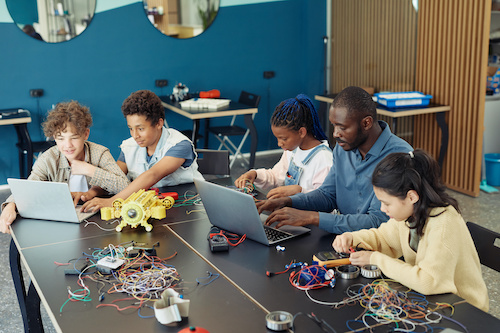
High school students who attended STEM Career Days were far more likely to pursue STEM-related careers than those who did not participate.

Key points:

A new study at the University of Missouri–in partnership with Harvard-Smithsonian researchers–shows that when colleges host ‘STEM Career Days,’ the students who attend are far more likely to pursue a career in a STEM (Science, Technology, Engineering and Math) related field.

The findings not only highlight the benefits of college recruiters introducing high school students to STEM-related opportunities, but they can also help increase and diversify the STEM workforce in the United States.

Michael Williams, an assistant professor in the MU College of Education and Human Development, analyzed a nation-wide survey conducted by Harvard University that asked nearly 16,000 college students if they attended a college-run STEM Career Day while in high school. He found that the students who attended were far more likely to have STEM-related career aspirations compared to the students who did not attend.

“Now that we have found that this type of intervention works for turning that potential interest in STEM into career aspirations in STEM, we can work on designing these interventions in a way to be even more effective and accessible to develop a more diverse STEM workforce,” said Williams, who is also a faculty fellow in the MU Division of Inclusion, Diversity & Equity. “If you want someone to be good at something, you want them to develop a sense of efficacy, which is about putting them in a position where they can see themselves doing it and succeeding at it, and seeing other people that look like them doing it as well.”

When Williams was pursing a master’s degree in computer information technology, he remembers being the only Black student in classes such as computer engineering and differential equations. He also remembers the classes being disproportionately made up of international students.

“The United States trails a lot of global competitors in the production of STEM talent, especially in areas like sophisticated technology and quantitative methodologies,” Williams said. “The National Science Foundation has pushed for broadening participation in STEM fields and increasing diversity for populations that have previously been excluded from STEM-related opportunities. So, I am passionate about reaching people earlier in the educational pipeline and seeing what interventions help turn interest into career aspiration.”

Williams added that MU is a land-grant university and has several community outreach initiatives to not only expose Missouri students to STEM topics at the high school level, but also at the middle and elementary school levels.

“STEM Cubs is a free STEM education program for students in kindergarten through eighth grade that is hosted by the MU Office of Academic Access and Leadership Development, MU College of Education and Human Development, and MU College of Engineering that emphasizes the importance of exposing all students to exploratory and experiential learning,” Williams said. “The program seeks to engage young students, particularly those historically underrepresented in STEM education and career fields, to hands-on STEM activities. By allowing them to learn about scientific concepts and how they relate to everyday life, the program helps them build interest in science and science-based careers.”

The study “A quasi-experimental study of the impact of college-run science, technology, engineering, and mathematics (STEM) career days on American students’ STEM career aspirations,” was published in International Journal of Science Education.

This press release originally appeared online.

Poptential™ High School Economics Curriculum by Certell Offers Free Stock Market Investment Lessons

20 October 2023 at 14:00

INDIANAPOLIS, Ind. — October historically has been a month of notable volatility in the stock market, with historic crashes like the 1929 Great Depression and Black Monday in 1987. These events have given rise to a sense of “Octoberphobia” among some investors. Lessons on these events and others are included in Common Sense Economics from Poptential™, a comprehensive and free high school digital curriculum. Click to tweet.

“It’s never too early for teachers to engage students in discussions about the history of the stock market, its impact on economic growth or decline, and how it can potentially empower students to invest in their own futures,” said Julie Smitherman, a former social studies teacher and director of content at Certell, Inc., the nonprofit behind Poptential.

Poptential course packages boost student engagement by using a variety of pop culture media to illustrate concepts, including those taken from sitcoms, movies, animations, cartoons, late-night shows, and other sources. Lessons on the history of the stock market and how to invest in stocks are covered in the new 2023 Poptential Common Sense Economics e-book, including:

Investing for the future: Students can learn about the two broad categories of equity mutual funds—managed and indexed funds—in a chapter on investing. The material covers how a diverse holding of stocks over the long term can mitigate risk and offer attractive returns. This underscores the wisdom of using stock market investments as a retirement strategy.

The stock market is for small investors too: The Poptential November 15 Bell Ringer showcases that Investing in the stock market need not be intimidating. Investing in mutual funds or exchange-traded funds (ETFs) offers individuals a pathway to participate in the stock market. A video clip explains the difference between these two investment vehicles.

Understanding stock market crashes: Poptential’s October 19 Bell Ringer explains how companies raise capital by selling stock and underscores that owning a company’s stock allows individuals to participate in the performance of that company, whether positive or negative. A video clip delves into historical market crashes, including their role in the 1929 Great Depression and the global recession of 2008.

Professionals profiting from market collapses: Throughout history, astute investment professionals have capitalized on market crashes. Those who can gauge the fragility of the financial markets and trade accordingly can profit from market downturns. This video clip from the movie “The Big Short,” featured in the Poptential March 16 Bell Ringer, highlights how investment professionals try to predict market swings and discuss strategies for profiting from market downturns.

Poptential course packages include everything instructors need to teach a subject, including lessons, e-books, bell ringers, quizzes, and tests. The curriculum is standards-based and developed by teachers.

Poptential is available via a digital platform that allows students to access lessons even in poor bandwidth environments. Course packages in American History, World History, U.S. Government/Civics, and Economics are available free at www.poptential.org.

About Certell, Inc.

Certell is a 501(c)(3) nonprofit dedicated to fostering a generation of independent thinkers. With over 100,000 users across the United States, Certell’s Poptential™ family of free social studies courses has garnered numerous awards, including recognition from EdTech Digest Awards, Tech&Learning, Tech Edvocate Awards, the National Association of Economics Educators, and Civvys Awards. For more information about Poptential™ and Certell’s mission, please visit www.poptential.org.

5 models that prioritize learner-centered education

18 October 2023 at 12:00
Learner-centered education collaborates with learners to design learning experiences and pathways tailored to their interests and needs.

Key points:

School models are, for the most part, outdated–and very overdue for replacement. When students reach high school, research shows that close to 66 percent of students are disengaged. But even students who do successfully navigate their schooling emerge with only a specific (and often narrow) skillset that may or may not match their strengths or interests.

Conventional schooling often leaves students disillusioned, questioning their intelligence and value as it is framed by a system that needs an overhaul.

Learner-centered education can play a critical role in reshaping education systems, offering a more holistic approach to meeting learners’ needs and helping students find fulfillment in their academic accomplishments.

K-12 Value Networks: The Hidden Forces That Help or Hinder Learner-Centered Education, a report from the Clayton Christensen Institute and authored by CCI senior research fellow Thomas Arnett, offers insight into understanding why schools struggle to change their instructional models, along with tips to establish and support learner-centered education models.

Program leaders, sponsors, learners and their families, staff, community partners, and funders are all critical to the success of these learner-centered education models.

The report describes how five different learner-centered education models–The Met, Virtual Learning Academy Charter School, Iowa BIG, Village High School, and Embark Education–were able to launch and grow their models by assembling value networks congruent with their vision for learner-centered education.

1. The Met: The Metropolitan Regional Career and Technical Center, known as The Met, is a network of six small, public high schools located in Providence and Newport, Rhode Island. The hallmark of The Met’s learner-centered model is that its learners go out in their communities for two days out of the week to lead real-world projects as interns for partner organizations. For example, learners might work with a local bakery, a law firm, a tech company, or a recording studio.

When learners join the Met, they and their families work with an advisor to identify their strengths, needs, and interests, and then develop an individualized learning plan with an internship as its centerpiece. Learners are responsible for researching potential internship opportunities and communicating with partner sites to arrange their internships. Advisors coach them as they do their research and outreach to ensure that internships match their needs and interests.

2. Virtual Learning Academy Charter School: The Virtual Learning Academy Charter School (VLACS) is a statewide virtual school created in 2007 that serves K–12 learners throughout New Hampshire. The concept for the school came from the superintendent of the Exeter Region Cooperative School District, who saw an opportunity to take advantage of a new charter school law to apply for a statewide charter. Rather than create another conventional school, however, the superintendent recognized the distinctive value of using a virtual school model to offer a wide array of flexible, part-time and full-time learning options unavailable through brick-and-mortar campuses.

VLACS’s competency-based model is highly adaptable to learners’ needs and interests. It offers a range of options for learners to earn credits: through online courses, learner-designed projects, and out-of-school learning experiences such as internships and travel. Learners who take online courses move through those courses at their own pace and earn credit whenever they’re able to demonstrate mastery of designated competencies. For projects and other learning experiences, VLACS aligns these experiences with state learning standards and then measures learners’ mastery of standards using performance-based assessments.

3. Iowa BIG: A community conversation about the knowledge and skills young people need to become engaged and successful members of the community as adults was linked with an initiative to send 60 community leaders back to school alongside learners over a four-month period. Through this experience, the community leaders realized that most learners were disengaged in school. Partitioning content into discrete subjects and courses made the learning boring and the teaching hard. Meanwhile, the work learners did in school had little connection to real-world problems, careers, and citizenship. Then came the founding of Iowa BIG, a high school learning experience sponsored by four local districts that enables learners to earn core credits by doing authentic projects.

The typical day of an Iowa BIG learner is half conventional and half learner-centered. For part of the day—either the morning or the afternoon—learners attend their local high schools. Then for the other half of the day, they go to an Iowa BIG site for real-world learning experiences. The model works with partner companies and organizations across Cedar Rapids to conceptualize projects learners might complete. Learners then work with partners to co-design interdisciplinary projects that both align with the academic and life goals of the learner, as well as the business or nonprofit needs of the partner. Projects might include creating museum exhibits, helping optimize processes at a hospital, hydroponic farming, or developing a messaging campaign for an animal shelter.

4. Village High School: The Village diverges markedly from standard approaches to high school education. Its learners receive all of their core academic content–English, history, social studies, and math–through mastery-based online courses. This format eliminates the need for scheduled class times and allows learners to progress at their own pace and test out of modules that they already have expertise in. Online courses at Village High School create time and capacity for the most learner-centered features of its model: its array of in-person electives.

Often team-taught and generally in-person, these courses are inspired by teachers’ and learners’ own passions. They cover myriad different topics, often in an interdisciplinary format: from Adulting 101, Renewable Energy, and Beekeeping to Comparative Religions and International Relations. Many electives take advantage of the Village’s flexible format. For an elective on ceramics, learners spend an entire day every week working on ceramics projects; and one physical education elective takes learners out into the Colorado Rockies for hiking and rock climbing. The grading model in electives is also different–closer to a workplace evaluation than to conventional points earned on assignments and tests. Learners and teachers sit down together to discuss learners’ progress and work, and decide on a grade together.

5. Embark Education: Miguel Gonzalez, a career educator, launched Embark Education in 2019 out of a coffee shop and a bike shop in North Denver, CO. His goal was to create a learner-centered model at the intersection of authentic experiences and relationships. That goal translated into a private, tuition-free micro-school serving approximately 50 sixth- through eighth-grade learners. Embark’s two businesses, Pinwheel Coffee and Framework Cycles, enable learners to engage in projects that integrate academics with real-world questions. For example, while working on the practical skill of crafting the perfect cappuccino under the guidance of adult baristas, learners investigate the differing mathematical ratios of ingredients present in a latte versus a cappuccino, and the chemistry behind the extraction of caffeine from coffee beans.

These integrated “shop projects’’ include a combination of direct instruction within the three core academic disciplines (math, science, and humanities); personalized learner exploration; and practical work within the bike and coffee shops. They enable learners to master foundational academic skills while simultaneously experiencing the application of these skills in the world beyond the classroom. Learners’ projects for the businesses must contribute to the success of the businesses. For example, learners don’t work on problems that the businesses have already solved, such as having learners apply math and science to reinvent the latte. Instead, Embark’s leaders look for opportunities that leverage the unique advantage of having learners’ on site to make the businesses better than what they could do alone.

4 essential resources for building research skills in high school

Strong research skills are valuable beyond high school and will serve students well as they enter a world of digital resources and information

Key points:

Right now is the perfect time to start a research project with your students, as it will help them develop skills they will use for the rest of their lives. While your students, who have grown up in the Information Age and think they already know everything, any classroom teacher knows that our students need help more than they think.

As a school librarian for the past 11 years, my primary focus has been on helping students become adept navigators of the sea of information they live in. By the time students reach me in high school, they are already juggling multiple social media accounts and unknowingly driving many business and political decisions through their media consumption.

Our students’ belief that everything they need to know is online can, without the right skillset, leave them prey to misinformation. So how do we teach our students to steer through the online ocean of data to be both effective researchers and responsible digital citizens?

Here are 4 must-have resources for teaching high school students how to research:

Digital encyclopedias like Britannica School or Credo Reference are still important, and vetted, sources of basic information. Each provides students with a credible resource and gives them helpful notation and citation tools. But don’t settle for just one. Take students on a tour of both databases and explore the differences. Britannica School is user-friendly and comprehensive, which makes it an ideal tool for building student confidence in their research skills. Even if your students are literal social media influencers, they may be apprehensive or overwhelmed navigating a database, and we do not want them to give up and turn to Google. They need to develop their research skills before they are ready to evaluate content from across the world wide web. The bold, colorful text features and differentiation of reading levels make Britannica School engaging and easy to use, and it is a trusted source of information.

Although both databases offer similar content, Credo Reference has a unique feature called Visual Exploration that you and your students will love. The database will retrieve your search results in the form of a mind map, which links your search term to related terms that are hyperlinked to vetted content. Articles related to the original search term appear alongside the mind map. Visual Exploration is an effective and interactive tool for teaching students about choosing search terms and narrowing their research topics. Credo Reference also has a series of short research tip videos for students on topics such as “what to do when your topic is too broad.” 

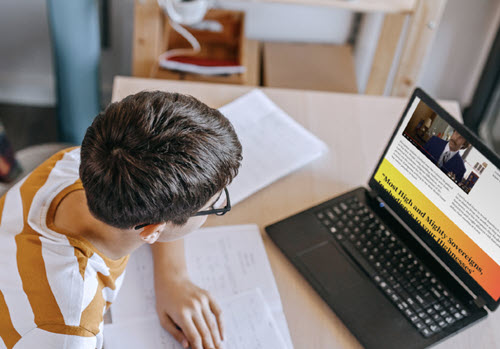
Upper-level courses require students to navigate and analyze more complex sources than a standard encyclopedia entry, which can often be just a list of facts. Whether you are teaching U.S. Government or A.P. Language and Composition, your students are learning to evaluate persuasive writing and identify propaganda, because these are key information literacy skills. Gale In Context: Opposing Viewpoints not only provides students with curated  sources and all the tools of an online encyclopedia but also introduces students to well-researched writing from various perspectives. A huge part of research is thinking critically about the credibility and intent of the source, and this database provides a safe space to analyze and examine issues from multiple angles. Gale In Context: Opposing Viewpoints is both visually appealing and has a unique feature for visual learners. The Topic Finder retrieves results as your choice of a tile or a wheel that displays terms at various sizes depending on the number of results for that term. For example, a Topic Finder search for “Artificial intelligence” displays “mental health” among the largest clusters of the tile or section of the wheel, which lets me know I can find significant content in the database related to A.I. and mental health. There is a curriculum search and an Educator Resources page with helpful tip sheets and worksheets, including one for students to create their own concept map.

Before you dive into an encyclopedia head first, you may want to go to Discovery Education Experience and gather some tools for teaching research effectively. You do not need to build a lesson from scratch. There’s a wealth of media within the platform to help you activate prior knowledge, develop assignments and create interactive lessons on any topic. The Discover Data channel, which is the result of a partnership between the Nielsen Foundation, Discovery Education, and the National Afterschool Association, has interactive, relevant lessons that you can adapt for your students. One of my favorites is the “Social Media and Misinformation” presentation. You can use it as an introduction to information literacy or assign the presentation as a self-paced lesson for students. In fact, you can use the Build an Activity feature with this or another presentation from Discovery Education to create an assignment and share it directly to Google Classroom, Microsoft Teams, Schoology or Canvas.

With these essentials in your toolbox, you will be able to equip your students with research skills that will help them unlock success in and out of the classroom.

Related: 4 tools to help students build post-COVID research skills

Companies go to high schools for career training

Vocational schools of the past contributed to inequity, but modern career training gives students a window into their options.

This story was originally published by Chalkbeat. Sign up for their newsletters at ckbe.at/newsletters.

Every now and then, Ayden Corbett has to explain to surprised homeowners what he’s doing in their front yard.

Since the second semester of his senior year of high school, he has responded to field calls as an employee of the largest underground utility locating company in North America — the Indianapolis-based U.S. Infrastructure Company (USIC). The white truck and multicolored flags marking the location of water, power, and telecommunications lines usually give it away. 

“You learn how to work with people,” he said. 

Corbett graduated in 2022 from a unique program at the Hinds Career Center in Elwood that trains high schoolers for the little-known underground utility locating industry. As demand for the profession skyrocketed during the work-from-home boom of the pandemic, USIC representatives approached the career center about creating a high school graduation pathway that would lead to a diploma, an industry certification, and a job offer.

While still uncommon in Indiana, partnerships between schools and private companies that lead students directly into employment in highly specific trades are growing — the Hinds Center program is the newest among four that have been started statewide.  

“Their goal is to have trained employees ready to enter the field; ours as a career center is to give students the workforce and soft skills to be employable in whatever they choose,” said Jim Pearson, director of the Hinds center. 

And creating more of these programs is a top priority for state education officials, who have been charged under a new state law with reworking high school requirements to encourage more students to work and earn credentials before they graduate. 

It’s part of an effort to counter Indiana’s declining college going rates by connecting high school students to in-demand and high-paying jobs without the need for postsecondary education. 

“Young people are really wanting a variety of options for leading to viable, successful futures. That’s not necessarily a four-year degree,” said Rachel Rosen, senior research associate at the Center for Effective Career and Technical Education at MRDC, a nonprofit, nonpartisan research organization. 

‘Employable in whatever they choose’

The underground utility graduation track at the Hinds Center is a slower version of the standard company training program, hosted inside a former sewing classroom that USIC equipped with a virtual reality system and a wall showing the typical utility connections on a home. The company also provides the two instructors, said Darrin Haynes, senior manager of career and technical education at USIC.

Students study the underground utility maps of Indiana cities like Westfield, where new home construction is booming, and learn to use the equipment that allows them to detect underground utility lines both through virtual reality and in the field. They spend part of the day at the center for career training, but also take traditional academic courses at their home high schools. 

USIC has hired 14 of the 16 graduates of the Elwood program over two years, and fielded calls from its competitors looking to hire students as well, Haynes said. As of this year, students will also earn college credit at Indiana Tech upon completing the pathway. 

One of the main draws of the track is the opportunity to start working during senior year, said Jacob Wright, another 2022 grad. Students who are at least 18 years old are paid the same rate as new hires to respond to calls to 811, the service that companies and homeowners are supposed to call before digging projects, according to Haynes. 

“You get a job out of high school, a (company) truck second semester, and you get paid to take calls,” said Wright. 

Programs should connect to college and career

Several other local graduation pathways in Indiana offer students direct links to local companies, including the RV construction pathway at Wa-Nee Community schools, and a now-defunct aviation sheet metal pathway at Decatur schools. 

The latter operated for a year before the pandemic created challenges for teaching and recruiting students, said Michael Gehrich, director of aviation at Vincennes University, which worked with Decatur schools on the pathway. 

Like the utility locating program, the aviation pathway sought to expose students to a local industry that’s in need of workers, with a lower barrier to entry than existing dual credit aviation programs that require additional college education, Gehrich said. 

Other similar programs can be found in New York City’s P-TECH schools, said Rosen, the researcher, which are six-year schools that partnered with companies to allow students to graduate with STEM skills, a high school diploma, and an associate’s degree. 

Where vocational schools of the past contributed to inequity by directing low-income and students of color into low-wage jobs, modern career training can give students a window into their options, Rosen said. 

“CTE in high school provides students an opportunity to explore what they don’t want to do as much as what they do want to do,” Rosen said. “We may see a failure because the student did not want to go into that field, but higher-resourced students have more opportunity to explore and make mistakes. If they wait till college to explore what they don’t like, there can be a real cost to doing that.”

The goal should be preparing students for a career with mobility, Rosen said. 

Haynes said underground utility locating offers that mobility. Graduates can work for municipalities instead, move into management and training roles at USIC, or request to be relocated to another state. 

The pathway opens a new option in a community where the college-going rate has dropped, said Haynes.

State data shows the rate for Madison County dropped 16 percentage points from 2015-2020, mirroring the state’s drop of 12 points in that time period

Though no students have yet changed their minds about the senior-level course, Pearson said one advantage of the career center is that it has the flexibility to redirect students to one of its other career paths.

Plans to expand in Indiana and other states

Pearson said the Hinds center is open to working with other companies to develop local graduation pathways and meet workforce needs — but that they would need to work closely with educators on curriculum and standards. 

The career center would aim to stay away from low-skill, low-pay tracks, but wouldn’t outright reject retail pathways, for example, if they led into supervision and management positions, Pearson said.

Haynes said that other companies interested in creating their own pipeline programs at local high schools need to commit to an upfront investment with a slow return. In addition to a workforce pipeline, one major benefit to USIC is that graduates have more time to absorb the training, and begin working with more experience, often making fewer mistakes than other new hires. 

Haynes said the company isn’t working with students who are using Indiana’s new career scholarship accounts, which give students money to take career training outside of their schools. Those students could apply for a job with the company and take the training there, he said.

The company plans to continue recruiting in high schools. Haynes said USIC has replicated the high school training program in Oklahoma and New York, and hopes to grow it further throughout Indiana and other states. 

“Most of our graduates have moved out, have a place of their own. They start their lives in a way that we all dream of when we’re teenagers,” said Haynes. “We’re putting them on a pathway to do that.”

Chalkbeat is a nonprofit news organization covering public education.

Related:
4 ways to enrich CTE programs
How our district engages students in a CTE program
 

Teacher Q&A: Strengthening PD with AI

11 October 2023 at 12:00
Artificial intelligence and AI coaching in PD is guiding teachers through a self-coaching cycle aligned to common growth areas.

Key points:

Just like educational technology is continually advancing, so are best practices for supporting teachers in classrooms. Professional development needs to be relevant, engaging, and personalized.

Megan Schlagel, a high school math teacher in St. Vrain Valley Schools in Longmont, Colo., is an award-winning educator who is dedicated to the continuous improvement of her teaching practices. As part of this dedication, Schlagel, as well as a number of her colleagues, are turning to innovative new approaches to support their learning. This includes the use of AI-powered teacher coaching via the AI Coach by Edthena platform.

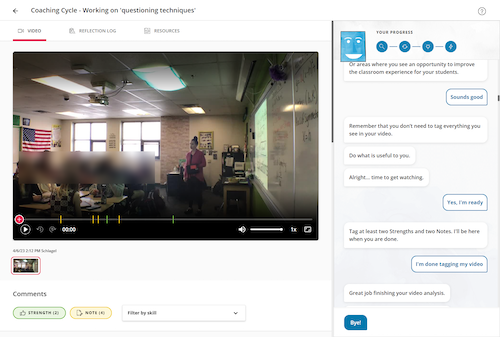
With the platform, teachers like Schlagel engage in personalized coaching cycles to further their development. The platform uses artificial intelligence to guide teachers through a self-coaching cycle aligned to common growth areas as they watch video of their classroom teaching in action.

We recently interviewed Schlagel about the use of this new technology and how her district prioritizes teacher development. 

What were your first thoughts when you heard about using AI for professional learning? Why did you decide to try it?

Last year, I was a mentor to a first-year teacher at my school, and my mentee had to record a lesson of her teaching as part of the induction program. I decided to also record myself conducting a similar lesson, so we could go over the lessons together, discuss what works and what doesn’t, and set goals for improvement.  

This was my first real introduction to video coaching. Admittedly, even as a mentor teacher, I was nervous to record myself. However, I quickly learned it wasn’t that bad seeing myself on screen and that this was a powerful way to reflect on my practice. My mentee and I both learned a lot.

So, when my district offered a new professional development course that would allow us to try out AI coaching, I signed up. I wasn’t sure exactly what I was getting into, but I was already benefiting from video coaching and wanted to see what the new AI aspect was all about. At the very least, I knew this opportunity would provide me more time for self-reflection.

How does the AI coaching process work?

During my first time using the AI Coach platform, I uploaded a video of one of my recent algebra lessons. Then, the platform’s computerized coach provided observation tips and asked me a number of questions to consider as I began to analyze my video. This helped me as I made a number of comments on the platform—both about areas I wanted to improve upon and areas I felt I was excelling in—as I watched my teaching play out.

The guidance from the virtual coach helped me think more critically about my practice (…and it also made me laugh – the coach can definitely be funny and sassy at times!).

This helped me set a goal for myself around increasing student discourse. I wanted to encourage my students to talk more in class, and the platform provided me with a number of instructional resources to help me get better at this skill.

At the end of the coaching cycle, after I incorporated these strategies in the classroom, I came back to the platform and reflected on what I learned. I thought about how these new strategies worked and created an action plan for my continued learning in the future.

How has AI-powered coaching impacted your teaching?

What surprised me most about the AI coaching process was that it opened my eyes to different things I could change (and might have missed) about my teaching. I was able to really reflect on how I was teaching and how my students were responding. 

Sometimes it can be daunting—or even feel less genuine—when a coach or administrator comes in to conduct a formal observation. You may be worried about how your students are acting or unknowingly teach differently than normal.

But, with the AI Coach process, I feel less pressure because it really is just myself reflecting on my teaching alongside a computerized coach. This gives me more freedom to try out a new instructional strategy or take a risk with how I deliver a lesson, without having the feeling of being evaluated.

Continuous reflection is so important, and I’m a firm believer that the best teachers have to be reflective—if you aren’t reflecting on your practice, you aren’t growing!

How do you and your colleagues plan to use AI Coach by Edthena moving forward?

In addition to supplementing in-person coaching, I think AI coaching will continue to be a great support for mentor and mentee teachers alike.

In chats with my administrative team, I’ve also suggested using the AI Coach platform for our school’s yearly peer observations or self-reflection observations. Traditionally for the self-reflection observation, teachers write a paper detailing their teaching and how it can improve, but I think this type of video-based reflection can be more impactful and feel more genuine. And, it will allow teachers to receive the benefits of ongoing coaching which is really about reflecting inward and trying to constantly improve.

My school and district always do a great job of supporting teachers’ growth and encouraging us to take on new and innovative professional learning opportunities. The use of AI Coach is just another example of this! 

❌
❌