Normal view

There are new articles available, click to refresh the page.
Before yesterdayMain stream

3 ways educators leverage gamification strategies

23 November 2023 at 11:00
Gamification helps students dive into learning--and it helps educators present challenging topics in engaging ways.

Key points:

Students don’t have to be video game fanatics to appreciate a gamified classroom lesson. When teachers turn a lesson or tough-to-teach concept into a motivational gamed or use a fun competition to teach new concepts, students become immersed in their learning and are often more engaged–meaning they’re more likely to retain information.

Still, there’s an art to gamifying a lesson and ensuring that students are actually learning instead of just playing a game for points.

Here’s how educators across the country are using tools–from Minecraft: Education Edition to Roblox and easy-to-access online resources–to gamify their lessons and help students engage with learning.

1. Carrie Rosenberg, a fourth grade teacher at Community Christian School, notes that gamification is one of the biggest education trends right now. According to ISTE, “gamification is about transforming the classroom environment and regular activities into a game.” Many students want more than just good grades from school–they want something physical or immediate. Rosenberg uses Gimkit, Kahoot!, and Prodigy to gamify her instruction and motivate students. Learn more about her instructional strategies.

2. Games are part of many people’s lives–so why not use them to benefit students when teaching? Abigail Beran, a fifth grade teacher enrolled in a masters program in education technology, knows that her students are more likely to engage in an educational activity when it is gamified–and that they’re even more likely to do so when the activity is gamified with technology. There are a variety of reading and math apps and websites that cater to gamification, and even provide the opportunity for differentiation. Beran uses tools including Raz KidsDreamscapesProdigy English, and IXL language arts for English/language arts gamification, and uses Prodigy MathMath PlaygroundPet BingoSushi Monster, and IXL math for gamifying math. Discover how she integrates these gamified tools into her classroom.

3. As an educator for more 27 years and a digital learning specialist (social studies) for the past 7 years in Atlanta Public Schools, Felisa Ford has supported educators across the district and beyond as they purposefully integrate technology in the classroom to promote engagement and 21st century skill development. While there are many tools and resources available to educators to support their efforts to create dynamic digital learning environments, one of the most engaging is Minecraft Education Edition (M:EE). Popular among students (and teachers!), M:EE is a game-based learning platform that promotes creativity, collaboration, and problem-solving in an immersive digital environment. Read about five ways Ford has helped the district’s teachers use M:EE into classroom instruction.

5 essential digital learning reads

22 November 2023 at 11:00
Digital learning is an essential element in today's connected and evolving classrooms--here's what you need to know.

Key points:

  • Digital learning is a key part of students’ school experiences
  • As technology evolves, so, too, do students’ learning opportunities
  • See related article: Is AI the future of education?
  • For more news on edtech trends, visit eSN’s Digital Learning page

Digital learning is a critical component of what happens in today’s classrooms. Edtech tools, connected learning experiences, and 21st-century skills all play a role in preparing students for the future.

But digital learning trends and technologies change so quickly that sometimes, it’s difficult to know where to focus or where to invest funding, time, and resources.

Here are 5 must-read stories about digital learning trends and developments to help your school leadership team determine which digital learning resources and edtech tools can best benefit students:

1. Digital learning requires digital research skills: Right now is the perfect time to start a research project with your students, as it will help them develop skills they will use for the rest of their lives. While your students, who have grown up in the Information Age and think they already know everything, any classroom teacher knows that our students need help more than they think. Our students’ belief that everything they need to know is online can, without the right skillset, leave them prey to misinformation. Let’s teach our students to steer through the online ocean of data to be both effective researchers and responsible digital citizens.

2. Digital escape rooms merge creativity with student engagement and skill development: Escape rooms are engaging for people of all ages–they require durable skills such as creativity, critical thinking, determination, and the ability to work in groups to solve challenges. It makes sense that educators would craft their lessons around the concept of an escape room–and that’s just what high school educator Lynn Thomas has done. In this Q&A with eSchool News, Thomas details how she found inspiration to create escape room learning opportunities and the benefits she sees for her students–and she offers a look at a new ChatGPT challenge she’s created.

3. Esports can engage even the youngest of students, and these programs help students develop critical skills no matter what paths they pursue: Scholastic esports is rapidly growing, and many schools are starting to incorporate esports programs into their curriculum. The benefits of esports make a compelling case for creating a program: Research shows that students who participate in scholastic esports experience social and emotional benefits, increased academic achievement, and higher graduation rates. These positive learning outcomes make esports popular in secondary grades, with both students and educators advocating for the addition and growth of scholastic esports in their middle and high schools. But esports isn’t just for the older kids, and starting an esports program in early elementary school can be an effective way to lay the groundwork for esports participation as students make their way into higher grade levels.

4. In an AI-driven world, how can students maintain their own voices? Now, more than ever, students’ future success in an ever-changing world requires that they learn how to think critically and creatively while collaborating with others to solve complex problems. But the unwritten curriculum of most schools—instilling process perfectionism through rewarding flawless performance—is probably doing more harm than good. Against this backdrop, there’s a lurking concern that AI is just going to help students find mindless shortcuts for cheating their way to good grades. But that’s only a risk if schools and teachers hold a low bar for what they expect of their students.

5. Effective digital learning means educators must know how to leverage digital tools correctly: When properly integrated, AI can amplify the work of teachers, shrink equity and accessibility gaps, and provide unrestricted access to information. But for technology to make a meaningful change in K-12 education, we need to address the true source of the problem: broken instructional models. Even though countless technology tools have been introduced into the market, classroom practice looks eerily similar to how it did a hundred years ago. That’s because educators are still equipped with an antiquated model of teaching that isn’t designed to be responsive to students’ learning styles. By leveraging AI and technology to rethink traditional teaching methodologies, we can level-set our classrooms to more effectively empower educators and personalize student learning.

Is generative AI a beacon for more accessible education?

20 November 2023 at 11:00
Despite low levels of preparedness and barriers to adoption in education, there is a belief in generative AI's potential to empower learners.

Key points:

  • Many educators look forward to the opportunity afforded by AI, but few feel ready to use it
  • Other educators wonder if they have proper district support for AI use
  • See related article: 5 positive ways students can use AI
  • For more news on AI in education, visit eSN’s Digital Learning page

A resounding 90 percent of educators in a recent survey said they believe that AI has the potential to make education more accessible. 

Teachers are recognizing that when implemented ethically and with thoughtful consideration, AI can help students with special needs, learning disabilities, and language barriers, for example, and experience more effective, personalized learning methods, according to the 2023 Educator AI Report: Perceptions, Practices, and Potential from digital curriculum solution provider Imagine Learning.

With generative AI emerging as a pivotal element in the dynamic educational landscape of 2023, Imagine Learning conducted the survey to explore the perceptions, current practices, and future aspirations of educators who have already embraced technology in the classroom. The inaugural report showcases a comprehensive exploration of AI’s current and future role in K-12 classrooms.

When it comes to readiness, however, only 15 percent of educators feel “prepared” or “very prepared” to oversee the use of generative AI in the classroom, with over twice that number (32 percent) expressing they are completely unprepared to do so. What’s more, educators indicate a disparity when it comes to the likelihood of using Generative AI in the classroom, with district and school leaders perceived as less likely to embrace new AI tools when compared to educators and students.

On top of this, only one-third (33 percent) of surveyed educators feel that they have the support they need from their district and school leadership to successfully implement generative AI into their teaching.

Other key findings from Imagine Learning’s report include:

  • Almost half of educators (44 percent) who have used generative AI believe that its use has alleviated the burden of their workload and made their jobs easier.
  • Of the respondents who reported they have not used AI in the classroom, 65 percent cite a lack of familiarity as the primary obstacle to the future utilization of generative AI, with 48 percent also expressing ethical concerns.
  • 72 percent of educators are most concerned about plagiarism and cheating due to generative AI, highlighting the need for clear guidelines for students for using AI with academic integrity.

“Generative AI is a blend of promise and prudence. Its transformative potential is undeniable, but the journey forward requires thoughtful consideration,” said Sari Factor, Vice Chair and Chief Strategy Officer, of Imagine Learning. “Learning is above all a human endeavor. With generative AI as a tool to simplify lesson planning, reduce administrative tasks, and enhance personalized learning, we can empower the potential of teachers and students and improve learning outcomes.”

This press release originally appeared online.

Most states don’t actually know if teachers are qualified to teach reading

20 November 2023 at 10:29
Requiring stronger elementary teacher reading licensure tests can improve teacher preparedness and the quality of reading instruction.

Key points:

  • States are using inadequate elementary reading licensure tests
  • States should transition to stronger tests and test providers should clearly identify weaknesses in tests
  • See related article: Teacher Q&A: Strengthening PD with AI
  • For more news on teacher prep, visit eSN’s Educational Leadership page

Most states (29 states and the District of Columbia) use a weak elementary teacher reading licensure test, meaning that they do not effectively measure teachers’ knowledge of scientifically based reading instruction prior to entering the classroom, according to a new analysis from the National Council on Teacher Quality (NCTQ).

In fact, one state, Iowa, requires no reading licensure test at all. This shortcoming means that, every year, nearly 100,000 elementary teachers across the country enter classrooms with false assurances that they are ready to teach reading.

The data brief, False Assurances: Many states’ licensure tests don’t signal whether elementary teachers understand reading instruction, provides the most up-to-date analysis on the quality of elementary reading teacher licensure exams being used by each state.

More than 50 years of research has illuminated the most effective way to teach children to read. It requires systematic, explicit instruction in the five core components of the science of reading: phonemic awareness, phonics, fluency, vocabulary, and comprehension. Preparing teachers to teach these five components–known as scientifically-based reading instruction–can ensure more than 1 million additional students enter 4th grade able to read each year.

Unfortunately, far too often, states allow teachers into the classroom inadequately prepared to teach reading. Licensure exams, if rigorous and aligned to the science of reading, can serve as an important guardrail for making sure teachers have this critical knowledge. However, many licensure tests are weak in that they do not adequately assess teachers’ preparedness to teach reading. Far too many states are using these weak tests.

“Every child deserves great reading instruction, but far too many children aren’t receiving it,” said NCTQ President Heather Peske. “As part of a comprehensive strategy to improve reading instruction, states can help ensure teachers are prepared to teach reading effectively by requiring stronger licensure tests.”

Examining every elementary teacher reading licensure exam currently being used by states, NCTQ looked for evidence that the tests adequately address the five core components of reading. NCTQ also examined whether these tests devote undue attention to methods of reading instruction that have been debunked by research and
can hinder students from becoming strong readers, such as three-cueing.

Additionally, NCTQ checked whether these tests combine reading with other subjects. This is important because if subjects are combined, the teacher’s understanding of reading could be masked. Using these criteria, NCTQ determined whether tests were strong, acceptable, weak, or unacceptable.

Key national findings:

  • Of the 25 elementary teacher reading licensure tests in use by states, the majority (15) are weak. Just six exams are rated “strong” and four are rated “acceptable.”
  • Across these 15 weak licensure tests: Ten do not adequately address all five components of the science of reading and five combine reading with other subjects, such as social studies or science. (Note, one test fits into both categories listed above.) One includes too much emphasis on content contrary to research-based practices.
  • The majority of states (29 states and the District of Columbia) use “weak” tests that do not signal whether teachers have the knowledge they need to teach students to read.

“Teachers who aren’t prepared in the most effective instructional practices for teaching reading unknowingly enter classrooms ill-prepared to help students become successful readers,” said Peske. “This lack of preparation has a profound impact on students’ literacy skills and future prospects, especially among students of color and
those living in poverty.”

Roughly one-third of children in elementary classrooms across the country cannot read at even a basic level by the middle of the fourth grade. The situation is even bleaker for historically marginalized students, for whom inadequate reading instruction is yet another barrier to educational equity, with 56 percent of Black students, 50 percent of Hispanic students, 52 percent of students in poverty, 70 percent of students with disabilities, and 67 percent of English Learners reading below basic reading levels.

Students who are not proficient readers are four times more likely to drop out of high school, face lower lifetime earnings, and have higher rates of unemployment.

Recommendations

To address this pressing issue, the NCTQ recommends the following solutions.

State education leaders should:

  • Transition to a stronger reading licensure test: States select and approve the tests that their teachers must pass for licensure. Requiring a stronger test will likely lead to better reading instruction in elementary classrooms across the state as preparation programs will be motivated to align their courses with the components of reading addressed in a stronger test.
  • Require a strong reading test for anyone teaching students in the elementary grades. In some cases, states require reading tests for general education elementary teachers but not for special education teachers or for early childhood teachers who are licensed to teach lower elementary grades. These loopholes ultimately hurt the students who most need teachers capable of building a foundation in literacy.

Testing companies should:

  • Shore up weaknesses and clearly identify limitations in existing tests: Both major testing companies, ETS and Pearson, have strong and acceptable reading licensure tests on the market, but they also offer tests that omit numerous topics from the core components of reading, and that combine reading with other subjects, diluting the assessment’s ability to verify teachers’ reading knowledge.

This press release originally appeared online.

How schools can help students overcome the digital divide

20 October 2023 at 11:18
Schools and school leaders can help students and families achieve digital equity by pursuing at-home internet connectivity.

Key points:

When it comes to digital equity, U.S. schools are well-positioned to help families get online with low-cost, high-speed internet options through the federal government’s Affordable Connectivity Program (ACP), according to a new study from Discovery Education and Comcast.

However, the study also found that educators lack centralized resources and direct support necessary to successfully overcome barriers to the digital divide. Released to help support this year’s Digital Inclusion Week theme of “Building Connected Communities,” key findings include: 

  • Nearly all educators surveyed feel strongly that digital equity is more important today than ever before. 
  • 82 percent of families and 80 percent of educators surveyed feel strongly that high-speed Internet at home is extremely important to fulfilling learning outcomes. 
  • While two-thirds of families and educators acknowledge their school’s interest in closing the digital divide, only one-third are aware of actionable measures being taken by the school district.  
  • Only 39 percent of parents were aware of the ACP, and of those that were aware, just 13 percent of parents have signed up. What’s more, only 22 percent of educators surveyed strongly agree that administrators in their school districts are equipped with the necessary information to communicate options for high-speed internet access at home. 
  • Data shows multiple disconnects between what parents pointed to as actual barriers to broadband adoption versus what teachers perceived as parents’ barriers to adoption. Addressing these will be critical to ensuring that school districts and digital navigator programs are effective in closing the digital divide for students. 
  • There was a 52-percentage-point difference between the share of teachers who thought that cost of service was the primary barrier to adoption for families versus the actual share of parents who pointed to cost as a barrier. 
  • Significantly larger shares of teachers thought that families did not live in buildings that were wired for broadband, did not know how to set up the Internet, and did not have devices than the share of parents who raised these barriers. 
  • Findings from the study also support a recommendation for school systems to partner with proven and trusted programs such as those that include support from Digital Navigators — to help streamline communication, advocacy, and adoption strategies that lead to equitable opportunities for all students. Ensuring all ACP-eligible families are signed up is equally important in supporting district connectivity goals. 

To help further address these issues, Comcast is helping school administrators more quickly and easily access additional resources to get more households enrolled in the ACP during the back-to-school season through the Online For All Back to School Challenge, led by the U.S. Department of Education and Civic Nation. 

A new online tool from Comcast is designed to help administrators quickly and easily assess ACP eligibility in their school districts. They can also learn about which schools have the lowest broadband adoption rates in their area. This valuable data will enable school leaders to better tailor communications around the ACP and direct families to resources that can assist in supporting Internet adoption. 

“Ensuring every student in America has access to reliable, high-speed Internet in the classroom and at home is a top priority for Comcast’s Project UP. The combination of historic investments in universal broadband, public-private collaboration, and private industry support will together ensure that neither availability nor affordability stand in the way of achieving connectivity for everyone,” said Broderick Johnson, EVP of Public Policy and EVP of Digital Equity, Comcast Corporation. 

“At Discovery Education, we are on a mission to prepare learners for tomorrow by creating innovative classrooms connected to today’s world. Today, no matter where learning takes place, access to and adoption of high-speed Internet is an essential ingredient for student success. As Comcast’s education partner in this work, we’re proud to support efforts to ensure students and families have the tools necessary to meet the demands of the modern learning environment,” said Amy Nakamoto, EVP of Social Impact, Discovery Education. 

“Today, 17 million unconnected households are eligible for low-cost, high-speed Internet under the Affordable Connectivity Program. Civic Nation is partnering with the U.S. Department of Education, school districts, and organizations across the country through Online For All to close this gap and ensure every student and family has equitable access to learning, both at home and in the classroom,” said Kyle Lierman, CEO of Civic Nation. 

Additional key findings from the study include: 

  • While educators believe their school district leaders are aware of the negative impacts the digital divide has on learning outcomes, there are numerous other factors being prioritized over home Internet adoption. 
  • 86 percent of educators surveyed elevated student well-being as the most important issue for schools to address, followed by school safety, and equity and inclusion more broadly. This places more emphasis on policymakers, school officials, institutions, and the private sector to show how digital equity and home broadband adoption facilitate broader equity issues and level the playing field for families seeking opportunities for their children. 
  • Further, coupling Internet access and adoption with an ability to address other school concerns, such as providing supports for student well-being and growth, has the ability to keep digital equity as a top priority for school leaders and help them serve broader needs for their students. 

There is widespread agreement that the pandemic forcefully evolved and rapidly closed gaps in the digital divide as schools moved swiftly to remote learning. This cultural shift was met with success stories of connectivity and technological advancements, but also shined a light on students and families who did not experience equitable access to learning because of lack of connectivity or devices, or other barriers that made remote learning cumbersome. 

This study and partnerships were made possible by Project UP, Comcast’s comprehensive initiative to advance digital equity and help build a future of unlimited possibilities. Part of Comcast’s $1 billion commitment is prioritizing Internet connectivity and its impact on education. In addition, through providing low-cost broadband through Internet Essentials to families and the Internet Essentials Partner Program (IEPP) for schools, Comcast continues to ensure there are no barriers to home connectivity that could impede learning. 

This press release originally appeared online.

OpenAI releases ChatGPT teaching guide

19 October 2023 at 11:13
Teaching with ChatGPT doesn't have to be challenging--educators can embrace the AI tool and also show students how to create original work

Key points:

  • OpenAI, maker of ChatGPT, is releasing a guide to help educators incorporate the AI tool in their instruction
  • The guide includes use examples and answers frequently-asked questions
  • See related article: An AI to-do list for educators
  • Get the latest news on AI in education by visiting eSN’s Digital Learning page

Educators face myriad dilemmas in the wake of ChatGPT’s explosion, with some of the most popular including teaching with ChatGPT and how to address student use of AI chatbots in assignments.

OpenAI, the maker of ChatGPT, has released a new guide to help educators navigate the many ways AI can be used in teaching and learning. The guide contains examples of how some educators are teaching with ChatGPT, along with a series of frequently-asked questions that may help guide teachers as they seek to strike a balance between accepting AI’s presence and an over-reliance on such tools.

As outlined in OpenAI’s guide, here’s how some instructors are teaching with ChatGPT:

Role playing challenging conversations: Dr. Helen Crompton, Professor of Instructional Technology at Old Dominion University, encourages her education graduate students to use ChatGPT as a stand-in for a particular persona—like a debate partner who will point out weaknesses in their arguments, a recruiter who’s interviewing them for a job, or a new boss who might deliver feedback in a specific way. She says exploring information in a conversational setting helps students understand their material with added nuance and new perspective.

Building quizzes, tests, and lesson plans from curriculum materials: Fran Bellas, a professor at Universidade da Coruña in Spain, recommends teachers use ChatGPT as an assistant in crafting quizzes, exams and lesson plans for classes. He says to first share the curriculum to ChatGPT and then ask for things like fresh quiz and lesson plan ideas that use modern or culturally relevant examples. Bellas also turns to ChatGPT to help teachers make sure questions they write themselves are inclusive and accessible for the students’ learning level. “If you go to ChatGPT and ask it to create 5 question exams about electric circuits, the results are very fresh. You can take these ideas and make them your own.”

Reducing friction for non-English speakers: Dr. Anthony Kaziboni, the Head of Research at the University of Johannesburg, teaches students who mostly don’t speak English outside of the classroom. Kaziboni believes that command of English is a tremendous advantage in the academic world, and that misunderstandings of even small details of English grammar can hold back students from recognition and opportunity. He encourages his students to use ChatGPT for translation assistance, to improve their English writing, and to practice conversation.

Teaching students about critical thinking: Geetha Venugopal, a high school computer science teacher at the American International School in Chennai, India, likens teaching students about AI tools to teaching students how to use the internet responsibly. In her classroom, she advises students to remember that the answers that ChatGPT gives may not be credible and accurate all the time, and to think critically about whether they should trust the answer, and then confirm the information through other primary resources. The goal is to help them “understand the importance of constantly working on their original critical thinking, problem solving and creativity skills.”

Some of the common questions around teaching with ChatGPT include:

  1. How can educators respond to students presenting AI-generated content as their own?
  2. How can ChatGPT be used for assessment and feedback?
  3. How can educators get started with ChatGPT?

Related: Coming out of the AI closet: A scholar’s embrace of ChatGPT-4

5 models that prioritize learner-centered education

18 October 2023 at 12:00
Learner-centered education collaborates with learners to design learning experiences and pathways tailored to their interests and needs.

Key points:

School models are, for the most part, outdated–and very overdue for replacement. When students reach high school, research shows that close to 66 percent of students are disengaged. But even students who do successfully navigate their schooling emerge with only a specific (and often narrow) skillset that may or may not match their strengths or interests.

Conventional schooling often leaves students disillusioned, questioning their intelligence and value as it is framed by a system that needs an overhaul.

Learner-centered education can play a critical role in reshaping education systems, offering a more holistic approach to meeting learners’ needs and helping students find fulfillment in their academic accomplishments.

K-12 Value Networks: The Hidden Forces That Help or Hinder Learner-Centered Education, a report from the Clayton Christensen Institute and authored by CCI senior research fellow Thomas Arnett, offers insight into understanding why schools struggle to change their instructional models, along with tips to establish and support learner-centered education models.

Program leaders, sponsors, learners and their families, staff, community partners, and funders are all critical to the success of these learner-centered education models.

The report describes how five different learner-centered education models–The Met, Virtual Learning Academy Charter School, Iowa BIG, Village High School, and Embark Education–were able to launch and grow their models by assembling value networks congruent with their vision for learner-centered education.

1. The Met: The Metropolitan Regional Career and Technical Center, known as The Met, is a network of six small, public high schools located in Providence and Newport, Rhode Island. The hallmark of The Met’s learner-centered model is that its learners go out in their communities for two days out of the week to lead real-world projects as interns for partner organizations. For example, learners might work with a local bakery, a law firm, a tech company, or a recording studio.

When learners join the Met, they and their families work with an advisor to identify their strengths, needs, and interests, and then develop an individualized learning plan with an internship as its centerpiece. Learners are responsible for researching potential internship opportunities and communicating with partner sites to arrange their internships. Advisors coach them as they do their research and outreach to ensure that internships match their needs and interests.

2. Virtual Learning Academy Charter School: The Virtual Learning Academy Charter School (VLACS) is a statewide virtual school created in 2007 that serves K–12 learners throughout New Hampshire. The concept for the school came from the superintendent of the Exeter Region Cooperative School District, who saw an opportunity to take advantage of a new charter school law to apply for a statewide charter. Rather than create another conventional school, however, the superintendent recognized the distinctive value of using a virtual school model to offer a wide array of flexible, part-time and full-time learning options unavailable through brick-and-mortar campuses.

VLACS’s competency-based model is highly adaptable to learners’ needs and interests. It offers a range of options for learners to earn credits: through online courses, learner-designed projects, and out-of-school learning experiences such as internships and travel. Learners who take online courses move through those courses at their own pace and earn credit whenever they’re able to demonstrate mastery of designated competencies. For projects and other learning experiences, VLACS aligns these experiences with state learning standards and then measures learners’ mastery of standards using performance-based assessments.

3. Iowa BIG: A community conversation about the knowledge and skills young people need to become engaged and successful members of the community as adults was linked with an initiative to send 60 community leaders back to school alongside learners over a four-month period. Through this experience, the community leaders realized that most learners were disengaged in school. Partitioning content into discrete subjects and courses made the learning boring and the teaching hard. Meanwhile, the work learners did in school had little connection to real-world problems, careers, and citizenship. Then came the founding of Iowa BIG, a high school learning experience sponsored by four local districts that enables learners to earn core credits by doing authentic projects.

The typical day of an Iowa BIG learner is half conventional and half learner-centered. For part of the day—either the morning or the afternoon—learners attend their local high schools. Then for the other half of the day, they go to an Iowa BIG site for real-world learning experiences. The model works with partner companies and organizations across Cedar Rapids to conceptualize projects learners might complete. Learners then work with partners to co-design interdisciplinary projects that both align with the academic and life goals of the learner, as well as the business or nonprofit needs of the partner. Projects might include creating museum exhibits, helping optimize processes at a hospital, hydroponic farming, or developing a messaging campaign for an animal shelter.

4. Village High School: The Village diverges markedly from standard approaches to high school education. Its learners receive all of their core academic content–English, history, social studies, and math–through mastery-based online courses. This format eliminates the need for scheduled class times and allows learners to progress at their own pace and test out of modules that they already have expertise in. Online courses at Village High School create time and capacity for the most learner-centered features of its model: its array of in-person electives.

Often team-taught and generally in-person, these courses are inspired by teachers’ and learners’ own passions. They cover myriad different topics, often in an interdisciplinary format: from Adulting 101, Renewable Energy, and Beekeeping to Comparative Religions and International Relations. Many electives take advantage of the Village’s flexible format. For an elective on ceramics, learners spend an entire day every week working on ceramics projects; and one physical education elective takes learners out into the Colorado Rockies for hiking and rock climbing. The grading model in electives is also different–closer to a workplace evaluation than to conventional points earned on assignments and tests. Learners and teachers sit down together to discuss learners’ progress and work, and decide on a grade together.

5. Embark Education: Miguel Gonzalez, a career educator, launched Embark Education in 2019 out of a coffee shop and a bike shop in North Denver, CO. His goal was to create a learner-centered model at the intersection of authentic experiences and relationships. That goal translated into a private, tuition-free micro-school serving approximately 50 sixth- through eighth-grade learners. Embark’s two businesses, Pinwheel Coffee and Framework Cycles, enable learners to engage in projects that integrate academics with real-world questions. For example, while working on the practical skill of crafting the perfect cappuccino under the guidance of adult baristas, learners investigate the differing mathematical ratios of ingredients present in a latte versus a cappuccino, and the chemistry behind the extraction of caffeine from coffee beans.

These integrated “shop projects’’ include a combination of direct instruction within the three core academic disciplines (math, science, and humanities); personalized learner exploration; and practical work within the bike and coffee shops. They enable learners to master foundational academic skills while simultaneously experiencing the application of these skills in the world beyond the classroom. Learners’ projects for the businesses must contribute to the success of the businesses. For example, learners don’t work on problems that the businesses have already solved, such as having learners apply math and science to reinvent the latte. Instead, Embark’s leaders look for opportunities that leverage the unique advantage of having learners’ on site to make the businesses better than what they could do alone.

Teacher Q&A: Strengthening PD with AI

11 October 2023 at 12:00
Artificial intelligence and AI coaching in PD is guiding teachers through a self-coaching cycle aligned to common growth areas.

Key points:

Just like educational technology is continually advancing, so are best practices for supporting teachers in classrooms. Professional development needs to be relevant, engaging, and personalized.

Megan Schlagel, a high school math teacher in St. Vrain Valley Schools in Longmont, Colo., is an award-winning educator who is dedicated to the continuous improvement of her teaching practices. As part of this dedication, Schlagel, as well as a number of her colleagues, are turning to innovative new approaches to support their learning. This includes the use of AI-powered teacher coaching via the AI Coach by Edthena platform.

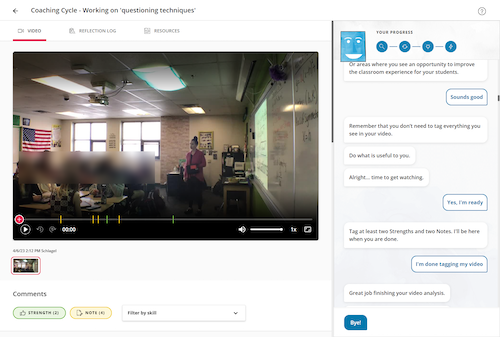
With the platform, teachers like Schlagel engage in personalized coaching cycles to further their development. The platform uses artificial intelligence to guide teachers through a self-coaching cycle aligned to common growth areas as they watch video of their classroom teaching in action.

We recently interviewed Schlagel about the use of this new technology and how her district prioritizes teacher development. 

What were your first thoughts when you heard about using AI for professional learning? Why did you decide to try it?

Last year, I was a mentor to a first-year teacher at my school, and my mentee had to record a lesson of her teaching as part of the induction program. I decided to also record myself conducting a similar lesson, so we could go over the lessons together, discuss what works and what doesn’t, and set goals for improvement.  

This was my first real introduction to video coaching. Admittedly, even as a mentor teacher, I was nervous to record myself. However, I quickly learned it wasn’t that bad seeing myself on screen and that this was a powerful way to reflect on my practice. My mentee and I both learned a lot.

So, when my district offered a new professional development course that would allow us to try out AI coaching, I signed up. I wasn’t sure exactly what I was getting into, but I was already benefiting from video coaching and wanted to see what the new AI aspect was all about. At the very least, I knew this opportunity would provide me more time for self-reflection.

How does the AI coaching process work?

During my first time using the AI Coach platform, I uploaded a video of one of my recent algebra lessons. Then, the platform’s computerized coach provided observation tips and asked me a number of questions to consider as I began to analyze my video. This helped me as I made a number of comments on the platform—both about areas I wanted to improve upon and areas I felt I was excelling in—as I watched my teaching play out.

The guidance from the virtual coach helped me think more critically about my practice (…and it also made me laugh – the coach can definitely be funny and sassy at times!).

This helped me set a goal for myself around increasing student discourse. I wanted to encourage my students to talk more in class, and the platform provided me with a number of instructional resources to help me get better at this skill.

At the end of the coaching cycle, after I incorporated these strategies in the classroom, I came back to the platform and reflected on what I learned. I thought about how these new strategies worked and created an action plan for my continued learning in the future.

How has AI-powered coaching impacted your teaching?

What surprised me most about the AI coaching process was that it opened my eyes to different things I could change (and might have missed) about my teaching. I was able to really reflect on how I was teaching and how my students were responding. 

Sometimes it can be daunting—or even feel less genuine—when a coach or administrator comes in to conduct a formal observation. You may be worried about how your students are acting or unknowingly teach differently than normal.

But, with the AI Coach process, I feel less pressure because it really is just myself reflecting on my teaching alongside a computerized coach. This gives me more freedom to try out a new instructional strategy or take a risk with how I deliver a lesson, without having the feeling of being evaluated.

Continuous reflection is so important, and I’m a firm believer that the best teachers have to be reflective—if you aren’t reflecting on your practice, you aren’t growing!

How do you and your colleagues plan to use AI Coach by Edthena moving forward?

In addition to supplementing in-person coaching, I think AI coaching will continue to be a great support for mentor and mentee teachers alike.

In chats with my administrative team, I’ve also suggested using the AI Coach platform for our school’s yearly peer observations or self-reflection observations. Traditionally for the self-reflection observation, teachers write a paper detailing their teaching and how it can improve, but I think this type of video-based reflection can be more impactful and feel more genuine. And, it will allow teachers to receive the benefits of ongoing coaching which is really about reflecting inward and trying to constantly improve.

My school and district always do a great job of supporting teachers’ growth and encouraging us to take on new and innovative professional learning opportunities. The use of AI Coach is just another example of this! 

5 spooky Halloween videos for students of all ages

9 October 2023 at 12:00
Use these fun Halloween-themed TED-Ed Lessons and videos to engage students in classroom learning and capture their attention.

Key points:

  • TED-Ed Lessons are a great way to inject some fun into learning a new topic
  • During October, take advantage of creepy decorations and Halloween and use these videos to teach students some new facts
  • See related article: 9 TED-Ed Lessons about different holiday origins

It’s October, and for many students, that means pumpkins, scary decorations, and trick-or-treating on Halloween. What better way to celebrate October than to incorporate some fun and spooky videos to engage students, while also teaching them some fun facts?

Teachers with students of all ages can use TED-Ed Lessons to leverage October’s fun events (Friday the 13th in October, anyone?) and speak to students’ different interests.

The TED-Ed platform lets educators build lessons around any TED-Ed Original, TED Talk, or YouTube video. Once teachers find the video they want to use, they can use the TED-Ed Lessons editor to add questions, discussion prompts, and additional resources.

Use these TED-Ed Lessons and videos for brain breaks, to introduce new lessons, or to give students some fun and age-appropriate spooky experiences into your classroom:

1. Where do superstitions come from? Are you afraid of black cats? Would you open an umbrella indoors? How do you feel about the number 13? Whether or not you believe in them, you’re probably familiar with a few of these superstitions. But where did they come from? Stuart Vyse shares the weird and specific origins of some of our favorite superstitions.

2. Why is being scared so fun? At this very moment, people are lining up somewhere to scare themselves, be it with a thrill-ride or a horror movie. In fact, in October of 2015 alone, about 28 million people visited a haunted house in the US. But you might wonder: What could possibly be fun about being scared? Margee Kerr examines the biology and psychology behind what makes fear so fun.

3. The fascinating history of cemeteries: Spindly trees, rusted gates, crumbling stone, a solitary mourner: these things come to mind when we think of cemeteries. But not long ago, many burial grounds were lively places, with gardens and crowds of people — and for much of human history, we didn’t bury our dead at all. How did cemeteries become what they are today? Keith Eggener delves into our ever-evolving rituals for honoring the dead.

4. What can you learn from ancient skeletons? Ancient skeletons can tell us a great deal about the past, including the age, gender and even the social status of its former owner. But how can we know all of these details simply by examining some old, soil-caked bones? Farnaz Khatibi examines a fascinating branch of science known as biological anthropology.

5. A video that terrifies while it teaches? There’s a TED-Ed Lesson for that: Pick your poison: Blood hungry vampires. Zombies on a mission for your tasty brain. Creepy crawlies. No matter your (fictional or real) fright of choice, TED-Ed has a lesson for all of your Halloween needs. So pick out your favorite candy (more on that later), choose a few videos, and have a very happy Halloween.

❌
❌